AP Inter 1st Year Botany 2nd Lesson Plant Kingdom Questions and Answers
IV. Very Short Answer Questions
Question 1.
Differentiate between antheridium and archegonium.
Answer:
| Antheridium | Archegonium |
| 1. It is the male sex organ | 1. It is the female sex organ |
| 2. It is club shaped | 2. It is flask shaped |
| 3. It produce male gametes or antherozoids | 3. It produces eggs |
Question 2.
What are the two stages found in the gametophyte of mosses? Mention the structures from which these two stages develop.
Answer:
- The gametophyte of a moss consists of two stages.
- Juvenile, green, filamentous, protonema
- The adult leafy gametophore.
- Protonema develops by the germination of spores.
- Gametophores develop from the buds on protonema.
Question 3.
Name the stored food materials found in Phaeophyceae and Rhodophyceae.
Answer:
- In Phaeophyceae – Laminarin or mannitol.
- In Rhodophyceae – Floridian starch
Question 4.
Name the pigments responsible for brown colour of Phaeophyceae and red colour of Rhodophyceae.
Answer:
- The brown colour of Phaeophyceae is due to fucoxanthin. (a xanthophyll)
- Red colour of Rhodophyceae is due to r-phycoerythrin. (a phycobilin)
Question 5.
Name different methods of vegetative reproduction in Bryophytes.
Answer:
- In liverworts, vegetative reproduction takes place by special structures called gemmae.
- They develop in small receptacles called gemma cups.
Ex. Marchantia - In mosses, vegetative reproduction is carried out by fragmentation, gemmae and budding.
Ex. Funaria.
Question 6.
Name the composite structure in which nucellus is protected by envelops in Gymno- sperms.
Answer:
The Ovule
Question 7.
Name the Gymnosperms which contain mycorrhizae and coralloid roots respectively.
Answer:
- Pinus is the gymnosperm which contains mycorrhiza.
- Cycas is the gymnosperm which contains coralloid roots.
Question 8.
Name the four classes of Pteridophyta with one example each.
Answer:
- Psilopsida – Psilotum
- Lycopsida – Selaginella, Lycopodium
- Sphenopsida – Equisetum
- Pteropsida – Pteris,’Dryopteris
Question 9.
What are the first organisms to colonise rocks? Give the generic name of the moss which provides peat.
Answer:
- Mosses along with Lichens are the first organisms to colonise rocks.
- Sphagnum, a moss provides peat that is used as a fuel.
Question 10.
Why are Bryophytes called the Amphibians of Plant Kingdom ?
Answer:
Bryophytes are called amphibians of the plant kingdom because they survive in moist soils and are dependent on water for sexual reproduction.
V. Short Answer Questions
Question 1.
Differentiate between red algae and brown algae.
Answer:
| Red Algae | Brown Algae |
| 1. They belong to class Rhodophyceae. | 1. They belong to class Phaeophyceae |
| 2. The thallus is multicellular. | 2. The thallus is simple, branched. filamentous to profusely branched form |
| 3. Cell wall is made up of cellulose, pectin and polysulphate esters. | 3. Cell wall is made up of cellulose and algin. |
| 4.. Flagella are absent. | 4. Flagella are two, unequal and lateral. |
| 5. The major pigments are Chlorophyll a, d and r-phycoerythrin. | 5. The main pigments are chlorophyll a, c, carotenoids and xanthophylls. |
| 6. Food is stored as floridean starch. | 6. Food is stored in the form of laminarin or mannitol. |
| 7. Asexual reproduction is by non-motilespores. | 7. Asexual reproduction is by biflagellate zoospores. |
| 8. Sexual reproduction is by non-motile gametes. | 8. Sexual reproduction is by motile gametes. |
| Ex: Polysiphonia, Porphyra, Gracilaria and Gelidium. | Ex: Ectocarpus,Laminaria, Dictyota, Fucus. |
Question 2.
Differentiate between liverworts and mosses.
Answer:
| Liverworts | Mosses |
| 1. Plant body is thalloid, prostrate, dorsiventral and is closely appressed to the substratum. | 1. The adult stage is gametophore consists of upright slender axis gets attached to the substratum by Rhizoids. |
| 2. Rhizoids are unicellular. | 2. Rhizoids are multicellular. |
| 3. Vegetative reproduction is by fragmentation or by Gemmae. | 3. Vegetative reproduction is by fragmentation or by Gemmae or by budding on the secondary protonema. |
| 4. Male and Female sex organs are produced on the same thallus or on different thalli. | 4. Male and Female sex organs are produced at the apex of the leafy shoots. |
| 5. Paraphysis is absent. | 5. Paraphysis is present. |
| 6. Elaters are present in the capsule which help in spore dispersal. | 6. Peristomial teeth are present in the capsule which help in spore dispersal. |
| 7. Spores germinate to form free living gametophytes. | 7. Spores germinate to form creeping green branched protonema. |
| Ex: Marchantia | Ex: Funaria |
Question 3.
What is meant by homosporous and heterosporous pteridophytes? Give two examples.
Answer:
- Pteridophytes which produce the same kind of spores are known as homosporous pteridophytes.
Ex: Lycopodium, Pteris - Pteridophytes,which produce two kinds of spores i.e microspores and megaspores are called heterosporous pteridophytes.
Ex: Selaginella, Salvinia. - Small spores are called microspores that develop into male gametophytes and large spores are called megaspores which develop into female gametophytes.
Question 4.
Give a brief account of prothallus.
Answer:
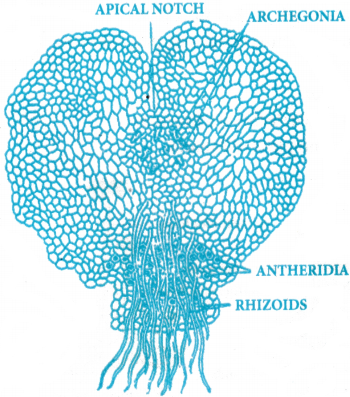
- In pteridophytes, haploid spores liberated from the sporangia of sporophyte develop into inconspicuous, small, multicellular, free-living photosynthetic, thalloid gametophytes called prothallus.
- These gametophytes require cool, damp, shady places to grow.
- The prothallus bears sex organs male and female called antheridia and archegonia.
- The sex organs are multicellular, jacketed and sessile.
- Water is required for the transfer of antherozoids.
- Fusion of male gamete with egg takes place in the archegonium.
- After fertilization, zygote develop into Embryo.
Question 5.
Write a note on the economic importance of algae and bryophytes.
Answer:
i) Economic importance of Algae :
- At least a half of the total carbon dioxide fixation on earth is carried out by algae through photosynthesis.
- Being photosynthetic, they increase the level of dissolved oxygen in their immediate environment.
- They are important as primary producers of energy rich compounds which form the basis of the food cycles of all aquatic animals.
- Many species of Porphyra, Laminaria and Sargassum are used as food.
- Certain marine brown and red algae produce large amounts of hydrocolloids (water holding substances) e.g., algin (brown algae) and carrageenan (red algae) which are used commercially.
- Agar, one of the commercial products obtained from Gelidium and Gracilaria is used to grow microbes and in preparation of ice-creams and jellies.
- Chlorella are unicellular alga used as food supplements even by space travelers.
ii) Economic importance of Bryophytes :
- Some mosses provide food for herbaceous mammals, birds and other animals.
- Species of Sphagnum, (peat moss) provides peat that has long been used as fuel, and because of its capacity to hold water as packing material for trans-shipment of living material.
- Mosses along with lichens are the first organisms to colonise rocks and hence are of great ecological importance.
- They decompose rocks making the substrate suitable for the growth of higher plants, hence play a significant role in plant succession.
- Since mosses form dense mats on the soil, they reduce the impact of falling rain and prevent soil erosion.
Question 6.
Draw labelled diagrams of:
a) Female thallus and male thallus of a liverwort
b) Gametophyte and sporophyte of Funaria.
Answer:
a) 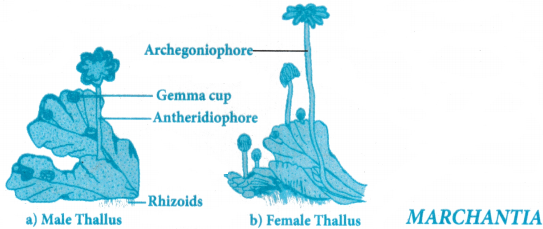
b) 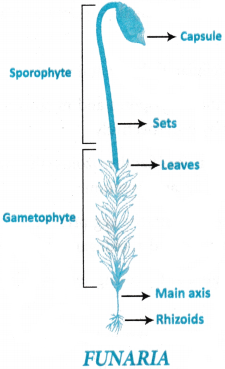
VI. Long Answer Questions
Question 1.
Give the salient features of Pteridophytes.
Answer:
- The pteridophytes include club mosses, horsetails, ferns, etc.
- They are embryophytic, archegoniate, vascular (tracheophyte) cryptogams.
- The pteridophytes are commonly found in cool, damp, shady places.
- The main plant body is a sporophyte which is differentiated into true roots, stems and leaves.
- The roots are adventitious.
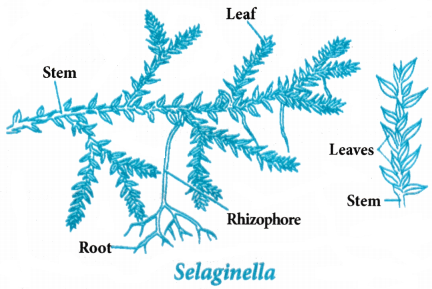
- The leaves in pteridophytes are small (microphylls) as in Selaginella or large (macrophylls) as in ferns.
- The sporophytes bear sporangia that are subtended by leaf-like appendages called sporophylls.
- The sporangia produce spores by meiosis in spore mother cells.
- In the majority of the pteridophytes, all the spores are of similar kind; such plants are termed homosporous.
Ex: Lycopodium, Pteris. - Genera like Selaginella and Salvinia, which produce two kinds of spores, megaspores and microspores, are described as heterosporous.
- The spores germinate to give rise to inconspicuous, small but multicellular, free-living, mostly photosynthetic, thalloid gametophytes called Prothallus.
- The gametophytes bear male and female sex organs called antheridia and archegonia, respectively.
- The sex organs are multicellular, jacketed and sessile.
- In heterosporous plants, the megaspores and microspores germinate and give rise to female and male gametophytes respectively.
- Water is required for the transfer of antherozoids (the male gametes) released from the antheridia, to the mouth of the archegonium.
- Fusion of motile male gamete with the egg present in the archegonium results in the formation of a zygote. This is called zooidogamous oogamy.
The development of zygote into young embryo takes place within the female gametophytes. - This event is a precursor to the seed habit and is considered an important step in evolution.
- The embryo thereafter produces a multicellular, well differentiated sporophyte which is the dominant phase in the pteridophytes.
- Pteridophytes show heteromorphic alternation of generations with a diplo-haplontic life cycle.
- Both the sporophyte and gametophyte are independent, but the sporophyte is dominant.
Question 2.
Describe the important characteristics of Gymnosperms.
Answer:
- The gymnosperms (gymnos: naked, sperma : seeds) are plants in which the ovules are not enclosed by any ovary wall and remain exposed, both before and after fertilization.
- The seeds are naked.
- Gymnosperms include medium-sized trees or tall trees and shrubs.
- The giant redwood tree Sequoia is one of the tallest trees.
- The roots are generally tap roots.
- Roots in Pinus, have a fungal association in the form of mycorrhiza, while in Cycas, small specialized roots called coralloid roots are associated with N2– fixing cyanobacteria.
- The stem is unbranched (Cycas) or branched (Pinus, Cedrus).
- The leaves may be simple or compound.
- In Cycas, the pinnate leaves persist for a few years.
- In conifers, the needle-like leaves reduce the surface area.
- The gymnosperms are heterosporous; they produce haploid microspores and megaspores.
- The two kinds of spores are produced within sporangia that are borne on sporophylls, which are arranged spirally along an axis to form lax or compact strobili or cones.
- The strobili bearing microsporophylls and microsporangia are called microsporangiate or male strobili.
- The microspores develop into a male gametophyte called a pollen grain.
- The cones bearing megasporophylls with ovules or megasporangia are called microsporangiate or female strobili.
- The male or female cones or strobili may be borne on the same tree (Pinus).
- However, in Cycas male cones and megasporophylls are borne on different trees.
- The megaspore mother cell is differentiated from one of the cells of the nucellus.
- The nucellus is protected by envelopes and the composite structure is called an ovule.
- The ovules are borne on megasporophylls, which may be clustered to form the female cones.
- The megaspore mother cell divides meiotically to form four megaspores.
- One of the megaspores enclosed within the megasporangium develops into a multicellular female gametophyte that bears two or more archegonia.
- The multicellular female gametophyte is also retained within megasporangium.
- The male and the female gametophytes, do not have an independent free-living existence.
- The pollen grains are released from the microsporangium. They are carried by air currents and come in contact with the opening of the ovules borne on megasporophylls.
- The pollen tube carrying the male gametes grows towards archegonia in the ovules and discharges their contents near the mouth of the archegonia.
- Following fertilization, the zygote develops into an embryo, and the ovules into seeds. These seeds are not covered.
I. Multiple Choice Questions
Question 1.
Which of the following have been excluded from plant kingdom (Plantae) in the modern system of classification (Whittaker’s classification) ?
1. Algae and Fungi
2. Fungi and some members of Monera and Protista
3. Members of Monera only
4. Algae and some members of Protista
Answer:
2. Fungi and some members of Monera and Protista
Question 2.
Which of the following pieces of evidence is very crucial to establish evolutionary relationships in Phylogenetic systems of classification ?
1. Morphological evidence
2. Anatomical evidences
3. Fossil evidence
4. Cytological evidences
Answer:
3. Fossil evidence
Question 3.
Pick out the right examples for filamentous and colonial forms of algae respectively.
1. Ulothrix and Spirogyra
2. Ulothrix and Volvox
3. Volvox and Fucus
4. Spirogyra and Fucus
Answer:
2. Ulothrix and Volvox
Question 4.
Which of the following alga is not suitable as human food ?
1. Chlorella
2. Porphyra
3. Chara
4. Laminaria
Answer:
3. Chara
Question 5.
The alga Porphyra belongs to the class
1. Rhodophyceae
2. Phaeophyceae
3. Chlorophyceae
4. Cyanophyceae
Answer:
1. Rhodophyceae
Question 6.
The shape of archegonium in bryophytes is
1. Flask shape
2. Club shape
3. Saucer shape
4. Cup shape
Answer:
1. Flask shape
Question 7.
The sporophyte in mosses develops from
1. Microspore
2. Megaspore
3. Zygote
4. Zygospore
Answer:
3. Zygote
Question 8.
Heterospory in Pteridophytes is commonly seen in species of
1. Selaginella and Salvinia
2. Lycopodium and Equisetum
3. Equisetum and Psilotum
4. Lycopodium and Psilotum
Answer:
1. Selaginella and Salvinia
Question 9.
Which of the following is synonymous to the male gametophyte in Gymnosperms?
1. Megaspore
2. Microspore / pollen grain
3. Megasporangia
4. Microsporophyll
Answer:
2. Microspore / pollen grain
Question 10.
Smallest living angiosperm
1. Wolffia
2. Typha
3. Cuscuta
4. Cedrus
Answer:
1. Wolffia
II. Fill in the Blanks
Question 1.
Natural classification system based on natural affinities was given by __________.
Answer:
George Bentham and J.D. Hooker
Question 2.
Using numbers and codes for characters and utilising computers to process the data is seen in __________ taxonomy.
Answer:
Numerical
Question 3.
The fusion of two gametes dissimilar in size in Eudorina is termed as __________.
Answer:
Anisogamy
Question 4.
At Least half of the total carbon dioxide fixation on earth is carried out by __________ through photosynthesis.
Answer:
Algae
Question 5.
In green algae the members have one or more storage bodies called __________ located in the chloroplasts.
Answer:
Pyrenoids
Question 6.
In phaeophyceae, the plant body is usually attached to the substratum by a __________.
Answer:
Holdfast
Question 7.
The food is stored in the form of __________ in Rhodophyceae (red algae).
Answer:
Floridean starch
Question 8.
__________ moss provides peat and is also used as packing material to hold water.
Answer:
Sphagnum
Question 9.
__________ are green multicellular asexual buds on the thalli of liverworts.
Answer:
Gemmae
Question 10.
In mosses the first stage is the __________ stage, which directly develops from a Spore.
Answer:
Protonema
Question 11.
In Pteridophytes, the main plant body is a __________.
Answer:
Sporophyte
Question 12.
The free living, photosynthetic, thalloid gametophyte of Pteridophytes is called __________.
Answer:
Prothallus
Question 13.
Selaginella belongs to __________ class of Pteridophyta.
Answer:
Lycopsida
Question 14.
Mycorrhizal association with a fungus is seen in the Gymnosperm
Pinus
III. One Word Answer Questions
Question 1.
Which taxonomy is based on cytological information like chromosome number, structure and behaviour?
Answer:
Cytotaxonomy
Question 2.
What do you call the fusion between one large, non-motile (static) female gamete and a smaller motile male gamete in Volvox and Fucus ?
Answer:
Oogamy
Question 3.
What is the commercial product obtained from red algae Gelidium and Gracilaria?.
Answer:
Agar agar
Question 4.
Which are the two chlorophyll pigments found in chloroplasts of Phaeophyceae algae?
Answer:
Chlorophyll a and c
Question 5.
Which is the predominant red pigment present in the body of red alga?
Answer:
r-Phycoerythrin
Question 6.
In which algae the vegetative cells have a cellulose cell wall covered by algin?
Answer:
Phaeophyceae
Question 7.
Give one example for a liverwort with a thalloid plant body.
Answer:
Marchantia
Question 8.
Which stage of the mosses bears sex organs?
Answer:
Gametophyte, leafy stage
Question 9.
Majority of the Pteridophytes produce spores that are similar. What do you call this condition?
Answer:
Homosporous condition or Homospory
Question 10.
Which important step in evolution does the heterospory lead to?
Answer:
Seed-Habit
Question 11.
Name the tallest tree in Gymnosperms.
Answer:
Sequoia
Question 12.
What type of roots in Cycas show symbiosis with Nitrogen fixing cyanobacteria?
Answer:
Coralloid roots
Question 13.
In which group of plants the seeds are enclosed in a fruit?
Answer:
Angiosperms