Sole Proprietorship Questions and Answers AP Inter 1st Year Commerce Chapter 3

AP Inter 1st Year Commerce 3rd Lesson Sole Proprietorship Questions and Answers

Fill in the Blanks

Question 1.
The arrangement of ownership and management of business organisations is termed as ___________ organisation.
Answer:
Business

Question 2.
A sole proprietorship is also known as ___________ entrepreneurship.
Answer:
Individual

Question 3.
___________ is the oldest form of business organisation.
Answer:
A sole proprietorship

Question 4.
The ___________ form of business organisation has a single owner.
Answer:
Sole proprietorship

Question 5.
The liability of the sole proprietor is ___________.
Answer:
Unlimited

Very Short Answer Questions

Question 1.
Business Organisation ?
Answer:
In order to carryout any business and to achieve of objective of earning profit, it is required to bring together all the resources and put them into action in a systematic way and to co-ordinate and controll all these activities properly. This arrangement is knownas “Business Organisation”.

Question 2.
Sole proprietorship.
Answer:

  • “A type of business unit where one person is solely responsible for providing the capital and bearing the risk of the enterprise, and for the management of the business”. – J.L. Hanson
  • “Sole proprietorship is a form of business where the individual proprietor is the supreme judge of all matters pertaining to his business”. – Kimball and Kimball

Question 3.
Unlimited liability.
Answer:
The liability of the sole proprietor is unlimited. Incase of loss, if his business assets are not enough to make the payment of business liabilities, his personal property can also be utilised to pay off the liabilities of the business.

Question 4.
Explain any two characteristics of Sole trade business.
Answer:
Characteristics/Features of sole trade business :

  1. Single ownership : The sole proprietorship form of business organisation has a single owner who himself/herself starts the business by bringing together all the resources.
  2. Less Legal Formalities : The formation and operation of a sole proprietorship form of business organisation involves less legal formalities. Thus, its formation is quite easy and simple.

Question 5.
Explain any two limitations of Sole trade business.
Answer:
Limitations of sole trade business :

  1. Limited Resources : The resources of a sole proprietor are always limited. Being a single owner, it is not always possible to arrange sufficient funds from his own sources. Again borrowing funds from friends and relatives or banks has its own implications. So, the proprietor has a limited capacity to raise funds for his business.
  2. Unlimited Liability : In the eyes of the law, the proprietor and the business are one and the same. So, personal properties of the owner can also be used to meet the business obligation and debts.

Question 6.
One man control.
Answer:
One man control : The controlling power of the sole proprietorship business always remain with the owner. He/she runs the business as per his/her own will.

Question 7.
No separate Entity.
Answer:
The sole proprietorship unit does not have an entity separate from the owner. The businessman and its enterprise are one and the same, and the businessman is responsible for everything that happens in his business firm.

Question 8.
What is the meaning of sole proprietorship ?
Answer:
It is a business organisation in which a single individual introduces his own capital, skill and intelligence in the management of the affairs. He is solely responsible for the results of its operations.

Question 9.
Write about lack of continuity.
Answer:
The sole trader has to run his business on his ability and capacity. When he suffers from a long illness or when he dies the business may be closed down. There is no continuity in the sole trading concern.

Question 10.
Explain Direct Motivation.
Answer:
The sole proprietor takes keen interest in the working of the business. He tries put his heart and soul in the business so as to earn as much profits as he can. There is direct relationship between effort and reward.

Question 11.
Explain Limited Resources.
Answer:
The resources of a sole proprietor are limited. He has only two sources of securing capital – personal savings and borrowings on personal securities. There is a limit to which a single person can invest. Therefore, the sole trading concern has limited capital.

Question 12.
Write about quick decisions.
Answer:
He is the supreme master of his business. He has to take all the business decisions himself. He need not consult any other person. If more than one person is involved in decision-making, then delay is bound or occurs.

Short Answer Questions

Question 1.
Explain the features of sole proprietorship (or) characteristics.
Answer:
Features / Characteristics :

  1. Single ownership : The business organisation has a single ownership. The proprietor brings all the resources. One man contributes capital.
  2. No separation of ownership and management : The owner manages the business using his/her own intelligence and skill. There is no scope for distinguish ownership and management as in the case of other organisations like joint stock companies.
  3. Less number of legal formalities : Formation of sole proprietorship is very simple and easy. A lesser number of legal formalities is required. Registration is not also compulsory.
  4. No separate Entity : The businessman and business enterprise are one and the same. There is no separate legal entity. Hence, the proprietor is responsible for every act of the business.
  5. No share in profits or losses : The sole proprietor enjoys all the benefits and he has to borne all the losses solely. The proprietor has to face the risk alone.
  6. Unlimited Liability : The liability of the sole proprietor is unlimited. That is, the liabilities of the business are to be re-paid even by utilizing personal assets.
  7. One-man control: The controlling power of the sole proprietorship rests with the owner. On the will of the owner business will be managed and controlled.
  8. Limited area of operations : This kind of business is not so easy to scatter everywhere, due to limited capability of managerial abilities and resources.

Question 2.
What is meant by Business Organisation ?
Answer:
Arrangement of ownership and management of business organisations is termed as ‘Forms of Business Organisation’. Business organisations may be owned and managed by a single individual (sole proprietorship) or a group of individuals (Partnership) or in the form of a company (Joint stock company). In India, business organisations usually take the following forms.

Question 3.
What is sole proprietorship ?
Answer:
The sole proprietor is an individual who owns and manages a business. The individual brings his own or borrowed capital, manages the business himself, bears all the risks alone, enjoys all profits, suffers all losses.

Definition:

  1. According to Wheeler : The sole proprietorship is that form of business ownership which is owned and controlled by a single individual. He receives all the profits and bears the risks of his property in the success or failure of the enterprise”.
  2. According to Kimball & Kimball: “The individual proprietor is the supreme judge of all matters pertaining to his business subject only to the general laws of land and to such special legislation as may effect his particular business”.

Question 4.
Explain the limitations of a sole trader.
Answer:
Demerits/Disadvantages/Limitations of sole proprietorship :

  1. Limited Resources : The resources of a sole proprietor are limited. He has only two sources of securing capital. Personal savings and borrowings on personal securities. There is a limit to which a single person can invest. Therefore, the sole trading concern has limited capital.
  2. Limited managerial ability : A single person may not be an expert in all fields. This business organisation always suffers from lack of managerial expertise.
  3. Unlimited Liability : The liability of a sole proprietor is unlimited. His private properties can also be used for meeting business losses. So, he never shows interest of expansion.
  4. Less scope for economies of scale : Sole trader usually operates on small scale only. So, he cannot enjoy the benefits of large-scale production. This may raise the cost of business operations.
  5. Limited area of operations : Generally the sole trader’s activities cannot go beyond a certain area due to his limited skill and resources.
  6. No Division of Labour : The sole trader has limited capital. So he cannot hire the service of experts. Therefore, there is no specialization or division of labour in the sole trading concern.
  7. Lack of continuity : The continuity of the business is linked with the life of the proprietor illness, death of insolvency of the proprietor can lead to closure of the business. Thus, the continuity of business is uncertain.
  8. Restricted growth : The limitations of capital and managerial ability act as a barrier to the development and expansion of business. Economies of large scale manufacturing buying and selling cannot be obtained.

Question 5.
Explain the advantages of sole proprietorship.
Answer:
Merits / Advantages :

  1. Easy Formation : It can be very easily started no legal formalities are necessary business.
  2. Direct motivation : The entire profit of the business goes to the owner. This motivates the proprietor to work hard and run the business effectively and efficiently.
  3. Business secrets : In this form of organisation the secretes can be retained easily.
  4. Direct contact with customers : He can establish and maintain personal touch with his customers.
  5. Economy in management: The sole trader knows that he is the only person to bear all the losses of his business.
  6. Personal relations with employees : He establishes personal and direct contact with his employees.
  7. Quick decisions : He is the supreme master of his business. He has to take all the business decisions himself.
  8. Social Advantages : This form of organisation provides employment opportunities. It prevents concentration of economic wealth and power in the hands of a few individuals and encourages decentralization.
  9. Flexibility in operation : Changes in the buusiness are necessary. The sole trading concern is dynamic in its nature. The nature of the business can be easily changed according to the changing market conditions. So, it is an ideal form of business organisation.
  10. Easy Dissolution : There is no scope of difference of opinion in case of dissolution of business.

Long Answer Questions

Question 1.
Define Sole Proprietorship and discuss its merits and demerits.
Answer:
Any business unit which is owned and run by a single person is known as sole trade. This organisation is also known as sole proprietorship.

Definitions :
“The individual entrepreneurship is the form of business on the head of which stands an individual as the one who is responsible who directs its operations, who alone runs the risk of failure”. – L.H. Haney

“A type of business unit where one person is solely responsible for providing the capital and bearing the risk of the enterprise, and for management of the business”. – J.L. Hanson

Merits / Advantages :

  1. Easy Formation : It can be very easily started no legal formalities are necessary for its formation.
  2. Direct motivation : The sole proprietor takes keen interest in the working of the business.
  3. Business secrets : In this form of organisation the secrets can be retained easily.
  4. Direct contact with customers : He can establish and maintain personal touch with his customers.
  5. Quick Decisions : He is the supreme master of his business. He has to take all the business decisions himself.
  6. Economy in management: The sole trader knows that he is the only person to bear all the losses of his business.
  7. Personal relations with employees : He establishes personal and direct contact with his employees.
  8. Social Advantages : This form of organisation provides employment opportunities.
  9. Flexibility in operation : It >s very easy to initiate and implement changes as per the requirements of the business.
  10. Easy Dissolution : There is no scope of difference of opinion in case of dissolution of business.

Demerits / Disadvantages / Limitations :

  1. Limited Resources : The resources of a sole proprietor are limited. There is a limit to which a single person can invest. Therefore, the sole trading concern has limited capital.
  2. Limited managerial ability : He will not be able to devote sufficient time for all types of activities. Hence, limited managerial capacity will hinder the growth of concern.
  3. Unlimited liability : The liability of a sole trader is unlimited. So personal properties of the owner can also he used to meet the business obligations and debts.
  4. Less scope of economies of scale : Sole trader usually operates on small scale only. So, he cannot enjoy the benefits of large-scale production.
  5. No division of labour : Sole trader has limited capital. So he cannot hire the service of experts. Therefore, there is no specialization or division of labour in the sole trading concern.
  6. Limited area of operation : Generally, the sole trader’s activities cannot go beyond a certain area due to his limited skill and resources.
  7. Lack of continuity : The continuity of the business is linked with the life of the proprietor. Illness, death or insolvency of the proprietor can lead to closure of the business. Thus, the continuity of business is uncertain.
  8. Restricted growth : The limitations of capital and managerial ability act as breaker to the development and expansion of business.

Question 2.
Define Sole proprietorship and explain the features of sole proprietorship.
Answer:
It is a business organisation in which a single individual introduces his own capital, skill and intelligence in the management of its affairs. He is solely responsible for the results of its operations.

Definition : “A type of business unit where one person is solely responsible for providing the capital and bearing the risk of the enterprize, and for the management of the business”. – J.L. Hanson

Features / Characteristics :

  1. One man ownership : The ownership lies with one person only. He invests his own money or borrow from his friends or relatives.
  2. No seperation of ownership and management : The owner himself manages the business. The separation of ownership from management is not present in this form of organisation.
  3. No legal formalities : No legal formalities are required to start sole trading business. However, in some cases, a licence may be required.
  4. No separate entity : The business does not have any entity separate from the owner. The owner and the business are one and the same.
  5. Sharing of profits : One person is the sole owner of the business. He takes all profits and bears all losses. There is direct relationship between efforts and rewards.
  6. Unlimited liability : The liability of the sole proprietor is unlimited and the creditors has the right to come a cross the personal properties of him.
  7. Secrecy : All important decisions are taken by the owner himself. He keeps all business secrets only to himself.

Question 3.
“One man show is the best in the world provided that one man is big enough to take care of everything”. Discuss.
Answer:
Any business unit which is owned and run by a single person is known as sole trade.

Definition : “A type of business unit where one person is solely responsible for providing the capital and bearing the risk of the enterprise, and for the management of the business”. – J.L. Hanson

We can say that a sole trade is one man show basing on the following points :

  1. The business is started by the initiative of a single person and he contributes complete efforts.
  2. As the sole trade unit is a small business concern it is possible to keep all business secrets.
  3. The sole proprietor invests the necessary capital in the business from his own sources.
  4. Legally, the sole trader does not have separate legal entity from his business.
  5. A sole trader is having unlimited liability.
  6. A sole trade business has generally a limited area of operations, the reason being the limited resources and managerial abilities of the sole trader.
  7. The proprietor managers the whole business himself.
  8. He enjoys all profits and bears losses if any.
  9. There is direct relationship between efforts and reward.
  10. The sole proprietor takes keen interest in the working of the business.
  11. The proprietor can establish and maintain personal touch with his customers.
  12. The sole trader is the supreme master of his business.
  13. Changes in the business are necessary.
  14. The sole trader tries to avoid all kinds of waste and unnecessary expenses.
  15. The sole trader introduces his children into the business.
  16. The proprietor establishes personal and direct contact with his employees.

In sole trade large number of traders was entered in different types of business. There is no scope of difference of opinion in case of dissolution of business. Therefore, “one man show is the best in the world provided that one man is big enough to take care of everything”.

Check Your Knowledge

I. Fill in the blanks for the following questions :

Question 1.
A business ___________ can be owned and against in several forms.
Answer:
Enterprize

Question 2.
Registration is not compulsory in the form of business ___________
Answer:
Sole proprietorship

Question 3.
The proprietor is ___________ of the business.
Answer:
Sole owner

Question 4.
All is he and he is ___________
Answer:
All

Question 5.
The simplest form of the business ownership is a ___________
Answer:
Proprietorship

Question 6.
“Supreme Judge of all matters pertaining to his business” who said ___________
Answer:
Kimbal & Kimbal

Question 7.
As per law ___________ and ___________ are same.
Answer:
Proprietor and business

II. State whether the statement are True or False.

Question 1.
A sole proprietorship is a form of business organisation in which an individual invests his own capital. (True/False)
Answer:
True

Question 2.
The business unit does not have an entity separate from the owner. (True/False)
Answer:
True

Question 3.
The proprietor works hard and run business efficiently. (True/False)
Answer:
True

Question 4.
The business secrets are known only to the proprietor. (True/False)
Answer:
True

Student Activity

State whether the statements are True or False.

Question 1.
A sole proprietorship form of business is suitable for large – scale business operations. (True/False)
Answer:
False

Question 2.
A sole proprietorship business is managed by a single individual. (True/False)
Answer:
True

Question 3.
The liability of the sole proprietor is limited. (True/False)
Answer:
False

Question 4.
To form a sole proprietorship business, more legal formalities are involved. (True/False)
Answer:
False

Question 5.
The decision – making is quick and easy in a sole proprietorship. (True/False)
Answer:
True

Question 6.
The resources of a sole proprietor are unlimited. (True/False)
Answer:
False

AP Inter 1st Year Commerce Study Material

Business Activities Questions and Answers AP Inter 1st Year Commerce Chapter 2

AP Inter 1st Year Commerce 2nd Lesson Business Activities Questions and Answers

Fill in the Blanks

Question 1.
The production side of business activity is referred to as _________
Answer:
Industry

Question 2.
The equation form of _________ is industry + commerce.
Answer:
Business

Question 3.
The equation form of _________ is trade + aids to trade.
Answer:
Commerce

Question 4.
_________ refers to the quality of life enjoyed by the members of a society.
Answer:
Standard of living

Question 5.
_________ is also known as ‘external trade’ or ‘International trade’.
Answer:
Foreign Trade

Question 6.
_________ is also known as ‘domestic trade’ or ‘internal trade’.
Answer:
Home Trade

Question 7.
Entrepot trade is also known as _________ trade.
Answer:
Re-export

Question 8.
Personal hindrances can be removed by _________.
Answer:
Trade

Question 9.
_________ removes the hindrance of place.
Answer:
ransportation

Question 10.
_________ services remove the hindrance of financial problems.
Answer:
Banking

Question 11.
_________ removes the hindrance of time.
Answer:
Warehouse

Question 12.
_________ removes the hindrance of risk.
Answer:
Insurance

Question 13.
_________ removes the hindrance of knowledge.
Answer:
Advertisement

Question 14.
_________ removes the hindrance of information.
Answer:
Communication

Question 15.
The _________ connects links between the producers and the retailers.
Answer:
Wholesalers

Question 16.
The _________ connects links between wholesalers and consumers.
Answer:
Retailers

Very Short Answer Questions

Question 1.
Industry.
Answer:
Industry is concerned with making or manufacturing of goods. Simply means the production of wealth or value. Industry is the backbone to the commerce and trade. Both industry and commerce are the part & parcel of business.

Question 2.
Commerce.
Answer:
The word “commerce” means and includes all the efforts originating for transfer of goods and services from their place of origin to the place of consumption.
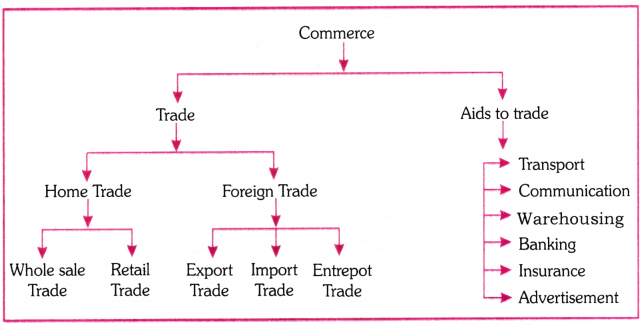
Commerce = Trade + Aids to Trade where Trade = Purchase and sale of goods & services
Aids to Trade = Transport, Communication, Warehousing, insurance, banking, advertisement.

Question 3.
Trade.
Answer:
Trade is a branch of commerce. It connects buying & selling activities. An individual who does trade is called a trader. Trader transfers the goods from the producer to the consumer. He earns profit form this activity.

Question 4.
Home Trade.
Answer:
Trade takes place between the individuals of the same country (or) with in the geographical boundaries of a country is called “Home Trade”. It is also called as Domestic Trade or Internal Trade.

Question 5.
Foreign Trade.
Answer:
The trade takes place between individuals of different countries is called “Foreign Trade”or “International Trade”.

Question 6.
Entrepot Trade or Re-export Trade.
Answer:
It means importing (buying) goods from one country for the purpose of exporting (selling) them to another country. This type of trade is also known as re-export trade.

Question 7.
Genetic Industries.
Answer:
Genetic Industry is related to the re-producing and multiplying of certain species of animals and plants with the object of earning profits from their sale. Nature, climate and Environment play an important role in these industries.
Ex : Plant nurseries, Poultry forms. Cattle breeding etc.

Question 8.
Extractive Industry.
Answer:
The extractive industry is engaged in raising some form of wealth from the soil, climate, air and water. Here nature does not everything and man does very little to add it. All that the man has to do is simply to take out what the nature has already given.
Ex : Extractive industries are mining, fishing, agriculture, extraction of timber, rubber from forest etc.

Question 9.
Warehousing.
Answer:
The goods are produced in anticipation of demand. They may also be produced at a time when they are not needed. So there is time gap between the production and consumption. This gap is filed up by warehouses. Warehouses store the goods and protect the goods until the goods are consumed.

Question 10.
Transportation.
Answer:
The goods are taken from a place where there is a less demand, to the places where they are in more demand. These goods are to be taken to the source of consumption with the help transport facilities we can create ‘Place utility’ in goods.

Question 11.
Banking.
Answer:
The traders purchase goods from the producers and sell them to the consumers. It takes time to collect money after sale. There is a need of finance to trade activities. The commercial banks help trade in the form of overdrafts, loan etc.

Question 12.
Wholesale Trade.
Answer:
Buying and selling of goods in large quantities is called “wholesale trade”. A wholesaler buys goods in large quantities from the producers and sells in small quantities to retailers.

Question 13.
Retail Trade.
Answer:
Retail Traders sell goods in small quantities directly to the consumers. A person who is involved in the retail trade is called “retailer”. He maintains all varieties of goods to attract the consumers for sales either in cash or credit.

Question 14.
Consumer goods.
Answer:
The goods which are acquired for the purpose of consumption are called consumer goods. Consumer goods are the goods those can be used directly by the consumers food grains, textiles etc.

Question 15.
Producer goods.
Answer:
The goods which are acquired for the purpose of production are called producer goods. The producer goods are the goods used by producers to produce some other goods like machinery, equipment etc.

Question 16.
Communication.
Answer:
Transmitting information from one person to other is known as communication. Communication plays an important role between producer, businessman and consumers.

Question 17.
Advertising.
Answer:
Advertising helps in providing information about the availability and usefulness of various products in the market. Therefore advertising, publicity and selling campaigns will remove the hindrances of knowledge about products.

Question 18.
Import Trade.
Answer:
When the goods are purchased from outside countries for use in the domestic market, it is called “Import Trade”.
Ex : India buys petrol from Iran.

Question 19.
Export Trade.
Answer:
When domestic goods are sold to the other country it is called “Export Trade”.
Ex : India sells readymade dressess to America.

Question 20.
Home Trade.
Answer:
Trade takes place between the inviduals of the same country or within the geographical boundaries of a country is called “Home Trade”. It is also called a “Domestic Trade” or “Internal Trade”.

Short Answer Questions

Question 1.
List out types of Industries.
Answer:
Industry is concerned with the making or manufacturing of goods. Simply it means the production of wealth or value.

Types of Industry :

  1. Primary Industry : It is concerned with production of goods with the help of nature. It is a nature oriented, which requires lesser human efforts.
    Ex : Agriculture, Farming, Forestry, Fishing. Horticulture etc.
  2. Genetic Industry : Genetic industry is related to the re-producing and multiplying of certain species of plants and animals with the object of sale. The main aim is to earn profit from such sale.
    Ex : Plant nurseries, Poultry forms, Cattle breeding etc.
  3. Extractive Industry : The extractive industry is engaged in raising some form of wealth from the soil, climate, air and water. All that the man has to do is simply to take out what the nature has already given.
    Ex : Mining Industry, coal, mineral, oil industry, fishing, agriculture, extraction of tumber & Rubber from forest etc.
  4. Manufacturing Industry : Manufacturing industries are engaged in transforming raw- material into finished product with the help of machines and manpower. The finished goods can be either consumer goods or producer goods.
    Ex : Textiles, chemicals, sugar industry, paper industry etc.,
  5. Construction Industry : The industry is engaged in the creation of infrastructure. These industries are engaged in the construction of buildings, roads, dams, bridges and canals.
  6. Service Industry : In modern times, service sector plays an important role in the development of the nation and therefore it is named as service industry. These are engaged in the provision of essential services to the community.
    Ex : Banking, Hotels, Tourism, Insurance etc.

Question 2.
How Trade is classified ?
Answer:
Trade : Trade is the part of commerce and it creates connection between buyers and sellers.

Trade is nothing but the summation of purchasing and selling of goods.

1) Home Trade : The purchase and sale of goods inside the country is called as “Home Trade”. It is divided into Wholesale Trade and Retail Trade.

  •  Wholesale Trade : In wholesale Trade, goods are purchased in large quantities by whole saler and sold them in small quantities to retailer.
  • Retail Trade : In retail trade, the retailer purchases goods from wholesaler and sells them to ultimate consumers. Unlike a wholesaler, the retailers will have direct contact with customers.

2) Foreign Trade : When trade takes place between two countries, it is called foreign trade (or) international trade. It can be divided into 3.

  • Import Trade : When goods are purchased from outside countries, it is called Import Trade”.
  • Export Trade : When the goods are sold and sent to other countries is called “Export Trade”.
  • Entrepot Trade : When one .country imports the goods from another country and the same goods are exported to another foreign country, it is called “Re-export Trade” or Entrepot Trade”.

Question 3.
What are the hindrances involved in Commerce ?
Answer:
’Commerce’ plays an important role in the distribution of goods and services. For the smooth running of trade and business some services are needed, like transport, banking, insurance etc.

Definition : “Commerce is an organized system for the exchange of goods between the members of the industrial world”. – James Stephenson

The main hindrances are as follows :

  1. Hindrances of Place : The place of production may be away from the place of consumption. The various means of transport will helps for the smooth distribution of goods and services.
  2. Hindrances of time : Goods are produced by expecting the demand. So it is necessary to make suitable arrangement for their storage. The gap between production and consumption is the main hindrance with the help of warehousing we can overcome this hindrance.
  3. Hindrances of exchange : Exchange of goods and services automatically deals with exchange of value. For that time, value, place may vary. Those hindrances and working capital problems will be solved with help of banks.
  4. Hindrances of knowledge : Creation of demand is very important junction of commerce. If we fails to create demand then no question of production or distribution arises with the help of advertisements we can overcome this hindrance.
  5. Hindrances of work : Objective of business is to earn profit. But profit is the reward of risk bearing. A choice of loss occurence is there. This hindrance can be removed with the help of Insurance. Finally commerce is a group of services it includes trade and aids to trade.

Question 4.
Trace out the various types of Aids to Trade.
Answer:
Aids to Trade : Auxiliaries which help in smooth exchange of goods directly or indirectly are known as “Aids to trade”. Various aids to trade are :

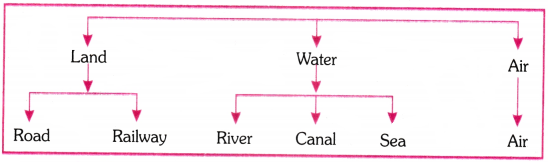
  1. Transport : Transferring of goods from the centre of production to the center of communication is done by transport. Several types of transports are like air, water and land etc.
  2. Communication : Transmitting of information from one person to other is known as “Communication”. Communication plays an important role between producer, businessman and consumer. Telex, Telephone, Telegraph, e-mail, teleconference etc.
  3. Warehousing : Production takes place only in few seasons on large scale and their utility is spread throughout the year. There is gap between production & consumption. Hence, warehousing eliminates the time gap between production and consumption. For this reason, warehousing provides “time utility”.
  4. Insurance : The businessmen covers all the risks through insurance companies. Insurance covers all risks due to fire, theft, floods, storm other calamities. Insurance helps the development of trade by removing the fear of loss.
  5. Banking : Banking helps in buying and selling of goods by providing convenient and safe mode of payment. They play an important role in overcoming the financial problem.
  6. Advertisement : Advertising helps in providing information about the availability and usefulness of various products in the market. Therefore advertising publicity and selling campaigns will remove the hindrances of knowledge about products.

Question 5.
What do you understand by commerce ?
Answer:
Commerce : Commerce is that part of business which is connected with the exchange of goods and services. Commerce involves the process of bringing goods from the place of production and sending them to the place of consumption. In other words, it supplies goods to ultimate consumer.

Definition : “Commerce is an organized system for the exchange of goods between the members of the Industrial World”. – James Stephenson

Importance of Commerce :

  1. Commerce tries to satisfy increasing human wants.
  2. Commerce helps to increase our standard of living.
  3. Commerce links producers and consumers.
  4. Commerce generates employment opportunities.
  5. Commerce increases national income and wealth.
  6. Commerce encourages International Trade.
  7. Commerce benefits underdeveloped countries.
  8. Commerce helps during emergencies like floods, earthquakes and wars.

Question 6.
How foreign Trade is classified ?
Answer:
Trade is the part of commerce. It is the summation of purchasing and selling of goods. Trade can be divided into home trade and foreign trade.

Foreign Trade : When trade takes place between two countries, it is called foreign trade (or) international trade.

  1. Import trade : When goods are purchased from outside countries, it is called “Import Trade”.
    Ex : India purchases wheat goods from Russia. This is called import trade.
  2. Export Trade : When the goods are sold and sent to other countries is called “Export Trade”.
    Ex : India sells leather goods to Russia. This is an export trade to India.
  3. Entrepot or Re-export Trade : If one country imports the goods from another country and the same goods are exported to another foreign country, it is called “Re-export Trade” or Entrepot Trade”.

Long Answer Questions

Question 1.
What is meant by Industry ? Explain various types of industries with suitable examples.
Answer:
Industry is concerned with the production of goods and services. Extracting, producing, processing and manufacturing of goods.

Industries can be classified into 6 types :

Business Activities Questions and Answers AP Inter 1st Year Commerce Chapter 2 1

1) Primary Industry: Primary industry is concerned with production of goods with the help of naure. It is a nature – oriented industry, which requires very little human effort.
Ex : Agriculture, Farming Forestry, Fishing, Horticulture etc.

2) Genetic Industry : Genetic industries are engaged, in re-production and multiplication of certain species of plants and animals with the object of sale. The main aim is to earn profit from such sale.
Ex : Poultry forms, cattle breeding farms, plants nurseries.

3) Extractive Industry : The extractive industry is engaged in raising some form of wealth from the soil, climate, air or water. Generally products of extractive industries come in raw-material, they are used for manufacturing and construction industries for producing finished products.
Ex : Mining, Fishing, Coal, Mineral, Iron ore. Oil industry, Timber, Rubber from forests etc.

4) Manufacturing Industry : Manufacturing industries are engaged in transforming raw- materials into finished product with the help of machines and man power. The finished goods can be either consumer goods or producer goods.
Ex : Textiles, chemicals, sugar industry, paper industry etc.

These kind of industries can be divided under :

  • Analytical : In an analytical industry the basic raw-material is broken into several useful materials.
    Ex : In oil refinery, crude oil is refined and several petroleum products are procured.
  • Synthetic : In this type of manufacturing industry two or more materials are mixed to form a new product.
    Ex : Cosmetics, detergents, fertilizers etc.
  • Processing : In the processing industry, material is processed through various stages.
    Ex : Spinning, weaving, dying, bleaching and printing process.
  • Assembling : This kind of industry assembles various parts to manufacture a finished product.
    Ex : Manufacturing of automobiles, by assembling various spare-parts.

5) Construction Industry : This industry is engaged in the creation of infrastructure for the smooth development of the economy. These industries are engaged in the provision of essential service to the community.
Ex : Construction of buildings, roads, dams etc.,

6) Service Industries : In modern times service plays vital role in the development of nation and therefore it is named as service industry.
Ex : Banking, transport, hotels, tourism industry, film and other entertainment industries etc.

Question 2.
What is commerce ? Describe the various branches of commerce.
Answer:
Commerce is that part of business which is concerned with the exchange of goods and services and include all the activities which directly or indirectly facilitate that exchange.

Definition : “Commerce is an organized system for the exchange of goods between the members of the industrial world”. – James Stephenson

Commerce = Trade + Aids to Trade
Where, Trade = Purchase and sale of goods and services.
Aids to Trade = Transport, communication, warehousing, insurance, banking, advertisement.

Business Activities Questions and Answers AP Inter 1st Year Commerce Chapter 2 2

A) Trade: Trade is nothing but the summation of purchasing and selling of goods. An individual who does trade is called a “Trader”.

Trade classified into Home Trade & Foreign Trade.

1) Home Trade : The purchase and sale of goods inside the country is called as “Home Trade”. It is also known as “Internal trade” or “Domestic trade”. It is divided into “wholesale trade” & “Retail trade”.

  • Wholesale Trade : Buying and selling of goods in large quantities is called “Wholesale trade”. A wholesaler buys goods in large quantities from the producers and sell in small quantities to retailers.
  • Retail Trade : Retail traders sell goods in small quantities directly to the consumers. A person who is involved in the retail trade is called ‘retailer’.

2) Foreign Trade : When trade takes place between two countries, it is called “Foreign trade” or “International trade”. Buyer and seller belong to different countries. It can be divided into three :

  • Export Trade : When the goods are sold and sent to other countries is called “Export Trade”.
    Ex : India sells leather goods to Russia.
  • Import trade : When goods are purchased from other countries, it is called “Import Trade”.
    Ex : India purchases wheat goods from Russia.
  • Entrepot Trade : If one country imports the goods from another country and the same goods are exported to another foreign country, it is called “Entrepot trade” or “Re-entrepot trade”.
    Ex : India importing wheat from U.S. and exporting the same to Sri Lanka.

B) Aids to Trade : Auxiliaries which help in smooth exchange of goods directly or indirectly are known as “Aids to trade”. Various aids to trade are :

  1. Transport : Transferring of goods from the centre of production to the center of communication is done by transport. Several types of transports are like air, water and land etc.
    Business Activities Questions and Answers AP Inter 1st Year Commerce Chapter 2 3
  2. Communication : Transmitting of information from one person to other is known as “Communication”. Communication plays an important role between producer, businessman and consumer. Telex, Telephone, Telegraph, e-mail, teleconference etc.
  3. Warehousing : Production takes place only in few seasons on large scale and their utility is spread throughout the year. There is gap between production & consumption. Hence, warehousing eliminates the time gap between production and consumption. For this reason, warehousing provides “time utility”.
  4. Insurance : The businessmen covers all the risks through insurance companies. Insurance covers all risks due to fire, theft, floods, storm other calamities. Insurance helps the development of trade by removing the fear of loss.
  5.  Banking : Banking helps in buying and selling of goods by providing convenient and safe mode of payment. They play an important role in overcoming the financial problem.
  6. Advertisement : Advertising helps in providing information about the availability and usefulness of various products in the market. Therefore advertising publicity and selling campaigns will remove the hindrances of knowledge about products.

Question 3.
Define Trade and explain various types of Aids to Trade.
Answer:
Trade means buying and selling of goods in order to earn or make profit. It creates a link between producers and customers.

Types of Trade : Trade classified into two :

1) Home Trade : Trade takes place between the individuals of the same country within the geographical boundaries of a country is called “Home Trade”. It is also called as “Domestic Trade” or “Internal Trade”. It is classified into two :

  • Wholesale Trade : Buying and selling of goods in large quantities is called “wholesale trade”. A wholesaler buys goods in large quantities from the producers and sells in small quantities to retailers.
  • Retail Trade : It involves selling goods to the final consumers. He purchases goods from wholesaler and sells them to ultimate consumers.

2) Foreign Trade : When trade takes place between two countries, it is called “foreign trade” or “internal trade”. Buyer and seller belong to different countries. It can be divided into three :

  • Import trade : When goods are purchased from other countries it is called “import trade”.
    Ex: India purchases wheat goods from Russia.
  • Export trade : When the goods are sold and sent to other countries is called “export trade”.
    Ex : India sells leather goods to Russia.
  • Entrepot trade or Re-export trade : If one country imports the goods from another country and the same goods are exported to another foreign country, it is called “Re-export trade”.
    Ex : India purchases wheat from Russia and exporting the same to Sri Lanka.

Aids to Trade of Auxiliaries to trade :

For smooth running of trade and commerce these services are required without the help of such functions, it is not possible to take goods from one place to another. These are also known as auxiliaries to trade and also called as “aids to trade”.

  1. Transport : Transporting of goods from the centre of production to the center of communication is done by transport.
  2. Communication : Transmitting of information from one person to other is known as “Communication”.
  3. Warehousing : The goods are produced in anticipation of demand. They may also be produced at a time when they are not needed. So there is time gap between the production and consumption. Warehousing provides ‘time utility’.
  4. Insurance : The businessmen covers all the risks through insurance. Insurance covers all risks due to fire, theft, floods and-accidents. Insurance acts as risk bearers.
  5. Banking : Banking helps in buying and selling of goods by providing convenient and safe mode of payment. They play an important role in overcoming the financial problem.
  6. Advertisement : Advertising helps in providing information about the availability and usefulness of various products in the market. Therefore advertising, publicity and selling campaigns will remove the hindrances of knowledge about products.

Question 4.
Narrate the importance of commerce ?
Answer:
The importance of commerce is explained with the help of the following points :

  1. Commerce tries to satisfy increasing human wants : Human wants are never ending. Commerce has made distribution and movement of goods possible from one part of the world to the other. Today we can buy anything produced anywhere in the world.
  2. Commerce helps to increase our standard of living : Standard of living refers to the quality of life enjoyed by the members of a society. When a man consumes more products his standard of living improves. Commerce helps us to get what we want at the right time, right place, and at the right price and thus helps us in improving our standard of living.
  3. Commerce links producers and consumers ; Production is meant for ultimate consumption. Commerce makes possible to link producers and consumers through wholesalers and retailers and also through the aids to trade. Thus, commerce creates and facilitates the contact between the centres of production and consumption and links them.
  4. Commerce generates employment opportunities : The growth of commerce, industry and trade caused the growth of agencies of trade such as banking, transport, warehousing, insurance, advertising, etc. These agencies need people to look after their functioning. Thus, development of commerce generates more and more employment opportunities.
  5. Commerce increases national income and wealth : When production increases, national income also increases. It also helps to earn foreign exchange by way of exports and duties levied on imports.
  6. Commerce helps in expansion of aids-to-trade : With the growth in trade and commerce there is a growing need for expansion and modernisation of aids to trade. Aids to trade such as Banking, Communication, advertising and publicity, transport, insurance etc. are expanded and modernised for the smooth conduct of commerce.
  7. Commerce encourages international trade : With the help of transport and communication development, countries can exchange their surplus commodities and earn foreign exchange. Thus, commerce ensures faster economic growth of the country.
  8. Commerce benefits underdeveloped countries : Underdeveloped countries can import skilled labour and technical know-how from developed countries, while the advanced countries can import raw-material’s from underdeveloped countries. This helps in laying down the seeds of industrialization in the underdeveloped countries.
  9. Commerce helps during emergencies : During emergencies like floods, earthquakes, and wars, commerce helps in reaching the essential requirements like foodstuff, medicines and relief measures to the affected areas.

Question 5.
Explain the hindrances involved in commerce.
Answer:
Commerce is an organized system which facilitates the free flow of goods and services. In business, products and services are produced through industry. The produced goods and services face various types of hindrances to reach the customers. Commerce removes these hindrances and helps to distribute products and achieving the business’s desired goals. The following table presents the hindrances involved in the commerce and aids to remove them :

Hindrances Removed by
Persons Trade
Place Transportation
Time Warehousing
Finance Banking
Risk Insurance
Promotion Advertisement
Information Communication

Thus, commerce involves trade and aids to trade. Following are some of the hindrances in commerce.

  1. Hindrance of Person : Trade is done by buyers and sellers, in exchange for money. The sellers sell the goods and services to the buyers. Therefore, by handing over products or services, personal hindrance can be removed.
  2. Hindrance of Finance : Banking services remove the hindrance of financial problems. It facilitates trade by providing credit in various forms.
  3. Hindrance of Time and Duration : There is a time gap between production and consumption. The goods produced are not immediately required for consumption. Warehousing removes the hindrance of time and duration. It preserves the goods from the time of production to the time of consumption. It creates time utility.
  4. Hindrance of Place : Goods are produced in a limited number of production centres, whereas consumers are located everywhere. Transportation removes the hindrance of place. It implies conveyance of goods and passengers from one place to another. It creates place utility.
  5. Hindrance of Risk : Business involves risk. Risk and uncertainty are inherent in any business. Insurance stands for protection significant against risk. So, it removes the hindrance of risk. The risk of businessman is reduced by several types of insurance such as fire insurance, transit insurance, marine insurance, factory insurance on stocks and assets etc.
  6. Hindrance of Knowledge and Information : Advertisement helps to eliminate the hindrance of knowledge. It informs the customers about the availability of various products. Communication helps in the efficient operation of commercial activities. Thus, it removes the hindrance of information.

Question 6.
Explain the inter relationship between trade, commerce and industry. (Additional)
Answer:
Industry, commerce and trade are a part of business and closely related to each other.

    • Industry : Industry is concerned with the making or manufacturing of goods.
    • Trade : Trade is a channel for transport of goods from producer to consumer.
    • Commerce : Commerce helps industry before and after the production.
Aspect Industry Commerce Trade
1. Meaning It is concerned with production of goods & services. Industry means creation of wealth or value. Commerce is nothing but the process of distribution of goods and services. It includes trade and aids to trade. Trade means transfer of ownership of goods and services. In simple the activities of selling and buying of goods and services is called as trade.
2. Utility Industry creates form utility Commerce creates place and time utility. Trade creates possession (place) utility, which helps in the distribution of goods & services.
3. Scope Industry includes all the activities needed to produce final product. Commerce includes trade and aids to trade. Trade includes home trade and foreign trade.
4. Capital Requires huge capital Requires less capital Requires less capital
5. Risk Involves high risk Lower amount of risk than industry. Lower amount of risk than industry.
6. Elements Primary industry, Genetic industry, extractive industry, manufacturing industry, construction industry and service industry. A trade and aids to trade. Home trade and foreign trade.
7. Place of operation Firms, factories, workshops, mines etc. Distribution of goods from one place to the other place. Market
8. Ownership and control By industrialists By merchants. By traders

Check Your Knowledge

I. Fill in the blanks for the following questions :

Question 1.
_________ industry is conserved with production of goods with the help of nature.
Answer:
Primary

Question 2.
The goods may be _________ goods.
Answer:
Consumer

Question 3.
_________ industries are engaged, in reproduction and multiplication of certain species of plants and animals with the object of sale.
Answer:
Genetic

Question 4.
_________ industry is concerned with extraction or drawing out goods from the soil, air or water.
Answer:
Extractive

Question 5.
_________ industries are engaged in transforming raw – materials into finished product with the help of machines and manpower.
Answer:
Manufacturing

Question 6.
The _________ industry, material is processed through various stages.
Answer:
Processing

Question 7.
_________ industries take up the work of construction of buildings, bridges, roads, dams, canals etc.
Answer:
Construction

Question 8.
_________ deals with the distribution aspect of the business.
Answer:
Commerce

Question 9.
_________ is done by buyers and sellers, in exchange for money.
Answer:
Trade

Question 10.
Home Trade is also known as _________ trade.
Answer:
Domestic trade

Question 11.
Traders who engage themselves in wholesale trade are called _________
Answer:
Wholesalers

Question 12.
Traders engaged in retail trade called _________
Answer:
Retailers

Question 13.
The geographical distance between producers and consumers is removed with the help of _________
Answer:
Transport

Question 14.
_________ means transmitting of exchanging information from one person to another.
Answer:
Communication

Question 15.
_________ and _________ are important medias of mass communication.
Answer:
Advertising and Publicity

II. State whether the statement are True or False.

Question 1.
Human wants are never ending. (True/False)
Answer:
True

Question 2.
Production is meant for ultimate consumption. (True/False)
Answer:
True

Question 3.
When production decreases, national income also decreases. (True/False)
Answer:
False

Question 4.
Business involves not risk. (True/False)
Answer:
False

Question 5.
Trade is a branch of business. (True/False)
Answer:
False

Question 6.
Trade is the nucleus of commerce. (True/False)
Answer:
True

Question 7.
Home trade is also known as wholesale trade. (True/False)
Answer:
False

Question 8.
Wholesale Trade involves buying and selling of goods in large quantities. (True/False)
Answer:
True

Question 9.
Traders engaged in retail trade are called wholesale traders. (True/False)
Answer:
False

Question 10.
Buying and selling of goods and services between two or more countries are called Foreign Trade. (True/False)
Answer:
True

Question 11.
Trade or exchange of goods involves several difficulties which can be removed by auxiliaries to business. (True/False)
Answer:
False

Question 12.
Modern means of communication like telephone, telex, telegraph, email, teleconference etc. (True/False)
Answer:
True

Question 13.
Export trade means the sale of goods to our country. (True/False)
Answer:
False

Question 14.
Import Trade refers to the purchase of goods from foreign countries. (True/False)
Answer:
True

Question 15.
Aids to Trade include Transport, communication. Warehousing, Banking, Insurance, Advertising. (True/False)
Answer:
True

Question 16.
Industry refers to production of consumer goods and capital goods and creates form utility. (True/False)
Answer:
True

Question 17.
The hindrances of commerce are person, place, finance, time and duration etc. (True/False)
Answer:
True

Student Activity

State whether the statements are True or False.

Question 1.
The production side of business activity is referred to as industry. (True/False)
Answer:
True

Question 2.
Business = Trade + Commerce. (True/False) (True/False)
Answer:
False

Question 3.
Buying and selling of goods and services is called commerce.
Answer:
False

Question 4.
Agriculture is related to Primary Industry.
Answer:
True

Question 5.
Fishing related to genetic industry. (True/False)(True/False)
Answer:
True

Question 6.
Tourism belongs to the service industry.
Answer:
True

Question 7.
Commerce = Trade + Aids to Trade. (True/False)
Answer:
True

Question 8.
Commerce facilitates the free flow of goods & services. (True/False)
Answer:
True

AP Inter 1st Year Commerce Study Material

Concept of Business Questions and Answers AP Inter 1st Year Commerce Chapter 1

AP Inter 1st Year Commerce 1st Lesson Concept of Business Questions and Answers

Fill in the Blanks

Question 1.
The term Business refers to the state of being _____________
Answer:
Busy

Question 2.
All the activities of human beings can be broadly classified into economic and _____________ activities.
Answer:
Non-Economic Activities

Question 3.
Economic Activities refer to the activities involved with _____________
Answer:
Money

Question 4.
‘Chartered Accountants’ (CA) is an example for _____________
Answer:
Profession

Question 5.
The relationship between the employer and the employee is master and _____________
Answer:
Servant

Question 6.
_____________ are known as intangible and invisible goods.
Answer:
Services

Question 7.
_____________ goods are meant for direct use by the ultimate consumers.
Answer:
Consumer

Question 8.
_____________ goods are used for the production of consumer or capital goods.
Answer:
Producer

Question 9.
The primary objective of business is to earn _____________
Answer:
Profit

Question 10.
_____________ implies an uncertainty of profit or the possibility of loss.
Answer:
Risk

Question 11.
“The primary aim of the business should be service and the subsidiary aim should be eearning profit” pronounced by _____________
Answer:
Henry Ford

Very Short Answer Questions

Question 1.
Define Business.
Answer:

  1. “A human activity directed towards producing or acquiring wealth through buying and selling of goods”. – L.H. Haney
  2. “Business is a sum of all activities involved in the production and distribution of goods and services for private profits”. – Keith and Carlo

Question 2.
Profession.
Answer:
Profession is an occupation requiring specialized education. In other sense, profession refers “to a body of people in a learned occupation”. It requires an association with a professional body for a person to practice.
For example : A chartered accountant, lawyers, doctors.

Question 3.
Employment.
Answer:
Employment involves working under a contract of employment for or under someone known as employer in return for a salary. The person engaged under employment works as per the direction of the employer.

Question 4.
Economic Activities.
Answer:
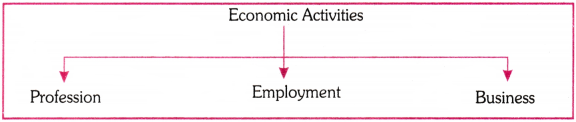
Economic Activities are broadly classified into three. They are –

  1. Profession : Profession is an occupation requiring specialized education. In another sense, profession refers “to a body of people in a learned occupation”.
  2. Employment: A person who works under the contract for a salary is called an employee and the person who has given the job to the employee is called an employer.
  3. Business : Business is an economic activity involving the production, exchange, distribution, and sale of goods and services to make profits.

Question 5.
Non-Economic Activities.
Answer:
Those human activities do not involve money or money’s worth, such activities are termed as non-economic activities. Human beings engage themselves in non-economic activities due to love, affection, patriotism, charity, sympathy and other such sentiments.
Ex : A mother looks after her children, youngman helps a blind man to cross the road etc.

Question 6.
Human Activities.
Answer:
The activities performed by the human being in their daily life are called human activities. These are undertaken by them to fulfill their needs, desires, wants and luxuries.

Question 7.
Risk & Uncertainty.
Answer:
Risk is the fear of loss and profit is reward for assuming risk. Uncertainty is a potential, unpredictable and uncontrollable outcome. When the future events or circumstances is indefinite it is termed as uncertanity.

Question 8.
Art as well as Science.
Answer:
Business is an art because it requires personal skills and experience. It is also a science because it is based on certain principles and laws.

Question 9.
Labour Welfare.
Answer:
A business must recognize the dignity of labour. Adequate health, safety and social security provisions are to be made.

Short Answer Questions

Question 1.
What are the characteristics of business ?
Answer:
Characteristics/Features :

  1. Creation of utility : Business creates time, place, form and possession utilities to various types of goods and services. It enables people satisfy their wants and needs.
  2. Goods & Services : A business concern produces or purchases goods and services, with an intention of sale to others to earn profits. Goods are tangible and the services are intangible. The goods may be consumer goods or producer goods.
  3. Continuity in dealings : A single isolated transaction of purchase and sale does not constitute business. Recurring or repeated transactions of purchase and sale constitutes business. Regularity of dealings is an essential feature of business.
  4. Profit motive : The primary objective of business is to earn profits. Profits are essential for the survival as well as growth of business.
  5. Risk and Uncertainty : Risk implies uncertainty of profit or the possibility of loss. Risk is a part and parcel of business. Changes, in customers tastes and fashions, demand, competition, Government policies etc., create risk. Flood, fire, earthquake, strike by employees, theft etc., also cause loss. A business man can reduce risks through correct forecasting and insurance.
  6. Economic Activity : Business is primarily an economic activity as it involves production and distribution of goods and services for earning money.
  7. Sale, transfer or exchange : All business activities involve transfer or exchange of goods and services for some consideration. The consideration, called price, is usually expressed in terms of money. Business delivers goods and services to those who need them and are able and willing to pay for them.
  8. Art as well as science : Business is an art because it requires personal skills and experience. It is also a science because it is based on certain principles and laws.

Question 2.
What are the economic objectives of Business ?
Answer:
Every Business enterprize has certain objectives. Objectives of business are classified into four objectives.

Economic Objectives : Business is basically an economic activity. Therefore, its primary objectives are economic in nature. The main economic objectives of business are as follows:

  1. Earning Profits : A business enterprise is established to earn some income. It is the hope of earning profits that inspires people to start business. Profit is essential for the survival of every business unit. Profit also serves as the barometer of stability, efficiency and progress of a business enterprise.
  2. Creating customers : Profits arise from the business – man’s efforts to satisfy the needs and wants of customers. A businessman can earn profits only when there are enough customers to buy and pay for his goods and services. The customer is the foundation of business and keeps it in existence. Business exists to satisfy the wants, tastes and preferences of customers.
  3. Innovation : Innovation refers to “creation of new things resulting from the study and experimentation, research and development”. In these days of competition, a business can be successful only when it creates new designs, better machines, improved techniques, new varieties etc. Modern science and technology have created a great scope for innovation in the business world.

Question 3.
What are the social objectives of business ?
Answer:
Social Objectives : Business is a part of society. Business cannot survive and grow without the support of society. It must therefore discharge social responsibilities in addition to earning profits.

According to Henry Ford “The primary aim of business should be service and subsidary aim should be earning profits”.

Social Objectives of Business :

  1. Supplying desired goods at reasonable prices : Goods and services should be good quality and these should be supplied at reasonable prices.
  2. Fair Remuneration to employees : Employees must be given fair compensation for their work. In addition to wages and salary a reasonable part of profits should be distributed among employees by way of bonus. Such sharing of profits will help to increase the motivation and efficiency of employees.
  3. Employment Generation : Provision of adequate and fully employment opportunities is a significant service to society.
  4. Social Welfare : Business should provide support to social, cultural and religious organisations.
  5. Payment of Government dues : Every business entereprize should pay tax dues (Income tax, sales tax, excise duty, customs duty etc.) to the Government honestly and at the right time. It provides revenue to the Government honestly and at the right time. It provides revenue to Government for spending on public welfare.

Question 4.
What are the human objectives of business ?
Answer:
Business is run by people and for people. Labour is a valuable human element in business. Human objectives of business are concerned with the well being of labour which are given below :

  1. Labour Welfare : Business must recognise the dignity of labour and human factor should be given due recognition. Adequate provisions should be made for their health, safety and social security.
  2. Developing Human Resources : Employees must be provided with the opportunities to develop new skills and attitudes. This can be done by training the employees and conducting workshops on skill development and attitude. Human resources are the most valuable asset of business and their development will help in the growth of business.
  3. Participative Management : Employees should be allowed to take part in decision making process of business. This will help the development of employees. Worker’s participation in management will learn to industrial democracy.
  4. Labour Management Co-operation : Business should strive to create and maintain cordial employer – employee relations so as to ensure peace and progress in industry.

Question 5.
What are the National Objectives of business ?
Answer:
National objectives of business are optinum utilization of resources, National Self Reliance by reducing imports and development of backward areas by set up factories in notified areas.

National Objectives :

  1. Optimum utilization of resources : Adequate usage of natural resources will develop nation. Wastage of scarce resources is not only a loss to the business but also to the nation.
  2. National Self-Reliance : By increasing exports and reducing imports lead to self:reliance over dependency is reduced by having sufficient supply of goods and services.
  3. Development of small-scale industries : Small-scale industries will provide inputs the big business organizations. Hence, development of large-scale units leads to the development of small-scale industries.
  4. Development of backward areas : Business is expected to give preference to the industrialisation of backward regions of the country. Balanced Regional Development is necessary for peace and progress in the country. Government offers special incentives to the businessmen who set up factories in notified backward areas.

Question 6.
What are the Business Objectives ?
Answer:
Business objectives are divided into four types. They are
i) Economic Objectives :
a) Earning profit.
b) Creation of customer.
c) Technological Improvements.

ii) Social Objectives :
a) Availability and Supply of Quality goods
b) Fair Remuneration to employees
c) Creation of employment opportunities
d) Co-operation with the government

iii) Human Objectives :
a) Labour management Co-operation
b) Welfare of workers
c) Development of human resources
d) Labour participation in management

iv) National Objectives :
a) Producing goods according to national priorities
b) Optimum utilisation of natural resources
c) Development of backward regions
d) Development of small scale industries
e) Self-reliance

Question 7.
What are the Economic activities ?
Answer:
Activities undertaken with the aim of earning money are called economic activities. These are the activities related to production, exchange and consumption of goods and services.
Ex : Doctor, Lawyer, Teacher, Chartered Accountant.

Economic activities are divided into three. They are

  1. Business : Business is an economic activity involving production, exchange, distribution and sale of goods and services with profits motive.
  2. Profession : Which involves the rendering of personalized services of a specialized nature based on professional knowledge, education and training is called a ‘Profession’.
  3. Employment: An employment is a contract of service between employee and employer. The employee works under an agreement as per the rules of services and performs tasks assigned to him by the employer.

Question 8.
What is the role of Profit in business ?
Answer:
The primary objective of business is to earn profits.

The following are the points to measure the importance or role of profit in every business.

  1. Profits earn adequate funds for future expansion of the business.
  2. Profits are also helpful to attract more funds from outsider. Like Banks, investors, financial institutions etc.
  3. Profits provide the most accurate test of business efficiency.
  4. Accumulation of wealth through business profits provides economic power and social status.
  5. Profits are necessary to meet the business risk.

Long Answer Questions

Question 1.
Define business. What are its characteristics ?
Answer:
Definition : “A human activity directed towards producing or acquiring wealth through buying and selling of goods and services”. – L.H. Haney

Characteristics/Features :

  1. Creation of utility : Business creates time, place, form and possession utilities to various types of goods and services. It enables people satisfy their wants and needs.
  2. Goods & Services ; A business concern produces or purchases goods and services, with an intention of sale to others to earn profits. Goods are tangible and the services are intangible. The goods may be consumer goods or producer goods.
  3. Continuity in dealings : A single isolated transaction of purchase and sale does not constitute business. Recurring or repeated transactions of purchase and sale constitutes business. Regularity of dealings is an essential feature of business.
  4. Profit motive : The primary objective of business is to earn profits. Profits are essential for the survival as well as growth of business.
  5. Risk and Uncertainty : Risk implies uncertainty of profit or the possibility of loss. Risk is a part and parcel of business. Changes, in customers tastes and fashions, demand, competition. Government policies etc., create risk. Flood, fire, earthquake, strike by employees, theft etc., also cause loss. A business man can reduce risks through correct forecasting and insurance.
  6. Economic Activity : Business is primarily an economic activity as it involves production and distribution of goods and services for earning money.
  7. Sale, transfer or exchange : All business activities involve transfer or exchange of goods and services for some consideration. The consideration, called price, is usually expressed in terms of money. Business delivers goods and services to those who need them and are able and willing to pay for them,
  8.  Art as well as science : Business is an art because it requires personal skills and experience. It is also a science because it is based on certain principles and laws.

Question 2.
Explain the objectives of a business.
Answer:
The term business refers to “the state of being busy”.

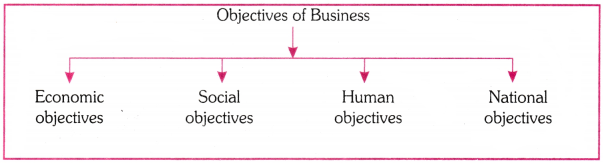
The objectives of a business are classified as under :

Concept of Business Questions and Answers AP Inter 1st Year Commerce Chapter 1 1

1) Economic Objectives : The Economic objectives are :

a) Earning Profits : Earning profits is an essential for the existence of business. It gives sustainability for a business in any fluctuations. It is a barometer for a business enterprise to measure stability, capability, efficiency etc.

b) Creating customers : A business can earn profits only when there are sufficient number of customers to buy the goods and services. The customer is the foundation for business and keeps it in existence. Hence, creation of customer is an important economic object of a business.

c) innovation : It refers to creation of new things. Modern science and technology is giving great scope for innovation. Therefore, business firms invest money, time and efforts in Research & development.

2) Social objectives : Business does not exist in a vaccum. It is a part of society. It cannot survive and grow without the support of society. So, business must have some social objectives. They are given below :

a) Supply of goods at reasonable price : A business should produce its goods and services with fair quality and reasonable price. It also has a social obligation of avoiding malpractices, smuggling, black marketing, misleading the customers with false advertisements, exploiting the customers with fixation of high or inappropriate pricing etc.

b) Fair Remuneration to employees : Apart from payment of salaries to the employees and wages to workers, if profits of business are distributed, it helps in motivating them. It is primary role of the employers to provide healthy and safe working environment to the workers.

c) Employment generation : Business should provide opportunities for gainful employment to members of the society. Government cannot provide employment to all. Therefore, provision of adequate and full employment opportunities is a significant service to society.

d) Social welfare : Business enterprizes can build schools, colleges, libraries, dharmashalas, hospitals, sports bodies and research institutions. They can help non¬government organisations (NGO’s) like CRY (Child Relief and You), Help Age, and other which render services to weaker sections of society’.

e) Payment of government dues : The duties, direct and indirect taxes (such as income tax. sales tax, excise duty, customs duty etc.) to be paid by a business enterprise to Government honestly and promptly. Business should also comply with the laws of the country.

3) Human objectives : Business is run by the people and for the people. Human objectives are :

a) Labour Welfare : A business must recognize the dignity of labour. Adequate health, safety and social security provisions are to be made.

b) Developing human resources : Human resources are the most valuable asset of business and their development will help in the growth of business. Development of skilled manpower is necessary for the economic development of a country.

c) Participative management : Employees should be allowed to take part in decision making process of business. This will help in the development of employees. Workers participation in management will lead to industrial democracy.

d) Labour – Management Co-operation : To keep the organizational climate peaceful, it is very important to maintain a cordial employee – employee relation.

4) National objectives : National objectives are :

a) Optimum utilization of resources : Adequate usage of natural resources will develop nation. Wastage of scarce resources is not only a loss to the business but also to the nation.

b) National self-reliance : By increasing exports and reducing imports lead to self-reliance. Over dependency is reduced by having sufficient supply of goods & services.

c) Development of small-scale industries : Small-scale industries will provide inputs to the big business organizations. Hence, development of large scale units leads to the development of small-scale industries.

d) Development of backward areas : Business is expected to give preference to the industrialization of backward regions of the country. Balanced Regional Development is necessary for progress in the country. It will also help to raise standard of living in backward areas.

Question 3.
Classify and describe each type of Economic Activities.
Answer:
Economic activities are those which are engages in, to earn livelihood by producing and distributing goods and rendering services.

Concept of Business Questions and Answers AP Inter 1st Year Commerce Chapter 1 2

  1. Profession : Profession is an occupation based on specialized education. Profession refers “to a body of people in a learned occupation”. It requires an association with a professional body for a person to practise.
    Ex : Chartered Accountants, Doctors, Lawyers, Teachers etc.
  2. Employment : An employment is a contract of service. A person who works under the contract for a salary is called an employee and the person who has given the job to the employee is called an employer. An employee works under an agreement as per the rules of service and performs tasks assigned to him by the employer. The relationship between the employer and the employee is that of a ‘Master’ and ‘Servant’.
  3. Business : Business is an economic activity involving production, exchange, distribution and sale of goods and services with an objective of making profits.

Question 4.
Discuss the Social Responsibility of business.
Answer:
The social responsibility of business are :

1) Responsibility towards owners : These are

a) Regular and fair returns on capital invested by way of dividends.
b) Safety of their capital and growth.
c) Proper utilisation of capital.
d) Running the business efficiently.

2) Responsibility towards employees :

a) Regular payment of their wages and allowances.
b) Better working conditions and welfare amenities.
c) To improve the skill and efficiency by providing proper training.
d) Job security and social security like group insurance, pension, retirement benefits etc.

3) Responsibility towards suppliers :

a) Timely payment of dues.
b) Dealing on fair terms and conditions.
c) Availing reasonable credit period.

4) Responsibility towards customers :

a) Providing qualitative goods & services.
b) Charging reasonable prices.
c) Giving delivery of goods with stipulated time.
d) After sale survive.
e) Avoiding unfair means like under weighing the product, adulteration etc.

5) Responsibility towards government:

a) Payment of fees, duties and taxes honesty & regularly.
b) Setting up units as per guidelines of the government.
c) Following the pollution control norms.
d) Not to indulge in unlawful activities.

6) Responsibility towards society :

a) To help weaker and backward sections of the society.
b) To generate employment.
c) To protect environment.
d) To conserve natural resources and wild life.
e) To promote sports, social and cultural values.

Check Your Knowledge

I. Fill in the blanks :

Question 1.
Business is an _____________
Answer:
Economic Activity

Question 2.
Business is one of the _____________
Answer:
Human Activity

Question 3.
Goods are _____________
Answer:
Tangible

Question 4.
Services are _____________
Answer:
Intangible

Question 5.
Goods may be _____________
Answer:
Consumer goods (or) Producer goods

Question 6.
The primary objective of business is to earn _____________
Answer:
Profit

Question 7.
Capital goods also known as _____________
Answer:
Producer goods

Question 8.
How many types of Economic Activities ?
Answer:
3

Question 9.
Which one is the Non-Economic Activities ?
Answer:
Love & affection

Question 10.
Which one is National objective ?
Answer:
MSME

Question 11.
Which one is Human activities ?
Answer:
Labour Welfare

Question 12.
Innovation means _____________
Answer:
Creation of New things

Question 13.
Business risk is not likely to arise to _____________
Answer:
Good Management

Question 14.
Economic activities may be classified into business _____________ and employment.
Answer:
Profession

Question 15.
Transfer of interest exist in the case of _____________
Answer:
Business

II. State whether the statements are True or False.

Question 1.
The primary aim of business should be service and subsidiary aim should be earning of profit. (True/False)
Answer:
True

Question 2.
Regularity of dealings is an unnecessary feature of business. (True/False)
Answer:
False

Question 3.
If a person cooks and serves food to his family, it is business. (True/False)
Answer:
False

Question 4.
Services are known as intangible and invisible goods. (True/False)
Answer:
True

Question 5.
Profit is also necessary for the expansion and growth of business. (True/False)
Answer:
True

Question 6.
R & D stands for Research and Development. (True/False)
Answer:
True

Question 7.
Business must to provide healthy and safework environment for employees. (True/False)
Answer:
True

Question 8.
N.G.O’s stands for Non-Government Organization. (True/False)
Answer:
True

Question 9.
CRY stands for Child Relief and You. (True/False)
Answer:
True

Question 10.
Employees should not be allowed to take part in decision making process of business. (True/False)
Answer:
False

Question 11.
The primary objective of business is to earn loss. (True/False)
Answer:
False

Question 12.
BRD stands for Balanced Recruitment Development. (True/False)
Answer:
False

Question 13.
BRD is necessary for peace and progress in the country. (True/False)
Answer:
True

Question 14.
C.A stands for Certificate Accountant. (True/False)
Answer:
False

Student Activity

State whether the statements are True or False.

Question 1.
Economic activities are the activities a man is engaged in, to earn his livelhood by producing and distributing goods ands and rendering services. (True/False)
Answer:
True

Question 2.
Non-economic activities result in a payment. (True/False)
Answer:
False

Question 3.
The primary intention of busines is to serve the society. (True/False)
Answer:
False

Question 4.
Businesses make goods available for futur use through storage. (True/False)
Answer:
True

Question 5.
Risk implies certainty of profits. (True/False)
Answer:
True

Question 6.
Non-economic activities are also part of business. (True/False)
Answer:
False

Question 7.
Business is an art but not a science. (True/False)
Answer:
False

Question 8.
Profit is essential for the survival of every business. (True/False)
Answer:
True

Question 9.
Business must discharge social responsibility in addition to earning profits. (True/False)
Answer:
True

Question 10.
Businesses must help the government to increase exports and reduce dependence on imports. (True/False)
Answer:
True

AP Inter 1st Year Commerce Study Material

Money, Banking and Inflation Questions and Answers AP Inter 1st Year Economics Chapter 10

AP Inter 1st Year Economics 10th Lesson Money, Banking and Inflation Questions and Answers

Essay Questions

Write an essay on the following questions.

Question 1.
Write the functions of commercial banks.
Answer:
Commercial banks play a very important role in economic growth of a country. It is a financial institution. It is a profit making business firm dealing with money. Modern banks in India are joint stock companies registered under the Indian Companies Act.

Definitions of Bank:

  1. According to Sayers “we can define bank as an institution whose debts are widely accepted in settlement of other people’s debts. ”
  2. According to Crowther “a bank collects money from those who have it to spare or who are saving it out of their incomes, and lends this money to those who require it. ”

Functions of Commercial Banks :

Functions of Commercial Banks have been classified into various types as mentioned below.

  1. Primary functions
  2. Secondary functions
  3. Creation of credit
  4. Agency functions
  5. General utility services

1. Acceptance of Deposits : One of the primary functions of a commercial bank is to accept deposits from the public. The deposits accepted by the banks are of the following types.

a) Savings deposits : These deposits are made into a savings account of a bank. These deposits encourage savings habit among the public. These are most convenient to small businessmen, salaried employees, artisans, etc. The rate of interest paid on these deposits is comparatively low and it is around 4% per annum.

b) Current deposits: These are the deposits made into the current account of a bank. These are most convenient to the business people, public authorities, and joint stock companies, because there are no restrictions on the number and the amount of withdrawals. Bank do not pay any interest on these deposits.

c) Term deposits : These are also called fixed deposits because the money is deposited with the bank for a fixed period of time. These deposits can be withdrawn after the expiry of maturity period. These deposits carry more interest than the saving deposits. The rate of interest varies from 6% to 12% per annum depending on the period of deposits.

d) Recurring or Cumulative deposits : These are the variants of fixed deposits. These deposits are very convenient to those who can’t save huge amount at a time. These are the monthly installments for a fixed period of time. A fixed amount in the multiples of Rs. 10 may be deposited every month for a period one or more years. These deposits carry rate of interest at a rate more than that of savings bank and less than that of a term deposit.

2. Payment of Loans and Advances: Another primary function of the commercial bank is to give loans and advances to different sections of the public like traders, industrialists, farmers, artisans, etc.

a) Demand loans / Call loans : A demand loan is a loan that should be repaid on demand by the bank. The entire loan amount is credited to the account of the borrower in a lump sum. The entire amount carries rate of interest from the date of credit. This loan is a kind of advance made with or without security. These are also called call loans.

b) Short term loans : These loans are given for a specified short period. They are sanctioned to businessmen and farmers, etc. to finance working capital. Individuals may also receive such loans as personal loans. They are given against security.

c) Cash credits : Banks give cash credit to business firms and industries against current assets such as shares, stocks, bonds, etc. up to a specified limit. The customer need not withdraw the entire amount in one installment. He may withdraw as and when he needs and interest is charged on the amount of actual withdrawal.

d) Overdraft. This is a facility allowed by the bank to current account holders. Sometimes they are allowed to withdraw amount above the balances in their account up to a limit. Interest is charged on the amount of actual withdrawal.

e) Discounting of bills of exchange: The most useful and popular form of bonding is by discounting “bills of exchange”. These are undertakings
written by the buyers and given to sellers when the transaction is made on credit basis. The buyer undertakes to make payment after a specified period or on a specified future date.

f) Credit cards : Now-a-days banks devised new methods of giving loans to the customers. One such popular method is issuance of the credit card. A credit cardholder can use his card to purchase goods on credit from specified firms and shops subject to certain regulations. The card holder pays the amount to the bank on a later date with interest.

3. Creation of Credit: The unique function of commercial banks is creation of credit. This type of credit is created from out of the primary deposits of money received from the public. Part of the total amount of these deposits is given as loans and advances to its customers.

4. Agency Functions: Along with above functions commercial banks perform certain agency functions also. Some of the important agency functions are;

  1. Collection of cheques, drafts, bills of exchange, etc. of their customers from other banks.
  2. Collection of dividends and interest from business and industrial firms.
  3. Purchase and sale of securities, shares, debentures, government securities on behalf of the customers.
  4. Acting as trustees and keeping their funds in safe custody.
  5. Making payments such as insurance premium, income tax, etc. on behalf of their customers as per their advice.

5. General Utility Functions: Besides the above agency functions, commercial banks provide certain utility services to their customers.

  1. They provide locker facility for the safe custody of the silver, gold ornaments, etc.
  2. They transfer money of the customers from one bank to the other by way of demand drafts, mail transfer, etc. by collecting commission from them.
  3. With the use of computers and internet facility, now-a-days the banks are facilitating online transfer of money from one bank to the other.
  4. They issue letters of credit to help the traders and businessmen.
  5. Traveller’s cheques are issued by the commercial banks to avoid the risk of carrying of cash.
  6. They provide foreign exchange to the customers for exports and imports in connection with their business.
  7. They convey information on behalf of their customers to the businessmen operating in other places.
  8. Recently the commercial banks have been establishing ATMs at different locations to enable their customers to withdraw cash from their accounts.

Question 2.
State the functions of the RBI.
Answer:
Reserve Bank of India is the Central bank of India. It was established in April 1935 with a share capital of Rs. 5 crores. It was originally owned by private shareholders but it was nationalized in 1949. It performs all the Central bank functions under RBI Act, 1934.

Functions of RBI : RBI performs the following functions.

1. Note Issue : RBI has the monopoly of note issue in the country. It maintains gold and foreign exchange reserves of a minimum Rs. 200 crores of which gold should be worth of 115 cores. RBI issues currency notes of the denomination of Rs. 2000,1000, Rs. 500, Rs. 100, Rs. 50, Rs. 20, and Rs. 5, Rs. 2, one rupee note and other coins are issued by the Finance Ministry of the Government of India but circulated by the RBI.

2. Banker of Government: RBI acts as the banker, agent and advisor to the Government of India. It is the agent of the Government of India and all the State governments except the Government of Jammu and Kashmir. It receives money and makes payments on behalf of the Government and keeps the cash balances as deposits without any interest.

3. Bankers’ Bank : RBI serves as a Banker not only to the Government but also to the banks.

  • All the scheduled banks are bound by the state to maintain with RBI a part of their total deposit amount as cash balances. This ratio is called the Cash Reserve Ratio (CRR).
  • RBI provides financial assistance to the commercial banks in times of their financial stringency or crisis / problems by giving loans or rediscounting the bills of exchange.
  • It acts as a clearing house for settlement of inter-bank accounts.

4. Lender of last resort: In times of financial crisis the schedule banks can approach the RBI as a last resort. The RBI grants them loans against the securities such as treasury bonds, treasury bills and other approved securities. The RBI may also provide financial assistance by rediscounting the eligible bills of exchange.

5. Clearing House : Businessmen and other customers issue cheques towards payment for their transactions. A businessman or customer may get a cheque issued on a bank in which he has no account. He has to deposit it in his bank and which collects the amount from the bank on which the cheque is issued.

6. Custodian of foreign exchange reserves : The RBI acts as a custodian of foreign exchange reserves for the country. It has also the responsibility of maintaining the stability of foreign exchange rate. As a member of the International Monetary Fund, it maintains the stability of the exchange rate between the Indian currency and currencies of the member countries.

7. Credit controller: It is the responsibility of RBI to control the volume of credit in the country. It controls credit through different quantitative and qualitative control methods. RBI announces a credit policy for every six months suitable to the credit needs of the country.

8. Supervisory functions : The RBI, being the apex institution of the banking system, exercises wide powers of supervision and control over all the commercial banks and the cooperative banks through the system of licensing, inspection and amalgamation of banks.

9. Promotional and developmental functions : It performs certain promotional and developmental functions also in order to achieve economic development.

  1. Takes steps for establishment of banks throughout the country and expansion of their branches.
  2. Refinances the state cooperative banks and the financial institutions which give agriculture credit.
  3. Promotes different financial institutions to provide industrial finance.

Question 3.
Explain how inflation affects production, income and distribution.
Answer:
Effects of inflation : The effects of Inflation on production and distribution can be explained below.

1. On production:

  • Mild inflation stimulates production, as it increases the profit margin of entrepreneurs.
  • High inflation rate or hyperinflation hinders production.
  • Inflation discourages savings. This affects the capital formation, which in turn affects production.

2. Income and Distribution : The impact of inflation is not uniform on all sections of people. It affects certain sections of the people adversely, while certain other sections may benefit from inflation. This can be elaborated as follows:

  • Fixed income groups : People belonging to fixed income groups suffer due to inflation because, their incomes remain constant even prices of commodities rise.
  • Working class : Workers and wage earners in the informal sector normally work for incomes. Even otherwise their wages do not rise when prices rise. Such people suffer because of inflation.
  • Debtors and creditors : Inflation results in a decline in the value of money. Therefore, creditors lose as‘the value of money is higher when they have lent and less when they are repaid. But debtor gains because the value of money is high when they borrowed but low when they repay.
  • Consumers and entrepreneurs : Inflation can negatively impact the consumers. During inflation, the purchasing power of money will be less, hence, consumer will suffer during inflation. On the other hand, entrepreneurs gain from inflation by selling more output at higher prices.

Question 4.
Examine the difficulties of the barter system.
Answer:
Prior to the introduction of money, people can exchange one commodity for another commodity. This method of exchanging good is called “barter system”. This system consists of several difficulties. These are as follows :

  1. Lack of coincidence of wants : Under the barter system, the buyer must be willing to accept the commodity which the seller is willing to offer in exchange. The wants of both buyer and seller must coincide. This is called coincidence of wants.
    E.g: Suppose the seller has a goat and he is willing to exchange it for rice. Then the buyer must have rice and he must be willing to exchange rice for goat.
  2. Lack of store value: Some commodities are perishable. They perish within a short time. It was not possible to store the value of such goods in their original form under barter system.
  3. Lack of divisibility of commodities : Exchange of goods or commodities was possible when we divide the goods into small units. But in reality all commodities are not divisible. This is particularly true in the case of animals.
  4. Lack of common measure of value : Under the barter system, there was no common measure of value. To make exchange is possible, it was necessary to determine the value of every commodity in terms of every other commodity.
  5. Difficulty in making deferred payments: Deferred payments means, payments to be paid in future for present transaction. But it is not possible in barter system. Because future exchange involved some difficulties.
    E.g: Suppose it was agreed to sell specific quantity of rice in exchange for a goat on a future date keeping in view that present value of the goat. But the value of goat may decrease or increase by that date.

Question 5.
Explain the functions of Money.
Answer:
The term “Money” was derived from the name of Goddess Juno Moneta of Rome. Prior to the introduction of money, the barter system was introduced. To eliminate difficulties in barter system, money was introduced. Money plays a key role in < Modern Economics. A modern economy is rightly known as Monetary Economy.

Definitions of Money : Several economists have defined money in several ways. Some are given below:

  1. According to Seligman, “Money is one that possesses general acceptability”.
  2. According to Walker “Money is what money does”.

Functions of Money : The functions of money may be classified into 4 types.

  1. Primary functions,
  2. Secondary functions,
  3. Contingent functions,
  4. Static and dynamic functions

1) Primary functions The primary functions of money are really the technical and important functions of money. They are of two types,

a) Medium of exchange : The most important function of money is to serve as a medium of exchange. It removes the inconveniences of the barter system in which exchange of goods was possible If only there was double coincidence of wants.

Money serves as a medium of exchange and facilitates the buying and selling of goods. People can exchange goods and services through the medium of exchange.

b) Measure of value: Money serves as a measure of the value of goods and services. The value of goods and services is expressed in terms of money. It has removed the difficulty of the barter system and has made transactions simple and easy. The value of each commodity is expressed in the units of money. We call it the price.

2) Secondary functions : The secondary functions of money has been classified into “3 types”.

a) Store of value : The value of goods and services can be stored in the form of money. Certain commodities are perishable. If they are exchanged for money before they perish, their value can be preserved in the form of money.

b) Standard of deferred payments : Money serves as a standard of deferred payments. In modem economics, most of the business transactions take place on in the form of credit. An individual consumer may now purchase a commodity and pay for it in future because it is possible to express future payments in terms of money.

c) Transfer of money: Money can be easily transferred from one person to another at any time and at any place.

3) Contingent functions Besides the primary and secondary functions, money has certain contingent functions also. These are classified into 4 types.

a) Measurement and distribution of national income: National income of a country can be measured in terms of money by aggregating the value of all commodities. It is not possible in a barter system. In the same manner, national income can be distributed to different factors of production like (N, L, K, O) by making payments to them (rent, wage, interest, profit) in money terms.

b) Money equalizes marginal utilities: The consumer can measure utilities of goods in money terms and he can equalize the marginal utilities of different commodities which are purchased by them with the help of money.

c) Basic for credit: Credit is created by banks from out of primary deposits of money. It is the basis of modem economic progress. The supply of credit in an economy depends on the supply of nominal money.

d) Liquidity: Money is the most important liquid asset. All types of properties can be converted into money easily. Money is 100% liquid.

4) Static and dynamic functions of money “Paul Engig” classified the functions of money as static and dynamic functions.

a) Static functions: The functions like medium of exchange, measure of value, store of value and deferred payment are the traditional functions or technical functions of money. In the point of Engig all these are called static functions of money. These functions do not show any effect on the economic development.

b) Dynamic functions: The functions of money which influence output, consumption, distribution, and general price level are called dynamic functions of money. The contingent functions come under dynamic functions.

Question 6.
Write note on supply of money.
Answer:
Money supply includes all money in the economy. It is a stock concept. There may be increase or decrease in the money stock over a period of time. The components of money supply may vary from country to country. Money supply consists of the following:

  1. Currency issued by the Central Bank In any country the Central Bank issues currency. It consists of paper notes, and coins. In India RBI, which is the Central Bank of the country, issues notes in the denominations of 500,100, 50, 20,10, 5 and 2 rupees. The one rupee note and coins are issued by the Finance Ministry of the Government of India.
  2. Demand deposits created by Commercial Banks : Bank deposits are a prominent component of money supply. Commercial banks create credit from the primary deposits of money received from the public. Credit is created in the form of deposits called derived or secondary deposits. In developed countries, they constitute nearly 80% of money supply.

Monetary aggregates : In India money supply is measured in terms of the following monetary aggregates.
M1 = Currency + demand deposits + other deposits
M2 = M1 + time liability portion of savings deposits with banks + certificates of deposits issued by banks + term deposits maturing within one year.
M3 = M2 + term deposits over one year maturity + call / term borrowing of banks.

Question 7.
Define Inflation. Explain the causes of inflation.
Answer:
Introduction: Inflation is one of the serious macro-economic problems confronting all the economies in the world today. It affects the economic lives and the welfare of the people in many ways.

Inflation: Inflation means a general rise in prices. It is a continuous rise in the general price level rather than once for all rise in it.

Definitions :

  1. According to Samuelson, “Inflation denotes a rise in the general level of prices”.
  2. According to Ackley, “Inflation is a persistent and appreciable rise in the general level or average of prices”.

Causes of Inflation : Inflation may occur due to the following reasons.

  1. Excess demand
  2. Supply shortage or increased cost of production

1. Factors causing increase in the aggregate demand for commodities :

a) High rate of population growth
b) Increase in non-plan and plan expenditure of government
c) Rise in government expenditure on employment and welfare schemes
d) Rise in the per capita income of the people due to economic development
e) Heavy investment on development projects with long gestation period
f) Increase in the money supply in the economy
g) Liberal availability of credit for unproductive economic activities
h) Deficit financing by the government
i) Reduction in direct tax rates.

2. Factors that raise the cost of production :

a) Increase in cost of factors of production
b) Rise in the prices of capital equipment
c) Increase in the tax rates
d) Excessive wear and tear of machinery
e) Import of machinery and equipment at higher prices
fj Devaluation of domestic currency
g) Inefficiency in management
h) Lack of optimum allocation of resources

3. Factors causing inadequate supply :

a) Failure of monsoons, floods, etc. in agriculture.
b) Shortage of investment
c) Non-availability of inputs and raw materials
d) Under-utilization of productive capacity
e) Long gestation period of certain industries
f) Exports at the cost of domestic supply
g) Artificial scarcity due to black-marketing.

Question 8.
Explain the payment system of Electronic (or) Online banking.
Answer:
Mobile Banking All banking transactions can be performed using a smartphone through a mobile ‘app’ of the respective banks. This is very popular now.

Payment Systems

a) Real Time Gross Settlement (RTGS) : The RTGS system is a fund transfer mechanism where the transfer of money takes place from one bank to another on a ‘real time’ and on ‘gross basis’. This is the fastest possible money transfer system through the banking channel. Settlement in real time means payment transaction is not subjected to any waiting period. The transactions are settled as soon as they are processed. In India, the Reserve Bank of India maintains this payment network. There is no limit on the amount to be transferred.

b) National Electronic Fund Transfer (NEFT) ;The NEFT system is a nationwide system that facilitates individuals, firms and corporates to electronically transfer funds from any bank branch to any individual, firm or corporate having an account with any other bank branch in the country. There is a limit of Rs. 2 lakhs. Transfer is done in batches and hence there is waiting time. NEFT requires an IFSC to perform transactions.

Only domestic transactions are possible through RTGS and NEFT. For international transactions, there is another system called SWIFT (Society for Worldwide Interbank Financial Telecommunication).

c) Immediate payment Services (IMPS) :The IMPS is a 24/7 interbank electronic fund transfer system in India that enables instant money transfers via mobile, internet and ATM channels.

d) Unified Payments Interface (UPI): UPI is a payment system that enables transactions through mobile apps. Eg.: Phonepe, G-Pay, Paytm etc. National Payments Corporation of India (NPCI) established in 2008, promoting and manages UPI.

e) Indian Financial System Code (IFSC) : Core Banking enabled banks and branches are assigned an Indian Financial System Code (IFSC) for RTGS and NEFT transactions. IFSC is an 11 digit alphanumeric code and unique to each branch of a bank.

The first ‘4’ alphabetic characters representing the bank name, and the last ‘6’ characters (usually numeric) representing the branch. The 5th character is 0 (zero) and reserved for future use.

Money, Banking and Inflation Questions and Answers AP Inter 1st Year Economics Chapter 10 1

Question 9.
Explain the policy tools of Control Money Supply or Monetary Policy.
Answer:
Policy tools to control Money Supply (Monetary Policy) : Monetary policy is the policy adopted by the monetary authority of the nation (i.e., RBI). The main objectives of monetary policy in India are:

  1. Price stability,
  2. Exchange Rate stability,
  3. Employment generation, and
  4. Control of money supply, etc.

The RBI controls the money supply in the economy in various ways. The tools used by the central bank to control money supply can be quantitative or qualitative.

Quantitative (or) General Measures:

a) Bank Rate : The Bank Rate is the rate at which the Central Bank discounts the bills of commercial banks. It is also known as discount rate. If the Central Bank wishes to control credit and inflation in the economy, it raises the Bank Rate. If the Central Bank wishes to boost production and investment activities in the economy, it will decrease the Bank Rate.

b) Open Market Operations : It implies the deliberate direct sales and purchases of securities and bills in the market by the Central Bank on its own initiative to control the volume of credit. If RBI wants to discourage credit in the economy, it sell its securities. This step leads to contraction of credit and money in circulation.

If RBI wants to encourage credit in the economy, it purchases its securities. This measure leads to expansion of credit and money in circulation.

c) Cash Reserve Ratio (CRR): CRR refers to that portion of total deposits which a commercial bank has to keep with the Central Bank in the form of cash reserves. Cash reserves determine the capacity of the commercial banks to create credit. During inflation the CRR is raised consequently, credit contracts. During deflation or recession, CRR is reduced. This will facilitate credit expansion.

d) Statutory Liquidity Ratio (SLR) : SLR refers to that portion of total deposits which a commercial bank has to keep with itself in the form of liquid assets like cash, gold or approved government securities. Liquidity impacts the credit creating ability of commercial banks.

If RBI wants to discourage credit in the economy, it increases SLR and if it wants to encourage credit in the economy, it decreases SLR.

e) Repo Rate : Repurchase options or in short ‘Repo’is defined as ‘an instrument for borrowing funds by selling securities with an agreement to repurchase the securities on a mutually agreed future date at agreed price, which includes interest for the funds borrowed’. The interest rate charged by RBI for this transaction is called the ‘repo rate’. Changes in repo rate influence the quantity of credit in the economy.

f) Reverse Repo Rate : ‘Reverse Repo’ is defined as “an instrument for lending funds by purchasing securities with an agreement to resell the securities on a mutually agreed future date at an agreed price which includes interest for the funds lent”. The interest rate paid by RBI for such transactions is called the reverse repo rate. Changes in reverse repo rate lead to expansion or contraction of credit.

Qualitative measures :

These are also known as selective credit controls. They include changing margin requirements, changing credit regulatory conditions, issuing directives, rationing of credit and moral suasion. RBI can also take direct action. These measures help in directing the credit to the desired sectors and purposes.

Question 10.
Write the methods of measuring inflation in India.
Answer:
Methods of Measuring Inflation in India : Whole sale Price Index (WPI) and Consumer Price Index (CPI) are two commonly used measures that later effective in determining the inflation in the country. WPI only consider changes in the price of goods. Whereas CPI considers changes in the prices of both goods and services.

a) Wholesale Price Index (WPI): It measures the changes in the prices of goods sold and traded in bulk by wholesale businesses to other businesses. WPI indices are published by the Office of “Economic Adviser, Ministry of Commerce and Industry”. It is the most widely used inflation indicator in India. The base year for the all India WPI has been revised from 2004-05 to 2011-12 in 2017. The WPI was calculated using about 435 elements in the base year 1993-94, but 697 items in the advanced foundation base year 2011-12.

b) Consumer Price Index (CPI): It measures price changes from the perspective of retail buyers (consumers). It is released by the “National Statistical Office (NSO)” of the Ministry of Statistics and Program Implementation (MoSPI). The CPI calculates the difference in the price of commodities and services such as food, medical care, education, electronics etc, which Indian consumers buy for final consumption.

There are 4 types of CPI indices. They are CPI for Industrial Workers (IW), CPI for Agricultural Labourer (AL), CPI for Rural Labourer (RL) and CPI (Rural/Urban/ Combined). The base year for CPI is 2012. The “Ministry of Labour and Employment” released the new series of Consumer Price Index for Industrial Worker (CPI-IW) with the base year as 2016. The Monetary Policy Committee (MPC) uses CPI data to control inflation. In April 2014, the Reserve Bank of India (RBI) adopted the CPI as its key measure of inflation.

Short Answer Questions

Write the answers briefly for the following questions.

Question 1.
Briefly explain the primary and secondary functions of Money.
Answer:
I. Primary Functions : The primary functions of money are both technical and essential to the functions of the economy. They are of two types :

a) Medium of exchange : Money serves as a medium of exchange. It removes the inconveniences of the barter system. Money facilitates the exchange of commodities without the need for a double coincidence of wants. Any commodity can be exchanged for money, enabling people to trade goods and services efficiently.

b) Measure of value (Unit of Account) : Money serves as a measure of the value of goods and services. As a common measure of value, it removes the difficulty of the barter system and simplifies transactions. The value of each commodity is expressed in units of money. Eg.: Indian Rupees, US Dollar.

II. Secondary Functions

Money has the following secondary functions:

a) Store of value : The value of commodities and services can be stored in the form of money. Certain commodities are perishable. If they are exchanged for money before they perish, their value can be preserved in the form of money. Otherwise, they perish and their value is lost forever. Even in the case of durable commodities, their value may diminish over a period of time. But their value can be stored, without any decline, in the form of money by exchanging them for money.

b) Standard of deferred payments : Money serves as a standard of deferred payments. In modem economies, most of the business transactions take place in the form of credit. An individual consumer or a business person may now purchase a commodity and pay for it in future, as this makes it possible to express future payments in terms of money. Similarly, one can borrow a certain amount of money now and repay it in future.

Question 2.
What are the monetary aggregates in India?
Answer:
Monetary aggregates (Measurement of Money Supply) : Following the recommendations of the Second Working Group on Money Supply (SWG), from April, 1997 the RBI has been publishing data on four alternative measures of money supply.

The respective empirical definitions of these measures are as follows;

M1 = Currency notes and coins with the public + demand deposits of the banks (current and savings deposits accounts) + other deposits of the RBI
M2 = M1 + Savings deposits with post office savings banks.
M3 = M1 + Net time deposits with the banking system.
M4 = M3 + Total deposits with the post office savings organisation (excluding National “Savings Certificate)

Note: Mi is known as “narrow money-and MS is known as “broad money”.

These measures are in decreasing order of liquidity. M1 is most liquid and easiest for transactions, whereas, M4 is least the liquid of all. Ms is the most commonly used measure of money supply. It is also known as the “aggregate monetary resource”.

Question 3.
Differentiate between Repo Rate and Reverse Repo Rate and their uses.
Answer:
Differentiate between Repo Rate and Reverse Repo Rate :

Aspect Repo Rate Reverse Repo Rate
Definition Interest rate at which the central bank lends money to commercial banks against securities. Interest rate at which the central bank borrows money from commercial banks by selling securities.
Direction of Transaction

Purpose

Central bank → commercial banks.

To provide short-term liquidity to banks.

 Commercial banks → Central Bank.

To absorb excess liquidity from banks.

Impact on Economy Higher Repo rate increases borrowing cost for banks, reducing money supply and controlling inflation. Higher reverse repo rate encourages banks to park funds with the central bank, reducing liquidity and controlling inflation.
Collateral Banks provide government securities to RBI. RBI provides securities to banks.
Use in Monetary policy Controls inflation and stimulates or slows economic growth by influencing borrowing costs. Regulate liquidity and stabilizes prices by managing excess funds in the banking system.
Typical Rate Relation Usually higher than reverse repo rate. Usually lower than repo rate.

Uses : Repo Rate is used by the central bank to lend money to commercial bank to meet short term fund shortages and manage liquidity. By adjusting the repo rate, the central bank controls inflation and influences economic growth. A higher repo rate makes borrowing costly, reducing spending and inflation, a lower repo rate encourages borrowing and economic activity.

Reserve Repo Rate is used by the central bank to borrow money from commercial banks to absorb excess liquidity in the system, thus controlling inflation and maintaining Financial stability. Where the reserve repo rate is high, banks proper to keep surplus funds with one central bank, reducing money supply. A lower reserve repo rate encourages banks to lend more.

Question 4.
What are the quantitative credit controlling tools used by the RBI?
Answer:
Quantitative (or) General Measures :

a) Bank Rate The Bank Rate is the rate at which the Central Bank discounts the bills of commercial banks. It is also known as discount rate. If the Central Bank wishes to control credit and inflation in the economy, it raises the Bank Rate. If the Central Bank wishes to boost production and investment activities in the economy, it will decrease the Bank Rate.

b) Open Market Operations : It implies the deliberate direct sales and purchases of securities and bills in the market by the Central Bank on its own initiative to control the volume of credit. If RBI wants to discourage credit in the economy, it sell its securities. This step leads to contraction of credit and money in circulation.

c) Cash Reserve Ratio (CRR): CRR refers to that portion of total deposits which a commercial bank has to keep with the Central Bank in the form of cash reserves. Cash reserves determine the capacity of the commercial banks to create credit. During inflation the CRR is raised consequently, credit contracts. During deflation or recession, CRR is reduced. This will facilitate credit expansion.

d) Statutory Liquidity Ratio (SLR) : SLR refers to that portion of total deposits which a commercial bank has to keep with itself in the form of liquid assets like cash, gold or approved government securities. Liquidity impacts the credit creating ability of commercial banks.

If RBI wants to discourage credit in the economy, it increases SLR and if it wants to encourage credit in the economy, it decreases SLR.

e) Repo Rate : Repurchase options or in short ‘Repo’is defined as ‘an instrument for borrowing funds by selling securities with an agreement to repurchase the securities on a mutually agreed future date at agreed price, which includes interest for the funds borrowed. The interest rate charged by RBI for this transaction is called the “repo rate’. Changes in repo rate influence the quantity of credit in the economy.

f) Reverse Repo Rate : ‘Reverse Repo’ is defined as “an instrument for lending funds by purchasing securities with an agreement to resell the securities on a mutually agreed future date at an agreed price which includes interest for the funds lent”. The interest rate paid by RBI for such transactions is called the reverse repo rate. Changes in reverse repo rate lead to expansion or contraction of credit.

Question 5.
Define Inflation, state the types of Inflation.
Answer:
Definition : In a broader sense, the term inflation refers to a persistent rise in the general price level over a long period of time. Many modem economists agree that Inflation is a situation in which there is a persistent and appreciable increase in the general level of prices. Some of the important definitions are given below:

  • According to Pigou, ‘inflation exists when money income is expanding more than in proportion to increase in earning activity’.
  • Crowther defined inflation as ‘a state in which the value of money is falling, i.e, the prices are rising’.
  • According to Ackley, ‘Inflation is a persistent and appreciable rise in the level or average of prices’.
  • According to Samuelson, ‘Inflation denotes a rise in the general level of prices’

All definitions/agree that inflation refers to a rise in the general price level and that the rise is persistent.

Types : Inflation refers to a persistent rise in the general price level of goods and services over time. Inflation is divided into different types based on its pace or rate of inflation and the causes of inflation. They are explained below:

I. Based on the rate of inflation

  1. Creeping inflation : When the rise in the prices is very slow and small, it is called creeping inflation. Creeping inflation is also known as ‘mild inflation’. Under this, a gradual rise in prices is usually less than 3 per cent per annum. Creeping inflation is generally good for economic growth.
  2. Walking inflation : This is also referred to as ‘trotting inflation’. In this case, the inflation rate ranges between 3% and 5% annually.
  3. Running inflation : When the rate of inflation is in the range of 5% to 10% per annum, it is known as running inflation.
  4. Galloping (or) Hyper inflation : When the inflation rate exceeds 10 per cent annually, it is known as galloping inflation or hyper inflation.

II. On the basis of the cause

  1. Demand-Pull inflation : Inflation caused by an increase in the aggregate demand for commodities over aggregate supply is referred to as ‘demand- pull inflation’.
  2. Cost-push inflation : Prices of the commodities may rise due to a rise in the cost of production. Inflation caused by the rise in cost of production is called ‘cost-push inflation’,

Question 6.
Enumerate any eight factors of Demand and Supply that cause inflation.
Answer:
Inflation is generally caused by either excess demand or supply shortages, or increased production costs.

1. Factors causing increase in demand for commodities.

a) High rate of population growth.
b) Increase in non-plan and plan expenditure of the government.
c) Rise in the per capita income of the people due to economic development.
d) Increased spending by the government on employment programmes and welfare schemes.
e) Liberal availability of credit for unproductive economic activities.
f) Deficit financing by the Government.

2. Factors causing inadequate supply.

a) Failure of monsoons, floods, pests, use of spurious seeds etc. in agriculture.
b) Shortage of investment due to inadequate availability of institutional credit.
c) Non-availability (or) inadequate availability of inputs and raw materials.
d) Under-utilisation of productive capacity due to power shortage, labour unrest, etc.
e) Artificial scarcity due to black marketing.

Question 7.
Explain the components of demand for and supply of money.
Answer:
a) Demand for Money : The demand for money reflects why people desire a certain amount of money. Since money is needed for transactions, the value of transactions will determine the amount of money required. The greater the volume of transactions, the greater the demand for money. As volume of transactions depends on income, an increase in income will lead to a rise in demand for money.

When people keep their savings in the form of money rather than putting it in a bank, demand for money is high. How much money people keep also depends on rate of interest offered by banks. Specifically, when interest rates go up, people become less interested in holding money. Since holding money amounts to holding less of interest-earning deposits, and thus less interest received. Therefore, at higher interest rates, money demanded comes down.

b) Supply of Money : Money supply refers to the total amount of money circulating in an economy. The components of money supply may vary from country to country. Broadly speaking, money supply consists of the following:

  1. Currency issued by the central bank : In any country, the central bank issues currency, which includes paper notes and coins. In India, Reserve Bank of India, which is the central bank of the country, issues notes in the denominations of Rs. 500, 200, 100, 50, 20, 10, 5 and 2.
  2. Demand deposits created by commercial banks : Bank deposits are a prominent component of money supply. Commercial banks create credit from Third primary deposits of money receive from the public. The credit is created in the form of deposits known as derived or secondary deposits.

Question 8.
Define demonetisation and explain its advantages and disadvantages.
Answer:
Meaning : Demonetisation is an economic process where the existing currency unit (such as bank notes and coins) is withdrawn from circulation and replaced with new currency.

Demonetisation was an initiative taken by the Government of India in November, 2016 to tackle the problem of corruption, black money, terrorism and circulation of fake currency in the economy. Old currency notes of Rs.’500 and Rs. 1000 were declared no longer legal tender. New currency notes in the denomination of Rs. 500 and Rs. 2000 were launched. The public was advised to deposit old currency notes in their bank account till 31st December, 2016 without any declaration and upto 31st March, 2017 with the RBI declaration.

Advantages of Demonetisation

  • Helps to minimise tax evasion and eliminate black money.
  • Encourages a cashless society (digital payments network).
  • Decreases a variety of criminal activities.
  • Leads to an improvement in cash deposits.

Disadvantages of Demonetisation

  • Damage to economic sentiment.
  • Fall in employment in the unorganised sector.
  • Slow growth rate of GDP.
  • Public panic during the demonetisation process.

Question 9.
WPI and CPI. (Or)
Explain Methods of measuring inflation in India.
Answer:
Whole Sale Price Index (WPI) and Consumer Price Index (CPI) are two commonly used measures that later effective in determining the inflation in the country. WPI only consider changes in the price of goods. Whereas CPI considers changes in the prices of both goods and services.

a) Wholesale Price Index (WPI) : It measures the changes in the prices of goods sold and traded in bulk by wholesale businesses to other businesses. WPI indices are published by the Office of “Economic Adviser, Ministry of Commerce and Industry”. It is the most widely used inflation indicator in India. The base year for the all India WPI has been revised from 2004-05 to 2011-12 in 2017. The WPI was calculated using about 435 elements in the base year 1993-94, but 697 items in the advanced foundation base year 2011-12.

b) Consumer Price Index (CPI): It measures price changes from the perspective of retail buyers (consumers). It is released by the “National Statistical Office (NSO)” of the Ministry of Statistics and Program Implementation (MoSPI). The CPI calculates the difference in the price of commodities and services such as food, medical care, education, electronics etc, which Indian consumers buy for final consumption.

There are 4 types of CPI indices. They are CPI for Industrial Workers (IW), CPI for Agricultural Labourer (AL), CPI for Rural Labourer (RL) and CPI (Rural/ Urban/Combined). The base year for CPI is 2012. The “Ministry of Labour and Employment” released the new series of Consumer Price Index for Industrial Worker (CPI-IW) with the base year as 2016. The Monetary Policy Committee (MPC) uses CPI data to control inflation. In April 2014, the Reserve Bank of India (RBI) adopted the CPI as its key measure of inflation.

Very Short Answer Questions

Question 1.
Barter System.
Answer:
The Barter System is the oldest form of commerce where goods or services are exchanged directly without using money or any medium of exchange. In this system, two or more parties trade items or services. They have for those they need, based on mutually agreed values. For example, a carpenter might build a fence for a farmer who pays with crops instead of cash.

Question 2.
Liquidity.
Answer:
Liquidity can be defined as the ability of any asset to act as a direct medium of exchange. Money is the most liquid asset. The degree of liquidity differs from one asset to other asset.

Question 3.
Legal Tender Money.
Answer:
Legal Tender Money is the official currency recognised by law that must be accepted as payment for debts and financial obligations within a country. It typically includes coins and bank notes issued by the Government or Central Bank. In India, coins and currency notes issued by the RBI are legal tender.

Question 4.
Near Money.
Answer:
The term near money refers to those highly liquid asset which are not accepted as money i.e., they are not accepted but be easily converted into money within a short period.

Question 5.
Money Multiplier.
Answer:
The money multiplier (m) is defined as “the ratio of the change in the money supply to a given change in the monetary base (MJ”. It indicates how much the money supply will increase of a in high-powered money.
Money Multiplier (m) = \(\frac{\text { Money Supply }}{\text { Monetary Base }\left(\mathrm{M}_0\right)}\)
Thus, money multiplier indicates what multiple of the monetary base is transformed into money supply.

Question 6.
RBI.
Answer:
RBI is the Central Bank of India. It is established in April 1935 with a share capital of Rs.5 crores, as a shareholders bank. It was nationalized in 1949. It performs all the important functions of Central Bank under the Reserve Bank of India Act, 1934.

Question 7.
Bank Rate.
Answer:
The Bank Rate is the rate at which the Central Bank discounts the bills of commercial banks. It is also known as discount rate. If the Central Bank wishes to control credit and inflation in the economy, it raises the Bank Rate. If the Central Bank wishes to boost production and investment activities in the economy, it will decrease the Bank Rate.

Question 8.
RTGS.
Answer:
The RTGS system is a funds transfer mechanism where the transfer of money takes place from one bank to another on a ‘real time’ and on ‘gross basis’. This is the fastest possible money transfer system through the banking channel. Settlement in real time means payment transaction is not subjected to any waiting period. The transactions are settled as soon as they are processed. In India, the Reserve Bank of India maintains this payment network. There is no limit on the amount to be transferred.

Question 9.
Cash Reserve Ratio.
Answer:
CRR refers to that portion of total deposits which a commercial bank has to keep with the Central Bank in the form of cash reserves. Cash reserves determine the capacity of the commercial banks to create credit. During inflation the CRR is raised consequently, credit contracts. During deflation or recession, CRR is reduced. This will facilitate credit expansion.

Question 10.
Open Market Operation.
Answer:
It implies the deliberate direct sales and purchases of securities and bills in the market by the Central Bank on its own initiative to control the volume of credit. If RBI wants to discourage credit in the economy, it sell its securities. This step leads to contraction of credit and money in circulation.

Question 11.
Lender of Lost Resort.
Answer:
In times of financial stringency, the scheduled banks can approach the RBI as a last resort. The RBI grants loans against the securities such as the treasury bonds, treasury bills, etc. This, acts as the lender of last resort.

Question 12.
High Powered Money.
Answer:
It is also called the monetary base, is the total amount of currency in circulation plus the reserves the commercial banks hold at the central bank. It includes physical currency and bank reserves deposited with the central bank.

This money is termed high-powered because a small change in it can lead to a much larger change in the overall money supply through the money multiplier effect in the fractional reserve banking system. Central Banks control high powered money directly and use it as a key tool to implement monetary policy influencing interest rates, inflation, and economic stability.

Question 13.
Consumer Price Index.
Answer:
CPI is one of the price indices to know about inflation. This is the index of prices of a given basket of commodities which are brought by the representative consumer. It is generally expressed in percentage terms. Here we calculate the cost of purchase of a given basket of commodities for both base year and current year.

Question 14.
Stagflation.
Answer:
The term “Stagflation” is a combination of the words ‘stagnation’ and ‘inflation’. Stagflation refers to an economic condition characterised by high inflation, low economic growth and high unemployment.

One Word Answer Questions

Answer the following questions in ONE WORD.

Question 1.
What is the full form of the IFSC?
Answer:
Indian Financial System Code

Question 2.
The latest ‘Demonetisation measure’ was taken by Govt, of India on.
Answer:
November 2016

Question 3.
MI + Net time deposits with the banking system is equal to :
Answer:
M3

Question 4.
The ratio of change in the money supply to a given change in the monetary base is known as :
Answer:
Money Multiplier

Question 5.
“An instrument for borrowing funds by selling securities with an agreement to repurchase on a mutually agreed future date” is called: ___________
Answer:
Repo Rate

Fill in the blanks

Question 1.
___________ measure of money supply is known as broad money.
Answer:
M3

Question 2.
“Money is what money does”. This definition of money is given by ___________.
Answer:
Walker

Question 3.
Currency in circulation + Banker’s deposits with the RBI + Other deposits with the RBI is equal to ___________.
Answer:
Reserve Money (M0)

Question 4.
During inflation, the purchasing power of money ___________.
Answer:
Decreases

Question 5.
___________ is responsible for overall credit and monetary policy in India.
Answer:
RBI

Multiple Choice Questions

Question 1.
Which of the following is not a quantitative credit controlling measure by
the RBI?
1) Repo Rate
2) Bank Rate
3) CRR
4) Margin Requirements
Answer:
4) Margin Requirements

Question 2.
Which of the following currency notes were demonetised in 2016?
1) Rs. 100 & 200
2) Rs.200 & 500
3) Rs. 500 & 1000
4) Rs.500 & 200
Answer:
3) Rs. 500 & 1000

Question 3.
The rate at which Rupee was borrowed by commercial banks from the RBI is known as:
1) SLR
2) Repo Rate
3) Reverse Repo Rate
4) CRR
Answer:
2) Repo Rate

Question 4.
When the aggregate demand exceeds aggregate supply, it results in:
1) Demand-pull Inflation
2) Cost-push Inflation
3) Hyper Inflation
4) Creeping Inflation
Answer:
1) Demand-pull Inflation

Question 5.
Which of the following statement is true?
1) M3 is the most liquid money supply measure
2) M2 is the most liquid money supply measure
3) M1 is the most liquid money supply measure
4) M4 is the most liquid money supply measure
Answer:
3) M1 is the most liquid money supply measure

AP Inter 1st Year Economics Study Material

Theory of Employment and Public Finance Questions and Answers AP Inter 1st Year Economics Chapter 9

AP Inter 1st Year Economics 9th Lesson Theory of Employment and Public Finance Questions and Answers

Essay Questions

Write an essay on the following questions.

Question 1.
Elucidate the classical theory of employment.
Answer:
The classical theory of employment was developed by Economist such as Adam Smith, David Ricardo, Robert Mathus, etc. It is based on the famous “Law of Markets” advocated by J.B. Say. According to this law, “Supply creates its own Demand”.

The implications of the classical theory of employment may be summarized as follows.

  1. There is no general over production and general unemployment.
  2. There is an automatic adjustment of demand and supply levels through the price mechanism.
  3. There is no need for the interference by the government.
  4. The whole income is spent. Even if there is saving, all savings will be gradually spent on capital goods. Thus the whole income is spent either on consumption good or on capital goods. It means savings and investments are equal.
  5. Flexible interest rate keeps saving and investment in equilibrium.
  6. Flexible wage rate brings about equilibrium in the labour market.
  7. It is possible to increase output and employment as long as there are unemployed or idle resources.
  8. Goods are exchanged for goods. Money facilitates such exchange of goods. Hence, money has no other role except acting as medium of exchange.

Salient features of Classical Theory of Employment: The classical economists held the view that in a capitalistic economy, there is always a stable equilibrium at full employment level in the long run under conditions of perfect competition.

They consider full employment as a general feature and unemployment a rare phenomenon. If there is unemployment at anytime, the economy has a tendency to move towards full employment. There would be automatic adjustment through free play of market forces, provided there is no interference by the government. Thus, the classical economists ruled out any general unemployment in the long run. These views are broadly known as the classical theory of output, income and employment.

Assumptions of classical theory of employment : The classical theory of employment including J.B. Say’s market law is based on the following assumptions :

  1. There is a free enterprise economy.
  2. There is perfect competition in the economy.
  3. There is no government interference in the functioning of the economy. Price mechanism is allowed to work freely.
  4. The equilibrium process is considered from the long term point of view.
  5. All savings are automatically invested.
  6. The interest rate is flexible.
  7. The wage rate is flexible.
  8. There are no limits to the expansion of the market.
  9. Money acts as the medium of exchange and it has no role to play in the determination of output and employment. It is neutral.

The classical theory of employment can be discussed with three dimensions:

A) Goods market equilibrium.
B) Money market equilibrium and
C) Equilibrium of the labour market (Pigou wage – cut policy).

The equilibrium of the first two markets was propounded by J.B. Say, whereas the third one was advocated by A.C. Pigou.

Question 2.
Describe the Keynesian theory of employment with the help of diagram.
Answer:
The classical employment theory assumed that there is always full employment in the economy. The classical economists consider full employment as a general situation in the long run. But J.M. Keynes criticized it and he considered full employment as a rare phenomenon. He considered full employment as special case in short run.

J.M. Keynes stated his employment theory in his famous book entitled “The General Theory of Employment, Interest and Money”, published in 1936. His theory is known as Keynesian theory of employment.

He says that the level of employment is determined by two factors.

  1. Aggregate supply
  2. Aggregate demand.

The term effective demand is used to denote that level of aggregate demand which is equal to aggregate supply.

Aggregate Supply: Aggregate supply refers to the total supply of goods and services in the economy. The level of aggregate supply depends on the level of employment. The minimum amount of money which the producers in the economy must receive by selling the goods and services at different levels of employment is called aggregate supply price. As the level of output increases with the level of employment the aggregate supply price also increases with every increase in the level of employment.

Aggregate Supply Schedule: It shows the various amounts of supply at different levels of employment. It is shown in the table given below.

Level of employment
(in lakhs of workers)
Aggregate supply price
(in crore of rupees)
10 500
11 550
12 600
13 650
14 700
15 750
16 800

From the above table, we know that as employment increases aggregate supply is increasing. So there is a direct relationship between level of employment and aggregate supply.

Aggregate Supply Curve: If the above schedule is shown in graph, then we get a curve. This curve is called aggregate supply curve.

Aggregate supply curve can be seen sloping upwards from left to right. It started from the origin which means the aggregated supply is zero, when the employment is nil.

Theory of Employment and Public Finance Questions and Answers AP Inter 1st Year Economics Chapter 9 1

In the adjacent diagram as employment levels increase the AS curve rises to the right. ON is assumed to be full employment level. At this level, aggregate supply the function AS is parallel to Y – axis which means that the aggregated supply is perfectly inelastic.

Aggregate Demand : Aggregate demand means the total demand for all commodities in the economy at a particular level of employment. The amount they spend on consumption goods is called consumption expenditure (C) and their expenditure on capital goods is called investment (I). The entrepreneurs expect that the community as a whole is willing to spend certain amount towards purchase of the total output. That expected expenditure is termed as aggregate demand price.

Aggregate Demand Schedule : It shows the aggregate demand at different levels of employment. As the level of employment rises, the total income of the community also rises and therefore the aggregate demand price also increases. This can be seen in the following table.

Aggregate Demand Function

Level of employment
(in lakhs of workers)
Aggregate demand price
(in crore of rupees)
10 600
11 625
12 650
13 675
14 700
15 725
16 750

In the above table, as employment increases AD also increases. So there is direct relationship between levels of employment and aggregate demand.

Aggregate Demand Curve : If the AD schedule is shown on a graph, then we get a curve. This curve is called aggregate demand curve. This is shown in the diagram given adjacent:

Theory of Employment and Public Finance Questions and Answers AP Inter 1st Year Economics Chapter 9 2

In the adjacent diagram, AD curve is the aggregate demand curve. It slopes upwards from left to right.

Effective Demand : The level of employment will be in equilibrium at a point where aggregate demand and aggregate supply are equal. The aggregate demand at which it is equal to aggregate supply is called effective demand. This is shown in the table given below.

Effective Demand

Levels of employment
(in lakhs of workers)
Aggregate supply price
(in crores of rupees)
Aggregate demand price
(in crores of rupees)
10 500 600
11 550 625
12 600 650
13 650 675
14 700 700
15 750 725
16 800 750

In the above table, at the employment of 14 lakhs, the aggregate supply and aggregate demand are equal. At the level of employment of below 14 lakhs, aggregate supply is less than aggregate demand. Similarly, at the level of employment of above 14 lakhs aggregate supply is more than aggregate demand.

Only at the level of 14 lakhs the A.D and AS are equal. Hence, it is called effective demand.

Theory of Employment and Public Finance Questions and Answers AP Inter 1st Year Economics Chapter 9 3

In this diagram, Aggregate demand price curve (AD) and aggregate supply price curve (AS) intersect each other at point E1“. It shows the equilibrium point. The equilibrium has been attained at “ON1”, level of employment. It is assumed that ON in the above diagram does not indicate full employment as the economy is having idle factors of production. So it is considered as under-employment equilibrium.

According to Keynes, to achieve full employment an upward shift of aggregate demand curve is required. This can be possible through government expenditure on goods and services supplied in the economy, whenever private entrepreneurs may not show interest to invest. With this the AD1 curve (C + I) shifts as AD2 (C + I + G) at new point of effective demand E2, where the economy reaches full employment level i.e., ONF.

Question 3.
Explain various methods of redemption of public debt.
Answer:
When the government’s expenditure exceeds its revenue, the government can borrow funds from various sources within the country or from abroad. Such debts are known as public debt.

On the basis of the sources, public debt is classified into two categories

Theory of Employment and Public Finance Questions and Answers AP Inter 1st Year Economics Chapter 9 4

Internal debt: It is the fund which is borrowed by a government from the people and institutions within the country. In other words, debts floated within the country is called internal debt.

External debt: It is the fund or amount which is borrowed by a government from the individuals, institutions, and governments of other countries, (or) In other words, debt floated from abroad is called “external debt”.

Redemption of public debt: Repayment of debt by government is called redemption of public debt. Internal debt can be repaid in the domestic currency, but to repay external debt foreign exchange is necessary (dollars,…………………).

The following are the methods of redemption of public debt.

  1. Surplus budget: Surplus budget means having public revenue is excess of public expenditure. If the government plans for a surplus budget, the excess revenue may be utilized to repay public debt.
  2. Refunding : In this method, the government sells new bonds and securities in the market and the money thus raised is utilized for the repayment of old or maturing debts.
  3. Annuities : By using this method, the government repays part of the public debt every year. These are called annuities. Such annual payments are made regularly till the debts are completely cleared.
  4. Sinking fund : By using this method, the government creates a separate fund called ‘sinking fund’ for the purpose of repaying public debt. A part of the public revenue is deposited into fund every year. Public debt is repaid from the sinking fund. This method is considered as the better method of redemption.
  5. Conversion : Conversion means that existing loans are changed into new loans before the date of their maturity. This method is advantageous when the rate of interest charged on the new loans is less than the rate of interest to be paid on the existing loans.
  6. Additional taxation : The government can levy new taxes and raise funds for the repayment of old debts. Under this method new taxes are imposed.
  7. Capital levy : It is a heavy one – time tax on the capital assets and estates.
  8. Surplus balance of payment: This is useful to repay external debt for which foreign exchange is required. Surplus balance of payment implies exports in excess of imports by which reserves of foreign exchange can be created.

Question 4.
Describe various components of a budget.
Answer:
The government budget consists of two main components: Revenue Budget and Capital Budget. They are presented as revenue account and capital account in the budget documents. Each consists of receipts and expenditure as shown below.

Theory of Employment and Public Finance Questions and Answers AP Inter 1st Year Economics Chapter 9 5

I. Revenue Budget :

a) Revenue Receipts: Revenue receipts are those receipts that do not lead to a claim on the government. They are therefore termed non-redeemable. They are divided into tax and non-tax revenues, tax revenues are divided into direct taxes and indirect taxes. Non-tax revenue consists of interest receipts, dividends and profits on government investments.

b) Revenue Expenditure: Revenue expenditure is expenditure incurred for purposes other than the creation of physical or financial assets of the central government. It relates to those expenses incurred for the normal functioning of the government departments and various services, such as interest payments, subsidies, and pensions,

II. Capital Budget :

a) Capital Receipts: These include market loans and borrowings. Market loans are raised from the public by floating bonds and securities. Borrowings include loans raised from the Reserve Bank of India and financial institutions by selling Treasury Bills. The government may also receive loans from World Bank and IMF. Another source is small savings such as National Savings Certificates, Provident Fund etc. The government also receives money by way of loans or from the sale of its assets. Loans will have to be returned to the agencies from which they have been borrowed. Thus, capital receipts liabilities for the government.

b) Capital Expenditure: Capital expenditure refers to the government spending that results in the creation of physical or financial assets or the reduction in financial liabilities. This includes expenditure on the acquisition of land, buildings, machinery, equipment, investment in shares, and loans and advances by the central government to state and union territory governments.

Question 5.
How does Keynes advocate government expenditure to reduce un¬employment? Explain. ‘
Answer:
J.M. Keynes was one of the famous British economist of the 20th century. According to Keynes theory, lack of effective demand is the basic cause for unemployment in India.

Keynes suggests that unemployment can be removed and full employment level reached by increasing the aggregate demand. Aggregate demand consists of consumption expenditure (C) and investment (AD = C + I).

Keynes opines or believes that in short run it is not possible to raise consumption expenditure and therefore suggested that aggregate demand can be raised by increasing investment. In order to encourage private investment the government should reduce rate of interest. However he argued that the organisers in private sector may not be willing to come forward to increase private investment, when they are not optimistic. In this situation, the government should spend on public works. The government expenditure raises aggregate demand and removes unemployment.

Theory of Employment and Public Finance Questions and Answers AP Inter 1st Year Economics Chapter 9 6

In the view of Keynes, the level of employment in the short run will depend on effective demand for goods in the country. Greater the effective demand leads higher volume of employment and vice – versa. Total employment depends on total demand and unemployment is result of a deficiency of total demand. Effective demand represents the total money spent on consumption and investment. The total national expenditure is equal to total national income which is equal to national output.

So Effective Demand = National Income (Y) = National Output (O)

Effective demand determines the volume of employment in the economy at a particular time, the deficiency of effective demand in employment. The deficiency of effective demand is due to the gap between income and consumption. As income increases, consumption also increases but it is in a smaller proportion than the increase in national income. Since consumption is less, the demand is less. The gap must be filled by increasing investment and hence effective demand. In order to maintain employment at high level. Thus it is increase in effective demand which results in increase in employment or total output or national income.

In terms of expenditure, effective demand means, the total expenditure of the community at a particular level of employment. This expenditure is just equal to economy’s aggregate supply. So effective is the aggregate or total demand of community both for consumption and investment.

Question 6.
Discuss how the Keynesian Theory is an improvement over the classical theory of employment.
Answer:
Keynesian theory has a greater particular value in the world of reality. Keynesian theory is entirely new and marks a revolutionary thinking. So it has been aptly called a Keynesian Revolution. Based on cary some point Keynesian theory is better than classical theory of employment.

Keynesian theory relates to Macro Economics, which studies the economy as a whole but the classical economic theory deals with the individual aspect of the economy that is Micro Economics. Keynes, dealt with Aggregates. Whereas classical economics system, in terms of it innumerable decision – marking units. The classical economists believed that a state of full employment could be brought about through cuts in money wages. But Keynes held that this theory was not only unrealistic but theoretically unsound.

According to Keynes, lowering of wages in any particular industry might increase employment there. But in reality reducing wages caused for reduction in income level of the public. It leads reduce in effective demand and the volume of employment.

In the point view of classical group of economists, interest is the reward for “waiting”. But in the point view of Keynes, rate of interest is the reward for parting with liquidity. The classical economists opined that Rate of Interest is determined by the intersection of the saving and investment schedule. The Keynes theory gives us a set of liquidity preference schedules various levels of income.

The classical theory is based on the conception of static economy. Whereas Keyne’s theory is dynamic. Keynes theory is a general theory and as such as a very wide application to all situations – unemployment, partial employment and near full employment.

The classical theory analysis relates only to full employment. The classical economists consider full employment a general feature and unemployment a rare phenomenon. Keynes integrated the theory of money with the theory of value and output.

According to the classical economists, increase in money supply brings about inflation and must, therefore, be avoided, this arose from their convention that allows existed full employment. But Keynes pointed out that full employment was a rare phenomenon, actually there was generally less than full employment so that some productive resources of the community lay idle and unemployed, totally or partially. That being, an increase in money supply would increase employment and output and may not thus necessarily be in inflation.

Thus Keynes’ theory has great relevance to the world reality and has great particular value. Whereas the view of the classical economists are more or less theoretical and devoid of any particular importance.

Short Answer Questions

Write the answers briefly for the following questions.

Question 1.
State the assumptions of the classical theory of Employment.
Answer:
Assumptions of the classical theory of Employment: The classical theory of employment is based on the following assumptions:

  1. There is a free enterprise economy.
  2. The economy operates under conditions of perfect competition.
  3. There is no government interference in the economy, and price mechanism is allowed to work freely.
  4. The equilibriums viewed from the long-term perspective.
  5. It is assumed that all savings are automatically converted into investment.
  6. Both interest rates and wage rates are flexible, adjusting to restore equilibrium.
  7. There are no constraints on market expansion.
  8. Money acts as a medium of exchange and does not influence out and employment.

Question 2.
“Supply creates its own denland”. Explain this statement.
Answer:
Jean Baptist Say (1767 – 1832) was a French economist and a business man. He founded the French classical school of Economics. He wrote a book titled “Treatise on Political Economy” in 1803 which became so much famous that it was used as a textbook in American colleges in those days. His writings influenced many countries.

The classical theory of employment is based on the Say’s law of market. The famous law of markets propounded by J.B. Say states that “Supply creates its own demand. ’’This law is generally interpreted as supply always equals demand or it can be expressed as S = D. Whenever additional output is produced in the economy, the factors of production which participate in the process of production, earns income in the form of rent, wages, interest and profit.

The total income so generated is equivalent to the total value of the additional output produced. Such income creates additional demand necessary for the sale of the additional output. Therefore the question of the additional output not being sold does not arise. It is assumed that the whole income is spent on purchase of commodities, partly on consumption goods and partly on capital goods.

Question 3.
What are the sources of public revenue?
Answer:
Revenue received by the government from different sources is called public revenue. Public revenue is broadly classified into two kinds.

  1. Tax revenue
  2. Non-tax revenue.

1) Tax Revenue: Revenue received through collection of taxes from the public is called tax revenue. Both the Central and State governments collect taxes as per their allocation in the Constitution. Broadly, taxes are divided into two categories.

a) Direct taxes:

  • Taxes on income and expenditure.
    E.g : Personal income tax, corporate tax, interest and expenditure tax.
  • Taxes on property and capital assets.
    E.g : Wealth tax, gift tax, estate duty.

b) Indirect taxes : Taxes levied on goods and services.
Eg : Excise duty, customs duty, service tax.

2) Non-tax Revenue: Government receives revenues from sources other than taxes and such revenue is called the non – tax revenue. The sources of non-tax revenue are as follows.

  1. Administrative revenue: Government receives money for certain administrative services. Ex : License fee, tuition fee, penalty, etc.
  2. Commercial revenue : It is the second important source of public revenue. Modern governments establish public sector units to manufacture certain goods and offer certain services. These goods and services are exchanged for the prices. Government gets revenue from public sector units like IOC, BSNL, Indian Railways, Indian Airways, etc.
  3. Loans and advances When the revenue received by the government from taxes and from the above non – tax sources is not sufficient to meet the needs of government expenditure, it may receive loans from the financial institutions operating within the country and also from the public. The modern governments can also obtain loans from foreign governments and international financial institutions.
  4. Grants-in-aid: Grants are amounts received without any condition of repayment. They are not repaid. State governments receive such grants from the central government. The Central government may receive such grants from foreign governments or any international funding agency. Grants are of two types.

Theory of Employment and Public Finance Questions and Answers AP Inter 1st Year Economics Chapter 9 7

  1. General grants: When a grant is given to meet shortage of funds in general without specifying a purpose, it is called general grant.
  2. Specific grants : When a grant is given for a specific purpose, it is called a specific grant. It cannot be spent on any other purpose.
    E.g : Education grant, Family planning grant, etc.

Question 4.
List out the various items of public expenditure.
Answer:
Public expenditure is an important part of public finance. Modern governments spend money to perform various functions. The expenditure incurred by the government on various economic activities is called the public expenditure. Usually public expenditure will be made on following aspects.

  1. Defence
  2. Internal security (Police)
  3. Economic services (agriculture, industry, power, transport, communication, science and technology, etc.)
  4. Social services (education, health, broadcasting, etc.)
  5. Other general services (organs of state, tax collection, external affairs, etc.)
  6. Pensions
  7. Subsidies
  8. Grants to state governments
  9. Grants to foreign governments
  10. Loans to state governments
  11. Loans to public enterprises
  12. Loans to foreign governments
  13. Repayment of loans (principal amount, interest and debt management)
  14. Assistance to states on natural calamities, etc.
  15. Expenditure made for day to day administration

Public expenditure transfers money to the community. The income of the society increases on account of the increase in public expenditure. Development may take place.

Question 5.
Write a note on Goods and Services Tax (GST).
Answer:
Goods and Services Tax (GST) is a comprehensive, multistage, destination-based value-added tax levied on the supply of goods and services for domestic consumption in India. It was introduced on July 1, 2017. GST replaced multiple indirect taxes like excise duty, VAT, and service tax, aiming to create a unified tax system under the slogan One Nation, One Tax.

GST operates under a dual structure – Central GST (CGST) and State GST (SGST) – for intrastate transactions, and integrated GST (IGST) for interstate transactions. The tax is collected at every stage of the supply chain, but businesses can claim input tax credit for taxes paid on inputs, ensuring only the value added at each stage is taxed and eliminating the cascading effect of taxes.

This reform has simplified tax administration, improved compliance and fostered a seamless national market, making Indian industry more competitive and transparent.

Question 6.
Distinguish between Revenue account and Capital account in the Budget.
Answer:
Here is a comparison between the revenue accounts and the capital account in the budget.

Criteria Revenue Account Capital Account
Definition Deals with day-to-day operational expenses and recurring income. Deals with long-term investments and creation of assets.
Receipts Revenue receipts (eg. Taxes, fees, interest) Capital receipts (eg. Loans, sale of assets, disinvestment).
Expenditure Recurring expenses (eg. salaries, subsidies, maintenance) Non-recurring assets-creating expenses (eg. Infrastructure, loans to states.
Impact on Assets or Liabilities No change in assets or liabilities, only affects current year incomne/expense. Leads to creation of assets or reduction or increase in liabilities.
Nature Short – term recurring Long-term non-recurring.
Examples Salaries, pensions, subsidies, healthcare. Roads, bridges, hospitals, loans.

Question 7.
Explain the Investment multiplier.
Answer:
The concept of the Investment multiplier was introduced by JM. Keynes. The Investment multiplier is an important in Keynesian theory, which explains how an economy’s income and employment are determined.

The multiplier refers to the phenomenon where a change in investment or expenditure lead to a proportionately larger change (or multiple change) in the national income.

Multiplier explains how many times the aggregate income increases as a result of an increase in investment. When the level of investment increases by an amount say ∆I , the equilibrium level of income will increase by some multiple amounts ∆Y.

Thus, the multiplier expresses the relationship between an initial increment in investment and the resulting increase in aggregate income. In other words, the ratio of change in income (∆Y) to change in investment (∆I) is called the investment multiplier.
Thus, k = \(\frac{\Delta \mathrm{Y}}{\Delta \mathrm{I}}\)
Where, k = Multiplier,
∆Y = Change in Income,
∆I = Change in Investment.

Question 8.
Define Foreign Exchange Rate. Explain the types of foreign exchange rate.
Answer:
Foreign Exchange Rate : Foreign Exchange (FX) rate is the price of one currency expressed in terms of units of another currency and represents the number of units of one currency that exchanges for a unit of another.

Previously the exchange rate was determined in terms of one major foreign currency such as the US dollar or British pound sterling. As this was causing frequent fluctuations, the concept of basket of currencies was introduced in 1969. Now, the basket includes ‘five currencies’ assigned different weightages.

Types of Exchange rates : There are two major types of exchange rate regimes at the extreme ends, namely

  • Floating (Flexible) exchange rate regime,
  • Fixed (Non-Floating) exchange rate regime.

a) Floating exchange rate regime : Under floating exchange rate regime, the equilibrium value of the exchange rate of a country’s currency is market- determined (i.e. the demajid for and supply of currency relative to other currencies determine the exchange rate).

Under this system, there is no interference on the part of the government or central bank of the country in the determination of exchange rate.

b) Fixed exchange rate regime : Under fixed exchange rate regime, a country’s central bank or government declares the value of its currency relative to another country’s currency or a basket of currencies.
Eg.: Fixing the value of Rs. 85 per US dollar.

In order to maintain the exchange rate at the predetermined level, the central bank intervenes in the foreign exchange market.

Question 9.
Explain the difference between current account and capital account in Balance of Payments.
Answer:

Feature Current Account Capital Account
Definition Records net income from trade in goods services and transfers. Records net changes in ownership of national assets and liabilities.
Main components Exports or import of goods and services, income (eg. dividends interest) current transfers (remittances, aid) Foreign direct investment, portfolio investment loans, changes in reserves.
Nature of transactions Receipts and payments for non capital items (trade, services, income). Sources and uses of capital (investments, loans, asset sales.
Effect on economy Affects net income, employment, and trade balance. Affects country’s foreign assets / liabilities and investment flows.
Example transactions Export of cars, import of oil, remittances sent home. FDI in a factory, purchase of foreign stock government borrowing abroad.
Formula (simplified) Current Account = (Exports – Imports) + Net Income + Net current Transfers. Capital Account = Change in foreign ownership of Domestic Assets -Change in domestic ownership of Foreign Assets.

Question 10.
Explain the criticism against the classical theory of employment.
Answer:
J.M. Keynes criticized, the basic assumptions of classical theory. According to him, the assumptions of classical theory are far from reality. The main points of criticism are as follows.

  1. The assumption of full employment is unrealistic. It is a rare phenomenon and not a normal feature.
  2. The wage cut policy is not a practical policy in the modern times. The supply of labour is a function of money wage and not real wage. Trade unions would never accept and reduction in the money wage rate.
  3. Equilibrium between savings and investment is not brought about by a flexible rate of interest. In fact, saving is a function of income and not of interest.
  4. Classical economists believe that the economic forces automatically adjust by themselves without interference of government. But automatic adjustment mechanism failed to restore full employment during the period of economic depression in 1930.
  5. The long-run approach to the problem of unemployment is also not realistic. Keynes commented, “We are all dead in the long run”. He considered unemployment is a short-run problem.
  6. J.M. Keynes dissolved the classical assumption that “Money is neutral”. He integrated monetary variables with real variables through rate of interest and successfully demonstrated effect of change in money supply in the real variables.

Question 11.
Distinguish between aggregate supply price and aggregate demand price.
Answer:
Aggregate Supply: Aggregate supply refers to the total supply of goods and services in the economy. The level of aggregate supply depends on the level of employment. The minimum amount of money which the producers in the economy must receive by selling the goods and services at different levels of employment is called aggregate supply price. As the level of output increases with the level of employment the aggregate supply price also increases with every increase in the level of employment.

Aggregate Supply Schedule: It shows the various amounts of supply at different levels of employment. It is shown in the table given below.

Level of employment
(in lakhs of workers)
Aggregate supply price
(in crore of rupees)
10 500
11 550
12 600
13 650
14 700
15 750
16 800

From the above table, we know that as employment increases aggregate supply is increasing. So there is a direct relationship between level of employment and aggregate supply.

Aggregate Supply Curve: If the above schedule is shown in graph, then we get a curve. This curve is called aggregate supply curve.

Aggregate supply curve can be seen sloping upwards from left to right. It started from the origin which means the aggregated supply is zero, when the employment is nil.

Theory of Employment and Public Finance Questions and Answers AP Inter 1st Year Economics Chapter 9 8

In the above diagram as employment levels Aggregate Supply Function increase the AS curve rises to the right. ON is assumed to be full employment level. At this level, aggregate supply the function AS is parallel to Y – axis which means that the aggregated supply is perfectly inelastic.

Aggregate Demand : Aggregate demand means the total demand for all commodities in the economy at a particular level of employment. The amount they spend on consumption goods is called consumption expenditure (C) and their expenditure on capital goods is called investment (I). The entrepreneurs expect that the community as a whole is willing to spend certain amount towards purchase of the total output. That expected expenditure is termed as aggregate demand price.

Aggregate Demand Schedule: It shows the aggregate demand at different levels of employment. As the level of employment rises, the total income of the community also rises and therefore the aggregate demand price also increases. This can be seen in the following table.

Aggregate Demand Function

Level of employment
(in lakhs of workers)
Aggregate demand price
(in crore of rupees)
10 600
11 625
12 650
13 675
14 700
15 725
16 750

In the above table, as employment increases AD also increases. So there is direct relationship between levels of employment and aggregate demand.

Aggregate Demand Curve : If the AD schedule is shown on a graph, then we get a curve. This curve is called aggregate demand curve. This is shown in the diagram given adjacent:

Theory of Employment and Public Finance Questions and Answers AP Inter 1st Year Economics Chapter 9 9

In the adjacent diagram, AD curve is the aggregate demand curve. It slopes upwards from left to right.

Question 12.
Explain the concept of Effective Demand.
Answer:
Effective Demand : The level of employment will be in equilibrium at a point where aggregate demand and aggregate supply are equal. The aggregate demand at which it is equal to aggregate supply is called effective demand. This is shown in the table given below.

Effective Demand

Levels of employment
(in lakhs of workers)
Aggregate supply price
(in crores of rupees)
Aggregate demand price
(in crores of rupees)
10 500 600
11 550 625
12 600 650
13 650 675
14 700 700
15 750 725
16 800 750

In the above table, at the employment of 14 lakhs, the aggregate supply and aggregate demand are equal. At the level of employment of below 14 lakhs, aggregate supply is less than aggregate demand. Similarly, at the level of employment of above 14 lakhs aggregate supply is more than aggregate demand. Only at the level of 14 lakhs the A.D and AS are equal. Hence, it is called effective demand.

Theory of Employment and Public Finance Questions and Answers AP Inter 1st Year Economics Chapter 9 10

In this diagram, Aggregate demand price curve (AD) and aggregate supply price curve (AS) intersect each’other at point E1”. It shows the equilibrium point. The equilibrium has been attained at “ON,”, level of employment. It is assumed that “ON1” in the above diagram does not indicate full employment as the economy is having idle factors of production. So it is considered as under- employment equilibrium.

According to Keynes, to achieve full employment an upward shift of aggregate demand curve is required. This can be possible through government expenditure on goods and services supplied in the economy, whenever private entrepreneurs may not show interest to invest. With this the AD1 curve (C + I) shifts as AD2 (C + I + G) at new point of effective demand E2, where the economy reaches full employment level i.e., ONF.

Question 13.
Explain the objectives of Government Budget.
Answer:
Objectives of Government Budget : The government plays a crucial role in promoting public welfare. To achieve this, it intervenes in the economy through the following three essential functions. They are:

1. Reallocation Function:
Under the budgetary policy, the government aims to reallocate resources in line with the economic (profit maximization) and social benefit (public welfare) priorities of the country. For example, Government discourages the production of harmful consumption goods (like liquor, cigarettes, etc.) through heavy taxes and encourages the use of “khadi products” by providing subsidies.

2. Redistribution Function :
Economic inequality is an inherent part of every economic system. The government aims to reduce such inequalities of income and wealth through its budgetary policy. Fiscal instruments like taxation, subsidies, expenditure on social security and public works are used by the government to achieve this objective.

3. Stabilization Function:
The government budget is used to prevent business fluctuations of inflation (or) deflation and to maintain economic stability. The Government aims to control the different phases of business fluctuations, with the help of budgetary policy. Policies of surplus budget during inflation and deficit budget during deflation are adopted to achieve stability in the economy.

Question 14.
Write the types of budget.
Answer:
There are three types of budget based on the difference between the receipts and expenditure:

  1. Surplus Budget : This refers to a budget in which the total revenue is more than the total expenditure.
  2. Balanced Budget: This refers to a budget in which the total expenditure and the total revenue are equal.
  3. Deficit Budget: This refers to a budget in which the total expenditure exceeds the total revenue.

Question 15.
Explain different types of deficit.
Answer:
Generally speaking, budget deficit arises when the total expenditure in the budget exceeds the total-receipts.

a) Revenue Deficit Revenue Deficit arises when revenue expenditure exceeds revenue receipts.
Revenue Deficit = Revenue receipts – Revenue expenditure

b) Capital Deficit Capital deficit occurs when capital expenditure exceeds capital receipts.
Capital Deficit = Capital receipts – Capital expenditure

c) Budget deficit Budget deficit is the difference between the total receipts and the total expenditure. In other words, it is the sum of Revenue Deficit and Capital Deficit.
Budget Deficit = Total Receipts – Total Expenditure (OR)
Budget Deficit = Revenue Deficit + Capital Deficit

d) Fiscal deficit: Fiscal Deficit is the difference between Government’s total expenditure and its total receipts (revenue and capital), excluding borrowings and other liabilities. In other words, Fiscal Deficit is the sum of budget deficit and market borrowings and other liabilities.
Fiscal deficit = Revenue Receipts + Capital Receipts (excluding borrowings and other liabilities) – Total expenditure. (OR)
Fiscal Deficit = Budget Deficit + Market borrowings and other liabilities

e) Primary deficit: The primary deficit is derived by subtracting interest payments from the fiscal deficit.
Primary Deficit = Fiscal deficit – Interest payments

Question 16.
Write the objectives of FRBMA.
Answer:
The enactment of the FRBMA, in August 2003, marked a turning point in fiscal reforms, binding the government through an institutional framework to pursue a prudent fiscal policy.

Main objectives :

  1. The Act mandates the central government to take appropriate measures to reduce fiscal deficit to not more than 3 percent of GDP and to eliminate the revenue deficit by March 31, 2009. This deadline was later extended to 2021. However, the target is yet to be achieved.
  2. It requires a reduction in the fiscal deficit by 0.3 per cent of GDP each year and the revenue deficit by 0.5 per cent.
  3. The Act also requires the debt of central government to be limited to 40% of GDP by 2024-25.

Very Short Answer Questions

Question 1.
Laissez Faire.
Answer:
According to classical the role of government in economic activities should be nominal or very less. The free play of economic forces itself brings about the fuller utilization of economic resources including labour. Any interference with the free play of market force, Say’s theory shall fail to bring about full employment.

Question 2.
Say’s Law of Markets.
Answer:
J.B. Say, French economist advocated the famous “Law of markets” on which the classical theory of employment is based. According to this law “Supply creates its own demand’’. According to this law, whenever additional output is created, the factors of production which participate in that production receive incomes equal to that value of that output.

Question 3.
Consumption function.
Answer:
Consumption is a function of income, denoted as C = f(Y) (where C is consumption and Y is income). It means consumption depends on the level of income. As income rises, consumption also increases but not in the same proportion. The increase in consumption is usually less than the increase in income. It is because of the propensity to consume. It means the tendency on the part of the consumers to spend their income. It depends upon several factors.

Question 4.
Marginal Propensity to Save.
Answer:
In Keynesian economic theory, Marginal Propensity to Save (MPS) refers to the proportion of an aggregate raise in income that a consumer saves rather than spends on the consumption of goods and services. Put differently MPS is the proportion of each added dollar of income that is saved rather than spent, MPS is a component of Keynesian macroeconomics theory and is calculated as the change in savings divided by the change in income.

MPS = Change in Saving = Change in Income

Question 5.
Paradox Thrift.
Answer:
The paradox of thrift was developed by British economist J.M. Keynes and popularized in his book The General Theory of Employment, Interest and Money.

If all the people of the economy increase the proportion of income they save (ie., if the MPS of the economy increases) the total value of savings in the economy will not increase – it will either decline or remain unchanged. This result is known as the Paradox of Thrift. This theory states that as people become more thrifty, overall savings may actually decline or remain unchanged.

Question 6.
Goods and Services Tax.
Answer:
Goods and Services Tax is the biggest tax reform in the country since Independence. GST was introduced in India on 1st July 2017. The motto of the GST is One Nation, One Tax, One Market, it is applicable throughout the country with one rate for one type of goods or services. GST replaced large number of taxes on goods and services levied by central and state/UT Governments, Some of the major taxes like excise duty, service tax, central sales tax, VAT etc. are replaced by GST.

Question 7.
Marginal propensity to consume.
Answer:
It refers to the ratio of change in consumption expenditure to the change in the income.
MPC = \(\frac{\Delta C}{\Delta Y}\)
∆C = Change in consumption
∆Y = Change in income
If the MPC increase, consumption increases more and aggregate demand can be increased.

Question 8.
Effective Demand.
Answer:
Effective demand is that aggregate demand which becomes equal to the aggregate supply. This refers to the aggregate demand at equilibrium.

Question 9.
Deficit Budget.
Answer:
Deficit budget refers to the budget in which the total expenditure exceeds the total revenue.

Question 10.
Fiscal Deficit.
Answer:
Fiscal deficit is the difference between the total expenditure and the total revenue minus the market borrowings. In other words, fiscal deficit is the budget deficit plus the market borrowings and other liabilities.

Fiscal deficit = (Total revenue – Total expenditure) + market borrowings & other liabilities, (or)
Fiscal deficit = Budget deficit + market borrowings and other liabilities.

Question 11.
FRBM Act.
Answer:
The FRBM Bill was introduced in the parliament of India in the year 2000 by Atal Bihari Vajpayee Government to provide legal backing to the fiscal discipline to be institutionalized in the country. Subsequently, the FRBM Act was passed in the year 2003. It is an act of the parliament that sets targets for the government of India to establish financial discipline, improve the management of public funds, strengthen fiscal prudence, and reduce its fiscal deficits.

Question 12.
Fiscal Deficit Balance of Trade and Balance of Payments.
Answer:
Balance of Trade (BoT) is a statement showing the total value of exports and imports of goods over a specific period of time. Invisible items i.e., services are not included in BoT.

The BoP (Balance of Payment) is a systematic record of all economic transactions between the residents of one country and the residents of the rest of the world in a year. The BoT always balance in an accounting sense.

One Word Answer Questions

Answer the following questions in ONE WORD.

Question 1.
In which year, Goods and Services Taxes (GST) was introduced in India ?
Answer:
1.7.2017

Question 2.
The ratio of change in consumption to the change in Income is known as
Answer:
Marginal Propensity to Consume (MPC)

Question 3.
“Supply creates its own demand”, stand by ?
Answer:
J.B.Say

Question 4.
The slope of consumption function is equal to :
Answer:
MPC – Marginal Propensity to Consume)

Fill in the blanks

Question 1.
The minimal interference of the government in economic activities is known as ____________.
Answer:
Laissez Faire

Question 2.
In ____________ budget, the total receipt and total expenditure are equal.
Answer:
Balance Budget

Question 3.
The ratio of change in Income to change in investment is called ____________.
Answer:
Investment Multiplier

Question 4.
Fiscal deficit minus interest payments is equal to ____________.
Answer:
Primary Deficit

Question 5.
If borrowings and other liabilities are added to the budget deficit, we get ____________.
Answer:
Fiscal Deficit

Multiple Choice Questions

Question 1.
Which of the following is not an assumption of classical theory of employment?
1) Full employment
2) Laisswez faire employment
3) Perfect competition
4) Short period
Answer:
4) Short period

Question 2.
A point where aggregate demand equals to aggregate supply is called :
1) Direct Demand
2) Indirect demand
3) Effective Demand
4) Derived Demand
Answer:
3) Effective Demand

Question 3.
Which of the following is not considered as public revenue?
1) Direct Taxes
2) Indirect Taxes
3) Goods and Services Tax
4) Transfer Payments
Answer:
3) Goods and Services Tax

Question 4.
If revenue receipts are Rs. 800 cr. capital receipts Rs. 500 cr. borrowings and other liabilities are Rs.400 and total expenditure is Rs.1200 cr. the fiscal deficit is
1) Rs. 1200 cr.
2) Rs. 500 cr.
3) Rs. 300 cr.
4) Rs. 400 cr.
Answer:
3) Rs. 300 cr.

Question 5.
GST comes under which type of tax in the government budget ?
1) Indirect tax
2) Corporate Tax
3) Direct Tax
4) Income Tax
Answer:
1) Indirect tax

AP Inter 1st Year Economics Study Material

AP Inter 1st Year Commerce Study Material

AP Intermediate 1st Year Commerce Textbook Solutions

National Income Accounting Questions and Answers AP Inter 1st Year Economics Chapter 8

AP Inter 1st Year Economics 8th Lesson National Income Accounting Questions and Answers

Essay Questions

Write an essay on the following questions.

Question 1.
Describe the components of National Income.
Answer:
In Macro Economics, national income plays an important role. For the economic development of a country, the national income estimates are very important.

The total market value of all goods and services produced in a country during a given period of time is called national income.

Definition : According to Marshall, “Labour and capital of a country, acting on its natural resources produce annually a certain net aggregate of commodities material and immaterial, including services of all kinds” is called National Income.

Components of national income : There are five main components of national income.
They are ;
a) Consumption – C
b) Gross domestic investment – I
c) Government expenditure – G
d) Net foreign investment – (x – m)
e) Net income from abroad

a) Consumption – C : It is the total expenditure made by households on goods and services. It includes both durable and non-durable goods like food grains, clothing, medical services, etc. The level of consumption depends on the level of incomes.

b) Investment – I : It is the expenditure by firms on goods and services which are not for current consumption. It includes expenditure on capital like machinery, roadways, bridges, etc. which will help in production of consumer goods in future.

c) Government expenditure (G) : It is the expenditure made by the government on infrastructural facilities for the use of the society. It also includes government expenditure on services like Police, Military and Judicial services.

d) Net foreign investment (x – m) : It is the income earned by a country through international trade. Every country exports certain volume of goods produced by it and imports goods which are relatively cheaper in the international market or other countries.

The difference between the value of exports and imports (either positive or negative) has to be taken into account to estimate the national income of a country.

The net foreign investment depends on the export – import policy of the government and the comparative price level of the goods in domestic and international markets.
Y = C + I + G + (x – m)

e) Net income from abroad : Some of the nationals of a country working in other countries may be sending remittances to their country. Likewise foreigners in one country may be sending their income abroad. Hence net income from abroad represents the difference between receipts and payments of the above type of factor incomes.

Question 2.
Explain various methods of calculations National Income. [March-2026]
Answer:
National Income is the total market value of all goods and services produced in a country during a given period of time.

Measurement of National Income :

There are three methods of measuring National Income.

  1. Output method or Product method
  2. Expenditure method and
  3. Income method.

Cairn Cross says “National Income can be looked in any one of the three ways, as the National Income measured by adding up everybody’s income, by adding up everybody’s output, and by adding up the value of all things that people buy and adding in their savings.”

1) Output method or Product method : It is also known as inventory method or commodity service method. In this method we find the market value of all final goods and services produced in a country during a given period of time. The entire output of final goods and services are multiplied by their respective market prices to find out the gross national product.

NI = (P1Q1, P2Q2 + ………………. PnQn)
= Depreciation – Indirect taxes + Net Income from abroad.
where NI = National Income,
P = Price of the good or service;
Q = Quantity of good or service produced; 1, 2 ………………………. n are the various goods and services produced.

The values of raw material, intermediary goods, etc. should not be included. Only final goods should be taken into account.

Here we find out the value added in the different sectors like agriculture, government professionals, industry and services sectors. Hence it is also called “Value added method”.

National income based on output data is calculated by adding the sum of Values added’ by each firm in each industry. Industrial activity is conventionally classified according to the standard industrial classification.

Value added is the difference between the final value of the product and the cost of the inputs of raw materials and components, i.e., it is the rise in value of the product caused by the activities of the firm itself.

2) Income method: In this method, the incomes earned by all factors of production are aggregated to arrive at the national income of a country. The four factors of production receive incomes in the form of wages, rent, interest and profits. This is also National Income at factor cost.
NI = W + I + R + P + Net income from abroad
NI = National Income.
W = Wages,
I = Interest,
R = Rent,
P = Profits
This method gives us National Income according to distributive shares, (the most important share is that of labour)

Income from employment
+ Income from self employment
+ Gross trading profits of companies
+ Gross trading surpluses of nationalized industries
+ Gross trading surpluses of general government enterprises
+ Rent
+ Imputed charge for the consumption of non-traded capital
= Total domestic income
– Stock appreciation
+ Residual error
= Gross Domestic Product at factor cost

Undistributed profits of companies are included in the accounts as they have been earned in the accounting period. It makes no difference what the firm does with the profits subsequently.

Residual error refers to a sum that is added to balance the accounts. Each approach to calculating national income involves thousands of figures ‘ collected from a variety of sources. It is not surprising that the totals are not, in practice, equal. The residual error appears in the income accounts purely for convenience of presentation.

3) Expenditure method: In this method we add the personal consumption expenditure of households, expenditure of the firms, government purchase of goods and services, net exports plus net income from abroad.

MI = EH + EF + EG + Net exports + Net income from abroad.

Here national income = Private final consumption expenditure + government final consumption expenditure + net domestic capital formation + net exports + net income from abroad
EH = Expenditure of Households
EF = Expenditure of Firms
EG = Expenditure of Government

Care should be taken to include spending or expenditure made on final goods and services only.

There are two different ways in which national income of a country is estimated. They are national income at market prices and national income at constant prices.

Question 3.
Find the GDPMP, GNPMP and GNPFC from the following data on the economy.

Items Amount (in Cr.)
1. Value of output in primary sector 600
2. Net factor income from abroad 30
3. Value of output in tertiary sector 900
4. Value of output in secondary sector 700
5. Intermediate consumption in tertiary sector 300
6. Intermediate consumption in primary sector 350
7. Intermediate consumption in secondary sector 200
8. Net Indirect taxes 10

Answer:
To find the GDPMP and GNPFC from the given data, we will follow these steps.

Step I :
Given Data :
I.

  1. Value of output = 600 cr. Rs.
  2. Secondary Sector = 700 cr. Rs.
  3. Tertiary sector = 900 cr. Rs.

II. Intermediate Consumption

  1. Primary sector = 350 cr. Rs.
  2. Secondary sector = 200 cr. Rs.
  3. Tertiary sector = 300 cr. Rs.

III. Net Factor Income from Abroad

NFIA = 30 cr. Rs.

IV. Net Indirect taxes (NIT) = 10 cr. Rs.

GVAFC for each sector
GVAFC = Value of output – Intermediate consumption

  1. Primary sector = 600 – 350 = 250 cr. Rs.
  2. Secondary sector = 700 – 200 = 500 cr. Rs.
  3. Tertiary sector = 900 – 300 = 600 cr. Rs.

Total GVAFC = 250 + 500 + 600 = 1350 cr. Rs.

Step II :

Calculate GDP at market price (MP)
GDPMP = GVAFC + Net Indirect Taxes
GDPMP = 1350 + 10 = 1360 cr. Rs.

Step III :

Calculate GNP at Factor Cost (FC).
GNPFC = GDPMP – NIT + NFIA.
GNPFC = 1360 – 10 + 30 = 1380 cr.Rs.
Alternatively we can also compute it as :
GNPFC = GVAFC + NFIA = 1350 + 30 – 1380 Crs.
So, GDPMP = Rs. 1360 cr. rs.
GNPFC = Rs.1380 cr.rs.

Question 4.
Calculate GDPMP, GNPMP and GNPFC and NNPFC from the following data on the economy.

Items Amount (in Cr.)
1. Consumer Expenditure (inclusive of indirect taxes) 160
2. Investment 40
3. Government Expenditure (inclusive of transfer payments) 90
4. Exports 30
5. Imports 50
6. Net Factor Income from Abroad (NFIA) 20
7. Transfer Payments 30
8. Net Indirect Taxes 40
9. Depreciation 10

Answer:

1. Calculate Government Final Consumption (GFCE)
Government expenditure inclusive of transfer payments is given.
To find GFCE, we need to subtract the transfer payments as they are not part of final consumption of goods and services.
GFCE = Government Expenditure inclusive of Transfer Payments – Transfer Payments.
GFCE = 90 – 30 = 60 crore rupees.

2. Calculate GDP at MP (Gross Domestic Product at Market Price)
GDP at MP is calculated using the expenditure method.
GDP at MP = Private Final Consumption Expenditure at MP + Gross Domestic Capital Formation (Investment) + Government Final Consumption Expenditure + (Exports – Imports).
GDPMP = 160 + 40 + 60 +(30 – 50) = 260 – 20 = 240 cr. rs.

3. Calculate GNPMP
GDPMP + NFIA = 240 + 20 = 260 cr. rs.

4. NNPFC = GNPFC – Depreciation
= 220 – 10 = 210 cr. rs.
So, GDPMP = 240 cr. rs.
GNPMP = 260 cr. rs.
GNPFC = 220 cr. rs.
NNPFC = 210 cr. rs.

Question 5.
Define National Income and explain the various concepts of National Income.
Answer:
In Macro Economics, National Income plays an important role. For the economic development of a country, the National Income estimates are very important.

Meaning : National Income is the total market value of all goods and services produced in a country during a given period of time.

Definition : “The labour and capital of a country acting on its natural resources, produce annually a certain net aggregate of commodities, material and immaterial including services of all kinds. This is the net annual income (or) revenue of a country. ”

Concepts of National Income : There are five main concepts of National Income. The various concepts are :

A) Gross National Product (GNP) at Market Prices
B) Gross Domestic Product (GDP) at Market Prices
C) Net National Product (NNP) at Market Prices
D) National Income (or) Net National Product at factor cost
E) Personal Income (PI)
F) Disposable Personal Income (DPI)
G) Per capita Income
H) Relationship between per capita income and population

A) Gross National Product (GNP) at Market Prices: Gross National Product at market prices is the current market value of all final goods and services produced in a country during a given period. The main components of GNP are :

  1. The goods and services purchased by consumers; C
  2. Investments made by public and private sectors; I
  3. Government expenditure on public utility services; G
  4. Incomes earned through International trade; (x – m)
  5. Net factor incomes from abroad.

GNP at market prices = C + I + G + (x – m) + net factor income from abroad. In this concept production of goods and services must be made by the citizens of that country irrespective of where it is produced.

B) Gross Domestic Product (GDP) at Market Prices : This is that part of the GNP that is produced within the country in a given period of time usually a year. In this concept it is essential that production of goods and services must take place within the country, who produces it is not the criterion for computing National Income.

C) Net National Product (NNP) at Market Prices: The country’s stock of fixed capital undergoes certain amount of wear and tear in producing goods and services over a period of time. This \iser cost’ or depreciation or charges for renewals and repairs must be subtracted from the GNP to obtain Net National Product at Market Prices.

NNP at market prices = GNP at market prices – Depreciation.

D) National Income or Net National product at factor cost : It is the total income received by the four factors of production in the form of rent, wages, interest and profits in an economy during a given period of time.

It is also the incomes received by persons supplying the services or resources used in production. It includes all wages earned by employees, interest paid to private individuals, net rent received by landlords and net profit of all kind of business.

The NNP is not available for distribution among the factors of production. The amount of indirect taxes are paid by the firms to the government and not to the factors of production. Similarly the government gives subsidies to firms for production of certain types of goods and services and that part of the production cost is borne by the government.

Hence the goods are sold in the market at a lower price than the actual cost of production. Therefore this volume of subsidies has to be added to the Net National Income.

In modern days the government sector is vastly enlarging and runs several industries and enterprises. The profits of the government do not go to the factors of production.

NI or NNP at factor cost = NNP at market prices – Indirect taxes + Subsidies – Profits of government owned firms.

E) Personal Income (PI) : It is the total incomes received by all persons of households in a country during a given period of time. The whole of NI earned by factors of production is not available to them. Corporate taxes have to be paid by firms before distributing them to share-holders.

Similarly, firms may prefer to keep a part of its profits for expansion or for other exigencies. This part of profits are also not distributed to its shareholders. Salaried employees make contributions for social security.

The government may provide social security allowances like pensions, unemployment allowances, scholarships, etc. These are incomes for some sections of the society even though no productive services are made by them.

Personal Income PI = NI at factor cost – Undistributed profits – Corporate taxes – Social security contributions + Transfer payments.

F) Disposable Personal Income (DPI) Disposable personal income is that part of personal income which is left with the individual after payment of all direct taxes like income tax, property tax, etc. generally disposable income is either spent for consumption or for savings.

DPI = PI – Personal taxes DPI = Consumption + Savings ;

G) Per capita Income : Per capita income is the average income of an individual in a country. It is calculated by dividing national income by population of the country.

Per Capita Income = \(\frac{National Income}{Population}\)

This concept is a good indicator of the average standard of living in a country.

H) Relationship between per capita income and population : There is a close relationship between national income and population. These two together determine the per capita income. If rate of growth of national income is 6% and rate of growth of population is 3%, the rate of growth of per capita income will be 3% and it can be expressed as follows.
QPC = Q – QP
QPC = rate of growth of per capita income
Q = rate of growth of national income
QP = rate of growth of population

Question 6.
Write the importance of National Income Estimation.
Answer:
The importance of national income studies is growing for several reasons :

  1. The national income estimates or statistics are very important for preparing economic plans.
  2. It is a very important tool for framing economic policies.
  3. It enables us to assess the performance of each sector in the economy.
  4. It is very useful in making budgetary allocations.
  5. It gives us an idea of the standard of living in the country.
  6. It helps us to compare economic growth with other countries.
  7. It gives a clear picture of the level of utilization of natural resources in a country.
  8. It is essential to calculate per capita incomes in a country and income inequalities.
  9. It helps the Government in macroeconomic policy making.
  10. It will enable us to know the role of public and private sectors in the economy.

Short Answer Questions

Write the answers briefly for the following questions.

Question 1.
Explain any four factors that determine National Income.
Answer:
The total market value of all goods and services produced in a country during a given period of time is called National Income.

There are many factors that influence and determine the size of national income in a country. These factors are responsible for the differences in national incomes of various countries.

a) Natural Resources : The availability of natural resources in a country, its climatic conditions, geographical features, fertility of soil, mines and fuel resources, etc. influence the size of National Income.

b) Quality and Quantity of Factors of Production : The National Income of a country is largely influenced by the Quality and Quantity of country’s stock of factors of production.

c) State of Technology : Output and National Income are influenced by the level of technical progress achieved by the country. Advanced techniques of production help in optimum utilization of a country’s national resources.

d) Political Will and Stability: Political will and stability in a country helps in planned economic development and for a faster growth of national income.

Question 2.
Distinguish between GNP and GDP.
Answer:
Differences between GNP and GDP:

Gross National Product Gross Domestic Product
i. The term “National’ refers to normal residents of a country who may be within or outside the domestic territory. i. The term ‘Domestic’ refers to the domestic territory of the country.
ii. GNP is a broader concept than GDP. ii. GDP is a narrower concept than GNP.
iii. GNP includes NFIA such as earnings of Indian corporations in overseas and Indian residents working in overseas. iii. GDP excludes NFIA (Net factor income from abroad).
iv. GNP excludes earnings from current production in India accrue to foreign residents or foreign-owned firms. iv. GDP includes earnings from current production in India that accrue to foreign residents (or) foreign-owned firms.

Question 3.
Suppose the GDPMp of a country in 2023-24 was Rs. 1100 crores, Net Factor Income from Abroad (NFIA) was Rs. 100 Crores, the value of indirect taxes – subsidies were Rs. 150 crores and the value of depreciation was Rs. 200 crores then calculate the NNPFC ?
Answer:
NNPFC = GDP at Market Price – Depreciation + Net Factor Income From Abroad – (Indirect Taxes – Subsidies)
GDPMp = Rs.100 crores
NFIA = Rs. 100 crores
Value of Indirect Taxes – Subsidies = Rs. – 150 crores
Depreciation = Rs – 200 crores
NNPFC = 1100 – 200 + 100 – 150
= 900 + 100 – 150
= 1000 – 150 = 850
∴ NNPFC = Rs.850 crores

Question 4.
Calculate the National income by using the total expenditure approach.

Components Amount (in cr.)
1. Consumption Expenditure 500
2. Wages and Salaries 400
3. Investment Expenditure 080
4. Government Expenditure 100
5. Depreciation 070
6. Net Factor Income from Abroad 050
7. Net Indirect Taxes 030
8. Net Exports (- 100)

Answer:
National Income (NDP at MP) = Consumption Expenditure + Investment Expenditure + Government Expenditure + Net Exports.

1. GDPMp = 500 + 80 + 100 + (-100)
= 680 – 100 = 580 cr. rupees

2. NDPMp = GDPMp – Depreciation
= Rs. 580 – 70 = 510 cr. rupees

3. NNPMp = NDPMp + NFIA
= 510 + 50 = 560 cr. rupees

4. NNPFC = NNPMp – Net Indirect Taxes
= 560 – 30 = 530 cr. rupees

Therefore, the national income using the total expenditure approach is Rs.530 crores.

Question 5.
From the following data, compute the Gross National Product at Market Prices (GNPMp) by using value added method.

Items Amount (in cr.)
1. Value of output in secondary sector 3500
2. Intermediate consumption in primary sector 400
3. Value of output in tertiary sector 4600
4. Intermediate consumption in secondary sector 500
5. Net factor income from abroad (- 200)
6. Value of output in primary sector 2000
7. Intermediate consumption in tertiary sector 500

Answer:
GVA (Gross Value Added) of Primary Sector = 2000 – 400 = 1,600 crore rupees
GVA of Secondary Sector = 3500 – 500 = 3000 crore rupees
GVA of Tertiary Sector = 460 – 500 = Rs.410 crore Rupees
GDP at Market Price = 160 + 300 + 4,100 = 8,700 crore rupees.
GNPMp = 8700 – 200 = 8,500 crore rupees.

Question 6.
What is National Income at Factor Cost ?
Answer:
National Income at factor cost is the total income received by the four factors of production in the form of rent, wages, interest and profits in an economy during a given period of time. It is also the incomes received by persons supplying the services or resources used in production. It includes all wages earned by employees, interest paid to private individuals, net rent received by landlords and net profits of all kinds of business.

NNP is not available for distribution among the factors of production. The amount of indirect taxes are paid by the firms to the government and not to the factors of production. Similarly, the government gives subsidies to firms for production of certain types of goods and services and that part of the production cost is borne by the government.

Hence, the goods are sold in the market at a lower price than the actual cost of production. Therefore, this volume of subsidies has to be added to the Net National Income.

In modern days, the government sector is vastly enlarging and runs several industries and enterprises. The profits of the government do not go to the factors of production.

NI or NNP at factor cost = NNP at market prices – Indirect taxes + subsidies – profits of government-owned firms.

Question 7.
Write the definitions of National Income.
Answer:
Meaning: National Income is the total market value of all goods and services produced in a country during a given period of time. Several economists have defined National Income as follows :

  1. Fisher’s Definition : “The National Dividend, or Income consists solely of services as received by ultimate consumers, whether from their material or from their human environment.”
  2. Marshall’s Definition : “The labour and capital of country acting on its natural resources, produce annually a certain net aggregate of commodities, material and immaterial including services of all kinds. This is the net annual income or revenue of a country. ”
  3. Kuznet Definition : According to Kuznet, “National Income is the net output of commodities and services flowing during the year from the country’s productive system into the hands of the ultimate consumers or into the net addition to country’s capital goods”.

Question 8.
What is the relationship between per capita income and population?
Answer:
There is a close relationship between national income and population. These two together determine the per capita income. If rate of growth of material income is 6% and the rate of growth of population is 3%, the rate of growth of per capita income will be 3% and it can be expressed as follows.
QPC = Q – QP
QPC = Rate of growth of per capita income
Q = Rate of growth of national income
QP = Rate of growth of population

A rise in the per capita income indicates a rise in standard of living. The rise in per capita income is possible only when the rate of growth of population is less than the rate of growth of the National Income.

Question 9.
Distinguish between Real GDP and Nominal GDP.
Answer:
Differences between Real GDP and Nominal GDP :

Real GDP Nominal GDP
i. GDP in terms of constant prices of a selected base year is termed as real GDP or GDP at constant prices. i. GDP in terms of current market prices is termed as nominal GDP or GDP at current prices.
ii. Real GDP changes only when production changes. ii. Nominal GDP which is essentially a quantity measure is sensitive to changes in the average price level.
iii. The real GDP, when available by industry of origin, gives a measure of the structural changes in the pattern of production in the country which is vital for economic analysis. iii. Nominal GDP refers to rise without any real increase in physical output.

Question 10.
Write the difficulties related to the measurement of National Income.
Answer:
Difficulties related to the measurement of National Income :

  1. Lack of an agreed definition of national income.
  2. Accurate distinction between final goods and intermediate goods.
  3. Issues of transfer payments.
  4. Inadequacy of data and lack of reliability of available data.
  5. Presence of non-monetized sector.
  6. Production for self-consumption, which does not reach markets and therefore not counted.
  7. Absence of recording of incomes due to illiteracy and ignorance.
  8. Lack of proper occupational classification.

Very Short Answer Questions

Question 1.
GNP.
Answer:
Gross National Product at market prices is the current market value of all final goods produced in a country during a given period. The main components of GNP are ;

GNP at market prices = C + I – G + (x – m) + net factor income from abroad.

In this concept production of goods and services must be made by the citizens of that country irrespective of where it is produced.

Question 2.
Per Capita Income.
Answer:
Per capita income is the average income of an individual in a country. It is calculated by dividing national income by population of the country.

Per Capita Income = \(\frac{National Income}{Population}\)

This concept is a good indicator of the average standard of living in a country.

Question 3.
Depreciation.
Answer:
Depreciation is a user cost or replacement cost. The consumption of fixed capital or fall in value of the capital due to wear and tear is called depreciation.

Question 4.
Disposable Income.
Answer:
Disposable income is that part of personal income which is left with the individual after payment of all direct taxes like income tax, property tax, etc. generally disposable income is either spent for consumption or for savings.

Disposable Income (DPI) :
Personal Income – Personal taxes (or) DPI = Consumption + Savings.

Question 5.
Transfer Payments.
Answer:
In National Income Accounting, Transfer payments refer to payments made for which no goods or, services are received in return. They are essentially a redistribution of income and wealth, rather than a payment for current productive activity. These are not included in the calculation of core national income aggregate. The primary reason is to avoid double counting and to accurately reflect the value of current economic production.

Eg: Old age pensions (Social Security),
Unemployment benefits.
Students Scholarships and Grants.

Question 6.
Circular Flow of Income.
Answer:

National Income Accounting Questions and Answers AP Inter 1st Year Economics Chapter 8 1

Question 7.
Net Value Added.
Answer:
Net Value Added (NVA) in National Income accounting defined as the value of output produced by a sector or industry minus the value of intermediate consumption and consumption of fixed capital. Essentially it measures the net contribution of a production unit to the economy after accounting for the inputs consumed and capital depreciation. It captures the real economic value generated by production activities, including intermediate inputs and capital wear and tear, providing a clearer picture of economic contributing within national income accounting.

Question 8.
CSO definition of National Income.
Answer:
According to the Central Statistical Organization (CSO), ‘National Income’ is the sum total of factor incomes generated by the normal residents of a country in the form of wages, rent, interest and profit in an accounting year.

Question 9.
GDP Deflator.
Answer:
The GDP Deflator is an economic measure that reflects the changes in the price levels of all goods and services produced domestically in an economy over a period, capturing inflation or deflation. It is used to convert nominal GDP, thereby showing how much of the GDP growth is due to price changes rather than the actual output increase.

GDP Deflation = \(\frac{Nominal GDP}{Real GDP}\)

Question 10.
Intermediary consumption.
Answer:
Intermediary consumption consists of the value of the goods and services consumed as inputs by a process of production, excluding fixed assets whose consumption is recorded as consumption of fixed capital, the goods or services may be either transformed or used up by the production processes.

Question 11.
Real GDP.
Answer:
Real GDP is the total value of the goods and services measured at constant prices. Since these prices remain fixed, if the Real GDP changes, we can be sure that it is the volume of production which is undergoing changes.

Question 12.
Production Taxes and Product Taxes.
Answer:
Taxes on Production: Taxes on production are to be paid by a firm by virtue of production of a good or service.
Eg.: registration fee, factory license fee, stamp duties, pollution tax etc. They are unrelated to the quantum of production. It means they do not depend on the actual volume of production.

Product Taxes: Product taxes are related to the quantum of production or actual volume of production and are levied by the government on goods and services like excise duties, customs, sales tax, service tax, etc.

Question 13.
Compute National income from the given table.

Items Amount (in cr.)
1. Consumption 600
2. Investment 200
3. Government Purchases 100
4. Exports 100
5. Imports 200

Answer:
X = C + I + G + (X – M)
C = 600 Crore rupees
I = 200 Crore rupees
G = 100 Crore rupees
X = 100 Crore rupees
M = 200 Crore rupees
Y = 600 + 200 + 100 + (100 – 200)
= 900 – 100
= 800 Crore rupees
So the National Income is 800 crore rupees.

One Word Answer Questions

Answer the following questions in ONE WORD.

Question 1.
The sum of Gross Domestic Product and net Factor Income from abroad is equal to:
Answer:
GNPMP

Question 2.
GDPFC minus Depreciation is equal to:
Answer:
NDPFC

Question 3.
The difference between GNPMP and NNPMP is equal to:
Answer:
Depreciation

Question 4.
GDP Deflator is equal to:
Answer:
\(\frac{Nominal GDP}{Real GDP}\) × 100

Question 5.
GVAMP minus Net Product Taxes is equal to:
Answer:
GVA at basic prices

Fill in the blanks

Question 1.
Prabhas working in Australia and sends money to his parents in India. Which concept of national income covers this item _____________.
Answer:
GNPMP

Question 2.
The goods and services produced within the boundaries of the country are known as _____________.
Answer:
Gross domestic Product

Question 3.
The market value of a rice is Rs. 40/- kg. But in PDS system, the government is charged Re. 1/ – i.e., the government is bearing Rs.39/- kg. This type of government expenditure is own as _____________.
Answer:
Subsidies

Question 4.
The main difference between NNPMP and NNPFC is equal to _____________.
Answer:
Net Indirect Taxes (NIT)

Question 5.
In India, National Income is calculated in _____________ and _____________ methods.
Answer:
Output, Income

Multiple Choice Questions

Question 1.
NNPMp is equal to :
1) GDPmp-D
2) GNPMp – D
3) GDPMp – D + NFIA
4) Both 2 & 3
Answer:
4) Both 2 & 3

Question 2.
The difference between GNPMp and GDPM is equals to:
1) Net domestic investment
2) Gross foreign investment
3) Gross factor income from abroad
4) Net factor income from abroad
Answer:
4) Net factor income from abroad

Question 3.
The difference between indirect taxes and subsidies:
1) Gross subsidies
2) Gross indirect taxes
3) Net indirect taxes
4) Net exports
Answer:
3) Net indirect taxes

Question 4.
Which of the following is not correct?
1) GDP Mp= C + I + G + (X-M)
2) GNPMp = C + I + G + (X-M) + NFIA
3) NNPMp = C + I + G + (X-M) + NFIA – D
4) NNP = C + I + G + (X-M) + NFIA – D + I.T – S
Answer:
4) NNP = C + I + G + (X-M) + NFIA – D + I.T – S

Question 5.
If Nominal GDP = Rs. 1000, Real GDP = Rs. 500, then GDP Deflator is equal to (in cr.):
1) 1000
2) 500
3) 1500
4) 200
Answer:
4) 200

AP Inter 1st Year Economics Study Material

Theory of Distribution Questions and Answers AP Inter 1st Year Economics Chapter 7

AP Inter 1st Year Economics 7th Lesson Theory of Distribution Questions and Answers

Essay Questions

Write an essay on the following questions.

Question 1.
Explain the marginal productivity theory of distribution.
Answer:
This theory was introduced by Prof. David Ricardo but was later developed by J.B. Clark. According to this theory, the price of a factor of production is determined by its marginal productivity. Productivity refers to the quantity of output produced by the use of the factor or factor of production. When a worker produces 10 units in a day, productivity of that worker is 10 units.

Marginal Productivity: Marginal productivity or marginal product means the increase in the total output when one more unit of a factor (labour) is employed, keeping the other factors constant.
E.g : 10 workers can produce 50 pens in a day 11 workers are producing 52 pens. So, the marginal product of the 11th worker is 2 pens because the quantity of pens has increased from 50 to 52 when the 11th worker is employed. If the price of each pen is Rs.5 in the market, the value of the additional pens (output) produced by 11th worker is Rs. 10. So, the increase in the total value of pens by Rs. 10 is also called marginal revenue product or marginal value product.

Assumptions of the theory : The theory is based on the following assumptions:

  1. There is full employment of factors of production.
  2. Substitution of factors of production for each other is possible.
  3. There is perfect competition both in product market and in factor markets.
  4. There is perfect mobility of factors of production.
  5. The firm employs the factor till its price becomes equal to its marginal productivity.
  6. The marginal productivity of an individual factor can be measured.

“Under static conditions every factor including entrepreneur would get a remuneration equal to its Marginal Product or Marginal Value/Revenue Product” – J.B. Clark

This theory states that the price or remuneration of each factor of production is determined basing on its marginal productivity. Factors having higher marginal productivity can get higher price/reward than factors having lower marginal productivity. In other words, the reward or price of any factor of production is equal to its Marginal Revenue Product (MRP) or Marginal Value Product (MVP).

The law can be explained with the following diagram.
Theory of Distribution Questions and Answers AP Inter 1st Year Economics Chapter 7 1

In the adjacent diagram the firm employee OL quantity/number of workers. This is because, when the firm employs or uses OL quantity of labour/workers, wage rate OP is equal to Marginal Revenue S- Product of OL workers.

If the firm uses/employs less than OL quantity of labour (i.e., OL1 workers), Marginal Revenue Product (MRP) of OL1 workers is higher (E1L1) than the Wage Rate (OP). This means the employment of more workers up to OL, add to the revenue and profits of the entrepreneur.

If the firm employs more than OL, quantity of workers (i.e., OL2 workers), the Marginal Revenue Product of (MRP) of OL1 workers (E2L2) is less than the Wage Rate OP. It means, that the employment of more workers than OL adds more to the cost of the firm than to the revenue firm. Hence, the firm employs/uses that quantity of factors/workers where the, MRP of factor is equal to its price/reward.

Question 2.
Define rent and explain the Ricardian theory of rent.
Answer:
Generally rent refers to the remuneration or price paid for the use of durable goods for some period of time like a car, cycle, etc. In Economics, rent refers to the reward/ price paid to the factor of production land, for its services.

Ricardian theory of rent / Classical economic rent: According to David Ricardo, rent is the price paid for the use of land or for free gifts of nature. He defines rent as follows:

“Rent is that portion of the produce of the earth which is paid by tenant for using the original and indestructible powers of soil.”

According to David Ricardo, rent is “differential surplus” earned by more fertile lands in comparison with less fertile land. He feels that rent arises because of differences in the fertility of soils or lands.

Prof. Ricardo explained the concept of rent with the help of an example: A new island is discovered and people have migrated to that place. The first batch of people cultivate A-grade land which is highly fertile. The expenses of cultivation on that land are Rs. 300. The yield on this type of land is 20 quintals of paddy. So, the average cost per quintal is Rs. 15. To cover the expenses of agriculture (cultivation) paddy is to be sold in the market at Rs. 15 per quintal. So there is no rent for this land because the cost of cultivation is equal to the revenue obtained from the sale of the output.

Another batch of people comes to that area and start cultivating B-grade land which is less fertile than A-grade land. For this land also, the expenses of cultivation are Rs. 300 but this land gives only 15 quintals of paddy. To recover cost of the cultivation, paddy received from this land is to be sold at Rs. 20 per quintal. The increase in this demand for paddy raises its price to Rs. 20 per quintal. So, the sale price of paddy in the market received from A-grade land, B- grade land (20 +15 quintals) will be Rs. 20 uniformly per quintal. So, now A-grade land will have surplus rent of 5 quintals of paddy, having a value of Rs. 100. In this way, if only A-grade land is cultivated, there is no rent on it. Rent on A-grade land arises only when B-grade land is also cultivated.

After some time, C-grade land is cultivated by new batch of people. C-grade land is less fertile than B-grade land. The expenses of cultivation on this land are also Rs. 300 but this land gives only 10 quintals of paddy. The average cost per quintal is Rs. 30. To recover the cost of cultivation of this land, paddy is to be sold in the market per Rs. 30 per quintal. The increase in the demand for paddy further increases price of paddy to Rs. 30. So, at the market price of Rs. 30 per quintal B-grade land will have a surplus or rent of 5 quintals and its value is 150. The rent or surplus on A-grade land has increased from 5 quintals to 10 quintals, land value from Rs. 100 to Rs. 300.

This theory can be explained with the help of following table and diagram.

Table
Type of
Land
Cost of
Production
Produce
(Quintals)
Rent or Differential Surplus
in Physical
Units
   In Value
Form (Rs.)
A 300 20 10 300
B 300 15 5 150
C 300 10 0 0

Economic Rent = Value of agricultural produce – Cost of cultivation

The shaded area represents the rent or differential surplus.

The above table clearly shows that when less fertile lands, B-grade and C-grade, are cultivated the rent or differential surplus of more fertile lands increases. According to David Ricardo, fertile lands will not have rent if less fertile lands are not cultivated. Lands which are not having rent or differential surplus are known as “Marginal Land”!
Theory of Distribution Questions and Answers AP Inter 1st Year Economics Chapter 7 2

Assumptions of the Law:

  1. Land is a free gift of nature and has no cost of production. .
  2. Supply of land is absolutely fixed or the supply of land is perfectly inelastic.
  3. Land has original and indestructible powers.
  4. Land has only single use, i.e. cultivation of crops.
  5. Land is heterogeneous, which means lands differ in fertility.
  6. When used for agriculture, land is subject to the law of diminishing returns.
  7. Last grade of land, which does not have rent is called Marginal Land.

Question 3.
What is meant by wages? Briefly explain the various theories of wages.
Answer:
In Economics, the term wage refers to the reward paid to the factor of production, labour for its services. In other words, it is price or reward paid to labour to its services, whether physical or mental.

According to Benham, wage can be defined as “the sum of money paid under contract by an employer to a worker, for the services rendered.”

Theories of Wages:

1) Subsistence Theory of Wages :
This theory was developed by a group of French economists, known as Physiocrats. According to them, wage rate should always be equal to subsistence wage.

Subsistence wage is that amount of wage which enables the worker and his family to satisfy the basic or minimum requirements of life like food, clothing, shelter, etc.

According to Physiocrats, if the actual wage rate is above the subsistence wage rate, workers are encouraged to get married and to have more number of children. So, the supply of labour increases which results in a fall in the actual wage / market wage rate to subsistence level.

On the other hand, if the actual wage in the labour market is below the Subsistence Wage Rate, workers are discouraged to get married. In addition, there will be starvation and diseases in labour families. All these will result in a decrease in labour supply. The fall in the supply of labour in labour market will push up the actual wage to the subsistence level.

In the nutshell, the theory states that wage rates should always be at the subsistence wage level.

2) Wage Fund Theory : This theory was developed by J.S. Mill. According to J.S. Mill, in every organisation, the entrepreneur maintaining (keeps aside) some amount of working capital towards the payment wages. Such amount or fund is known as wage fund.

According to J.S.Mill, wage rate depends on amount of wage fund (which cannot be increased in the short run) and quantity or supply of labour. According to him, wage rate can increase if there is, either an increase in the wage fund or fall in the supply of labour.

Wage Rate = \(\frac{Amount of wage fund}{Number or quantity of labour}\)

According to this theory, wage rates are inversely related to the supply of labour and directly to the amount of wage fund.

3) Residual Claimant Theory of Wages:
This theory was introduced by Prof. Walker. According to Prof. Walker, among the four factors of production, worker is the residual claimant. According to this theory, worker gets as his wages whatever residue or balance is left out, after making payments to land, capital and entrepreneur (in the form of rent, interest, profit) from the sale value (sales revenue) of the goods sold.

Wages = Total Sales Revenue – (Rent + Interest + Profit)

4) Taussig’s Theory of Wages:
This is a revised or modified version of marginal productivity theory. According to Prof. Taussig, the wages of workers are equal to the discounted (value of) marginal product (MRP/MVP) of labour.

Being very poor, workers in general have less waiting capacity. Similarly, there is a lot of time gap between the completion of work / completion of production and sale of the good. Workers expect advance payment of wages to be made before the completion of the sale of goods. For making such advance payment of wages to workers, the employer deducts a certain percentage from the final output (value of the work done by workers) to cover the risk involved in advance payment of wages. Hence, according to Prof. Taussig, wages are equal to the discounted marginal product of labour.

5) Modern Theory of Wages :
This theory was introduced by Alfred Marshall and J.R.Hicks. According to them, price of labour, i.e., the wages of workers, like any other good, are determined by two forces namely, demand for labour and supply of labour.

Demand for labour is dependent on factors like demand for the product to be produced, prices of other supporting factors, technology, etc. Supply of labour depends on factors like size of population, age composition of population, qualifications, level of education, mobility of labour, etc.

According to Marshall and Hicks, wages in factor market or labour market, are determined at that point where demand for labour and supply of labour are equal.

Question 4.
Define interest. Briefly explain the various theories of interest.
Answer:
Interest is the price or reward paid for the use of capital. It is the reward paid to those who save and lend. In other words, it is the share of National Income that goes to the capitalists/capital.

According to Seligman, “Interest is the return from the fund of capital.” According to J.M. Keynes, “Interest is the reward paid to the lender of money for parting with liquidity for the specific period.”

According to Carver, “Interest is the income which goes to capital. ”

Theories of Interest :

1) Abstinence or Waiting Theory of Interest:

This theory was introduced by Nassau Senior. According to him, creation or accumulation of capital is possible only through postponing consumption. It means that savings are possible only through abstaining or refraining from consumption/spending. But abstaining from consumption (not making expenditure) is painful. Similarly, lending of funds or money involves lenders making sacrifices. Hence, interest is the reward for paid to lenders of money for refraining from spending / consumption and for the sacrifices involved in lending.

Marshall has substituted the word “waiting” for abstinence and as such this theory is also known as waiting theory of interest.

2) Agio Theory of Interest or Bohm – Bawerk’s Theory:

The tendency of the people is to prefer present goods/consumption and present enjoyment to future goods and future enjoyment. Savings result in the loss of present goods and present enjoyment. So, interest is the premium or reward on present goods to future goods. Interest is the amount of incentive (reward) paid to the people to induce them to save and lend money and preparing them to have future enjoyment then present enjoyment. In this way, interest is the reward or premium paid for the postponement of present consumption.

3) Productivity Theory of Interest:

This theory is developed by classical economists. According to them, demand for capital arises because capital is productive. According to classical, the productivity of capital rises, up to a certain level, with the use of additional amount of capital. Beyond that level, marginal productivity of capital decreases due to the effect of law of variable proportions. This theory states that rate of interest is just equal to the productivity of capital. So, whenever demand for capital increases, the rate of interest falls or decreases. In other words, the theory states that demand for capital and rate of interest are inversely related.

4) Loanable Fund Theory of Interest :

This theory, a neo-classical theory, was formulated by Knutt Wicksell. According to Wicksell, rate of interest is determined at that point where there is equality (equilibrium) between demand for loanable funds and supply of loanable funds.

On supply side, supply of loanable funds is influenced or determined by factors like savings, dishoarding, bank credit and disinvestment. Higher and larger the savings, dishoarding, bank credit, and disinvestment, larger the supply of loanable funds.

On demand side, demand for loanable funds is determined or influenced by factors like level of investment, level of consumption and demand for hoarding. Higher the demand for funds towards consumption, investment and hoarding, higher the demand for loanable funds.

Supply of loanable funds and rate of interest are inversely related while demand for loanable funds and rate of interest are directly related. This theory states the actual rate of interest , in capital market depends upon demand for loanable funds and supply of loanable funds.

5) Time Preference Theory:

This theory was developed by Irving Fisher. According to Fisher, rate of the interest arises because people have time preference. They prefer present satisfaction to future satisfaction, in view of the future uncertainty and falling value of money. Hence, according to Fisher, interest is the compensation (reward) paid to the people to sacrifice present satisfaction/present enjoyment. If people have more preference to present enjoyment/satisfaction (time preference), higher the compensation/reward they should be offered/paid, in the form of interest.

Fisher states that the degree of time preference depends upon factors like, size of income, distribution of income, the composition of income, certainty of enjoying income in future, temperament and character of the individual.

6) Keynes’ Liquidity Preference Theory:

This theory was developed by J.M. Keynes. According to J.M. Keynes, (the rate of) interest rate is determined by both demand for (liquidity preference) money and supply of money. According to him, Interest is the reward paid for parting with liquidity for the specific period.

On the supply side, supply of money refers to the total money in circulation and is determined by Central Bank (Reserve Bank) of the country. On demand side, demand for money is determined by liquidity preference.

Liquidity preference refers to desire of the people to keep money in the form of liquid cash. Liquidity preference arises because of 3 motives, namely, transactions motive, precautionary motive and speculative money. According to Keynes, liquidity preference and rate of interest are directly related. Supply of money and rate of interest are inversely related.

Question 5.
Explain the difference between risk bearing and uncertainty theories of profit.
Answer:
Risk bearing Theory of Profit :

  1. Proposed by F.B. Hawley, this theory states that profit is the reward for entrepreneurs who bear business risks.
  2. Risks include factors of such a product obsolescence, price fluctuations, competition and natural calamities.
  3. The theory suggests that higher risks lead to higher potential profits, as entrepreneurs must be compensated for the unpleasantness and anxiety of taking risks.
  4. All types of risks are considered, but critics note that many risks (like fire or theft) can be insured and thus do not necessarily lead to profit.

Uncertainty Theory of Profit :

    1. Propounded by Frank H. Knight, this theory distinguishes between risk (which is measurable and insurable) and uncertainty (which is not measurable or insurable).
    2. Knight, economist, argued that profit arises only from bearing uncertainties – unforeseeable, non insurable risks such as unpredictable changes in technology, government policy, or consumer preferences.
    3. Foreseeable risks can be covered by insurance and do not generate profit; only true uncertainties which can not be anticipated or insured against, result is profit for entrepreneurs.
Aspect Risk bearing Theory Uncertainty Theory
Main proponent F.W. Hawley Frank H. Knight
Source of Profit Bearing all business risks. Bearing unforseeable, uninsurable uncertainties.
Types of risks considered All risks (insurable and uninsurable). Only uncertainties (non-insurable risks).
Insurance Does not distinguish between insurable risks. Only non-insurable risks lead to profit.
Criticism Too broad; not all risks lead to profit. More precise; focuses on true entrepreneurial risk.

On the whole, the risk bearing theory sees profit as a reward for taking any business risk, while the uncertainty theory narrows this to profits arising only from bearing unpredictable, non-insurable uncertainties.

Question 6.
Explain J. M. Keynes liquidity preference theory of interest.
Answer:
Keynes, in his book “The General Theory of Employment, Interest, and Money,” proposed a monetary explanation of the rate of interest. According to Keynes, interest is determined by both the demand for and the supply of money. According to Keynes “Interest is the reward paid for parting with liquidity for the specified period”.

A. Supply of money: The supply of money refers to the total quantity of money in circulation which is fixed or perfectly inelastic at a given point of time. It is determined by the central bank of a country.

B. Demand for money : The desire to hold ready cash is referred to as liquidity preference. Liquidity preference is negatively related to the rate of interest. People demand money for three primary reasons:

  1. Transactions motive: People’s desire to keep cash for current transactions in personal and business exchanges, considering their level of income and the state of business activity.
  2. Precautionary motive: People keep cash in reserve to meet unforeseen expenses like illness, accidents, and unemployment. Businessmen keep cash in reserve to benefit from unexpected deals in the future, such as purchasing new machines, deal with fire accidents and unexpected needs, etc.,
  3. Speculative motive: The speculative demand for money relates to the desire to hold cash to take advantage of future changes in the rate of interest and bond prices. If bond prices are expected to rise, the rate of interest is expected to fall. As a result, businessmen will buy bonds to sell them when prices rise, and vice versa.

According to Keynes, the rate of interest is determined at point ‘E’ where the demand for money curve intersects the supply of money curve. Hence, the rate of interest is at rx as shown in Fig. The demand for money is inversely related to the rate of interest, meaning that as the interest rate falls, the demand for money increases, and vice versa. Consequently, the demand for money curve slopes downward from left to right. This implies that liquidity preference is inversely related to the rate of interest.
Theory of Distribution Questions and Answers AP Inter 1st Year Economics Chapter 7 3

Question 7.
What is meant by profit? Explain briefly various theories of profit.
Answer:
Generally, the term profit refers to the (surplus of income) difference between total revenue/total income and total cost of production. In Economics, profit is the reward paid/payable to the factor of production, organiser or entrepreneur. It is the reward to the organiser/entrepreneur for the risk and uncertainty borne by him in the form of business and for his entrepreneurial abilities/skills.

Theories of Profits:

1) Dynamic Theory of Profits : This theory is associated with the name of J.B. Clark. According to J.B. Clark, among the four factors of production, organiser / entrepreneur is highly dynamic and profit is the reward paid for his entrepreneurial dynamism.

Being veiy dynamic, entrepreneurs introduce dynamic changes in business like introduction of new products, new production processes, new varieties of products etc. For all such dynamic changes the entrepreneur is paid reward in the form of extra or special profits. Over a period of time, when such dynamic changes are introduced by other sellers also competition among sellers increases. Because of such intense competition in all in the long run, all sellers / firm earn normal profit, the wage of the entrepreneur.

2) Innovation Theory : This theory was developed by Prof. Joseph Schumpeter. According to Schumpeter, profit is the reward paid to entrepreneur for his inventive/ innovation skills.

According to Schumpeter, in a closed capitalist economy, with a stationary equilibrium and with no innovations, prices are equal to cost of production. So, profits do not arise. But the innovations introduced by the entrepreneurs like introduction of new goods, introduction of new methods of production, opening up of or exploring new markets, discovery of new sources of raw materials, etc. result in a wide difference between selling price and cost of production and attractive profits.

In this way, profits, according to Schumpeter, are the reward for innovation and not for risk borne.

3) The Risk Theory of Profit: This theory was proposed by Prof. Hawley. Among the 4 factors of production, entrepreneur is only factor of production who bears the risk in the form of production and sale of goods. He bears various types of risks like fluctuations in future prices, fluctuations in demand, possible entry of new firms sudden change in the taxes of the consumers, etc.

For all such risks taken by entrepreneur, entrepreneur as a factor of production, gets an excess payment (comparatively a higher share in National Income) in the value of goods/output produced. In this way, profit is the reward for the wisely selected business risk taking.

4) Uncertainty Theory of Profit: Prof. Knight developed this theory, which is a slightly modified version of risk theory of profit. In business, there are two types of risks-foreseeable/insurable and unforeseeable/non-insurable risks. Unforeseen and non-insurable risks and uncertainties in business are contingencies like changes in prices, demand, supply, competition from substitutes trade cycles, government interference, etc.

For bearing such uncertainties in business, the entrepreneur should be rewarded in the form of profit. Hence, according to’Prof. Knight, it is not only the entrepreneur who is rewarded in the form of profit, but also his uncertainty bearing abilities.

5) Walker’s Theory of Profit: This theory was developed by Prof. Walker, which is similar to Ricardian theory of rent. According to Walker, capitalists are different from entrepreneurs. He feels that all entrepreneurs are not same, in the sense their managerial / entrepreneurial abilities differ. Some are more efficient whereas some less efficient. According to Walker, only efficient and able entrepreneurs are paid profits.

Similar to Ricardian theory of rent, profits arise as the difference between the output produced by a more efficient firm and the output of a less efficient firm. They are the reward payable to superior managerial ability of the entrepreneur and does not enter the list of production.

Short Answer Questions

Write the answers briefly for the following questions.

Question 1.
What factors determine factor prices?
Answer:
The prices of factor of production like any other good, is determined by its demand and its supply.

On demand side, the price/reward of a factor of production is determined by factors like;

  1. The demand for the goods produced by the factor
  2. Price of that factor of production
  3. Prices of other participating/supporting factors of production
  4. Technological changes.
  5. The stage of returns to scale that apply in production.

On the supply side, the price of factor of production depends on factors like

  1. The size of the population and its age composition.
  2. Mobility of factors of production
  3. Efficiency of factors of production
  4. Geographical conditions
  5. The level of wages in factor / Labour Markets
  6. Income level of the people/ working class.

Question 2.
Explain the concept of quasi-rent with the help of a diagram.
Answer:
Quasi-rent: The concept of quasi-rent was introduced by Prof. Marshall. Quasi-rent means “The additional income derived from machines and other man-made appliances of production in the short-run.”

In the short run, the supply of man-made appliances like ships, trucks, and machines etc., is fixed or inelastic. So, in the short run, when demand for them increases, their income increases and they earn a surplus. Such additional earnings or surplus in the price of such machines, etc. is quasi -rent.

Quasi-rent appears/exists in the short run but disappears in the long run.
Theory of Distribution Questions and Answers AP Inter 1st Year Economics Chapter 7 4

In the above diagram, on X – axis is Quantity of factor of production is shown and on Y-axis rent is shown. In the above diagram, when demand has increased in the short run, rent has increased from OR to ORr But, with the supply of input increasing from OM to OM1 in the long run, the Quasi Rent of RR1 has disappeared and become OR.

Question 3.
Illustrate the concept of scarcity rent with the help of a diagram.
Answer:
The concept of scarcity rent was introduced by Prof. Marshall. According to Marshall, the supply of land is fixed or perfectly inelastic. It cannot be increased. When demand for land increases, the price of land rises. Such additional price or rise in the price of land due to its scarcity is known as scarcity rent. In this way, according to modern economists, rent arises even if all lands are homageneous and also not only to land but also to any other factor of production, if its supply is inelastic.
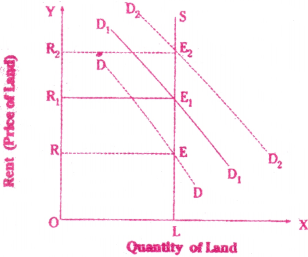
Theory of Distribution Questions and Answers AP Inter 1st Year Economics Chapter 7 5

In the above diagram, on X-axis, quantity of land is shown. On Y-axis, rent is shown. SL is the line which shows the supply of land, which is perfectly inelastic. DD is the line showing the original demand for land and original rent is OR. When demand for land has increased from DD to D1D1 and D1D1 to D2D2 rent has increased from OR to OR1 and OR1 to OR2.

Question 4.
What is a real wage and what are the factors that determine real wages?
Answer:
The term real wage, refers to the quantity of goods and services that can be purchased with given money wages. It is the money wage expressed in terms of general price level or purchasing power. Real wage is an important concept that determines the standards of living of the people. There is an inverse relationship between real wage and price level.

Determinants of Real Wages :

  1. Purchasing Power of Money: Whether real wage is higher or lower depends upon the purchasing power of money. An increase in the general price level, by lowering the purchasing of money, results in lower real wages and vice-versa.
  2. Method or Form of Payment: If the worker gets additional facilities like free housing, free transport, free medical facilities, etc. along with money wages, his real wage will be higher.
  3. Working Conditions: If workers are having good working conditions like more holidays, less hours of work, etc. their real wages will be higher.
  4. Possibility of Extra Earnings (Subsidiary Earnings) : In some occupations there is possibility or opportunity of having extra earnings. In such occupations, real wages will be higher.
    E.g : Government doctors earning through private practice.
  5. Regularity of Employment: If the employment is regular and permanent, real wage will be higher. But if employment is temporary and irregular, real wage will be lower.
  6. Future Prospects: In jobs where there are better future prospects like promotional opportunities, etc. real wages will be higher.
  7. Nature of Employment: Whether real wage is high or low depends upon the nature of work. If the job is a more dangerous, difficult and involves more risk, real wage will be less.
    E.g Pilots of aeroplanes, mining workers working underground, etc.
  8. Timely Payment: If workers are employed in those organisations where there is regular payment of wages, real wage tends to be high, even though money wages are very low.
  9. Social Prestige: Real wage tends to be very high if a person is employed in a job which carries a lot of social prestige.
    E.g : District Collector, Judge of a High Court, etc.
  10. Period of Education and Educational Expenses: Real wages are also influenced by length of education and amount of educational expenditure. Between two persons receiving the same amount of money wage, real wage of that person tends to be high who is less educated and incurred less expenditure on education.

Question 5.
Explain the concepts of Gross Profit, net profit and their components.
Answer:
Profit is the reward of the factor of production organisation or entrepreneur. It is the reward of the organiser for the risk and uncertainty incurred by him in the form of starting and running of a business.

According to Taussig, “Profit is a mixed and vexed income”. Hawley considers, “profit as a reward for risk bearing”. According to J.B. Clark “Profits are the reward for the dynamic role of entrepreneur”.

According to Prof. Knight, “Profits are the rewards for uncertainty”. There are two important concepts of profits.

1. Gross Profit: Normally, profit means gross profit. It is the difference between (excess of) total revenue and total cost of production.
Components of Gross Profit: Gross profit includes various components as given below.
Implicit rent, implicit wages, implicit interest, normal profit, depreciation charges, windfall gains or profits and net profits.
Gross Profit = Net profit + (Implicit rent + Implicit wage + Implicit interest + Depreciation charges + Insurance premium).

2. Net Profit: Net profit is the economic profit or pure business profit. It is the reward received by the entrepreneur for his entrepreneurial services alone.
Components of Net Profit: Net profit includes the following components. They are:
Reward for coordinating the services of factors of production, Reward for bearing risk and uncertainty, Reward for making innovations, Reward for bargaining the price of factors of production, etc.
Net Profit = Gross profit – (Implicit rent + Implicit wage + Implicit interest + Depreciation charges + Insurance premium).

Question 6.
Explain the concepts of gross interest, net interest and their components.
Answer:
Interest is the price paid for the use of capital. It is the reward paid to those who save and lend. In other words, it is the share of National Income that goes to the capitalists / capital.

According to Seligman, “Interest is the return from the fund of capital”. Keynes considers interest as “Purely monetary phenomenon”. According to him, interest is the “reward paid to the lender of money for parting with liquidity”. There are two types of interests. They are :

  1. Gross Interest,
  2. Net Interest.

1) Gross Interest : Generally, interest means gross interest. It is the actual amount paid by the borrower to the lender as the price or reward for funds borrowed. Gross interest includes not only net interest (price for the use of capital), but also the following elements.

Gross interest = Net interest + Reward for risk taking + Reward for inconvenience + Reward for management.

A) Net Interest : Net interest is the reward for the services of capital alone. Net interest is the interest paid on government bonds and government loans.

B) Reward for Risk Taking: Lending money always involves risk of non – repayment of loan by the borrower. These risks may be trade risks or business risks and personal risks. So, the capitalist charges some extra amount, in addition to the net interest to cover these risks. Greater the risk involved in lending the money, higher will be the rate of interest.

C) Compensation for Inconvenience : Lending of money always involves some inconvenience in making savings. In the same way, the lender may not get back his money when he requires it for his own use. So, the lender charges some extra amount to these inconveniences over and above the net interest. This is included in gross interest.0

D) Rewards for Management Services: A money lender has to incur the expenditure on maintaining records relating to loans, repayments, etc. He has to maintain office and clerical staff. Sometimes, he has to incur legal expenses for the recovery of loans. So, gross interest includes some extra amount to recover all such expenses in addition to other elements.

2) Net Interest : Net interest is the reward for the services of capital alone. It is the interest paid on government bonds and loans. It is the gross interest minus the total of payment for inconvenience, reward for management and insurance against risk.

Net Interest = Gross interest – (Reward for risk taking + Compensation for inconvenience + Reward for management).

Question 7.
Explain the concept of distribution.
Answer:
In Economics, the term distribution (theory of distribution) refers to the pricing of factors of production as well as the distribution of the total national income among the factors of production, which contributed to/made possible the production and National Income.

“Distribution accounts for the sharing of wealth produced by a community among the agents or owners which have been active in its production” – Chapman.

Distribution is of two types namely,

  • Functional Distribution
  • Personal Distribution.

Functional distribution is of 2 types, namely Micro Distribution and Macro Distribution.

Question 8.
Write the assumptions of MPT. (Marginal Productivity Theory).
Answer:
The theory is based on the following assumptions.

  1. There is perfect competition in the factor market.
  2. All the units of a factor are homogeneous and divisible.
  3. The theory assumes full employment of the factors.
  4. There is perfect mobility of the factors of production.
  5. Substitution is possible between the factors.
  6. The marginal productivity of an individual factor is measurable.
  7. The theory is based on the law of variable proportions.
  8. The theory is applicable only in the long run.

Question 9.
Explain the concepts of Productivity and Product.
Answer:
The product can be explained in physical units or monetary units (revenue/ value) as follows:

a) Marginal Physical Product (MPP) : MPP is the additional output obtained by using an additional unit of the factor of production.

MPP = TPPn – TPP(n-1)

b) Marginal Revenue Product (MRP) (or) Marginal Value Product (MVP): MRP is the additional revenue that a firm earns, when it employs an additional unit of the factor in production. It means the increase in the total revenue.

MRP = TRPn – TRP(n-1)

Value of Marginal product (VMP) : It is obtained by multiplying the marginal physical product (MPP) with the price of the product.

MVP or VMP = MPP × P

Under perfect competition, MRP and VMP are equal as the price remains constant. However, under imperfect competition, VMP > MRP.

c) Average Physical Product (APP) : It is the output per unit of factor of production. It is obtained by dividing the total physical product by the number of factor units employed.

APP = \(\frac{TPP}{No. of factor units}\)

d) Average Revenue Product (ARP) : ARP is the revenue per unit of the factor. It can be obtained by dividing the total revenue product by the number of factor units employed.

ARP = \(\frac{TRP}{No. of factor units}\) or APP × P

e) Average Factor Cost (AFC): AFC can be calculated by dividing the total factor cost by the total factor units employed.

f) Marginal Factor Cost (MFC): MFC is the additional cost incurred by employing an additional unit of a factor of production.

Question 10.
Write the criticism of J. B. Clark’s Marginal Productivity Theory.
Answer:

  1. There is no perfect competition in either the factor market or the commodity market.
  2. All the factor units are riot,homogeneous and divisible.
  3. All the factors are not fully employed.
  4. Perfect mobility is not possible for all factors of production.
  5. Substitution is not always possible between the factors.
  6. Marginal productivity is not solely the result of a singular factor alone.
  7. The theory neglects technological progress.
  8. The theory is not applicable in the short run.
  9. This theory considers only demand for a factor and ignores its supply.

Question 11.
Discuss briefly the assumptions of Ricardian Theory of Rent.
Answer:

  1. Land is a natural gift. It has no cost of production.
  2. Land supply is perfectly inelastic. It has indestructible powers of the soil.
  3. Land has no alternative use except cultivation.
  4. Land is heterogeneous i.e., it differs in fertility.
  5. Land is subject to the law of diminishing returns whenever it is cultivated.
  6. Land of the last grade has no rent i.e., such a land is marginal or ‘no rent’ land.
  7. Land’s soil differences generate rent under perfect competition in the economy.
  8. Land accrues rent in the long run and rent is determined by the price of the produce.

Question 12.
Briefly explain criticism of the Ricardian Theory of rent.
Answer:

  1. There is no perfect competition. In fact, perfect competition does not exist in agriculture.
  2. It assumes that land is restricted only to cultivation, but land has many other , uses.
  3. It is not always true that the best land is cultivated first.
  4. Rent also arises in the short run and in such cases price is determined by rent.
  5. The concept of no rent land is not true. Every land has some rent.
  6. Rent is not a payment solely for the use of land. In reality, rent is paid to all factors whose supply is inelastic.

Question 13.
What are the types of wages ? Explain them.
Answer:
Types of Wages :

  • Money Wages (or) Nominal Wages
  • Real Wages
  • Piece Wages
  • Time Wages

a) Money Wages : Money wages are also called nominal wages. Money wages refer to the amount of remuneration received by a labourer in terms of money for services rendered, whether physical or mental.

b) Real Wages : Real wages represent the purchasing power of money wages. They are expressed in terms of the goods and services a worker can buy with their money wages. Real wages are considered high when labourers can obtain a larger quantity of goods and services with their money income.

c) Piece Wages : Piece wages refer to payments made based on the amount of work completed by a labourer. Here, the skill and expertise of the labourers play a crucial role in determining their earnings. For example; a cobbler may be paid Rs.200 for manufacturing a pair of shoes or a painter may be paid Rs. 100 for painting one square meter of a wall.

d) Time Wages Time wages refer to payments made based on the duration of time worked, irrespective of the worker’s contribution to production. Wages may be paid daily, weekly, monthly, or yearly. For example, the basic salary of a bank employee is Rs. 50,000 per month.

Very Short Answer Questions

Question 1.
Contract rent.
Answer:
Generally, rent means the reward/price paid to the factor of production land. But contract rent means a periodical payment by the tenant/ user to the owners of durable goods for the use of durable commodities as per agreement or contract.
E.g: Monthly rent of a house, Hourly/ rent of a cycle, etc.

Question 2.
Economic rent.
Answer:
Rent is the price or reward paid to the factor of production, land, for its services in the production of goods and services. Economic rent is the reward paid to land, in terms of money.
It is of two types.

  1. Classical economic rent, introduced by Prof. David Ricardo,
  2. Modern economic/rent, like Scarcity rent, Quasi – rent, etc.

Question 3.
Scarcity rent.
Answer:
The concept of scarcity rent was introduced by Prof. Marshall. The supply of land is fixed or perfectly inelastic. In other words, there is scarcity of land with an increase in demand for land, the price of land increases/rises. The additional price or the rise in the price of land due to such scarcity of land is known as scarcity rent.

Question 4.
Quasi rent.
Answer:
The concept Quasi – rent was introduced by Prof. Marshall. In the short run, the supply of man – made appliances like ships, trucks, etc. is fixed or inelastic. In the short run, when the demand for them increases, they get additional income or a surplus. Such additional income derived from machines and other man-made appliances of production in the short run is called Quasi – rent. Quasi – rent appears/ exists only in the short run but disappears in the long run.

Question 5.
Transfer earnings.
Answer:
The term transfer – earnings refers to the excess or surplus amount which a factor of production.
E.g, a worker earns in the present use/employment over what he / it could earn in the. next best use.

Question 6.
Real wages.
Answer:
Real wage refers to the amount / quantity of goods that can be purchased with the money wage at any particular time. It is the money wage expressed in terms of purchasing power or general price level. It mainly depends upon the general price level. There is an inverse relationship between price level and real wage.

Question 7.
Loanable funds.
Answer:
The Loanable Funds are central to understanding how interest rates are set and how savings are channeled into productive investment in the economy. These are the money available in an economy for lending and borrowing, coming from sources like household savings, business profits, government surpluses and foreign investments.

Question 8.
Innovations.
Answer:
Innovation is central to business success, scientific progress and societal advancement. It enables organisations to stay competitive, adapt to change, and solve complex problems. Profits arise from the difference between price and production cost due to innovations. Entrepreneurs disrupt this equilibrium by introducing innovations, such as

  1. new goods,
  2. new methods of production,
  3. new markets,
  4. new sources of raw materials,
  5. industry organisation.

As a result of these innovations, the cost of production remains below and selling price, and thus profit arises.

Question 9.
Net interest.
Answer:
Interest is the price paid for the use of capital. Net interest is the reward paid for the use of capital alone. The interest paid on government bonds and government loans is called net interest.

It is the gross interest minus the total of payment for inconvenience, reward for management and insurance against risk.

Net Interest = Gross interest – (Insurance against risk + Compensation for inconvenience + Reward for management)

Question 10.
Net profit.
Answer:
Generally, profit means the reward or price paid to the factor or production entrepreneur “for his entrepreneurial abilities /functions.

Net profit is the reward earned by entrepreneur exclusively or purely for their entrepreneurial functions/ skills/abilities.

Question 11.
Piece wages.
Answer:
The wages paid according to (basing on) the work done by the worker are known as piece wages. This type of wages are paid when it is possible to measure the work done by the workers. When wages are paid according to piece rate system, efficient workers can earn more income /wages.
E.g.: If the piece rate for each unit produced is Rs. 10 each and if a worker produces 40 units in a day, the total piece wage earned by that worker is Rs. 400.

Question 12.
Time wages.
Answer:
The wage paid according to the period of time is called time wage. Time wages are paid either on daily, weekly, monthly, or yearly basis. Such wages are paid, when it is not possible to measure the output of the workers. Time wages will be uniform irrespective of the efficiency of the workers.

One Word Answer Questions

Answer the following questions in ONE WORD.

Question 1.
Who said that rent is the difference between superior land and interior land?
Answer:
David Ricardo

Question 2.
Which theory of wages is formed as the Iron Law of wages?
Answer:
Subsistence Theory of rent

Question 3.
How does the interest rate react to the fall in bond prices?
Answer:
Increase or rise

Question 4.
Which term is substituted for abstinence by Marshall in the Nashau Senior abstinence theory of interest?
Answer:
Waiting

Question 5.
Who classified risks as foreseen insurable, and unforeseen, non-insurable risks?
Answer:
Prof. Knight

Fill in the blanks

Question 1.
The Law of ______________ is the base for Marginal Productivity Theory operating under perfect competition.
Answer:
Diminishing Marginal Returns

Question 2.
According to Mrs. Joan Robinson, rent is the surplus earned by a factor over the above its ______________
Answer:
Transfer earnings

Question 3.
According to Keynes the ______________ is determined by the interaction of a perfectly inelastic money supply curve and a downward-sloping liquidity preference curve.
Answer:
Interest Rate

Question 4.
According to Walker, a worker is a ______________ claimant.
Answer:
Residual

Question 5.
According to Schumpeter, net profit is the reward paid for an entrepreneur’s ______________ skills.
Answer:
Innovation

Multiple Choice Questions

Question 1.
According to the modern theory of rent, rent accrue to :
1) Land only
2) Capital only
3) Any factor of production
4) Labour only
Answer:
3) Any factor of production

Question 2.
If the marginal revenue product is greater than the factor cost, the firm should hire.
1) Fewer factors
2) More factors
3) The same factors
4) All of the above
Answer:
2) More factors

Question 3.
The return to a man-made appliance due to a fixed supply in the short period is called :
1) Quasi rent
2) Contract rent
3) Economic rent
4) Scarcity rent
Answer:
1) Quasi rent

Question 4.
Find the incorrect match :
1) Dynamic Theory of profit – J.B. Clark
2) Risk Theory of profit – Prof. Hawley
3) Modern Theory of Wages – Prof. Knight
4) Wages Fund Theory – J.S. Mill
Answer:
3) Modern Theory of Wages – Prof. Knight

Question 5.
Which of the following is not a determinant of the supply of loanable funds?
1) Savings
2) Investment
3) Bank Credit
4) Dishoarding
Answer:
2) Investment

AP Inter 1st Year Economics Study Material
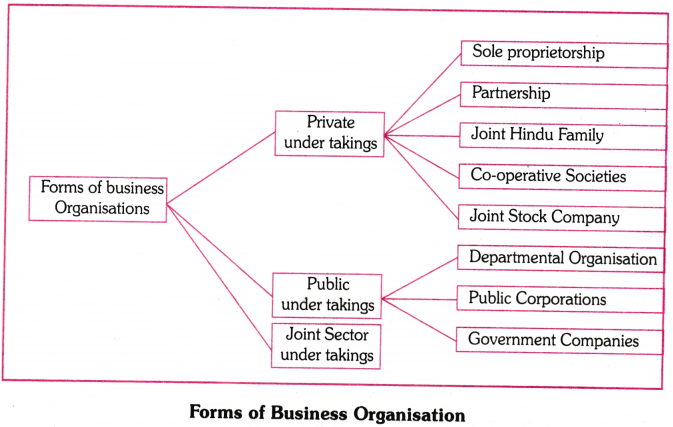
Market Structure Questions and Answers AP Inter 1st Year Economics Chapter 6

AP Inter 1st Year Economics 6th Lesson Market Structure Questions and Answers

Essay Questions

Write an essay on the following questions.

Question 1.
Describe the classification of the markets.
Answer:
The term market, generally refers to a place, where buyers and sellers meet and where; exchange or buying and selling of goods take place.

According to Benham, market can be defined as “Any area over which buyers and sellers are in such arrangement (close touch) with each other directly or through dealers, so that the price obtainable in one part of the market affect the price paid in other parts’’.

Classification of markets:

1. Basing on Competition :

a) Perfect markets : Perfect markets are those markets where there are conditions of perfect competition, like large number of buyers and sellers, homogeneous good, uniform or single price, etc.

b) Imperfect markets : Imperfect markets are those markets where there are conditions of imperfect competition, like single / two / few sellers, differentiated products, different prices, etc.

2. Basing on Area :

a) Local market: A market with few sellers and few buyers covering a limited geographical area with limited demand and limited supply is called local market. Eg : Village market for perishable goods like milk, vegetables, etc.

b) National market : A market with sellers and buyers spread/located throughout the country and with demand and supply spread throughout the country is known as national market. Eg: Market for durable goods like sugar, wheat, cotton, etc.

c) International market : A market with demand and supply spread throughout the world and purchases and sales taking place with global buyers and global sellers, at international level is known as international market or global market.

3. Basing on Time :

a) Very short period market: It is a market relating to very short period time (less than 1 day) in which supply is absolutely fixed or constant. In this market, demand plays, all or very important role in the fixation of price in the market.

b) Short period market: It is a market relating to short period (covering a time period of more than 1 day, but up to 1 year) of time. In this market, supply can be changed partially by making changes in variable inputs. In this market, in the fixation of price demand plays greater role than supply.

c) Long period market: It is a market covering / relating to a long period of time (covering a time period of more than 1 year) in which supply can be fully adjusted by making changes both in fixed inputs and variable inputs. In this market, in the fixation of price, supply plays more important role than demand.

Question 2.
Explain the market equilibrium with the help of a diagram.
Answer:
Equilibrium is a state of rest, in which there is no tendency to change. It does not mean that there is no activity or movement, but the forces are in balance. Market equilibrium can therefore be defined as a state in which neither the sellers have a tendency to increase or decrease supply nor the buyers have a tendency to increase or decrease demand. In other words, market supply equals market demand.

The market supply refers to how much of the commodity, firms would wish to supply at different prices, and the market demand refers to how much of the commodity, the consumers would be willing to purchase at different prices.

The price at which market demand is equal to the market supply is called ‘equilibrium price’ (also called as market clearing price) and quantity bought and sold at this price is called ‘equilibrium quantity’.

The following table and diagram helps to understand the market equilibrium.

Table : Demand and Supply Schedule
Price (Rs.) Quantity Demanded (kgs) Quantity Supplied (kgs)
10 500 100
20 400 200
30 300 300
40 200 400
50 100 500

From table, we can understand that the market attains equilibrium at Rs.30 because at this price, market demand is equal to the market supply. Hence, the price, Rs. 30 in the table is called ‘equilibrium price’ (or) ‘market clearing price’. The quantity of 300 kgs at equilibrium price is called equilibrium quantity. If the price above the equilibrium price, there will be an ‘excess supply’, and if the price below the equilibrium price, there will be an ‘excess demand’. This can be shown in the figure. Such imbalance is called disequilibrium.

Equilibrium, Excess Demand and Excess Supply:

Market Structure Questions and Answers AP Inter 1st Year Economics Chapter 6 1

Figure illustrates equilibrium for a perfectly competitive market with a fixed number of firms.

Equilibrium occurs at the intersection of the market demand curve (DD) and market supply curve (SS). The point ‘E’ is the equilibrium point. Here, the equilibrium quantity is OQ and the equilibrium price is OP. The price greater than equilibrium price (OP), there will be an ‘excess supply’, and at a price below the equilibrium price (OP), there will be an ‘excess demand’ as shown in figure.

Question 3.
Analyse the equilibrium of a firm and industry in the long run under perfect competition.
Answer:
Equilibrium of the Industry : An industry consists of a large number of independent firms. Industry is said to be in equilibrium, if there is no tendency for new firms to enter and existing firms to exit. This situation prevails if all industries earn only normal profits. If some firms earn super normal profits, the new firms may enter. If any firms are incurring loss, some firms may choose to exit.

Market Structure Questions and Answers AP Inter 1st Year Economics Chapter 6 2

From the figure, we can see that point ‘E’ is industry demand and supply curves intersect. At this point, OP is the equilibrium price and OQ is the equilibrium quantity.

An industry is not in equilibrium, if some firms earn normal profits and other firms earn supernormal profits or losses.

Equilibrium of the Firm :
A firm is said to be in equilibrium when it maximizes its profit. The output which gives maximum profit to the firm is called equilibrium output or profit maximising output. In this state, the firm has no incentive to either increase or decrease its output.

Firms in a perfectly competitive market are price-takers and industry is a price maker. This is because, there are a large number of firms in the market producing identical (homogeneous) products. No single firm is able to influence the price determined by the industry. So that, firms have to accept the price determined through the interaction of total demand and total supply of the commodity which they produce. In other words, it is the market demand and market supply that determine the price. This is the equilibrium price. All firms accept this price and determine the quantity of their product. Firms do not determine the price.

Equilibrium conditions of a firm :

  1. Marginal Cost is equal to Marginal Revenue (MC = MR).
  2. Marginal Cost (MC) curve should cuts Marginal Revenue (MR) curve from the below. That means, MC curve has a positive slope.

Market Structure Questions and Answers AP Inter 1st Year Economics Chapter 6 3

From the figure, the market price OP is fixed through the interaction of total demand and total supply of the industry. Firms have to accept this price as given and as such they are price-takers rather than price-makers. AR and MR are equal. AR = MR curve is the Demand Curve (AR) which is parallel to horizontal axis.

In the adjacent figure, firm attained the state of equilibrium at point ‘R’, where the MC curve is cutting the MR curve from below and where MC = MR.

MC = MR at point T also, where the MC curve cuts MR curve from above. If the firm stops output at this point, it will be losing opportunity to maximize its profits because MR > MC beyond T (OQ1 output).

Question 4.
Compare and contrast the different Market Structures under Imperfect Competition.
Answer:

Features Monopoly Monopolistic Competition Oligopoly Duopoly
Number of firms. Single seller Many buyers and sellers Few dominant sellers Two dominent sellers.
Product differentiation No close substitutes Slight differentiation Many other homogeneous (or) differential products Can be homogeneous or differentiated.
Price control Complete, with prices set well above marginal cost. Limited ability to set prices due to substituted produces. Significant, often through collusion or strategic interdependence. High, with firms often mirroring each other’s pricing strategies.
Barriers to entry Insurmountable Low, allowing new firms to enter easily. High due to economies of scale. Extremely high as incumbents dominate the market.
Examples Utility companies (Water, electricity) patented pharmaceuticals Restaurants, clothing brands, coffee shops. Airline industry, tele-communications, automotive manufacturers. Boeing and Airbus in commercial Aircraft.
Economic impact Allocative inefficiency, as output is lower and prices higher than socially optimal. Firms operate with excess capacity in the long run leading to higher prices than perfect competition but lower than monopolies. Prices are higher than in monopolistic competition, with profits sustained through cartel like behaviour.

Question 5.
Write the features of Perfect Competition.
Answer:
Features of Perfect Competition : A market is said to be operate under perfect competition, when it has the following characteristic features:

  1. Large number of buyers and sellers : There must be a large number of buyers and sellers, so that any seller, or any buyer will not be able to influence the market price. The price of the product is determined by the collective forces of market demand and market supply.
  2. Homogeneous products : In perfect competition, the product of each firm produces a homogeneous product meaning, all products are identical in size, shape, quantity, quality and packaging. As a result, a single price prevails in the industry.
  3. Free entry or exit of firms : In this market, any firm can enter or exit the industry at will. This helps new firms to enter business when conditions are favourable. As long as a firm earns supernormal or normal profits, it stays in competition. But, when a firm incur losses, it would leave the market.
  4. Perfect mobility of factors of production : In this market, factors of production are free to move from one firm to another firm as per their desire. This is also useful for free entry and exit of firms. Factors of production (land, labour, capital) are free to move to the production activities where they get higher incomes.
  5. Absence of transport costs : Transport costs do not effect the prices of the commodities. Due to this, the price of the commodity will be the same throughout the market.
  6. Perfect market knowledge : It is assumed that both buyers and sellers have perfect knowledge of market conditions. Every buyer and seller knows the price of the product. In the absence of perfect knowledge, it is possible that some buyers may buy the commodity at higher prices when the same product is available at lower price.
  7. Profit maximisation : The primary goal of every firm is to maximise profits.
  8. No regulation by government: Government does not interfere in the market through price regulation, subsidies, or other means that could distort competition between firms.

Question 6.
Write about the concepts of Normal Profit and Super Normal Profit.
Answer:
Concepts of Normal Profit and Super Normal Profit : If the average revenue and average cost of the firm are equal, it earns normal profits. If average revenue is more than average cost, the firm earns supernormal or abnormal profits. If the average cost is more than average revenue, the firm incurs losses. This is shown in below diagrams.

Short run equilibrium – Super normal profits, normal profits and losses: Inperfect competition, even though all firms are following uniform price fixed by the industry, some firms enjoy with the supernormal profits, some firms may earn just normal profits and some other may incur losses. This is mainly due to differences in the firm’s cost conditions. This is explained with the help of the following figures.

1. Firm earning Super Normal Profits (AR > AC): A firm Y may earn supernormal profits or normal profits or incur losses in the short run. This is shown in figures.

Market Structure Questions and Answers AP Inter 1st Year Economics Chapter 6 4

The figure depicts, the firm is in equilibrium at point ‘E’ where marginal revenue is equal to marginal cost (MC = MR). OQ is the equilibrium output for the firm. At this level of output, the average revenue (or) price per unit is EQ and average total cost is BQ. The firm’s profit per unit is EB (AR – ATC). Total profit is ABEP. (EB × OQ; OQ = AB). Applying the principle, Total Profit = TR -TC, we find totalprofit as the difference between OPEQ and OABQ which is equal to ABEP. It represents supernormal or abnormal profits.

2. Firm earning Normal Profits (AR = AC): The figure, shows that the firm attained equilibrium at point ‘E’, where it’s MR = MC. The equilibrium output is OQ. At this level of output, price or AR covers full cost (ATC). Since AR = ATC (or) OP = EQ, the firm is just earning normal profits. Applying TR – TC, we find that TR – TC = zero (or) there is zero economic profit (or) no profit and no loss.

Market Structure Questions and Answers AP Inter 1st Year Economics Chapter 6 5

3. Firm incurring Losses (AR < AC): In the short run, some perfectly competitive firms may incur losses even at equilibrium state (MC=MR). But the firm try to minimise the losses so as to stay on the business. For all prices above the minimum point on the AVC curve, the firm will stay open and will produce the level of output at which MR = MC. When the firm is able to meet its variable cost and a part of fixed cost, it will try to continue production in the short run.

Market Structure Questions and Answers AP Inter 1st Year Economics Chapter 6 6

In the figure, point ‘E’ is the equilibrium point. At this point, the firm’s average total cost (ATC) curve lies above the firm’s average revenue (AR) curve and incurring a loss per unit worth of BE. Because, at this point, AR = EQ and ATC = BQ.

Question 7.
Explain price determination under perfect competition in long run.
Answer:
Equilibrium of a Competitive Firm : All perfectly competitive firms are in equilibrium in the long run when they have adjusted their plant so as to produce at the minimum point of their long run ATC curve, which is tangent to the demand curve defined by the market price.

Market Structure Questions and Answers AP Inter 1st Year Economics Chapter 6 7

In the long run, all firms will be earning just normal profits, which are included in the ATC. If they are making supernormal profits in the short run, new firms will enter the industry. This will lead to an increase in supply and a fall in price (a downward shift in the individual demand curves) and an upward shift of the cost curves due to an increase in the prices of factors as the industry expands. New firms enter until all firms earn only normal profits. These changes will continue until the ATC is tangent to the demand curve (AR curve) at its minimum point. If the firms make losses in the short run, they will leave the industry in the long run. This will decrease supply and raise the price and costs may fall as the industry contracts. Exit of firms continue till all firms losses disappear and even firm get only normal profits.

The condition for long run equilibrium of the firm is that the marginal cost should be equal to the price and the long run average cost i.e.,

LMC = LAC = P.

The firm adjusts its plant size so as to produce that level of output at which the LAC is at its minimum position. At equilibrium, the short-run marginal cost is equal to the long run marginal cost and the short run average cost is equal to the long run average cost. Thus, in the long run we have,

SMC = LMC = SAC – LAC = P = MR

Short Answer Questions

Write the answers briefly for the following questions.

Question 1.
Discuss the features of perfect competition with reference to price determination.
Answer:
Perfect competition is a theoretical market structure characterized by specific features that collectively ensure prices are determined solely by supply and demand.

Reference to Price Determination :

Equilibrium Price : The intersection of the market demand and supply curves determines the equilibrium price. At this price, the quantity demanded equals the quantity supplied, eliminations shortages or surpluses,

  1. Demand Curve : Slopes downward, reflecting higher quantity demanded at lower prices.
  2. Supply curve : Slopes upward, indicating higher quantity supplied at higher prices.

Role of Firms as Price Takers: Individual firms adjust output to the equilibrium price but can’t set prices. For example, a wheat farmer must sell at the market price: changing more would drive buyers to competitors.

Long-run Adjustments :

  • Supernormal Profits : Attract new firms, increasing supply and lowering prices until profits normalize.
  • Losses : Cause firms to exit, reducing supply and raising prices until losses are eliminated.

In the long run, price equal to MC and ATC, ensuring efficient production.

Question 2.
Compare Perfect Competition and Monopoly.
Answer:

Perfect Competition Monopoly
1. Large number of sellers. 1. Single seller exists in the market.
2. Free entry and free exit of firms. 2. Restrictions on the entry of new firms.
3. Homogeneous product. 3. No close substitutes to the product.
4. Difference between industry and firm. 4. Both industry and firm are the same.
5. Industry is a price maker and firms are price takers. 5. Monopolist is a price maker.
6. Uniform price prevails for the same good. 6. Price distrimination is possible.
7. Price, AR and MR are the same and the curve is parallel to the OX-axis. 7. AR and MR curves are different and slope downwards from left to right.

Question 3.
Explain the concepts of Price Floor and Price Ceiling.
Answer:
Price Floor:
When the government imposes lower limit on the price that may be charged for a particular good or service, it is called a ‘price floor’. The most well-known examples of the imposition of price floors are agricultural price support programmes and the minimum wage legislation. Through agricultural price support programmes, the government imposes a lower limit on the purchase price for some agricultural goods. The price floor is normally set above the market determined price for these goods.

Market Structure Questions and Answers AP Inter 1st Year Economics Chapter 6 8

Price Ceiling:
When the government imposes an upper limit on the price of a good or service, it is called a ‘price ceiling’. A price ceiling is generally imposed on ‘essential items’ like wheat, rice, kerosene, and sugar. Price ceiling is fixed below the market-determined price if it is high. Since low income sections of the population will not be able to afford these goods at the market price.

Market Structure Questions and Answers AP Inter 1st Year Economics Chapter 6 9

Question 4.
What are the feature of Monopoly ? Explain the price determination under monopoly.
Answer:
Monopoly Features :

  1. A single firm produces the good in the market.
  2. No close substitutes for this good.
  3. Strong barriers exist for the entry of new firms into market, which means that there is no competition.
  4. Both industry and firm are one and the same.
  5. Monopolist determines the price (Price maker).
  6. The degree of Monopoly power depends on the price elasticity of demand, it is relatively high.
  7. Producer controls either the price of the good or the supply of the good. But he cannot control both simultaneously.
  8. The demand curve of a monopoly firm slopes downward from left to right, because the demand is relatively inelastic. This is because, there are no close substitutes.
  9. The monopolist practices price discrimination by charging different prices from different buyers to increase profits.
    This practice depends on the differences in elasticity of demand.

Price Determination : Fig. shows the equilibrium of a monopoly firm. AR and MR are downward sloping curves. The firm reaches its equilibrium when MC = MR. ‘E’ is the equilibrium point. OP is the equilibrium price, and OQ is the equilibrium output.

Market Structure Questions and Answers AP Inter 1st Year Economics Chapter 6 10

In the short-run a monopoly firm may earn supernormal profits or losses. But it earns only super normal profits in the long-run.

Question 5.
Define Monopolistic competition and write its features.
Answer:
In real world we rarely find perfect competition and monopoly. In the majority of cases, there is neither a single individual who controls the total supply, nor many sellers so that their individual shares are negligible in relation to the total supply of the market. Thus, the real situation is one of imperfect competition, where there is neither perfect competition nor absolute monopoly. This market situation is known as ‘Monopolistic Competition.
Eg.: Smart phones, soft drinks etc.

Prof. E. H. Chamberlin and Mrs. Joan Robinson pioneered this market analysis in economics. According to Chamberlin, the important characteristics of monopolistic competition are as follows:

Features:

  1. Large number of buyers and sellers.
  2. Product differentiation (Heterogeneous product).
  3. Freedom of entry and exit of firms.
  4. Competitive advertising (or) selling costs.
  5. Downward sloping and more elastic demand curve due to availability of close substitutes.
  6. Non-price competition.
  7. Normal profits in the long-run and finds the excess capacity.
  8. Relatively low degree of monopoly power.
    This market is discussed in detail in higher classes.

Question 6.
Write the features of Oligopoly.
Answer:
Features :

  1. Very few sellers of the product.
  2. Interdependence of firms in decision making.
  3. Presence of monopoly power.
  4. Existence of price rigidity.
  5. Excessive expenditure on advertisement.
  6. Indeterminate demand curve due to high degree of interdependence among firms.
  7. Group behaviour.

Question 7.
Define the term Duopoly and write its features.
Answer:
Duopoly is a special form of oligopoly, where only two sellers produce the goods. It is also caracals a limited form of oligopoly. The goods produced by the producers may be homogenous or differentiated. As there are only two producers, both are aware that the decisions of one will affect the other. Rivalry and collusion of the producers are both possible in this market situation.

Features:

  1. Only two firms (sellers) of the product.
  2. Strategic interdependence.
  3. High level of market concentration.

Very Short Answer Questions

Question 1.
Normal Profits.
Answer:
If the average revenue and average cost of the firm are equal, it means normal profit. It is considered part of businesses total costs and is essential for long term sustainability, especially in perfectly competitive markets when, in the long run, firms tend to make only normal profit.

Question 2.
Equilibrium conditions of a firm under perfect competition.
Answer:

i) Condition Equilibrium Rule Short Run MC = MR = P Long Run MC = MR = P = (Min ATC)
ii) Profit Level zero, or negation Can be positive, Zero (normal profit)
iii) Entry / Exit Not possible Free entry and exit.

These conditions ensure that under perfect competition, each firm produces at the most efficient scale and has no incentive change its output or leave / enter the market.

Question 3.
Discriminating monopoly.
Answer:
A discriminating monopoly is a type of monopoly where a single firm dominates the market and changes different prices for the same product or service to different consumers or market segments, not based on cost differences but on consumers, willingness on ability to pay. This practice is also known as price discrimination. The main purpose of discriminating monopoly is to increase profits by extracting more consumer surplus.

Question 4.
Selling costs.
Answer:
Selling costs mean the costs incurred by business firms towards attracting customers and for the sale of the goods.
Eg : Advertising and publicity costs, free sampling, etc. Selling costs are very important in monopolistic competition and in oligopoly where there is severe or intense competition among the firms.

Question 5.
Duopoly.
Answer:
A market where there are two sellers or firms is known as duopoly. As there are only two firms in the market, each firm or seller will have comparatively large share in the market. In duopoly, there is close interdependence between firms and a lot of uncertainty in the behaviour of sellers.

Question 6.
Oligopoly.
Answer:
A market where there are few sellers (3 or 4 firms or sellers) is known as oligopoly. Such firms may produce either homogeneous good or differentiated product. There is severe competition and close interdependence among the firms in the market. There is a lot of uncertainty among the firms in the market.

Question 7.
Break even point.
Answer:
BEP is the level at which a businesse’s total revenue exactly equals its total costs (both fixed and variable), resulting in neither profit nor loss. At this point, a company has covered all its expenses, and any sales beyond this point generate profit. The BEP is where business covers all costs with zero profit or loss and is of a fundamental measure for business management.

Question 8.
Shut down point.
Answer:
In short-run, the firm continues to produce as long as the price (AR) remains greater than or equal to the minimum of AVC (AR > AVC). When the firm’s Average Revenue (AR) is less than Average Cost (AC) and equal to Average Variable Cost, it is continues to operate with losses. This situation is known as the shut down point, (AR = AVC).

Question 9.
Price ceiling.
Answer:
When a government imposes an upper limit on the price of a good or service it is called a price ceiling. It is generally imposed on essential items like wheat, rice, kerosene, and sugar. It is fixed below the market determined price if it is high. Low income people will not be able to afford these goods at the market price.

Question 10.
Price floor.
Answer:
When the government imposes lower limit on the price that may be changed for a particular good or service it is called a price floor. The most well known examples of the imposition of price floors are agricultural price support programmes and the minimum wage legislation.

One Word Answer Questions

Answer the following questions in ONE WORD.

Question 1.
The Average Revenue (AR) curve is also known as :
Answer:
Demand Curve

Question 2.
The firm’s demand curve in perfect competition is :
Answer:
Parallel to X axis (Horizontal)

Question 3.
Imposing upper limit on the price of good or service by the government is called:
Answer:
Price ceiling

Question 4.
When there is decrease in demand with unchanged supply of a good then equilibrium price?
Answer:
Decrease

Question 5.
In the long run, the industry is in equilibrium when all the firms in a perfectly competitive market earn :
Answer:
Normal Profits

Fill in the blanks

Question 1.
When average revenue is equals to Rs.20/- and average cost is equals to Rs. 15/- then the firm makes ___________ profits.
Answer:
Super normal

Question 2.
No close substitutes is a feature of a ___________ market.
Answer:
monopoly

Question 3.
P = AR = MR is a feature of a ___________ market structure.
Answer:
Perfect competition

Question 4.
‘Indeterminate demand curve’ is a feature of a ___________ market.
Answer:
Oligopoly

Question 5.
A point on supply curve at which firm earns only normal profit is called the ___________ point.
Answer:
Break even

Multiple Choice Questions

Question 1.
The price at where market demand is equal to market supply is known as :
1) Short run Price
2) Long run Price
3) Normal Price
4) Equilibrium Price
Answer:
4) Equilibrium Price

Question 2.
As shut-down point :
1) AR = AC
2) AR > A VC
3) AR < AVC
4) AR = AVC
Answer:
4) AR = AVC

Question 3.
Which of the following is not a feature of Monopoly?
1) One buyer and one seller
2) No close substitutes
3) One seller and many buyers
4) Full control over price by the seller
Answer:
1) One buyer and one seller

Question 4.
The condition of equilibrium of a firm in perfect competition is:
1) Average Revenue = Average Cost
2) Marginal Revenue > Marginal Cost
3) Average Revenue – Average Variable Cost
4) Marginal Revenue = Marginal Cost
Answer:
4) Marginal Revenue = Marginal Cost

Question 5.
Break-Even Point is a situation, where firm is in:
1) Profit
2) Loss
3) No profit and no loss
4) Can’t say anything
Answer:
2) Loss

AP Inter 1st Year Economics Study Material

Cost and Revenue Analysis Questions and Answers AP Inter 1st Year Economics Chapter 5

AP Inter 1st Year Economics 5th Lesson Cost and Revenue Analysis Questions and Answers

Essay Questions

Write an essay on the following questions.

Question 1.
Explain the different short-run cost structure of a firm.
Answer:
In the short run, a firm’s cost structure can be broken down into several key components. It is important to understand these different types of costs of analyze a firms profitability and decision-making. Here are the main short-run cost concepts.
1. Fixed Cost (FC):
These are costs that do not change with the level of output in the short run. They remain constant regardless of whether the firm produces a lot, a little, or even nothing at all. These are associated with the firm’s fixed factors of production, such as plant and equipment and contractual obligations.
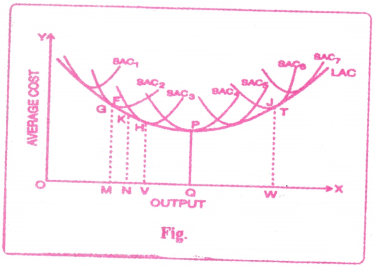
Eg: Rent for building and land, salaries of permanent staff.

2. Variable Costs (VC) :
These are costs that change directly with the level of output. As the firm produces more, its variable costs increase, as it produces less they decrease. If the firm produces nothing, its variable costs are zero.
Eg: i) Cost of raw-materials.
ii) Wages of temporary (or) hourly workers.

3. Total Costs (TC):
This is the sum of all costs incurred by a firm in producing a certain level of output. It is the combination of total fixed costs and total variable costs.
TC = TFC + TVC
Since fixed costs remain constant in the short run, changes in total cost are solely driven by changes in variable costs as output levels fluctuate.

4. Average Fixed Costs (AFC) :
This is the fixed cost per unit of output. It is calculated by dividing total fixed cost by the quantity of output (Q).

The formula for Average Fixed Cost = AFC = \(\frac{FC}{Q}\). AFC decreases as output increases because the constant total fixed cost is spread over a larger number of units. This results in a downward sloping AFC curve.

5. Average Variable Cost (AVC) :
This is the variable cost per unit of output. It is calculated by dividing total variable cost by the quantity of output (Q).
The formula for Average Variable Cost = AVC = \(\frac{VC}{Q}\).

The AVC curve is typically U shaped. Intially, as output increases, AVC may fall due to increasing efficiency. However beyond a certain point, as variable factors become less productive (due to the law of diminishing returns) AVC starts to rise.

6. Average Total Cost or Average Cost (ATC or AC) :
This is the total cost per unit of output. It can be calculated in two ways:

  • Dividing Total Cost by the quantity of output, ATC = \(\frac{TC}{Q}\).
  • Adding Average Fixed Cost and Average Variable Cost.
    ATC = AFC + AVC

The ATC curve is also typically U-shaped. It reflects the combined influence of the falling AFC and the U-shaped AVC. ATC falls initially as AFC decreases rapidly, but eventually rises as the increase in AVC outweighs the decrease in AFC. The minimum point of the ATC curve represents the most efficient level of production in the short run.

7. Marginal Cost (MC) :
It is the additional cost incurred by producing one more unit of output. It measures the change in total cost resulting from a one-unit change in quantity. The formula for MC = \(\frac{\Delta \mathrm{TC}}{\Delta \mathrm{Q}}\).

Since fixed costs do not change with output, marginal cost is also equal to the change in total variable cost resulting from a one unit change in quantity.

MC = \(\frac{\Delta \mathrm{VC}}{\Delta \mathrm{Q}}\)

The MC curve is also typically U-shaped. It initially falls due to increasing marginal returns but eventually rises due to diminishing marginal returns. TheMC curve insects both the AVC and ATC curves at their minimum points.

Question 2.
Compare the relationship between AR and MR under perfect competition and imperfect competition.
Answer:
In Economic returns, the relationship between AR and MR varies significantly depending on the market structure specifically between perfect competition and imperfect competition.

Perfect Competition : In a perfectly competitive market, firms are price takers, meaning they have no control over the market price. The market price is determined by the interaction of supply and demand. Under these conditions ;

AR : The AR is equal to market price. This is because each unit sold fetches the same price, and thus, the total revenue divided by the number of units sold is the market price.

MR : The marginal revenue is also equal to the market price. This is because selling an additional unit does not affect the price, and the revenue from the additional unit is the same as the market price.
So, AR = MR = Price

Table : Revenue under Perfect Competition (in Rs.)
Output Price Total Revenue Average Revenue Marginal Revenue
1 10 10 10 10
2 10 20 10 10
3 10 30 10 10
4 10 40 10 10
5 10 50 10 10
6 10 60 10 10

Cost and Revenue Analysis Questions and Answers AP Inter 1st Year Economics Chapter 5 1

Cost and Revenue Analysis Questions and Answers AP Inter 1st Year Economics Chapter 5 2

It is clear from the table and diagrams that the total revenue increases with an increase in quantity. When there is no change in price, average revenue remains the same. Marginal revenue is equal to the average revenue is fig. TR curve slopes upwards with a constant slope. Since, AR = MR it is the same curve which are horizontal and parallel to OX-axis. The AR curve is called Demand Curve.

Imperfect Competition : In Imperfect competition, which includes monopolistic competition and oligopoly, firms have some degree of market power and can influence the price of their products. This leads to a different relationship between AR and MR.

AR : The AR is the price at which the firm sells its products. However, to sell more units, the firm must lower its price, which affects the AR.

MR : The MR is less than the AR. This is because to sell an additional unit, the firm must lower the price on all units sold, not just the additional unit. Therefore, the revenue from the additional unit is less than the price of that unit.

MR < AR

Table (in Rs.)
Output Price Total Revenue Average Revenue Marginal Revenue
1 10 10 10 10
2 9 18 9 8
3 8 24 8 6
4 7 28 7 4
5 6 30 6 2
6 5 30 5 0
7 4 28 4 – 2
8 3 24 4 – 4

Cost and Revenue Analysis Questions and Answers AP Inter 1st Year Economics Chapter 5 3

The table and diagrams (figures) reveals that as price falls, sales may improve and total revenue also increases gradually. Hence, the TR curve initially increases, reaches its maximum at a certain level of output and then falls after reaching its maximum. So that the shape of TR curve takes an “inverted U” shape. On the other hand, as the price falls, average revenue and marginal revenue decrease. Hence, the AR and MR curves slope, downwards and MR curve lies below the AR curve. It is to be noted that MR can be zero or even negative, but AR cannot be zero.

Relationship between TR and MR:

  1. When TR increases MR falls.
  2. When TR reaches its maximum (or) remains constant, MR becomes zero.
    (The slope of TR = 0).
  3. When TR decreases, MR becomes negative.

Question 3.
Discuss the Long-run Cost Curves with a suitable diagram.
Answer:
Shape of Long run Cost Curves :

Let us check how the LRMC curve looks like. For the first unit of output, both LRMC and LRAC are the same. Then, as output increases, LRAC initially falls, and then, after a certain point, it rises. As long as average cost is falling, marginal cost must be less than the average cost. When the average cost is rising, marginal cost must be greater than the average cost. LRMC curve is a ‘U’-shaped curve. It cuts the LRAC curve from below at the minimum point of the LRAC. This is shown in Fig. (a)

Long-run average cost curve:

The long run average cost curve (LAC) is a smooth curve enveloping all short-run average cost curves (SACs). The LAC is drawn as tangent to each of the SACSs. The long run average cost curve (LAC) is called ‘planning curve’, ‘boat shaped curve’ and ‘envelope curve’. Whereas, the short- run average cost curves (SACs) are called ‘plant curves’.

When LAC is declining, it is tangent to the falling portions of SACs and when LAC is rising, it is tangent to the rising portions of SACs. Hence, the LAC is a “U” shaped curve. The behaviour of LAC depends upon the “Law of returns to scale” (fig.(b)).

Cost and Revenue Analysis Questions and Answers AP Inter 1st Year Economics Chapter 5 4

Cost and Revenue Analysis Questions and Answers AP Inter 1st Year Economics Chapter 5 5

Question 4.
Discuss the short-run Cost Curves with a suitable diagram.
Answer:
Short-run Total Costs – Graph :
These are, total fixed cost (TFC), total variable cost (TVC) and total cost (TC) curves for a firm. Total cost is the vertical sum of total fixed cost and total variable cost.

Cost and Revenue Analysis Questions and Answers AP Inter 1st Year Economics Chapter 5 6

In the figure, output is measured on OX – axis and costs on OY-axis. Since total fixed cost remains constant at all levels of output in the short-run, TFC curve is a horizontal line and parallel to the OX-axis. On the other hand, TVC curve rises along with the level of output. It starts from origin and slopes upwards to the right. The sum of TC curve and TVC curve is rise with the level of output and slopes upwards to the right. TC and TVC curves are parallel to each other as the difference is the same (TFC).

Short run Average Costs :

Cost and Revenue Analysis Questions and Answers AP Inter 1st Year Economics Chapter 5 7

Fig. shows the average and marginal cost curves. It may be observed that AFC falls from downwards left to right continuously. The fall is steep in the beginning but flatter later. The AFC curve is convex to origin. This curve is a rectangular hyperbola. It is because at any point on the curve multiplication of the AFC by the number of output units gives fixed value.

Both ATC curve and the AVC curve fall upto a point and rise later. The curves are ‘U’-shaped cost curves. It may be observed that ATC curve is above the AVC curve and the distance between the two keeps declining. Because it represents the AFC which continuously declining, MC curve is also a U-shaped cost curve. It cuts both ATC and AVC from below at their minimum (lowest) points.

Short Answer Questions

Write the answers briefly for the following questions.

Question 1.
Briefly explain the various concepts of costs.
Answer:
The following are the various concepts of costs.

  1. Explicit Costs : These are actual monetary payments made for resources like wages, rent and materials.
    Eg: Rent for the factory building
  2. Implict Costs : Cost of using resources owned by the firm itself; without direct monetary payment.
    Eg : Owner’s time or capital.
  3. Opportunity Cost : It is the cost of next best alternative, sacrificed in order to obtain that commodity. These are also called alternative cost.
  4. Money Cost: The money outlays of a firm in the process of production of its output, in terms of money are called money costs.
    Eg. : Wages and salaries.
  5. Real Cost : It is defined as the efforts and sacrifices producer has to make for producing a desired output.
  6. Short run Costs : These refer to costs relating to the short period of time.
    Eg.: Capital equipment.
  7. Long run Costs : These relating to the long period of time. All costs are variable in the long run.

Question 2.
Explain the relationship between Average Cost and Marginal Cost with the help of diagram.
Answer:
Relationship between Average cost and Marginal Cost :
The Average Cost (AC) is the cost per unit of output and the Marginal Cost (MC) is the total cost of producing an additional unit of output.

The average and marginal cost concepts are important to a producer in determining the optimum output. Both Average Cost (AC) and Marginal Costs (MC) are “U” shaped due to the operation of “the law of variable proportions”. The minimum point of Average Cost (AC) curve is called the “Optimum point”. At optimum point, Average Cost is equal to Marginal Cost (AC = MC). The output at optimum point is called “Optimum output”, shown in the figure.

Cost and Revenue Analysis Questions and Answers AP Inter 1st Year Economics Chapter 5 8

From the graph it is clear that,

a) When AC is falling MC lies below the AC i.e., MC is less than AC (MC < AC). MC may be falling or rising in this condition.
b) When AC is minimum (constant) at point ‘E’, MC is equal to AC (MC = AC). This point called optimum point and OQ output is optimum output
c) When AC is rising beyond OQ level of output, MC is also rises and becomes greater than AC (MC > AC).

Question 3.
What is Revenue ? Explain different types of Revenues.
Answer:
Revenue : The amount of money that the producer receives in exchange for the goods (sale proceeds) is called producer’s receipts or revenue. In other words, the total sale proceeds of a firm is known as revenue. There are three types of revenue: i) Total Revenue, ii) Average Revenue, and iii) Marginal Revenue.

Total Revenue (TR) : Total amount of money or income received by the firm from the sale of a certain quantity of output is called total revenue. It is obtained by multiplying the price of a commodity by the number of units sold i.e. TR = P × Q.
P = Price of the good
Q = The quantity of the good sold.

Average Revenue (AR) : It is the revenue per unit of good sold. It is computed by dividing the total revenue by the number of units of a good sold.
AR = \(\frac{T R}{Q}\)
= \(\frac{P \times Q}{Q}\) = P
It is clear that the AR at each level of output is equal to the price per unit i.e. AR = P.

Marginal Revenue : It is the addition to the total revenue by selling one additional unit of the good i.e., the revenue which would be earned by selling an additional unit of the good.
MR = \(\frac{Change in TR}{Change in Quantity}\)
= \(\frac{\Delta \mathrm{TR}}{\Delta \mathrm{Q}}\)
MRn = TRn – TRn-1

Question 4.
Explain the Revenue Curves in imperfect competition.
Answer:
MR < AR

Table (in Rs.)
Output Price Total Revenue Average Revenue Marginal Revenue
1 10 10 10 10
2 9 18 9 8
3 8 24 8 6
4 7 28 7 4
5 6 30 6 2
6 5 30 5 0
7 4 28 4 – 2
8 3 24 4 – 4

The table and diagrams (figures) reveals that as price falls, sales may improve and total revenue also increases gradually. Hence, the TR curve initially increases, reaches its maximum at a certain level of output and then falls after reaching its maximum. So that the shape of TR curve takes an ‘inverted U” shape. On the other hand, as the price falls, average revenue and marginal revenue decrease. Hence, the AR and MR curves slope downwards and MR curve lies below the AR curve. It is to be noted that MR can be zero or even negative, but AR cannot be zero.

Cost and Revenue Analysis Questions and Answers AP Inter 1st Year Economics Chapter 5 9

Relationship between TR and MR:

  1. When TR increases MR falls.
  2. When TR reaches its maximum (or) remains constant, MR becomes zero. (The slope of TR = 0).
  3. When TR decreases, MR becomes negative.

Question 5.
The following table shows the total cost schedule of a firm. Calculate the TFC, TVC, AFC and AVC schedule of the time.

Q TC
0 10
1 30
2 45
3 55
4 70
5 90
6 120

Answer:

Q TC TFC TVC AFC AVC
0 10 10 0 0
1 30 10 20 10.00 20.00
2 45 10 35 5.00 17.50
3 55 10 45 3.30 15.00
4 70 10 60 2.50 15.00
5 90 10 80 2.00 16.00
6 120 10 110 1.65 18.33

Question 6.
Compute the Total Revenue, Average Revenue and Marginal Revenue schedules in the following table. Market price of each unit of the good is Rs. 10%.

Cost and Revenue Analysis Questions and Answers AP Inter 1st Year Economics Chapter 5 10

Answer:

Quantity Sold TR (P.Q) AR Price MR = TRn – TRn-1
0 10 × 1 = 10 10 10 – 0 = 10
2 10 × 2 = 20 \(\frac{20}{2}\) = 10 20 – 10 = 10
3 10 × 3 = 30 \(\frac{30}{3}\) = 10 30 – 20 = 10
4 10 × 4 = 40 \(\frac{40}{4}\) = 10 40 – 30 = 10
5 10 × 5 = 50 \(\frac{50}{5}\) = 10 50 – 40 = 10
6 10 × 6 = 60 \(\frac{60}{6}\) = 10 60 – 50 = 10

Question 7.
The following table shows the total cost schedule of a firm. What is the total fixed cost schedule of this firm? Calculate the TVC, AFC, AVC, AC and MC schedules of the firm.

Q TC
0 10
1 30
2 45
3 55
4 70
5 90
6 120

Answer:

Q TC TFC (TC at 0) TVC (TC – TFC) AFC = TFC ÷ Output AVC = TVC ÷ Output AC = TC ÷ Output MC = TCn – TC n-1
0 10 10 0             –             –
1 30 10 20 10 20 30 20
2 45 10 35 5 17.50 22.5 15
3 55 10 45 3.33 15 18.33 10
4 70 10 60 2.50 15 17.50 15
5 90 10 80 2 16 18.00 20
6 120 10 110 1.67 18.33 20.00 30

Question 8.
The following table gives the total cost schedule of a firm. It is also given that the average fixed cost at 4 units of output is Rs.5. Find the AVC, AFC, AC and MC schedule of the firm for the corresponding values of output.

Q TC
1 50
2 65
3 75
4 95
5 130
6 185

Answer:

Output TC TFC TVC SAC AFC AVC SMC
1 50 20 30 50 20 30 30
2 65 20 45 32.50 10 22.50 15
3 75 20 55 25 6.67 18.33 10
4 95 20 75 23.75 5 18.75 20
5 130 20 110 26 4 22 35
6 185 20 165 30.83 3.33 27.50 55

Formulas :

  1. TVC = TC – TFC
  2. SAC (AC) = TC ÷ Output.
  3. AVC = TVC ÷ Output
  4. SMC(n) (MCn) = TCn – TCn-1
  5. TFC = AFC × Unit of output = 5 × 4 = Rs.20
  6. AFC = \(\frac{TFC}{Output}\)

Very Short Answer Questions

Question 1.
Explicit Cost.
Answer:
The remuneration paid to outside factors of production is called explicit costs. They involve cash payments and are recorded in the books of accounts. Explicit costs are also called “Accounting costs”.
Eg.: Wages to the labourers, rent for the factory building, payments for raw materials, etc.
Both economists and accountants take them into account.

Question 2.
Implicit Cost.
Answer:
The cost of factors owned by the entrepreneur himself and employed in his own business is called implicit costs. These are also called as imputed costs.
Eg : Rent of own factory building, interest on own money, capital investment Economists take into account implied costs also while accountants ignore them, because no monetary transactions takes place.

Explicit Cost + Implicit cost = Total Cost

Question 3.
Opportunity Cost.
Answer:
Opportunity Cost is the cost of next best alternative, sacrificed in order to obtain that commodity.

It is a loss of income due to opportunity foregone. Opportunity cost is also called ‘alternative cost’. It arises because of scarcity and alternative uses of resources.

Question 4.
Enveloping curve.
Answer:
Long-run average cost curve:

Cost and Revenue Analysis Questions and Answers AP Inter 1st Year Economics Chapter 5 11

The long run average cost curve (LAC) is a smooth curve enveloping all short-run average cost curves (SACs). The LAC is drawn as tangent to each of the SACs. The long run average cost curve (LAC) is called ‘planning curve’, ‘boat shaped curve’ and ‘envelope curve’. Whereas, the short-run average cost curves (SACs) are called ‘plant curves’.

When LAC is declining, it is tangent to the falling portions of SACs and when LAC is rising, it is tangent to the rising portions of SACs. Hence, the LAC is a “U” shaped curve. The behaviour of LAC depends upon the “Law of returns to scale” (fig-(b))

Question 5.
Diagram showing AC and MC.
Answer:

Cost and Revenue Analysis Questions and Answers AP Inter 1st Year Economics Chapter 5 12

a) When AC is falling MC lies below the AC i.e., MC is less than AC (MC < AC). MC may be falling or rising in this condition.
b) When AC is minimum (constant) at point ‘E’, MC is equal to AC (MC = AC). This point called optimum point and OQ output is optimum output.
c) When AC is rising beyond OQ level of output, MC is also rises and becomes greater than AC (MC > AC).

Question 6.
Horizontal Revenue Curve.
Answer:
We have seen that a perfectly competitive firm’s marginal revenue curve is simply a horizontal line at the market price and that this same line is also the firm’s average revenue curve.

For the perfectly competitive firm,
MR = P = AR.

Cost and Revenue Analysis Questions and Answers AP Inter 1st Year Economics Chapter 5 13

Question 7.
Sloping AR, MR Curves Text.
Answer:
As the price falls, AR and MR decrease. Hence the AR and MR curves slope downwards and MR curve lies below the AR curve. It is to be noted that MR can be zero or even negative, but AR can not be zero.

Cost and Revenue Analysis Questions and Answers AP Inter 1st Year Economics Chapter 5 14

Question 8.
The following table shows the total revenue and total cost schedules of a competitive firm. Calculate the profit at each level output.
Answer:

Quantity sold TR (Rs.) TC (Rs.) Profit (TR – TC) Rs.
0 0 5 (0 – 5) = – 5
1 5 7 (5 – 7) = – 2
2 10 10 (10 – 10) = 0
3 15 12 (15 – 12) = 3
4 20 15 (20 – 15) = 5
5 25 23 (25 – 23) = 2
6 30 33 (30 – 33) = – 3
7 35 40 (35 – 40) = – 5

Question 9.
From the following details, find out the Average Variable Cost of 10 units.

Output (Units) Total Cost (in Rs.)
0 100
5 200
10 400
15 600

Answer:
AVC = \(\frac{TVC}{Q}\)
Total Cost for 0 units =100 Rs.
Total Cost for 10 units = 400 Rs.
TVC = TC – TVC = 400 – 100 = 300
AVC = \(\frac{300}{10}\) = 30
∴ The Average Variable Cost AVC for 10 units is Rs. 30 per unit.

Question 10.
What is the Average total cost in producing 20 units ? If fixed cost is Rs. 1000/- and average variable cost is Rs. 2 ?
Answer:
Fixed Cost = 1,000 Rs.
AVC = Rs. 2
Quantity = 20 units
TVC = AVC × Q
= 2 × 20 = 40

TC = FC + TVC
= 1000 + 40 = 1040
∴ The Average total cost in producing 20 units is Rupees 52 per unit.

One Word Answer Questions

A) Answer the following question in ONE WORD.

Question 1.
Mr. Sreenu is working as a manager in his own factory. Which concept of cost covers the salary of Mr. Sreenu?
Answer:
Implicit cost

Question 2.
The Average Cost (AC) minus Average Fixed Cost (AFC) equals to:
Answer:
Average Variable Cost (AVC)

Question 3.
If after selling 10 units the total revenue is Rs. 10,000 and after selling 12 units the total revenue increases to Rs. 15,000- then marginal revenue is:
Answer:
Rs. 2,500

Question 4.
The Average Revenue (\(\frac{TR}{Q}\)) is always equals to:
Answer:
Price

Question 5.
The mathematical relation between cost of a product and the various determinants of cost is known as:
Answer:
Cost function

Fill in the blanks

Question 1.
The cost incurred by producing an additional unit of output is ___________.
Answer:
Marginal Cost

Question 2.
The Long-run Average Cost (LAC) curve is also called as ___________.
Answer:
Envelope curve

Question 3.
The shape of average fixed cost curve is ___________.
Answer:
Rectangular hyperbola

Question 4.
When the average cost is at its minimum, then the marginal cost is ___________.
Answer:
Equal to average cost

Question 5.
When the average revenue decreases, then the marginal revenue is ___________.
Answer:
Less than average revenue

Multiple Choice Questions

Question 1.
The costs of self-owned and self-employed resources are termed as:
1) Accounting cost
2) Explicit cost
3) Money cost
4) Implicit cost
Answer:
4) Implicit cost

Question 2.
Find the total cost, when TFC = Rs. 200/- and TVC = Rs.225 :
1) Rs. 200
2) Rs.225
3) Rs.425
4) Rs.25
Answer:
3) Rs.425

Question 3.
If the total cost at 5 units of output is Rs.5007 and at 7 units, it is Rs. 7007. Find the marginal cost at 7th unit (In Rs.)?
1) 400
2) 300
3) 200
4) 100
Answer:
4) 100

Question 4.
The Total Cost (TC) at zero (0) units of output is:
1) Equal to zero
2) Equal to total fixed cost
3) Equal to total variable cost
4) Equal to marginal cost
Answer:
2) Equal to total fixed cost

Question 5.
The minimum point of the Average Cost (AC) curve is known as:
1) Equilibrium point
2) Break Even Point (BEP)
3) Point of inflexion
4) Optimum point
Answer:
4) Optimum point

AP Inter 1st Year Economics Study Material