AP Inter 1st Year Commerce 1st Lesson Concept of Business Questions and Answers
Fill in the Blanks
Question 1.
The term Business refers to the state of being _____________
Answer:
Busy
Question 2.
All the activities of human beings can be broadly classified into economic and _____________ activities.
Answer:
Non-Economic Activities
Question 3.
Economic Activities refer to the activities involved with _____________
Answer:
Money
Question 4.
‘Chartered Accountants’ (CA) is an example for _____________
Answer:
Profession
Question 5.
The relationship between the employer and the employee is master and _____________
Answer:
Servant
Question 6.
_____________ are known as intangible and invisible goods.
Answer:
Services
Question 7.
_____________ goods are meant for direct use by the ultimate consumers.
Answer:
Consumer
Question 8.
_____________ goods are used for the production of consumer or capital goods.
Answer:
Producer
Question 9.
The primary objective of business is to earn _____________
Answer:
Profit
Question 10.
_____________ implies an uncertainty of profit or the possibility of loss.
Answer:
Risk
Question 11.
“The primary aim of the business should be service and the subsidiary aim should be eearning profit” pronounced by _____________
Answer:
Henry Ford
Very Short Answer Questions
Question 1.
Define Business.
Answer:
- “A human activity directed towards producing or acquiring wealth through buying and selling of goods”. – L.H. Haney
- “Business is a sum of all activities involved in the production and distribution of goods and services for private profits”. – Keith and Carlo
Question 2.
Profession.
Answer:
Profession is an occupation requiring specialized education. In other sense, profession refers “to a body of people in a learned occupation”. It requires an association with a professional body for a person to practice.
For example : A chartered accountant, lawyers, doctors.
Question 3.
Employment.
Answer:
Employment involves working under a contract of employment for or under someone known as employer in return for a salary. The person engaged under employment works as per the direction of the employer.
Question 4.
Economic Activities.
Answer:
Economic Activities are broadly classified into three. They are –
- Profession : Profession is an occupation requiring specialized education. In another sense, profession refers “to a body of people in a learned occupation”.
- Employment: A person who works under the contract for a salary is called an employee and the person who has given the job to the employee is called an employer.
- Business : Business is an economic activity involving the production, exchange, distribution, and sale of goods and services to make profits.
Question 5.
Non-Economic Activities.
Answer:
Those human activities do not involve money or money’s worth, such activities are termed as non-economic activities. Human beings engage themselves in non-economic activities due to love, affection, patriotism, charity, sympathy and other such sentiments.
Ex : A mother looks after her children, youngman helps a blind man to cross the road etc.
Question 6.
Human Activities.
Answer:
The activities performed by the human being in their daily life are called human activities. These are undertaken by them to fulfill their needs, desires, wants and luxuries.
Question 7.
Risk & Uncertainty.
Answer:
Risk is the fear of loss and profit is reward for assuming risk. Uncertainty is a potential, unpredictable and uncontrollable outcome. When the future events or circumstances is indefinite it is termed as uncertanity.
Question 8.
Art as well as Science.
Answer:
Business is an art because it requires personal skills and experience. It is also a science because it is based on certain principles and laws.
Question 9.
Labour Welfare.
Answer:
A business must recognize the dignity of labour. Adequate health, safety and social security provisions are to be made.
Short Answer Questions
Question 1.
What are the characteristics of business ?
Answer:
Characteristics/Features :
- Creation of utility : Business creates time, place, form and possession utilities to various types of goods and services. It enables people satisfy their wants and needs.
- Goods & Services : A business concern produces or purchases goods and services, with an intention of sale to others to earn profits. Goods are tangible and the services are intangible. The goods may be consumer goods or producer goods.
- Continuity in dealings : A single isolated transaction of purchase and sale does not constitute business. Recurring or repeated transactions of purchase and sale constitutes business. Regularity of dealings is an essential feature of business.
- Profit motive : The primary objective of business is to earn profits. Profits are essential for the survival as well as growth of business.
- Risk and Uncertainty : Risk implies uncertainty of profit or the possibility of loss. Risk is a part and parcel of business. Changes, in customers tastes and fashions, demand, competition, Government policies etc., create risk. Flood, fire, earthquake, strike by employees, theft etc., also cause loss. A business man can reduce risks through correct forecasting and insurance.
- Economic Activity : Business is primarily an economic activity as it involves production and distribution of goods and services for earning money.
- Sale, transfer or exchange : All business activities involve transfer or exchange of goods and services for some consideration. The consideration, called price, is usually expressed in terms of money. Business delivers goods and services to those who need them and are able and willing to pay for them.
- Art as well as science : Business is an art because it requires personal skills and experience. It is also a science because it is based on certain principles and laws.
Question 2.
What are the economic objectives of Business ?
Answer:
Every Business enterprize has certain objectives. Objectives of business are classified into four objectives.
Economic Objectives : Business is basically an economic activity. Therefore, its primary objectives are economic in nature. The main economic objectives of business are as follows:
- Earning Profits : A business enterprise is established to earn some income. It is the hope of earning profits that inspires people to start business. Profit is essential for the survival of every business unit. Profit also serves as the barometer of stability, efficiency and progress of a business enterprise.
- Creating customers : Profits arise from the business – man’s efforts to satisfy the needs and wants of customers. A businessman can earn profits only when there are enough customers to buy and pay for his goods and services. The customer is the foundation of business and keeps it in existence. Business exists to satisfy the wants, tastes and preferences of customers.
- Innovation : Innovation refers to “creation of new things resulting from the study and experimentation, research and development”. In these days of competition, a business can be successful only when it creates new designs, better machines, improved techniques, new varieties etc. Modern science and technology have created a great scope for innovation in the business world.
Question 3.
What are the social objectives of business ?
Answer:
Social Objectives : Business is a part of society. Business cannot survive and grow without the support of society. It must therefore discharge social responsibilities in addition to earning profits.
According to Henry Ford “The primary aim of business should be service and subsidary aim should be earning profits”.
Social Objectives of Business :
- Supplying desired goods at reasonable prices : Goods and services should be good quality and these should be supplied at reasonable prices.
- Fair Remuneration to employees : Employees must be given fair compensation for their work. In addition to wages and salary a reasonable part of profits should be distributed among employees by way of bonus. Such sharing of profits will help to increase the motivation and efficiency of employees.
- Employment Generation : Provision of adequate and fully employment opportunities is a significant service to society.
- Social Welfare : Business should provide support to social, cultural and religious organisations.
- Payment of Government dues : Every business entereprize should pay tax dues (Income tax, sales tax, excise duty, customs duty etc.) to the Government honestly and at the right time. It provides revenue to the Government honestly and at the right time. It provides revenue to Government for spending on public welfare.
Question 4.
What are the human objectives of business ?
Answer:
Business is run by people and for people. Labour is a valuable human element in business. Human objectives of business are concerned with the well being of labour which are given below :
- Labour Welfare : Business must recognise the dignity of labour and human factor should be given due recognition. Adequate provisions should be made for their health, safety and social security.
- Developing Human Resources : Employees must be provided with the opportunities to develop new skills and attitudes. This can be done by training the employees and conducting workshops on skill development and attitude. Human resources are the most valuable asset of business and their development will help in the growth of business.
- Participative Management : Employees should be allowed to take part in decision making process of business. This will help the development of employees. Worker’s participation in management will learn to industrial democracy.
- Labour Management Co-operation : Business should strive to create and maintain cordial employer – employee relations so as to ensure peace and progress in industry.
Question 5.
What are the National Objectives of business ?
Answer:
National objectives of business are optinum utilization of resources, National Self Reliance by reducing imports and development of backward areas by set up factories in notified areas.
National Objectives :
- Optimum utilization of resources : Adequate usage of natural resources will develop nation. Wastage of scarce resources is not only a loss to the business but also to the nation.
- National Self-Reliance : By increasing exports and reducing imports lead to self:reliance over dependency is reduced by having sufficient supply of goods and services.
- Development of small-scale industries : Small-scale industries will provide inputs the big business organizations. Hence, development of large-scale units leads to the development of small-scale industries.
- Development of backward areas : Business is expected to give preference to the industrialisation of backward regions of the country. Balanced Regional Development is necessary for peace and progress in the country. Government offers special incentives to the businessmen who set up factories in notified backward areas.
Question 6.
What are the Business Objectives ?
Answer:
Business objectives are divided into four types. They are
i) Economic Objectives :
a) Earning profit.
b) Creation of customer.
c) Technological Improvements.
ii) Social Objectives :
a) Availability and Supply of Quality goods
b) Fair Remuneration to employees
c) Creation of employment opportunities
d) Co-operation with the government
iii) Human Objectives :
a) Labour management Co-operation
b) Welfare of workers
c) Development of human resources
d) Labour participation in management
iv) National Objectives :
a) Producing goods according to national priorities
b) Optimum utilisation of natural resources
c) Development of backward regions
d) Development of small scale industries
e) Self-reliance
Question 7.
What are the Economic activities ?
Answer:
Activities undertaken with the aim of earning money are called economic activities. These are the activities related to production, exchange and consumption of goods and services.
Ex : Doctor, Lawyer, Teacher, Chartered Accountant.
Economic activities are divided into three. They are
- Business : Business is an economic activity involving production, exchange, distribution and sale of goods and services with profits motive.
- Profession : Which involves the rendering of personalized services of a specialized nature based on professional knowledge, education and training is called a ‘Profession’.
- Employment: An employment is a contract of service between employee and employer. The employee works under an agreement as per the rules of services and performs tasks assigned to him by the employer.
Question 8.
What is the role of Profit in business ?
Answer:
The primary objective of business is to earn profits.
The following are the points to measure the importance or role of profit in every business.
- Profits earn adequate funds for future expansion of the business.
- Profits are also helpful to attract more funds from outsider. Like Banks, investors, financial institutions etc.
- Profits provide the most accurate test of business efficiency.
- Accumulation of wealth through business profits provides economic power and social status.
- Profits are necessary to meet the business risk.
Long Answer Questions
Question 1.
Define business. What are its characteristics ?
Answer:
Definition : “A human activity directed towards producing or acquiring wealth through buying and selling of goods and services”. – L.H. Haney
Characteristics/Features :
- Creation of utility : Business creates time, place, form and possession utilities to various types of goods and services. It enables people satisfy their wants and needs.
- Goods & Services ; A business concern produces or purchases goods and services, with an intention of sale to others to earn profits. Goods are tangible and the services are intangible. The goods may be consumer goods or producer goods.
- Continuity in dealings : A single isolated transaction of purchase and sale does not constitute business. Recurring or repeated transactions of purchase and sale constitutes business. Regularity of dealings is an essential feature of business.
- Profit motive : The primary objective of business is to earn profits. Profits are essential for the survival as well as growth of business.
- Risk and Uncertainty : Risk implies uncertainty of profit or the possibility of loss. Risk is a part and parcel of business. Changes, in customers tastes and fashions, demand, competition. Government policies etc., create risk. Flood, fire, earthquake, strike by employees, theft etc., also cause loss. A business man can reduce risks through correct forecasting and insurance.
- Economic Activity : Business is primarily an economic activity as it involves production and distribution of goods and services for earning money.
- Sale, transfer or exchange : All business activities involve transfer or exchange of goods and services for some consideration. The consideration, called price, is usually expressed in terms of money. Business delivers goods and services to those who need them and are able and willing to pay for them,
- Art as well as science : Business is an art because it requires personal skills and experience. It is also a science because it is based on certain principles and laws.
Question 2.
Explain the objectives of a business.
Answer:
The term business refers to “the state of being busy”.
The objectives of a business are classified as under :
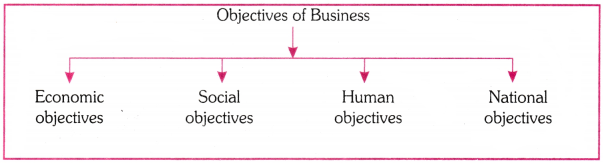
1) Economic Objectives : The Economic objectives are :
a) Earning Profits : Earning profits is an essential for the existence of business. It gives sustainability for a business in any fluctuations. It is a barometer for a business enterprise to measure stability, capability, efficiency etc.
b) Creating customers : A business can earn profits only when there are sufficient number of customers to buy the goods and services. The customer is the foundation for business and keeps it in existence. Hence, creation of customer is an important economic object of a business.
c) innovation : It refers to creation of new things. Modern science and technology is giving great scope for innovation. Therefore, business firms invest money, time and efforts in Research & development.
2) Social objectives : Business does not exist in a vaccum. It is a part of society. It cannot survive and grow without the support of society. So, business must have some social objectives. They are given below :
a) Supply of goods at reasonable price : A business should produce its goods and services with fair quality and reasonable price. It also has a social obligation of avoiding malpractices, smuggling, black marketing, misleading the customers with false advertisements, exploiting the customers with fixation of high or inappropriate pricing etc.
b) Fair Remuneration to employees : Apart from payment of salaries to the employees and wages to workers, if profits of business are distributed, it helps in motivating them. It is primary role of the employers to provide healthy and safe working environment to the workers.
c) Employment generation : Business should provide opportunities for gainful employment to members of the society. Government cannot provide employment to all. Therefore, provision of adequate and full employment opportunities is a significant service to society.
d) Social welfare : Business enterprizes can build schools, colleges, libraries, dharmashalas, hospitals, sports bodies and research institutions. They can help non¬government organisations (NGO’s) like CRY (Child Relief and You), Help Age, and other which render services to weaker sections of society’.
e) Payment of government dues : The duties, direct and indirect taxes (such as income tax. sales tax, excise duty, customs duty etc.) to be paid by a business enterprise to Government honestly and promptly. Business should also comply with the laws of the country.
3) Human objectives : Business is run by the people and for the people. Human objectives are :
a) Labour Welfare : A business must recognize the dignity of labour. Adequate health, safety and social security provisions are to be made.
b) Developing human resources : Human resources are the most valuable asset of business and their development will help in the growth of business. Development of skilled manpower is necessary for the economic development of a country.
c) Participative management : Employees should be allowed to take part in decision making process of business. This will help in the development of employees. Workers participation in management will lead to industrial democracy.
d) Labour – Management Co-operation : To keep the organizational climate peaceful, it is very important to maintain a cordial employee – employee relation.
4) National objectives : National objectives are :
a) Optimum utilization of resources : Adequate usage of natural resources will develop nation. Wastage of scarce resources is not only a loss to the business but also to the nation.
b) National self-reliance : By increasing exports and reducing imports lead to self-reliance. Over dependency is reduced by having sufficient supply of goods & services.
c) Development of small-scale industries : Small-scale industries will provide inputs to the big business organizations. Hence, development of large scale units leads to the development of small-scale industries.
d) Development of backward areas : Business is expected to give preference to the industrialization of backward regions of the country. Balanced Regional Development is necessary for progress in the country. It will also help to raise standard of living in backward areas.
Question 3.
Classify and describe each type of Economic Activities.
Answer:
Economic activities are those which are engages in, to earn livelihood by producing and distributing goods and rendering services.
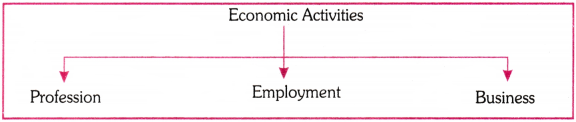
- Profession : Profession is an occupation based on specialized education. Profession refers “to a body of people in a learned occupation”. It requires an association with a professional body for a person to practise.
Ex : Chartered Accountants, Doctors, Lawyers, Teachers etc. - Employment : An employment is a contract of service. A person who works under the contract for a salary is called an employee and the person who has given the job to the employee is called an employer. An employee works under an agreement as per the rules of service and performs tasks assigned to him by the employer. The relationship between the employer and the employee is that of a ‘Master’ and ‘Servant’.
- Business : Business is an economic activity involving production, exchange, distribution and sale of goods and services with an objective of making profits.
Question 4.
Discuss the Social Responsibility of business.
Answer:
The social responsibility of business are :
1) Responsibility towards owners : These are
a) Regular and fair returns on capital invested by way of dividends.
b) Safety of their capital and growth.
c) Proper utilisation of capital.
d) Running the business efficiently.
2) Responsibility towards employees :
a) Regular payment of their wages and allowances.
b) Better working conditions and welfare amenities.
c) To improve the skill and efficiency by providing proper training.
d) Job security and social security like group insurance, pension, retirement benefits etc.
3) Responsibility towards suppliers :
a) Timely payment of dues.
b) Dealing on fair terms and conditions.
c) Availing reasonable credit period.
4) Responsibility towards customers :
a) Providing qualitative goods & services.
b) Charging reasonable prices.
c) Giving delivery of goods with stipulated time.
d) After sale survive.
e) Avoiding unfair means like under weighing the product, adulteration etc.
5) Responsibility towards government:
a) Payment of fees, duties and taxes honesty & regularly.
b) Setting up units as per guidelines of the government.
c) Following the pollution control norms.
d) Not to indulge in unlawful activities.
6) Responsibility towards society :
a) To help weaker and backward sections of the society.
b) To generate employment.
c) To protect environment.
d) To conserve natural resources and wild life.
e) To promote sports, social and cultural values.
Check Your Knowledge
I. Fill in the blanks :
Question 1.
Business is an _____________
Answer:
Economic Activity
Question 2.
Business is one of the _____________
Answer:
Human Activity
Question 3.
Goods are _____________
Answer:
Tangible
Question 4.
Services are _____________
Answer:
Intangible
Question 5.
Goods may be _____________
Answer:
Consumer goods (or) Producer goods
Question 6.
The primary objective of business is to earn _____________
Answer:
Profit
Question 7.
Capital goods also known as _____________
Answer:
Producer goods
Question 8.
How many types of Economic Activities ?
Answer:
3
Question 9.
Which one is the Non-Economic Activities ?
Answer:
Love & affection
Question 10.
Which one is National objective ?
Answer:
MSME
Question 11.
Which one is Human activities ?
Answer:
Labour Welfare
Question 12.
Innovation means _____________
Answer:
Creation of New things
Question 13.
Business risk is not likely to arise to _____________
Answer:
Good Management
Question 14.
Economic activities may be classified into business _____________ and employment.
Answer:
Profession
Question 15.
Transfer of interest exist in the case of _____________
Answer:
Business
II. State whether the statements are True or False.
Question 1.
The primary aim of business should be service and subsidiary aim should be earning of profit. (True/False)
Answer:
True
Question 2.
Regularity of dealings is an unnecessary feature of business. (True/False)
Answer:
False
Question 3.
If a person cooks and serves food to his family, it is business. (True/False)
Answer:
False
Question 4.
Services are known as intangible and invisible goods. (True/False)
Answer:
True
Question 5.
Profit is also necessary for the expansion and growth of business. (True/False)
Answer:
True
Question 6.
R & D stands for Research and Development. (True/False)
Answer:
True
Question 7.
Business must to provide healthy and safework environment for employees. (True/False)
Answer:
True
Question 8.
N.G.O’s stands for Non-Government Organization. (True/False)
Answer:
True
Question 9.
CRY stands for Child Relief and You. (True/False)
Answer:
True
Question 10.
Employees should not be allowed to take part in decision making process of business. (True/False)
Answer:
False
Question 11.
The primary objective of business is to earn loss. (True/False)
Answer:
False
Question 12.
BRD stands for Balanced Recruitment Development. (True/False)
Answer:
False
Question 13.
BRD is necessary for peace and progress in the country. (True/False)
Answer:
True
Question 14.
C.A stands for Certificate Accountant. (True/False)
Answer:
False
Student Activity
State whether the statements are True or False.
Question 1.
Economic activities are the activities a man is engaged in, to earn his livelhood by producing and distributing goods ands and rendering services. (True/False)
Answer:
True
Question 2.
Non-economic activities result in a payment. (True/False)
Answer:
False
Question 3.
The primary intention of busines is to serve the society. (True/False)
Answer:
False
Question 4.
Businesses make goods available for futur use through storage. (True/False)
Answer:
True
Question 5.
Risk implies certainty of profits. (True/False)
Answer:
True
Question 6.
Non-economic activities are also part of business. (True/False)
Answer:
False
Question 7.
Business is an art but not a science. (True/False)
Answer:
False
Question 8.
Profit is essential for the survival of every business. (True/False)
Answer:
True
Question 9.
Business must discharge social responsibility in addition to earning profits. (True/False)
Answer:
True
Question 10.
Businesses must help the government to increase exports and reduce dependence on imports. (True/False)
Answer:
True