AP Inter 1st Year Commerce 3rd Lesson Sole Proprietorship Questions and Answers
Fill in the Blanks
Question 1.
The arrangement of ownership and management of business organisations is termed as ___________ organisation.
Answer:
Business
Question 2.
A sole proprietorship is also known as ___________ entrepreneurship.
Answer:
Individual
Question 3.
___________ is the oldest form of business organisation.
Answer:
A sole proprietorship
Question 4.
The ___________ form of business organisation has a single owner.
Answer:
Sole proprietorship
Question 5.
The liability of the sole proprietor is ___________.
Answer:
Unlimited
Very Short Answer Questions
Question 1.
Business Organisation ?
Answer:
In order to carryout any business and to achieve of objective of earning profit, it is required to bring together all the resources and put them into action in a systematic way and to co-ordinate and controll all these activities properly. This arrangement is knownas “Business Organisation”.
Question 2.
Sole proprietorship.
Answer:
- “A type of business unit where one person is solely responsible for providing the capital and bearing the risk of the enterprise, and for the management of the business”. – J.L. Hanson
- “Sole proprietorship is a form of business where the individual proprietor is the supreme judge of all matters pertaining to his business”. – Kimball and Kimball
Question 3.
Unlimited liability.
Answer:
The liability of the sole proprietor is unlimited. Incase of loss, if his business assets are not enough to make the payment of business liabilities, his personal property can also be utilised to pay off the liabilities of the business.
Question 4.
Explain any two characteristics of Sole trade business.
Answer:
Characteristics/Features of sole trade business :
- Single ownership : The sole proprietorship form of business organisation has a single owner who himself/herself starts the business by bringing together all the resources.
- Less Legal Formalities : The formation and operation of a sole proprietorship form of business organisation involves less legal formalities. Thus, its formation is quite easy and simple.
Question 5.
Explain any two limitations of Sole trade business.
Answer:
Limitations of sole trade business :
- Limited Resources : The resources of a sole proprietor are always limited. Being a single owner, it is not always possible to arrange sufficient funds from his own sources. Again borrowing funds from friends and relatives or banks has its own implications. So, the proprietor has a limited capacity to raise funds for his business.
- Unlimited Liability : In the eyes of the law, the proprietor and the business are one and the same. So, personal properties of the owner can also be used to meet the business obligation and debts.
Question 6.
One man control.
Answer:
One man control : The controlling power of the sole proprietorship business always remain with the owner. He/she runs the business as per his/her own will.
Question 7.
No separate Entity.
Answer:
The sole proprietorship unit does not have an entity separate from the owner. The businessman and its enterprise are one and the same, and the businessman is responsible for everything that happens in his business firm.
Question 8.
What is the meaning of sole proprietorship ?
Answer:
It is a business organisation in which a single individual introduces his own capital, skill and intelligence in the management of the affairs. He is solely responsible for the results of its operations.
Question 9.
Write about lack of continuity.
Answer:
The sole trader has to run his business on his ability and capacity. When he suffers from a long illness or when he dies the business may be closed down. There is no continuity in the sole trading concern.
Question 10.
Explain Direct Motivation.
Answer:
The sole proprietor takes keen interest in the working of the business. He tries put his heart and soul in the business so as to earn as much profits as he can. There is direct relationship between effort and reward.
Question 11.
Explain Limited Resources.
Answer:
The resources of a sole proprietor are limited. He has only two sources of securing capital – personal savings and borrowings on personal securities. There is a limit to which a single person can invest. Therefore, the sole trading concern has limited capital.
Question 12.
Write about quick decisions.
Answer:
He is the supreme master of his business. He has to take all the business decisions himself. He need not consult any other person. If more than one person is involved in decision-making, then delay is bound or occurs.
Short Answer Questions
Question 1.
Explain the features of sole proprietorship (or) characteristics.
Answer:
Features / Characteristics :
- Single ownership : The business organisation has a single ownership. The proprietor brings all the resources. One man contributes capital.
- No separation of ownership and management : The owner manages the business using his/her own intelligence and skill. There is no scope for distinguish ownership and management as in the case of other organisations like joint stock companies.
- Less number of legal formalities : Formation of sole proprietorship is very simple and easy. A lesser number of legal formalities is required. Registration is not also compulsory.
- No separate Entity : The businessman and business enterprise are one and the same. There is no separate legal entity. Hence, the proprietor is responsible for every act of the business.
- No share in profits or losses : The sole proprietor enjoys all the benefits and he has to borne all the losses solely. The proprietor has to face the risk alone.
- Unlimited Liability : The liability of the sole proprietor is unlimited. That is, the liabilities of the business are to be re-paid even by utilizing personal assets.
- One-man control: The controlling power of the sole proprietorship rests with the owner. On the will of the owner business will be managed and controlled.
- Limited area of operations : This kind of business is not so easy to scatter everywhere, due to limited capability of managerial abilities and resources.
Question 2.
What is meant by Business Organisation ?
Answer:
Arrangement of ownership and management of business organisations is termed as ‘Forms of Business Organisation’. Business organisations may be owned and managed by a single individual (sole proprietorship) or a group of individuals (Partnership) or in the form of a company (Joint stock company). In India, business organisations usually take the following forms.
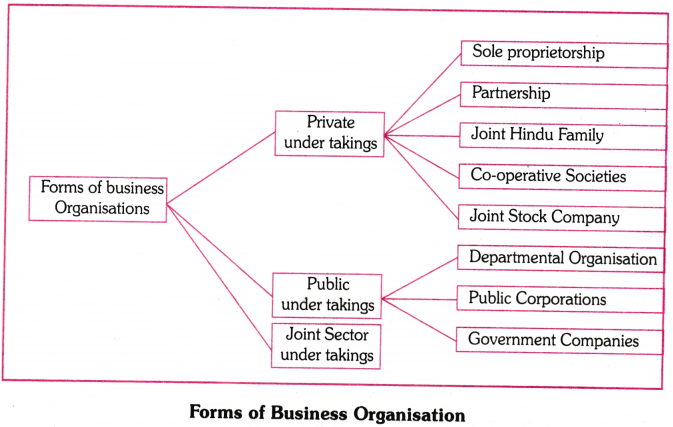
Question 3.
What is sole proprietorship ?
Answer:
The sole proprietor is an individual who owns and manages a business. The individual brings his own or borrowed capital, manages the business himself, bears all the risks alone, enjoys all profits, suffers all losses.
Definition:
- According to Wheeler : The sole proprietorship is that form of business ownership which is owned and controlled by a single individual. He receives all the profits and bears the risks of his property in the success or failure of the enterprise”.
- According to Kimball & Kimball: “The individual proprietor is the supreme judge of all matters pertaining to his business subject only to the general laws of land and to such special legislation as may effect his particular business”.
Question 4.
Explain the limitations of a sole trader.
Answer:
Demerits/Disadvantages/Limitations of sole proprietorship :
- Limited Resources : The resources of a sole proprietor are limited. He has only two sources of securing capital. Personal savings and borrowings on personal securities. There is a limit to which a single person can invest. Therefore, the sole trading concern has limited capital.
- Limited managerial ability : A single person may not be an expert in all fields. This business organisation always suffers from lack of managerial expertise.
- Unlimited Liability : The liability of a sole proprietor is unlimited. His private properties can also be used for meeting business losses. So, he never shows interest of expansion.
- Less scope for economies of scale : Sole trader usually operates on small scale only. So, he cannot enjoy the benefits of large-scale production. This may raise the cost of business operations.
- Limited area of operations : Generally the sole trader’s activities cannot go beyond a certain area due to his limited skill and resources.
- No Division of Labour : The sole trader has limited capital. So he cannot hire the service of experts. Therefore, there is no specialization or division of labour in the sole trading concern.
- Lack of continuity : The continuity of the business is linked with the life of the proprietor illness, death of insolvency of the proprietor can lead to closure of the business. Thus, the continuity of business is uncertain.
- Restricted growth : The limitations of capital and managerial ability act as a barrier to the development and expansion of business. Economies of large scale manufacturing buying and selling cannot be obtained.
Question 5.
Explain the advantages of sole proprietorship.
Answer:
Merits / Advantages :
- Easy Formation : It can be very easily started no legal formalities are necessary business.
- Direct motivation : The entire profit of the business goes to the owner. This motivates the proprietor to work hard and run the business effectively and efficiently.
- Business secrets : In this form of organisation the secretes can be retained easily.
- Direct contact with customers : He can establish and maintain personal touch with his customers.
- Economy in management: The sole trader knows that he is the only person to bear all the losses of his business.
- Personal relations with employees : He establishes personal and direct contact with his employees.
- Quick decisions : He is the supreme master of his business. He has to take all the business decisions himself.
- Social Advantages : This form of organisation provides employment opportunities. It prevents concentration of economic wealth and power in the hands of a few individuals and encourages decentralization.
- Flexibility in operation : Changes in the buusiness are necessary. The sole trading concern is dynamic in its nature. The nature of the business can be easily changed according to the changing market conditions. So, it is an ideal form of business organisation.
- Easy Dissolution : There is no scope of difference of opinion in case of dissolution of business.
Long Answer Questions
Question 1.
Define Sole Proprietorship and discuss its merits and demerits.
Answer:
Any business unit which is owned and run by a single person is known as sole trade. This organisation is also known as sole proprietorship.
Definitions :
“The individual entrepreneurship is the form of business on the head of which stands an individual as the one who is responsible who directs its operations, who alone runs the risk of failure”. – L.H. Haney
“A type of business unit where one person is solely responsible for providing the capital and bearing the risk of the enterprise, and for management of the business”. – J.L. Hanson
Merits / Advantages :
- Easy Formation : It can be very easily started no legal formalities are necessary for its formation.
- Direct motivation : The sole proprietor takes keen interest in the working of the business.
- Business secrets : In this form of organisation the secrets can be retained easily.
- Direct contact with customers : He can establish and maintain personal touch with his customers.
- Quick Decisions : He is the supreme master of his business. He has to take all the business decisions himself.
- Economy in management: The sole trader knows that he is the only person to bear all the losses of his business.
- Personal relations with employees : He establishes personal and direct contact with his employees.
- Social Advantages : This form of organisation provides employment opportunities.
- Flexibility in operation : It >s very easy to initiate and implement changes as per the requirements of the business.
- Easy Dissolution : There is no scope of difference of opinion in case of dissolution of business.
Demerits / Disadvantages / Limitations :
- Limited Resources : The resources of a sole proprietor are limited. There is a limit to which a single person can invest. Therefore, the sole trading concern has limited capital.
- Limited managerial ability : He will not be able to devote sufficient time for all types of activities. Hence, limited managerial capacity will hinder the growth of concern.
- Unlimited liability : The liability of a sole trader is unlimited. So personal properties of the owner can also he used to meet the business obligations and debts.
- Less scope of economies of scale : Sole trader usually operates on small scale only. So, he cannot enjoy the benefits of large-scale production.
- No division of labour : Sole trader has limited capital. So he cannot hire the service of experts. Therefore, there is no specialization or division of labour in the sole trading concern.
- Limited area of operation : Generally, the sole trader’s activities cannot go beyond a certain area due to his limited skill and resources.
- Lack of continuity : The continuity of the business is linked with the life of the proprietor. Illness, death or insolvency of the proprietor can lead to closure of the business. Thus, the continuity of business is uncertain.
- Restricted growth : The limitations of capital and managerial ability act as breaker to the development and expansion of business.
Question 2.
Define Sole proprietorship and explain the features of sole proprietorship.
Answer:
It is a business organisation in which a single individual introduces his own capital, skill and intelligence in the management of its affairs. He is solely responsible for the results of its operations.
Definition : “A type of business unit where one person is solely responsible for providing the capital and bearing the risk of the enterprize, and for the management of the business”. – J.L. Hanson
Features / Characteristics :
- One man ownership : The ownership lies with one person only. He invests his own money or borrow from his friends or relatives.
- No seperation of ownership and management : The owner himself manages the business. The separation of ownership from management is not present in this form of organisation.
- No legal formalities : No legal formalities are required to start sole trading business. However, in some cases, a licence may be required.
- No separate entity : The business does not have any entity separate from the owner. The owner and the business are one and the same.
- Sharing of profits : One person is the sole owner of the business. He takes all profits and bears all losses. There is direct relationship between efforts and rewards.
- Unlimited liability : The liability of the sole proprietor is unlimited and the creditors has the right to come a cross the personal properties of him.
- Secrecy : All important decisions are taken by the owner himself. He keeps all business secrets only to himself.
Question 3.
“One man show is the best in the world provided that one man is big enough to take care of everything”. Discuss.
Answer:
Any business unit which is owned and run by a single person is known as sole trade.
Definition : “A type of business unit where one person is solely responsible for providing the capital and bearing the risk of the enterprise, and for the management of the business”. – J.L. Hanson
We can say that a sole trade is one man show basing on the following points :
- The business is started by the initiative of a single person and he contributes complete efforts.
- As the sole trade unit is a small business concern it is possible to keep all business secrets.
- The sole proprietor invests the necessary capital in the business from his own sources.
- Legally, the sole trader does not have separate legal entity from his business.
- A sole trader is having unlimited liability.
- A sole trade business has generally a limited area of operations, the reason being the limited resources and managerial abilities of the sole trader.
- The proprietor managers the whole business himself.
- He enjoys all profits and bears losses if any.
- There is direct relationship between efforts and reward.
- The sole proprietor takes keen interest in the working of the business.
- The proprietor can establish and maintain personal touch with his customers.
- The sole trader is the supreme master of his business.
- Changes in the business are necessary.
- The sole trader tries to avoid all kinds of waste and unnecessary expenses.
- The sole trader introduces his children into the business.
- The proprietor establishes personal and direct contact with his employees.
In sole trade large number of traders was entered in different types of business. There is no scope of difference of opinion in case of dissolution of business. Therefore, “one man show is the best in the world provided that one man is big enough to take care of everything”.
Check Your Knowledge
I. Fill in the blanks for the following questions :
Question 1.
A business ___________ can be owned and against in several forms.
Answer:
Enterprize
Question 2.
Registration is not compulsory in the form of business ___________
Answer:
Sole proprietorship
Question 3.
The proprietor is ___________ of the business.
Answer:
Sole owner
Question 4.
All is he and he is ___________
Answer:
All
Question 5.
The simplest form of the business ownership is a ___________
Answer:
Proprietorship
Question 6.
“Supreme Judge of all matters pertaining to his business” who said ___________
Answer:
Kimbal & Kimbal
Question 7.
As per law ___________ and ___________ are same.
Answer:
Proprietor and business
II. State whether the statement are True or False.
Question 1.
A sole proprietorship is a form of business organisation in which an individual invests his own capital. (True/False)
Answer:
True
Question 2.
The business unit does not have an entity separate from the owner. (True/False)
Answer:
True
Question 3.
The proprietor works hard and run business efficiently. (True/False)
Answer:
True
Question 4.
The business secrets are known only to the proprietor. (True/False)
Answer:
True
Student Activity
State whether the statements are True or False.
Question 1.
A sole proprietorship form of business is suitable for large – scale business operations. (True/False)
Answer:
False
Question 2.
A sole proprietorship business is managed by a single individual. (True/False)
Answer:
True
Question 3.
The liability of the sole proprietor is limited. (True/False)
Answer:
False
Question 4.
To form a sole proprietorship business, more legal formalities are involved. (True/False)
Answer:
False
Question 5.
The decision – making is quick and easy in a sole proprietorship. (True/False)
Answer:
True
Question 6.
The resources of a sole proprietor are unlimited. (True/False)
Answer:
False