AP Inter 1st Year Economics 8th Lesson National Income Accounting Questions and Answers
Essay Questions
Write an essay on the following questions.
Question 1.
Describe the components of National Income.
Answer:
In Macro Economics, national income plays an important role. For the economic development of a country, the national income estimates are very important.
The total market value of all goods and services produced in a country during a given period of time is called national income.
Definition : According to Marshall, “Labour and capital of a country, acting on its natural resources produce annually a certain net aggregate of commodities material and immaterial, including services of all kinds” is called National Income.
Components of national income : There are five main components of national income.
They are ;
a) Consumption – C
b) Gross domestic investment – I
c) Government expenditure – G
d) Net foreign investment – (x – m)
e) Net income from abroad
a) Consumption – C : It is the total expenditure made by households on goods and services. It includes both durable and non-durable goods like food grains, clothing, medical services, etc. The level of consumption depends on the level of incomes.
b) Investment – I : It is the expenditure by firms on goods and services which are not for current consumption. It includes expenditure on capital like machinery, roadways, bridges, etc. which will help in production of consumer goods in future.
c) Government expenditure (G) : It is the expenditure made by the government on infrastructural facilities for the use of the society. It also includes government expenditure on services like Police, Military and Judicial services.
d) Net foreign investment (x – m) : It is the income earned by a country through international trade. Every country exports certain volume of goods produced by it and imports goods which are relatively cheaper in the international market or other countries.
The difference between the value of exports and imports (either positive or negative) has to be taken into account to estimate the national income of a country.
The net foreign investment depends on the export – import policy of the government and the comparative price level of the goods in domestic and international markets.
Y = C + I + G + (x – m)
e) Net income from abroad : Some of the nationals of a country working in other countries may be sending remittances to their country. Likewise foreigners in one country may be sending their income abroad. Hence net income from abroad represents the difference between receipts and payments of the above type of factor incomes.
Question 2.
Explain various methods of calculations National Income. [March-2026]
Answer:
National Income is the total market value of all goods and services produced in a country during a given period of time.
Measurement of National Income :
There are three methods of measuring National Income.
- Output method or Product method
- Expenditure method and
- Income method.
Cairn Cross says “National Income can be looked in any one of the three ways, as the National Income measured by adding up everybody’s income, by adding up everybody’s output, and by adding up the value of all things that people buy and adding in their savings.”
1) Output method or Product method : It is also known as inventory method or commodity service method. In this method we find the market value of all final goods and services produced in a country during a given period of time. The entire output of final goods and services are multiplied by their respective market prices to find out the gross national product.
NI = (P1Q1, P2Q2 + ………………. PnQn)
= Depreciation – Indirect taxes + Net Income from abroad.
where NI = National Income,
P = Price of the good or service;
Q = Quantity of good or service produced; 1, 2 ………………………. n are the various goods and services produced.
The values of raw material, intermediary goods, etc. should not be included. Only final goods should be taken into account.
Here we find out the value added in the different sectors like agriculture, government professionals, industry and services sectors. Hence it is also called “Value added method”.
National income based on output data is calculated by adding the sum of Values added’ by each firm in each industry. Industrial activity is conventionally classified according to the standard industrial classification.
Value added is the difference between the final value of the product and the cost of the inputs of raw materials and components, i.e., it is the rise in value of the product caused by the activities of the firm itself.
2) Income method: In this method, the incomes earned by all factors of production are aggregated to arrive at the national income of a country. The four factors of production receive incomes in the form of wages, rent, interest and profits. This is also National Income at factor cost.
NI = W + I + R + P + Net income from abroad
NI = National Income.
W = Wages,
I = Interest,
R = Rent,
P = Profits
This method gives us National Income according to distributive shares, (the most important share is that of labour)
Income from employment
+ Income from self employment
+ Gross trading profits of companies
+ Gross trading surpluses of nationalized industries
+ Gross trading surpluses of general government enterprises
+ Rent
+ Imputed charge for the consumption of non-traded capital
= Total domestic income
– Stock appreciation
+ Residual error
= Gross Domestic Product at factor cost
Undistributed profits of companies are included in the accounts as they have been earned in the accounting period. It makes no difference what the firm does with the profits subsequently.
Residual error refers to a sum that is added to balance the accounts. Each approach to calculating national income involves thousands of figures ‘ collected from a variety of sources. It is not surprising that the totals are not, in practice, equal. The residual error appears in the income accounts purely for convenience of presentation.
3) Expenditure method: In this method we add the personal consumption expenditure of households, expenditure of the firms, government purchase of goods and services, net exports plus net income from abroad.
MI = EH + EF + EG + Net exports + Net income from abroad.
Here national income = Private final consumption expenditure + government final consumption expenditure + net domestic capital formation + net exports + net income from abroad
EH = Expenditure of Households
EF = Expenditure of Firms
EG = Expenditure of Government
Care should be taken to include spending or expenditure made on final goods and services only.
There are two different ways in which national income of a country is estimated. They are national income at market prices and national income at constant prices.
Question 3.
Find the GDPMP, GNPMP and GNPFC from the following data on the economy.
| Items | Amount (in Cr.) |
| 1. Value of output in primary sector | 600 |
| 2. Net factor income from abroad | 30 |
| 3. Value of output in tertiary sector | 900 |
| 4. Value of output in secondary sector | 700 |
| 5. Intermediate consumption in tertiary sector | 300 |
| 6. Intermediate consumption in primary sector | 350 |
| 7. Intermediate consumption in secondary sector | 200 |
| 8. Net Indirect taxes | 10 |
Answer:
To find the GDPMP and GNPFC from the given data, we will follow these steps.
Step I :
Given Data :
I.
- Value of output = 600 cr. Rs.
- Secondary Sector = 700 cr. Rs.
- Tertiary sector = 900 cr. Rs.
II. Intermediate Consumption
- Primary sector = 350 cr. Rs.
- Secondary sector = 200 cr. Rs.
- Tertiary sector = 300 cr. Rs.
III. Net Factor Income from Abroad
NFIA = 30 cr. Rs.
IV. Net Indirect taxes (NIT) = 10 cr. Rs.
GVAFC for each sector
GVAFC = Value of output – Intermediate consumption
- Primary sector = 600 – 350 = 250 cr. Rs.
- Secondary sector = 700 – 200 = 500 cr. Rs.
- Tertiary sector = 900 – 300 = 600 cr. Rs.
Total GVAFC = 250 + 500 + 600 = 1350 cr. Rs.
Step II :
Calculate GDP at market price (MP)
GDPMP = GVAFC + Net Indirect Taxes
GDPMP = 1350 + 10 = 1360 cr. Rs.
Step III :
Calculate GNP at Factor Cost (FC).
GNPFC = GDPMP – NIT + NFIA.
GNPFC = 1360 – 10 + 30 = 1380 cr.Rs.
Alternatively we can also compute it as :
GNPFC = GVAFC + NFIA = 1350 + 30 – 1380 Crs.
So, GDPMP = Rs. 1360 cr. rs.
GNPFC = Rs.1380 cr.rs.
Question 4.
Calculate GDPMP, GNPMP and GNPFC and NNPFC from the following data on the economy.
| Items | Amount (in Cr.) |
| 1. Consumer Expenditure (inclusive of indirect taxes) | 160 |
| 2. Investment | 40 |
| 3. Government Expenditure (inclusive of transfer payments) | 90 |
| 4. Exports | 30 |
| 5. Imports | 50 |
| 6. Net Factor Income from Abroad (NFIA) | 20 |
| 7. Transfer Payments | 30 |
| 8. Net Indirect Taxes | 40 |
| 9. Depreciation | 10 |
Answer:
1. Calculate Government Final Consumption (GFCE)
Government expenditure inclusive of transfer payments is given.
To find GFCE, we need to subtract the transfer payments as they are not part of final consumption of goods and services.
GFCE = Government Expenditure inclusive of Transfer Payments – Transfer Payments.
GFCE = 90 – 30 = 60 crore rupees.
2. Calculate GDP at MP (Gross Domestic Product at Market Price)
GDP at MP is calculated using the expenditure method.
GDP at MP = Private Final Consumption Expenditure at MP + Gross Domestic Capital Formation (Investment) + Government Final Consumption Expenditure + (Exports – Imports).
GDPMP = 160 + 40 + 60 +(30 – 50) = 260 – 20 = 240 cr. rs.
3. Calculate GNPMP
GDPMP + NFIA = 240 + 20 = 260 cr. rs.
4. NNPFC = GNPFC – Depreciation
= 220 – 10 = 210 cr. rs.
So, GDPMP = 240 cr. rs.
GNPMP = 260 cr. rs.
GNPFC = 220 cr. rs.
NNPFC = 210 cr. rs.
Question 5.
Define National Income and explain the various concepts of National Income.
Answer:
In Macro Economics, National Income plays an important role. For the economic development of a country, the National Income estimates are very important.
Meaning : National Income is the total market value of all goods and services produced in a country during a given period of time.
Definition : “The labour and capital of a country acting on its natural resources, produce annually a certain net aggregate of commodities, material and immaterial including services of all kinds. This is the net annual income (or) revenue of a country. ”
Concepts of National Income : There are five main concepts of National Income. The various concepts are :
A) Gross National Product (GNP) at Market Prices
B) Gross Domestic Product (GDP) at Market Prices
C) Net National Product (NNP) at Market Prices
D) National Income (or) Net National Product at factor cost
E) Personal Income (PI)
F) Disposable Personal Income (DPI)
G) Per capita Income
H) Relationship between per capita income and population
A) Gross National Product (GNP) at Market Prices: Gross National Product at market prices is the current market value of all final goods and services produced in a country during a given period. The main components of GNP are :
- The goods and services purchased by consumers; C
- Investments made by public and private sectors; I
- Government expenditure on public utility services; G
- Incomes earned through International trade; (x – m)
- Net factor incomes from abroad.
GNP at market prices = C + I + G + (x – m) + net factor income from abroad. In this concept production of goods and services must be made by the citizens of that country irrespective of where it is produced.
B) Gross Domestic Product (GDP) at Market Prices : This is that part of the GNP that is produced within the country in a given period of time usually a year. In this concept it is essential that production of goods and services must take place within the country, who produces it is not the criterion for computing National Income.
C) Net National Product (NNP) at Market Prices: The country’s stock of fixed capital undergoes certain amount of wear and tear in producing goods and services over a period of time. This \iser cost’ or depreciation or charges for renewals and repairs must be subtracted from the GNP to obtain Net National Product at Market Prices.
NNP at market prices = GNP at market prices – Depreciation.
D) National Income or Net National product at factor cost : It is the total income received by the four factors of production in the form of rent, wages, interest and profits in an economy during a given period of time.
It is also the incomes received by persons supplying the services or resources used in production. It includes all wages earned by employees, interest paid to private individuals, net rent received by landlords and net profit of all kind of business.
The NNP is not available for distribution among the factors of production. The amount of indirect taxes are paid by the firms to the government and not to the factors of production. Similarly the government gives subsidies to firms for production of certain types of goods and services and that part of the production cost is borne by the government.
Hence the goods are sold in the market at a lower price than the actual cost of production. Therefore this volume of subsidies has to be added to the Net National Income.
In modern days the government sector is vastly enlarging and runs several industries and enterprises. The profits of the government do not go to the factors of production.
NI or NNP at factor cost = NNP at market prices – Indirect taxes + Subsidies – Profits of government owned firms.
E) Personal Income (PI) : It is the total incomes received by all persons of households in a country during a given period of time. The whole of NI earned by factors of production is not available to them. Corporate taxes have to be paid by firms before distributing them to share-holders.
Similarly, firms may prefer to keep a part of its profits for expansion or for other exigencies. This part of profits are also not distributed to its shareholders. Salaried employees make contributions for social security.
The government may provide social security allowances like pensions, unemployment allowances, scholarships, etc. These are incomes for some sections of the society even though no productive services are made by them.
Personal Income PI = NI at factor cost – Undistributed profits – Corporate taxes – Social security contributions + Transfer payments.
F) Disposable Personal Income (DPI) Disposable personal income is that part of personal income which is left with the individual after payment of all direct taxes like income tax, property tax, etc. generally disposable income is either spent for consumption or for savings.
DPI = PI – Personal taxes DPI = Consumption + Savings ;
G) Per capita Income : Per capita income is the average income of an individual in a country. It is calculated by dividing national income by population of the country.
Per Capita Income = \(\frac{National Income}{Population}\)
This concept is a good indicator of the average standard of living in a country.
H) Relationship between per capita income and population : There is a close relationship between national income and population. These two together determine the per capita income. If rate of growth of national income is 6% and rate of growth of population is 3%, the rate of growth of per capita income will be 3% and it can be expressed as follows.
QPC = Q – QP
QPC = rate of growth of per capita income
Q = rate of growth of national income
QP = rate of growth of population
Question 6.
Write the importance of National Income Estimation.
Answer:
The importance of national income studies is growing for several reasons :
- The national income estimates or statistics are very important for preparing economic plans.
- It is a very important tool for framing economic policies.
- It enables us to assess the performance of each sector in the economy.
- It is very useful in making budgetary allocations.
- It gives us an idea of the standard of living in the country.
- It helps us to compare economic growth with other countries.
- It gives a clear picture of the level of utilization of natural resources in a country.
- It is essential to calculate per capita incomes in a country and income inequalities.
- It helps the Government in macroeconomic policy making.
- It will enable us to know the role of public and private sectors in the economy.
Short Answer Questions
Write the answers briefly for the following questions.
Question 1.
Explain any four factors that determine National Income.
Answer:
The total market value of all goods and services produced in a country during a given period of time is called National Income.
There are many factors that influence and determine the size of national income in a country. These factors are responsible for the differences in national incomes of various countries.
a) Natural Resources : The availability of natural resources in a country, its climatic conditions, geographical features, fertility of soil, mines and fuel resources, etc. influence the size of National Income.
b) Quality and Quantity of Factors of Production : The National Income of a country is largely influenced by the Quality and Quantity of country’s stock of factors of production.
c) State of Technology : Output and National Income are influenced by the level of technical progress achieved by the country. Advanced techniques of production help in optimum utilization of a country’s national resources.
d) Political Will and Stability: Political will and stability in a country helps in planned economic development and for a faster growth of national income.
Question 2.
Distinguish between GNP and GDP.
Answer:
Differences between GNP and GDP:
| Gross National Product | Gross Domestic Product |
| i. The term “National’ refers to normal residents of a country who may be within or outside the domestic territory. | i. The term ‘Domestic’ refers to the domestic territory of the country. |
| ii. GNP is a broader concept than GDP. | ii. GDP is a narrower concept than GNP. |
| iii. GNP includes NFIA such as earnings of Indian corporations in overseas and Indian residents working in overseas. | iii. GDP excludes NFIA (Net factor income from abroad). |
| iv. GNP excludes earnings from current production in India accrue to foreign residents or foreign-owned firms. | iv. GDP includes earnings from current production in India that accrue to foreign residents (or) foreign-owned firms. |
Question 3.
Suppose the GDPMp of a country in 2023-24 was Rs. 1100 crores, Net Factor Income from Abroad (NFIA) was Rs. 100 Crores, the value of indirect taxes – subsidies were Rs. 150 crores and the value of depreciation was Rs. 200 crores then calculate the NNPFC ?
Answer:
NNPFC = GDP at Market Price – Depreciation + Net Factor Income From Abroad – (Indirect Taxes – Subsidies)
GDPMp = Rs.100 crores
NFIA = Rs. 100 crores
Value of Indirect Taxes – Subsidies = Rs. – 150 crores
Depreciation = Rs – 200 crores
NNPFC = 1100 – 200 + 100 – 150
= 900 + 100 – 150
= 1000 – 150 = 850
∴ NNPFC = Rs.850 crores
Question 4.
Calculate the National income by using the total expenditure approach.
| Components | Amount (in cr.) |
| 1. Consumption Expenditure | 500 |
| 2. Wages and Salaries | 400 |
| 3. Investment Expenditure | 080 |
| 4. Government Expenditure | 100 |
| 5. Depreciation | 070 |
| 6. Net Factor Income from Abroad | 050 |
| 7. Net Indirect Taxes | 030 |
| 8. Net Exports | (- 100) |
Answer:
National Income (NDP at MP) = Consumption Expenditure + Investment Expenditure + Government Expenditure + Net Exports.
1. GDPMp = 500 + 80 + 100 + (-100)
= 680 – 100 = 580 cr. rupees
2. NDPMp = GDPMp – Depreciation
= Rs. 580 – 70 = 510 cr. rupees
3. NNPMp = NDPMp + NFIA
= 510 + 50 = 560 cr. rupees
4. NNPFC = NNPMp – Net Indirect Taxes
= 560 – 30 = 530 cr. rupees
Therefore, the national income using the total expenditure approach is Rs.530 crores.
Question 5.
From the following data, compute the Gross National Product at Market Prices (GNPMp) by using value added method.
| Items | Amount (in cr.) |
| 1. Value of output in secondary sector | 3500 |
| 2. Intermediate consumption in primary sector | 400 |
| 3. Value of output in tertiary sector | 4600 |
| 4. Intermediate consumption in secondary sector | 500 |
| 5. Net factor income from abroad | (- 200) |
| 6. Value of output in primary sector | 2000 |
| 7. Intermediate consumption in tertiary sector | 500 |
Answer:
GVA (Gross Value Added) of Primary Sector = 2000 – 400 = 1,600 crore rupees
GVA of Secondary Sector = 3500 – 500 = 3000 crore rupees
GVA of Tertiary Sector = 460 – 500 = Rs.410 crore Rupees
GDP at Market Price = 160 + 300 + 4,100 = 8,700 crore rupees.
GNPMp = 8700 – 200 = 8,500 crore rupees.
Question 6.
What is National Income at Factor Cost ?
Answer:
National Income at factor cost is the total income received by the four factors of production in the form of rent, wages, interest and profits in an economy during a given period of time. It is also the incomes received by persons supplying the services or resources used in production. It includes all wages earned by employees, interest paid to private individuals, net rent received by landlords and net profits of all kinds of business.
NNP is not available for distribution among the factors of production. The amount of indirect taxes are paid by the firms to the government and not to the factors of production. Similarly, the government gives subsidies to firms for production of certain types of goods and services and that part of the production cost is borne by the government.
Hence, the goods are sold in the market at a lower price than the actual cost of production. Therefore, this volume of subsidies has to be added to the Net National Income.
In modern days, the government sector is vastly enlarging and runs several industries and enterprises. The profits of the government do not go to the factors of production.
NI or NNP at factor cost = NNP at market prices – Indirect taxes + subsidies – profits of government-owned firms.
Question 7.
Write the definitions of National Income.
Answer:
Meaning: National Income is the total market value of all goods and services produced in a country during a given period of time. Several economists have defined National Income as follows :
- Fisher’s Definition : “The National Dividend, or Income consists solely of services as received by ultimate consumers, whether from their material or from their human environment.”
- Marshall’s Definition : “The labour and capital of country acting on its natural resources, produce annually a certain net aggregate of commodities, material and immaterial including services of all kinds. This is the net annual income or revenue of a country. ”
- Kuznet Definition : According to Kuznet, “National Income is the net output of commodities and services flowing during the year from the country’s productive system into the hands of the ultimate consumers or into the net addition to country’s capital goods”.
Question 8.
What is the relationship between per capita income and population?
Answer:
There is a close relationship between national income and population. These two together determine the per capita income. If rate of growth of material income is 6% and the rate of growth of population is 3%, the rate of growth of per capita income will be 3% and it can be expressed as follows.
QPC = Q – QP
QPC = Rate of growth of per capita income
Q = Rate of growth of national income
QP = Rate of growth of population
A rise in the per capita income indicates a rise in standard of living. The rise in per capita income is possible only when the rate of growth of population is less than the rate of growth of the National Income.
Question 9.
Distinguish between Real GDP and Nominal GDP.
Answer:
Differences between Real GDP and Nominal GDP :
| Real GDP | Nominal GDP |
| i. GDP in terms of constant prices of a selected base year is termed as real GDP or GDP at constant prices. | i. GDP in terms of current market prices is termed as nominal GDP or GDP at current prices. |
| ii. Real GDP changes only when production changes. | ii. Nominal GDP which is essentially a quantity measure is sensitive to changes in the average price level. |
| iii. The real GDP, when available by industry of origin, gives a measure of the structural changes in the pattern of production in the country which is vital for economic analysis. | iii. Nominal GDP refers to rise without any real increase in physical output. |
Question 10.
Write the difficulties related to the measurement of National Income.
Answer:
Difficulties related to the measurement of National Income :
- Lack of an agreed definition of national income.
- Accurate distinction between final goods and intermediate goods.
- Issues of transfer payments.
- Inadequacy of data and lack of reliability of available data.
- Presence of non-monetized sector.
- Production for self-consumption, which does not reach markets and therefore not counted.
- Absence of recording of incomes due to illiteracy and ignorance.
- Lack of proper occupational classification.
Very Short Answer Questions
Question 1.
GNP.
Answer:
Gross National Product at market prices is the current market value of all final goods produced in a country during a given period. The main components of GNP are ;
GNP at market prices = C + I – G + (x – m) + net factor income from abroad.
In this concept production of goods and services must be made by the citizens of that country irrespective of where it is produced.
Question 2.
Per Capita Income.
Answer:
Per capita income is the average income of an individual in a country. It is calculated by dividing national income by population of the country.
Per Capita Income = \(\frac{National Income}{Population}\)
This concept is a good indicator of the average standard of living in a country.
Question 3.
Depreciation.
Answer:
Depreciation is a user cost or replacement cost. The consumption of fixed capital or fall in value of the capital due to wear and tear is called depreciation.
Question 4.
Disposable Income.
Answer:
Disposable income is that part of personal income which is left with the individual after payment of all direct taxes like income tax, property tax, etc. generally disposable income is either spent for consumption or for savings.
Disposable Income (DPI) :
Personal Income – Personal taxes (or) DPI = Consumption + Savings.
Question 5.
Transfer Payments.
Answer:
In National Income Accounting, Transfer payments refer to payments made for which no goods or, services are received in return. They are essentially a redistribution of income and wealth, rather than a payment for current productive activity. These are not included in the calculation of core national income aggregate. The primary reason is to avoid double counting and to accurately reflect the value of current economic production.
Eg: Old age pensions (Social Security),
Unemployment benefits.
Students Scholarships and Grants.
Question 6.
Circular Flow of Income.
Answer:
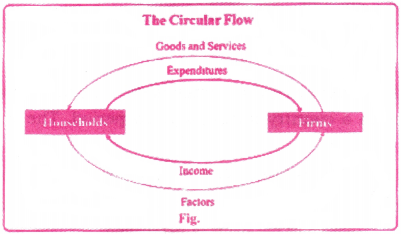
Question 7.
Net Value Added.
Answer:
Net Value Added (NVA) in National Income accounting defined as the value of output produced by a sector or industry minus the value of intermediate consumption and consumption of fixed capital. Essentially it measures the net contribution of a production unit to the economy after accounting for the inputs consumed and capital depreciation. It captures the real economic value generated by production activities, including intermediate inputs and capital wear and tear, providing a clearer picture of economic contributing within national income accounting.
Question 8.
CSO definition of National Income.
Answer:
According to the Central Statistical Organization (CSO), ‘National Income’ is the sum total of factor incomes generated by the normal residents of a country in the form of wages, rent, interest and profit in an accounting year.
Question 9.
GDP Deflator.
Answer:
The GDP Deflator is an economic measure that reflects the changes in the price levels of all goods and services produced domestically in an economy over a period, capturing inflation or deflation. It is used to convert nominal GDP, thereby showing how much of the GDP growth is due to price changes rather than the actual output increase.
GDP Deflation = \(\frac{Nominal GDP}{Real GDP}\)
Question 10.
Intermediary consumption.
Answer:
Intermediary consumption consists of the value of the goods and services consumed as inputs by a process of production, excluding fixed assets whose consumption is recorded as consumption of fixed capital, the goods or services may be either transformed or used up by the production processes.
Question 11.
Real GDP.
Answer:
Real GDP is the total value of the goods and services measured at constant prices. Since these prices remain fixed, if the Real GDP changes, we can be sure that it is the volume of production which is undergoing changes.
Question 12.
Production Taxes and Product Taxes.
Answer:
Taxes on Production: Taxes on production are to be paid by a firm by virtue of production of a good or service.
Eg.: registration fee, factory license fee, stamp duties, pollution tax etc. They are unrelated to the quantum of production. It means they do not depend on the actual volume of production.
Product Taxes: Product taxes are related to the quantum of production or actual volume of production and are levied by the government on goods and services like excise duties, customs, sales tax, service tax, etc.
Question 13.
Compute National income from the given table.
| Items | Amount (in cr.) |
| 1. Consumption | 600 |
| 2. Investment | 200 |
| 3. Government Purchases | 100 |
| 4. Exports | 100 |
| 5. Imports | 200 |
Answer:
X = C + I + G + (X – M)
C = 600 Crore rupees
I = 200 Crore rupees
G = 100 Crore rupees
X = 100 Crore rupees
M = 200 Crore rupees
Y = 600 + 200 + 100 + (100 – 200)
= 900 – 100
= 800 Crore rupees
So the National Income is 800 crore rupees.
One Word Answer Questions
Answer the following questions in ONE WORD.
Question 1.
The sum of Gross Domestic Product and net Factor Income from abroad is equal to:
Answer:
GNPMP
Question 2.
GDPFC minus Depreciation is equal to:
Answer:
NDPFC
Question 3.
The difference between GNPMP and NNPMP is equal to:
Answer:
Depreciation
Question 4.
GDP Deflator is equal to:
Answer:
\(\frac{Nominal GDP}{Real GDP}\) × 100
Question 5.
GVAMP minus Net Product Taxes is equal to:
Answer:
GVA at basic prices
Fill in the blanks
Question 1.
Prabhas working in Australia and sends money to his parents in India. Which concept of national income covers this item _____________.
Answer:
GNPMP
Question 2.
The goods and services produced within the boundaries of the country are known as _____________.
Answer:
Gross domestic Product
Question 3.
The market value of a rice is Rs. 40/- kg. But in PDS system, the government is charged Re. 1/ – i.e., the government is bearing Rs.39/- kg. This type of government expenditure is own as _____________.
Answer:
Subsidies
Question 4.
The main difference between NNPMP and NNPFC is equal to _____________.
Answer:
Net Indirect Taxes (NIT)
Question 5.
In India, National Income is calculated in _____________ and _____________ methods.
Answer:
Output, Income
Multiple Choice Questions
Question 1.
NNPMp is equal to :
1) GDPmp-D
2) GNPMp – D
3) GDPMp – D + NFIA
4) Both 2 & 3
Answer:
4) Both 2 & 3
Question 2.
The difference between GNPMp and GDPM is equals to:
1) Net domestic investment
2) Gross foreign investment
3) Gross factor income from abroad
4) Net factor income from abroad
Answer:
4) Net factor income from abroad
Question 3.
The difference between indirect taxes and subsidies:
1) Gross subsidies
2) Gross indirect taxes
3) Net indirect taxes
4) Net exports
Answer:
3) Net indirect taxes
Question 4.
Which of the following is not correct?
1) GDP Mp= C + I + G + (X-M)
2) GNPMp = C + I + G + (X-M) + NFIA
3) NNPMp = C + I + G + (X-M) + NFIA – D
4) NNP = C + I + G + (X-M) + NFIA – D + I.T – S
Answer:
4) NNP = C + I + G + (X-M) + NFIA – D + I.T – S
Question 5.
If Nominal GDP = Rs. 1000, Real GDP = Rs. 500, then GDP Deflator is equal to (in cr.):
1) 1000
2) 500
3) 1500
4) 200
Answer:
4) 200