AP Inter 1st Year Economics 6th Lesson Market Structure Questions and Answers
Essay Questions
Write an essay on the following questions.
Question 1.
Describe the classification of the markets.
Answer:
The term market, generally refers to a place, where buyers and sellers meet and where; exchange or buying and selling of goods take place.
According to Benham, market can be defined as “Any area over which buyers and sellers are in such arrangement (close touch) with each other directly or through dealers, so that the price obtainable in one part of the market affect the price paid in other parts’’.
Classification of markets:
1. Basing on Competition :
a) Perfect markets : Perfect markets are those markets where there are conditions of perfect competition, like large number of buyers and sellers, homogeneous good, uniform or single price, etc.
b) Imperfect markets : Imperfect markets are those markets where there are conditions of imperfect competition, like single / two / few sellers, differentiated products, different prices, etc.
2. Basing on Area :
a) Local market: A market with few sellers and few buyers covering a limited geographical area with limited demand and limited supply is called local market. Eg : Village market for perishable goods like milk, vegetables, etc.
b) National market : A market with sellers and buyers spread/located throughout the country and with demand and supply spread throughout the country is known as national market. Eg: Market for durable goods like sugar, wheat, cotton, etc.
c) International market : A market with demand and supply spread throughout the world and purchases and sales taking place with global buyers and global sellers, at international level is known as international market or global market.
3. Basing on Time :
a) Very short period market: It is a market relating to very short period time (less than 1 day) in which supply is absolutely fixed or constant. In this market, demand plays, all or very important role in the fixation of price in the market.
b) Short period market: It is a market relating to short period (covering a time period of more than 1 day, but up to 1 year) of time. In this market, supply can be changed partially by making changes in variable inputs. In this market, in the fixation of price demand plays greater role than supply.
c) Long period market: It is a market covering / relating to a long period of time (covering a time period of more than 1 year) in which supply can be fully adjusted by making changes both in fixed inputs and variable inputs. In this market, in the fixation of price, supply plays more important role than demand.
Question 2.
Explain the market equilibrium with the help of a diagram.
Answer:
Equilibrium is a state of rest, in which there is no tendency to change. It does not mean that there is no activity or movement, but the forces are in balance. Market equilibrium can therefore be defined as a state in which neither the sellers have a tendency to increase or decrease supply nor the buyers have a tendency to increase or decrease demand. In other words, market supply equals market demand.
The market supply refers to how much of the commodity, firms would wish to supply at different prices, and the market demand refers to how much of the commodity, the consumers would be willing to purchase at different prices.
The price at which market demand is equal to the market supply is called ‘equilibrium price’ (also called as market clearing price) and quantity bought and sold at this price is called ‘equilibrium quantity’.
The following table and diagram helps to understand the market equilibrium.
| Table : Demand and Supply Schedule | ||
| Price (Rs.) | Quantity Demanded (kgs) | Quantity Supplied (kgs) |
| 10 | 500 | 100 |
| 20 | 400 | 200 |
| 30 | 300 | 300 |
| 40 | 200 | 400 |
| 50 | 100 | 500 |
From table, we can understand that the market attains equilibrium at Rs.30 because at this price, market demand is equal to the market supply. Hence, the price, Rs. 30 in the table is called ‘equilibrium price’ (or) ‘market clearing price’. The quantity of 300 kgs at equilibrium price is called equilibrium quantity. If the price above the equilibrium price, there will be an ‘excess supply’, and if the price below the equilibrium price, there will be an ‘excess demand’. This can be shown in the figure. Such imbalance is called disequilibrium.
Equilibrium, Excess Demand and Excess Supply:
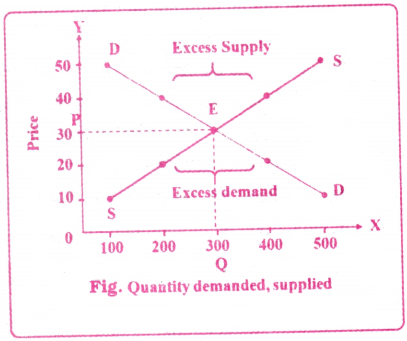
Figure illustrates equilibrium for a perfectly competitive market with a fixed number of firms.
Equilibrium occurs at the intersection of the market demand curve (DD) and market supply curve (SS). The point ‘E’ is the equilibrium point. Here, the equilibrium quantity is OQ and the equilibrium price is OP. The price greater than equilibrium price (OP), there will be an ‘excess supply’, and at a price below the equilibrium price (OP), there will be an ‘excess demand’ as shown in figure.
Question 3.
Analyse the equilibrium of a firm and industry in the long run under perfect competition.
Answer:
Equilibrium of the Industry : An industry consists of a large number of independent firms. Industry is said to be in equilibrium, if there is no tendency for new firms to enter and existing firms to exit. This situation prevails if all industries earn only normal profits. If some firms earn super normal profits, the new firms may enter. If any firms are incurring loss, some firms may choose to exit.
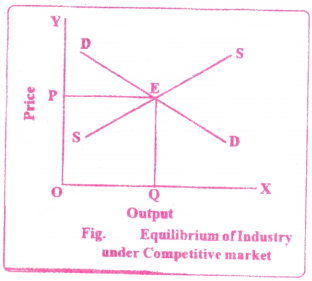
From the figure, we can see that point ‘E’ is industry demand and supply curves intersect. At this point, OP is the equilibrium price and OQ is the equilibrium quantity.
An industry is not in equilibrium, if some firms earn normal profits and other firms earn supernormal profits or losses.
Equilibrium of the Firm :
A firm is said to be in equilibrium when it maximizes its profit. The output which gives maximum profit to the firm is called equilibrium output or profit maximising output. In this state, the firm has no incentive to either increase or decrease its output.
Firms in a perfectly competitive market are price-takers and industry is a price maker. This is because, there are a large number of firms in the market producing identical (homogeneous) products. No single firm is able to influence the price determined by the industry. So that, firms have to accept the price determined through the interaction of total demand and total supply of the commodity which they produce. In other words, it is the market demand and market supply that determine the price. This is the equilibrium price. All firms accept this price and determine the quantity of their product. Firms do not determine the price.
Equilibrium conditions of a firm :
- Marginal Cost is equal to Marginal Revenue (MC = MR).
- Marginal Cost (MC) curve should cuts Marginal Revenue (MR) curve from the below. That means, MC curve has a positive slope.
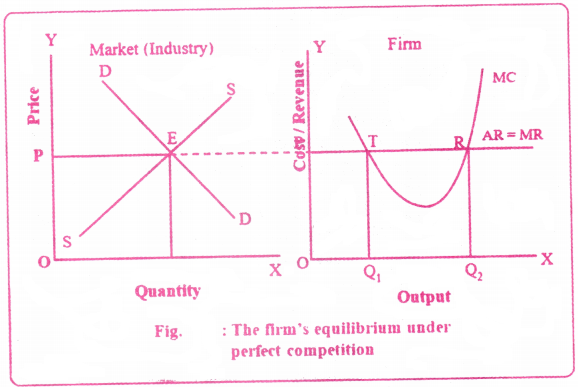
From the figure, the market price OP is fixed through the interaction of total demand and total supply of the industry. Firms have to accept this price as given and as such they are price-takers rather than price-makers. AR and MR are equal. AR = MR curve is the Demand Curve (AR) which is parallel to horizontal axis.
In the adjacent figure, firm attained the state of equilibrium at point ‘R’, where the MC curve is cutting the MR curve from below and where MC = MR.
MC = MR at point T also, where the MC curve cuts MR curve from above. If the firm stops output at this point, it will be losing opportunity to maximize its profits because MR > MC beyond T (OQ1 output).
Question 4.
Compare and contrast the different Market Structures under Imperfect Competition.
Answer:
| Features | Monopoly | Monopolistic Competition | Oligopoly | Duopoly |
| Number of firms. | Single seller | Many buyers and sellers | Few dominant sellers | Two dominent sellers. |
| Product differentiation | No close substitutes | Slight differentiation | Many other homogeneous (or) differential products | Can be homogeneous or differentiated. |
| Price control | Complete, with prices set well above marginal cost. | Limited ability to set prices due to substituted produces. | Significant, often through collusion or strategic interdependence. | High, with firms often mirroring each other’s pricing strategies. |
| Barriers to entry | Insurmountable | Low, allowing new firms to enter easily. | High due to economies of scale. | Extremely high as incumbents dominate the market. |
| Examples | Utility companies (Water, electricity) patented pharmaceuticals | Restaurants, clothing brands, coffee shops. | Airline industry, tele-communications, automotive manufacturers. | Boeing and Airbus in commercial Aircraft. |
| Economic impact | Allocative inefficiency, as output is lower and prices higher than socially optimal. | Firms operate with excess capacity in the long run leading to higher prices than perfect competition but lower than monopolies. | Prices are higher than in monopolistic competition, with profits sustained through cartel like behaviour. | – |
Question 5.
Write the features of Perfect Competition.
Answer:
Features of Perfect Competition : A market is said to be operate under perfect competition, when it has the following characteristic features:
- Large number of buyers and sellers : There must be a large number of buyers and sellers, so that any seller, or any buyer will not be able to influence the market price. The price of the product is determined by the collective forces of market demand and market supply.
- Homogeneous products : In perfect competition, the product of each firm produces a homogeneous product meaning, all products are identical in size, shape, quantity, quality and packaging. As a result, a single price prevails in the industry.
- Free entry or exit of firms : In this market, any firm can enter or exit the industry at will. This helps new firms to enter business when conditions are favourable. As long as a firm earns supernormal or normal profits, it stays in competition. But, when a firm incur losses, it would leave the market.
- Perfect mobility of factors of production : In this market, factors of production are free to move from one firm to another firm as per their desire. This is also useful for free entry and exit of firms. Factors of production (land, labour, capital) are free to move to the production activities where they get higher incomes.
- Absence of transport costs : Transport costs do not effect the prices of the commodities. Due to this, the price of the commodity will be the same throughout the market.
- Perfect market knowledge : It is assumed that both buyers and sellers have perfect knowledge of market conditions. Every buyer and seller knows the price of the product. In the absence of perfect knowledge, it is possible that some buyers may buy the commodity at higher prices when the same product is available at lower price.
- Profit maximisation : The primary goal of every firm is to maximise profits.
- No regulation by government: Government does not interfere in the market through price regulation, subsidies, or other means that could distort competition between firms.
Question 6.
Write about the concepts of Normal Profit and Super Normal Profit.
Answer:
Concepts of Normal Profit and Super Normal Profit : If the average revenue and average cost of the firm are equal, it earns normal profits. If average revenue is more than average cost, the firm earns supernormal or abnormal profits. If the average cost is more than average revenue, the firm incurs losses. This is shown in below diagrams.
Short run equilibrium – Super normal profits, normal profits and losses: Inperfect competition, even though all firms are following uniform price fixed by the industry, some firms enjoy with the supernormal profits, some firms may earn just normal profits and some other may incur losses. This is mainly due to differences in the firm’s cost conditions. This is explained with the help of the following figures.
1. Firm earning Super Normal Profits (AR > AC): A firm Y may earn supernormal profits or normal profits or incur losses in the short run. This is shown in figures.
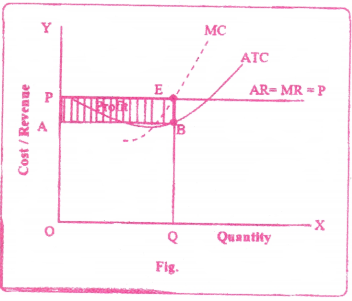
The figure depicts, the firm is in equilibrium at point ‘E’ where marginal revenue is equal to marginal cost (MC = MR). OQ is the equilibrium output for the firm. At this level of output, the average revenue (or) price per unit is EQ and average total cost is BQ. The firm’s profit per unit is EB (AR – ATC). Total profit is ABEP. (EB × OQ; OQ = AB). Applying the principle, Total Profit = TR -TC, we find totalprofit as the difference between OPEQ and OABQ which is equal to ABEP. It represents supernormal or abnormal profits.
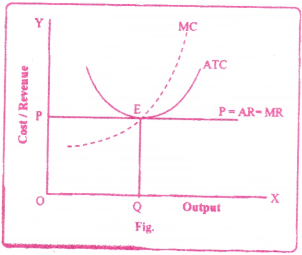
2. Firm earning Normal Profits (AR = AC): The figure, shows that the firm attained equilibrium at point ‘E’, where it’s MR = MC. The equilibrium output is OQ. At this level of output, price or AR covers full cost (ATC). Since AR = ATC (or) OP = EQ, the firm is just earning normal profits. Applying TR – TC, we find that TR – TC = zero (or) there is zero economic profit (or) no profit and no loss.
3. Firm incurring Losses (AR < AC): In the short run, some perfectly competitive firms may incur losses even at equilibrium state (MC=MR). But the firm try to minimise the losses so as to stay on the business. For all prices above the minimum point on the AVC curve, the firm will stay open and will produce the level of output at which MR = MC. When the firm is able to meet its variable cost and a part of fixed cost, it will try to continue production in the short run.
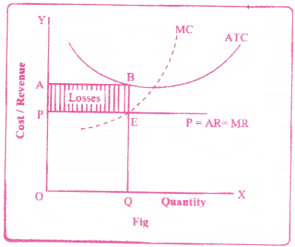
In the figure, point ‘E’ is the equilibrium point. At this point, the firm’s average total cost (ATC) curve lies above the firm’s average revenue (AR) curve and incurring a loss per unit worth of BE. Because, at this point, AR = EQ and ATC = BQ.
Question 7.
Explain price determination under perfect competition in long run.
Answer:
Equilibrium of a Competitive Firm : All perfectly competitive firms are in equilibrium in the long run when they have adjusted their plant so as to produce at the minimum point of their long run ATC curve, which is tangent to the demand curve defined by the market price.
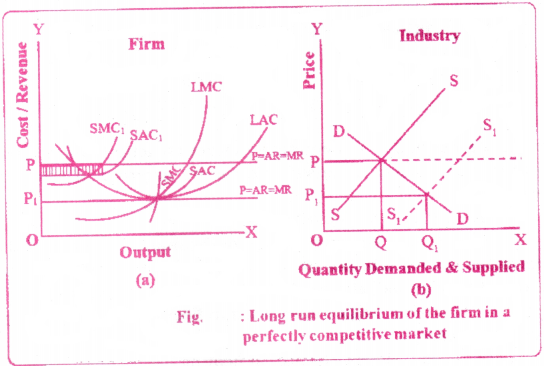
In the long run, all firms will be earning just normal profits, which are included in the ATC. If they are making supernormal profits in the short run, new firms will enter the industry. This will lead to an increase in supply and a fall in price (a downward shift in the individual demand curves) and an upward shift of the cost curves due to an increase in the prices of factors as the industry expands. New firms enter until all firms earn only normal profits. These changes will continue until the ATC is tangent to the demand curve (AR curve) at its minimum point. If the firms make losses in the short run, they will leave the industry in the long run. This will decrease supply and raise the price and costs may fall as the industry contracts. Exit of firms continue till all firms losses disappear and even firm get only normal profits.
The condition for long run equilibrium of the firm is that the marginal cost should be equal to the price and the long run average cost i.e.,
LMC = LAC = P.
The firm adjusts its plant size so as to produce that level of output at which the LAC is at its minimum position. At equilibrium, the short-run marginal cost is equal to the long run marginal cost and the short run average cost is equal to the long run average cost. Thus, in the long run we have,
SMC = LMC = SAC – LAC = P = MR
Short Answer Questions
Write the answers briefly for the following questions.
Question 1.
Discuss the features of perfect competition with reference to price determination.
Answer:
Perfect competition is a theoretical market structure characterized by specific features that collectively ensure prices are determined solely by supply and demand.
Reference to Price Determination :
Equilibrium Price : The intersection of the market demand and supply curves determines the equilibrium price. At this price, the quantity demanded equals the quantity supplied, eliminations shortages or surpluses,
- Demand Curve : Slopes downward, reflecting higher quantity demanded at lower prices.
- Supply curve : Slopes upward, indicating higher quantity supplied at higher prices.
Role of Firms as Price Takers: Individual firms adjust output to the equilibrium price but can’t set prices. For example, a wheat farmer must sell at the market price: changing more would drive buyers to competitors.
Long-run Adjustments :
- Supernormal Profits : Attract new firms, increasing supply and lowering prices until profits normalize.
- Losses : Cause firms to exit, reducing supply and raising prices until losses are eliminated.
In the long run, price equal to MC and ATC, ensuring efficient production.
Question 2.
Compare Perfect Competition and Monopoly.
Answer:
| Perfect Competition | Monopoly |
| 1. Large number of sellers. | 1. Single seller exists in the market. |
| 2. Free entry and free exit of firms. | 2. Restrictions on the entry of new firms. |
| 3. Homogeneous product. | 3. No close substitutes to the product. |
| 4. Difference between industry and firm. | 4. Both industry and firm are the same. |
| 5. Industry is a price maker and firms are price takers. | 5. Monopolist is a price maker. |
| 6. Uniform price prevails for the same good. | 6. Price distrimination is possible. |
| 7. Price, AR and MR are the same and the curve is parallel to the OX-axis. | 7. AR and MR curves are different and slope downwards from left to right. |
Question 3.
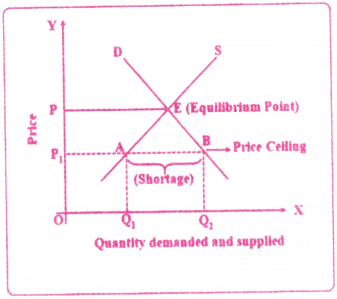
Explain the concepts of Price Floor and Price Ceiling.
Answer:
Price Floor:
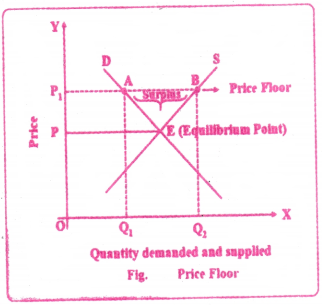
When the government imposes lower limit on the price that may be charged for a particular good or service, it is called a ‘price floor’. The most well-known examples of the imposition of price floors are agricultural price support programmes and the minimum wage legislation. Through agricultural price support programmes, the government imposes a lower limit on the purchase price for some agricultural goods. The price floor is normally set above the market determined price for these goods.
Price Ceiling:
When the government imposes an upper limit on the price of a good or service, it is called a ‘price ceiling’. A price ceiling is generally imposed on ‘essential items’ like wheat, rice, kerosene, and sugar. Price ceiling is fixed below the market-determined price if it is high. Since low income sections of the population will not be able to afford these goods at the market price.
Question 4.
What are the feature of Monopoly ? Explain the price determination under monopoly.
Answer:
Monopoly Features :
- A single firm produces the good in the market.
- No close substitutes for this good.
- Strong barriers exist for the entry of new firms into market, which means that there is no competition.
- Both industry and firm are one and the same.
- Monopolist determines the price (Price maker).
- The degree of Monopoly power depends on the price elasticity of demand, it is relatively high.
- Producer controls either the price of the good or the supply of the good. But he cannot control both simultaneously.
- The demand curve of a monopoly firm slopes downward from left to right, because the demand is relatively inelastic. This is because, there are no close substitutes.
- The monopolist practices price discrimination by charging different prices from different buyers to increase profits.
This practice depends on the differences in elasticity of demand.
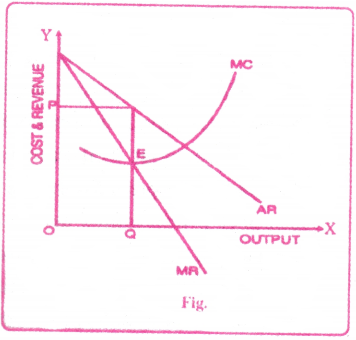
Price Determination : Fig. shows the equilibrium of a monopoly firm. AR and MR are downward sloping curves. The firm reaches its equilibrium when MC = MR. ‘E’ is the equilibrium point. OP is the equilibrium price, and OQ is the equilibrium output.
In the short-run a monopoly firm may earn supernormal profits or losses. But it earns only super normal profits in the long-run.
Question 5.
Define Monopolistic competition and write its features.
Answer:
In real world we rarely find perfect competition and monopoly. In the majority of cases, there is neither a single individual who controls the total supply, nor many sellers so that their individual shares are negligible in relation to the total supply of the market. Thus, the real situation is one of imperfect competition, where there is neither perfect competition nor absolute monopoly. This market situation is known as ‘Monopolistic Competition.
Eg.: Smart phones, soft drinks etc.
Prof. E. H. Chamberlin and Mrs. Joan Robinson pioneered this market analysis in economics. According to Chamberlin, the important characteristics of monopolistic competition are as follows:
Features:
- Large number of buyers and sellers.
- Product differentiation (Heterogeneous product).
- Freedom of entry and exit of firms.
- Competitive advertising (or) selling costs.
- Downward sloping and more elastic demand curve due to availability of close substitutes.
- Non-price competition.
- Normal profits in the long-run and finds the excess capacity.
- Relatively low degree of monopoly power.
This market is discussed in detail in higher classes.
Question 6.
Write the features of Oligopoly.
Answer:
Features :
- Very few sellers of the product.
- Interdependence of firms in decision making.
- Presence of monopoly power.
- Existence of price rigidity.
- Excessive expenditure on advertisement.
- Indeterminate demand curve due to high degree of interdependence among firms.
- Group behaviour.
Question 7.
Define the term Duopoly and write its features.
Answer:
Duopoly is a special form of oligopoly, where only two sellers produce the goods. It is also caracals a limited form of oligopoly. The goods produced by the producers may be homogenous or differentiated. As there are only two producers, both are aware that the decisions of one will affect the other. Rivalry and collusion of the producers are both possible in this market situation.
Features:
- Only two firms (sellers) of the product.
- Strategic interdependence.
- High level of market concentration.
Very Short Answer Questions
Question 1.
Normal Profits.
Answer:
If the average revenue and average cost of the firm are equal, it means normal profit. It is considered part of businesses total costs and is essential for long term sustainability, especially in perfectly competitive markets when, in the long run, firms tend to make only normal profit.
Question 2.
Equilibrium conditions of a firm under perfect competition.
Answer:
| i) Condition Equilibrium Rule | Short Run MC = MR = P | Long Run MC = MR = P = (Min ATC) |
| ii) Profit Level zero, or negation | Can be positive, | Zero (normal profit) |
| iii) Entry / Exit | Not possible | Free entry and exit. |
These conditions ensure that under perfect competition, each firm produces at the most efficient scale and has no incentive change its output or leave / enter the market.
Question 3.
Discriminating monopoly.
Answer:
A discriminating monopoly is a type of monopoly where a single firm dominates the market and changes different prices for the same product or service to different consumers or market segments, not based on cost differences but on consumers, willingness on ability to pay. This practice is also known as price discrimination. The main purpose of discriminating monopoly is to increase profits by extracting more consumer surplus.
Question 4.
Selling costs.
Answer:
Selling costs mean the costs incurred by business firms towards attracting customers and for the sale of the goods.
Eg : Advertising and publicity costs, free sampling, etc. Selling costs are very important in monopolistic competition and in oligopoly where there is severe or intense competition among the firms.
Question 5.
Duopoly.
Answer:
A market where there are two sellers or firms is known as duopoly. As there are only two firms in the market, each firm or seller will have comparatively large share in the market. In duopoly, there is close interdependence between firms and a lot of uncertainty in the behaviour of sellers.
Question 6.
Oligopoly.
Answer:
A market where there are few sellers (3 or 4 firms or sellers) is known as oligopoly. Such firms may produce either homogeneous good or differentiated product. There is severe competition and close interdependence among the firms in the market. There is a lot of uncertainty among the firms in the market.
Question 7.
Break even point.
Answer:
BEP is the level at which a businesse’s total revenue exactly equals its total costs (both fixed and variable), resulting in neither profit nor loss. At this point, a company has covered all its expenses, and any sales beyond this point generate profit. The BEP is where business covers all costs with zero profit or loss and is of a fundamental measure for business management.
Question 8.
Shut down point.
Answer:
In short-run, the firm continues to produce as long as the price (AR) remains greater than or equal to the minimum of AVC (AR > AVC). When the firm’s Average Revenue (AR) is less than Average Cost (AC) and equal to Average Variable Cost, it is continues to operate with losses. This situation is known as the shut down point, (AR = AVC).
Question 9.
Price ceiling.
Answer:
When a government imposes an upper limit on the price of a good or service it is called a price ceiling. It is generally imposed on essential items like wheat, rice, kerosene, and sugar. It is fixed below the market determined price if it is high. Low income people will not be able to afford these goods at the market price.
Question 10.
Price floor.
Answer:
When the government imposes lower limit on the price that may be changed for a particular good or service it is called a price floor. The most well known examples of the imposition of price floors are agricultural price support programmes and the minimum wage legislation.
One Word Answer Questions
Answer the following questions in ONE WORD.
Question 1.
The Average Revenue (AR) curve is also known as :
Answer:
Demand Curve
Question 2.
The firm’s demand curve in perfect competition is :
Answer:
Parallel to X axis (Horizontal)
Question 3.
Imposing upper limit on the price of good or service by the government is called:
Answer:
Price ceiling
Question 4.
When there is decrease in demand with unchanged supply of a good then equilibrium price?
Answer:
Decrease
Question 5.
In the long run, the industry is in equilibrium when all the firms in a perfectly competitive market earn :
Answer:
Normal Profits
Fill in the blanks
Question 1.
When average revenue is equals to Rs.20/- and average cost is equals to Rs. 15/- then the firm makes ___________ profits.
Answer:
Super normal
Question 2.
No close substitutes is a feature of a ___________ market.
Answer:
monopoly
Question 3.
P = AR = MR is a feature of a ___________ market structure.
Answer:
Perfect competition
Question 4.
‘Indeterminate demand curve’ is a feature of a ___________ market.
Answer:
Oligopoly
Question 5.
A point on supply curve at which firm earns only normal profit is called the ___________ point.
Answer:
Break even
Multiple Choice Questions
Question 1.
The price at where market demand is equal to market supply is known as :
1) Short run Price
2) Long run Price
3) Normal Price
4) Equilibrium Price
Answer:
4) Equilibrium Price
Question 2.
As shut-down point :
1) AR = AC
2) AR > A VC
3) AR < AVC
4) AR = AVC
Answer:
4) AR = AVC
Question 3.
Which of the following is not a feature of Monopoly?
1) One buyer and one seller
2) No close substitutes
3) One seller and many buyers
4) Full control over price by the seller
Answer:
1) One buyer and one seller
Question 4.
The condition of equilibrium of a firm in perfect competition is:
1) Average Revenue = Average Cost
2) Marginal Revenue > Marginal Cost
3) Average Revenue – Average Variable Cost
4) Marginal Revenue = Marginal Cost
Answer:
4) Marginal Revenue = Marginal Cost
Question 5.
Break-Even Point is a situation, where firm is in:
1) Profit
2) Loss
3) No profit and no loss
4) Can’t say anything
Answer:
2) Loss