AP Inter 1st Year Botany 3rd Lesson Morphology of Flowering Plants Questions and Answers
IV. Very Short Answer Questions
Question 1.
Differentiate fibrous roots from adventitious roots.
Answer:
| Fibrous roots | Adventitious roots |
| A bunch of roots that originate from the base of the stem are called fibrous roots. | Roots that originate from any other part of the plant other than the radicle are called adventitious roots. |
| Ex: Monocots | Ex: Banyan tree |
Question 2.
What is meant by pulvinus leaf base ? In members of which angiospermic family do you find them?
Answer:
- Swollen leaf base is called a pulvinus leaf base.
- It is found in plants of Leguminosae- (Fabaceae).
Question 3.
How do dicots differ from monocots with respect to venation?
Answer:
- In Dicots- reticulate venation is seen (Net like arrangement of Veins and Veinlets).
- In monocots- parallel venation is seen (Parallel arrangement of Veins).
Question 4.
How is a pinnately compound leaf different from a palmately compound leaf ? Explain with one example each.
Answer:
| Pinnate compound leaf | Palmate compound leaf |
| Leaflets are arranged on either side of the petiole(Rachis). | Leaflets are arranged at the tip of the petiole. |
| Ex : Neem | Ex : Bombax |
Question 5.
Differentiate between Racemose and Cymose inflorescence.
Answer:
| Racemose | Cymose |
| 1. Peduncle grows indefinitely. | 1. Peduncle grows definitely. |
| 2. Flowers are arranged in acropetal manner. | 2. Flowers are arranged in basipetal manner. |
Question 6.
Differentiate actinomorphic from zygomorphic flowers.
Answer:
| Actinomorphic flower | Zygomorphic flower |
| A flower that can be cut into two equal halves in any vertical plane. | A flower that can be cut into two equal halves in one longitudinal plane. |
| Ex: Hibiscus, Datura | Ex: Pea, Bean |
Question 7.
How do the petals in a pea plant are arranged ? What is such a type of arrangement called?
Answer:
- In the flower of the pea plant there are five, unequal petals, the largest standard petal / vexillum, overlaps the two lateral wing petals / alae.
- Wing petals in turn overlap two smallest anterior keel petals/carina.
- This type of corolla is called papilionaceous corolla.
- This type of arrangement of petals is called vexillary or descendingly imbricate aestivation.
Question 8.
What is meant by epipetalous condition? Give an example.
Answer:
Stamens are united with petals which is called epipetalous condition.
Ex: Datura, Solarium
Question 9.
Differentiate between apocarpous and syncarpous ovary.
Answer:
| Apocarpous ovary | Syncarpous ovary |
| All the carpels are free on the thalamus. | All the carpels are fused on the thalamus. |
| Ex. Lotus, Rose | Ex. Datura, Hibiscus |
Question 10.
Define placentation.What type of placentation is found in Dianthus?
Answer:
- The arrangement of ovules within the ovary is known as placentation.
- In “Dianthus” the placentation is “free central”.
Question 11.
What is meant by parthenocarpic fruit?
Answer:
- The fruit that is formed from the ovary without fertilization is called parthenocarpic fruit.
- Such fruits are seedless and commercially useful in juice industries.
Ex. Banana, Grapes.
Question 12.
What is the type of fruit found in mango ? How does it differ from that of coconut ?
Answer:
- In Mango, the fruit is known as Drupe.
- In Mango, the middle mesocarp is fleshy and edible.
- In coconut, the fruit is drupe, mesocarp is fibrous and not edible.
- In coconut, endosperm is edible.
Question 13.
What is meant by scutellum? In which type of seeds is it present?
Answer:
- Large shield shaped cotyledon is called scutellum.
- It is seen in monocot seeds.
Question 14.
Define with examples endospermic and non-endospermic seeds.
Answer:
Endospermic seeds or albuminous seeds:
The embryo doesn’t consume the entire endosperm. The seeds with endosperm are called endospermic seeds.
Ex :Maize, Wheat, Rice, Castor and Coconut.
Non-endospermic seeds or exalbuminous seeds or non-albuminous seeds:
The embryo consumes the entire endosperm during development. Seeds without endosperm are called non-endospermic seeds.
Ex: Pea, Gram and Beans
Question 15.
Write the floral formula of the Solatium plant.
Answer:
Ebr, Ebrl, 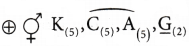
Question 16.
Give the technical description of ovary in Solanum nigrum.
Answer:
- In Solanum nigrum ovary is bicarpellary, syncarpous, bilocular, superior ovary, with many ovules on swollen axile placentation.
- Style terminal, stigma capitate.
- Carpels are arranged obliquely at 45°.
V. Short Answer Questions
Question 1.
Explain different regions of root with neat labelled diagram.
Answer:
A typical young root shows 4 regions.
- Region of root cap
- Region of meristematic activity
- Region of elongation
- Region of maturation
1. Region of root cap :
- The root is covered at the apex by a thimble-like structure called the root cap.
- It protects the apex of the root as it makes way through the soil.
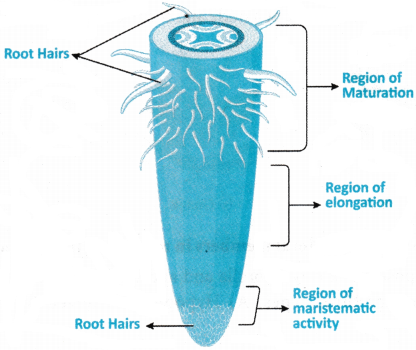
2. Region of meristematic activity:
- The cells of this region are very small, thin walled and with dense protoplasm.
- These cells divide repeatedly by mitosis and produce daughter cells.
3. Region of elongation :
- Cells proximal to the region of the meristematic zone undergo rapid elongation and enlargement.
- This region is responsible for the growth of the root in length.
4. Region of maturation :
- This region is proximal to the region of elongation.
- Cells in the elongation zone gradually differentiate and mature.
- From this region some of the epidermal cells form very fine and delicate thread like structures called “root hairs”.
- Root hairs absorb water and minerals from the soil.
Question 2.
Explain different types of phyllotaxy with examples.
Answer:
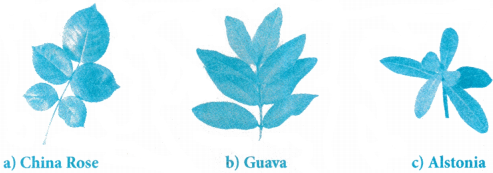
The pattern of arrangement of leaves on the stem or branches is called phyllotaxy.
Phyllotaxy is usually 3 types based on the number of leaves at each node.
They are
A) Alternate phyllotaxy,
B) Opposite Phyllotaxy, and
C) Whorled Phyllotaxy
A) Alternate phyllotaxy:
A single leaf arises at each node in an alternate manner.
Ex: Hibiscus rosa-sinensis (China rose), Mustard, Sunflower.
B) Opposite phyllotaxy:
- A pair of leaves arise at each node.
- They lie opposite to each other.
Ex: Calotropis, Guava.
C) Whorled phyllotaxy:
More than two leaves arise at a node and form a whorl.
Ex: Alstonia.
Question 3.
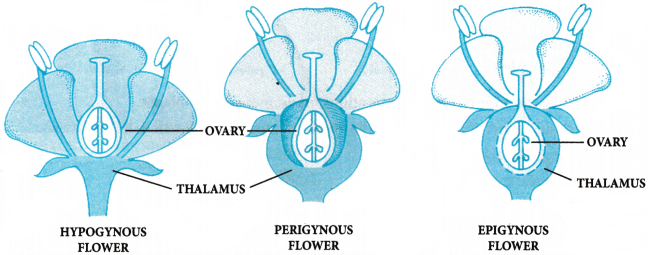
Describe the arrangement of floral members in relation to their insertion on thalamus.
Answer:
Based on the position of calyx, corolla and androecium on thalamus with respect to ovary; flowers are three types.
A) Hypogynous flower,
B) Perigynous flower
C) Epigynous flower.
A) Hypogynous flower:
- Thalamus is convex or cone-shaped.
- Gynoecium occupies the highest position on the thalamus.
- Other floral parts of the flower are situated below the gynoecium.
- Position of the ovary is superior.
Ex: Mustard, China rose, Brinjal.
B) Perigynous flower :
- Thalamus is saucer or shallow cup-shaped.
- Gynoecium is situated in the centre of the thalamus.
- Other floral parts of the flower are located on the rim of the thalamus almost at the same level.
- Position of the ovary is half inferior / half superior.
Ex: Plum, Rose, Peach.
C) Epigynous flower:
- Thalamus is deep cup shaped.
- The margins of the thalamus grow upward enclosing the ovary completely.
- Thalamus gets fused. with the ovary wall.
- Other floral parts of the flower arise above the ovary from the margin of the thalamus.
- Position of the ovary is inferior.
Ex : Guava, Cucumber, Ray and disc florets of sunflower.
Question 4.
The flowers of many angiospermic plants which show sepals and petals, differ with respect to the arrangement of sepals and petals in respective whorls. Explain.
Answer:
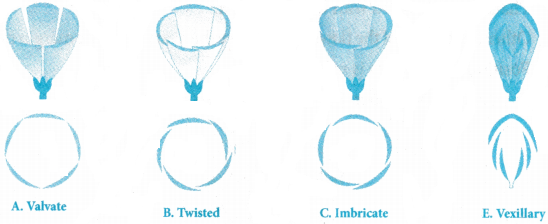
The mode of arrangement of sepals/ petals in a floral bud is known as aestivation.
It is of four types.
A) Valvate
B) Twisted
C) Imbricate
D) Vexillary
A) Valvate:
Sepals or petals in a whorl just touch one another at the margin without overlapping.
Ex: Calotropis.
B) Twisted:
One margin of the appendage (sepal/ petal) overlaps that of the next one.
Ex: China rose, Lady’s finger, Cotton.
C) Imbricate:
The margins of sepals/ petals overlap one another but not in any particular direction.
Ex: Cassia, Gulmohur.
D) Vexillary: (Papilionaceous / descendingly imbricate aestivation).
- It is commonly found in members of Fabaceae.
- Corolla has 5 petals.
- Largest standard petal overlaps the two lateral wing petals.
- Wing petals in turn overlap the two smallest anterior keel petals.
Ex: Pea, Bean.
Question 5.
Describe any four types of placentations found in flowering plants.
Answer:
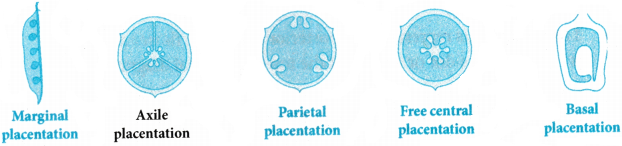
The arrangement of ovules within the ovary is known as placentation. It is of 5 types.
A) Marginal placentation
B) Parietal placentation
C) Axile placentation
D) Basal placentation
E) Free central placentation
A) Marginal placentation:
- The placenta forms a ridge along the ventral suture of the ovary.
- Ovules are borne on this ridge forming two rows.
Ex: Pea.
B) Axile placentation:
Placenta is axial and the ovules are attached to it in a multi locular ovary.
Ex: China rose, Tomato, Lemon.
C) Parietal placentation:
- Ovules develop on the inner wall of the ovary or on the peripheral parts.
- Ovary is one chambered (unilocular). But it becomes two chambered due to formation of false septum.
Ex: Mustard, Argemone.
D) Free central placentation :
Ovules are borne on the central columnar axis from the base without septum
Ex: Dianthns, Primrose.
E) Basal placentation:
Placenta develops at the base of the bvary, single ovule is attached to the placenta.
Ex: Sunflower, Marigold.
Question 6.
Write a brief note on semi technical description of a typical flowering plant.
Answer:
- The plant is described beginning with its habit, habitat, vegetative characters (root, stem and leaves) and then floral characters (inflorescence, flower and its parts) followed by fruit.
- After describing various parts of a plant, a floral diagram and floral formula are presented.
- The floral formula is represented by some symbols of floral parts.
- In the floral formula.
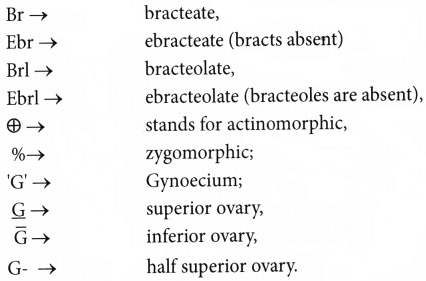
- Floral formula also indicates the number of free or united (within brackets) members of the corresponding whorl as subscript of the respective symbol.
- It also shows cohesion (union among similar members) and adhesion (union between dissimilar members).
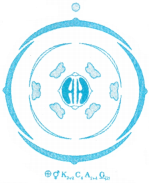
- A floral diagram provides information about the number of parts of a flower, their arrangement and the relation they have with one another.
- The mother axis represents the posterior side of the flower and is indicated as a dot or a circle at the top of the floral diagram.
- Calyx, corolla, androecium and gynoecium are drawn in successive whorls, calyx being the outermost and the gynoecium being in the centre represented by a diagram of T.S. of ovary.
- The bract represents the anterior side of the flower and is indicated at the bottom of the floral diagram.
Question 7.
Give an account of the floral diagram.
Answer:
- A floral diagram provides information about the number of parts of a flower, their arrangement and the relation they have with one another.
- The mother axis represents the posterior side of the flower and is indicated as a dot or a circle at the top of the floral diagram.
- Calyx, corolla, androecium and gynoecium are drawn in successive whorls, calyx being the outermost and the gynoecium being in the centre.
- The bract represents the anterior side of the flower and is indicated at the bottom of the floral diagram.
Question 8.
Draw the labelled diagram of the following.
i) Gram seed
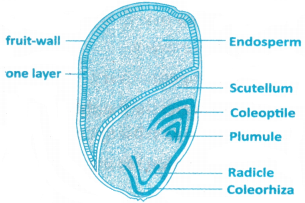
ii) V.S. of maize seed
Answer:
i) Gram seed
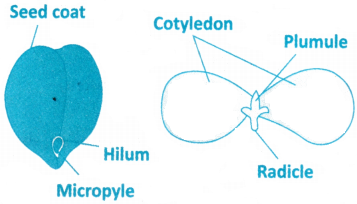
ii) V.S. of maize seed
VI. Long Answer Questions
Question 1.
What is a flower ? Describe the parts of a typical angiosperm flower.
Answer:
A flower is a reproductive unit of an angiosperm plant that performs sexual reproduction. It is a modified stem with a condensed axis. A typical flower has four different kinds of whorls arranged successively on the swollen end of the pedicel called thalamus or receptacle. The parts of a flower include : Calyx, Corolla, Androecium and Gynoecium. Calyx and corolla are called accessory organs whereas Androecium and Gynoecium are called reproductive organs.
1. Calyx:
- It is the outermost whorl of a flower. It is made up of units called sepals.
- It is generally green in colour, leaf-like and protects the flower in the bud condition.
- The calyx may be gamosepalous(Sepals united) or polysepalous (Sepals free).
2) Corolla:
- It is the whorl present inner to the Calyx.
- It consists of petals. The petals are brightly coloured to attract the insects for pollination.
- It may be gamopetalous (Petals United) or polypetalous (Petals free).
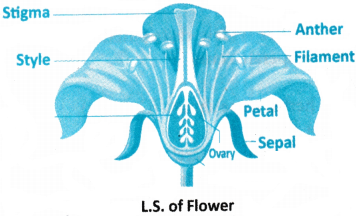
3. Androecium:
- It is the whorl present next to the corolla.
- The androecium mainly consists of stamens which are the male reproductive unit of a flower.
- A stamen is composed of two parts i.e. anther and filament.
- The anther is the bilobed structure and each lobe has two chambers called pollen sacs.
- The stalk of the stamen is called a filament. Inside the anther, pollen grains are formed.
- A sterile stamen is called staminode.
- Stamens of a flower may be united with other floral parts.
- When stamens are attached to petals, they are Epipetalous (Brinjal), when attached to the perianth- they are called Epiphyllous (Lily).
- The stamens in a flower may be free (Polyandrous) or may be united among themselves.
- They may be Monadelphous- the filaments of all the stamens may be united into Diadelphous- into two bundles (Pea)
- Polyadelphous- into more than two bundles (Citrus).
- In Salvia, didynamous stamens are seen meaning two longer and two shorter stamens in a flower.
- In mustard- Tetradynamous stamens are seen, meaning four are longer and two are shorter.
4. Gynoecium:
- The innermost whorl and female reproductive part of a flower is called gynoecium.
- It consists of carpels. A carpel is composed of three parts: stigma, style and ovary.
- Ovary is the enlarged basal part on which lies the style.
- The style connects the ovary to the stigma.
- The stigma is the receptive surface for pollen grains.
- Each ovary bears one or more ovules attached to a flattened cushion like placenta.
- When more than one carpel is present, they may be free (Lotus, Rose) and are called apocarpous or fused they are syncarpous (Mustard, Tomato).
- After fertilization, the ovary develops into fruit and ovules develop into seeds.
Question 2.
Write about the key characteristics of Solanaceae ?
Answer:
- It is commonly called the ‘potato family and includes about 3200 species belonging to 85 genera.
- Members of this family are widely distributed in mesophytic habitats of tropical, subtropical and even temperate zones.
Vegetative Characters:
- Habit: Plants mostly herbs, some shrubs (Cestrum).
- Root system : Tap root system.
- Stem : Aerial, erect, herbaceous or rarely woody, cylindrical, solid or hollow, hairy or glabrous. Underground stem is tuber in Potato.
- Leaves: Alternate phyllotaxy, exstipulate, petiolate, simple or rarely pinnately compound leaf with reticulate venation.
- Inflorescence : Cymose, axillary as in Solanum.
- Flower : Actinomorphic, bisexual, pentamerous, hypogynous.
- Calyx: Sepals five, gamosepalous, persistent, valvate aestivation.
- Corolla : Petals five, gamopetalous, valvate aestivation.
- Androecium : Stamens five, epipetalous
Gynoecium : Bicarpellary, syncarpous, bilocular, superior ovary, placenta is swollen with many ovules on axile placentation, style terminal, stigma capitate. Carpels are arranged obliquely at 45°.
- Fruit: Berry (Capsicum, Solanum, Lycopersicon) or capsule (Datura, Nicotiana).
- Seed : Many, endospermic, dicotyledonous
- Floral Formula : Ebr, Ebrl,
I. Multiple Choice Questions
Question 1.
The type of root system commonly found in dicot plants is
1. Tap root system
2. Fibrous root system
3. Adventitious root system
4. Rhizoids
Answer:
1. Tap root system
Question 2.
A few millimeters above the root cap, what region can be found
1. Elongation
2. Maturation
3. Meristematic activity
4. Root hairs
Answer:
3. Meristematic activity
Question 3.
The stem develops from
1. Hypocotyl
3. Epicotyl
3. Radicle
4. Plumule
Answer:
4. Plumule
Question 4.
Arrangement of flowers on floral axis is called
1. Placentation
2. Phyllotaxy
3. Inflorescence
4. Aestivation
Answer:
3. Inflorescence
Question 5.
In a cymose inflorescence, the main axis
1. Terminates with a flower
2. Has unlimited growth but lateral branches ends with a flower
3. Has limited growth, do not ends with a flower
4. Shows acropetal arrangement of flowers
Answer:
1. Terminates with a flower
Question 6.
Arrangement of ovules within the ovary is known as
1. Aestivation
2. Placentation
3. Cohesion
4. Adhesion
Answer:
2. Placentation
Question 7.
The basal bulged part of the carpel is
1. Filament
2. Ovary
3. Style
4. Stigma
Answer:
2. Ovary
Question 8.
Name the aestivation where the standard petal overlaps the two wing petals, which then overlap the two smaller keel petals.
1. Twisted
2. Valvate
3. Vexillary
4. Alternate
Answer:
3. Vexillary
Question 9.
The main characteristic feature of a drupe.
1. Stony mesocarp
2. Stony endocarp
3. Fleshy seed coat
4. Stony pericarp
Answer:
2. Stony endocarp
Question 10.
After fertilization, ovule develops into
1. Seed
2.Fruit
3. Flower
4. Root
Answer:
1. Seed
Question 11.
Non-endospermic monocot seed
1. Rice
2.Maize
3. Wheat
4. Orchid
Answer:
4. Orchid
Question 12.
The placentation in Solanaceae family members
1. Parietal placentation
2.Basal placentation
3. Marginal placentation
4. Axile placentation
Answer:
4. Axile placentation
Question 13.
Persistent calyx can be seen in
1. Pea
2. Brinjal
3. Lily
4. Brassica
Answer:
2. Brinjal
II. Fill In the Blanks
Question 1.
Radicle develop into ____________ of the plant.
Answer:
Primary Root system
Question 2.
Reticulate venation is a characteristic feature of ____________ Plants.
Answer:
Dicots
Question 3.
The flowers in racemose inflorescence are arranged in ____________ succession.
Answer:
Acropetal
Question 4.
The first and outermost whorl of a flower is ____________.
Answer:
Calyx
Question 5.
Epiphyllous conditions can be seen in ____________.
Answer:
Lily
Question 6.
The function of stigma is to receive ____________.
Answer:
Pollen grains
Question 7.
The sheath enclosing the radicle in a monocot seed is called ____________.
Answer:
Coleorhiza
Question 8.
Seeds with an endosperm are called ____________ seeds.
Answer:
Endospermic / Albuminous
Question 9.
The ovary of Solanum nigrum is bicarpellary, syncarpous and ____________ locular.
Answer:
Bi
Question 10.
In semi-technical description of a flower G stands for ____________ ovary.
Answer:
Superior
III. One Word Answer Questions
Question 1.
What is the role of root hair?
Answer:
Absorption of water
Question 2.
What is the swollen leaf base in leguminous plants called?
Answer:
Pulvinus
Question 3.
What is the arrangement of veins in the leaf called?
Answer:
Venation
Question 4.
What type of phyllotaxy is seen in Alstonia?
Answer:
Cyclic or whorled
Question 5.
What is the flower with both androecium and gynoecium called?
Answer:
Bisexual
Question 6.
In which type of flower does the gynoecium occupy the highest position?
Answer:
Hypogynous
Question 7.
What is the function of sepals in the bud stage?
Answer:
Protection of inner floral leaves
Question 8.
In vexillary aestivation, what is the largest petal called?
Answer:
Standard or vexillum
Question 9.
What is a sterile stamen called?
Answer:
Staminode
Question 10.
What connects the ovary to the stigma?
Answer:
Style
Question 11.
What is the middle fleshy part of the pericarp in mango fruit called?
Answer:
Mesocarp
Question 12.
How many cotyledons are present in the embryo of wheat and maize?
Answer:
One
Question 13.
Name the two layers of the dicot seed coat?
Answer:
Testa and tegmen
Question 14.
What is the large shield-shaped cotyledon in grass seed called?
Answer:
Scutellum
Question 15.
In the floral formula, “Br”stands for?
Answer:
Bracteate