AP Inter 1st Year Botany 5th Lesson Cell: The Unit of Life Questions and Answers
IV. Very Short Answer Questions
Question 1.
What is the significance of vacuole in a plant cell ?
Answer:
Vacuole plays an important role in osmoregulation and also contains sap mainly composed of water.metabolic byproducts,excretions,other waste materials and pigments like anthocyanins.
Question 2.
What does ‘S’ refer to in 70S & 80S ribosomes ?
Answer:
“S” stands for the sedimentation coefficient’ (expressed in the Svedberg unit). It is indirectly a measure of density and size of ribosbmes.
Question 3.
What is the function of a polysome ?
Answer:
Several ribosomes attach to a single m-RNA and form a chain called polyribosomes (or) polysome. The ribosomes of a polysome translate the genetic message of one m-RNA into proteins.
Question 4.
What is referred to as a satellite in some chromosomes ?
Answer:
A few chromosomes have non- staining secondary constrictions at a constant location. A round terminal part of the chromosome present beyond the secondary constriction is called satellite and such chromosomes are called satellite chromosomes.
Question 5.
What is middle lamella made of? What is its functional significance ? [March-26]
Answer:
Middle lamella is mainly made of calcium pectate and magnesium pectate.lt holds or glues the different neighbouring cells together.
Question 6.
What is osmosis?
| a) Cristae | i) Flat membranous sacs in stroma of chloroplast |
| b) Mesosome | ii) Infoldings in mitochondria |
| c) Thylakoids | iii) Disc-shaped sacs in Golgi apparatus |
| d) Cisternae | iv) Infoldings of plasma membrane in bacteria |
Answer:
| a) Cristae | ii) Infoldings in mitochondria |
| b) Mesosome | iv) Infoldings of plasma membrane in bacteria |
| c) Thylakoids | i) Flat membranous sacs in stroma of chloroplast |
| d) Cisternae | iii) Disc-shaped sacs in Golgi apparatus |
V. Short Answer Questions
Question 1.
Briefly describe the cell theory.
Answer:
- In 1838, Mathias Schleiden, a German botanist, examined a large number of plants and observed that all plants are composed of different kinds of cells which form the tissues.
- Theodor Schwann in 1839, a German zoologist, studied different types of animal cells and reported that all cells possess an outer layer called “Plasma membrane”.
- He also concluded that plant cells have a characteristic cell wall that differentiates from animal cells.
- Schwann proposed the hypothesis that the bodies of animals and plants are composed of cells and products of cells.
- On the basis of these points, both Schleiden and Schwann together formulated cell theory. But they failed to explain how new cells are formed.
- Rudolf Virchow (1855) first explained that cells divide and new cells are formed from pre-existing cells (Omnis cellula-e cellula).
- He modified the hypothesis of Schleiden and Schwann to give the cell theory a final shape.
- Cell theory states that, all living Organisms are composed of cells and products of cells.
- Cell is the structural and functional unit of living organisms .
- All cells arise from pre-existing cells.
Question 2.
Give the biochemical composition of plasma membrane. How are lipid molecules arranged in the membrane?
Answer:
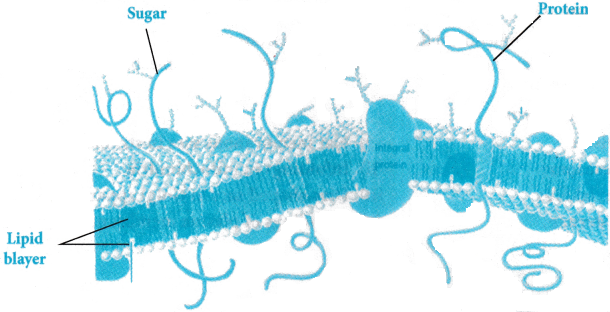
- Plasma membrane is chemically composed of lipids, proteins and carbohydrates.
- So, plasma membrane is lipo-proteinaceous in nature.
- Depending on the location and ease of extraction, membrane proteins can be classified as integral and peripheral.
- Integral proteins are partially or totally buried in the membrane, whereas peripheral proteins lie on the surface of the membrane.
- In the cell membrane lipids are ararnged in bilayer.
- The lipids are arranged within the membrane with the polar (hydrophilic) head towards the outer side and the non-polar (hydrophobic) tails towards the inner part, which ensures that the non-polar tail of saturated hydrocarbons is protected from the aqueous environment.
- Widely accepted model of plasma membrane is the “Fluid mosaic model” improved by Singer and Nicolson. According to this, the quasi-fluid nature of lipids, enables lateral movement of proteins within the overall bilayer.
Question 3.
Distinguish between active transport and passive transport?
Answer:
| Active transport | Passive transport |
| 1. Movement of molecules or ions across the membrane through carrier proteins by utilizing metabolic energy. | 1. Movement of molecules across the membrane without utilizing metabolic energy. |
| 2. It is carried against concentration gradients (Lower to higher conc.) Ex : Na+, K+ |
2. It is carried along concentration gradients (Higher to lower). Ex : Diffusion, osmosis |
Question 4.
What are the characteristics of a prokaryotic cell?
Answer:
- Most prokaryotes, particularly bacterial cells, have a chemically complex cell envelope.
- Cell envelope consists of glycocalyx, cell wall and cell membrane.
- Glycocalyx may be in loose sheath form called slime layer (or) thick and tough form called capsule.
- There is no well-defined nucleus.
- The genetic material is naked and is not enveloped by nuclear membrane.
- DNA is double stranded, circular, without histones (Naked) called genophore and the area is called nucleoid.
- Prokaryotes like some bacteria possess extra chromosomal DNA called plasmid.
- Prokaryotes lack membrane bound organelles.
- 70S type of Ribosomes are present in the cytoplasm.
- Prokaryotes have invaginations in the cell membrane called ‘Mesosomes’.
- Some bacterial cells are able to move with flagella.
- Flagella has three parts namely basal body, hook and filament which is the longest portion. Flagella play a role in motility.
- Besides flagella, pili and fimbriae are present.
- Pili are elongated tubular structures.
- Fimbriae are small bristle-like fibres and are useful for attachment of bacteria to rocks, in streams and also to the host tissues.
- Division of cells takes place amitotically.
Question 5.
Explain the structure of the cell organelle which contain chlorophyll, with a neat labelled diagram.
Answer:
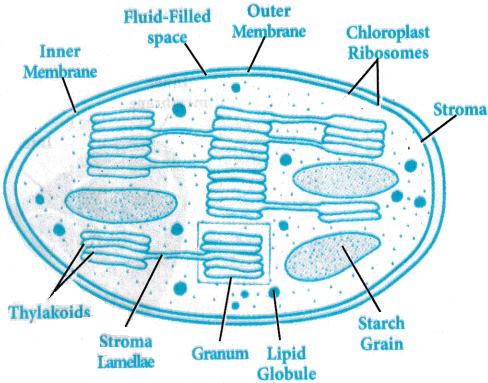
- The cell organelle which contains chlorophyll pigments is chloroplast.
- These are green coloured plastids found in all green plant parts i.e., mesophyll cells of the leaves.
- Each chloroplast is bounded by a double membrane envelope and the gap present between the two membranes is called peri plastidial space of about 10 nm wide.
- It contains an inner space called stroma containing photosynthetic enzymes, circular, naked d.sDNA, RNA and 70S ribosomes.
- At certain places, flattened membranous sacs are present called thylakoids. They are arranged in stacks like the pile of coins called Grana.
- The large number of lipoprotein membranes present between grana are called stroma lamellae (or) stroma thylakoids.
- The empty space present in each thylakoid is called lumen.
- Chlorophylls and carotenoids which are present in the membranes of thylakoids are responsible for trapping light energy.
- DNA present in a chloroplast helps in self duplication. So they are called semi- autonomous cell organelles.
Functions:
- Chloroplasts are mainly concerned with assimilation of food materials by photosynthetic process.
- Light reaction of photosynthesis takes place in grana and carbon fixation (dark reaction) takes place in the stroma region.
Question 6.
Explain the structure of the cell organelle which is known as ‘Powerhouse of the cell’ with a neat labelled diagram.
Answer:
- ‘Mitochondria’ are commonly called powerhouses of cell.
- Mitochondria occur in all eukaryotic cells.
- Mitochondria is sausage – shaped or cylindrical having a diameter of 0.2 -1.0 Micrometer and a length of 1.0 – 4.1 Micrometer.
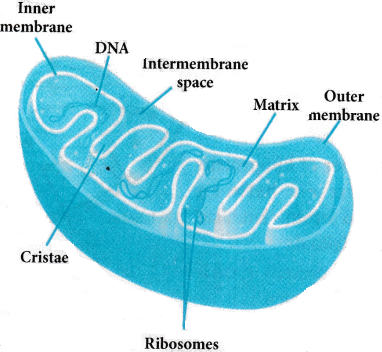
- Mitochondria is a double membrane bound cell organelle and the space present between the two membranes is called peri mitochondrial space.
- Outer membrane is continuous while the inner membrane forms a number of infoldings called cristae.
- Many stalked particles present on the.surface of the cristae are called F0 – F1 particles.
- Inner space of mitochondria is filled with a fluid matrix which contains circular, naked dsDNA, RNA, 70S ribosomes and respiratory enzymes.
- Krebs cycle of aerobic respiration occurs in matrix and electron transport takes place in cristae.
- Mitochondria divide by fission.
Functions:
Mitochondria are concerned with cellular respiration and are involved in oxidation of food material. They produce energy in the form of ATP and hence are called powerhouses of cell.
Question 7.
Differentiate between rough endoplasmic reticulum (RER) and smooth endoplasmic reticulum (SER).
Answer:
| RER | SER |
| 1. Ribosomes are present on the outer surface of the membrane. | 1. Ribosomes are absent on the outer surface of the membrane. |
| 2. It is formed of cisternae and tubules. | 2. It is formed of vesicles and tubules. |
| 3. It takes part in the synthesis of proteins and enzymes. | 3. It takes part in the synthesis of lipids and steroids. |
| 4. RER is internal and is connected with nuclear membrane. | 4. SER is external and is connected with plasma membrane. |
| 5. It may develop from nuclear membrane. | 5. It may develop from RER. |
| 6. It forms lysosomes through Golgi complex. | 6. It forms sphaerosomes. |
| 7. Detoxification enzymes are absent. | 7. Detoxification enzymes are present. |
| 8. It is also called Granular ER. | 8. It is also called Agranular ER. |
Question 8.
Explain the structure of the nucleus with a neat labelled diagram.
Answer:
- Nucleus as a cell organelle was first described by Robert Brown.
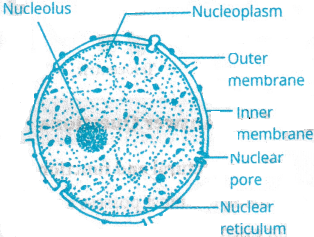
- Nucleus is also a double membrane bound cell organelle and the space present between the two membranes is called perinuclear space.
- Nucleus consists of highly extended and élaborated nucleoprotein fibres called chromatin, nuclear matrix and one (or) more spherical bodies called nucleoli.
- Outer membrane of the nucleolar envelope usually remains continuous with the E.R. and also bears 80S ribosomes on it.
- At a number of places the nuclear envelope is interrupted by minute pores called nuclear pores which connect the nucleoplasm with cytoplasm for the movement of RNA and protein molecules.
- The nuclear matrix (or) the nucleoplasm contains nucleolus and chromatın.
- Chromatin contains DNA and some basic proteins called histones, some non-histone proteins and RNA.
- Chromatin transforms into chromosomes during cell division.
- Nucleoli are spherical structures present in the nucleoplasm.
- The content of the nucleolus is continuous with the rest of the nucleoplasm as it is not a membrane bounded structure.
- Nucleolus is the site for active r-RNA synthesis.
- Larger and more numerous nucleoli are present in the cells which are actively carrying out protein synthesis.
Function :
Nucleus controls and regulates the functions of the cell.
Question 9.
Classify the chromosomes on the basis of centromere location.
Answer:
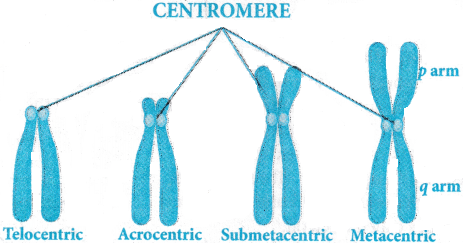
A chromosome with one centromere is called a monocentric chromosome. Based on the position of centromere, monocentric chromosomes are four types. They are,
a) Metacentric:
Centromere present in the middle point of the chromosome. So both arms of the chromosomes are equal in length. Chromosome appears L-shaped during anaphase of cell division.
b) Sub-metacentric:
Centromere is slightly away from the centre of the chromosome. So, the chromosome has two unequal arms. During anaphase such chromosomes appear as ‘L’ shaped.
c) Acrocentric:
In a chromosome, centromere is situated close to its end forming one extremely short and one very long arm. So chromosomes appear as ‘J’ shaped during anaphase.
d) Telocentric:
Centromere is present at the terminal end of chromosome. So the telocentric chromosome has only one arm. During anaphase it appears ‘I’ shaped.
VI. Long Answer Questions
Question 1.
What structural and functional attributes must a cell have to be called a living cell ?
Answer:
- A living cell must possess a plasma membrane to define its boundaries, contain cytoplasm for essential cellular processes, and have genetic material (DNA) for heredity and cell function.
- Additional attributes include being composed of protoplasm, which may be covered by a cell wall, and possessing at least some sub-cellular organelles like ribosomes.
Structural Attributes:
Plasma Membrane:
This outer covering separates the cell’s internal environment from the outside, allowing selective passage of materials.
Cytoplasm:
The semi-fluid matrix within the cell where various cellular components and chemical reactions occur.
Genetic Material (DNA):
This material, found in chromosomes or a nucleus, carries the cell’s genetic information and is responsible for heredity.
Protoplasm:
The living substance within the cell, bounded by the plasma membrane, and may be covered by a cell wall in some cases.
Sub-cellular Organelles (e.g., ribosomes):
These structures within the cytoplasm carry out specific functions essential for cell life.
Functional Attributes:
Metabolism:
Living cells must be capable of carrying out various metabolic processes, including energy production, nutrient processing, and waste excretion.
Regulation and Homeostasis:
Cells must be able to regulate their internal environment and maintain a stable internal state.
Response to Stimuli:
Living cells must be able to detect and respond to changes in their environment.
Adaptation and Reproduction:
Cells must be able to adapt to their environment through changes in DNA and reproduce to perpetuate life.
Question 2.
Write the functions of the following.
a) Centromere
b) Cell wall
c) Smooth ER
d) Golgi apparatus
Answer:
a) Functions of centromere:
- Centromere (or) primary constriction divides the chromosomes into two equal arms (or) two unequal arms based on its position in the chromosomes.
- Centromere has disc shaped structures on its either side called kinetochores, which are the sites of implantation of spindle fibres during cell division.
- Thus helpful in the formation of daughter chromosomes during cell division.
b) Functions of a cell wall:
- It gives shape to the cell.
- It protects the cell from mechanical damage and infection.
- It helps in cell-to-cell interaction.
- It acts as a barrier to undesirable macro molecules.
c) Functions of smooth E.R :
- Smooth endoplasmic reticulum is the major site for synthesis of lipids.
- In animal cells, lipids – like steroidal hormones are synthesized in smooth endoplasmic reticulum.
d) Functions of golgi apparatus:
- Golgi apparatus is the important site of formation of glycoproteins and glycolipids.
- In plants, golgi apparatus involved in the synthesis of cell wall materials like cellulose, hemi cellulose etc.
- It plays a role in the formation of cell plates during cell division.
- Golgi apparatus is involved in the formation of lysosomes.
Question 3.
Describe the structure of the following with the help of labelled diagrams.
a) Nucleus
b) T.S. of flagellum
Answer:
a) Nucleus:
- Nucleus as a cell organelle was first described by Robert Brown.
- Nucleus is also a double membrane bound cell organelle and the space present between the two membranes is called perinuclear space.
- Nucleus consists of highly extended and elaborated nucleoprotein fibres called chromatin, nuclear matrix and one (or) more spherical bodies called nucleoli.
- Outer membrane of the nucleolar envelope usually remains continuous with the E.R. and also bears 80S ribosomes on it.
- At a number of places the nuclear envelope is interrupted by minute pores called nuclear pores which connect the nucleoplasm with cytoplasm
- for the movement of RNA and protein molecules.
- The nuclear matrix (or) the nucleoplasm contains nucleolus and chromatin.
- Chromatin contains DNA and some basic proteins called histones, some non-histone proteins and RNA.
- Chromatin transforms into chromosomes during cell division.
- Nucleoli are spherical structures present in the nucleoplasm.
- The content of the nucleolus ft continuous with the rest of the nucleoplasm as it is not a membrane bounded structure.
- Nucleolus is the site for active r-RNA synthesis.
- Larger and more numerous nucleoli are present in the cells which are actively carrying out protein synthesis.
Function:
Nucleus controls and regulates the functions of the cell.
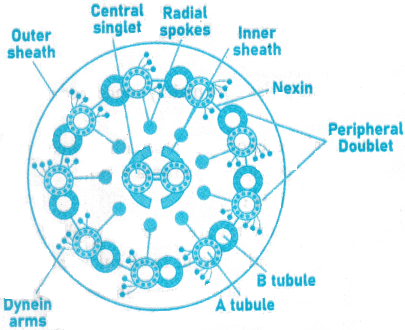
T.S of flagellum:
- The electron microscopic study of the flagellum shows that they are covered with plasma membrane.
- Their core, called the axoneme, possesses a number of microtubules running parallel to the long axis.
- The axoneme usually has nine doublets of radially arranged peripheral microtubules, and a pair of centrally located microtubules.
- Such an arrangement of axonemal microtubules is referred to as the 9 + 2 array.
- The central tubules are connected by bridges and are also enclosed by a central sheath, which is connected to one of the tubules of each
- peripheral doublets by a radial spoke.
- Thus, there are nine radial spokes.
- The peripheral doublets are also interconnected by linkers.
- Both the cilium and flagellum emerge from centriole-like structures called the basal bodies.
Question 4.
Name two cell- organelles that are double membrane bound. State their functions and draw labelled diagrams of both.
Answer:
Chloroplast:
- The cell organelle which contains chlorophyll pigments is chloro¬plast.
- These are green coloured plastids found in all green plant parts i.e., mesophyll cells of the leaves.
- Each chloroplast is bounded by a double membrane envelope and the gap present between the twO membranes is called peri plastidial space of about 10 nm wide.
- It contains an inner space called stroma containing photosynthetic enzymes, circular, naked dsDNA, RNA and 70S ribo-somes.
- At certain places, flattened membranous sacs are present called thylakoids. They are arranged in stacks like the pile of coins called Grana.
- The large number of lipoprotein membranes present between grana are called stroma lamellae (or) stroma thylakoids.
- The empty space present in each thylakoid is called lumen.
- Chlorophylls and carotenoids which are present in the membranes of thylakoids are responsible for trapping light energy.
- DNA present in a chloroplast helps in self duplication. So they are called semi- autonomous cell organelles.
Functions:
- Chloroplasts are mainly concerned with assimilation of food materials by photosynthetic process.
- Light reaction of photosynthesis takes place in grana and carbon fixation (dark reaction) takes place in the stroma region.
Mitochondria:
- ‘Mitochondria are commonly called powerhouses of cell.
- Mitochondria occur in all eukaryotic cells.
- Mitochondria is sausage – shaped or cylindrical having a diameter of 0.2 -1.0 Micrometer and a length of 1.0 – 4.1 Micrometer.
- Mitochondrion is a double membrane bound cell organelle and the space present between the two membranes is called peri mitochondrial space.
- Outer membrane is continuous while the inner membrane forms a number of infoldings called cristae.
- Many stalked particles present on the surface of the cristae are called F0 – F1 particles.
- Inner space of mitochondria is filled with a fluid matrix which contains circular, naked dsDNA, RNA, 70S ribosomes and respiratory enzymes.
- Krebs cycle of aerobic respiration occurs in matrix and electron transport takes place in cristae.
- Mitochondria divide by fission.
Functions:
- Mitochondria are concerned with cellular respiration and are involved in oxidation of food material.
- They produce energy in the form of ATP and hence are called powerhouses of cell.
I. Multiple Choice Questions
Question 1.
Identify the cell organelle that lacks a membrane.
1. Vacuole
2. Nucleus
3. Ribosome
4. Mitochondria
Answer:
3. Ribosome
Question 2.
Identify the cell which does not contain a cell wall.
1. Bacteria
2. Blue-green algae
3. Mycoplasma
4. Plant cell
Answer:
3. Mycoplasma
Question 3.
The protein-lipid ratio in the cell membrane of human erythrocytes.
1. 40 : 52
2. 52 : 40
3. 42 : 50
4. 50 : 42
Answer:
2. 52 : 40
Question 4.
Movement of molecules from lower concentration to higher concentration by utilising energy is
1. Diffusion
2. Osmosis
3. Passive transport
4. Active transport
Answer:
4. Active transport
Question 5.
Middle lamella is made up o
1. Cellulose
2. Calcium pectate
3. Chitin
4. Lignin
Answer:
2. Calcium pectate
Question 6.
Which cell organelle is important site for formation of glycoproteins and glycolipids ?
1. Golgi apparatus
2. Er
3. Ribosomes
4. Peroxisomes
Answer:
1. Golgi apparatus
Question 7.
In a plant cell the vacuole can occupy upto
1. 70% of cell volume
2. 90% of cell volume
3. 80% of cell volume
4. 60% of cell volume
Answer:
2. 90% of cell volume
Question 8.
The protein storing leucoplast is
1. Amyloplast
2. Aleuroplast
3. Elaioplast
4. Chromoplast
Answer:
2. Aleuroplast
Question 9.
Which among the following does not come under the cytoskeleton ?
1. Microtubules
2. Microfilaments
3. Cilia
4. Intermediate filaments
Answer:
3. Cilia
Question 10.
A chromosome has extremely short and very long arm, identify the possible chromosome type.
1. Metacentric
2. Sub-metacentric
3. Acrocentric
4. Telocentric
Answer:
3. Acrocentric
Question 11.
Ribosomes are site for the synthesis of
1. Lipids
2. Proteins
3. Carbohydrates
4. Nucleic acids
Answer:
2. Proteins
Question 12.
Identify the smallest living cell.
1. Cells of all living organisms have a nucleus.
2. Both animal and plant cells have a well-defined cell wall.
3. In prokaryotes, there are no membrane bound organelles.
4. Cells are formed de novo from abiotic materials.
Answer:
2. Both animal and plant cells have a well-defined cell wall.
Question 13.
Identify the cell organelle which is not considered as part of the endomembrane system.
1. ER
2. Golgi complex
3. Peroxisomes
4. Lysosomes
Answer:
3. Peroxisomes
Question 14.
According to Rudolf Virchow new cells generate from
1. Bacterial fermentation
2. De novo synthesis
3. Pre-existing cells
4. Abiotic materials
Answer:
3. Pre-existing cells
Question 15.
Which of the following is correct ?
1. Cells of all living organisms have a nucleus.
2. Both animal and plant cells have a well-defined cell wall.
3. In prokaryotes, there are no membrane bound organelles.
4. Cells are formed de novo from abiotic materials.
Answer:
3. In prokaryotes, there are no membrane bound organelles.
Question 16.
Which of the following is not correct ?
1. Robert Brown discovered the cell.
2. Schleiden and Schwann formulated the cell theory.
3. Virchow explained that cells are formed from pre-existing cells.
4. A unicellular organism carries out its life activities within a single cell.
Answer:
1. Robert Brown discovered the cell.
II. Fill In the Blanks
Question 1.
The smaller subunit of 80S ribosome is ____________
Answer:
40S
Question 2.
Nucleolus is a site for ____________ RNA synthesis.
Answer:
Ribosomal
Question 3.
Chloroplast number in Chlamydomonas cell ____________
Answer:
One
Question 4.
In cell membranes ____________ proteins are partially or totally buried.
Answer:
Integral
Question 5.
The peripheral fibrils of centriole are made up of ____________ protein.
Answer:
Tubulin
Question 6.
The membrane of the vacuole is named as ____________
Answer:
Tonoplast
Question 7.
The contractile vacuole in Amoeba is important for ____________.
Answer:
Osmoregulation/ Excretion
Question 8.
Arrangement of axonemal microtubules in cilia or flagella is ____________ array.
Answer:
9 + 2
Question 9.
Chromatin contains DNA, RNA, Histones and ____________.
Answer:
Non-histone proteins
Question 10.
Small bristles like fibres sprouting out of the bacterial cell are known as ____________.
Answer:
Fimbriae
III. One Word Answer Questions
Question 1.
Mention a single membrane bound organelle which is rich in hydrolytic enzymes.
Answer:
Lysosomes
Question 2.
What is the location of a centromere in a metacentric chromosome?
Answer:
Middle of the chromosome
Question 3.
Which part of the bacterial cell is targeted in gram staining ?
Answer:
Cell wall
Question 4.
Which type of ribosomes are present in chloroplast and mitochondria ?
Answer:
70S
Question 5.
Name the fat-soluble pigments which are present in chromoplast.
Answer:
Carotenoid pigments
Question 6.
Who discovered the ribosomes ?
Answer:
Palade
Question 7.
Name the cell organelle which is called the powerhouse of the cells.
Answer:
Mitochondria
Question 8.
Name the model which was proposed by Singer and Nicolson to explain the cell membrane structure.
Answer:
Fluid Mosaic model
Question 9.
Who discovered the living cell ?
Answer:
Leeuwenhoek
Question 10.
In which form of cellular energy does the mitochondria produce ?
Answer:
ATP