AP Inter 1st Year Botany 6th Lesson Biomolecules Questions and Answers
IV. Very Short Answer Questions
Question 1.
Give one example for each of amino acids, sugars, nucleotides and fatty acids.
Answer:
- Amino acids : Glycine, Alanine, Serine
- Sugars : Glucose, Ribose, deoxyribose
- Nucleotides : Adenylic acid, Thymidylic acid, Guanylic acid, Uridylic acid, Cytidylic acid
- Fatty acids : Palmitic acid, Arachidonic acid
Question 2.
Explain the zwitterionic form of an amino acid.
Answer:
- The zwitterionic form of an amino acid is when an amino acid has both a positive and a negative charge on the same molecule, but an overall neutral charge.
- This form of amino acid exists under neutral conditions.
Question 3.
Glycine and alanine are different with respect to one substituent on the alpha carbon. What are the other common substituent groups?
Answer:
Common substituent groups on the alpha carbon of Glycine and Alanine are hydrogen, carboxyl group and amino group.
Question 4.
Starch, cellulose, glycogen, and chitin are polysaccharides found among the following.
Choose the one appropriate against each.
a) Cotton fibre ___________
b) Exoskeleton of cockroach ___________
c) Liver ___________
d) Peeled potato ___________
Answer:
a) Cotton fibre : Cellulose
b) Exoskeleton of cockroach : Chitin
c) Liver : Glycogen
d) Peeled potato : Starch
Question 5.
What are primary, secondary metabolites ? Give examples.
Answer:
Primary metabolites:
The metabolites which have identifiable functions and play known roles in normal physiological processes are called primary metabolites.
Ex: Carbohydrates, lipids, prdteins, Aminoacids
Secondary metabolites:
The metabolic products that do not have identifiable functions in the host organism are called secondary metabolites. Many of them are useful to human welfare.
Ex: Rubber, drugs, spices, scents, pigments, Alkaloids, Lectins etc.
Question 6.
Distinguish between apoenzyme and cofactor.
Answer:
- Apoenzyme: The protein part of the enzyme is called apoenzyme.
- Cofactor: Non-protein part of a holoenzyme is a co-factor.
Question 7.
How are prosthetic groups different from coenzymes ?
Answer:
Prosthetic Group:
Non-proteinaceous carbon cofactor that is tightly attached to the Apoenzyme is called the prosthetic group.
Ex: Haeme group of peroxidase.
Co-factor:
Non-protein part of the holoenzyme is called cofactor. It may be a metal ion co-factor or an organic cofactor.
Ex: Zn, NAD.
Question 8.
What are competitive enzyme inhibitors? Mention one example.
Answer:
The inhibitor closely resembles the substrate in its molecular structure and inhibits the activity of the enzyme known as ‘competitive inhibitor’.
Ex : Inhibition of succinic dehydrogenase by malonate which closely resembles the substrate succinate in structure.
Question 9.
Why are Oxidoreductases so named?
Answer:
Enzymes which catalyse oxidation and reduction between two substrates S and S’.
Malate + NAD → Oxaloacetate + NADH + H+.
V. Short Answer Questions
Question 1.
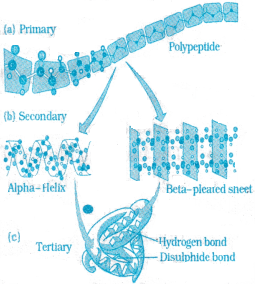
Schematically represent primary, secondary and tertiary structures of a hypothetical polymer using protein as an example.
Answer:
Primary Structure:
Definition: The primary structure of a protein is the linear sequence of amino acids linked by peptide bonds.
Representation:
Draw a straight line of circles or squares, each representing an amino acid. Label them with their respective one-letter codes (e.g., A for Alanine, R for Arginine, etc.). Connect these with lines to represent peptide bonds.
Secondary Structure:
Definition: The secondary structure refers to the local folding of the polypeptide chain into structures such as alpha helices and beta sheets.
Representation:
For the alpha helix, draw a spiral or coiled structure.
For the beta sheet, draw arrows pointing in the direction of the polypeptide chains. Indicate whether they are parallel or antiparallel by arranging the arrows accordingly.
Tertiary Structure
Definition: The tertiary structure is the overall three-dimensional shape of a single polypeptide chain, formed by the interactions between the side chains of the amino acids.
Representation:
Draw a more complex, folded structure that incorporates both the alpha helices and beta sheets from the secondary structure.
Indicate interactions such as hydrogen bonds, Van der Waals forces, electrostatic interactions, and disulfide bonds with different types of lines or symbols.
Question 2.
Nucleic acid exhibits secondary structure, justify with example.
Answer:
- One of the secondary structures exhibited by DNA is the Watson-Crick model.
- According to this model, DNA exists as a double helix.
- The two polynucleotide strands are antiparallel, i.e., run in opposite directions.
- The backbone is formed by the sugar-phosphate-sugar chain.
- N2 -bases are projected-perpendicular to the back bone, but face inside.
- Adenine (A) and Guanine (G) of one strand pair with Thymine (T) and Cytosine (C) of other strands, respectively.
- Two hydrogen bonds are present in between A and T. Three hydrogen bonds are present in between G and C.
- Each strand looks like a helical staircase. Each step is represented by a pair of N2 -bases.
- At each step of ascent, the strand turns 36°
- Ten steps or ten base pairs are present in one full turn of the helix.
- The pitch (coil) would be 34 Å. The distance between two successive base pairs would be 3.4 Å. This form of DNA is called B – DNA.
Question 3.
Explain briefly about polysaccharides.
Answer:
- Polysaccharides are polymeric carbohydrate molecules composed of long chains of monosaccharide units bound together by glycosidic bonds.
- The building blocks of polysaccharide are called monosaccharides.
- Cellulose is a homopolymer as it consists of only one type of monosaccharide called glucose. It is a structural polysaccharide present in the cell walls of plants and other organisms.
- Paper made from plant pulp is cellulose.
- Starch is a homopolymer of glucose and is used as energy storage in plant tissues.
- Glycogen is a branched homopolymer and is used as energy storage in animal cells.
- Inulin is a homopolymer of fructose and is used as energy storage in tuberous roots or stems. Ex: Asteraceae.
- In a polysaccharide chain, the right end is called the reducing end and the left end is called the non-reducing end.
- Complex polysaccharides possess amino-acids and chemically modified sugars (glucosamine, N-acetyl galactosamine etc).
- Exoskeleton of arthropods and the cell wall of fungi have a complex polysaccharide called chitin.
Question 4.
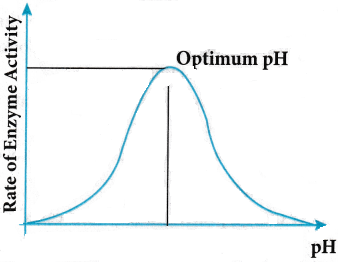
Explain how pH affects enzyme activity with the help of a graphical representation.
Answer:
- Enzymes generally function in a narrow range of pH.
- Each enzyme shows its highest activity at a particular pH, called optimum pH.
- Mostly intracellular enzymes function near neutral pH.
- Different digestive enzymes have different optimum pH.
Ex: Pepsin at 2.0, trypsin at 8.0. - Change in pH above or below the optimum value within range reduces the rate of enzyme action.
Question 5.
Explain the mechanism of enzyme action.
Answer:
- The chemical which is converted into a product is called a ‘substrate’.
- Hence enzymes, i.e, proteins with three dimensional structures including an ‘active site’, convert a substrate (S) into a product (P).
- Symbolically, this can be depicted as: S → P
Nature of Enzyme action:
- Each enzyme (E) has a substrate (S) binding site in its molecule so that a highly reactive enzyme – substrate complex (ES) is produced.
- This complex is short – lived and dissociates into its product(s) P and the unchanged enzyme, with an intermediated formation of the enzyme – product complex (EP).
- The formation of the ES complex is essential for catalysis.
- E + S → (ES) (EP) → E + P
- Formation of (ES) complex has been explained with the ‘lock and key’ hypothesis by Emil fischer (1884) and much later with the ‘induced – fit hypothesis’ by Daniel E.Koshland.
The catalytic cycle of an enzyme action :
- First, the substrate binds to the active site of the enzyme,, fitting into the active site.
- The binding of the substrate induces the enzyme to alter its shape, fitting more tightly around the substrate.
- The active site of the enzyme, now in close proximity to the substrate, breaks the chemical bonds of the substrate and the new enzyme – product complex is formed.
- The enzyme releases the products of the reaction and the free enzyme is ready to bind to another molecule of the substrate and runs through the catalytic cycle once again.
Question 6.
Define enzyme inhibition. Write briefly about competitive inhibition, give an example.
Answer:
- The activity of an enzyme is also sensitive to the presence of specific chemicals that bind to the enzyme.
- When the binding of the chemical shuts off enzyme activity, the process is called inhibition and the chemical is called an inhibitor.
- When the inhibitor closely resembles the substrate in its molecular structure and inhibits the activity of the enzyme, it is known as a competitive inhibitor.
- Due to its close structural similarity with the substrate, the inhibitor competes with the substrate for the substrate-binding site of the enzyme.
- Consequently, the substrate cannot bind and as a result, the enzyme action declines.
Ex : Inhibition of succinic dehydrogenase by malonate which closely resembles the substrate succinate in structure. - Such competitive inhibitors are often used in the control of bacterial pathogens.
Question 7.
Explain different types of cofactors.
Answer:
- There are a number of non-protein constituents called co-factors which are bound to the apoenzyme to make the holoenzyme catalytically active.
- The protein portion of the enzyme is called the apoenzyme, the non-protein part of the holoenzyme is called co-factor.
- Three kinds of cofactors are :
- Prosthetic groups
- Coenzymes
- Metal ions.
a) Prosthetic groups: Organic compounds that are tightly bound to the apoenzyme.
Ex : Haeme group in peroxidase enzyme.
b) Coenzymes: Organic compounds that are loosely bound to apoenzymes.
Ex : Nicotinamide adenine dinucleotide (NAD) and NADP contain the vitamin niacin, TPP.
c) Metal ions: They form coordination bonds with side chains at the active site and at the same time form one or more coordination bonds with the substrate.
Ex : Zinc is a co-factor for Carboxypeptidase. Copper for Cytochrome oxidase.
VI. Long Answer Questions
Question 1.
What are secondary metabolites? Enlist them indicating their usefulness to man.
Answer:
- Secondary metabolites: Metabolic products that do not have identifiable functions in the host organism are called secondary metabolites.
- Thousands of compounds found in plant, fungal and microbial cells other than primary metabolites are called secondary metabolites’.
Eg : Alkaloids, flavonoids, rubber, essential oils, antibiotics, coloured pigments, scents, gums, spices, etc.
Some secondary metabolites:
| Pigments | Carotenoids, Anthocyanins etc. |
| Alkaloids | Morphine, Codeine |
| Terpenoids | Monoterpenes, Diterpenes |
| Essential oils | Lemongrass oil, |
| Toxins | Abrin, Ricin |
| Lectins | Concanavalin A |
| Drugs | Vinblastine, curcumin |
| polymeric substances | Rubber, gums, cellulose |
Many secondary metabolites are useful to human welfare’.
Ex: Rubber, drugs, spices, scents and pigments.
1. Rubber :
- Uncured rubber is used for adhesive, insulating and friction tapes.
- Other significant uses of rubber are manufacturing of belts, matting, flooring, medical gloves and much more Used rubber tyres are often recycled to make other items like shoes, bags, coats.
2. Drugs:
In medicine:
- Antidiabetic drug is used to treat diabetes mellitus.
- Antihistamine medicine is used to treat allergies and hypersensitivity reactions and cold.
- Anti-inflammatory drug is intended to reduce inflammation.
In sports :
Anabolic steroids are synthetic substances that stimulate proteins that help in building non-fat muscle mass, helping an athlete become stronger and able to play for longer periods of time.
3. Spices:
- Cloves : Cloves offer health benefits for reducing intestinal worms, digestive discomfort and can be used topically for toothache.
- Cardamom : This spice has been shown to reduce cancer development in animal studies and increase cell death of cancer cells in the colon. This herb can be used for its diuretic benefits.
- Asafoetida It is used as a remedy for asthma and bronchitis. It has antiflatulent and antimicrobial properties.
4. Scents : These are used at various places like retail space with customers, hotel lobby with guests, an office space with clients and employees. Scents smell has a strong influence on the emotions we feel in our daily lives. Fragrances make clothes smell clean, cosmetics pretty’ and households ‘well kept’.
5. Pigments These are used in food colouring, water colour paints, clothing dyes Green tea guards against cardiovascular disease.
Question 2.
What are the processes used to analyse elemental composition, organic constituents and inorganic constituents of living tissue?
Answer:
- Chemical analysis of a living tissue : On elemental analysis of a plant tissue, animal tissue or a microbial paste, a list of elements like carbon, hydrogen, oxygen and several others and their content per unit mass of a living tissue is known.
- The relative abundance of carbon and hydrogen with respect to other elements is higher in any living organism than in earth’s crust.
A comparison of elements present in Non-living and Living matter
| Element | % weight of Earth’ crust | % weight of Human body |
| Hydrogen (H) | 0.14 | 0.5 |
| Carbon (C) | 0.13 | 18.5 |
| Oxygen (O) | 46.6 | 65.0 |
| Nitrogen (N) | very little | 3.3 |
| Sulphur (S) | 0.03 | 0.3 |
| Sodium (Na) | 2.8 | 0.2 |
| Calcium (Ca) | 3.6 | 1.5 |
| Magnesium (Mg) | 2.1 | 0.1 |
| Silicon (Si) | 27.7 | negligible |
- To analyse the organic compounds in a living tissue, any living tissue should be taken and grind it in trichloroacetic acid (Cl3CCOOH) using a mortar and a pestle.
- The obtained thick slurry should be strained through a cheesecloth or cotton.
- Two fractions can be obtained.
- Filtrate or acid soluble pool, and
- Retentate or acid insoluble fraction.
- Thousands of organic compounds can be found in acid soluble pools.
- To analyse a living tissue sample and to identify a particular organic compound, first the compounds should be extracted.
- Then the extract should be subjected to various separation techniques to separate a compound from all other compounds.
- The isolated compound should be purified. All the carbon compounds obtained from living tissue are called ‘biomolecules’.
- Living organisms also contain inorganic elements and compounds in them.
- To analyse inorganic elements and compounds in living organisms a small amount of a living tissue should be weighed (wet weight) and it should be dried.
- As a result of this water evaporated. The remaining material gives dry weight.
- Now, the tissue should be burnt. Due to this, all the carbon compounds are oxidised to gaseous form (CO2 and water vapour) and are removed.
- The remaining substance is called ‘ash’.
- This ash contains inorganic elements like calcium, magnesium, etc. Inorganic compounds like sulphate phosphate, etc. are also seen in the acid soluble fraction.
A list of representatives inorganic constituents of living tissues
| Compound | Formula |
| Sodium | Na+ |
| Potassium | K+ |
| Calcium | Ca++ |
| Magnesium | Mg++ |
| Water | H2O |
| Compounds | NaCl, CaCO3 |
- Therefore, element analysis gives elemental composition of living tissues in the form of hydrogen, oxygen, chlorine, carbon, etc.
- The analysis of compounds gives the analysis of organic and inorganic constituents present in living tissues.
Question 3.
Write an account of the classification of enzymes.
Answer:
- Thousands of enzymes have been discovered, isolated and studied. Most of these enzymes have been classified into different groups based on the type of reactions they catalyse.
- Enzymes are divided into 6 classes each with 4-13 subclasses and named accordingly by a four-digit number.
a) Oxidoreductases/dehydrogenases:
Enzymes which catalyse oxidoreduction between two substrates S and S’.
Ex: S reduced + S’ oxidised → S oxidised + S’ reduced.
b) Transferases
Enzymes catalysing a transfer of a group, G (other than hydrogen) between a pair of substrate S and S’.
Ex: S – G + S’ → S + S’ -G
c) Hydrolases
Enzymes catalysing hydrolysis of ester, ether, peptide, glycosidic, C-C, C-halide or P-N bonds.
d) Lyases
Enzymes that catalyse removal of groups from substrates by mechanisms other than hydrolysis leaving double bonds.
e) Isomerases
Includes all enzymes catalysing inter-conversion of optical, geometric or positional isomers.
f) Ligases
Enzymes catalysing the linking together of 2 compounds.
Ex: Enzymes which catalyse joining of C-O, C-S, C-N, P-0 etc. bonds.
I. Multiple Choice Questions
Question 1.
Chemical analysis of living organisms can be done by the usage of the following chemical.
1. Ethanol
2. Benzene
3. Trichloro acetic acid
4. Acetic acid
Answer:
3. Trichloro acetic acid
Question 2.
Identify the polysaccharide which is a polymer of fructose.
1. Starch
2. Glycogen
3. Cellulose
4. Inulin
Answer:
4. Inulin
Question 3.
Identify the aromatic amino acid.
1. Glutamic acid
2. Tyrosine
3. Lysine
4. Alanine
Answer:
2. Tyrosine
Question 4.
Palmitic acid contains how many carbons ?
1. 16
2. 20
3. 15
4. 19
Answer:
1. 16
Question 5.
Cytidylic acid is a
1. Nitrogen base
2. Nucleotide
3. Nucleoside
4. Nucleic acid
Answer:
2. Nucleotide
Question 6.
Concanavalin A is
1. Drug
2. Lectins
3. Alkaloids
4. Toxins
Answer:
2. Lectins
Question 7.
Identify the secondary metabolite.
1. Amino acid
2. Nucleic acids
3. Carbohydrates
4. Rubber
Answer:
4. Rubber
Question 8.
Which among the following is not a pyrimidine ?
1. Thymine
2. Cytosine
3. Adenine
4. Uracil
Answer:
3. Adenine
Question 9.
The following protein enables glucose uptake into cells.
1. GLUT-4
2. Collagen
3. Antibody
4. Trypsin
Answer:
1. GLUT-4
Question 10.
The following structure is necessary for the many biological activities of proteins.
1. Primary structure
2. Secondary structure
3. Tertiary structure
4. Quaternary structure
Answer:
3. Tertiary structure
Question 11.
Which among the following is not a polymer ?
1. Polysaccharide
2. Protein
3. Nucleic acid
4. Lipid
Answer:
4. Lipid
II. Fill in the Blanks
Question 1.
The pentose sugar in DNA is ___________
Answer:
Deoxyribose sugar
Question 2.
Nucleic acid percentage in the total cellular mass is ___________
Answer:
5 – 7%
Question 3.
Most abundant protein in the biosphere ___________
Answer:
RUBISCO
Question 4.
The molecular weight of macromolecules is greater than ___________ Daltons.
Answer:
1000
Question 5.
The amino acids in protein are linked by ___________ bond.
Answer:
Peptide
Question 6.
Exoskeleton of arthropods is made up of ___________
Answer:
Chitin
Question 7.
The R-group of the serine is ___________
Answer:
CH2OH
Question 8.
The macromolecule which is found in acid insoluble fraction ___________
Answer:
Lipids
Question 9.
Coenzyme NAD and NADP contain ___________ vitamin.
Answer:
Niacin
Question 10.
Most of the enzymes get damaged/ denatured above ___________ degrees temperature.
Answer:
40
III. One Word Answer Questions
Question 1.
Name the pyrimidine which is absent in the RNA.
Answer:
Thymine
Question 2.
Name the acid which is formed in our skeletal muscle, under anaerobic conditions.
Answer:
Lactic acid
Question 3.
In the presence of carbonic anhydrase how many H<sub>2</sub>CO<sub>3</sub> molecules can be formed per sec.
Answer:
6 lakhs
Question 4.
What is the metal ion cofactor for the proteolytic enzyme carboxypeptidase?
Answer:
Zn
Question 5.
Name the non-protein constituent of the enzyme.
Answer:
Cofactor
Question 6.
What is the most abundant protein in the animal world?
Answer:
Collagen
Question 7.
Among the starch and cellulose which one holds iodine and gives blue colour?
Answer:
Starch
Question 8.
Nucleic acids with catalytic power are known as _______ ?
Answer:
Ribozyme
Question 9.
Name the first and last amino acids of a polypeptide chain.
Answer:
N-terminal and C-terminal amino acids.
Question 10.
Enzymes are categorised into how many classes?
Answer:
6