AP Inter 1st Year Botany 7th Lesson Cell Cycle and Cell Division Questions and Answers
IV. Very Short Answer Questions
Question 1.
Which tissue of animals and plants exhibit meiosis ?
Answer:
- In higher animals, meiosis occurs in gamete mother cells (spermatocytes and oocytes) during gametogenesis.
- In higher plants, meiosis occurs in spore mother cells, microspore mother cells and megaspore mother cells during sporogenesis.
Question 2.
What attributes does a chromatid require to be classified as a chromosome?
Answer:
A chromatid is said to be as a chromosome when it possesses
- Independent existence.
- Its own centromere with one DNA molecule.
Question 3.
Which of the four chromatids of a bivalent at prophase-I of meiosis can involve in crossing over?
Answer:
Non-sister chromatids of homologous chromosomes of a bivalent can involve in crossing over.
Question 4.
Write the sub stages of meiotic prophase-I in which ‘synapsis’ and ‘crossing over’ occurs.
Answer:
Synapsis occurs in Zygotene and Crossing over occurs in Pachytene stage.
Question 5.
A cell has 32 chromosomes. It undergoes mitotic division. What will be the chromosome number during metaphase and DNA content (C) during anaphase?
Answer:
- The mitotic cell division occurs in somatic cells of an organism.
- The chromosome number in the daughter cells remains the same as that of the parent cell. So even at metaphase, the chromosome number does not change.
- The DNA content gets doubled at the synthetic phase or interphase and gets divided at anaphase but the chromosome number remains same.
V. Short Answer Questions
Question 1.
In which phase of meiosis the following are formed ? Choose the answers from hint points given below.
a) Synaptonemal complex
b) Recombination nodules
c) Functioning of the enzyme recombinase
d) Terminalization of chiasmata
e) Interkinesis
f) Formation of dyad of cells
Hints :
i) Pachytene,
ii) After Telophase-I/before meiosis-II,
iii) Zygotene,
iv) Telophase-I/After meiosis-I,
v) Pachytene,
vi) Diakinesis
Answer:
a) Zygotene
b) Pachytene
c) Pachytene
d) Diakinesis
e) After Telophase-I/before Meiosis-II
f) Telophase-1/After Meiosis-I
Question 2.
Mitosis results in producing two daughter cells which are similar to each other. What would be the consequence if each of the following irregularities occurs during mitosis?
a) Nuclear membrane fails to disintegrate
b) Duplication of DNA does not occur.
c) Centromere does not divide
d) Cytokinesis does not occur.
Answer:
a) If a nuclear membrane fails to disintegrate, the replicated chromosomes remain within the same cell. Nucleus does not divide (Endomitosis).
b) If duplication of DNA does not occur there is no further cell division. Every mitotic cell division must be preceded by DNA duplication. Then only separation of sister chromatids is possible in Anaphase.
c) If centromeres do not divide, daughter chromosomes are not formed (polytomy).
d) If cytokinesis does not occur, multinucleate condition arises leading to the formation of syncytium (Ex: liquid endosperm in coconut).
Question 3.
Describe the events in prophase-1 of meiosis.
Answer:
Prophase-I : This is a typically longer and complex phase. It is further subdivided into 5 phases based on the behaviour of chromosomes into
- Leptotene,
- Zygotene,
- Pachytene,
- Diplotene,
- Diakinesis.
i) Leptotene :
During the leptotene stage, chromosomes become gradually visible. This compaction of chromosomes lasts throughout the leptotene stage.
ii) Zygotene:
- Chromosomes start pairing together by a process called synapsis. Such chromosomes are called homologous chromosomes.
- It is followed by the formation of synaptonemal complex.
- Such a complex formed by a pair of synapsed homologous chromosomes is called bivalent or a tetrad of chromatids.
iii) Pachytene:
- Bivalents clearly appear as tetrads. Formation of recombination nodules occur.
- Crossing over is exchange of genetic material between two homologous chromosomes is mediated by recombinase enzymes.
- It leads to recombination of genetic material on the two chromosomes.
iv) Diplotene:
- The dissolution of the synaptonemal complex occurs.
- Separation of bivalents from each other except at the regions of crossing over occurs. Such X- shaped regions are referred to as chiasmata.
v) Diakinesis:
- Terminalisation of chiasmata occurs.
- The chromosomes are fully condensed.
- The meiotic spindle is assembled to prepare the homologous chromosomes for separation.
- During late diakinesis, the nucleolus disappears and nuclear envelope also break down.
Question 4.
Though redundantly described as a resting phase, interphase does not really involve rest. Comment.
Answer:
- Actually during the interphase, great metabolic activities occur so it is a preparatory phase.
- Division of chromosomes or cytoplasm does not occur.
- During interphase cell enlarges.
- The interphase is divided into three phases: G1 phase (Gap 1), S-phase (Synthesis), and G1 phase (Gap 2).
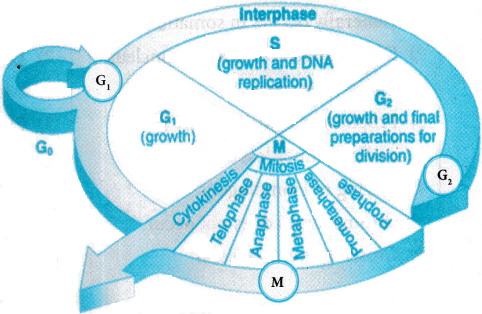
G1 phase:
- It corresponds to the interval between mitosis and initiation of DNA replication.
- During G1 phase the cell is metabolically active and continuously grows.
S or synthesis phase:
- It marks the period during which DNA synthesis or replication takes place.
- During this time the amount of DNA per cell doubles.
- If the initial amount of DNA is denoted as 2C, then it increases to 4C.
- However, there is no increase in the chromosome number.
G2 phase :
- Proteins are synthesized in preparation for mitosis.
- Cell growth continues.
- Hence, interphase is not a resting phase.
VI. Long Answer Questions
Question 1.
Discuss on the statement – telophase is he reverse of prophase.
Answer:
It is true to say that telophase is the reverse of the prophase stage. Based on the following points we can support this fact.
During Prophase:
- Chromatin fibres are shorter and thicker due to coiling and folding which results in thread-like chromosomes.
- Each chromosome consists of two coiled sister chromatids joined by centromeres
- During late prophase, ER, Golgi complex, Nucleolus and nuclear envelope disappear.
- Centrioles migrate towards opposite poles.
- Sharp radiating microtubules appear around each centriole and migrate towards opposite poles.
During Telophase :
- Daughter chromosomes undergo decondensation and uncoiling at each pole.
- The chromatin material gets surrounded by segments of nuclear membrane formed from the elements of ER.
- Cellular components like ER and golgi complex reorganize once again.
- Formation of the new nucleoli can be noticed.
- Astral rays and spindle fibres are gradually disintegrate and are absorbed into the cytoplasm.
- Two daughter nuclei are designed.
Question 2.
Differentiate between the events of mitosis and meiosis.
Answer:
| MITOSIS | MEIOSIS |
| 1. Generally occurs in somatic cells. | 1. Occurs in germ cells. |
| 2. DNA duplicates once and nucleus also divides once. | 2. DNA duplicates once but nucleus divides twice. |
| 3. Prophase is comparatively simple and consumes less time. | 3. Prophase is comparatively longer and consumes more time. |
| 4. Pairing of Homologous chromosomes does not occur. | 4. Pairing of Homologous chromosomes occurs. |
| 5. Crossing over is absent. | 5. Crossing over occurs between non sister chromatids of homologous chromosomes. |
| 6. Division of centromere occurs in Anaphase. | 6. Division of centromere occurs in Anaphase II. |
| 7. Two daughter cells are formed at the end of division. | 7. Four daughter cells are formed as a result of Meiosis. |
| 8. Both diploid and haploid cells can undergo Mitosis. | 8. Only diploid cells can undergo meiosis. |
| 9. The genetic constitution of daughter cells is identical to that of parent cell. | 9. Due to crossing over, the genetic constitution of daughter cells is different from parent cells. |
| 10. One spindle apparatus is developed. | 10. Three spindle apparatus are developed. |
| 11. Daughter cells formed at the end of mitosis have the same number of chromosomes as that of parent cells. | 11. Chromosomal number in daughter cells is reduced to half that of parent cells. |
Question 3.
Write a brief note on the following:
a) Synaptonemal complex,
b) Metaphase plate
Answer:
a) Synaptonemal complex:
- Synaptonemal complex is a fibrillar structure that develops during zygotene of prophase-1 of meiosis I.
- It develops between the synapsed homologous chromosomes.
- It helps in stabilization of paired conditions of chromosomes and involves in chiasmata formation and crossing over.
- The synaptonemal complex is attached at both ends through its lateral elements to the inner surface of the nuclear membrane.
- It disappears during diplotene.
- This helps in repulsion activity between homologous chromosomes. .
- As a result the homologues of the bivalents are separated from each other.
b) Metaphase Plate:
- Metaphase plate gets organised during metaphase of mitosis and metaphase of meiosis.
- The spindle fibres organised during metaphase get accumulated at the centre of the cell.
- The plane of alignment of the chromosomes during cell division at metaphase is referred to as the metaphase plate.
- The orientation of the metaphase plate is based on the chromosomal arrangement.
- Metaphase plate is important in equitable and simultaneous distribution of all the chromosomes.
Question 4.
Write briefly the significance of mitosis and meiosis in multicellular organisms.
Answer:
A) Significance of mitosis:
- Equal distribution of chromosomes : Mitosis results in the production of diploid daughter cells with genetic complement usually identical to that of the parent cell.
- The growth in multicellular organisms is due to mitosis only.
- Cell growth results in disturbing the ratio between the nucleus and the cytoplasm.
- It therefore becomes essential for the cell to divide to restore the nucleo-cytoplasmic ratio.
- Repair: The cells of the upper layer of the epidermis, cells of the lining of the gut, and RBC are constantly being replaced.
- Mitotic divisions in the meristematic cells and the apical and the lateral meristems result in continuous growth of plants throughout their lifetime.
B) Significance of meiosis
- Meiosis is responsible for the formation of sex cells or gametes that are responsible for sexual reproduction.
- In sexually reproducing organisms the constant number of chromosomes through generations is maintained by meiosis by producing haploid gametes.
- It is the only means of restoring the chromosome number characteristic of the species.
- In pachytene due to crossing over the hereditary factors from male and female parents get mixed thus providing a new combination of genetic material.
- Variations inherited lead to evolution of species.
I. Multiple Choice Questions
Question 1.
Phase between two successive M-phases
1. Prophase
2. Metaphase
3. Interphase
4. Anaphase
Answer:
3. Interphase
Question 2.
Cell cycle duration of yeast
1. 24 hours
2. 90 minutes
3. 20 minutes
4. 60 minutes
Answer:
2. 90 minutes
Question 3.
During ‘S’ phase of interphase
1. DNA synthesizes, chromosome number remains same
2. DNA synthesizes, chromosome number doubled
3. DNA does not synthesize, chromosome number reduced to half
4. DNA does not synthesize, chromosome number remains same
Answer:
1. DNA synthesizes, chromosome number remains same
Question 4.
A cell in G1 phase has 16 chromosomes, how many chromosomes does the cell have a G2 phase.
1. 24
2. 32
3. 8
4. 16
Answer:
4. 16
Question 5.
The cells in the quiescent stage (G0) exit the cell cycle from the following phase;
1. G2 phase
2. G1 phase
3. S phase
4. M phase
Answer:
2. G1 phase
Question 6.
Identify the correct sequential phases in the karyokinesis.
1. Prophase, metaphase, anaphase, telophase
2. Metaphase, anaphase, telophase, prophase
3. Anaphase, telophase, prophase, metaphase
4. Telophase, prophase, metaphase, anaphase
Answer:
1. Prophase, metaphase, anaphase, telophase
Question 7.
Centromere splitting occurring in
1. Mitotic anaphase and meiotic anaphase – I
2. Mitotic anaphase and meiotic anaphase – II
3. Meiotic anaphase – I and meiotic anaphase- II
4. Mitotic anaphase only
Answer:
2. Mitotic anaphase and meiotic anaphase – II
Question 8.
Compaction of chromosomes start from
1. Zygotene
2. Pachytene
3. Leptotene
4. Diplotene
Answer:
3. Leptotene
Question 9.
Bivalent formation occurs in the following stage.
1. Zygotene
2. Pachytene
3. Leptotene
4. Diplotene
Answer:
1. Zygotene
Question 10.
The X-shaped structures called chiasmata appears in
1. Zygotene
2. Pachytene
3. Leptotene
4. Diplotene
Answer:
4. Diplotene
Question 11.
Terminalisation of chiasmata happens in
1. Zygotene
2. Pachytene
3. Diplotene
4. Diakinesis
Answer:
4. Diakinesis
Question 12.
A bivalent in meiosis-I consists of
1. One chromosome, two chromatids
2. Two chromosomes, two chromatids
3. Two chromosomes, four chromatids
4. Four chromosomes, four chromatids
Answer:
3. Two chromosomes, four chromatids
II. Fill in the Blanks
Question 1.
Most suitable phase of cell division to study the morphology of chromosomes is ____________
Answer:
Metaphase
Question 2.
Prophase – I of meiosis has leptotene, ____________ pachytene, diplotene and diakinesis.
Answer:
Zygotene
Question 3.
The stage between meiosis -I and meiosis – II is ____________
Answer:
Interkinesis
Question 4.
Crossing over happens in the ____________ of prophase – I.
Answer:
Pachytene
Question 5.
In meiosis splitting of centromere in a chromosome happens during ____________
Answer:
Anaphase – II
Question 6.
What is the longest phase in the oocytes of some vertebrates ____________
Answer:
Diplotene
Question 7.
The disc shaped structures at the surface of the centromeres are called ____________
Answer:
Kinetochores
Question 8.
Cell furrow forms during cytokinesis of ____________ cell.
Answer:
Animal
Question 9.
The duration of M-phase in human cells is ____________
Answer:
1 hour
Question 10.
Which division increases the genetic variability in the population ? ____________
Answer:
Meiosis
III. One Word Answer Questions
Question 1.
Name the two phases of cell cycle.
Answer:
M phase and Interphase
Question 2.
What is the approximate duration of human cell cycle?
Answer:
24 Hours
Question 3.
Which of the phases of the cell cycle is of longest duration?
Answer:
Interphase
Question 4.
In which stage of cell cycle does DNA synthesis occur?
Answer:
S-phase
Question 5.
Name the stage of meiosis in which actual reduction in chromosome number occurs.
Answer:
Anaphase-I
Question 6.
What is the DNA content in a cell after completion of ‘S’ phase of interphase, when taken G1 as in its phase.
Answer:
4C
Question 7.
Centriole duplication occurs in which phase of interphase.
Answer:
S-phase
Question 8.
Is the cell in quiescent stage (G0) metabolically active or not.
Answer:
Active
Question 9.
What type of cell division is also known as equational division ?
Answer:
Mitosis
Question 10.
How many chromatids does the prophase chromosome has ?
Answer:
Two
Question 11.
An anther has 1200 pollen grains. How many pollen mother cells must have been there to produce them ?
Answer:
300 pollen mother cells
Question 12.
Given that the average duplication time of E.coli is 20 minutes. How much time will two E. coli cells take to become 32 cells ?
Answer:
80 minutes
Question 13.
If a tissue has at a given time 1024 cells. How many cycles of mitosis had the original parental single cell undergone?
Answer:
10 Cycles