AP Inter 1st Year Economics 9th Lesson Theory of Employment and Public Finance Questions and Answers
Essay Questions
Write an essay on the following questions.
Question 1.
Elucidate the classical theory of employment.
Answer:
The classical theory of employment was developed by Economist such as Adam Smith, David Ricardo, Robert Mathus, etc. It is based on the famous “Law of Markets” advocated by J.B. Say. According to this law, “Supply creates its own Demand”.
The implications of the classical theory of employment may be summarized as follows.
- There is no general over production and general unemployment.
- There is an automatic adjustment of demand and supply levels through the price mechanism.
- There is no need for the interference by the government.
- The whole income is spent. Even if there is saving, all savings will be gradually spent on capital goods. Thus the whole income is spent either on consumption good or on capital goods. It means savings and investments are equal.
- Flexible interest rate keeps saving and investment in equilibrium.
- Flexible wage rate brings about equilibrium in the labour market.
- It is possible to increase output and employment as long as there are unemployed or idle resources.
- Goods are exchanged for goods. Money facilitates such exchange of goods. Hence, money has no other role except acting as medium of exchange.
Salient features of Classical Theory of Employment: The classical economists held the view that in a capitalistic economy, there is always a stable equilibrium at full employment level in the long run under conditions of perfect competition.
They consider full employment as a general feature and unemployment a rare phenomenon. If there is unemployment at anytime, the economy has a tendency to move towards full employment. There would be automatic adjustment through free play of market forces, provided there is no interference by the government. Thus, the classical economists ruled out any general unemployment in the long run. These views are broadly known as the classical theory of output, income and employment.
Assumptions of classical theory of employment : The classical theory of employment including J.B. Say’s market law is based on the following assumptions :
- There is a free enterprise economy.
- There is perfect competition in the economy.
- There is no government interference in the functioning of the economy. Price mechanism is allowed to work freely.
- The equilibrium process is considered from the long term point of view.
- All savings are automatically invested.
- The interest rate is flexible.
- The wage rate is flexible.
- There are no limits to the expansion of the market.
- Money acts as the medium of exchange and it has no role to play in the determination of output and employment. It is neutral.
The classical theory of employment can be discussed with three dimensions:
A) Goods market equilibrium.
B) Money market equilibrium and
C) Equilibrium of the labour market (Pigou wage – cut policy).
The equilibrium of the first two markets was propounded by J.B. Say, whereas the third one was advocated by A.C. Pigou.
Question 2.
Describe the Keynesian theory of employment with the help of diagram.
Answer:
The classical employment theory assumed that there is always full employment in the economy. The classical economists consider full employment as a general situation in the long run. But J.M. Keynes criticized it and he considered full employment as a rare phenomenon. He considered full employment as special case in short run.
J.M. Keynes stated his employment theory in his famous book entitled “The General Theory of Employment, Interest and Money”, published in 1936. His theory is known as Keynesian theory of employment.
He says that the level of employment is determined by two factors.
- Aggregate supply
- Aggregate demand.
The term effective demand is used to denote that level of aggregate demand which is equal to aggregate supply.
Aggregate Supply: Aggregate supply refers to the total supply of goods and services in the economy. The level of aggregate supply depends on the level of employment. The minimum amount of money which the producers in the economy must receive by selling the goods and services at different levels of employment is called aggregate supply price. As the level of output increases with the level of employment the aggregate supply price also increases with every increase in the level of employment.
Aggregate Supply Schedule: It shows the various amounts of supply at different levels of employment. It is shown in the table given below.
| Level of employment (in lakhs of workers) |
Aggregate supply price (in crore of rupees) |
| 10 | 500 |
| 11 | 550 |
| 12 | 600 |
| 13 | 650 |
| 14 | 700 |
| 15 | 750 |
| 16 | 800 |
From the above table, we know that as employment increases aggregate supply is increasing. So there is a direct relationship between level of employment and aggregate supply.
Aggregate Supply Curve: If the above schedule is shown in graph, then we get a curve. This curve is called aggregate supply curve.
Aggregate supply curve can be seen sloping upwards from left to right. It started from the origin which means the aggregated supply is zero, when the employment is nil.
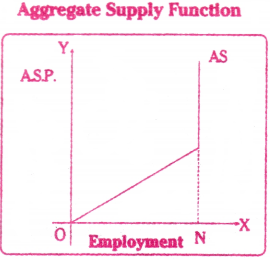
In the adjacent diagram as employment levels increase the AS curve rises to the right. ON is assumed to be full employment level. At this level, aggregate supply the function AS is parallel to Y – axis which means that the aggregated supply is perfectly inelastic.
Aggregate Demand : Aggregate demand means the total demand for all commodities in the economy at a particular level of employment. The amount they spend on consumption goods is called consumption expenditure (C) and their expenditure on capital goods is called investment (I). The entrepreneurs expect that the community as a whole is willing to spend certain amount towards purchase of the total output. That expected expenditure is termed as aggregate demand price.
Aggregate Demand Schedule : It shows the aggregate demand at different levels of employment. As the level of employment rises, the total income of the community also rises and therefore the aggregate demand price also increases. This can be seen in the following table.
Aggregate Demand Function
| Level of employment (in lakhs of workers) |
Aggregate demand price (in crore of rupees) |
| 10 | 600 |
| 11 | 625 |
| 12 | 650 |
| 13 | 675 |
| 14 | 700 |
| 15 | 725 |
| 16 | 750 |
In the above table, as employment increases AD also increases. So there is direct relationship between levels of employment and aggregate demand.
Aggregate Demand Curve : If the AD schedule is shown on a graph, then we get a curve. This curve is called aggregate demand curve. This is shown in the diagram given adjacent:
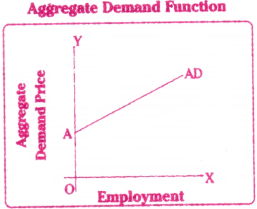
In the adjacent diagram, AD curve is the aggregate demand curve. It slopes upwards from left to right.
Effective Demand : The level of employment will be in equilibrium at a point where aggregate demand and aggregate supply are equal. The aggregate demand at which it is equal to aggregate supply is called effective demand. This is shown in the table given below.
Effective Demand
| Levels of employment (in lakhs of workers) |
Aggregate supply price (in crores of rupees) |
Aggregate demand price (in crores of rupees) |
| 10 | 500 | 600 |
| 11 | 550 | 625 |
| 12 | 600 | 650 |
| 13 | 650 | 675 |
| 14 | 700 | 700 |
| 15 | 750 | 725 |
| 16 | 800 | 750 |
In the above table, at the employment of 14 lakhs, the aggregate supply and aggregate demand are equal. At the level of employment of below 14 lakhs, aggregate supply is less than aggregate demand. Similarly, at the level of employment of above 14 lakhs aggregate supply is more than aggregate demand.
Only at the level of 14 lakhs the A.D and AS are equal. Hence, it is called effective demand.
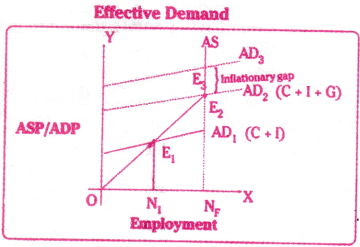
In this diagram, Aggregate demand price curve (AD) and aggregate supply price curve (AS) intersect each other at point E1“. It shows the equilibrium point. The equilibrium has been attained at “ON1”, level of employment. It is assumed that ON in the above diagram does not indicate full employment as the economy is having idle factors of production. So it is considered as under-employment equilibrium.
According to Keynes, to achieve full employment an upward shift of aggregate demand curve is required. This can be possible through government expenditure on goods and services supplied in the economy, whenever private entrepreneurs may not show interest to invest. With this the AD1 curve (C + I) shifts as AD2 (C + I + G) at new point of effective demand E2, where the economy reaches full employment level i.e., ONF.
Question 3.
Explain various methods of redemption of public debt.
Answer:
When the government’s expenditure exceeds its revenue, the government can borrow funds from various sources within the country or from abroad. Such debts are known as public debt.
On the basis of the sources, public debt is classified into two categories
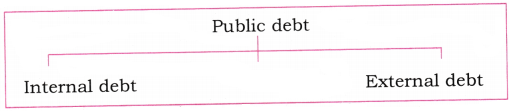
Internal debt: It is the fund which is borrowed by a government from the people and institutions within the country. In other words, debts floated within the country is called internal debt.
External debt: It is the fund or amount which is borrowed by a government from the individuals, institutions, and governments of other countries, (or) In other words, debt floated from abroad is called “external debt”.
Redemption of public debt: Repayment of debt by government is called redemption of public debt. Internal debt can be repaid in the domestic currency, but to repay external debt foreign exchange is necessary (dollars,…………………).
The following are the methods of redemption of public debt.
- Surplus budget: Surplus budget means having public revenue is excess of public expenditure. If the government plans for a surplus budget, the excess revenue may be utilized to repay public debt.
- Refunding : In this method, the government sells new bonds and securities in the market and the money thus raised is utilized for the repayment of old or maturing debts.
- Annuities : By using this method, the government repays part of the public debt every year. These are called annuities. Such annual payments are made regularly till the debts are completely cleared.
- Sinking fund : By using this method, the government creates a separate fund called ‘sinking fund’ for the purpose of repaying public debt. A part of the public revenue is deposited into fund every year. Public debt is repaid from the sinking fund. This method is considered as the better method of redemption.
- Conversion : Conversion means that existing loans are changed into new loans before the date of their maturity. This method is advantageous when the rate of interest charged on the new loans is less than the rate of interest to be paid on the existing loans.
- Additional taxation : The government can levy new taxes and raise funds for the repayment of old debts. Under this method new taxes are imposed.
- Capital levy : It is a heavy one – time tax on the capital assets and estates.
- Surplus balance of payment: This is useful to repay external debt for which foreign exchange is required. Surplus balance of payment implies exports in excess of imports by which reserves of foreign exchange can be created.
Question 4.
Describe various components of a budget.
Answer:
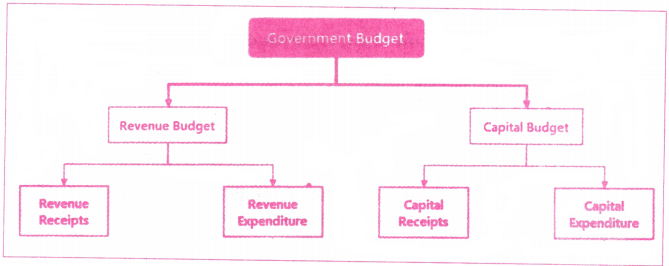
The government budget consists of two main components: Revenue Budget and Capital Budget. They are presented as revenue account and capital account in the budget documents. Each consists of receipts and expenditure as shown below.
I. Revenue Budget :
a) Revenue Receipts: Revenue receipts are those receipts that do not lead to a claim on the government. They are therefore termed non-redeemable. They are divided into tax and non-tax revenues, tax revenues are divided into direct taxes and indirect taxes. Non-tax revenue consists of interest receipts, dividends and profits on government investments.
b) Revenue Expenditure: Revenue expenditure is expenditure incurred for purposes other than the creation of physical or financial assets of the central government. It relates to those expenses incurred for the normal functioning of the government departments and various services, such as interest payments, subsidies, and pensions,
II. Capital Budget :
a) Capital Receipts: These include market loans and borrowings. Market loans are raised from the public by floating bonds and securities. Borrowings include loans raised from the Reserve Bank of India and financial institutions by selling Treasury Bills. The government may also receive loans from World Bank and IMF. Another source is small savings such as National Savings Certificates, Provident Fund etc. The government also receives money by way of loans or from the sale of its assets. Loans will have to be returned to the agencies from which they have been borrowed. Thus, capital receipts liabilities for the government.
b) Capital Expenditure: Capital expenditure refers to the government spending that results in the creation of physical or financial assets or the reduction in financial liabilities. This includes expenditure on the acquisition of land, buildings, machinery, equipment, investment in shares, and loans and advances by the central government to state and union territory governments.
Question 5.
How does Keynes advocate government expenditure to reduce un¬employment? Explain. ‘
Answer:
J.M. Keynes was one of the famous British economist of the 20th century. According to Keynes theory, lack of effective demand is the basic cause for unemployment in India.
Keynes suggests that unemployment can be removed and full employment level reached by increasing the aggregate demand. Aggregate demand consists of consumption expenditure (C) and investment (AD = C + I).
Keynes opines or believes that in short run it is not possible to raise consumption expenditure and therefore suggested that aggregate demand can be raised by increasing investment. In order to encourage private investment the government should reduce rate of interest. However he argued that the organisers in private sector may not be willing to come forward to increase private investment, when they are not optimistic. In this situation, the government should spend on public works. The government expenditure raises aggregate demand and removes unemployment.
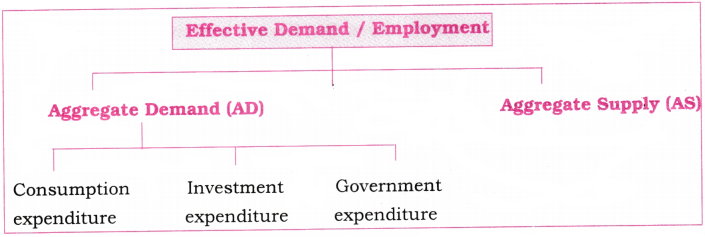
In the view of Keynes, the level of employment in the short run will depend on effective demand for goods in the country. Greater the effective demand leads higher volume of employment and vice – versa. Total employment depends on total demand and unemployment is result of a deficiency of total demand. Effective demand represents the total money spent on consumption and investment. The total national expenditure is equal to total national income which is equal to national output.
So Effective Demand = National Income (Y) = National Output (O)
Effective demand determines the volume of employment in the economy at a particular time, the deficiency of effective demand in employment. The deficiency of effective demand is due to the gap between income and consumption. As income increases, consumption also increases but it is in a smaller proportion than the increase in national income. Since consumption is less, the demand is less. The gap must be filled by increasing investment and hence effective demand. In order to maintain employment at high level. Thus it is increase in effective demand which results in increase in employment or total output or national income.
In terms of expenditure, effective demand means, the total expenditure of the community at a particular level of employment. This expenditure is just equal to economy’s aggregate supply. So effective is the aggregate or total demand of community both for consumption and investment.
Question 6.
Discuss how the Keynesian Theory is an improvement over the classical theory of employment.
Answer:
Keynesian theory has a greater particular value in the world of reality. Keynesian theory is entirely new and marks a revolutionary thinking. So it has been aptly called a Keynesian Revolution. Based on cary some point Keynesian theory is better than classical theory of employment.
Keynesian theory relates to Macro Economics, which studies the economy as a whole but the classical economic theory deals with the individual aspect of the economy that is Micro Economics. Keynes, dealt with Aggregates. Whereas classical economics system, in terms of it innumerable decision – marking units. The classical economists believed that a state of full employment could be brought about through cuts in money wages. But Keynes held that this theory was not only unrealistic but theoretically unsound.
According to Keynes, lowering of wages in any particular industry might increase employment there. But in reality reducing wages caused for reduction in income level of the public. It leads reduce in effective demand and the volume of employment.
In the point view of classical group of economists, interest is the reward for “waiting”. But in the point view of Keynes, rate of interest is the reward for parting with liquidity. The classical economists opined that Rate of Interest is determined by the intersection of the saving and investment schedule. The Keynes theory gives us a set of liquidity preference schedules various levels of income.
The classical theory is based on the conception of static economy. Whereas Keyne’s theory is dynamic. Keynes theory is a general theory and as such as a very wide application to all situations – unemployment, partial employment and near full employment.
The classical theory analysis relates only to full employment. The classical economists consider full employment a general feature and unemployment a rare phenomenon. Keynes integrated the theory of money with the theory of value and output.
According to the classical economists, increase in money supply brings about inflation and must, therefore, be avoided, this arose from their convention that allows existed full employment. But Keynes pointed out that full employment was a rare phenomenon, actually there was generally less than full employment so that some productive resources of the community lay idle and unemployed, totally or partially. That being, an increase in money supply would increase employment and output and may not thus necessarily be in inflation.
Thus Keynes’ theory has great relevance to the world reality and has great particular value. Whereas the view of the classical economists are more or less theoretical and devoid of any particular importance.
Short Answer Questions
Write the answers briefly for the following questions.
Question 1.
State the assumptions of the classical theory of Employment.
Answer:
Assumptions of the classical theory of Employment: The classical theory of employment is based on the following assumptions:
- There is a free enterprise economy.
- The economy operates under conditions of perfect competition.
- There is no government interference in the economy, and price mechanism is allowed to work freely.
- The equilibriums viewed from the long-term perspective.
- It is assumed that all savings are automatically converted into investment.
- Both interest rates and wage rates are flexible, adjusting to restore equilibrium.
- There are no constraints on market expansion.
- Money acts as a medium of exchange and does not influence out and employment.
Question 2.
“Supply creates its own denland”. Explain this statement.
Answer:
Jean Baptist Say (1767 – 1832) was a French economist and a business man. He founded the French classical school of Economics. He wrote a book titled “Treatise on Political Economy” in 1803 which became so much famous that it was used as a textbook in American colleges in those days. His writings influenced many countries.
The classical theory of employment is based on the Say’s law of market. The famous law of markets propounded by J.B. Say states that “Supply creates its own demand. ’’This law is generally interpreted as supply always equals demand or it can be expressed as S = D. Whenever additional output is produced in the economy, the factors of production which participate in the process of production, earns income in the form of rent, wages, interest and profit.
The total income so generated is equivalent to the total value of the additional output produced. Such income creates additional demand necessary for the sale of the additional output. Therefore the question of the additional output not being sold does not arise. It is assumed that the whole income is spent on purchase of commodities, partly on consumption goods and partly on capital goods.
Question 3.
What are the sources of public revenue?
Answer:
Revenue received by the government from different sources is called public revenue. Public revenue is broadly classified into two kinds.
- Tax revenue
- Non-tax revenue.
1) Tax Revenue: Revenue received through collection of taxes from the public is called tax revenue. Both the Central and State governments collect taxes as per their allocation in the Constitution. Broadly, taxes are divided into two categories.
a) Direct taxes:
- Taxes on income and expenditure.
E.g : Personal income tax, corporate tax, interest and expenditure tax. - Taxes on property and capital assets.
E.g : Wealth tax, gift tax, estate duty.
b) Indirect taxes : Taxes levied on goods and services.
Eg : Excise duty, customs duty, service tax.
2) Non-tax Revenue: Government receives revenues from sources other than taxes and such revenue is called the non – tax revenue. The sources of non-tax revenue are as follows.
- Administrative revenue: Government receives money for certain administrative services. Ex : License fee, tuition fee, penalty, etc.
- Commercial revenue : It is the second important source of public revenue. Modern governments establish public sector units to manufacture certain goods and offer certain services. These goods and services are exchanged for the prices. Government gets revenue from public sector units like IOC, BSNL, Indian Railways, Indian Airways, etc.
- Loans and advances When the revenue received by the government from taxes and from the above non – tax sources is not sufficient to meet the needs of government expenditure, it may receive loans from the financial institutions operating within the country and also from the public. The modern governments can also obtain loans from foreign governments and international financial institutions.
- Grants-in-aid: Grants are amounts received without any condition of repayment. They are not repaid. State governments receive such grants from the central government. The Central government may receive such grants from foreign governments or any international funding agency. Grants are of two types.

- General grants: When a grant is given to meet shortage of funds in general without specifying a purpose, it is called general grant.
- Specific grants : When a grant is given for a specific purpose, it is called a specific grant. It cannot be spent on any other purpose.
E.g : Education grant, Family planning grant, etc.
Question 4.
List out the various items of public expenditure.
Answer:
Public expenditure is an important part of public finance. Modern governments spend money to perform various functions. The expenditure incurred by the government on various economic activities is called the public expenditure. Usually public expenditure will be made on following aspects.
- Defence
- Internal security (Police)
- Economic services (agriculture, industry, power, transport, communication, science and technology, etc.)
- Social services (education, health, broadcasting, etc.)
- Other general services (organs of state, tax collection, external affairs, etc.)
- Pensions
- Subsidies
- Grants to state governments
- Grants to foreign governments
- Loans to state governments
- Loans to public enterprises
- Loans to foreign governments
- Repayment of loans (principal amount, interest and debt management)
- Assistance to states on natural calamities, etc.
- Expenditure made for day to day administration
Public expenditure transfers money to the community. The income of the society increases on account of the increase in public expenditure. Development may take place.
Question 5.
Write a note on Goods and Services Tax (GST).
Answer:
Goods and Services Tax (GST) is a comprehensive, multistage, destination-based value-added tax levied on the supply of goods and services for domestic consumption in India. It was introduced on July 1, 2017. GST replaced multiple indirect taxes like excise duty, VAT, and service tax, aiming to create a unified tax system under the slogan One Nation, One Tax.
GST operates under a dual structure – Central GST (CGST) and State GST (SGST) – for intrastate transactions, and integrated GST (IGST) for interstate transactions. The tax is collected at every stage of the supply chain, but businesses can claim input tax credit for taxes paid on inputs, ensuring only the value added at each stage is taxed and eliminating the cascading effect of taxes.
This reform has simplified tax administration, improved compliance and fostered a seamless national market, making Indian industry more competitive and transparent.
Question 6.
Distinguish between Revenue account and Capital account in the Budget.
Answer:
Here is a comparison between the revenue accounts and the capital account in the budget.
| Criteria | Revenue Account | Capital Account |
| Definition | Deals with day-to-day operational expenses and recurring income. | Deals with long-term investments and creation of assets. |
| Receipts | Revenue receipts (eg. Taxes, fees, interest) | Capital receipts (eg. Loans, sale of assets, disinvestment). |
| Expenditure | Recurring expenses (eg. salaries, subsidies, maintenance) | Non-recurring assets-creating expenses (eg. Infrastructure, loans to states. |
| Impact on Assets or Liabilities | No change in assets or liabilities, only affects current year incomne/expense. | Leads to creation of assets or reduction or increase in liabilities. |
| Nature | Short – term recurring | Long-term non-recurring. |
| Examples | Salaries, pensions, subsidies, healthcare. | Roads, bridges, hospitals, loans. |
Question 7.
Explain the Investment multiplier.
Answer:
The concept of the Investment multiplier was introduced by JM. Keynes. The Investment multiplier is an important in Keynesian theory, which explains how an economy’s income and employment are determined.
The multiplier refers to the phenomenon where a change in investment or expenditure lead to a proportionately larger change (or multiple change) in the national income.
Multiplier explains how many times the aggregate income increases as a result of an increase in investment. When the level of investment increases by an amount say ∆I , the equilibrium level of income will increase by some multiple amounts ∆Y.
Thus, the multiplier expresses the relationship between an initial increment in investment and the resulting increase in aggregate income. In other words, the ratio of change in income (∆Y) to change in investment (∆I) is called the investment multiplier.
Thus, k = \(\frac{\Delta \mathrm{Y}}{\Delta \mathrm{I}}\)
Where, k = Multiplier,
∆Y = Change in Income,
∆I = Change in Investment.
Question 8.
Define Foreign Exchange Rate. Explain the types of foreign exchange rate.
Answer:
Foreign Exchange Rate : Foreign Exchange (FX) rate is the price of one currency expressed in terms of units of another currency and represents the number of units of one currency that exchanges for a unit of another.
Previously the exchange rate was determined in terms of one major foreign currency such as the US dollar or British pound sterling. As this was causing frequent fluctuations, the concept of basket of currencies was introduced in 1969. Now, the basket includes ‘five currencies’ assigned different weightages.
Types of Exchange rates : There are two major types of exchange rate regimes at the extreme ends, namely
- Floating (Flexible) exchange rate regime,
- Fixed (Non-Floating) exchange rate regime.
a) Floating exchange rate regime : Under floating exchange rate regime, the equilibrium value of the exchange rate of a country’s currency is market- determined (i.e. the demajid for and supply of currency relative to other currencies determine the exchange rate).
Under this system, there is no interference on the part of the government or central bank of the country in the determination of exchange rate.
b) Fixed exchange rate regime : Under fixed exchange rate regime, a country’s central bank or government declares the value of its currency relative to another country’s currency or a basket of currencies.
Eg.: Fixing the value of Rs. 85 per US dollar.
In order to maintain the exchange rate at the predetermined level, the central bank intervenes in the foreign exchange market.
Question 9.
Explain the difference between current account and capital account in Balance of Payments.
Answer:
| Feature | Current Account | Capital Account |
| Definition | Records net income from trade in goods services and transfers. | Records net changes in ownership of national assets and liabilities. |
| Main components | Exports or import of goods and services, income (eg. dividends interest) current transfers (remittances, aid) | Foreign direct investment, portfolio investment loans, changes in reserves. |
| Nature of transactions | Receipts and payments for non capital items (trade, services, income). | Sources and uses of capital (investments, loans, asset sales. |
| Effect on economy | Affects net income, employment, and trade balance. | Affects country’s foreign assets / liabilities and investment flows. |
| Example transactions | Export of cars, import of oil, remittances sent home. | FDI in a factory, purchase of foreign stock government borrowing abroad. |
| Formula (simplified) | Current Account = (Exports – Imports) + Net Income + Net current Transfers. | Capital Account = Change in foreign ownership of Domestic Assets -Change in domestic ownership of Foreign Assets. |
Question 10.
Explain the criticism against the classical theory of employment.
Answer:
J.M. Keynes criticized, the basic assumptions of classical theory. According to him, the assumptions of classical theory are far from reality. The main points of criticism are as follows.
- The assumption of full employment is unrealistic. It is a rare phenomenon and not a normal feature.
- The wage cut policy is not a practical policy in the modern times. The supply of labour is a function of money wage and not real wage. Trade unions would never accept and reduction in the money wage rate.
- Equilibrium between savings and investment is not brought about by a flexible rate of interest. In fact, saving is a function of income and not of interest.
- Classical economists believe that the economic forces automatically adjust by themselves without interference of government. But automatic adjustment mechanism failed to restore full employment during the period of economic depression in 1930.
- The long-run approach to the problem of unemployment is also not realistic. Keynes commented, “We are all dead in the long run”. He considered unemployment is a short-run problem.
- J.M. Keynes dissolved the classical assumption that “Money is neutral”. He integrated monetary variables with real variables through rate of interest and successfully demonstrated effect of change in money supply in the real variables.
Question 11.
Distinguish between aggregate supply price and aggregate demand price.
Answer:
Aggregate Supply: Aggregate supply refers to the total supply of goods and services in the economy. The level of aggregate supply depends on the level of employment. The minimum amount of money which the producers in the economy must receive by selling the goods and services at different levels of employment is called aggregate supply price. As the level of output increases with the level of employment the aggregate supply price also increases with every increase in the level of employment.
Aggregate Supply Schedule: It shows the various amounts of supply at different levels of employment. It is shown in the table given below.
| Level of employment (in lakhs of workers) |
Aggregate supply price (in crore of rupees) |
| 10 | 500 |
| 11 | 550 |
| 12 | 600 |
| 13 | 650 |
| 14 | 700 |
| 15 | 750 |
| 16 | 800 |
From the above table, we know that as employment increases aggregate supply is increasing. So there is a direct relationship between level of employment and aggregate supply.
Aggregate Supply Curve: If the above schedule is shown in graph, then we get a curve. This curve is called aggregate supply curve.
Aggregate supply curve can be seen sloping upwards from left to right. It started from the origin which means the aggregated supply is zero, when the employment is nil.
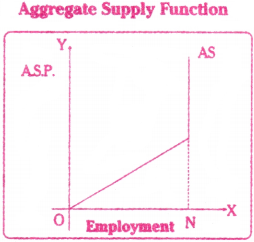
In the above diagram as employment levels Aggregate Supply Function increase the AS curve rises to the right. ON is assumed to be full employment level. At this level, aggregate supply the function AS is parallel to Y – axis which means that the aggregated supply is perfectly inelastic.
Aggregate Demand : Aggregate demand means the total demand for all commodities in the economy at a particular level of employment. The amount they spend on consumption goods is called consumption expenditure (C) and their expenditure on capital goods is called investment (I). The entrepreneurs expect that the community as a whole is willing to spend certain amount towards purchase of the total output. That expected expenditure is termed as aggregate demand price.
Aggregate Demand Schedule: It shows the aggregate demand at different levels of employment. As the level of employment rises, the total income of the community also rises and therefore the aggregate demand price also increases. This can be seen in the following table.
Aggregate Demand Function
| Level of employment (in lakhs of workers) |
Aggregate demand price (in crore of rupees) |
| 10 | 600 |
| 11 | 625 |
| 12 | 650 |
| 13 | 675 |
| 14 | 700 |
| 15 | 725 |
| 16 | 750 |
In the above table, as employment increases AD also increases. So there is direct relationship between levels of employment and aggregate demand.
Aggregate Demand Curve : If the AD schedule is shown on a graph, then we get a curve. This curve is called aggregate demand curve. This is shown in the diagram given adjacent:
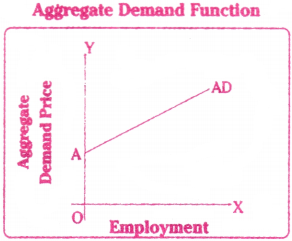
In the adjacent diagram, AD curve is the aggregate demand curve. It slopes upwards from left to right.
Question 12.
Explain the concept of Effective Demand.
Answer:
Effective Demand : The level of employment will be in equilibrium at a point where aggregate demand and aggregate supply are equal. The aggregate demand at which it is equal to aggregate supply is called effective demand. This is shown in the table given below.
Effective Demand
| Levels of employment (in lakhs of workers) |
Aggregate supply price (in crores of rupees) |
Aggregate demand price (in crores of rupees) |
| 10 | 500 | 600 |
| 11 | 550 | 625 |
| 12 | 600 | 650 |
| 13 | 650 | 675 |
| 14 | 700 | 700 |
| 15 | 750 | 725 |
| 16 | 800 | 750 |
In the above table, at the employment of 14 lakhs, the aggregate supply and aggregate demand are equal. At the level of employment of below 14 lakhs, aggregate supply is less than aggregate demand. Similarly, at the level of employment of above 14 lakhs aggregate supply is more than aggregate demand. Only at the level of 14 lakhs the A.D and AS are equal. Hence, it is called effective demand.
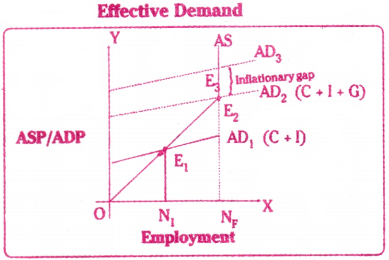
In this diagram, Aggregate demand price curve (AD) and aggregate supply price curve (AS) intersect each’other at point E1”. It shows the equilibrium point. The equilibrium has been attained at “ON,”, level of employment. It is assumed that “ON1” in the above diagram does not indicate full employment as the economy is having idle factors of production. So it is considered as under- employment equilibrium.
According to Keynes, to achieve full employment an upward shift of aggregate demand curve is required. This can be possible through government expenditure on goods and services supplied in the economy, whenever private entrepreneurs may not show interest to invest. With this the AD1 curve (C + I) shifts as AD2 (C + I + G) at new point of effective demand E2, where the economy reaches full employment level i.e., ONF.
Question 13.
Explain the objectives of Government Budget.
Answer:
Objectives of Government Budget : The government plays a crucial role in promoting public welfare. To achieve this, it intervenes in the economy through the following three essential functions. They are:
1. Reallocation Function:
Under the budgetary policy, the government aims to reallocate resources in line with the economic (profit maximization) and social benefit (public welfare) priorities of the country. For example, Government discourages the production of harmful consumption goods (like liquor, cigarettes, etc.) through heavy taxes and encourages the use of “khadi products” by providing subsidies.
2. Redistribution Function :
Economic inequality is an inherent part of every economic system. The government aims to reduce such inequalities of income and wealth through its budgetary policy. Fiscal instruments like taxation, subsidies, expenditure on social security and public works are used by the government to achieve this objective.
3. Stabilization Function:
The government budget is used to prevent business fluctuations of inflation (or) deflation and to maintain economic stability. The Government aims to control the different phases of business fluctuations, with the help of budgetary policy. Policies of surplus budget during inflation and deficit budget during deflation are adopted to achieve stability in the economy.
Question 14.
Write the types of budget.
Answer:
There are three types of budget based on the difference between the receipts and expenditure:
- Surplus Budget : This refers to a budget in which the total revenue is more than the total expenditure.
- Balanced Budget: This refers to a budget in which the total expenditure and the total revenue are equal.
- Deficit Budget: This refers to a budget in which the total expenditure exceeds the total revenue.
Question 15.
Explain different types of deficit.
Answer:
Generally speaking, budget deficit arises when the total expenditure in the budget exceeds the total-receipts.
a) Revenue Deficit Revenue Deficit arises when revenue expenditure exceeds revenue receipts.
Revenue Deficit = Revenue receipts – Revenue expenditure
b) Capital Deficit Capital deficit occurs when capital expenditure exceeds capital receipts.
Capital Deficit = Capital receipts – Capital expenditure
c) Budget deficit Budget deficit is the difference between the total receipts and the total expenditure. In other words, it is the sum of Revenue Deficit and Capital Deficit.
Budget Deficit = Total Receipts – Total Expenditure (OR)
Budget Deficit = Revenue Deficit + Capital Deficit
d) Fiscal deficit: Fiscal Deficit is the difference between Government’s total expenditure and its total receipts (revenue and capital), excluding borrowings and other liabilities. In other words, Fiscal Deficit is the sum of budget deficit and market borrowings and other liabilities.
Fiscal deficit = Revenue Receipts + Capital Receipts (excluding borrowings and other liabilities) – Total expenditure. (OR)
Fiscal Deficit = Budget Deficit + Market borrowings and other liabilities
e) Primary deficit: The primary deficit is derived by subtracting interest payments from the fiscal deficit.
Primary Deficit = Fiscal deficit – Interest payments
Question 16.
Write the objectives of FRBMA.
Answer:
The enactment of the FRBMA, in August 2003, marked a turning point in fiscal reforms, binding the government through an institutional framework to pursue a prudent fiscal policy.
Main objectives :
- The Act mandates the central government to take appropriate measures to reduce fiscal deficit to not more than 3 percent of GDP and to eliminate the revenue deficit by March 31, 2009. This deadline was later extended to 2021. However, the target is yet to be achieved.
- It requires a reduction in the fiscal deficit by 0.3 per cent of GDP each year and the revenue deficit by 0.5 per cent.
- The Act also requires the debt of central government to be limited to 40% of GDP by 2024-25.
Very Short Answer Questions
Question 1.
Laissez Faire.
Answer:
According to classical the role of government in economic activities should be nominal or very less. The free play of economic forces itself brings about the fuller utilization of economic resources including labour. Any interference with the free play of market force, Say’s theory shall fail to bring about full employment.
Question 2.
Say’s Law of Markets.
Answer:
J.B. Say, French economist advocated the famous “Law of markets” on which the classical theory of employment is based. According to this law “Supply creates its own demand’’. According to this law, whenever additional output is created, the factors of production which participate in that production receive incomes equal to that value of that output.
Question 3.
Consumption function.
Answer:
Consumption is a function of income, denoted as C = f(Y) (where C is consumption and Y is income). It means consumption depends on the level of income. As income rises, consumption also increases but not in the same proportion. The increase in consumption is usually less than the increase in income. It is because of the propensity to consume. It means the tendency on the part of the consumers to spend their income. It depends upon several factors.
Question 4.
Marginal Propensity to Save.
Answer:
In Keynesian economic theory, Marginal Propensity to Save (MPS) refers to the proportion of an aggregate raise in income that a consumer saves rather than spends on the consumption of goods and services. Put differently MPS is the proportion of each added dollar of income that is saved rather than spent, MPS is a component of Keynesian macroeconomics theory and is calculated as the change in savings divided by the change in income.
MPS = Change in Saving = Change in Income
Question 5.
Paradox Thrift.
Answer:
The paradox of thrift was developed by British economist J.M. Keynes and popularized in his book The General Theory of Employment, Interest and Money.
If all the people of the economy increase the proportion of income they save (ie., if the MPS of the economy increases) the total value of savings in the economy will not increase – it will either decline or remain unchanged. This result is known as the Paradox of Thrift. This theory states that as people become more thrifty, overall savings may actually decline or remain unchanged.
Question 6.
Goods and Services Tax.
Answer:
Goods and Services Tax is the biggest tax reform in the country since Independence. GST was introduced in India on 1st July 2017. The motto of the GST is One Nation, One Tax, One Market, it is applicable throughout the country with one rate for one type of goods or services. GST replaced large number of taxes on goods and services levied by central and state/UT Governments, Some of the major taxes like excise duty, service tax, central sales tax, VAT etc. are replaced by GST.
Question 7.
Marginal propensity to consume.
Answer:
It refers to the ratio of change in consumption expenditure to the change in the income.
MPC = \(\frac{\Delta C}{\Delta Y}\)
∆C = Change in consumption
∆Y = Change in income
If the MPC increase, consumption increases more and aggregate demand can be increased.
Question 8.
Effective Demand.
Answer:
Effective demand is that aggregate demand which becomes equal to the aggregate supply. This refers to the aggregate demand at equilibrium.
Question 9.
Deficit Budget.
Answer:
Deficit budget refers to the budget in which the total expenditure exceeds the total revenue.
Question 10.
Fiscal Deficit.
Answer:
Fiscal deficit is the difference between the total expenditure and the total revenue minus the market borrowings. In other words, fiscal deficit is the budget deficit plus the market borrowings and other liabilities.
Fiscal deficit = (Total revenue – Total expenditure) + market borrowings & other liabilities, (or)
Fiscal deficit = Budget deficit + market borrowings and other liabilities.
Question 11.
FRBM Act.
Answer:
The FRBM Bill was introduced in the parliament of India in the year 2000 by Atal Bihari Vajpayee Government to provide legal backing to the fiscal discipline to be institutionalized in the country. Subsequently, the FRBM Act was passed in the year 2003. It is an act of the parliament that sets targets for the government of India to establish financial discipline, improve the management of public funds, strengthen fiscal prudence, and reduce its fiscal deficits.
Question 12.
Fiscal Deficit Balance of Trade and Balance of Payments.
Answer:
Balance of Trade (BoT) is a statement showing the total value of exports and imports of goods over a specific period of time. Invisible items i.e., services are not included in BoT.
The BoP (Balance of Payment) is a systematic record of all economic transactions between the residents of one country and the residents of the rest of the world in a year. The BoT always balance in an accounting sense.
One Word Answer Questions
Answer the following questions in ONE WORD.
Question 1.
In which year, Goods and Services Taxes (GST) was introduced in India ?
Answer:
1.7.2017
Question 2.
The ratio of change in consumption to the change in Income is known as
Answer:
Marginal Propensity to Consume (MPC)
Question 3.
“Supply creates its own demand”, stand by ?
Answer:
J.B.Say
Question 4.
The slope of consumption function is equal to :
Answer:
MPC – Marginal Propensity to Consume)
Fill in the blanks
Question 1.
The minimal interference of the government in economic activities is known as ____________.
Answer:
Laissez Faire
Question 2.
In ____________ budget, the total receipt and total expenditure are equal.
Answer:
Balance Budget
Question 3.
The ratio of change in Income to change in investment is called ____________.
Answer:
Investment Multiplier
Question 4.
Fiscal deficit minus interest payments is equal to ____________.
Answer:
Primary Deficit
Question 5.
If borrowings and other liabilities are added to the budget deficit, we get ____________.
Answer:
Fiscal Deficit
Multiple Choice Questions
Question 1.
Which of the following is not an assumption of classical theory of employment?
1) Full employment
2) Laisswez faire employment
3) Perfect competition
4) Short period
Answer:
4) Short period
Question 2.
A point where aggregate demand equals to aggregate supply is called :
1) Direct Demand
2) Indirect demand
3) Effective Demand
4) Derived Demand
Answer:
3) Effective Demand
Question 3.
Which of the following is not considered as public revenue?
1) Direct Taxes
2) Indirect Taxes
3) Goods and Services Tax
4) Transfer Payments
Answer:
3) Goods and Services Tax
Question 4.
If revenue receipts are Rs. 800 cr. capital receipts Rs. 500 cr. borrowings and other liabilities are Rs.400 and total expenditure is Rs.1200 cr. the fiscal deficit is
1) Rs. 1200 cr.
2) Rs. 500 cr.
3) Rs. 300 cr.
4) Rs. 400 cr.
Answer:
3) Rs. 300 cr.
Question 5.
GST comes under which type of tax in the government budget ?
1) Indirect tax
2) Corporate Tax
3) Direct Tax
4) Income Tax
Answer:
1) Indirect tax