AP Inter 1st Year Commerce 2nd Lesson Business Activities Questions and Answers
Fill in the Blanks
Question 1.
The production side of business activity is referred to as _________
Answer:
Industry
Question 2.
The equation form of _________ is industry + commerce.
Answer:
Business
Question 3.
The equation form of _________ is trade + aids to trade.
Answer:
Commerce
Question 4.
_________ refers to the quality of life enjoyed by the members of a society.
Answer:
Standard of living
Question 5.
_________ is also known as ‘external trade’ or ‘International trade’.
Answer:
Foreign Trade
Question 6.
_________ is also known as ‘domestic trade’ or ‘internal trade’.
Answer:
Home Trade
Question 7.
Entrepot trade is also known as _________ trade.
Answer:
Re-export
Question 8.
Personal hindrances can be removed by _________.
Answer:
Trade
Question 9.
_________ removes the hindrance of place.
Answer:
ransportation
Question 10.
_________ services remove the hindrance of financial problems.
Answer:
Banking
Question 11.
_________ removes the hindrance of time.
Answer:
Warehouse
Question 12.
_________ removes the hindrance of risk.
Answer:
Insurance
Question 13.
_________ removes the hindrance of knowledge.
Answer:
Advertisement
Question 14.
_________ removes the hindrance of information.
Answer:
Communication
Question 15.
The _________ connects links between the producers and the retailers.
Answer:
Wholesalers
Question 16.
The _________ connects links between wholesalers and consumers.
Answer:
Retailers
Very Short Answer Questions
Question 1.
Industry.
Answer:
Industry is concerned with making or manufacturing of goods. Simply means the production of wealth or value. Industry is the backbone to the commerce and trade. Both industry and commerce are the part & parcel of business.
Question 2.
Commerce.
Answer:
The word “commerce” means and includes all the efforts originating for transfer of goods and services from their place of origin to the place of consumption.
Commerce = Trade + Aids to Trade where Trade = Purchase and sale of goods & services
Aids to Trade = Transport, Communication, Warehousing, insurance, banking, advertisement.
Question 3.
Trade.
Answer:
Trade is a branch of commerce. It connects buying & selling activities. An individual who does trade is called a trader. Trader transfers the goods from the producer to the consumer. He earns profit form this activity.
Question 4.
Home Trade.
Answer:
Trade takes place between the individuals of the same country (or) with in the geographical boundaries of a country is called “Home Trade”. It is also called as Domestic Trade or Internal Trade.
Question 5.
Foreign Trade.
Answer:
The trade takes place between individuals of different countries is called “Foreign Trade”or “International Trade”.
Question 6.
Entrepot Trade or Re-export Trade.
Answer:
It means importing (buying) goods from one country for the purpose of exporting (selling) them to another country. This type of trade is also known as re-export trade.
Question 7.
Genetic Industries.
Answer:
Genetic Industry is related to the re-producing and multiplying of certain species of animals and plants with the object of earning profits from their sale. Nature, climate and Environment play an important role in these industries.
Ex : Plant nurseries, Poultry forms. Cattle breeding etc.
Question 8.
Extractive Industry.
Answer:
The extractive industry is engaged in raising some form of wealth from the soil, climate, air and water. Here nature does not everything and man does very little to add it. All that the man has to do is simply to take out what the nature has already given.
Ex : Extractive industries are mining, fishing, agriculture, extraction of timber, rubber from forest etc.
Question 9.
Warehousing.
Answer:
The goods are produced in anticipation of demand. They may also be produced at a time when they are not needed. So there is time gap between the production and consumption. This gap is filed up by warehouses. Warehouses store the goods and protect the goods until the goods are consumed.
Question 10.
Transportation.
Answer:
The goods are taken from a place where there is a less demand, to the places where they are in more demand. These goods are to be taken to the source of consumption with the help transport facilities we can create ‘Place utility’ in goods.
Question 11.
Banking.
Answer:
The traders purchase goods from the producers and sell them to the consumers. It takes time to collect money after sale. There is a need of finance to trade activities. The commercial banks help trade in the form of overdrafts, loan etc.
Question 12.
Wholesale Trade.
Answer:
Buying and selling of goods in large quantities is called “wholesale trade”. A wholesaler buys goods in large quantities from the producers and sells in small quantities to retailers.
Question 13.
Retail Trade.
Answer:
Retail Traders sell goods in small quantities directly to the consumers. A person who is involved in the retail trade is called “retailer”. He maintains all varieties of goods to attract the consumers for sales either in cash or credit.
Question 14.
Consumer goods.
Answer:
The goods which are acquired for the purpose of consumption are called consumer goods. Consumer goods are the goods those can be used directly by the consumers food grains, textiles etc.
Question 15.
Producer goods.
Answer:
The goods which are acquired for the purpose of production are called producer goods. The producer goods are the goods used by producers to produce some other goods like machinery, equipment etc.
Question 16.
Communication.
Answer:
Transmitting information from one person to other is known as communication. Communication plays an important role between producer, businessman and consumers.
Question 17.
Advertising.
Answer:
Advertising helps in providing information about the availability and usefulness of various products in the market. Therefore advertising, publicity and selling campaigns will remove the hindrances of knowledge about products.
Question 18.
Import Trade.
Answer:
When the goods are purchased from outside countries for use in the domestic market, it is called “Import Trade”.
Ex : India buys petrol from Iran.
Question 19.
Export Trade.
Answer:
When domestic goods are sold to the other country it is called “Export Trade”.
Ex : India sells readymade dressess to America.
Question 20.
Home Trade.
Answer:
Trade takes place between the inviduals of the same country or within the geographical boundaries of a country is called “Home Trade”. It is also called a “Domestic Trade” or “Internal Trade”.
Short Answer Questions
Question 1.
List out types of Industries.
Answer:
Industry is concerned with the making or manufacturing of goods. Simply it means the production of wealth or value.
Types of Industry :
- Primary Industry : It is concerned with production of goods with the help of nature. It is a nature oriented, which requires lesser human efforts.
Ex : Agriculture, Farming, Forestry, Fishing. Horticulture etc. - Genetic Industry : Genetic industry is related to the re-producing and multiplying of certain species of plants and animals with the object of sale. The main aim is to earn profit from such sale.
Ex : Plant nurseries, Poultry forms, Cattle breeding etc. - Extractive Industry : The extractive industry is engaged in raising some form of wealth from the soil, climate, air and water. All that the man has to do is simply to take out what the nature has already given.
Ex : Mining Industry, coal, mineral, oil industry, fishing, agriculture, extraction of tumber & Rubber from forest etc. - Manufacturing Industry : Manufacturing industries are engaged in transforming raw- material into finished product with the help of machines and manpower. The finished goods can be either consumer goods or producer goods.
Ex : Textiles, chemicals, sugar industry, paper industry etc., - Construction Industry : The industry is engaged in the creation of infrastructure. These industries are engaged in the construction of buildings, roads, dams, bridges and canals.
- Service Industry : In modern times, service sector plays an important role in the development of the nation and therefore it is named as service industry. These are engaged in the provision of essential services to the community.
Ex : Banking, Hotels, Tourism, Insurance etc.
Question 2.
How Trade is classified ?
Answer:
Trade : Trade is the part of commerce and it creates connection between buyers and sellers.
Trade is nothing but the summation of purchasing and selling of goods.
1) Home Trade : The purchase and sale of goods inside the country is called as “Home Trade”. It is divided into Wholesale Trade and Retail Trade.
- Wholesale Trade : In wholesale Trade, goods are purchased in large quantities by whole saler and sold them in small quantities to retailer.
- Retail Trade : In retail trade, the retailer purchases goods from wholesaler and sells them to ultimate consumers. Unlike a wholesaler, the retailers will have direct contact with customers.
2) Foreign Trade : When trade takes place between two countries, it is called foreign trade (or) international trade. It can be divided into 3.
- Import Trade : When goods are purchased from outside countries, it is called Import Trade”.
- Export Trade : When the goods are sold and sent to other countries is called “Export Trade”.
- Entrepot Trade : When one .country imports the goods from another country and the same goods are exported to another foreign country, it is called “Re-export Trade” or Entrepot Trade”.
Question 3.
What are the hindrances involved in Commerce ?
Answer:
’Commerce’ plays an important role in the distribution of goods and services. For the smooth running of trade and business some services are needed, like transport, banking, insurance etc.
Definition : “Commerce is an organized system for the exchange of goods between the members of the industrial world”. – James Stephenson
The main hindrances are as follows :
- Hindrances of Place : The place of production may be away from the place of consumption. The various means of transport will helps for the smooth distribution of goods and services.
- Hindrances of time : Goods are produced by expecting the demand. So it is necessary to make suitable arrangement for their storage. The gap between production and consumption is the main hindrance with the help of warehousing we can overcome this hindrance.
- Hindrances of exchange : Exchange of goods and services automatically deals with exchange of value. For that time, value, place may vary. Those hindrances and working capital problems will be solved with help of banks.
- Hindrances of knowledge : Creation of demand is very important junction of commerce. If we fails to create demand then no question of production or distribution arises with the help of advertisements we can overcome this hindrance.
- Hindrances of work : Objective of business is to earn profit. But profit is the reward of risk bearing. A choice of loss occurence is there. This hindrance can be removed with the help of Insurance. Finally commerce is a group of services it includes trade and aids to trade.
Question 4.
Trace out the various types of Aids to Trade.
Answer:
Aids to Trade : Auxiliaries which help in smooth exchange of goods directly or indirectly are known as “Aids to trade”. Various aids to trade are :
- Transport : Transferring of goods from the centre of production to the center of communication is done by transport. Several types of transports are like air, water and land etc.
- Communication : Transmitting of information from one person to other is known as “Communication”. Communication plays an important role between producer, businessman and consumer. Telex, Telephone, Telegraph, e-mail, teleconference etc.
- Warehousing : Production takes place only in few seasons on large scale and their utility is spread throughout the year. There is gap between production & consumption. Hence, warehousing eliminates the time gap between production and consumption. For this reason, warehousing provides “time utility”.
- Insurance : The businessmen covers all the risks through insurance companies. Insurance covers all risks due to fire, theft, floods, storm other calamities. Insurance helps the development of trade by removing the fear of loss.
- Banking : Banking helps in buying and selling of goods by providing convenient and safe mode of payment. They play an important role in overcoming the financial problem.
- Advertisement : Advertising helps in providing information about the availability and usefulness of various products in the market. Therefore advertising publicity and selling campaigns will remove the hindrances of knowledge about products.
Question 5.
What do you understand by commerce ?
Answer:
Commerce : Commerce is that part of business which is connected with the exchange of goods and services. Commerce involves the process of bringing goods from the place of production and sending them to the place of consumption. In other words, it supplies goods to ultimate consumer.
Definition : “Commerce is an organized system for the exchange of goods between the members of the Industrial World”. – James Stephenson
Importance of Commerce :
- Commerce tries to satisfy increasing human wants.
- Commerce helps to increase our standard of living.
- Commerce links producers and consumers.
- Commerce generates employment opportunities.
- Commerce increases national income and wealth.
- Commerce encourages International Trade.
- Commerce benefits underdeveloped countries.
- Commerce helps during emergencies like floods, earthquakes and wars.
Question 6.
How foreign Trade is classified ?
Answer:
Trade is the part of commerce. It is the summation of purchasing and selling of goods. Trade can be divided into home trade and foreign trade.
Foreign Trade : When trade takes place between two countries, it is called foreign trade (or) international trade.
- Import trade : When goods are purchased from outside countries, it is called “Import Trade”.
Ex : India purchases wheat goods from Russia. This is called import trade. - Export Trade : When the goods are sold and sent to other countries is called “Export Trade”.
Ex : India sells leather goods to Russia. This is an export trade to India. - Entrepot or Re-export Trade : If one country imports the goods from another country and the same goods are exported to another foreign country, it is called “Re-export Trade” or Entrepot Trade”.
Long Answer Questions
Question 1.
What is meant by Industry ? Explain various types of industries with suitable examples.
Answer:
Industry is concerned with the production of goods and services. Extracting, producing, processing and manufacturing of goods.
Industries can be classified into 6 types :

1) Primary Industry: Primary industry is concerned with production of goods with the help of naure. It is a nature – oriented industry, which requires very little human effort.
Ex : Agriculture, Farming Forestry, Fishing, Horticulture etc.
2) Genetic Industry : Genetic industries are engaged, in re-production and multiplication of certain species of plants and animals with the object of sale. The main aim is to earn profit from such sale.
Ex : Poultry forms, cattle breeding farms, plants nurseries.
3) Extractive Industry : The extractive industry is engaged in raising some form of wealth from the soil, climate, air or water. Generally products of extractive industries come in raw-material, they are used for manufacturing and construction industries for producing finished products.
Ex : Mining, Fishing, Coal, Mineral, Iron ore. Oil industry, Timber, Rubber from forests etc.
4) Manufacturing Industry : Manufacturing industries are engaged in transforming raw- materials into finished product with the help of machines and man power. The finished goods can be either consumer goods or producer goods.
Ex : Textiles, chemicals, sugar industry, paper industry etc.
These kind of industries can be divided under :
- Analytical : In an analytical industry the basic raw-material is broken into several useful materials.
Ex : In oil refinery, crude oil is refined and several petroleum products are procured. - Synthetic : In this type of manufacturing industry two or more materials are mixed to form a new product.
Ex : Cosmetics, detergents, fertilizers etc. - Processing : In the processing industry, material is processed through various stages.
Ex : Spinning, weaving, dying, bleaching and printing process. - Assembling : This kind of industry assembles various parts to manufacture a finished product.
Ex : Manufacturing of automobiles, by assembling various spare-parts.
5) Construction Industry : This industry is engaged in the creation of infrastructure for the smooth development of the economy. These industries are engaged in the provision of essential service to the community.
Ex : Construction of buildings, roads, dams etc.,
6) Service Industries : In modern times service plays vital role in the development of nation and therefore it is named as service industry.
Ex : Banking, transport, hotels, tourism industry, film and other entertainment industries etc.
Question 2.
What is commerce ? Describe the various branches of commerce.
Answer:
Commerce is that part of business which is concerned with the exchange of goods and services and include all the activities which directly or indirectly facilitate that exchange.
Definition : “Commerce is an organized system for the exchange of goods between the members of the industrial world”. – James Stephenson
Commerce = Trade + Aids to Trade
Where, Trade = Purchase and sale of goods and services.
Aids to Trade = Transport, communication, warehousing, insurance, banking, advertisement.
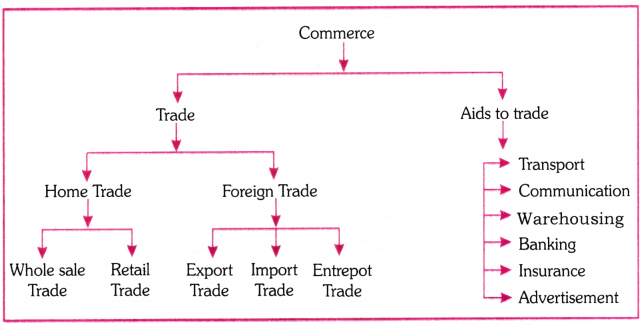
A) Trade: Trade is nothing but the summation of purchasing and selling of goods. An individual who does trade is called a “Trader”.
Trade classified into Home Trade & Foreign Trade.
1) Home Trade : The purchase and sale of goods inside the country is called as “Home Trade”. It is also known as “Internal trade” or “Domestic trade”. It is divided into “wholesale trade” & “Retail trade”.
- Wholesale Trade : Buying and selling of goods in large quantities is called “Wholesale trade”. A wholesaler buys goods in large quantities from the producers and sell in small quantities to retailers.
- Retail Trade : Retail traders sell goods in small quantities directly to the consumers. A person who is involved in the retail trade is called ‘retailer’.
2) Foreign Trade : When trade takes place between two countries, it is called “Foreign trade” or “International trade”. Buyer and seller belong to different countries. It can be divided into three :
- Export Trade : When the goods are sold and sent to other countries is called “Export Trade”.
Ex : India sells leather goods to Russia. - Import trade : When goods are purchased from other countries, it is called “Import Trade”.
Ex : India purchases wheat goods from Russia. - Entrepot Trade : If one country imports the goods from another country and the same goods are exported to another foreign country, it is called “Entrepot trade” or “Re-entrepot trade”.
Ex : India importing wheat from U.S. and exporting the same to Sri Lanka.
B) Aids to Trade : Auxiliaries which help in smooth exchange of goods directly or indirectly are known as “Aids to trade”. Various aids to trade are :
- Transport : Transferring of goods from the centre of production to the center of communication is done by transport. Several types of transports are like air, water and land etc.
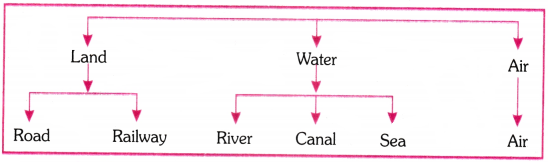
- Communication : Transmitting of information from one person to other is known as “Communication”. Communication plays an important role between producer, businessman and consumer. Telex, Telephone, Telegraph, e-mail, teleconference etc.
- Warehousing : Production takes place only in few seasons on large scale and their utility is spread throughout the year. There is gap between production & consumption. Hence, warehousing eliminates the time gap between production and consumption. For this reason, warehousing provides “time utility”.
- Insurance : The businessmen covers all the risks through insurance companies. Insurance covers all risks due to fire, theft, floods, storm other calamities. Insurance helps the development of trade by removing the fear of loss.
- Banking : Banking helps in buying and selling of goods by providing convenient and safe mode of payment. They play an important role in overcoming the financial problem.
- Advertisement : Advertising helps in providing information about the availability and usefulness of various products in the market. Therefore advertising publicity and selling campaigns will remove the hindrances of knowledge about products.
Question 3.
Define Trade and explain various types of Aids to Trade.
Answer:
Trade means buying and selling of goods in order to earn or make profit. It creates a link between producers and customers.
Types of Trade : Trade classified into two :
1) Home Trade : Trade takes place between the individuals of the same country within the geographical boundaries of a country is called “Home Trade”. It is also called as “Domestic Trade” or “Internal Trade”. It is classified into two :
- Wholesale Trade : Buying and selling of goods in large quantities is called “wholesale trade”. A wholesaler buys goods in large quantities from the producers and sells in small quantities to retailers.
- Retail Trade : It involves selling goods to the final consumers. He purchases goods from wholesaler and sells them to ultimate consumers.
2) Foreign Trade : When trade takes place between two countries, it is called “foreign trade” or “internal trade”. Buyer and seller belong to different countries. It can be divided into three :
- Import trade : When goods are purchased from other countries it is called “import trade”.
Ex: India purchases wheat goods from Russia. - Export trade : When the goods are sold and sent to other countries is called “export trade”.
Ex : India sells leather goods to Russia. - Entrepot trade or Re-export trade : If one country imports the goods from another country and the same goods are exported to another foreign country, it is called “Re-export trade”.
Ex : India purchases wheat from Russia and exporting the same to Sri Lanka.
Aids to Trade of Auxiliaries to trade :
For smooth running of trade and commerce these services are required without the help of such functions, it is not possible to take goods from one place to another. These are also known as auxiliaries to trade and also called as “aids to trade”.
- Transport : Transporting of goods from the centre of production to the center of communication is done by transport.
- Communication : Transmitting of information from one person to other is known as “Communication”.
- Warehousing : The goods are produced in anticipation of demand. They may also be produced at a time when they are not needed. So there is time gap between the production and consumption. Warehousing provides ‘time utility’.
- Insurance : The businessmen covers all the risks through insurance. Insurance covers all risks due to fire, theft, floods and-accidents. Insurance acts as risk bearers.
- Banking : Banking helps in buying and selling of goods by providing convenient and safe mode of payment. They play an important role in overcoming the financial problem.
- Advertisement : Advertising helps in providing information about the availability and usefulness of various products in the market. Therefore advertising, publicity and selling campaigns will remove the hindrances of knowledge about products.
Question 4.
Narrate the importance of commerce ?
Answer:
The importance of commerce is explained with the help of the following points :
- Commerce tries to satisfy increasing human wants : Human wants are never ending. Commerce has made distribution and movement of goods possible from one part of the world to the other. Today we can buy anything produced anywhere in the world.
- Commerce helps to increase our standard of living : Standard of living refers to the quality of life enjoyed by the members of a society. When a man consumes more products his standard of living improves. Commerce helps us to get what we want at the right time, right place, and at the right price and thus helps us in improving our standard of living.
- Commerce links producers and consumers ; Production is meant for ultimate consumption. Commerce makes possible to link producers and consumers through wholesalers and retailers and also through the aids to trade. Thus, commerce creates and facilitates the contact between the centres of production and consumption and links them.
- Commerce generates employment opportunities : The growth of commerce, industry and trade caused the growth of agencies of trade such as banking, transport, warehousing, insurance, advertising, etc. These agencies need people to look after their functioning. Thus, development of commerce generates more and more employment opportunities.
- Commerce increases national income and wealth : When production increases, national income also increases. It also helps to earn foreign exchange by way of exports and duties levied on imports.
- Commerce helps in expansion of aids-to-trade : With the growth in trade and commerce there is a growing need for expansion and modernisation of aids to trade. Aids to trade such as Banking, Communication, advertising and publicity, transport, insurance etc. are expanded and modernised for the smooth conduct of commerce.
- Commerce encourages international trade : With the help of transport and communication development, countries can exchange their surplus commodities and earn foreign exchange. Thus, commerce ensures faster economic growth of the country.
- Commerce benefits underdeveloped countries : Underdeveloped countries can import skilled labour and technical know-how from developed countries, while the advanced countries can import raw-material’s from underdeveloped countries. This helps in laying down the seeds of industrialization in the underdeveloped countries.
- Commerce helps during emergencies : During emergencies like floods, earthquakes, and wars, commerce helps in reaching the essential requirements like foodstuff, medicines and relief measures to the affected areas.
Question 5.
Explain the hindrances involved in commerce.
Answer:
Commerce is an organized system which facilitates the free flow of goods and services. In business, products and services are produced through industry. The produced goods and services face various types of hindrances to reach the customers. Commerce removes these hindrances and helps to distribute products and achieving the business’s desired goals. The following table presents the hindrances involved in the commerce and aids to remove them :
| Hindrances | Removed by |
| Persons | Trade |
| Place | Transportation |
| Time | Warehousing |
| Finance | Banking |
| Risk | Insurance |
| Promotion | Advertisement |
| Information | Communication |
Thus, commerce involves trade and aids to trade. Following are some of the hindrances in commerce.
- Hindrance of Person : Trade is done by buyers and sellers, in exchange for money. The sellers sell the goods and services to the buyers. Therefore, by handing over products or services, personal hindrance can be removed.
- Hindrance of Finance : Banking services remove the hindrance of financial problems. It facilitates trade by providing credit in various forms.
- Hindrance of Time and Duration : There is a time gap between production and consumption. The goods produced are not immediately required for consumption. Warehousing removes the hindrance of time and duration. It preserves the goods from the time of production to the time of consumption. It creates time utility.
- Hindrance of Place : Goods are produced in a limited number of production centres, whereas consumers are located everywhere. Transportation removes the hindrance of place. It implies conveyance of goods and passengers from one place to another. It creates place utility.
- Hindrance of Risk : Business involves risk. Risk and uncertainty are inherent in any business. Insurance stands for protection significant against risk. So, it removes the hindrance of risk. The risk of businessman is reduced by several types of insurance such as fire insurance, transit insurance, marine insurance, factory insurance on stocks and assets etc.
- Hindrance of Knowledge and Information : Advertisement helps to eliminate the hindrance of knowledge. It informs the customers about the availability of various products. Communication helps in the efficient operation of commercial activities. Thus, it removes the hindrance of information.
Question 6.
Explain the inter relationship between trade, commerce and industry. (Additional)
Answer:
Industry, commerce and trade are a part of business and closely related to each other.
-
- Industry : Industry is concerned with the making or manufacturing of goods.
- Trade : Trade is a channel for transport of goods from producer to consumer.
- Commerce : Commerce helps industry before and after the production.
| Aspect | Industry | Commerce | Trade |
| 1. Meaning | It is concerned with production of goods & services. Industry means creation of wealth or value. | Commerce is nothing but the process of distribution of goods and services. It includes trade and aids to trade. | Trade means transfer of ownership of goods and services. In simple the activities of selling and buying of goods and services is called as trade. |
| 2. Utility | Industry creates form utility | Commerce creates place and time utility. | Trade creates possession (place) utility, which helps in the distribution of goods & services. |
| 3. Scope | Industry includes all the activities needed to produce final product. | Commerce includes trade and aids to trade. | Trade includes home trade and foreign trade. |
| 4. Capital | Requires huge capital | Requires less capital | Requires less capital |
| 5. Risk | Involves high risk | Lower amount of risk than industry. | Lower amount of risk than industry. |
| 6. Elements | Primary industry, Genetic industry, extractive industry, manufacturing industry, construction industry and service industry. | A trade and aids to trade. | Home trade and foreign trade. |
| 7. Place of operation | Firms, factories, workshops, mines etc. | Distribution of goods from one place to the other place. | Market |
| 8. Ownership and control | By industrialists | By merchants. | By traders |
Check Your Knowledge
I. Fill in the blanks for the following questions :
Question 1.
_________ industry is conserved with production of goods with the help of nature.
Answer:
Primary
Question 2.
The goods may be _________ goods.
Answer:
Consumer
Question 3.
_________ industries are engaged, in reproduction and multiplication of certain species of plants and animals with the object of sale.
Answer:
Genetic
Question 4.
_________ industry is concerned with extraction or drawing out goods from the soil, air or water.
Answer:
Extractive
Question 5.
_________ industries are engaged in transforming raw – materials into finished product with the help of machines and manpower.
Answer:
Manufacturing
Question 6.
The _________ industry, material is processed through various stages.
Answer:
Processing
Question 7.
_________ industries take up the work of construction of buildings, bridges, roads, dams, canals etc.
Answer:
Construction
Question 8.
_________ deals with the distribution aspect of the business.
Answer:
Commerce
Question 9.
_________ is done by buyers and sellers, in exchange for money.
Answer:
Trade
Question 10.
Home Trade is also known as _________ trade.
Answer:
Domestic trade
Question 11.
Traders who engage themselves in wholesale trade are called _________
Answer:
Wholesalers
Question 12.
Traders engaged in retail trade called _________
Answer:
Retailers
Question 13.
The geographical distance between producers and consumers is removed with the help of _________
Answer:
Transport
Question 14.
_________ means transmitting of exchanging information from one person to another.
Answer:
Communication
Question 15.
_________ and _________ are important medias of mass communication.
Answer:
Advertising and Publicity
II. State whether the statement are True or False.
Question 1.
Human wants are never ending. (True/False)
Answer:
True
Question 2.
Production is meant for ultimate consumption. (True/False)
Answer:
True
Question 3.
When production decreases, national income also decreases. (True/False)
Answer:
False
Question 4.
Business involves not risk. (True/False)
Answer:
False
Question 5.
Trade is a branch of business. (True/False)
Answer:
False
Question 6.
Trade is the nucleus of commerce. (True/False)
Answer:
True
Question 7.
Home trade is also known as wholesale trade. (True/False)
Answer:
False
Question 8.
Wholesale Trade involves buying and selling of goods in large quantities. (True/False)
Answer:
True
Question 9.
Traders engaged in retail trade are called wholesale traders. (True/False)
Answer:
False
Question 10.
Buying and selling of goods and services between two or more countries are called Foreign Trade. (True/False)
Answer:
True
Question 11.
Trade or exchange of goods involves several difficulties which can be removed by auxiliaries to business. (True/False)
Answer:
False
Question 12.
Modern means of communication like telephone, telex, telegraph, email, teleconference etc. (True/False)
Answer:
True
Question 13.
Export trade means the sale of goods to our country. (True/False)
Answer:
False
Question 14.
Import Trade refers to the purchase of goods from foreign countries. (True/False)
Answer:
True
Question 15.
Aids to Trade include Transport, communication. Warehousing, Banking, Insurance, Advertising. (True/False)
Answer:
True
Question 16.
Industry refers to production of consumer goods and capital goods and creates form utility. (True/False)
Answer:
True
Question 17.
The hindrances of commerce are person, place, finance, time and duration etc. (True/False)
Answer:
True
Student Activity
State whether the statements are True or False.
Question 1.
The production side of business activity is referred to as industry. (True/False)
Answer:
True
Question 2.
Business = Trade + Commerce. (True/False) (True/False)
Answer:
False
Question 3.
Buying and selling of goods and services is called commerce.
Answer:
False
Question 4.
Agriculture is related to Primary Industry.
Answer:
True
Question 5.
Fishing related to genetic industry. (True/False)(True/False)
Answer:
True
Question 6.
Tourism belongs to the service industry.
Answer:
True
Question 7.
Commerce = Trade + Aids to Trade. (True/False)
Answer:
True
Question 8.
Commerce facilitates the free flow of goods & services. (True/False)
Answer:
True