AP Inter 1st Year Botany 10th Lesson Plant Growth and Development Questions and Answers
IV. Very Short Answer Questions
Question 1.
Define plasticity? Give an example.
Answer:
Ability of Plants to follow different pathways in response to the environment or phases of life to form different kinds of structures is called plasticity.
Ex: Heterophylly in Cotton, Coriander and Larkspur
Question 2.
What is the disease that formed the basis of the identification of gibberellins in plants? Name the causative fungus of this disease.
Answer:
The “BAKANE” or foolish seedling disease of rice seedlings. It is caused by a fungal pathogen Gibberella fujikuroi.
Question 3.
What is apical dominance? Name the growth hormone that causes it. [March-26]
Answer:
- The growing apical bud inhibits the growth of lateral or axillary buds is called apical dominance.
- It is caused by Auxins.
Question 4.
What is meant by bolting? Which hormone causes bolting?
Answer:
- The sudden elongation of internodes just prior to flowering is called bolting.
- Gibberellins are responsible for bolting.
Question 5.
Define respiratory climactic? Name the PGR associated with it.
Answer:
- The rise in the rate of respiration during ripening of fruits is called respiratory climactic.
- Ethylene enhances the respiration rate during ripening of fruits.
Question 6.
What is ethephon? Write its role in agricultural practices.
Answer:
- The most widely used compound as a source of ethylene is ethephon.
- Ethephon releases ethylene slowly.
- Ethephon hastens fruit ripening in tomatoes and apples and accelerates abscission in flowers and fruits.
- It promotes female flowers in cucumbers, thereby increasing the yield.
Question 7.
Why is abscisic acid also known as stress hormone ?
Answer:
- Abscisic acid (ABA) is a stress hormone.
- ABA stimulates the closure of stomata in the epidermis and increases the tolerance to plants for various kinds of stresses.
- Therefore, It is also called a stress hormone.
Question 8.
Define growth and development.
Answer:
- Growth is an irreversible, permanent increase in size of an organism or its parts or even of an individual cell.
- The changes that an organism goes through during its life cycle is called development.
Question 9.
Name the phases observed in sigmoid growth curve.
Answer:
Lag phase, Log phase and Stationary phase.
Question 10.
What are the very essential conditions required for growth ?
Answer:
Water, oxygen and nutrients.
V. Short Answer Questions
Question 1.
Write a note on agricultural and horticultural applications of auxins.
Answer:
- IBA, NAA and IAA help to initiate rooting in stem cuttings, an application widely used for plant propagation in horticulture.
- Auxins promote flowering in Pineapple.
- Auxins help to prevent fruit and leaf drop at early stages but promote the abscission of older mature leaves and fruits.
- Auxins are responsible for apical dominance and inhibit growth of lateral buds.
- Auxins also induce parthenocarpy in Tomatoes.
- Auxins like 2, 4-D are widely used as herbicides, which kill broad leafed dicot weeds.
- Auxins also control xylem differentiation and help in cell division.
Question 2.
Write the physiological responses of the gibberellins in plants.
Answer:
- Gibberellins have the ability to cause an increase in the length of axis or peduncle (or) pedicels in grapes.
- Gibberellins cause fruits like apples to elongate and improve their shape.
- Gibberellins delay senescence thus the fruits can be left on the tree longer so as to extend the market period.
- GA3 is used to speed up the malting process in the brewing industry.
- Spraying sugarcane crops with Gibberellins increases the length of the stem, thus increasing the yield by as much as 20 tonnes per acre.
- Spraying juvenile conifers with Gibberellins speeds up the maturity period, thus leading to early seed production.
- Gibberellins promote bolting in beet, cabbages and many plants with rosette habit.
- They also promote parthenocarpic fruits in grapes and tomatoes.
Question 3.
Write any four physiological effects of cytokinins in plants.
Answer:
- Cytokinins induce cell division.
- Cytokinins help to produce new leaves, chloroplasts in leaves.
- Cytokinins help in lateral shoot growth and adventitious shoot formation.
- Cytokinins help to overcome apical dominance.
- They promote nutrient mobilization which helps in the delay of leaf senescence.
- Cytokinins help in the opening of stomata by increasing the concentration of K+ ions in guard cells.
Question 4.
What are the physiological processes that are regulated by ethylene in plants?
Answer:
- Ethylene influences Horizontal growth of seedlings, swelling of the axis and apical hook formation in dicot seedlings.
- Ethylene promotes senescence and abscission of plant organs, especially of leaves and flowers.
- Ethylene is highly effective in fruit ripening.
- Ethylene enhances the respiration rate during ripening of fruits. This phenomenon is called respiratory climatic.
- Ethylene breaks seed and bud dormancy, initiates germination of peanut seeds and sprouting of potato tubers.
- Ethylene promotes rapid inter node or petiole elongation in deep water rice plants to make the leaves or upper parts of the shoot to remain above water.
- Ethylene promotes root growth and root hair formation, thus helping plants to increase their absorption surface.
- Ethylene is used to initiate flowering and for synchronizing fruit set in pineapples. It also induces flowering in mango.
- It promotes female flowers in cucumbers, thereby increasing the yield.
VI. Long Answer Questions
Question 1.
Define growth, differentiation, development, dedifferentiation, redifferentiation, determinate growth, meristem and growth rate.
Answer:
- Growth : It is an irreversible, permanent increase in size of an organism or its parts or even of an individual cell.
- Differentiation : The process by which cells become specialized in structure and function.
- Development: The changes in an organism undergoes from a single cell to maturity.
- Dedifferentiation: The process where mature cells reverse their state of differentiation and become undifferentiated.
- Redifferentiation : The process where dedifferentiated cells lose their ability to divide and become mature to perform a specific function.
- Determinate growth: Growth that stops after a certain point, meaning the organism or organ stops growing after reaching a certain size.
- Meristem : A region of actively dividing cells in plants, responsible for new growth.
- Growth rate : The increase in growth per unit time.
Question 2.
Describe briefly
a) Arithmetic growth,
b) Geometric growth,
c) Sigmoid growth curve,
d) Absolute and relative growth rates.
Answer:
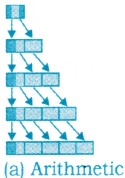
a) Arithmetic Growth:
- In arithmetic growth, following cell division (mitosis), only one of the daughter cells continues to divide, while the other differentiates and matures.
- Rate of Growth : The growth rate is constant, meaning the increase in size or number is the same over equal time intervals.
Ex: The elongation of roots at a constant rate is an example of arithmetic growth. - Graph : A graph of length against time in arithmetic growth results in a straight line (linear curve).
b) Geometric Growth:
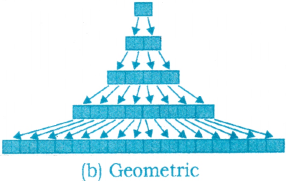
- In geometric growth, the daughter cells retain the ability to divide, but the rate of growth slows down due to factors like limited resources.
- Rate of Growth : The initial growth is slow (lag phase), followed by a period of rapid increase (log/exponential phase), and then a slowing phase.
Ex: The growth of all cells, tissues, and organs generally follows a geometric pattern. - Graph : A graph of size against time in geometric growth shows a S-shaped curve (sigmoid curve).
c) Sigmoid growth curve :
- If a graph is plotted for geometrical growth, it gives a typical sigmoid or S- curve.
- A Sigmoid curve is a characteristic of living organisms growing in a natural environ¬. ment.
- It consists of three phases namely Lag phase, log phase and stationary phase.
- Lag phase: Growth is slow ih the beginning when the cell number is small.
- Log phase: Growth increases rapidly or exponentially.
- Stationary phase : Due to shortage of space and nutrients, growth slows down leading to a stationary phase. This gives an S- shaped curve.
d) Absolute and relative growth rates:
- Quantitative comparisons between the growth of living systems can be of two kinds.
- Absolute growth rate: Measurement and comparison of the total growth per unit time is called the absolute growth rate.
- Relative growth rate: The growth of the given system per unit time expressed on a common basis.
Ex: Per unit initial parameter is called the relative growth rate.
I. Multiple Choice Questions
Question 1.
The three phases of growth in correct order is
1. Meristematic, maturation, elongation
2. Elongation, meristematic, maturation
3. Meristematic, elongation, maturation
4. Elongation, maturation, meristematic
Answer:
3. Meristematic, elongation, maturation
Question 2.
The phase in which maximum growth can be seen in the sigmoid curve.
1. Log
2. Lag
3. Stationary
4. Lag and Log
Answer:
1. Log
Question 3.
An aquatic plant which shows plasticity
1. Cotton
2. Coriander
3. Buttercup
4. Larkspur
Answer:
3. Buttercup
Question 4.
An example of adenine derivative plant growth regulator is
1. IAA
2. Kinetin
3. ABA
4. Gibberellic acid
Answer:
2. Kinetin
Question 5.
Gibberellic acid is
1. Indole compound
2. Adenine compound
3. Carotenoid derivative
4. Terpene derivative
Answer:
4. Terpene derivative
Question 6.
The foolish seedling disease of rice is caused by
1. Nematode
2. Bacteria
3. Fungus
4. Virus
Answer:
3. Fungus
Question 7.
2, 4-D is used to kill
1. Gymnosperms
2. Dicot weeds
3. Monocot grasses
4. Pteridophytes
Answer:
2. Dicot weeds
Question 8.
Bolting is
1. Yellowing of leaves
2. Internodal elongation prior to flowering
3. Early seed production
4. Re-greening of leaves
Answer:
2. Internodal elongation prior to flowering
Question 9.
Cytokinins help to produce
1. Chloroplast in leaves
2. Stem elongation in sugarcan
3. Synchronized fruit set in pineapple
4. Flowering in pineapple
Answer:
1. Chloroplast in leaves
Question 10.
Ethylene promotes
1. Senescence and abscission of flowers
2. Senescence but not abscission of flowers
3. Abscission of flowers but not senescence
4. Neither senescence nor abscission of flowers
Answer:
1. Senescence and abscission of flowers
II. Fill in the Blanks
Question 1.
Auxin was isolated by F.W.Went from tips of coleoptiles of ___________ seedlings.
Answer:
Oats
Question 2.
The ‘Bakanae’ disease of rice seedlings was caused by a fungal pathogen ___________
Answer:
Gibberella fujikuroi
Question 3.
Skoog and Miller crystallized the cytokinesis promoting active substance that they termed as ___________
Answer:
Kinetin
Question 4.
Inhibitor-b and Dormin were proved to be chemically identical and was named ___________
Answer:
ABA
Question 5.
NAA and 2,4-D are ___________ auxins.
Answer:
Synthetic
Question 6.
2, 4-D is widely used to kill ___________ weeds.
Answer:
Dicot weeds
Question 7.
___________ PGR causes elongation of apple fruits and improves its shape,
Answer:
libberellins
Question 8.
Natural cytokinin zeatin was extracted from ___________ and coconut milk.
Answer:
Corn Kernels
Question 9.
The rise in rate of respiration during ripening of fruits is called as ___________
Answer:
Respiratory climacteric
Question 10.
___________ plant growth regulator is called stress hormone.
Answer:
III. One Word Answer Questions
Question 1.
In which phase of growth is most rapid ?
Answer:
Log phase
Question 2.
Name the hormone that induce rooting in stem cutting.
Answer:
Auxins
Question 3.
Apical dominance is induced by which hormone ?
Answer:
Auxins
Question 4.
Name the auxin that kills dicotyledonous weeds.
Answer:
2,4 D
Question 5.
Which hormone is useful for ripening of fruits ?
Answer:
Ethylene
Question 6.
Name the phytohormone useful for closure of stomatAnswer:
Answer:
ABA
Question 7.
Name the fungus responsible for discovery of gibberellins.
Answer:
Gibberella fujikuroi
Question 8.
Which phytohormone induces bolting in rosette plants ?
Answer:
Gibberellins
Question 9.
Name the phytohormone which is isolated from corn kernels and coconut milk.
Answer:
Zeatin
Question 10.
Which phytohormone promotes female flowers in cucumbers ?
Answer:
Ethylene