AP Inter 1st Year Botany 9th Lesson Respiration in Plants Questions and Answers
IV. Very Short Answer Questions
Question 1.
Where does anaerobic respiration occur in man and yeast?
Answer:
- In muscles of man during exercise, when oxygen is inadequate for cellular respiration anaerobic respiration occurs.
- In yeasts when oxygen is not available, anaerobic respiration occurs.
Question 2.
What is the common pathway for aerobic and anaerobic respiration? Where does it take place?
Answer:
- The common pathway for aerobic and anaerobic respiration is Glycolysis.
- It occurs in the cytoplasm (cytosol) of the cell.
Question 3.
What is the final acceptor of electrons in aerobic respiration? From which complex does it receive electrons?
Answer:
- The final acceptor of electrons in aerobic respiration is oxygen.
- The oxygen receives electrons from Enzyme complex IV.
Question 4.
Why is the RQ of fats less than that of the carbohydrates?
Answer:
- Fats are poorer in O2 and the proportion of oxygen to carbon in fats is less when compared to carbohydrates.
- They require more O2 for complete oxidation. So the number of O2 used is greater than CO2 released.
- Thus the RQ of fats is less than that of carbohydrates.
Question 5.
Name the mobile electron carriers of the respiratory electron transport chain in the inner mitochondrial membrane.
Answer:
- Mobile electron carriers of the respiratory electron transport chain are ubiquinone and cytochrome ‘C’.
- Ubiquinone is present in the inner mitochondrial membrane while cytochrome ‘c’ is attached to the outer surface of the inner mitochondrial membrane.
Question 6.
F0 – F1 particles are involved in the synthesis of?
Answer:
- F0 – F1 particles are the two major components of ATP synthase or Enzyme complex-V.
- F0 is an integral membrane protein complex that forms the channel through which protons cross the inner membrane.
- The F1 head piece is a peripheral membrane protein complex and contains the site for synthesis of ATP from ADP and inorganic phosphate.
Question 7.
What is the end product of glycolysis? Where is it produced?
Answer:
- The end product of Glycolysis is Pyruvic acid.
- It is produced in the cytoplasm.
Question 8.
Write the substrate level phosphorylation reaction in Krebs cycle.
Answer:
- Succinyl Co.A splits into succinic acid and Co.A in the presence of thiokinase.
- The energy released is utilised to form ATP from ADP and Pi.
Question 9.
What are the end products in alcoholic fermentation?
Answer:
CO2 and Ethyl alcohol.
Question 10.
How many ATP are produced in aerobic and anaerobic respiration for one glucose.
Answer:
- In Aerobic respiration 38 ATP molecules are produced.
- In Anaerobic respiration only 2 ATP molecules are produced.
V. Short Answer Questions
Question 1.
Distinguish between aerobic and anaerobic respiration.
Answer:
| Aerobic respiration | Anaerobic respiration |
| i) It occurs in the presence of oxygen. | i) It occurs in the absence of oxygen. |
| ii) Glucose is completely oxidized. | ii) Glucose is partially oxidized. |
| iii) 38 ATP molecules are produced. | iii) Only 2 ATP molecules are produced. |
| iv) The end products are CO2 and H2O | iv) The end products are CO2 and ethyl alcohol. |
| v) It occurs in four steps namely. Glycolysis, oxidative decarboxylation of pyruvic acid, Krebs cycle and Electron transport system. | v) It occurs in two steps namely Glycolysis and fermentation. |
| vi) It occurs in the cytoplasm and mitochondrial matrix. | vi) It occurs in the cytoplasm. |
Question 2.
Define RQ? Write the RQ value of fats and carbohydrates.
Answer:
- The ratio of the volume of CO2 evolved to the volume of O2 consumed in respiration is called the respiratory quotient.
- The value of respiratory quotient depends on the type of respiratory substrate.
- If carbohydrates are used as respiratory substrates, the volume of CO2 evolved is equal to the amount of O2 consumed, so the RQ value is one.
- C6H12O6 + 6O2 + 6 H2O → 6 CO2 + 12 H2O + 686 KCal.
- RQ = 6/6 = 1
- If Fats are used as respiratory substrates, the volume of CO2 evolved is less than the amount of O2 consumed, so the RQ value is less than one.
- 2 (C51H98O6) + 145O2 → 102 CO2 + 98 H2O
- RQ = 102/145 = 0.7
- If proteins are used as respiratory substrate, the RQ value will be around 0.9.
Question 3.
Discuss the respiratory pathway is an amphibolic pathway.
Answer:
- Since respiration involves the breakdown of substrates, the respiratory pathway has been considered as a catabolic pathway.
- But the respiratory pathway is involved in both anabolism and catabolism.
- Fatty acid would be broken down to acetyl Co. A before entering the respiratory pathway when it is used as a substrate.
- When the organism needs to synthesize fatty acids, acetyl Co.A would be withdrawn from the respiratory pathway.
- Thus the respiratory pathway comes into picture both during breakdown and synthesis of fatty acids.
- Similarly during the breakdown and the synthesis of proteins also, respiratory intermediates form the link.
- The breaking-down process within the living organism is called catabolism while synthesis is called anabolism.
- Because the respiratory pathway is involved in both anabolism and catabolism, it is better referred to as an amphibolic pathway.
Question 4.
Explain the process of fermentation in yeast cells.
Answer:
In anaerobic conditions, Pyruvic acid undergoes partial oxidation to form ethyl alcohol called fermentation. It involves two steps.
A) Decarboxylation:
Pyruvic acid undergoes decarboxylation in the presence of Pyruvic decarboxylase to form Acetaldehyde molecules and CO2, molecules.
2 pyruvic acid → 2 Acetaldehyde + 2 CO2
B) Reduction:
2 Acetaldehyde undergoes reduction in the presence of Alcoholic dehydrogenase to form Ethyl alcohol. NADPH formed in Glycolysis supplies H+ to this reaction.
2 Acetaldehyde + 2 NADPH + H+ → 2 C2H5OH + 2 NAD+
VI. Long Answer Questions
Question 1.
Give an account of glycolysis? Where does it occur? What are the end products? Trace the fate of the products in both aerobic and anaerobic respiration.
Answer:
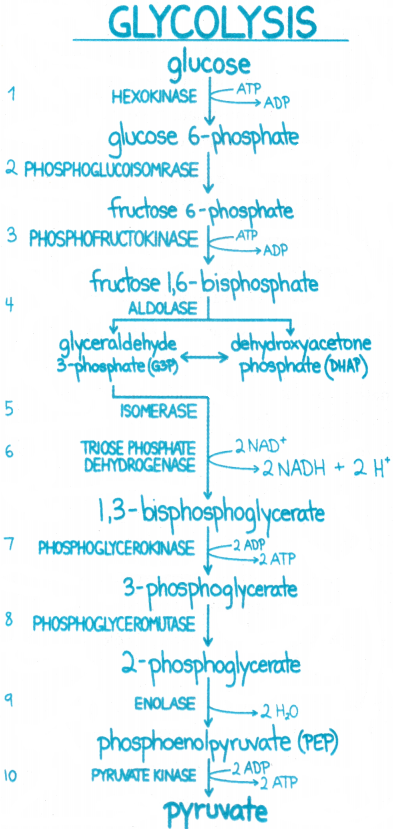
- Glucose undergoes partial oxidation to form 2 molecules of pyruvic acid is called Glycolysis.
- Glycolysis occurs in the “cytoplasm” of the cell and takes place in all living organisms.
- Its end products are 2ATP, 2 NADH + H+ and 2 PA.
- The reaction sequence was worked out by Embden, Mayerhoff and Paranas, hence the cycle is known as EMP-pathway.
Various steps of Glycolysis are:
- Phosphorylation: Glucose is phosphorylated to glucose-6 phosphate in the presence of ATP, catalyzed by the enzyme hexokinase.
- Isomerization : Glucose 6 phosphate is converted into its isomer fructose-6- phosphate, catalyzed by hexose phosphate isomerase.
- Phosphorylation: Fructose-6-phosphate is phosphorylated in the presence of ATP to form fructose 1.6 bisphosphate by phosphofructokinase.
- Cleavage : Fructose 1, 6 bisphosphate is split into 2 molecules of triose phosphate namely 3 phosphoglyceraldehyde (G,P or PGAI) and dihydroxyacetone phosphate (DHAP). This interconvertible reaction is catalyzed by Aldolase.
- Isomerization : DHAP is converted into another G3P molecule in the presence of isomerase.
- Dehydrogenation: 3- phosphoglyceraldehyde is oxidized to 1, 3 bisphosphoglyceric acid with the reduction of NAD to NADH + H+. This is catalysed by G-3 P dehydrogenase.
- Dephosphorylation: Phosphoglycerokinase catalyses the formation of 3 phosphoglyceric acid from 1, 3 bis PGA. Two molecules of ATP are produced directly by substrate level phosphorylation.
- Intra molecular shift: 3 phosphoglyceric acid is converted into 2 phosphoglyceric acid in the presence of phosphoglyceromutase.
- Dehydration: 2 PGA molecules lose water molecules in the presence of Enolase to form PEPA molecules.
- Dephosphorylation: 2 PGA molecules undergo dephosphorylation in the presence of pyruvic kinase to form 2 PA molecules and 2 ATP molecules are formed.
- Fate of pyruvic acid depends on the cellular need.
- There are three major ways in which different cells handle pyruvic acid produced by glycolysis.
- These are lactic acid fermentation, alcoholic fermentation and aerobic respiration.
- Fermentation takes place under anaerobic conditions in many prokaryotes and unicellular eukaryotes.
- For the complete oxidation of glucose to CO2 and H2O organisms adopt Krebs’ cycle which is also called aerobic respiration. This requires O2 supply.
Question 2.
Explain the reactions of Krebs cycle.
Answer:
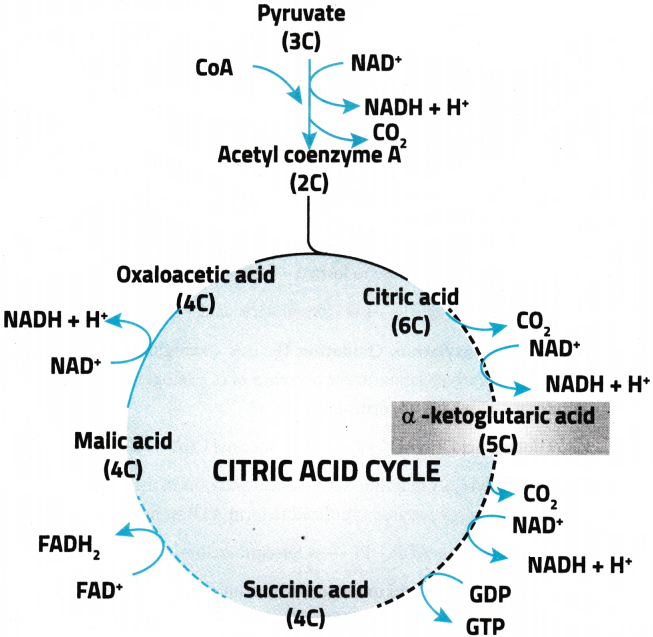
- Acetyl CoA is formed from pyruvic acid as a result of oxidative decarboxylation.
- Acetyl CoA acts as a substrate for Krebs cycle, Krebs cycle may also be called Tricarboxylic acid cycle (TCA cycle) or Citric acid cycle or Organic acid cycle.
- It is called Krebs cycle after the scientist Sir Hans Krebs who first elucidated it.
- There are 10 biochemical reactions in Krebs cycle.
1. Condensation :
In this, acetyl Co.A condenses with oxaloacetic acid and water to yield citric acid in the presence of Citrate synthetase and Co.A is released.
Oxaloacetic acid + Acetyl Co.A + H2O → Citric acid + Co.A
2. Dehydration :
Citric acid loses water molecule to form Cis aconitic acid in the presence of aconitase.
Citric acid → Cis-aconitic acid + H2O
3. Hydration:
A water molecule is added to cis-aconitic acid to yield isocitric acid in the presence of aconitase.
Cis – aconitic acid + H2O → isocitric acid
4. Oxidation I :
Isocitric acid undergoes oxidation in the presence of isocitric dehydrogenase to yield Oxalosuccinic acid,
Isocitric Acid + NAD+ → Oxalosuccinic acid + NADH + H+
5. Decarboxylation :
Oxalosuccinic acid undergoes decarboxylation in the presence of Oxalosuccinic decarboxylase to form a – ketoglutaric acid.
Oxalosuccinic acid → ∝ – ketoglutaric acid + CO2
6. Oxidative decarboxylation, Oxidation II :
∝ – ketoglutaric acid undergoes oxidation and decarboxylation in the presence of ∝ – ketoglutaric dehydrogenase and condenses with CoA to form succinyl CoA.
∝ – keto Glutaric acid + NAD+ + CoA → succinyl CoA + NADH + H+ + CO2
7. Cleavage:
Succinyl CoA splits into succinic acid and CoA in the presence of succinic thiokinase. The energy released is utilized to form ATP from ADP and Pi.
Succinyl CoA + ADP + Pi → Succinic Acid + ATP + CoA
8. Oxidation-III:
Succinic acid undergoes oxidation and forms Fumaric acid in the presence of succinic dehydrogenase.
Succinic Acid + FAD → Fumaric acid + FADH2
9. Hydration:
A water molecule is added to Fumaric acid in the presence of Fumarase to form Malic acid.
Fumaric acid + H2O → Malic acid
10. Oxidation IV :
Malic acid undergoes oxidation in the presence of malic dehydrogenase to form oxaloacetic acid.
Malic Acid + NAD+ → Oxaloacetate + NADH + H+
In the TCA cycle, for every 2 molecules of Acetyl CoA undergoing oxidation, 2 ATP, 6 NADH + H+ 2 FADH2 molecules are formed.
I. Multiple Choice Questions
Question 1.
Glycolysis is also known as ___________ pathway.
1. ETS
2. EMP
3. ENP
4. ELP
Answer:
2. EMP
Question 2.
End product of glycolysis is
1. Pyruvic acid
2. Oxalo acetic acid
3. Citric acid
4. Phosphoenolpyruvic acid
Answer:
1. Pyruvic acid
Question 3.
Fermentation occurs when there is
1. Complete supply of oxygen
2. No supply of oxygen
3. Complete supply of water
4. No supply of water
Answer:
2. No supply of oxygen
Question 4.
In alcoholic fermentation, pyruvate is converted to which among the following.
1. Ethanol, CO2, NADH
2. CO2and Methanol
3. CO2 and Ethanol only
4. CO2 and Carboxylic acid
Answer:
3. CO2 and Ethanol only
Question 5.
Which enzyme catalyses the oxidative decarboxylation of pyruvic acid.
1. Pyruvate carboxylase
2. Lactate dehydrogenase
3. Alcohol dehydrogenase
4. Pyruvate dehydrogenase
Answer:
4. Pyruvate dehydrogenase
Question 6.
Where does TCA cycle occurs
1. Cytoplasm
2. Inner membrane of Mitochondria
3. Mitochondrial matrix
4. Stroma of Chloroplast
Answer:
3. Mitochondrial matrix
Question 7.
What is the first formed compound in TCA cycle
1. Acetyl CoA
2. Citric acid
3. Isocitric acid
4. OAA
Answer:
2. Citric acid
Question 8.
Which among the following is synthesized during the conversion of succinyl – CoA to succinic acid inTCA cycle.
1. FADH2
2. GTP
3. NADH2
4. NADPH2
Answer:
2. GTP
Question 9.
How many total NADH + H+ are produced from a pyruvic acid after completion of TCA cycle ?
1. 2
2. 3
3. 4
4. 5
Answer:
3. 4
Question 10.
The site of ETC is
1. Outer membrane of mitochondria
2. Cytoplasm
3. Inner membrane of mitochondria
4. Matrix of mitochondria
Answer:
3. Inner membrane of mitochondria
II. Fill in the Blanks
Question 1.
The energy currency of the cell ___________
Answer:
ATP
Question 2.
Glycolysis occurs in ___________ of the cell.
Answer:
Cytoplasm
Question 3.
In muscle cells of animals, when oxygen is inadequate, pyruvic acid is converted to
Answer:
Lactic acid
Question 4.
Pyruvic acid + CoA + NAD + Acetyl CoA + CO2 + NADH + H+. Above reaction is catalyzed by enzyme ___________
Answer:
Pyruvic dehydrogenase
Question 5.
During the conversion of succinyl-CoA to succinic acid in citric acid cycle, a molecule of ___________ is synthesized.
Answer:
GTP
Question 6.
Tricarboxylic acid cycle was discovered by ___________
Answer:
Hans Krebs
Question 7.
ATP synthase is located on ___________ membrane of Mitochondria.
Answer:
Inner
Question 8.
Oxidation of one molecule of FADH2 gives rise to ___________ molecules of ATP.
Answer:
2
Question 9.
Respiratory pathway is an ___________ pathway as it involves both catabolism and anabolism.
Answer:
Amphibolic
Question 10.
The ratio of the volume of C02 evolved to the volume of 02 consumed in respiration is called ___________
Answer:
Respiratory Quotient
III. One Word Answer Questions
Question 1.
Which enzyme catalyses the phosphorylation of glucose during glycolysis?
Answer:
Hexokinase
Question 2.
Where is the electron transport system located in the mitochondria of a cell?
Answer:
Inner membrane of mitochondria
Question 3.
Name the cofactors required for the activity of pyruvate dehydrogenase.
Answer:
NAD+ and CoA
Question 4.
What is the number of ATP produced when pyruvate is converted to lactate by Fermentation?
Answer:
Zero (0)
Question 5.
In glucose, how many carbon molecules are present? [March-26]
Answer:
6 carbons
Question 6.
What is the end product of anaerobic respiration in yeast?
Answer:
Ethanol + CO2
Question 7.
Respiratory quotient of carbohydrates is 1. Why?
Answer:
Volume of CO2 released and volume of O2 consumed is equal. So the Rq value is one.
Question 8.
Glycolysis occurs in which part of the cell?
Answer:
Cytoplasm
Question 9.
Name the process of conversion of glucose into ethyl alcohol.
Answer:
Fermentation
Question 10.
Which compound serves as a connecting link between glycolysis and Kreb’s cycle?
Answer:
Acetyl CoA