AP Inter 1st Year Zoology 2nd Lesson Animal Kingdom Questions and Answers
IV. Very Short Answer Questions
Question 1.
Differentiate between diploblastic and triploblastic animals.
Answer:
- Animals in which the cells are arranged in two embryonic layers, an external ectoderm and internal endoderm are Diploblastic animals. E.g., Porifers, Coelenterates.
- An undifferentiated layer, mesoglea, is present in between the ectoderm and the endoderm in Coelenterates.
- Those animals in which the developing embryo has a third germinal layer, mesoderm in between the ectoderm and endoderm, are called triploblastic animals (Platyhel- minthes to chordates).
Question 2.
What are the functions of canal system in sponges?
Answer:
The function of canal sytem in sponges are helpful in food gathering, respiratory exchange of gases and removal of waste.
Question 3.
What are the two morphological forms of cnidarians? What are their chief functions?
Answer:
- Cnidarians exhibit two basic body forms called Polyp and Medusa.
- Polyp is sessile and cylindrical form like Hydra, Adamsia etc.
- Whereas the medusa is umbrella-shaped and free-swimming like Aurelia or jelly fish.
- Cnidarians which exist in both forms exhibit alternation of generation (metagenesis)
i.e., Polyps produce medusae asexually and medusa form the polyps sexually (e.g., Obelia).
Question 4.
What are the excretory cells of flatworms called? What is the other important function of these cells?
Answer:
Excretory cells of flat worms are called as flame cells. These help in osmoregulation and excretion.
Question 5.
What do you call the lateral appendages of Nereis? What is their function?
Answer:
Parapodia are the lateral appendages in Neries, their function is swimming.
Question 6.
What is radula and which group of animals possesses it?
Answer:
Radula is a file like rasping organ present in the mouth of mollusc useful for feeding
Question 7.
What is the most distinctive system of Echinoderms? What are its functions?
Answer:
The most distinctive feature of echinoderms is the presence of water vascular system which helps in locomotion, capture and transport of food and respiration.
Question 8.
Write any two fundamental characters of chordates.
Answer:
Two fundamental characters of chordates are the presence of a dorsal hollow nerve cord and a notochord.
Question 9.
“All vertebrates are chordates, but all chordates are not vertebrates. Justify the statement.
Answer:
- The presence of a vertebral column is a defining characteristic of vertebrates.
- The notochord is replaced by cartilaginous or bony vertebral column in adult.
- Thus all vertebrates are chordates but all chordates are not vertebrates.
Question 10.
Differentiate between poikilothermous and homoiothermous animals.
Answer:
- Poikilothermic animals or “cold-blooded,” they lack the ability to regulate their internal body temperature, and it fluctuates with the surrounding environment.
- Homoiothermic animals or “warm-blooded,” which can maintain a constant internal body temperature regardless of external temperature changes.
Question 11.
What is the difference between direct and indirect development?
Answer:
- Direct Development – It is seen in fish, reptile, birds and mammals, In the direct development, the embryo develops into a well-grown individual without involving a larval stage. Metamorphosis is absent.
- Indirect Development – It is seen in vertebrate amphibians. It involves a sexually immature larval stage. Metamorphosis is present.
V. Short Answer Questions
Question 1.
Describe the four different levels of organization in animals.
Answer:
| Cellular level | Tissue level | Tissue system or organ level | Organ system level |
| Porifera Ex: Sponges |
Coelenterate, Ctenophore | Platyhelminthes | Aschelminthes, Annelida, Arthropods Molluscs, Echinoderms, Hemichordate and Chordata. |
- In Sponges, the cells are arranged as loose cell aggregates (exhibit cellular level) of organization. Some division of labour , (activities) occurs among the cells.
- In coelenterates, the arrangement of cells is more complex. Here the cells performing the same function are arranged into tissues, hence tissue level of organization.
- Organ level is exhibited by members of Platyhelminthes and other higher phyla where tissues are grouped together to form organs each specialized for a particular function.
- In animals like Annelida, Arthropods, Molluscs, Echinoderms and chordates, organs have associated to form functional systems; each system concerned with a specific physiological function, this pattern is called Organ system level of organization.
Question 2.
Write short notes on the salient features of the phylum Porifera. [March-26]
Answer:
Members of this phylum are commonly known as sponges. All sponges are aquatic.
- They are generally marine and mostly asymmetrical animals.
- These are primitive multicellular animals and have cellular level of organization.
- Sponges have a water transport or canal system.
- Water enters through minute pores (Ostia) in the body wall into a central cavity, spongocoel, from where it goes out through the osculum.
- This pathway is helpful in food gathering, respiratory exchange and removal of waste.
- Choanocytes or collar cells line the spongocoel and the canals.
- Digestion is intracellular. The body is supported by a skeleton made up of spicules or spongin fibers.
- Sexes are not separate (hermaphrodite-eggs and sperms are produced by the same individual).
- Sponges reproduce asexually by Fragmentation and sexually by formation of gametes.
- Fertilization is internal. Development is indirect having a larval stage which is morphologically distinct from the adult.
e.g., Sycon (Scypha), Spongilla (fresh water sponge), Euspongia (Bath sponge).
Question 3.
Mention the general characters of the phylum Cnidaria.
Answer:
They are aquatic, mostly marine, Sessile or free-swimming, radially symmetrical animals.
- The name cnidarian is derived from the cnidoblasts or cnidocytes (Which contain the stinging capsules or nematocysts) present on the tentacles and the body.
- Cnidoblasts are used for anchorage, defense and for the capture of prey.
- Cnidarians exhibit tissue level of organization and are diploblastic.
- They have a central gastro-vascular cavity with a single opening, mouth on hypostome.
- Digestion is extracellular and intracellular.
- Some of the cnidarians e.g., corals have a skeleton composed of calcium carbonate.
- Cnidarians exhibit two basic body forms called Polyp and Medusa.
- Polyp (former) is sessile and cylindrical form like Hydra, Adamsia etc. Whereas the medusa (latter) is umbrella-shaped and free-swimming like Aurelia or jelly fish.
- Those cnidarians which exist in both forms exhibit alternation of generation (Metagenesis) i.e., Polyps produce medusae asexually and medusa form the polyps sexually (e.g., Obelia).
Example: Pysalia (Portuguese man of war), Adamsia (Sea anemone), Pennatula (Sea pen), Gorgonia (Sea fan), and Meandrina (Brain coral).
Question 4.
What are the salient features of the phylum Annelida?
Answer:
They may be aquatic (marine and fresh water) or terrestrial; free-living, and sometimes parasitic.
- They exhibit organ-system level of body organization and bilateral symmetry.
- They are triploblastic, metamerically segmented and coelomate animals.
- Their body surface is distinctly marked out into segments or metameres and, hence, the phylum name Annelida (Latin, annulus: little ring).
- They possess longitudinal and circular muscles which help in locomotion.
- Aquatic annelids like Nereis possess lateral appendages, Parapodia which help in swimming.
- A closed circulatory system is present.
- Nephridia (Nephridium) help in osmoregulation and excretion.
- Neural system consists of paired ganglia (sing-ganglion) connected by lateral nerves to a double ventral nerve cord.
Nereis, an aquatic form, is dioecious, but earthworms and leeches are monoecious, - Reproduction is sexual.
Examples: Nereis, Pheretima (Earthworm) and Hirudinaria (Blood sucking leech).
Question 5.
Which is the largest phylum of Animalia ? Mention its chief characters.
Answer:
This is the largest phylum of Animalia which includes insects (Arthropoda).
- Over two-thirds of all named species on earth are arthropods.
- They have organ-system level of organization.
- They are bilateral symmetrical, Triploblastic, segmented and coelomate animals.
- The body of arthropod is covered by chitinous exoskeleton.
- The body consists of head, thorax and abdomen.
- They have jointed appendages (arthros-Joint, poda-appendages).
- Respiratory organs are gills, book gills, book lungs or tracheal system.
- Circulatory system is of open type.
- Sensory organs like antennae, eyes (simple and compound), statocysts or balancing organs are present.
- Excretion takes place through Malpighian tubules.
- They are mostly dioecious. Fertilization is usually internal. They are mostly oviparous.
- Development may be direct or indirect.
- Examples: Economically important insects – Apis (Honey bee), Bombyx (Silkworm), Laccifer (Lac insect).
- Vectors- Anopheles, culex and Aedes mosquitoes.
- Gregarious pest – Locusta (Locust).
- Living fossil – Limulus (King crab).
Question 6.
Write any eight salient features of the phylum Echinodermata.
Answer:
These animals have an endoskeleton of calcareous ossicles and, hence, the name Echinodermata (spiny bodied).
- All are marine with organ-system level of organization.
- The adult echinoderms are radially symmetrical but larvae are bilaterally symmetrical.
- They are triploblastic and coelomate animals.
- Digestive system is complete with mouth on the lower (ventral) side and anus on the upper (dorsal) side.
- The most distinctive feature of echinoderms is the presence of water vascular system which helps in locomotion, capture and transport of food and respiration.
- Excretory system is absent. Sexes are separate. Reproduction is sexual.
- Fertilization is usually external. Development is indirect with free-swimming larvAnswer:Examples: Asterias (star fish), Echinus (Sea urchin),
- Antedon (Sea lily), Cucumaria (Sea cucumber) and Ophiura (Brittle star).
Question 7.
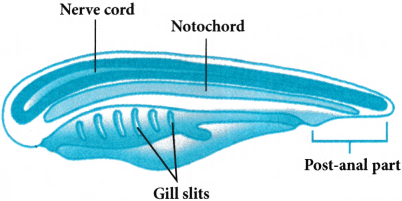
Give three major differences between chordates and non-chordates and draw the sketch of a chordate’s body showing those features.
Answer:
| Chordates | Non-chordates |
| 1. Notochord present. | Notochord absent. |
| 2. Central nervous system is dorsal, hollow and single. | Central nervous system is ventral, solid and double. |
| 3. Pharynx perforated by gill slits. | Gill slits are absent. |
| 4. Heart is ventral. | Heart is dorsal (if present). |
| 5. Post-anal tail is present. | Post-anal tail is absent. |
Question 8.
Compare and contrast cartilaginous and bony fishes.
Answer:
| Cartilaginous Fishes | Bony Fishes |
| Mostly marine | Both marine and fresh water |
| Endoskeleton is Cartilage | Bony |
| Mouth is ventral | Terminal |
| Operculum absent | Present |
| Air bladder absent | Present |
| Claspers present | Absent |
| Sexual dimorphism present | Absent |
| 5-7 Pairs gill slits | 4 Pairs |
| Placoid scales | Cycloid or ctenoid. |
| Ureotelic | Ammonotelic. |
Question 9.
Write any eight salient features of the class Amphibia.
Answer:
Amphibians can live in aquatic as well as terrestrial habitats.
- Most of them have two pairs of limbs. Body is divisible into Head and trunk.
- Tail may be present in some. The amphibious skin is moist (without scales).
- The eyes have eyelids. A tympanum represents the ear. Alimentary canal, urinary and reproductive tracts open into a common chamber called cloaca which opens to the exterior.
- Respiration is by gills, lungs and through skin. The heart is three chambered (Two auricles and one ventricle).
- These are cold blooded animals.
- Sexes are separate. Fertilization is external. They are oviparous and development is indirect.
Examples: Bufo (Toad), Rana (Frog), Hyla (Tree frog), Salamandra (Salamander), Ichthyophis (Limbless Amphibia).
Question 10.
What are the modifications in birds that help them in flight?
Answer:
The variations found in birds that help them fly are –
- The presence of feathers.
- The forelimbs are modified into wings
- Hind limbs generally have scales and are modified for walking, swimming or clasping the tree branches..
- Endoskeleton is fully ossified (bone) and the long bones are hollow with air cavities (pneumatic).
- Absence of urinary bladder.
- The body is streamlined provides less resistance
I. Multiple Choice Questions
Question 1.
Pick the odd pair out
1. Cellular level: Porifera
2. Tissue level: Aschelminthes
3. Organ level: Platyhelminthes
4. Organ system level: Annelida
Answer:
2. Tissue level: Aschelminthes
Question 2.
The type of symmetry in which the body can be divided into identical left and right halves in only one plane.
1. Radial symmetry
2. Asymmetry
3. Bilateral symmetry
4. Pentaradial symmetry
Answer:
3. Bilateral symmetry
Question 3.
Which of the following is a pseudocoelomate ?
1. Hydra
2. Periplaneta
3. Ascaris
4. Pheretima
Answer:
3. Ascaris
Question 4.
The skeleton of corals is composed of
1. Silica
2. Strontium sulphate
3. Calcium carbonate
4. Hydroxyapatite
Answer:
3. Calcium carbonate
Question 5.
Which of the following is not a feature of phylum Arthropoda ?
1. Chitinous exoskeleton
2. Metameric segmentation
3. Parapodia
4. Jointed appendages
Answer:
3. Parapodia
Question 6.
Molluscs are
1. triploblastic, acoelomates
2. triploblastic, coelomates
3. diploblastic, acoelomates
4. diploblastic, coelomates
Answer:
2. triploblastic, coelomates
Question 7.
Balanoglossus is a
1. Mollusca
2. Vertebrate
3. Hemichordate
4. Protozoan
Answer:
3. Hemichordate
Question 8.
Notochord persists throughout the life in
1. Tunicata
2. Chondrichthyes
3. Osteichthyes
4. Cephalochordata
Answer:
4. Cephalochordata
Question 9.
Sea horse belongs to the class
1. Mammalia
2. Amphibia
3. Aves
4. Pisces
Answer:
4. Pisces
Question 10.
Air bladder in bony fishes helps in
1. buoyancy
2. food collection
3. excretion
4. digestion
Answer:
1. buoyancy
Question 11.
Which of the following is a limbless amphibian ?
1. Salamandra
2. Ichthyophis
3. Bufo
4. Hyla
Answer:
2. Ichthyophis
Question 12.
Identify the given animal.
1. Hemidactylus
2. Calotes
3. Draco
4. Chameleon
Answer:
4. Chameleon
Question 13.
Which of the following is an oviparous mammal ?
1. Platypus
2. Kangaroo
3. Elephant
4. Whale
Answer:
1. Platypus
Question 14.
Select the correct match.
1. Taenia – Round worm
2. Apis – Honey bee
3. Asterias – Dog fish
4. Pavo- Frog
Answer:
2. Apis – Honey bee
Question 15.
Which of the following pair of animals has dry and cornified skin?
1. Snake and Frog
2. Lizard and Turtle
3. Frog and Pigeon
4. Crocodile and Tiger
Answer:
3. Frog and Pigeon
II. Fill in the Blanks
Question 1.
The central cavity of coelenterates is called ______________.
Answer:
Gastrovascular cavity
Question 2.
______________ cells are useful for defense and capture of the prey in Cnidarians.
Answer:
Cnidoblasts or Cnidocytes
Question 3.
Flatworms belong to the phylum ______________
Answer:
Platyhelminthes
Question 4.
The second largest phylum in the animal kingdom ______________.
Answer:
Mollusca
Question 5.
The skin of cartilaginous fishes contains minute ______________ scales.
Answer:
Placoid
Question 6.
In Urochordata, the notochord is present only in the ______________ region of larvae.
Answer:
Tail
Question 7.
The mouth in cydostomes is ______________ in shape.
Answer:
Round or Circular
Question 8.
Presence of pneumatic bones is the characteristic feature of ______________.
Answer:
Aves (Birds)
Question 9.
Gills are covered by ______________ in bony fishes.
Answer:
Operculum
III. One Word Answer Questions
Question 1.
Name the cells that line the spongocoel and canals in Poriferans.
Answer:
Choanocytes or collar cells
Question 2.
How do flatworms absorb nutrients from the host?
Answer:
Through the body surface
Question 3.
Write the common name of Ascaris.
Answer:
Round worms
Question 4.
Which organs of Nereis are useful for swimming?
Answer:
Parapodia
Question 5.
Which phylum includes spiny bodied animals?
Answer:
Echinodermata
Question 6.
Name the group of animals that possesses a stomochord.
Answer:
Hemichordata
Question 7.
Name a cartilaginous fish that can produce electric current.
Answer:
Torpedo
Question 8.
Which class of chordata exhibits creeping or crawling mode of locomotion?
Answer:
Reptilia
Question 9.
Where is the oil gland located in birds?
Answer:
Base of the tail