AP Inter 1st Year Zoology 3rd Lesson Structural Organization in Animals Questions and Answers
IV. Very Short Answer Questions
Question 1.
Why are frogs not seen during peak summer and winter ?
Answer:
- During this period they take shelter in deep burrows to protect them from extreme heat and cold.
- This is known as summer sleep (aestivation) and winter sleep (hibernation) respectively.
Question 2.
Mention the functions of nictitating membrane and tympanum in the frog.
Answer:
- The function of nictitating membrane is to protect the eyes in water.
- On either side of eyes a membranous tympanum (ear) receives sound signals.
Question 3.
Compare the forelimbs and hindlimbs of the frogs.
Answer:
- The forelimbs and hind limbs help in swimming, walking, leaping and burrowing.
- Fore limbs that ends in four digits (fingers) and they are shorter and stouter.
- The hind limbs ends in five digits and they are larger and muscular.
Question 4.
How do you distinguish a male frog from a female frog ?
Answer:
Male frogs can be distinguished by the presence of sound producing vocal sacs and also a copulatory pad on the first digit of the fore limbs, which are absent in female frogs.
Question 5.
What is Chyme? Where is it formed ?
Answer:
The partially digested food is called chyme. It is formed in stomach.
Question 6.
What are the respiratory organs of the frog ?
Answer:
- In water, skin acts as aquatic respiratory organ (cutaneous respiration).
- Dissolved oxygen in the water is exchanged through the skin by diffusion.
- On land, the buccal cavity, skin and lungs act as the respiratory organs. The respiration by lungs is called pulmonary respiration.
Question 7.
What are hepatic and renal portal systems ?
Answer:
Special venous connection between liver and intestine is called hepatic portal system, the kidney and lower parts of the body is called renal portal system.
Question 8.
How many eggs does a female frog lay at a time ? Where does fertilization take place ?
Answer:
A mature female can lay 2500 to 3000 eggs or ova at a time. Fertilization is external and takes place in water.
Question 9.
What is the larva of frog ? Name the process by which it develops into an adult.
Answer:
The larval stage of frog is called tadpole. Tadpole undergoes metamorphosis to develop into the adult.
Question 10.
How are frogs beneficial for mankind ?
Answer:
- Frogs are beneficial for mankind because they eat insects and protect the crop.
- Frogs maintain ecological balance because these serve as an important link of food chain and food web in the ecosystem.
- In some countries the muscular legs of frog are used as food by man.
V. Short Answer Questions
Question 1.
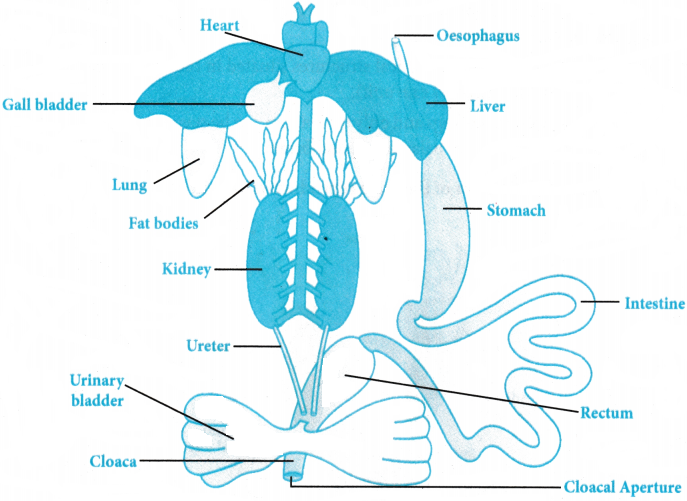
Describe the digestive system of the frog.
Answer:
- The digestive system consists of Alimentary canal and Digestive glands.
- The alimentary canal is short because frogs are carnivores and hence the length of intestine is reduced.
- The mouth opens into the buccal cavity that leads to the oesophagus through pharynx.
- Oesophagus is a short tube that opens into the stomach which in turn continues as the intestine, rectum and finally opens outside by the cloaca.
- Liver secretes bile that is stored in the gall bladder.
- Pancreas, a digestive gland produces pancreatic juice containing digestive enzymes.
- Food is captured by the bilobed tongue.
- Digestion of food takes place by the action of HC/ and gastric juices secreted from the walls of the stomach.
- Partially digested food called chyme is passed from stomach to the first part of the small intestine, the duodenum.
- The duodenum receives bile from gall bladder and pancreatic juices from the pancreas through a common bile duct.
- Bile emulsifies fat and pancreatic Juices digest carbohydrates and proteins. Final digestion takes place in the intestine.
- Digested food is absorbed by the numerous finger-like folds in the inner wall of intestine called villi and microvilli.
- The undigested solid waste moves into the rectum and passes out through cloaca.
Question 2.
Describe the respiratory organs of frogs in the different habitats.
Answer:
Frogs respire on land and in the water by two different methods.
- In water, skin acts as aquatic respiratory organ (cutaneous respiration).
- Dissolved oxygen in the water is exchanged through the skin by diffusion.
- On land, the buccal cavity, skin and lungs act as the respiratory organs. The respiration by lungs is called pulmonary respiration.
- The lungs are a pair of elongated, pink coloured sac-like structures present in the upper part of the trunk region (thorax).
- Air enters through the nostrils into the buccal cavity and then to lungs.
- During aestivation and hibernation, gaseous exchange takes place through skin.
Question 3.
Describe the blood vascular system in frog.
Answer:
The vascular system of frog is well-developed and it is closed type.
- Frogs have a lymphatic system also.
- The blood vascular system involves heart, blood vessels and blood.
- The lymphatic system consists of lymph, lymph channels and lymph nodes.
- Heart is a muscular structure situated in the upper part of the body cavity. It has three chambers, two atria and one ventricle and is covered by a membrane called pericardium.
- A triangular structure called sinus venosus joins the right atrium. It receives blood through the major veins called vena cava.
- The ventricle opens into a sac-like conus arteriosus on the ventral side of the heart.
- The blood from the heart is carried to all parts of the body by the arteries (arterial system).
- The veins collect blood from different parts of body to the heart and form the venous system.
- Special venous connection between liver and intestine as well as the kidney and lower parts of the body are present in frogs. The former is called hepatic portal system and the latter is called renal portal system;
- The blood is composed of plasma and cells. The blood cells are RBC (red blood cells) or erythrocytes, WBC (white blood cells) or leucocytes and platelets.
- RBC’s are nucleated and contain red coloured pigment namely haemoglobin.
- The lymph is different from blood. It lacks few proteins and RBCs.
- The blood carries nutrients, gases and water to the respective sites during the circulation.
- The circulation of blood is achieved by the pumping action of the muscular heart.
Question 4.
Describe the male reproductive system of frog.
Answer:
Male reproductive organs consist of a pair of yellowish ovoid testes which are found adhered to the upper part of kidneys by a double fold of peritoneum called mesorchium.
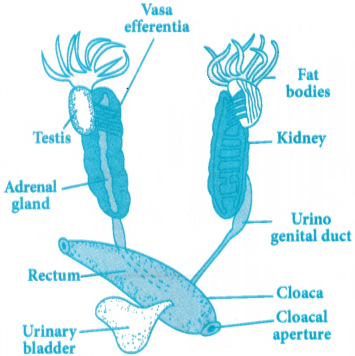
- Vasa efferentia are 10-12 in number that arise from testes. They enter the kidneys on their side and open into Bidder’s canal.
- Finally it communicates with the urinogenital duct that comes out of the kidneys and opens into the cloaca.
- The cloaca is a small, median chamber that is used to pass faecal matter, urine and sperms to the exterior.
Question 5.
Describe the female reproductive system of frog.
Answer:
The female reproductive organs include a pair of ovaries.
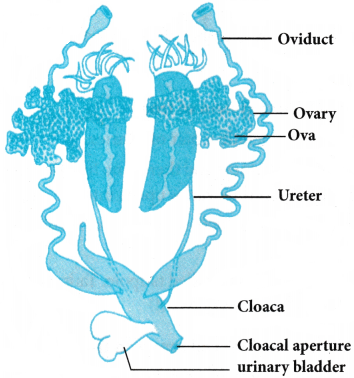
- The ovaries are situated near kidneys and there is no functional connection with kidneys. A pair of oviduct arising from the ovaries opens into the cloaca separately.
- A mature female can lay 2500 to 3000 ova at a time. Fertilization is external and takes place in water.
- Development involves a larval stage called tadpole. Tadpole undergoes metamorphosis to form the adult.
Question 6.
Write short notes on the organs of special senses in frog.
Answer:
Frog has different types of sense organs, namely organs of touch (sensory papillae), taste (taste buds), smell (nasal epithelium), vision (eyes) and hearing (tympanum with internal ears).
- Out of these, eyes and internal ears are well-organised structures and the rest are cellular aggregations around nerve endings.
- Eyes in a frog are a pair of spherical structures situated in the orbit in skull. These are simple eyes (possessing only one unit).
- External ear is absent in frogs and only tympanum can be seen externally. The ear is an organ of hearing as well as balancing (equilibrium).
Question 7.
Draw a neat labeled diagram of the male reproductive system of frog.
Answer:
Question 8.
Draw a neat labeled diagram of the female reproductive system of frog
Answer:
Question 9.
Draw a diagram of the internal organs of a frog showing the complete digestive system and label it.
Answer:
I. Multiple Choice Questions
Question 1.
A frog with a body temperature of 20°C is transferred into an area with 30°C temperature. What will be the body temperature of the frog in the new environment?
1. 20°C
2. 30°C
3. 50°C
4. 40°C
Answer:
2. 30°C
Question 2.
During aestivation and hibernation frogs respire through
1. lungs
2. gills
3. skin
4. bucco-pharyngeal cavity
Answer:
3. skin
Question 3.
Bile juice helps in the digestion of
1. proteins
2. carbohydrates
3. fats
4. carbohydrates and proteins
Answer:
3. fats
Question 4.
The triangular structure that brings venous blood to the right atrium in frog
1. pulmonary arch
2. systemic arch
3. sinus venosus
4. conus arteriosus
Answer:
3. sinus venosus
Question 5.
Conus arteriosus is present on the side of the heart of frog.
1. ventral
2. dorsal
3. lateral
4. upper
Answer:
1. ventral
Question 6.
The chief nitrogenous excretory product in frogs is
1. Ammonia
2. Urea
3. Uric acid
4. Creatinine
Answer:
2. Urea
Question 7.
Number of cranial nerves in frogs
1. 12 pairs
2. 8 pairs
3. 10 pairs
4. 11 pairs
Answer:
3. 10 pairs
Question 8.
In frogs, sensory papillae, taste buds and nasal epithelium are
1. cellular aggregations around muscular tissue
2. cellular aggregations around nerve endings
3. cellular aggregations around fatty tissue
4. cellular aggregations around epithelial tissue
Answer:
2. cellular aggregations around nerve endings
Question 9.
In frogs, Bidder’s canal is found in the
1. liver
2. ovary
3. kidney
4. heart
Answer:
3. kidney
Question 10.
In male frogs, testes are adhered to the kidneys by
1. mesorchium
2. pericardium
3. mesovarium
4. pleura
Answer:
1. mesorchium
Question 11.
The Ecological importance of frogs is to
1. reduce insect populations and form an important link of the food chain
2. increase insect populations and form an important link of the food chain
3. act as biological vectors of plasmodium
4. prevent the water pollution
Answer:
1. reduce insect populations and form an important link of the food chain
Question 12.
Select the correct statement.
1. Neck and tail are absent in frog.
2. Tympanum protects the eyes when the frog is in water
3. Frogs do not have lymphatic system.
4. HCl is secreted by the wall of the intestine
Answer:
1. Neck and tail are absent in frog.
II. Fill in the Blanks
Question 1.
Frogs are poikilothermic as they do not have a constant body ___________.
Answer:
Temperature
Question 2.
The ability to change the colour of the body to hide themselves from the enemies is called ___________.
Answer:
Camouflage
Question 3.
The skin of the frog is smooth and slippery due to the presence of ___________.
Answer:
Mucus
Question 4.
Each forelimb of frog has ___________ digits.
Answer:
Four (4)
Question 5.
In frogs ___________ acts as aquatic respiratory organ.
Answer:
Skin
Question 6.
The ureters in male frogs act as ___________ ducts.
Answer:
Urinogenital
Question 7.
Tadpole larva undergoes ___________ to become the adult.
Answer:
Metamorphosis
III. One Word Answer Questions
Question 1.
Why do frogs never drink water ?
Answer:
Absorb water through skin
Question 2.
When do frogs undergo aestivation ?
Answer:
In summer
Question 3.
Where do we find the copulatory pads in the male frogs ?
Answer:
Fore limb (on the first digit)
Question 4.
Name the finger like folds in the inner wall of intestine in frog ?
Answer:
Villi and Microvilli
Question 5.
How many optic lobes are there in the midbrain of frog ?
Answer:
One pair (2 lobes)
Question 6.
What is the larval stage of a frog called ?
Answer:
Tadpole
Question 7.
Where does fertilization take place in frogs ?
Answer:
In water
Question 8.
Name the chamber into which the urinogenital ducts of a male frog open.
Answer:
Cloaca