AP Inter 1st Year Zoology 9th Lesson Chemical Coordination and Integration Questions and Answers
IV. Very Short Answer Questions
Question 1.
Define the following.
A) Endocrine gland
B) Hormone
Answer:
A) Endocrine gland: These are ductless glands liberate their secretions into the bloodstream, transported to target organs located at a distance.
B) Hormone: Hormones are non-nutritive chemicals which act as intercellular messengers and are produced in trace amounts.
Question 2.
Which hormonal deficiency is responsible for the following?
A) Cretinism
B) Diabetes mellitus
Answer:
A) Cretinism: Hypothyroidism during pregnancy causes defective development and maturation of the growing baby leading to stunted growth (cretinism), mental retardation, low intelligence quotient, abnormal skin, deaf-mutism, etc.
B) Diabetes mellitus: Prolonged hyperglycemia leads to a complex disorder called diabetes mellitus which is associated with loss of glucose through urine and formation of harmful compounds known as ketone bodies.
Question 3.
What is acromegaly ? Name the hormone responsible for this disorder.
Answer:
Excess secretion of GH in adults especially in middle age can result in severe disfigurement (especially face) called Acromegaly.
- Acromegaly may lead to serious complications and premature death if unchecked.
- It is due to hypersecretion of growth hormone (GH) in adults.
Question 4.
Which hormone is called antidiuretic hormone? Write the name of the gland that releases it.
Answer:
Vasopressin hormone is called antidiuretic hormone (ADH). It is synthesized in hypothalamus, stored and released from posterior pituitary.
Question 5.
Name the endocrine gland that degenerates in old individuals. What important role does it play in the immune system?
Answer:
Thymus gland: It secretes thymosin hormone. It affects the development of immune, system and maturation of T-cells, which involve in Humoral immunity and cell mediated immunity.
Question 6.
Distinguish between diabetes mellitus and diabetes insipidus.
Answer:
- Diabetes insipidus: It is due to vasopressin deficiency. It is characterized by excessive loss of water through urine without loss of glucose, that causes dehydration.
- Diabetes mellitus: It is due to under secretion of insulin. It is characterized by hyperglycemia, excess urine with glucose and ketone bodies.
Question 7.
What are “Islets of Langerhans” ?
Answer:
- It is the endocrine part of pancreas. Among the pancreatic acini several/many cells are * present called islets of Langerhans.
- It contains alpha cells (∝)- secrete glucagon, beta cells (β) – secrete insulin.
Question 8.
Which gland secretes fight or flight hormones? Where is it located?
Answer:
Epinephrine and norepinephrine. They are secreted by adrenal medulla in response to stress and emergency.
Question 9.
What are Androgens? Which cells of testes secrete them?
Answer:
- Androgens are male sex hormones, e.g.: Testosterone.
- They are secreted by Leydig cells of testes (or) interstitial cells of Leydig.
Question 10.
What is erythropoietin? What is its function?
Answer:
The juxtaglomerular cells of the kidneys secrete a hormone called erythropoietin, which stimulates erythropoiesis (formation of RBC).
V. Short Question Answer
Question 1.
List out the names of the endocrine glands present in human beings and mention the hormones they secrete.
Answer:
| Name of the endocrine gland | Hormones |
| Pituitary gland | 1) Growth hormone(GH). 2) Prolactin. 3) Thyroid stimulating hormone(TSH). 4) Adrenocorticotropic hormone (ACTH). 5) Follicle stimulating hormone (FSH). 6) Luteinizing hormone, 1. Melanocyte stimulating hormone(MSH) 1. Oxytocin 2. Vasopressin (ADH). |
| Pineal gland | Melatonin |
| Thyroid gland | Thyroxine, Calcitonin |
| Parathyroid glands | Parathormone (PTH) |
| Thymus gland | Thymosins |
| Adrenal glands | Glucorticoids, Mineralocorticoids, |
| Androgens, Adrenaline, noradrenaline | |
| Pancreas | Glucagon, Insulin |
| Testes | Testosterone |
| Ovaries | Estrogen, Progesterone |
Question 2.
Diagrammatically indicate the location of various endocrine glands in the human body.
Answer:
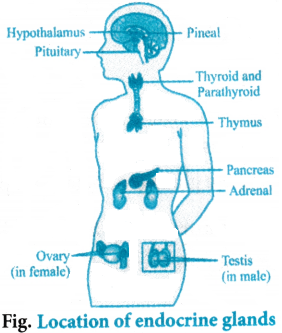
Question 3.
Write short notes on the functions of the following hormones.
a) Parathyroid hormone
b) Aldosterone
c) Thymosins
d) Insulin
Answer:
a) Parathyroid hormone:
- In humans, four parathyroid glands are present on the back side of the thyroid gland, one pair each in the two lobes of the thyroid.
- The parathyroid glands secrete a peptide hormone called Parathyroid hormone (PTH). The secretion of PTH is regulated by the circulating levels of calcium ions.
- Parathyroid hormone (PTH) increases the Ca2+ levels in the blood. PTH acts on bones and stimulates the process of bone resorption (dissolution / demineralization).
- PTH also stimulates reabsorption of Ca2+ by the renal tubules and increases Ca2+ absorption from the digested food. It is clear that PTH is a hypercalcemic hormone, i.e., it increases the blood Ca2+ levels.
- Along with TCT, it plays a significant role in calcium balance in the body.
b) Aldosterone:
- Aldosterone is the main mineralocorticoids in our body.
- Aldosterone acts mainly at the renal tubules and stimulates the reabsorption of Na+ and water and excretion of K+ and phosphate ions.
- Aldosterone helps in maintenance of electrolytes, body fluid volume, osmotic pressure and blood pressure.
c) Thymosins:
- The thymus gland is a lobular structure located between lungs behind sternum on the ventral side of the aorta.
- The thymus plays a major role in the development of the immune system.
- This gland secretes the peptide hormones called Thymosins.
- Thymosins play a major role in the differentiation of T-lymphocytes, which provide cell-mediated immunity.
- In addition, Thymosins also promote production of antibodies to provide humoral immunity.
- Thymus is degenerated in old individuals resulting in a decreased production of Thymosins. As result, the immune responses of old persons become weak.
d) Insulin:
- Insulin is a peptide hormone, which plays a major role in the regulation of glucose homeostasis.
- Insulin acts mainly on hepatocytes and adipocytes (cells of adipose tissue), and enhances cellular glucose uptake and utilization.
- Insulin also stimulates conversion of glucose to glycogen (glycogenesis) in the target cells.
- The glucose homeostasis in blood is thus maintained jointly by the two-insulin and Glucagon.
Question 4.
Write a note on the mechanism of hormone action.
Answer:
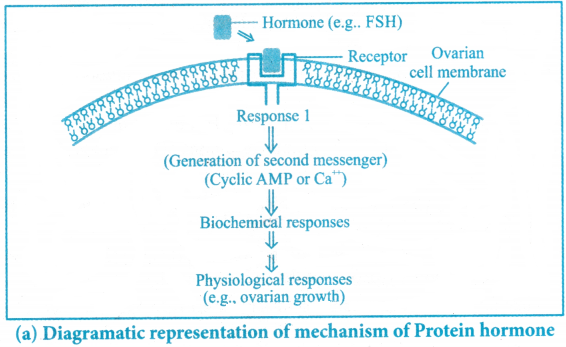
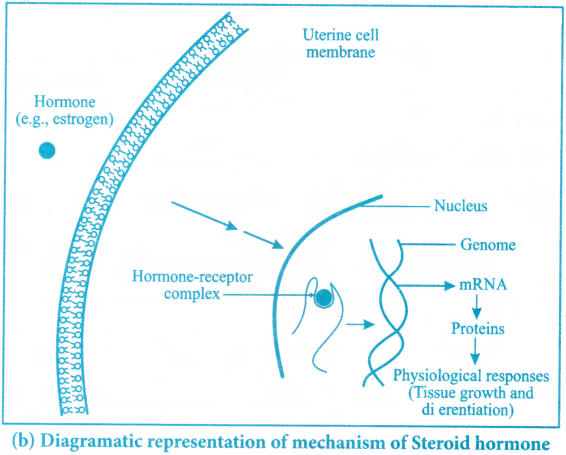
- Hormones produce their effect on target tissues by binding to specific proteins called hormone receptors located in the target tissue.
- Hormone receptors presen t on the cell membrane of the target cells are called membrane bound receptors and the receptors present inside the target cell are called Intracellular receptors, mostly nuclear receptors (Present in the nucleus).
- Binding of a hormone to its receptor leads to the formation of a hormone-receptor complex.
- Each receptor is specific to one hormone only and hence receptors are specific.
- Hormone-receptor complex formation leads to certain biochemical changes in the target tissue.
- Target tissue metabolism and hence physiological function are regulated by hormones.
On the basis of their chemical nature, hormones can be divide into groups.
a) Peptide, Polypeptide, Protein hormones (e.g., Insulin, Glucagon, Pituitary hormones, Hypothalamic hormones), TCT, PTH, Thymosins.
b) Steroids (e.g., Cortisol, Testosterone, Estradiol and Progesterone).
c) Iodothyronines (Thyroid hormones).
d) Amino-acid derivatives or biogenic amines (e.g., Epinephrine).
- Hormones which interact with membrane-bound receptors normally do not enter the target cell, but generate second messengers (e.g., Cyclic AMP, IP3, Ca+ etc.). Which in turn regulate cellular metabolism.
- Hormones which interact with intracellular receptors (e.g., Steroid, Iodothyronines, etc.) mostly regulate gene expression or chromosome function by the interaction of hormone-receptor complex with the genome. .
- Cumulative biochemical actions result in physiological and developmental effects.
Question 5.
Describe the role of hypothalamus as a neurosecretory endocrine organ.
Answer:
- It is the Master Endocrine gland of the body.
- The hypothalamus basal part of Diencephalon (part of fore brain) and hypothalamus regulates a wide spectrum of body functions. It contains several groups of neurosecretory cells called nuclei, which produce hormones.
- These hormones regulate synthesis and secretion of anterior pituitary hormones.
- However, these hormones produced by hypothalamus are of 2 types.
Releasing hormones (stimulates secretion of pituitary hormones) and inhibiting hormones (Inhibit secretions of pituitary hormones).
- For e.g., a hypothalamic hormone called Gonadotrophin releasing hormone (GnRH) stimulates to anterior pituitary for synthesis and release of Gonadotrophins (FSH/LH).
- On the other hand Somatostatin (Growth hormone inhibiting hormone) from hypothalamus inhibits release of growth hormone from anterior pituitary.
- These hormones (Releasing hormone or Inhibiting hormone) originating in hypothalamic neurons, pass through axons of neuron of hypothalamic nuclei and are released from their nerve endings into blood vessels.
- These reach anterior pituitary gland through a portal circulatory system and regulate functions of anterior pituitary.
- Posterior pituitary is under direct neural regulation of hypothalamus.
Question 6.
Give an account of the secretions of the pituitary gland.
Answer:
The hormones secreted by the pituitary gland.
Adenohypophysis:
- Follicle-stimulating hormone (FSH).
- Growth hormone (GH)
- Luteinising hormone (LH).
- Thyroid-stimulating hormone (TSH).
- Adrenocorticotropin hormone (ACTH).
Intermediate lobe:
- Melanocyte-stimulating hormone (MSH).
Neurohyophysis:
- Oxytocin.
- Anti-diuretic hormone (Vasopressin).
Question 7.
Explain how hypothyroidism and hyperthyroidism can affect the body. [March-26]
Answer:
Hypothyroidism:
- It is a condition in which production of thyroid hormones T3 & T4 decrease.
- It is characterized by enlargement of thyroid gland called as ‘Simple goiter’.
- Inadequate supply of iodine or impairment in the thyroid glands leads to this condition.
- Hypothyroidism during pregnancy leads to developmental disorder in baby called ‘cretinism’.
- Untreated congenital hypothyroidism leads to thyroid dwarf characterized by stunted growth, mental retardation, low IQ, abnormal skin, deafness, mutism etc.
- Hypothyroidism in adults results in myxedema-characterized by lethargy, mental impairment, puffmess of face, dry skin etc.
Hyperthyroidism:
- It is a condition in which production of thyroid hormones T3 & T4 abnormally increase.
- Overactivity of thyroid is due to cancer of the gland or nodule development.
- In adults it causes exophthalmic goiter-characterized by protruded eye balls.
- It also effects the physiology of the body like increased BMR (Basal metabolic rate) etc.
I. Multiple Choice Questions
Question 1.
Which of the following is not an endocrine gland ?
1. Pituitary
2. Pineal
3. Pancreas
4. Salivary glands
Answer:
4. Salivary glands
Question 2.
The posterior pituitary is under the direct neural regulation of the
1. Hypothalamus
2. Cerebellum
3. Epithalamus
4. Medulla oblongata
Answer:
1. Hypothalamus
Question 3.
The pituitary gland is located in a bony cavity called
1. Glenoid cavity
2. Acetabulum
3. Sella tursica
4. Pars intermedia
Answer:
3. Sella tursica
Question 4.
Oxytocin and vasopressin are synthesized in
1. Posterior pituitary
2. Anterior pituitary
3. Hypothalamus
4. Thyroid
Answer:
3. Hypothalamus
Question 5.
Excess secretion of growth hormone in adults leads to
1. Dwarfism
2. Acromegaly
3. Graves’ disease
4. Addison’s disease
Answer:
2. Acromegaly
Question 6.
Which hormone stimulates contractions of the uterus at the time of child birth and milk ejection from the mammary glands ?
1. Vasopressin
2. Oxytocin
3. Thyroxine
4. Insulin
Answer:
2. Oxytocin
Question 7.
Assertion(A): Vasopressin is called antidiuretic hormone.
Reason (R): It reduces loss of water through urine.
1. Both (A) and (R) are true, and R is the correct explanation of (A).
2. Both (A) and (R) are true, but R is not the correct explanation of (A).
3. (A) is true, but (R) is false.
4. (A) is false, but (R) is true.
Answer:
1. Both (A) and (R) are true, and R is the correct explanation of (A).
Question 8.
Match the following:
| Column – I | Column – II |
| a) T4 | i) Hypothalamus |
| b) PTH | ii) Thyroid |
| c) GnRH | iii) Pituatory |
| d) LH | iv) Parathyroid |
1. (a)-ii, (b)-iv, (c)-i, (d)-iii
2. (a)-i, (b) iii, (c)-iv, (d)-ii
3. (a)-iii, (b)-ii, (c)-iv, (d)-i
4. (a)-iv, (b)-iii, (c)-i, (d)-ii
Answer:
1. (a)-ii, (b)-iv, (c)-i, (d)-iii
Question 9.
Circulating levels of calcium ions regulate the secretion of
1. Parathyroid hormone
2. Adrenaline
3. Insulin
4. Glucagon
Answer:
1. Parathyroid hormone
Question 10.
Prolonged hyperglycemia leads to
1. Diabetes insipidus
2. Diabetes mellitus
3. Addison’s disease
4. Cretinism
Answer:
2. Diabetes mellitus
Question 11.
Which of the following is not a symptom of Cretinism ?
1. Stunted growth
2. Low IQ
3. Deafness and mutism
4. Decalcification of bones
Answer:
4. Decalcification of bones
Question 12.
Which of the following is mismatched?
1. Hypothyroidism – Goitre.
2. Hyperthyroidism – Graves’ disease.
3. Hypersecretion of corticoids – Addison’s disease.
4. Hypersecretion of growth hormone – Gigantism.
Answer:
3. Hypersecretion of corticoids – Addison’s disease.
Question 13.
The hormone that stimulates the secretion of HCl and pepsinogen from gastric glands.
1. Gastrin
2. Insulin
3. Secretin
4. Cholecystokinin
Answer:
1. Gastrin
Question 14.
Which of the following hormones is an amino acid derivative ?
1. Insulin
2. Glucagon
3. Epinephrine
4. Growth hormone
Answer:
3. Epinephrine
Question 15.
Which of the following does not act as a second messenger in hormonal action ?
1. Cyclic AMP
2. IP3
3. FSH
4. Ca+2
Answer:
3. FSH
II. Fill in the Blanks
Question 1.
The non-nutrient chemicals which act as intercellular messengers are called ________________.
Answer:
Hormones
Question 2.
Over secretion of ________________ hormone leads to gigantism.
Answer:
Growth
Question 3.
The composite gland that acts as both exocrine and endocrine gland is ________________.
Answer:
Pancreas
Question 4.
Follicle stimulating hormone and ________________ hormone are called gonadotropins.
Answer:
Luteinizing
Question 5.
Iodine is essential for the synthesis of ________________ hormones.
Answer:
Thyroid
Question 6.
The main mineralocorticoid produced by the adrenal cortex in the human body is
________________.
Answer:
Aldosterone
Question 7.
Basal metabolic rate is regulated by ________________ hormones.
Answer:
Thyroid
Question 8.
The enlargement of ________________ gland is called Goitre.
Answer:
Thyroid
Question 9.
Chemically cortisol is a ________________ hormone.
Answer:
Steroid
Question 10.
Underproduction of glucocorticoids by adrenal cortex leads to ________________ disease.
Answer:
Addison’s
III. One Word Answer Questions
Question 1.
What are the secretions of the endocrine glands called ?
Answer:
Hormones.
Question 2.
Which gland produces melatonin hormone?
Answer:
Pineal gland.
Question 3.
Name the bilobed gland located on either side of the trachea.
Answer:
Thyroid.
Question 4.
How many parathyroid glands are found in the human body ?
Answer:
Four (4)
Question 5.
Which cells of Islets of Langerhans secrete glucagon hormone ?
Answer:
∝ (alpha) cells.
Question 6.
Which mineral is essential for the synthesis of thyroid hormones ?
Answer:
Iodine.
Question 7.
Which disorder is treated with insulin therapy ?
Answer:
Diabetes mellitus.
Question 8.
Which hormone supports pregnancy in women ?
Answer:
Progesterone.