AP Inter 1st Year Economics 1st Lesson Introduction to Economics Questions and Answers
Essay Questions
Write an essay on the following questions.
Question 1.
Draw and explain production possibility Frontier.
Answer:
The Production Possibility Frontier (PPF) is a curve on a graph that illustrates the possible quantities that can be produced of two products if both depend upon the same finite resource for their manufacture. The PPF is also referred to as the production possibility curve.
It also plays a crucial role in economics. For example, it can demonstrate that a nations economy has reacted the highest level of efficiency possible.
Example : Consider an economy which can produce com or cotton by using its resources. Table gives some of the combinations of corn and cotton that the economy can produce, when its resources are fully utilised.
| Table : Production Possibiilities | ||
| Possibilities | Corn | Cotton |
| A | 0 | 10 |
| B | 1 | 9 |
| C | 2 | 7 |
| D | 3 | 4 |
| E | 4 | 0 |
If all the resources are used in the production of corn, the maximum amount of com that can be produced is 4 units and if all resources are used in the production of cotton, at the most, 10 units of cotton can be produced. The economy can also produce 1 unit of corn and 9 units of cotton or 2 units of corn and 7 units of cotton or 3 units of com and 4 units of cotton and so on as shown in the table. There can be many other possibilities.
The figure illustrates the production possibilities of the economy. Any point on or below the curve represents’a combination of corn and cotton that can be produced with the economy’s resources. The curve gives the maximum amount of corn that can be produced in the economy for any given amount of cotton and vice-versa. This curve is called the “Production Possibility Frontier”.
The production possibility frontier gives the combinations of corn and cotton that can be produced when the resources of the economy are fully utilized. Note that a point (Point F) lying strictly below the production possibility frontier represents a combination of com and cotton that will be produced when all or some of the resources are either underemployed or are utilized in a wasteful fashion.
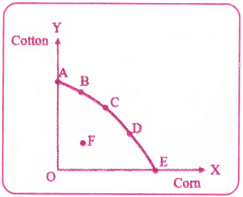
If more of the scarce resources are used in the production of com, less resources are available for the production of cotton and vice versa. Therefore, if we want to have more of one of the goods, we will have less of the other good. Thus, there is always a cost of having a little more of one good in terms of the amount of the other good that has to be forgone.
This is know as the opportunity cost of an additional unit of the goods.
Every economy has to choose one of the many possibilities that it has. In other words, one of the central problems of the economy is to choose from one of the many production possibilities.
Question 2.
Distinguish between Centrally Planned Economy and Market Economy.
Answer:
In a Centrally Planned Economy, the Government or the central authority plans all the important activities in the economy while as in a market economy, all economic activities are organized through the market. Here is the differences between them :
| Features | Centrally Planned Economy | Market Economy |
| Decision Making | Central authority, typically the government, makes all key economic decisions regarding what to produce, how to produce it, and for whom to produce it. | Economic decisions are primarily made by individuals and private firms based on their self interest and in response to market signals like prices. |
| Resource Allocation | The Government owns most of the resources (Land, labour, capital) and directs their allocation according to a national economic plan. | These are largely privately owned. Their allocation is driven by the interaction of supply and demand in free markets. |
| Pricing | Prices are generally set by the Government rather than by the forces of supply and demand. | Prices of goods and services are determined by the forces of supply and demand. |
| Production | Production targets and methods are determined by the central plan state owned enterprises are common. | Private firms decide what and how much to produce in response to consumer demand and the pursuit of profit. |
| Competition | It is typically limited or non-existent as the state controls production. | It among businesses is key characteristic, leading to innovation efficiency and variety. |
| Consumer Soverignity | Consumer choice is often limited to what the government decides to produce. | Consumers have significant influence over what is produced through their purchasing decisions. |
| Incentives | These are often based on meeting production targets rather than profit. | Profit act as a primary incentive for businesses and individuals. US, Japan. |
| Examples | Soviet Union, North Korea and Cuba. |
Question 3.
Give the meaning, importance and scope of economics.
Answer:
Meaning :
Microeconomics : The term Microeconomics is derived from the Greek word MIKROS, which means small. Thus, Microeconomics is the theory of small scale economics. Microeconomics is that branch of Economics, which deals with the analysis of individual economic units like a firm, a farmer, a good etc. It studies the economic actions and behaviour of individual units like firms and small groups of individual units like industry. Microeconomics does not study the economy in its totality. So, the microeconomics is known as partial analysis.
According to K.E. Boulding Microeconomics is the study ofparticular firms, particular households, individual prices, wages, incomes, individual industries and particular commodities.
Importance of Microeconomics :
- Microeconomics explains how a free market economy with its millions of consumers and producers words to decide about the allocation of productive resources among the thousands of goods and services.
- This analysis is useful to the Government to frame suitable policies to promote economic efficiency for the efficient use of scarce resources to achieve economic growth and stability.
- Microeconomics can be used to examine the condition of economic welfare and it suggests ways and means to bring about maximum social welfare.
- This analysis is also applicable to the field of international trade in the determination of exchange rates.
Scope of economics :
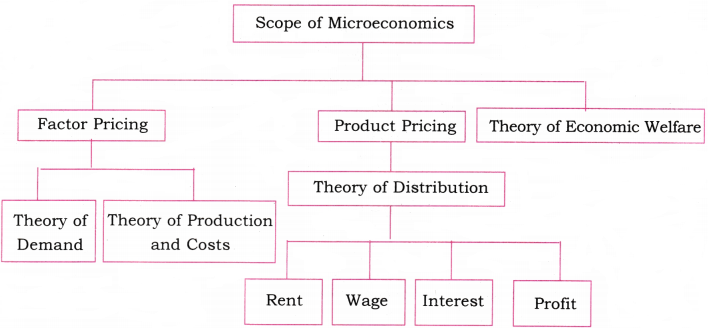
The scope of microeconomics is vast and in compasses various areas of study.
- Individual Units Analysis : It studies the behaviour and decisions of individual consumers, firms, and industries, focusing on how they interact in specific markets.
- Product Pricing : Examines how the price of a particular good or service is determined by study and demand in individual markets.
- Factor Pricing : Analyses how the prices of inputs (land, labour, capital and organisation) are set, resulting in rent, wages, interest and profit.
- Consumer and Producer Behaviour : Investigates how consumers allocate their income and how producers decide on output and input combinations.
- Market structures : Studies different market forms like perfect competition, monopoly, monopolistic competition, and oligopoly, and how they affect pricing and output.
- Economic Welfare : Looks at efficiency in production and consumption, addressing questions like what to produce, how to produce and for whom to produce aiming to maximize social welfare.
- Resource Allocation : Explores how limited resources are distributed among competing uses to achieve efficient outcomes.
- Policy Applications : Helps in formulation of economic policies, taxation and understanding international trade and tariffs.
Question 4.
Define Macro economics explain its importance and scope.
Answer:
Macroeconomics: The term Macroeconomics is derived from the Greek word MAKROS which means large. Thus, Macroeconomics is the theoiy of large-scale economics. The modern developments in Macroeconomics are most closely associated with the work of J.M. Keynes. Macroeconomics is known as Income and Employment Theory. Macroeconomics is also called as aggregative economics. It studies aggregates like national income, total consumption, total savings and total employment etc.
According to K.E. Boulding Macroeconomics studies national income, not individual income, general price level instead of individual prices and national output instead of individual output.
Importance of Macroeconomics : Macroeconomic analysis has acquired great importance after Great Depression (1929-39). The study of macroeconomics is useful for various reasons as explained below.
- The study of macroeconomics helps to understand the problems of unemployment, inflation etc., and suggests how to solve them.
- It helps to evaluate the overall functioning of an economy in order to distribute national income among different sections of the society.
- Macroeconomics provides solutions to overcome the problems of business cycles and helps to understand their occurrence.
- Macroeconomics includes economic growth and suggests how developing countries can use their resources to maximise their growth.
Scope of Macroeconomics:
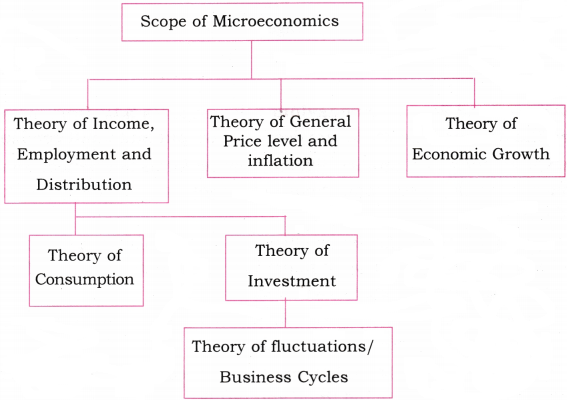
- National Income and GDP : It studies the measurement, components, and growth of national income and Gross Domestic Product, helping to assess a country’s economic performance.
- Employment and unemployment: It examines the overall level of employment, unemployment trends, and the factors influencing job creation and joblessness,
- General Price Level and Inflation : The analysis of inflation, deflation and price stability is central, including their causes, effects and policy responses.
- Economic Growth and Development : Macroeconomics investigates long¬term economic growth, factors driving development and policies for raising living standards.
- Monetary and Fiscal Policy : It covers how governments and central banks use tools like taxation, government spending, and interest rates to influence economic activity and maintain stability.
- Business Cycles : The study of economic fluctuations – booms and recessions and their impact on the economy.
- International Trade and Finance : It explores trade between countries exchange rates, and the effects of globalization on domestic economies.
Short Answer Questions
Write the answers briefly for the following questions.
Question 1.
Discuss the central problem of an economy.
Answer:
Scarcity is the central problem of any economy. This fundamental issue arises from the fact that human wants and desires are virtually unlimited, while the resources available to satisfy them are finite. This mismatch between unlimited wants and limited resources forces every economy to make crucial decisions about how to allocate these scarce resources.
The central problem of an economy can be broken down in three fundamental questions :
- What to produce ?
- How to produce?
- For whom to produce ?
1. What to produce ? Given limited resources, an economy cannot produce everything that everyone wants. Therefore, it must decide which goods and services should be produced and in what quantities.
2. How to produce ? Once the decision on what to produce is made, the economy must determine the most efficient way to produce these goods and services.
3. For whom to produce ? After goods and services are produced, the economy must decide how they will be distributed among its members.
These three questions highlight core challenge of scarcity and the necessity for economic systems to make choices regarding the allocation of limited resources to satisfy competing wants.
Question 2.
Mention any four differences between Microeconomics and Macroeconomics.
Answer:
Both Micro and Macroeconomics are interdependent, neither of the two is complete without the other. In spite of close relationship between the two branches of economics, fundamentally they differ from each other. The following table explains the differences.
| Microeconomics | Macroeconomics |
| 1. The word MICRO derived from the Greek word MIKROS, which means “small”. | 1. The word MACRO derived from the Greek word “MAKROS, which means “large”. |
| 2. Microeconomics is the study of individual units and groups of individual units of the economy. | 2. Macroeconomics is the study of economy as a whole. |
| 3. It is known as Price Theory | 3. It is known as Income and Employment Theory. |
| 4. Microeconomics explains price determination in both commodity and factor markets. | 4. Macroeconomics deals with national income, total employment, aggregate savings & investment, general price level and economic growth etc. |
| 5. Microeconomics is based on price mechanism which depends on demand and supply. | 5. Macroeconomics is based on aggregate demand and aggregate supply. |
Question 3.
Explain the differences between free goods and economic goods.
Answer:
Differences between Free Goods and Economic Goods.
| Free Goods | Economic Goods |
| 1. Free goods are gifts of nature. | 1. Economic goods are man-made. |
| 2. These goods have no cost of production. | 2. These goods have cost of production. |
| 3. These goods do not have a price. | 3. These goods do have price. |
| 4. These goods have value in use, but no value in exchange. | 4. These goods have both value in use and value in exchange. |
| 5. These values are not included in National Income. | 5. These values are included in National Income. |
Question 4.
Explain any four characteristics of wants.
Answer:
Human wants are the basis for all economic activities. They depend on economic and social status of individuals. The nature of human wants can be understood by considering the following characteristics.
- Unlimited wants: Human wants are unlimited. If you satisfy one want another one crops up.
- A particular want is satiable: A single want can be fully satisfied as wants are unlimited, a person can satisfy all wants. For example, if a person is thirsty he can satisfy it by drinking a glass of water.
- Competition: Wants are unlimited, whereas resources to satisfy them are limited. Thus certain wants compete with each other. Eg., A consumer can buy either milk or vegetables with the money he has. Though he wants both, he has to choose one, depending on the intensity of the want.
- Complementary: Satisfaction of a single want may require the use of more number of commodities. For example, writing need is satisfied only when we have pen, ink and paper together.
- Substitution: A person can satisfy his want with different commodities. For example, if a person is hungry he can eat either a meal or fruits to satisfy his hunger. He can substitute one for the other.
- Recurring or Repetitive: Certain wants recur. When you satisfy a particular want at a point of time it recurs or reappears at another time, e.g., hunger, thirst, desire to play etc.
- Habits: Wants change into habits. For example; smoking cigarettes as a joke forms into a habit if it is not controlled.
- Wants vary with time, place and person: Wants are dynamic in nature. Hence, they are changing from time to time, place to place and person to person. E.g.: Dosa for breakfast and rice for lunch.
Question 5.
Explain four kinds of utility with examples.
Answer:
The concept of utility has great importance in economics. The want satisfying capacity of a commodity at a given point of time is known as utility. It is a subjective concept and resides in human mind. Others do not know it unless one expresses it in words or body language.
Types of Utility :
Utility is divided into four types. They are :
- Form Utility : If a commodity satisfies a consumer by changing its shape, colour, size etc., is known as form utility. For example, A log has utility in the form of a chair or a table.
- Place Utility : When goods’acquire utility with the change of their place, is known as place utility. For example, vegetables at the production place have no utility but when they are brought to the market they gain utility.
- Time Utility : Goods acquire additional utility because of time. For example, woollen clothes have utility in winter but not in summer.
- Service Utility : Services also have the ability to satisfy human wants. For example, the teaching of a teacher directly helps a student to build his career. This is also known as personal utility.
Question 6.
Classify of Human Wants.
Answer:
Wants are classified mainly into 3 categories like necessities, comforts, and luxuries.
1. Necessities :
Necessities are those which are essential for living. Necessities refer to the want of products or services essential for survival.
E.g., food, clothing and housing.
2. Comforts :
Comforts refer to those products or services that help in making life comfortable. Comforts are less urgent than necessities. Comforts lie between necessities and luxuries. A person can live without these comforts but they help make life easier for them.
Eg.: Fan, cot, bicycle etc.
3. Luxuries :
Luxuries are those wants which give more pleasure and prestige. They are superfluous and expensive. They make humans feel better about themselves. They don’t actually need but are mostly meant for showing off.
Eg. Jewellry, expensive cars, elegant furniture, etc.
Question 7.
Explain Deductive and Inductive Method.
Answer:
Deductive Method :
Deductive method is mainly used by the classical economists. This method is also known as abstract, hypothetical and a priori method because it is based on abstract reasoning and not on actual facts. This method of reasoning tries to deduce conclusions from certain fundamental assumptions or accepted axioms or truths established and handed over from generation to generation. This method proceeds from the general to the particular.
Eg. The Law of Diminishing Marginal Utility, The Law of Demand.
The following are the steps under Deductive Method.
- Selecting the problem
- Formulating assumptions
- Formulating the hypothesis
- Verifying the hypothesis.
Inductive Method :
Inductive method is also known as historical, empirical, concrete, ethical or realistic method. The German school of economists advocated this method. This method proceeds from particular to the general, i.e., it refers to a process where facts are collected, arranged, analyzed and then general conclusions derived.
Eg: The law of Diminishing Returns, Malthusian theory of population. These are four steps‘involved in deriving economic generalizations through this method.
They are :
- Selection of the problem
- Collection and compilation of data.
- Analysis and common observations
- Generalization
Question 8.
Write about the important features of growth definition.
Answer:
Important features of Growth Definition : This definition analyses the benefits of improving patterns of resource allocation. Some of the important features of Samuelsons definition are :
- Prof. Samuelson’s definition is dynamic in nature as it considers both the present and future consumption, production and distribution.
- Growth definition deals the problem of choice in a dynamic society. Hence, his definition broadened the scope of economics.
- Samuelson’s definition is superior to that of Robbins definition, because he shifted the emphasis, from the scarcity of resources to income, output and employment and later to the problems of economic growth.
Question 9.
What are the features of Welfare Definition ?
Answer:
Important features of Welfare Definition :
- Marshall used the term Economics for Political Economy to make it similar to Physics. He assumed that economics must be a science even though it deals with the ever-changing forces of human nature.
- Economics studies only economic aspects of human life and it has no concern with the political, social and religious aspects of life.
- Marshall’s definition considered those human activities which increased welfare.
- This definition has given importance to man and his welfare and recognised wealth as a means for the promotion of human welfare.
Very Short Answer Questions
Question 1.
Jacob Viners definition.
Answer:
According to Jacob Viner, “Economics is what economists do”. It implies that the best way of understanding the scope and subject matter of economics is to study the problems and solutions offered by economists, and his definition is considered as the modem definition.
Question 2.
Cause of Choice Problem.
Answer:
The cause of choice problem refers to the underlying reasons and factors that make the act of choosing difficult, stressful or lead to suboptimal outcomes. It explores why, despite having options, individuals often stmggle with making decisions.
Question 3.
Production Possibility Curve (PPC).
Answer:
Production Possibility Curve (PPC), also known as Production Possibility Frontier (PPF). It is a graphical representation that illustrates the maximum possible combinations of two goods or services an economy can produce efficiently using all its available resources and given the current technology.
Question 4.
Value – Price.
Answer:
Value : The value of any good or service is the power to command another article or service in change.
These are of two types :
- Value in use,
- Value in exchange.
Value in use refers to the capacity of the good to satisfy human wants whereas value in exchange refers to the quantity of goods can be exchanged for another.
Question 5.
Consumer Goods.
Answer:
A consumer good is a finished good bought by individual or households for final consumption.
Eg : Fruits, milk, pens etc.
Again these are of two types :
i) Perishable goods :
Generally they perish with a single use.
Eg: Milk, Fruits.
ii) Durable goods :
These are used over time rather than being completely used up at the moment of consumption.
Eg : TV and Computer.
Question 6.
Producer or Capital Goods.
Answer:
Goods which are used in the production of other goods are called producer or capital goods. They satisfy human wants indirectly.
Eg : Machines, buildings etc.
These are divided into two types.
- Single-use Capital Goods : These goods are used only once in the production process.
Eg : Raw materials, coal and chemicals - Durable use Capital Goods : These goods are used for long time in the process of production.
Eg: Machines, Tools etc.
Question 7.
Intermediary Goods.
Answer:
Goods which are under the process of production and semi-finished goods are known as intermediary goods. The goods which are not yet finished and under different stages of production are known as intermediary goods.
Eg.: Cement, bricks and steel used as intermediary goods in construction work.
Question 8.
Wealth – Income.
Answer:
- Wealth : It means stock of assets held by an individual or institution that has the potential for yielding income in some form. It may be held in various forms. These include money shares of companies, land, ornaments etc.
- Income : It refers to the money earned or received from various sources, such as various economic activities. It is a flow from wealth. In every economy it flows from households to firms and vice-versa.
Question 9.
Deductive Method.
Answer:
Deductive method is mainly used by the classical economists. This method is also known as abstract, hypothetical and a priorimethod because it is based on abstract reasoning and not on actual facts. This method of reasoning tries to deduce conclusions from certain fundamental assumptions or accepted axioms or truths established and handed over from generation to generation. This method proceeds from the general to the particular.
Eg : The Law of Diminishing Marginal Utility, The Law of Demand.
Question 10.
Positive Economics.
Answer:
A positive science may be defined as a body of systematized knowledge concerning What is. The classical school of economists were of the opinion that economics is purely a positive science which had to right to comment upon the rightness or wrongness of economic behaviour. Further, economist cannot give any final judgement on any matter.
One Word Answer Questions
Answer the following questions in ONE WORD.
Question 1.
The Greek term OIKONOMIA means.
Answer:
The Greek term OIKONOMIA means Household Management.
Question 2.
Who is known as the father of Economics?
Answer:
Adam Smith is known as the father of Economics.
Question 3.
Which branch of economic studies economic problems relations to individual economic units.
Answer:
Microeconomic studies economic problems relating to individual economic units.
Question 4.
The General Theory of Employment, Interest and Money was written by :
Answer:
J.M Keynes.
Question 5.
The problem of allocating scarce resources so as to achieve the greatest possible satisfaction of wants is known as ……………….
Answer:
Economic Problem.
Fill in the blanks
Question 1.
The book Wealth of Nations was written by __________
Answer:
Adam Smith
Question 2.
Macroeconomics was popularized by __________
Answer:
J.M. Keynes
Question 3.
__________ Economics deals with general price level instead of relative prices.
Answer:
Macroeconomics
Question 4.
Scarcity definition of economics was given by __________
Answer:
Lionel Robbins
Question 5.
Inductive Method is also known as __________
Answer:
Historical (Or) Empirical (Or) Realistic Method
Multiple Choice Questions
Question 1.
Which of the following is not one of the central questions that the study of economics is supposed to answer?
1. Who produces what ?
2. Who consumes what ?
3. When are goods produced ?
4. How are goods produced ?
Answer:
3. When are goods produced ?
Question 2.
Under ‘Deductive Method’ the logic proceeds from :
1. Particular to General
2. General to Particular
3. Particular to Particular
4. General to General
Answer:
2. General to Particular
Question 3.
Which of the following may he defined as a systematic body df knowledge concerning ‘What is’?
1. Micro Economics
2. Public Economics
3. Normative Economics
4. Positive Economics
Answer:
4. Positive Economics
Question 4.
What do you mean by a mixed economy?
1. Coexistence of the modern and traditional industries
2. Coexistence of the public and private sectors
3. Coexistence of foreign and domestic sectors
4. Coexistence of commercial and subsistence farming.
Answer:
2. Coexistence of the public and private sectors
Question 5.
What does the bowed-out (Concave) shape of the production possibility curve illustrate ?
1. Increasing opportunity cost
2. Constant opportunity cost
3. Decreasing opportunity cost
4. Under utilization of resources
Answer:
1. Increasing opportunity cost