AP Inter 1st Year Economics 3rd Lesson Theory of Demand Questions and Answers
Essay Questions
Write an essay on the following questions.
Question 1.
Distinguish between income demand and cross demand with the help of diagrams.
Answer:
Income demand explains the relationship between a consumer’s income and various quantities of goods and services demanded at various levels of income, assuming that other factors remain constant. These factors include the price of the good, the price of related goods, tastes, preferences, etc., Symbolically, the functional relationship between income and demand is shown below.
Dx = f(Y)
Where; Dx = Demand for good X,
Y = Income of a consumer,
f = Functional relationship
This means the quantity demanded of good X is a function of the consumer’s income. The functional relationship between income and quantity demanded may be inverse or direct depending on the nature of the commodity.
Table : Income Demand Schedule
|
Income (Rs.) |
Demand | |
| Superior Goods (Kgs.) /(Units) | Inferior Goods (Kgs.) | |
| 2000 | 4 | 12 |
| 4000 | 6 | 10 |
| 6000 | 8 | 8 |
| 8000 | 10 | 6 |
| 10000 | 12 | 4 |
Income Demand Schedule:
An income demand schedule is a list of various quantities of commodities of both superior and inferior goods purchased at different levels of income.
Table shows the relationship between various levels of income and the quantities demanded for both superior and inferior goods. Whenever income increases, the demand for superior goods increases and the demand for inferior goods decreases and vice versa.
Superior / Normal Goods:
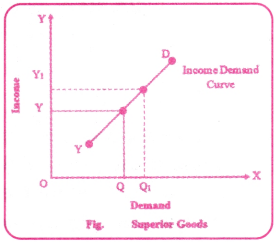
In the case of superior or normal goods, such as cereals, pulses, home appliances etc., demand increases when there is an increase in the income of consumers. The income demand for superior goods exhibits a positive relationship between income and demand.
In Fig., the OX-axis represents the demand for superior goods and the OY-axis represents the income of the consumer. YD represents the income demand curve, showing a positive slope. Whenever income increases from OY to OY1 the demand for superior or normal goods increases from OQ to OQ1 and vice versa.
Inferior Goods:
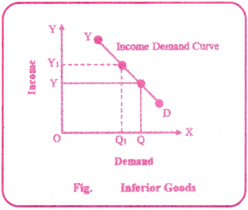
In the case of inferior goods such as ragi, bajra and broken rice etc., demand decreases with an increase in the income of consumers. The income demand for inferior goods exhibits an inverse relationship between income and demand.
In Fig., the OX-axis represents the demand, and the OY-axis represents the income of the consumer. YD is the income demand curve for inferior goods, which has a negative slope.
When the consumer’s income increases from OY to OY1 the demand for the commodity decreases from OQ to OQ1 and vice versa.
Cross Demand:
Cross Demand refers to the relationship between any two goods that are either complementary or substitutes for each other. It indicates the quantity of goods demanded when the price of its substitute or complementary goods changes. In short, when other factors remain constant, the functional relationship between the quantity demanded of a commodity and the price of another commodity is called cross demand.
Symbolically,
Dx = f (Py)
Where;
Dx = Demand for ‘X’ commodity,
Py = Price of ‘Y’ commodity,
f = Functional relationship
Substitute Goods:
Substitutes are goods that satisfy the same want. For example tea and coffee, pepsi and coca-cola etc.
| Table : Schedule for Substitutes | |||
| Coffee | Tea | ||
| Price (in Rs.) |
Demand (Cups) |
Price (in Rs.) |
Demand (Cups) |
| 10 | 500 | 10 | 500 |
| 9 | 600 | 10 | 400 |
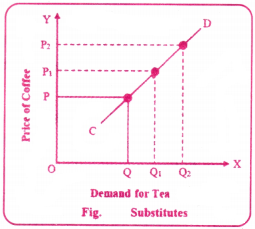
Table shows a positive relationship between the price of coffee and the demand for tea. If the price of coffee decreases, while the price of tea remains constant, then the demand for tea decreases, especially if the existing price of tea is higher than the new price of coffee. In such cases, consumers shift their demand from tea to coffee. Similarly, if the price of coffee increases, while the price of tea remains constant, the demand for tea increases. Hence, in the case of substitutes, the demand curve has a positive slope i.e. it slopes upward from left to right.
In Fig., the OY-axis represents the price of coffee and the OX-axis represents the demand for tea. An increase in the price of coffee from OP to OP2 leads to an increase in the demand for tea from OQ to OQ2. Hence, in the case of substitute goods the demand curve slopes upward from left to right.
Complementary Goods:
Complementary goods are those goods that satisfy the same want jointly. For instance, cars and fuel, shoes and socks, bread and butter, lock and key etc.
| Table : Schedule for Complementary goods | |||
| Fuel | Cars | ||
| Price (in Rs.) |
Demand (Lts) |
Price (in Lakhs) |
Demand (Units) |
| 100 | 5000 | 10 | 1000 |
| 75 | 10000 | 10 | 2000 |
Table shows an inverse relationship between the price of cars and the demand for fuel. If the price of fuel decreases, the demand for cars increases, with the prices of cars remaining constant.
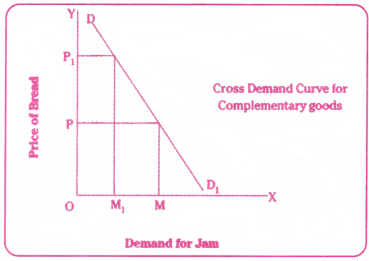
In Fig., the price of fuel is shown on the OY-axis and the demand for cars is shown on the OX-axis. If the price of fuel decreases from OP to OP2 the demand for cars may increase from OQ to OQ2 and vice versa. The cross demand curve for complementaries slopes downward.
So far, we have discussed important aspects of the theory of demand. Now we will proceed to learn the concept of ‘elasticity of demand’ comprehensively.
Question 2.
Which method of measuring price elasticity of demand do you consider most useful ? Explain your answer.
Answer:
The percentage (or proportionate) method of measuring price elasticity of demand is considered the most useful and widely used. This method calculates elasticity using the following formula :
Reasons why this method is most useful :
- Simple and clear : It directly relates the percentage change in quantity demanded to the percentage change in price, making it easy to understand and apply in real world situations.
- Widely applicable : It can be used across different types of goods and services, regardless of units or currency, making comparisons straight forward.
- Helps decision-making : Businesses and policy-makers often rely on
percentage changes to forecast consumer behaviour, set prices or assess tax impacts, making this method practical and relevant. - Flexible : It can be adopted into the mid point formula for more accurate elasticity between two points, reducing bias depending on the direction of change.
Question 3.
Explain the concepts of income elasticity and cross elasticity of demand.
Answer:
Income elasticity of demand and cross elasticity of demand are both important economic concepts that help understand consumer behaviour in response to changes in income and prices respectively.
Income Elasticity of Demand (IED) :
Definition : Income elasticity of demand measures how the quantity demanded of a good responds to a change in consumer’s income.
Interpretation :
- IED > 1 : The product is a luxury good. A 10% increase in income may result in more than a 10% increase in the quantity demanded,
- IED < 1 The product is a necessity. A 10% increase in income may result in less than a 10% increase in the quantity demanded.
- IED = 0 : The demand for the product is perfectly inelastic to income.
- IED < 0 : The product is an interior good. Higher income leads to a decrease in demand.
Example : If the income of consumers, increases by 5% and the demand for branded clothes increases by 10% the IED would be 2 (luxury). Cross
Elasticity of Demand (CED) :
Definition : Cross elasticity of demand measures how the quantity demanded of one good respond to a change in the price of another good. Formula :
\(C E D=\frac{\text { Percentage Change in Quantity Demand of Good A }}{\% \text { Change in Price of Good B }}\)Interpretation :
- CED > 0 : The goods are substitutes. An increase in the price of Good B will increase the demand for Good A (Eg: Tea and Coffee).
- CED < 0 : The goods are complements. An increase in the price of Good B will decrease the demand of Good A (Eg: Cameras and memory cards)
- CED = 0 : The goods are unrelated changes in the price of Good B do not affect the demand for Good A.
Example : If the price of coffee increases by 5% and the demand of tea increase by 2%, the CED is 0.4 indicating that tea and coffee are substitutes.
The concepts of income elasticity and cross elasticity of demand provide valuable insights into pricing strategies, consumer preferences, and market dynamics. Understanding the elasticity of demand helps businesses and policymakers make informed decisions regarding product pricing, supply chain adjustments and taxation impacts.
Question 4.
Explain the Law of Demand and examine exceptions for it.
Answer:
Demand is the desire accompanied by ability and willingness to buy the product. “By demand, we mean the various quantities of a given commodity or service, which consumers would buy in one market in a given period of time at various prices of the good” – Bober.
“The law of demand states that there is an inverse or opposite relationship between price and quantity demanded, other things remaining the same. The law states that demand curves slopes downwards from left to right. ”
Definition: “Other things being equal, the quantity demanded expands with fall in price and contracts with a rise in price. – Samuelson.
Determinants of demand : The demand for a product depends upon various factors. They are price of the products, income of consumer, prices of related goods, the habits of the consumers, advertising expenditure of the firm, etc. The functional or mathematical relationship between determinants of demand and demand of a good is known as demand function.
DA = f(Pa, y, Pr, T, A)
DA = Demand of product A
PA = Price of A
Y = Income of the consumer
Pr = Price of related goods
T = Tastes of the consumer
A = Advertising expenditure
Assumptions of Law of Demand : The Law of demand is based on a number of assumptions.
- There are no changes in the tastes and fashions of the consumers.
- People’s incomes are constant.
- The prices of related products remain the same.
- There are no substitutes to the product.
- There is no possibility of price changes in future.
Demand Schedule : Demand schedule is a table which shows different prices of the good and quantities demanded of the good at those prices. It is of two types. They are
- Individual demand schedule,
- Market demand schedule
| Price of Apply (Rs.) | Quantity Demand (Kg) |
| 5 | 3 |
| 4 | 7 |
| 3 | 12 |
| 2 | 18 |
| 1 | 25 |
The above table shows than when the price is high (Rs. 5) quantity is demanded is less and when price is low (Re. 1). quantity demanded is more.
Demand Curve: Demand curve can be shown diagramatically with the help of demand schedule.
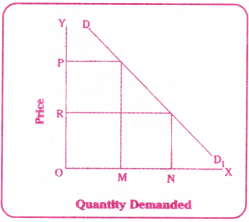
In the adjacent diagram when the price is OP, the demand is OM. When the price has decreased from OP to OR demand has expanded from OM to ON. In other words, the above diagram shows that demand curve slopes downwards from left to right.
Exceptions to the Law of Demand :
- Giffen goods : The law of demand is not applicable to Giffen goods. In the case of Giffen goods, a fall in their price leads to a decrease in demand.
- Veblen Goods (Prestige goods) : The law of demand will not apply in the case of costly products purchased by rich people. If the price of costly diamonds purchased by rich people increases, the demand for such diamonds also increases.
- Speculation : If the price of the good is increasing and likely to increase further in future, speculators purchase larger quantity even at a higher price.
- Illusion : Some consumers, with wrong illusion, purchase less quantity of a good whose price has decreased with the wrong illusion that quality has also been reduced.
Quantity 5.
Define the concept of Elasticity of Demand and explain the concept of price, Income and cross Elasticity of Demand.
Answer:
The degree to which quantity demanded responds to a change in price is known as elasticity of demand.
In other words “The elasticity of demand is the ratio of the percentage change in the quantity demanded and the percentage change in price”.
Mathematically, it can be expressed as
Price Elasticity of Demand PEd = \(\frac{Proportionate Change in Quantity Demand}{Proportionate Change tn Price}\)
Elasticity of Demand studies the relationship between proportionate or percentage change in demand and proportionate or percentage change in price. It is of 3 types.
1. Price elasticity of demand : Price elasticity of demand studies the relationship between proportionate change in price and proportionate change in demand. It explains the rate of change in demand for a given change in the price of commodity.
Price elasticity of demand (PEd) = \(\frac{Percentage of Proportionate Change in Demanded}{Percentage of Proportionate Change in Price}\)
Price elasticity demand is of five types. They are :
- Perfectly or infinite elastic demand (Ed = ∞)
- Perfectly inelastic demand (Ed = 0)
- Unitary elastic demand (Ed = 1.
- Relatively elastic demand (Ed > 1.
- Relatively inelastic demand (Ed < 1.
2. Income elasticity of demand: Income elasticity of demand explains the relationship between percentage proportionate change in demand and percentage, proportionate change income.
Income elasticity of demand (LH) = \(\frac{Percentage or Proportionate Change in Demanded}{Percentage or Proportionate Change in Income}\)
Income elasticity of demand is positive for normal goods. But in the case of inferior goods, income elasticity of demand is negative.
3. Cross elasticity of demand : Cross elasticity of demand studies the relationship between percentage or proportionate change in demand of product (E.g : Coffee) because of a percentage or proportionate change in price of another related good. (E.g: Tea)
Cross elasticity of demand CrEd = \(\frac{Percentage or Proportionate Change in Demand of Coffee}{Percentage or Proportionate Change in Price of Tea}\)
Related goods are of two types. They are
- Substitutes and
- Complementary goods.
Quantity 6.
What is Price Elasticity of Demand ? Explain the various types of Price – Elasticity of Demand.
Answer:
The degree to which quantity demanded responds to a change in price is, known as elasticity of demand.
In other words, the elasticity of demand is the ratio of the percentage change in the quantity demanded to the percentage change in price.
Mathematically, it can be expressed as price elasticity of demand (E) = PEd = \(\frac{Proportionate change in quantity demand} {Proportionate change in price}\)
1. Price elasticity of demand: It shows the relationship between percentage of change in quantity demanded and percentage change in price.
Elasticity of demand (PEd) = \(\frac{Proportionate Change in Demand }{proportionate Change in Price}\)
Types of price elasticity of demand: Basing on the percentage change in demand and percentage change in price, price elasticity of demand can be divided into following.
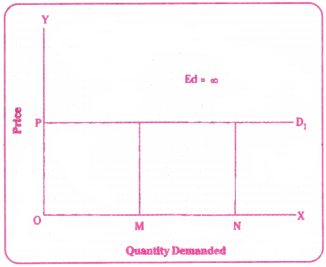
a) Perfectly elastic or Infinite elastic demand :
A product will have perfectly elastic demand when demand changes infinitely due to slight change in price or no change in price. Demand is also said to be perfectly elastic, when infinite quantity can be purchased at the same price.
In the given diagram, demand has increased from OM to ON, even though there is no change in price. The demand curve is horizontal straight line parallel to X – axis so, Ed = ∞
b) Perfectly Inelastic or Zero elastic demand :
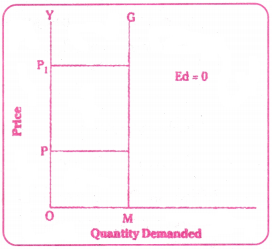
If the demand for a product does not change even though price changes many times, such demand is called as perfectly inelastic demand.
In the adjacent diagram, even though price has increased from OP to OPp there is no change in demand (OM). The demand curve is vertical straight line parallel to Y – axis. so, Ed = 0.
c) Relatively elastic demand :
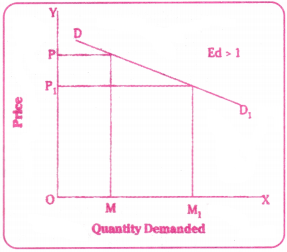
If the proportionate or percentage change in demand is more than the proportionate or percentage change in price, it ‘is called as relatively elastic demand. Such a demand curve is more flater so, Ed > 1.
In the adjacent diagram, when the price has decreased from OP to OP1, the increase in the demand is OM to OM1 Increase in demand (M, M1) is more than change in price PP1 So Ed > 1.
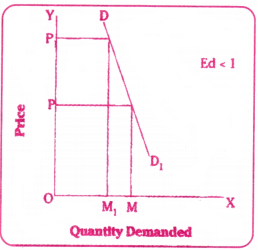
d) Relatively inelastic demand : When the proportionate or percentage change in demand is less than proportionate or percentage change in price, it is called as relatively inelastic demand. Such demand curve is more steeper.
In the adjacent diagram, when the price has increased from OP to OP1, the demand has decreased from OM to OM1. The amount of change in price (PPX) is more than the amount of change in demand (MM1). So Ed < 1.
e) Unitary elastic demand: When the proportionate or percentage change in demand is equal to proportionate or percentage in price, it is called unitary elastic demand.
In the adjacent diagram, when the price has decreased from OP to OP1 demand has increased from OM to OM1. The amount of change in demand M, M1 is equal to the amount of change in price P, P1. So, Ed = 1.
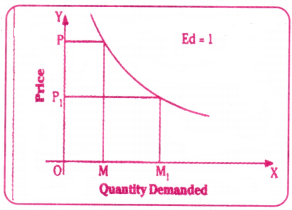
Short Answer Questions
Question 1.
Mention any four factors that determine demand with examples.
Answer:
There are a number of factors that determine the demand for a good. The following are some of the important factors that determine demand.
1. Price of the Commodity (Px) : The demand for a commodity is ordinarily inversely related to its price. If t he price of a commodity falls, its demand increases and vice versa, assuming other things remaining constant. Thus, the price of the commodity is an important determinant of its demand.
2. Prices of Substitutes and Complementaries (Pr) : Demand for a commodity is also influenced by the prices of its substitutes or complementaries. Tea and coffee are substitute goods. For instance, an increase in the price of coffee leads to an increase in the demand for tea and vice versa. In the case of substitutes, there exists a positive relationship between price and demand. Automobiles and fuel are complementary goods. If the price of fuel falls the demand for automobiles increases and vice versa. In the case of complementaries there exists a negative relationship between the price and the demand.
3. Income of the Consumer (Y): The income of the consumer is another important determinant of demand. Assuming other things remain constant, whenever the income of a consumer increases, the demand for normal goods increases and the demand for inferior goods decreases.
4. Tastes and Preferences (T) : The demand for a commodity may change due to changes in tastes, preferences, and fashion. Tastes vary from person to person and tastes do not remain the same forever. For instance, an increase in the use of trousers reduced the demand for dhotis due to a change in fashion. Advertisements also influence demand for particular commodities.
Quantity 2.
Do you agree with the law of demand? Explain your answer.
Answer:
Yes, I agree with the law of demand. It is a fundamental principle in economics that describes pretty consistent and logical relationship between the price of a good or service and the quantity of it that consumers are willing and able to purchase.
Essentially, the law of demand states that as the price of a good or service increases, the quantity demanded will decrease, all other thing being equal. Conversely as the price decreases, the quantity demand will increase.
Here is why this relationship generally hold true :
- Income Effect : When the price of a good falls, consumers have more purchasing power with their existing income. This allows them to buy more of that good, as well as potentially other goods and services.
- Substitution Effect: When the price of a good rises, consumers may look for cheaper alternatives or substitutes.
For example, if the price of coffee goes up significantly, some people might switch to tea. - Diminishing Marginal Utility : The principle suggests that the additional satisfaction, a consumer gets from consuming one more unit of a good decreases with each additional unit consumed. Therefore, consumers are generally willing to pay less for each additional unit.
- Increased Affordability : Lower prices make goods and services more affordable to a wider range of consumers, leading to an increase in overall demand.
In short, the law of demand provides a valuable framework for understanding how market’s function and how consumers respond to price changes. It is a cornerstone of economic analysis and has significant implication for businesses and policy makers like.
Quantity 3.
Why does a demand curve have a negative slope or downward slope from left to right?
Answer:
The law of demand states that there is an inverse or opposite relationship between the price and quantity demanded. In other words, demand curve slopes downwards left to right.
Reasons for the downward slope or demand curve: Demand curve slopes downwards because of the following reasons.
a) New buyers : Demand curve slope downwards because when price falls new buyers are attracted to the product or new buyers will also purchase the product.
b) Old buyers : When the price decreases old buyers purchases more quantity than before. So, demand curve slopes downwards.
c) Income effect : When a price of a product decreases, there will be saving in expenditure to the consumers. This saving can be treated just like an increase in the income. In other words, real income of the consumer increases. So, the consumer purchases more quantity of good whose price has decreased.
d) Substitution effect : When the price of a good (tea) decreases, the other related product (coffee) becomes relatively costlier. So consumer purchases more quantity of tea and less quantity of coffee, which has become relatively costlier.
e) Law of diminishing marginal utility : Demand curve slopes downwards from left to right also because of this law. According to the law, when the consumers are using continuously additional units of the same product, the marginal utility of additional units gradually decreases. So, at smaller quantity, consumer is prepared to pay higher price. But at larger quantities, he is prepared to pay a lower price because there he gets lesser marginal utility.
f) Multiple uses of a commodity : Goods like coal, milk, electricity have multiple uses. When prices of such goods decrease, consumers use such goods to more uses than before.
Quantity 4.
Distinguish between relatively elastic demand and relatively inelastic demand with numerical examples.
Answer:
Relatively elastic demand and relatively inelastic demand describe how much the quantity demanded of a good or service changes in response to a change in its price. The key difference lies in the degree of responsiveness.
Relatively Elastic Demand :
Definition : Demand is considered relatively elastic when a small percentage change in price leads to a larger percentage change in the quantity demanded. Consumers are quite sensitive to price changes for these goods.
Numerical Value : The price elasticity of demand coefficient (Ed) is greater than 1 (Ed > 1).
Numerical example of Relatively Elastic Demand : Suppose the price of a popular brand of coffee decreases by 5% and as a result the quantity demanded increases by 15%.
Percentage change in price = – 5%
Percentage change in quantity demanded = + 15%
The price elasticity of demand (Ed) would be calculated as :
Ed = \(\frac{Percentage change in quality demanded}{Percentage change in price}\)
= \(\frac{15 %}{- 5 %}\) = – 3 %
The absolute value of Ed is | – 3 | =3 which is greater than 1. This indicates that the demand for this brand of coffee is relatively elastic. A small decrease led to proportionally larger increase in quantity consumers wanted. Example of goods with relatively elastic demand often include luxury goods, goods with many close substitutes, and goods that represent a significant portion of a consumer’s budget.
Relatively Inelastic Demand :
Definition : Demand is considered relatively inelastic when a large percentage change in price leads to a smaller percentage change in the quantity demanded. Consumers are not very sensitive to price changes for these goods.
Numerical value : The price elasticity of demand coefficient (Ed) is less than 1 (1 Ed / < 1).
Numerical Example of Relatively inelastic demand : Consider the price gasoline increasing by 10% and as a consequence, the quantity demanded decrease by only 2%.
Percentage change in price = + 10%.
Percentage change in quantity demanded = – 2%
The price elasticity of demand (Ed) would be
Ed = \(\frac{Percentage Change in Quantity Demanded}{Percentage Change in Price}\)
= \(\frac{- 2 %}{10 %}\) = – 0.2 The absolute value of Ed is | – 2 | = 0.2 which is less than 1.
This shows that the demand for gasoline in this scenario is relatively inelastic. Even with a significant price increase, the quantity demanded did not decrease by a large proportion. Goods with relatively inelastic demand are often necessities, goods with few close substitutes, or goods that represent a small portion of consumer”s budget.
Question 5.
Calculate the price elasticity of demand with the help of the point method.
Answer:
Price elasticity of demand shows the responsiveness of quantity demanded to changes in price. In other words, it is the ratio proportionate of percentage change in quantity demanded and proportionate (percentage) change in price.
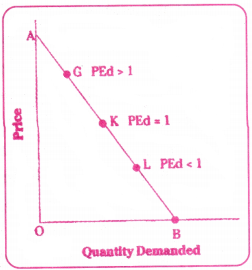
Point method : This method was suggested by Alfred Marshall. Under this method, the elasticity of demand at a point can be calculated measured by dividing the (length of) lower segment of the demand curve with the (length of) upper segment of the demand curve. To calculate elasticity of demand, a point is placed on the demand curve and such point divides the demand curve into two parts, namely, a lower part and an upper part.
1. In the given diagram, at the middle point of the demand curve (K) PEd = 1. This is because at point K lower segment (KB) is equal to upper segment of the demand curve (KA). \(\frac{\mathrm{KB}}{\mathrm{KA}}\) = 1, Ed = 1.
2. At a point above the middle point (G), Price elasticity of demand is greater than one (Ed > 1.. This is because at point G, the lower part of the demand curve, GB is more than the upper segment/part of the demand curve (GA).
GB > GA. PE > 1. \(\frac{\mathrm{GB}}{\mathrm{GA}}\) = more than one.
3. At a point below the mid point of the demand curve, price elasticity of demand is less than one. This is because at profit L, the length of the lower segment of the demand curve (LB) is less than the length of the upper part of the demand curve (LA).
\(\frac{\mathrm{LB}}{\mathrm{LA}}\) = less than one PEd < 1.
Question 6.
What are the factors that determine the price elasticity of demand ?
Answer:
The following are some of the factors that determine the demand for a good.
- Price of the good : The most important determinant of demand of any good is the price. Price and demand are inversely related. If price increases, demand contracts and if price decreases demand expands.
- Prices of related goods (Substitutes & Complementary goods) : Demand for a good depends not only on its price but also on the prices of substitutes and complementary goods. If the price of tea (substitute of coffee) decreases, demand for coffee decreases. In the same way, when the price of jam increases (complementary good of bread) demand for the jam decreases.
- Income of the consumer : Another important determinant of demand is the income of the consumer. Income and demand are directly related. If income increases demand increases and vice versa.
- Tastes and preferences : A change in the tastes and preferences of the consumer leads to a change demand for goods. A change in the preference
and tastes of the consumer towards cell phones results in a fall in the demand for landline phones. - Population : The size of population of the country is another determinant of demand. If population increases, demand for many goods increases.
- Technology changes : An improvement in technology, by leading an improvement in quality and reduction cost of production and selling price, leads to an increase in demand for goods.
- Changes in weather conditions : Demand for a good is also determined by weather conditions. Air conditioners, cool drinks, etc. will have higher demand during summer. The demand for woollen clothes increases during winter.
- State of Business : In a period of Economic depression, demand for goods contracts and in a period of Economic property, the demand for goods increases.
Question 7.
Explain any four points on the importance of price elasticity of demand.
Answer:
Elasticity of demand shows the ratio of proportionate or percentage change in quantity demanded to proportionate or percentage or change in price. Elasticity of demand is having a number of uses.
- Finance minister : Finance minister uses elasticity of demand for imposing taxes on different goods. He imposes higher (more) taxes on goods having inelastic demand and less taxes on goods having elastic demand.
- Monopolist: Elasticity of demand is also useful in determining price in monopoly. Monopolist charges higher price in that sub – market where the product is having inelastic demand. He charges a lower price in that sub – market where the product is having elastic demand.
- Useful in factor pricing : Elasticity of demand is also useful in fixing the rewards or prices of factors of production. Factors having inelastic demand will get higher price than factors having elastic demand.
- International trade : The concept is also useful in international trade. It helps in determining terms of international trade, tariff policy and foreign exchange rates.
- Nationalisation of Industries : The concept also helps the government in making of decisions about nationalisation of industries. The government nationalises those industries whose products are having inelastic demand. E.g : Elasticity, post and telegraphs, etc.
- Pricing of Joint products : In the case of joint products, it is not easy to know their separate cost of production. Their prices are fixed basing on elasticity and inelasticity of such products.
- Granting of protection : Government grants protection to industries basing elasticity of demand. It gives protection to industries or goods having elastic demand.
- Helps in fixing prices of goods and services of government sector : If the products and services of public sector units are having inelastic demand, higher prices are fixed. If they have elastic demand, lower prices are fixed for them.
Question 8.
Explain the concept of Income Demand.
Answer:
Income Demand shows the functional relationship between a change in the income of the consumer and a change in quantity demanded.
ID = f (y)
ID = Income Demand,
y = Income of the Consumer,
f = function.
Income demand curves is of 2 types.
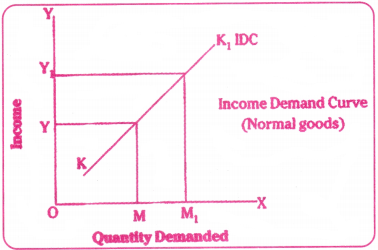
i) Normal goods : In the case of Normal goods an increase in the income of the consumer leads to an increase in the quantity purchased of such good. Income demand curve for normal goods slope upwards from left to right as shown below.
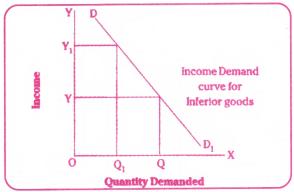
ii) Inferior goods : In the case of inferior goods, an increase in the income of the consumer leads to a decrease in the quantity purchased of the good. Income demand curve for Inferior goods slopes downwards from left to right as shown below.
Question 9.
Explain the concept of Cross Demand.
Answer:
Cross Demand shows the functional relationship between the change in the price of one good (coffee) and change in the demand of its related good (Tea).
Dc = f (Pt)
Dc = Demand for coffee,
Pt = Price of tea,
f = function.
Cross Demand curve is of two types – either upward sloping or downward sloping.
Substitutes:
Substitutes are those goods that are used in the place of some other good. E.g: Coffee & Tea. If there is an increase in the price of coffee, demand for tea increases. Cross Demand Curve for substitute slopes upwards from left to right as shown below.
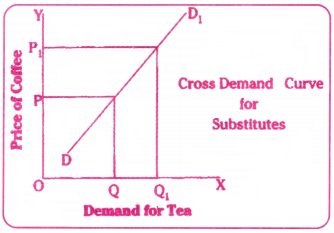
Complementary goods: Complementary goods are two or more goods used by the consumer simultaneously to satisfy the same want. E.g: Bread and jam. If the price of bread increases, the demand for jam decreases.
Cross Demand curve for complementary goods slopes downwards as shown below.
Question 10.
Explain the Total outlay Method of Measuring Elasticity of Demand.
Answer:
The degree of sensitiveness or responsiveness of demand to a change in the price of a good is known as (price) elasticity of demand. In the words, elasticity of demand is the ratio of the percentage or proportionate change in the quantity demanded and proportionate or percentage change in the price.
Outlay Method : (Expenditure Method): This method is associated with the name of Alfred Marshall. Under this method, elasticity of demand of a good can be calculated or measured by finding out whether the expenditure made on the good increases, decreases or remains constant with a change in the price of the good.
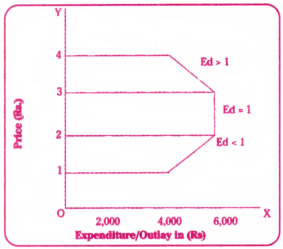
In the above diagram, on Y – axis price is shown and on X – axis is outlay or expenditure made is shown.
- When the price has decreased 1st time from Rs. 4 to 3, the outlay expenditure made on the good has increased from Rs. 4000 to Rs. 6000. If a decrease in the price leads to an increase in expenditure (vice versa), the good will have (relatively) elastic demand. (Ed > 1).
- When the price has decreased, 2nd time from Rs. 3/- to Rs. 2/- there is no change in expenditure of outlay made on the good. In this way, if a change (either increase or decrease) in price leads to no change in expenditure or outlay, the good will have unitary elastic demand. (Ed = 1).
- When in the price has decreased 3rd time, from Rs. 2 to Re. 1, the expenditure or outlay made on the good has also decreased from Rs. 6000/- to Rs. 4000/-. In this way, if a decrease in price leads to decrease in expenditure or outlay (vice versa), the good will have (relatively) inelastic demand. (Ed < 1).
Question 11.
What are the basic determinants of Elasticity of Demand ?
Answer:
The degree to which quantity demanded responds or reacts to a change in price is known as elasticity of demand. In other words, elasticity of demand is the ratio of proportionate or percentage change in quantity demanded and proportionate or percentage change in price. Determinants of elasticity of demand :
- Nature of the commodity : If the good is a necessity, it will have inelastic demand. If the good is a luxury, it will have elastic demand.
- Existence of substitutes : If a good is having many or more substitutes, it will have elastic demand. Goods with few substitutes will have inelastic demand.
- Number of uses : Goods, which are having many or multiple uses, generally have elastic demand. But goods which have one or two uses will have inelastic demand.
- Possibility of postponement: Goods, whose purchases are not postponable, normally have inelastic demand. But goods whose purchases can be postponed have elastic demand.
- Time element: Generally, in the short run, goods will have inelastic demand. But the same, products will have elastic demand in the long run.
- Complementary of goods : If the goods are complementary that are used simultaneously, they have inelastic demand.
- Level of Price : If the price of good is very high (at a higher price level) the demand tends to elastic. Goods, whose price are very low (Eg : Salt, matchbox) have inelastic demand.
- Proportion of total expenditure on the good: If a consumer spends a large portion of his income on a single good, that good will have elastic demand. But a good on which a very small percentage of total income is spent will have inelastic demand.
Question 12.
Explain the importance of the concept of Elasticity of Demand.
Answer:
The term elasticity of demand shows the responsiveness or reaction of quantity demanded of a good to a change in the price of that good, or income of the consumer or prices of related goods.
Importance of elasticity of demand : The concept of elasticity of demand has several uses.
- To business people in fixing the price of the good: The concept of useful to business people in fixing the price of the good. If the good is having elastic demand, they can change a lower price. If the good possesses inelastic demand, they change a higher price.
- To monopolist in price discrimination: A monopolist, following the policy of price discrimination, charges higher price in that sub -market where in good is having inelastic demand. But in the sub – market where the product is having elastic demand, he charges a lower price.
- Pricing of joint products: In the case of joint products, it is not possible to know the cost of production separately. A businessman charges a lower price to one of the joint products which is having elastic demand and higher price to that good having inelastic demand.
- Nationalisation decisions: The concept is also useful to the government in making decisions relating to nationalisation of private sector organisations. The government nationalises those industries whose goods are having inelastic demand.
- International Trade: The concept of elasticity of demand is useful to the government in matters of foreign trade like terms of trade, exchange rates, etc.
- To Finance Minister in tax matters: It helps the Finance Minister in determining the tax rates on different goods. The Financial Minister imposes higher taxes on the goods having inelastic demand. He charges or imposes lower rates of taxes on goods which possess elastic demand.
- To trade unions in wage bargains : The concept is useful to the trade unions of workers in wage bargains. Workers can demand steep increase in their wages if the product produced by them possesses inelastic demand. But workers have to satisfy with lesser hike in their wages if the goods produced by them possess elastic demand.
Question 13.
Briefly explain the various types of price elasticity of demand.
Answer:
Price elasticity of demand measures how much the quantity demanded of a product changes in response to a change in its price.
The main types are;
- Perfectly Elastic Demand (Ed = ∞) : Any small change in price leads to an infinite change in quantity demanded. The demand curve is horizontal.
- Elastic Demand (Ed > 1. : A percentage change in price leads to a larger percentage change in quantity demanded consumers are highly responsive to price changes.
- Unitary Elastic Demand (Ed = 1) : The percentage change in quantity demanded is exactly equal to the percentage change in price.
- Inelastic Demand (Ed < 1) : A percentage change in price leads to a smaller percentage change in quantity demanded. Consumers are less responsive to price changes.
- Perfectly Inelastic Demand (Ed = 0) : Quantity demanded does not change at all, regardless of price changes. The demand curve is vertical.
Very Short Answer Questions
Question 1.
Law of Demand.
Answer:
The Law of demand is based on the “Law of diminishing marginal utility”. It explains the inverse relationship between the price and quantity demanded of a commodity. If the price of a good falls, ceteris paribus, the demand for the good increases and vice verrsa. Hence the Law of Demand is a qualitative concept.
Question 2.
Demand Function.
Answer:
Demand function is Mathematical equation which shows the functional relationship between the demand of a good and the determinants of that good.
Question 3.
Giffen Paradox.
Answer:
Giffen goods are those inferior goods used by poor people, invented by and named after Sir Robert Giffen. This law of demand does not apply in the case of giffen goods. For such goods an increase in price leads to an expansion of their demand.
Question 4.
Veblen Effect.
Answer:
Prestigious goods, are also known as Veblen goods, are those costly goods used by rich people. For such goods the law of demand does not apply. Rich people purchase more of such goods even at increased prices since they are not worried about money expenditure.
Question 5.
Income Effect.
Answer:
When a price of a product decreases, there will be saving in expenditure to the consumers. This saving can be treated just like an increase in the income. In other words, real income of the consumer increases. So, the consumer purchases more quantity of good whose price has decreased.
Question 6.
Substitution Effect.
Answer:
When the price of a good (tea) decreases, the other related product (coffee) becomes relatively costlier. So consumer purchases more quantity of tea and less quantity of coffee, which has become relatively costlier.
Question 7.
Income Demand.
Answer:
Income demand refers to the various quantities of a good which a consumer purchases at different levels of his income. Income demand curve states that there is direct and positive relationship between income and quantity demanded. Income demand curve for normal goods slopes upwards from left to right and for inferior goods, it slopes downwards from left to right.
Question 8.
Demand Curve for Substitutes.
Answer:
Substitutes are goods that satisfy the same want. For example, tea and coffee. If the price of coffee decreases, while the price of tea remains constant. Then the demand of tea decreases, especially if the existing price of tea is higher than the new price of coffee. In such cases consumers shift their demand from tea to coffee. Similarly if the price of coffee increases, while the price of tea remains constant the demand for tea increases. Hence, in the case of substitutes, the demand curve has a positive slope i.e., it slopes upward from left to right.
Question 9.
Price Demand Curve for complementary goods.
Answer:
Complementary goods are those goods that satisfy the same went jointly. For instance cars and fuel, shoes and socks, bread and butter, lock and key etc. If the price of fuel decreases, the demand for cars increases, with the prices of cars remaining constant. The Cross Demand Curve for complementaries slopes downward.
Question 10.
Perfectly Elastic Demand.
Answer:
A good is said to be having perfectly elastic (infinite elastic) demand, when its demand increases infinitely due to a slight change (or) no change in price. Perfectly elastic (Infinite elastic) demand curve is horizontal straight line parallel to X – axis and its numerical value is infinite Ed = ∞.
Question 11.
Perfectly Inelastic Demand.
Answer:
If the demand for a good does not change even after significant increase or repeated increases in rise, it is said to be having perfectly inelastic (zero elastic) demand. Perfectly inelastic demand curve is a vertical straight line parallel to Y – axis and its numerical value is zero, Ed = 0.
Question 12.
Price Elasticity of demand.
Answer:
Price elasticity demand shows or indicates the responsiveness or reaction in the quantity demanded to the change in price. It is the ratio of proportionate change in quantity demanded to the proportionate change in price.
\(\mathrm{PEd}=\frac{\text { Proportionate (or) } \% \text { change in Quantity demand }}{\text { Proportionate (or) \% change in Price }}\)
Question 13.
Cross Elasticity of Demand.
Answer:
Cross elastic demand shows or indicates the responsiveness (or) reaction in quantity demanded of a good X (coffee) to a change in the price of related good Y (tea). It is the ratio of proportionate change in quantity demanded of coffee and proportionate change in price of tea.
Proportionate (or) % chane in Quantity demand of X (coffee)
Proportionate (or) % change in Price Y (tea)
Question 14.
Income Elasticity of Demand.
Answer:
The term income elastic demand shows or indicates the responsiveness or reaction in the quantity demanded to a change in income. It is the ratio of proportionate change in quantity demanded and proportionate change in income.
\(\mathrm{IEd}=\frac{\text { Proportionate change in quantity demand }}{\text { Proportionate change in income }}\)
Question 15.
Arc Method.
Answer:
Arc method is a method of calculating the elasticity of demand in which elasticity is calculated in a portion (or) segment of demand curve between two points of the demand curve. In other words, in this method, elasticity is calculated at the mid point of an arc of a demand curve.
One Word Answer Questions
Answer the following questions in ONE WORD.
Question 1.
What type of relationship exists between price and quantity demanded?
Answer:
Inverse (Negative)
Question 2.
What is the combined effect of the income effect and the substitution effect?
Answer:
Price Effect
Question 3.
What formula measure elasticity at any point on a downward sloping linear demand curve?
Answer:
Lower segment ÷ Upper segment
Question 4.
What is the value of elasticity of demand, if the price of a good fall from Rs. 10 to Rs. 8 and the quantity demanded increases from 100 units?
Answer:
– 2.5 (or) 2.5
Question 5.
Which type of elastic goods are taxed by the finance minister?
Answer:
In elastic (Ed < 1)
Fill in the blanks
Question 1.
The Veblen effect and the substitution effect are ____________ to the Law.
Answer:
exceptions
Question 2.
If coffee and tea are substitution goods, write in the price of coffee will lead to a or an ____________ in the demand for tea.
Answer:
increase (rise)
Question 3.
Where total expenditure decreases with a fall in price and increases with a rise in price, the elasticity of demand is said to be ____________
Answer:
Inelastic
Question 4.
If the price falls, demand increases because of the increase in ____________
Answer:
Real income (or) purchasing power
Question 5.
In the long run the demand for a product will be ____________ because of the availability of substitutes.
Answer:
Elastic
Multiple Choice Questions
Question 1.
Demand for a commodity refers to :
1. Ability to purchase the commodity
2. Willingness to pay the price of the commodity
3. Desire for the commodity
4. Demand is always measured per unit of time.
1. 1 & 2
2. 2 & 3
3. 3 & 1
4. All of the above
Answer:
4. All of the above
Question 2.
The law of demand can be derived with the help of which of the following principles.
1. The Law of Diminishing Marginal Utility
2. The Law of Equi-marginal Utility
3. The Law of Diminishing Returns
4. The Law of Supply
Answer:
2. The Law of Equi-marginal Utility
Question 3.
A right word shift in the demand curve is the result of:
1. An increase in the price of complementary good
2. A fall in the price of a substitute good
3. An increase in the price of a substitute good
4. A fall in the price of a commodity
Answer:
3. An increase in the price of a substitute good
Question 4.
Price elasticity of demand refers to the :
1. Responsiveness of price to change in demand
2. Responsiveness of demand to a change in price
3. Responsiveness of demand to a change in income
4. Responsiveness of demand to a change in prices of related goods
Answer:
2. Responsiveness of demand to a change in price
Question 5.
As a result of a rise in the price of Onions from Rs. 30 per kg. to Rs. 70 per kg. the quantity demanded decreases from 7 kg. per week to 3 kg. per week. Calculate the price elasticity of demand by using the Arc method.
1. 0.71
2. 1.0
3. 1.71
4. 1.25
Answer:
2. 1.0