Cell: The Unit of Life Questions and Answers AP Inter 1st Year Botany Chapter 5

AP Inter 1st Year Botany 5th Lesson Cell: The Unit of Life Questions and Answers

IV. Very Short Answer Questions

Question 1.
What is the significance of vacuole in a plant cell ?
Answer:
Vacuole plays an important role in osmoregulation and also contains sap mainly composed of water.metabolic byproducts,excretions,other waste materials and pigments like anthocyanins.

Question 2.
What does ‘S’ refer to in 70S & 80S ribosomes ?
Answer:
“S” stands for the sedimentation coefficient’ (expressed in the Svedberg unit). It is indirectly a measure of density and size of ribosbmes.

Question 3.
What is the function of a polysome ?
Answer:
Several ribosomes attach to a single m-RNA and form a chain called polyribosomes (or) polysome. The ribosomes of a polysome translate the genetic message of one m-RNA into proteins.

Question 4.
What is referred to as a satellite in some chromosomes ?
Answer:
A few chromosomes have non- staining secondary constrictions at a constant location. A round terminal part of the chromosome present beyond the secondary constriction is called satellite and such chromosomes are called satellite chromosomes.

Question 5.
What is middle lamella made of? What is its functional significance ? [March-26]
Answer:
Middle lamella is mainly made of calcium pectate and magnesium pectate.lt holds or glues the different neighbouring cells together.

Question 6.
What is osmosis?

a) Cristae i) Flat membranous sacs in stroma of chloroplast
b) Mesosome ii) Infoldings in mitochondria
c) Thylakoids iii) Disc-shaped sacs in Golgi apparatus
d) Cisternae iv) Infoldings of plasma membrane in bacteria

Answer:

a) Cristae ii) Infoldings in mitochondria
b) Mesosome iv) Infoldings of plasma membrane in bacteria
c) Thylakoids i) Flat membranous sacs in stroma of chloroplast
d) Cisternae iii) Disc-shaped sacs in Golgi apparatus

V. Short Answer Questions

Question 1.
Briefly describe the cell theory.
Answer:

  • In 1838, Mathias Schleiden, a German botanist, examined a large number of plants and observed that all plants are composed of different kinds of cells which form the tissues.
  • Theodor Schwann in 1839, a German zoologist, studied different types of animal cells and reported that all cells possess an outer layer called “Plasma membrane”.
  • He also concluded that plant cells have a characteristic cell wall that differentiates from animal cells.
  • Schwann proposed the hypothesis that the bodies of animals and plants are composed of cells and products of cells.
  • On the basis of these points, both Schleiden and Schwann together formulated cell theory. But they failed to explain how new cells are formed.
  • Rudolf Virchow (1855) first explained that cells divide and new cells are formed from pre-existing cells (Omnis cellula-e cellula).
  • He modified the hypothesis of Schleiden and Schwann to give the cell theory a final shape.
  • Cell theory states that, all living Organisms are composed of cells and products of cells.
  • Cell is the structural and functional unit of living organisms .
  • All cells arise from pre-existing cells.

Question 2.
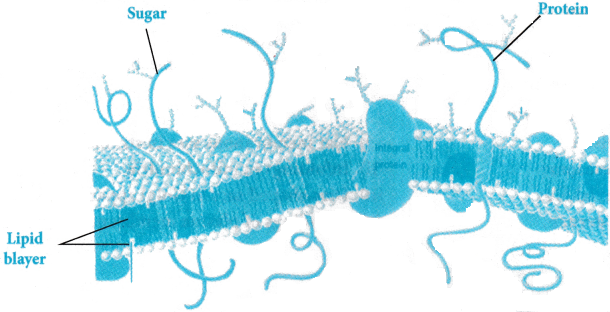
Give the biochemical composition of plasma membrane. How are lipid molecules arranged in the membrane?
Answer:

  • Plasma membrane is chemically composed of lipids, proteins and carbohydrates.
  • So, plasma membrane is lipo-proteinaceous in nature.
  • Depending on the location and ease of extraction, membrane proteins can be classified as integral and peripheral.
  • Integral proteins are partially or totally buried in the membrane, whereas peripheral proteins lie on the surface of the membrane.
  • In the cell membrane lipids are ararnged in bilayer.
  • The lipids are arranged within the membrane with the polar (hydrophilic) head towards the outer side and the non-polar (hydrophobic) tails towards the inner part, which ensures that the non-polar tail of saturated hydrocarbons is protected from the aqueous environment.
  • Widely accepted model of plasma membrane is the “Fluid mosaic model” improved by Singer and Nicolson. According to this, the quasi-fluid nature of lipids, enables lateral movement of proteins within the overall bilayer.
Cell The Unit of Life Questions and Answers AP Inter 1st Year Botany Chapter 5 1

Question 3.
Distinguish between active transport and passive transport?
Answer:

Active transport Passive transport
1. Movement of molecules or ions across the membrane through carrier proteins by utilizing metabolic energy. 1. Movement of molecules across the membrane without utilizing metabolic energy.
2. It is carried against concentration gradients (Lower to higher conc.)
Ex : Na+, K+
2. It is carried along concentration gradients (Higher to lower).
Ex : Diffusion, osmosis

Question 4.
What are the characteristics of a prokaryotic cell?
Answer:

  • Most prokaryotes, particularly bacterial cells, have a chemically complex cell envelope.
  • Cell envelope consists of glycocalyx, cell wall and cell membrane.
  • Glycocalyx may be in loose sheath form called slime layer (or) thick and tough form called capsule.
  • There is no well-defined nucleus.
  • The genetic material is naked and is not enveloped by nuclear membrane.
  • DNA is double stranded, circular, without histones (Naked) called genophore and the area is called nucleoid.
  • Prokaryotes like some bacteria possess extra chromosomal DNA called plasmid.
  • Prokaryotes lack membrane bound organelles.
  • 70S type of Ribosomes are present in the cytoplasm.
  • Prokaryotes have invaginations in the cell membrane called ‘Mesosomes’.
  • Some bacterial cells are able to move with flagella.
  • Flagella has three parts namely basal body, hook and filament which is the longest portion. Flagella play a role in motility.
  • Besides flagella, pili and fimbriae are present.
  • Pili are elongated tubular structures.
  • Fimbriae are small bristle-like fibres and are useful for attachment of bacteria to rocks, in streams and also to the host tissues.
  • Division of cells takes place amitotically.

Question 5.
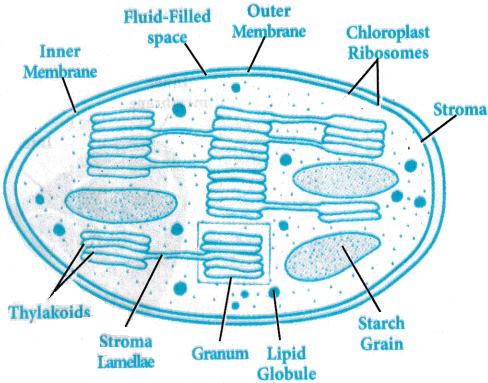
Explain the structure of the cell organelle which contain chlorophyll, with a neat labelled diagram.
Answer:

  • The cell organelle which contains chlorophyll pigments is chloroplast.
  • These are green coloured plastids found in all green plant parts i.e., mesophyll cells of the leaves.
  • Each chloroplast is bounded by a double membrane envelope and the gap present between the two membranes is called peri plastidial space of about 10 nm wide.
  • It contains an inner space called stroma containing photosynthetic enzymes, circular, naked d.sDNA, RNA and 70S ribosomes.
  • At certain places, flattened membranous sacs are present called thylakoids. They are arranged in stacks like the pile of coins called Grana.
  • The large number of lipoprotein membranes present between grana are called stroma lamellae (or) stroma thylakoids.
  • The empty space present in each thylakoid is called lumen.
  • Chlorophylls and carotenoids which are present in the membranes of thylakoids are responsible for trapping light energy.
  • DNA present in a chloroplast helps in self duplication. So they are called semi- autonomous cell organelles.

Functions:

  • Chloroplasts are mainly concerned with assimilation of food materials by photosynthetic process.
  • Light reaction of photosynthesis takes place in grana and carbon fixation (dark reaction) takes place in the stroma region.
Cell The Unit of Life Questions and Answers AP Inter 1st Year Botany Chapter 5 2

Question 6.
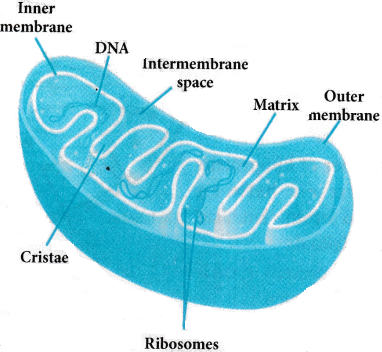
Explain the structure of the cell organelle which is known as ‘Powerhouse of the cell’ with a neat labelled diagram.
Answer:

  • ‘Mitochondria’ are commonly called powerhouses of cell.
  • Mitochondria occur in all eukaryotic cells.
  • Mitochondria is sausage – shaped or cylindrical having a diameter of 0.2 -1.0 Micrometer and a length of 1.0 – 4.1 Micrometer.
  • Mitochondria is a double membrane bound cell organelle and the space present between the two membranes is called peri mitochondrial space.
  • Outer membrane is continuous while the inner membrane forms a number of infoldings called cristae.
  • Many stalked particles present on the.surface of the cristae are called F0 – F1 particles.
  • Inner space of mitochondria is filled with a fluid matrix which contains circular, naked dsDNA, RNA, 70S ribosomes and respiratory enzymes.
  • Krebs cycle of aerobic respiration occurs in matrix and electron transport takes place in cristae.
  • Mitochondria divide by fission.

Functions:
Mitochondria are concerned with cellular respiration and are involved in oxidation of food material. They produce energy in the form of ATP and hence are called powerhouses of cell.
Cell The Unit of Life Questions and Answers AP Inter 1st Year Botany Chapter 5 3

Question 7.
Differentiate between rough endoplasmic reticulum (RER) and smooth endoplasmic reticulum (SER).
Answer:

RER SER
1. Ribosomes are present on the outer surface of the membrane. 1. Ribosomes are absent on the outer surface of the membrane.
2. It is formed of cisternae and tubules. 2. It is formed of vesicles and tubules.
3. It takes part in the synthesis of proteins and enzymes. 3. It takes part in the synthesis of lipids and steroids.
4. RER is internal and is connected with nuclear membrane. 4. SER is external and is connected with plasma membrane.
5. It may develop from nuclear membrane. 5. It may develop from RER.
6. It forms lysosomes through Golgi complex. 6. It forms sphaerosomes.
7. Detoxification enzymes are absent. 7. Detoxification enzymes are present.
8. It is also called Granular ER. 8. It is also called Agranular ER.

Question 8.
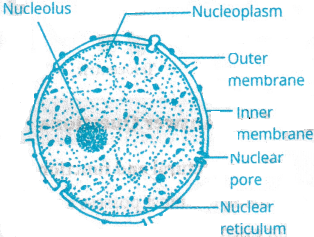
Explain the structure of the nucleus with a neat labelled diagram.
Answer:

  • Nucleus as a cell organelle was first described by Robert Brown.
  • Nucleus is also a double membrane bound cell organelle and the space present between the two membranes is called perinuclear space.
  • Nucleus consists of highly extended and élaborated nucleoprotein fibres called chromatin, nuclear matrix and one (or) more spherical bodies called nucleoli.
  • Outer membrane of the nucleolar envelope usually remains continuous with the E.R. and also bears 80S ribosomes on it.
  • At a number of places the nuclear envelope is interrupted by minute pores called nuclear pores which connect the nucleoplasm with cytoplasm for the movement of RNA and protein molecules.
  • The nuclear matrix (or) the nucleoplasm contains nucleolus and chromatın.
  • Chromatin contains DNA and some basic proteins called histones, some non-histone proteins and RNA.
  • Chromatin transforms into chromosomes during cell division.
  • Nucleoli are spherical structures present in the nucleoplasm.
  • The content of the nucleolus is continuous with the rest of the nucleoplasm as it is not a membrane bounded structure.
  • Nucleolus is the site for active r-RNA synthesis.
  • Larger and more numerous nucleoli are present in the cells which are actively carrying out protein synthesis.

Function :
Nucleus controls and regulates the functions of the cell.
Cell The Unit of Life Questions and Answers AP Inter 1st Year Botany Chapter 5 4

Question 9.
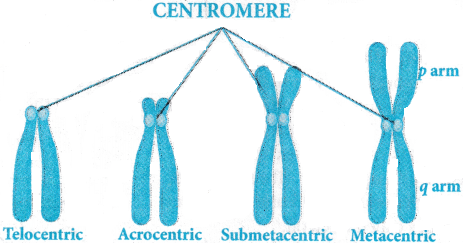
Classify the chromosomes on the basis of centromere location.
Answer:
A chromosome with one centromere is called a monocentric chromosome. Based on the position of centromere, monocentric chromosomes are four types. They are,

a) Metacentric:
Centromere present in the middle point of the chromosome. So both arms of the chromosomes are equal in length. Chromosome appears L-shaped during anaphase of cell division.

b) Sub-metacentric:
Centromere is slightly away from the centre of the chromosome. So, the chromosome has two unequal arms. During anaphase such chromosomes appear as ‘L’ shaped.

c) Acrocentric:
In a chromosome, centromere is situated close to its end forming one extremely short and one very long arm. So chromosomes appear as ‘J’ shaped during anaphase.

d) Telocentric:
Centromere is present at the terminal end of chromosome. So the telocentric chromosome has only one arm. During anaphase it appears ‘I’ shaped.
Cell The Unit of Life Questions and Answers AP Inter 1st Year Botany Chapter 5 5

VI. Long Answer Questions

Question 1.
What structural and functional attributes must a cell have to be called a living cell ?
Answer:

  • A living cell must possess a plasma membrane to define its boundaries, contain cytoplasm for essential cellular processes, and have genetic material (DNA) for heredity and cell function.
  • Additional attributes include being composed of protoplasm, which may be covered by a cell wall, and possessing at least some sub-cellular organelles like ribosomes.

Structural Attributes:

Plasma Membrane:
This outer covering separates the cell’s internal environment from the outside, allowing selective passage of materials.

Cytoplasm:
The semi-fluid matrix within the cell where various cellular components and chemical reactions occur.

Genetic Material (DNA):
This material, found in chromosomes or a nucleus, carries the cell’s genetic information and is responsible for heredity.

Protoplasm:
The living substance within the cell, bounded by the plasma membrane, and may be covered by a cell wall in some cases.

Sub-cellular Organelles (e.g., ribosomes):
These structures within the cytoplasm carry out specific functions essential for cell life.

Functional Attributes:

Metabolism:
Living cells must be capable of carrying out various metabolic processes, including energy production, nutrient processing, and waste excretion.

Regulation and Homeostasis:
Cells must be able to regulate their internal environment and maintain a stable internal state.

Response to Stimuli:
Living cells must be able to detect and respond to changes in their environment.

Adaptation and Reproduction:
Cells must be able to adapt to their environment through changes in DNA and reproduce to perpetuate life.

Question 2.
Write the functions of the following.
a) Centromere
b) Cell wall
c) Smooth ER
d) Golgi apparatus
Answer:
a) Functions of centromere:

  • Centromere (or) primary constriction divides the chromosomes into two equal arms (or) two unequal arms based on its position in the chromosomes.
  • Centromere has disc shaped structures on its either side called kinetochores, which are the sites of implantation of spindle fibres during cell division.
  • Thus helpful in the formation of daughter chromosomes during cell division.

b) Functions of a cell wall:

  • It gives shape to the cell.
  • It protects the cell from mechanical damage and infection.
  • It helps in cell-to-cell interaction.
  • It acts as a barrier to undesirable macro molecules.

c) Functions of smooth E.R :

  • Smooth endoplasmic reticulum is the major site for synthesis of lipids.
  • In animal cells, lipids – like steroidal hormones are synthesized in smooth endoplasmic reticulum.

d) Functions of golgi apparatus:

  • Golgi apparatus is the important site of formation of glycoproteins and glycolipids.
  • In plants, golgi apparatus involved in the synthesis of cell wall materials like cellulose, hemi cellulose etc.
  • It plays a role in the formation of cell plates during cell division.
  • Golgi apparatus is involved in the formation of lysosomes.

Question 3.
Describe the structure of the following with the help of labelled diagrams.
a) Nucleus
b) T.S. of flagellum
Answer:
a) Nucleus:

  • Nucleus as a cell organelle was first described by Robert Brown.
  • Nucleus is also a double membrane bound cell organelle and the space present between the two membranes is called perinuclear space.
  • Nucleus consists of highly extended and elaborated nucleoprotein fibres called chromatin, nuclear matrix and one (or) more spherical bodies called nucleoli.
  • Outer membrane of the nucleolar envelope usually remains continuous with the E.R. and also bears 80S ribosomes on it.
  • At a number of places the nuclear envelope is interrupted by minute pores called nuclear pores which connect the nucleoplasm with cytoplasm
  • for the movement of RNA and protein molecules.
  • The nuclear matrix (or) the nucleoplasm contains nucleolus and chromatin.
  • Chromatin contains DNA and some basic proteins called histones, some non-histone proteins and RNA.
  • Chromatin transforms into chromosomes during cell division.
  • Nucleoli are spherical structures present in the nucleoplasm.
  • The content of the nucleolus ft continuous with the rest of the nucleoplasm as it is not a membrane bounded structure.
  • Nucleolus is the site for active r-RNA synthesis.
  • Larger and more numerous nucleoli are present in the cells which are actively carrying out protein synthesis.

Function:
Nucleus controls and regulates the functions of the cell.

Cell The Unit of Life Questions and Answers AP Inter 1st Year Botany Chapter 5 4

T.S of flagellum:

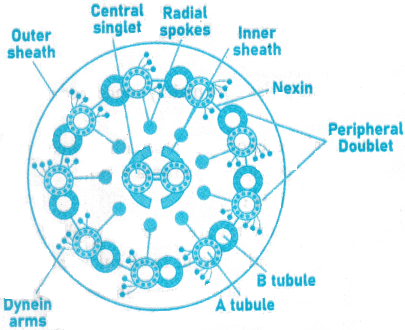
  • The electron microscopic study of the flagellum shows that they are covered with plasma membrane.
  • Their core, called the axoneme, possesses a number of microtubules running parallel to the long axis.
  • The axoneme usually has nine doublets of radially arranged peripheral microtubules, and a pair of centrally located microtubules.
  • Such an arrangement of axonemal microtubules is referred to as the 9 + 2 array.
  • The central tubules are connected by bridges and are also enclosed by a central sheath, which is connected to one of the tubules of each
  • peripheral doublets by a radial spoke.
  • Thus, there are nine radial spokes.
  • The peripheral doublets are also interconnected by linkers.
  • Both the cilium and flagellum emerge from centriole-like structures called the basal bodies.
Cell The Unit of Life Questions and Answers AP Inter 1st Year Botany Chapter 5 6

Question 4.
Name two cell- organelles that are double membrane bound. State their functions and draw labelled diagrams of both.
Answer:

Chloroplast:

  • The cell organelle which contains chlorophyll pigments is chloro¬plast.
  • These are green coloured plastids found in all green plant parts i.e., mesophyll cells of the leaves.
  • Each chloroplast is bounded by a double membrane envelope and the gap present between the twO membranes is called peri plastidial space of about 10 nm wide.
  • It contains an inner space called stroma containing photosynthetic enzymes, circular, naked dsDNA, RNA and 70S ribo-somes.
  • At certain places, flattened membranous sacs are present called thylakoids. They are arranged in stacks like the pile of coins called Grana.
  • The large number of lipoprotein membranes present between grana are called stroma lamellae (or) stroma thylakoids.
  • The empty space present in each thylakoid is called lumen.
  • Chlorophylls and carotenoids which are present in the membranes of thylakoids are responsible for trapping light energy.
  • DNA present in a chloroplast helps in self duplication. So they are called semi- autonomous cell organelles.

Cell The Unit of Life Questions and Answers AP Inter 1st Year Botany Chapter 5 2

Functions:

  • Chloroplasts are mainly concerned with assimilation of food materials by photosynthetic process.
  • Light reaction of photosynthesis takes place in grana and carbon fixation (dark reaction) takes place in the stroma region.

Mitochondria:

  • ‘Mitochondria are commonly called powerhouses of cell.
  • Mitochondria occur in all eukaryotic cells.
  • Mitochondria is sausage – shaped or cylindrical having a diameter of 0.2 -1.0 Micrometer and a length of 1.0 – 4.1 Micrometer.
  • Mitochondrion is a double membrane bound cell organelle and the space present between the two membranes is called peri mitochondrial space.
  • Outer membrane is continuous while the inner membrane forms a number of infoldings called cristae.
  • Many stalked particles present on the surface of the cristae are called F0 – F1 particles.
  • Inner space of mitochondria is filled with a fluid matrix which contains circular, naked dsDNA, RNA, 70S ribosomes and respiratory enzymes.
  • Krebs cycle of aerobic respiration occurs in matrix and electron transport takes place in cristae.
  • Mitochondria divide by fission.

Functions:

  • Mitochondria are concerned with cellular respiration and are involved in oxidation of food material.
  • They produce energy in the form of ATP and hence are called powerhouses of cell.

Cell The Unit of Life Questions and Answers AP Inter 1st Year Botany Chapter 5 3

I. Multiple Choice Questions

Question 1.
Identify the cell organelle that lacks a membrane.
1. Vacuole
2. Nucleus
3. Ribosome
4. Mitochondria
Answer:
3. Ribosome

Question 2.
Identify the cell which does not contain a cell wall.
1. Bacteria
2. Blue-green algae
3. Mycoplasma
4. Plant cell
Answer:
3. Mycoplasma

Question 3.
The protein-lipid ratio in the cell membrane of human erythrocytes.
1. 40 : 52
2. 52 : 40
3. 42 : 50
4. 50 : 42
Answer:
2. 52 : 40

Question 4.
Movement of molecules from lower concentration to higher concentration by utilising energy is
1. Diffusion
2. Osmosis
3. Passive transport
4. Active transport
Answer:
4. Active transport

Question 5.
Middle lamella is made up o
1. Cellulose
2. Calcium pectate
3. Chitin
4. Lignin
Answer:
2. Calcium pectate

Question 6.
Which cell organelle is important site for formation of glycoproteins and glycolipids ?
1. Golgi apparatus
2. Er
3. Ribosomes
4. Peroxisomes
Answer:
1. Golgi apparatus

Question 7.
In a plant cell the vacuole can occupy upto
1. 70% of cell volume
2. 90% of cell volume
3. 80% of cell volume
4. 60% of cell volume
Answer:
2. 90% of cell volume

Question 8.
The protein storing leucoplast is
1. Amyloplast
2. Aleuroplast
3. Elaioplast
4. Chromoplast
Answer:
2. Aleuroplast

Question 9.
Which among the following does not come under the cytoskeleton ?
1. Microtubules
2. Microfilaments
3. Cilia
4. Intermediate filaments
Answer:
3. Cilia

Question 10.
A chromosome has extremely short and very long arm, identify the possible chromosome type.
1. Metacentric
2. Sub-metacentric
3. Acrocentric
4. Telocentric
Answer:
3. Acrocentric

Question 11.
Ribosomes are site for the synthesis of
1. Lipids
2. Proteins
3. Carbohydrates
4. Nucleic acids
Answer:
2. Proteins

Question 12.
Identify the smallest living cell.
1. Cells of all living organisms have a nucleus.
2. Both animal and plant cells have a well-defined cell wall.
3. In prokaryotes, there are no membrane bound organelles.
4. Cells are formed de novo from abiotic materials.
Answer:
2. Both animal and plant cells have a well-defined cell wall.

Question 13.
Identify the cell organelle which is not considered as part of the endomembrane system.
1. ER
2. Golgi complex
3. Peroxisomes
4. Lysosomes
Answer:
3. Peroxisomes

Question 14.
According to Rudolf Virchow new cells generate from
1. Bacterial fermentation
2. De novo synthesis
3. Pre-existing cells
4. Abiotic materials
Answer:
3. Pre-existing cells

Question 15.
Which of the following is correct ?
1. Cells of all living organisms have a nucleus.
2. Both animal and plant cells have a well-defined cell wall.
3. In prokaryotes, there are no membrane bound organelles.
4. Cells are formed de novo from abiotic materials.
Answer:
3. In prokaryotes, there are no membrane bound organelles.

Question 16.
Which of the following is not correct ?
1. Robert Brown discovered the cell.
2. Schleiden and Schwann formulated the cell theory.
3. Virchow explained that cells are formed from pre-existing cells.
4. A unicellular organism carries out its life activities within a single cell.
Answer:
1. Robert Brown discovered the cell.

II. Fill In the Blanks

Question 1.
The smaller subunit of 80S ribosome is ____________
Answer:
40S

Question 2.
Nucleolus is a site for ____________ RNA synthesis.
Answer:
Ribosomal

Question 3.
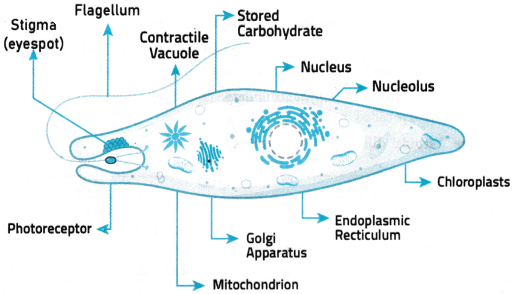
Chloroplast number in Chlamydomonas cell ____________
Answer:
One

Question 4.
In cell membranes ____________ proteins are partially or totally buried.
Answer:
Integral

Question 5.
The peripheral fibrils of centriole are made up of ____________ protein.
Answer:
Tubulin

Question 6.
The membrane of the vacuole is named as ____________
Answer:
Tonoplast

Question 7.
The contractile vacuole in Amoeba is important for ____________.
Answer:
Osmoregulation/ Excretion

Question 8.
Arrangement of axonemal microtubules in cilia or flagella is ____________ array.
Answer:
9 + 2

Question 9.
Chromatin contains DNA, RNA, Histones and ____________.
Answer:
Non-histone proteins

Question 10.
Small bristles like fibres sprouting out of the bacterial cell are known as ____________.
Answer:
Fimbriae

III. One Word Answer Questions

Question 1.
Mention a single membrane bound organelle which is rich in hydrolytic enzymes.
Answer:
Lysosomes

Question 2.
What is the location of a centromere in a metacentric chromosome?
Answer:
Middle of the chromosome

Question 3.
Which part of the bacterial cell is targeted in gram staining ?
Answer:
Cell wall

Question 4.
Which type of ribosomes are present in chloroplast and mitochondria ?
Answer:
70S

Question 5.
Name the fat-soluble pigments which are present in chromoplast.
Answer:
Carotenoid pigments

Question 6.
Who discovered the ribosomes ?
Answer:
Palade

Question 7.
Name the cell organelle which is called the powerhouse of the cells.
Answer:
Mitochondria

Question 8.
Name the model which was proposed by Singer and Nicolson to explain the cell membrane structure.
Answer:
Fluid Mosaic model

Question 9.
Who discovered the living cell ?
Answer:
Leeuwenhoek

Question 10.
In which form of cellular energy does the mitochondria produce ?
Answer:
ATP
AP Inter 1st Year Botany Study Material

Anatomy of Flowering Plants Questions and Answers AP Inter 1st Year Botany Chapter 4

AP Inter 1st Year Botany 4th Lesson Anatomy of Flowering Plants Questions and Answers

IV. Very Short Answer Questions

Question 1.
A transverse section of a plant shows conjoint, scattered vascular bundles surrounded by sclerenchymatous bundle sheath. What will you identify it as?
Answer:
Monocot stem

Question 2.
Which parts of the leaf surface reduce the rate of transpiration?
Answer:
The waxy cuticle on the leaf surface and the number and position of stomata on the leaf surface both reduce the rate of transpiration.

Question 3.
What are the cells that make the leaves curl in plants during water stress? Give an Example.
Answer:
Bulliform cells.
Ex: Monocot leaves (Grass).

Question 4.
How is the study of plant anatomy useful to us?
Answer:

  • Anatomy helps in understanding internal structure or arrangement of various tissues of plants.
  • Anatomy helps in understanding structural details of different organs of a plant, anatomical differences found in between different kinds of plants like monocots and dicots, and also helps in knowing adaptations found in plants to diverse environments

Question 5.
Name any two simple tissues found in the ground tissue system.
Answer:
Parenchyma and collenchyma are two simple tissues found in the ground tissue system of plants.

Question 6.
What are the shapes of guard cells in dicot leaf and monocot leaf respectively?
Answer:

  • In Dicot leaf- guard cells are Kidney or bean-shaped.
  • In Monocot leaves- guard cells are dumbbell-shaped.

Question 7.
What are casparian strips? In which part of the plant anatomy do you find them?
Answer:
Casparian strips are ring-like cell wall thickenings found in the endodermis of the roots of vascular plants.

Question 8.
Write three words to describe the vascular bundle of a dicot stem.
Answer:
Vascular bundles in dicot stem are: conjoint (xylem and phloem are arranged in the same radius), open (a strip of cambium is present in between xylem and phloem) and endarch (protoxylem is present towards the inside and metaxylem is present towards periphery).

V. Short Answer Questions

Question 1.
Write any four differences between monocot leaf and dicot leaf.
Answer:

Monocot leaf Dicot leaf
1. Trichomes are absent. 1. Trichomes are present.
2. Stomata are equal on both the layers. 2. Stomata are more in the lower epidermis.
3 Bulliform cells are present in the    upper epidermis. 3. Bulliform cells are absent.
4 Mesophyll consists of only spongy tissue. 4. Mesophyll is differentiated into palisade and spongy tissues.
5. Bundle sheath extensions are sclerenchymatous. 5. Bundle sheath extensions are collenchymatous.
6. Vascular bundles are similar in size. 6. Vascular bundles are big in the mid vein.

Question 2.
Cut a transverse section of the young stem of a plant from your garden and observe it under the microscope. How would you ascertain whether it is a monocot stem or a dicot stem? Give reasons.
Answer:
I) The given transverse section of the young stem can be ascertained as a dicot stem based on the following characters.

  • The epidermis bear trichomes.
  • Cortex is well distinguished into three subzones viz., collenchymatous hypodermis, general cortex and strachy endodermis.
  • Pericycle is present as semilunar patches of sclerenchyma, between endodermis and phloem of vascular bundles.
  • A large number of vascular bundles are arranged in a ring around the medulla.
  • Vascular bundles are conjoint and open.
  • Medulla (or) pith and Medullary rays are present.

II) The given transverse section of the young stem can be ascertained as monocot stem based on the following characters.

  • Trichomes are absent in the epidermis.
  • Cortex is highly reduced and represented by sclerenchyrhatous hypodermis.
  • Endodermis and pericycle are absent.
  • A large number of vascular bundles surrounded by a sclerenchymatous bundle sheath are scattered in the ground tissue.
  • Vascular bundles are conjoint and closed and phloem parenchyma is absent. In the vascular bundles, water-containing lysigenous cavities are present.
  • Peripheral vascular bundles are generally smaller than the centrally located ones.
  • Medulla (or) pith and medullary rays are absent.

Question 3.
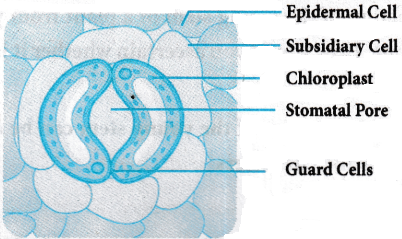
The stomatal pore is guarded by two kidney-shaped guard cells. Name the epidermal cells surrounding the guard cells. How does a guard cell differ from an epidermal cell? Use a diagram to illustrate your answer.
Answer:

    • The stomatal pore is guarded by two kidney-shaped guard cells.
    • These guard cells are surrounded by the epidermal cells known as subsidiary cells or accessory cells.
Guard cells Epidermal cells
1. The guard cells are smaller in size, bean-shaped or dumbbell-shaped. 1. They are barrel-shaped.
2. Chloroplasts are present. 2. Chloroplasts are absent.

Anatomy of Flowering Plants Questions and Answers AP Inter 1st Year Botany Chapter 4 1

Question 4.
Name the three basic tissue systems in the flowering plants. Give the tissue names under each system.
Answer:
The three basic tissue systems of flowering plants are
a) Epidermal tissue system
b) Ground tissue system
c) Vascular tissue system

a) Epidermal tissue system:
It forms the outermost covering of the whole plant body and comprises Epidermis, Stomata, Epidermal appendages like the trichomes and root hairs.

b) Ground tissue system :
All tissue, except epidermis and vascular bundles constitute the ground tissues. It consists of hypodermis, general cortex, endodermis, pericycle, medulla and medullary rays.

c) Vascular tissue system:

  • It consists of complex tissues like phloem and xylem, arranged in the form of bundles.
  • Vascular Bundles are of Radial (Roots), Collateral (Stem) type.

VI. Long Answer Questions

Question 1.
Describe the internal structure of dorsiventral leaf with the help of labelled diagram.
Answer:
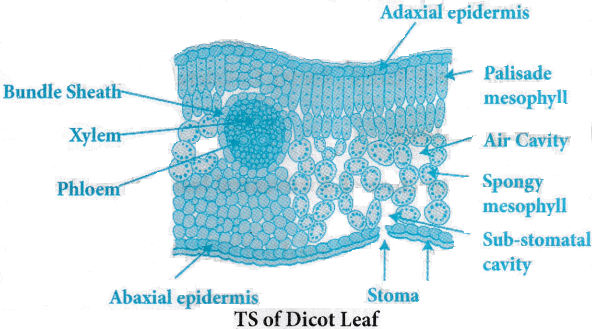
The transverse section of dorsiventral leaf (dicot leaf) shows three parts, namely
I) Epidermis,
II) Mesophyll,
III) Vascular bundle

I) Epidermis:

A single layered epidermis is present towards the lower (abaxial) and upper side (adaxial) of the leaf called lower epidermis and upper epidermis respectively.
Both adaxial and abaxial epidermis of leaves covered by a cuticle.
Stomata are more towards lower or abaxial epidermis.

II) Mesophyll:
Tissue present between upper and lower epidermis is called Mesophyll. It is of two kinds,
a) Palisade parenchyma and
b) Spongy parenchyma.

a) Palisade parenchyma:

  • It is present below the upper epidermis that is towards the adaxial surface.
  • It shows elongated cells which are arranged vertically and parallel to each other.

b) Spongy parenchyma:

  • Part of the mesophyll towards the lower epidermis or abaxial surface is called spongy parenchyma.
  • Spongy parenchyma is situated below the palisade cells and extends to the lower epidermis.
  • It is made up of oval or round shaped cells with large intercellular spaces.

III) Vascular bundle :

  • Vascular bundles are extended in the mesophyll in the form of vein and the midrib.
  • The vascular bundles are conjoint, collateral and closed.
  • The xylem is present towards the upper side (adaxial) and phloem is paresent towards lower epidermis (abaxial) in each vascular bundle.
  • The vascular bundle is surrounded by a layer of thick-walled cells called bundle sheath. The cells are arranged compactly.

Anatomy of Flowering Plants Questions and Answers AP Inter 1st Year Botany Chapter 4 2

Question 2.
What is a stomatal apparatus? Explain the structure of stomata with a labelled diagram.
Answer:

  • Stomata are tiny pores in the epidermis of leaves and other plant parts.
  • The stomata consist of minute pores called stoma surrounded by a pair of guard cells.
  • Stomata, open and close according to the turgidity of guard cells.
  • The cell wall surrounding the pore is tough and flexible.
  • Guard cells are bean-shaped and contain chloroplasts.
  • They contain chlorophyll and capture light energy.
  • The Guard cells are surrounded by subsidiary cells.
  • They are the accessory cells to guard cells and are found in the epidermis of plants.
  • The stomatal aperture, guard cells and the surrounding subsidiary cells are together called stomatal apparatus.

Anatomy of Flowering Plants Questions and Answers AP Inter 1st Year Botany Chapter 4 1

Question 3.
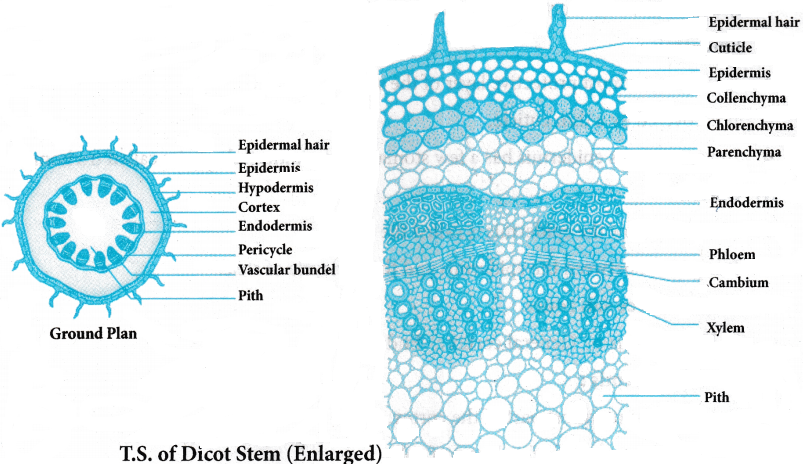
Describe the T.S. of a dicot stem with the help of neat labelled diagram ?
Answer:
The transverse section of the young primary dicot stem is differentiated into
I) Epidermis
II) Cortex
III) Stele

I) Epidermis:

  • It is the outermost protective layer of the stem.
  • It is covered by a thin cuticle.
  • In young stems epidermis has a few stomata and multicellular hairs called trichomes.

II) Cortex:

  • The part below the epidermis is called the cortex.
  • It is present between the epidermis and the pericycle of stele.
  • It shows three sub zones.
    • a) Hypodermis
    • b) General cortex
    • c) Endodermis

a) Hypodermis:

  • It is the outermost part of the cortex.
  • It is composed of a few layers of collenchymatous cells.
  • It provides mechanical strength (tensile) to the young stem.

b) General Cortex:

  • It is present between the hypodermis and endodermis.
  • It is composed of thin walled, round parenchyma cells with intercellular spaces.

c) Endodermis:

  • The innermost layer of the cortex is called endodermis.
  • Due to storage of large quantities of starch in the cells of endodermis, it is also called as “Starch sheath”.

III) Stele:

  • The central cylinder concerned with conduction of water and minerals is called stele.
  • It is differentiated into
    a) Pericycle
    b) vascular bundles
    c) Medulla (or) Pith.

a) Pericycle:

  • It is the outermost layer of the stele.
  • It is present in the form of semilunar patches of sclerenchyma in between endodermis and phloem of vascular bundles.

b) Vascular bundles:

  • A large number of vascular bundles are arranged in the form of a ring.
  • This arrangement is called Eustele.
  • Vascular bundles are conjoint, collateral, endarch and open type.

Anatomy of Flowering Plants Questions and Answers AP Inter 1st Year Botany Chapter 4 3

c) Medulla or Pith:
It is composed of a large number of rounded parenchymatous cells having intercellular spaces.

d) Medullary rays:
In between the vascular bundles there are a few layers of radially placed living parenchyma cells, which constitute medullary rays.

Question 4.
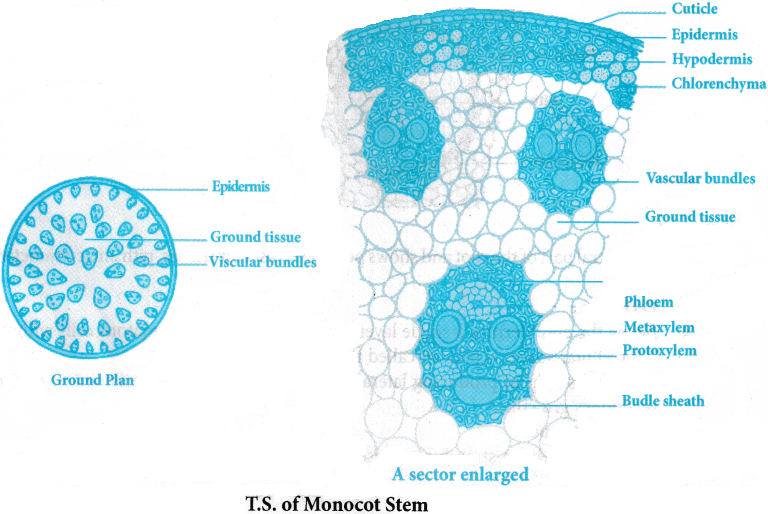
Describe the T.S. of a monocot stem with the help of labelled diagram ?
Answer:
T.S of young monocotyledonous stem shows Epidermis, hypodermis, ground tissue and vascular bundles.

A) Epidermis:

  • The outermost layer composed of compactly arranged cells.
  • It is covered by a thin layer of cuticle.
  • Trichomes are absent.

B) Hypodermis:

Below the epidermis, sclerenchymatous hypodermis is present, which gives mechanical support to the stem.

C) Ground tissue:

  • Below the hypodermis, parenchymatous ground tissue is present with intercellular spaces.
  • Endodermis and pericycle are absent.

D) Vascular bundles:

  • A large number of vascular bundles are scattered in the ground tissue so called atactostele.
  • Each vascular bundle is Collateral, conjoint, endarch and closed type.
  • Each vascular bundle is surrounded by sclerenchymatous bundle sheath.
  • The phloem parenchyma is absent and water containing cavities are present.
  • Medulla and medullary rays are absent.

Anatomy of Flowering Plants Questions and Answers AP Inter 1st Year Botany Chapter 4 4

Question 5.
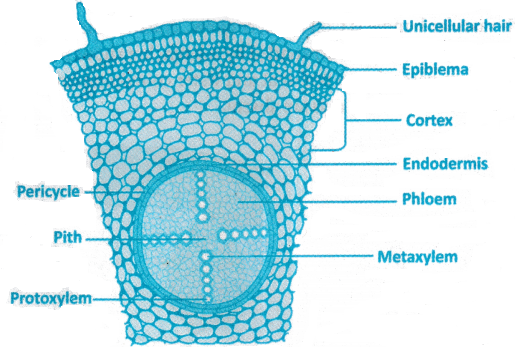
Describe the internal structure of a dicot root with the help of labelled diagram ?
Answer:
The internal structure of the dicot root shows Epidermis, cortex and stele.

A) Epidermis:

  • The outermost layer is made up of compactly arranged elongated cells called Epiblema.
  • Many of the cells produce unicellular root hairs which help in absorption of water from the soil.

B) Cortex:

  • It is present in between the epidermis and the stele.
  • Below the epidermis, several layered parenchymatous general cortex is present.
  • The cells are thin walled living.

Endodermis:

  • The innermost layer of the cortex is composed of a single layer of barrel shaped cells.
  • The radial and transverse walls are wrapped by ligno-suberised bands called casparian thickenings.

Anatomy of Flowering Plants Questions and Answers AP Inter 1st Year Botany Chapter 4 5

C) Stele:
It is the central part of the root and shows pericycle, vascular tissues, pith and conjunctive tissue.

i) Pericycle:

  • Below the endodermis, a single layer of thin walled parenchymatous cells without intercellular spaces is present called the pericycle.
  • These cells help in producing lateral roots and also become meristematic during secondary growth.

ii) Vascular tissues:

  • Xylem and phloem strands are present on different radii so called radial vascular bundles.
  • The xylem is in exarch type i.e.,protoxylem is towards the periphery and metaxylem is towards the centre.
  • The xylem and the phloem are present in two to four patches so it is in Diarch to tetrarch condition.

iii) Conjunctive tissue:

  • The parenchymatous tissue present between xylem and the phloem is called conjunctive tissue.
  • It becomes meristematic during secondary growth.

D) Pith:
It is small, made up of parenchyma tissue or absent.

I. Multiple Choice Questions

Question 1.
Which of the following is not a component of stomatal apparatus?
1. Guard cell
2. Subsidiary cell
3. Trichome
4. Stomatal aperture
Answer:
3. Trichome

Question 2.
When xylem and phloem are jointly situated along the same radius in a vascular bundle it is called
1. Closed
2. Open
3. Radial
4. Conjoint
Answer:
4. Conjoint

Question 3.
A plant material which shows small pith, two to four xylem patches alternating with phloem.
1. Dicot root
2. Monocot root
3. Dicopt stem
4. Monocot stem
Answer:
1. Dicot root

Question 4.
The hypodermis is collenchymatous in
1. Monocot stem
2. Dicot stem
3. Dicot root
4. Both dicot stem and monocot root
Answer:
2. Dicot stem

Question 5.
Phloem parenchyma is absent in
1. Monocot stem
2. Dicot stem
3. Dicot root
4. Both dicot stem and monocot root
Answer:
1. Monocot stem

Question 6.
Casparian strips are made up of water impermeable substance ___________
1. Inulin
2. Suberin
3. Chitin
4. Cutin
Answer:
2. Suberin

Question 7.
In a dicot root conjunctive tissue is generally present between
1. Xylem and phloem
2. Xylem and pericycle
3. Phloem and pericycle
4. Endodermis and pericycle
Answer:
1. Xylem and phloem

Question 8.
Open vascular bundles are seen in
1. Dicot root
2. Monocot root
3. Dicot stem
4. Monocot stem
Answer:
3. Dicot stem

Question 9.
The elongated parenchyma cells arranged vertically and parallel to each other
1. Hypodermis in dicot stem
2. Palisade tissue in dicot leaf
3. Hypodermis in monocot stem
4. Bulliform cells of monocot leaf
Answer:
2. Palisade tissue in dicot leaf

Question 10.
Water containing cavities in the vascular bundles is a characteristic of
1. Dicot leaf
2. Dorsiventral leaf
3. Dicot stem
4. Monocot stem
Answer:
4. Monocot stem

II. Fill in the Blanks

Question 1.
The special cells that surround the guard cells in the stomatal apparatus are ___________
Answer:
Subsidiary cells

Question 2.
Simple tissues like parenchyma, collenchyma and sclerenchyma are largely present in the ___________ tissue system.
Answer:
Ground

Question 3.
The tissue present between xylem and phloem in a dicot stem is ___________.
Answer:
Cambium

Question 4.
In the anatomy of a dicot or monocot root all the tissues on the inner side of the endodermis such as pericycle, vascular bundles and pith constitute the ___________.
Answer:
Stele

Question 5.
The innermost layer of cortex is ___________
Answer:
Endodermis

Question 6.
The tissue between upper and lower epidermis in a leaf is ___________.
Answer:
Mesophyll

Question 7.
The large colourless cells in the adaxial surface of monocot leaf are ___________.
Answer:
Bulliform cells

Question 8.
The conjoint vascular bundles usually have the phloem located only on the ___________ side of Xylem.
Answer:
Outer

Question 9.
Mechanical strength to the young dicot stem is provided by hypodermis which is made up of ___________ cells.
Answer:
Collenchymatous

Question 10.
The cells of ___________ in dicot stem are rich in starch grains, hence this layer is also referred to as starch sheath.
Answer:
Endodermis

III One Word Answer Questions

Question 1.
To which tissue system does the roothair and trichomes belong?
Answer:
Epidermal tissue system

Question 2.
What name is given to the vascular bundles of roots where the xylem and phloem are arranged in an alternate manner along different radii?
Answer:
Radial vascular bundles / Alternate

Question 3.
What is the region between epidermis and stele in a dicot stem called?
Answer:
Cortex

Question 4.
Which cells of a grass leaf help in curling to minimise water loss?
Answer:
Bulliform cells

Question 5.
What do you call the loosely arranged tissue situated below the palisade in a dicot leaf?
Answer:
Spongy parenchyma

Question 6.
In which vegetative part (among stem, root and leaf) of a plant body cuticle is absent?
Answer:
Roots

Question 7.
With respect to the presence of cambium, what is the name given to the vascular bundle in a dicot stem?
Answer:
Open vascular bundle

Question 8.
Which is the part in the dicot stem with a large number of rounded, parenchymatous cells with intercellular spaces in the stele?
Answer:
Pith or medulla

Question 9.
What is the shape of sclerenchymatous patches of pericycle in a dicot stem?
Answer:
Semilunar

Question 10.
In a dorsiventral leaf, which epidermis bears more stomata?
Answer:
Lower (Abaxial) epidermis

AP Inter 1st Year Botany Study Material

Morphology of Flowering Plants Questions and Answers AP Inter 1st Year Botany Chapter 3

AP Inter 1st Year Botany 3rd Lesson Morphology of Flowering Plants Questions and Answers

IV. Very Short Answer Questions

Question 1.
Differentiate fibrous roots from adventitious roots.
Answer:

Fibrous roots Adventitious roots
A bunch of roots that originate from the base of the stem are called fibrous roots. Roots that originate from any other part of the plant other than the radicle are called adventitious roots.
Ex: Monocots Ex: Banyan tree

Question 2.
What is meant by pulvinus leaf base ? In members of which angiospermic family do you find them?
Answer:

  • Swollen leaf base is called a pulvinus leaf base.
  • It is found in plants of Leguminosae- (Fabaceae).

Question 3.
How do dicots differ from monocots with respect to venation?
Answer:

  • In Dicots- reticulate venation is seen (Net like arrangement of Veins and Veinlets).
  • In monocots- parallel venation is seen (Parallel arrangement of Veins).

Question 4.
How is a pinnately compound leaf different from a palmately compound leaf ? Explain with one example each.
Answer:

Pinnate compound leaf Palmate compound leaf
Leaflets are arranged on either side of the petiole(Rachis).  Leaflets are arranged at the tip of the petiole.
Ex : Neem Ex : Bombax

Question 5.
Differentiate between Racemose and Cymose inflorescence.
Answer:

Racemose Cymose
1. Peduncle grows indefinitely. 1. Peduncle grows definitely.
2. Flowers are arranged in acropetal manner. 2. Flowers are arranged in basipetal manner.

Question 6.
Differentiate actinomorphic from zygomorphic flowers.
Answer:

Actinomorphic flower Zygomorphic flower
A flower that can be cut into two equal halves in any vertical plane. A flower that can be cut into two equal halves in one longitudinal plane.
Ex: Hibiscus, Datura Ex: Pea, Bean

Question 7.
How do the petals in a pea plant are arranged ? What is such a type of arrangement called?
Answer:

  • In the flower of the pea plant there are five, unequal petals, the largest standard petal / vexillum, overlaps the two lateral wing petals / alae.
  • Wing petals in turn overlap two smallest anterior keel petals/carina.
  • This type of corolla is called papilionaceous corolla.
  • This type of arrangement of petals is called vexillary or descendingly imbricate aestivation.

Question 8.
What is meant by epipetalous condition? Give an example.
Answer:
Stamens are united with petals which is called epipetalous condition.
Ex: Datura, Solarium

Question 9.
Differentiate between apocarpous and syncarpous ovary.
Answer:

Apocarpous ovary Syncarpous ovary
All the carpels are free on the thalamus. All the carpels are fused on the thalamus.
Ex. Lotus, Rose Ex. Datura, Hibiscus

Question 10.
Define placentation.What type of placentation is found in Dianthus?
Answer:

  • The arrangement of ovules within the ovary is known as placentation.
  • In “Dianthus” the placentation is “free central”.

Question 11.
What is meant by parthenocarpic fruit?
Answer:

  • The fruit that is formed from the ovary without fertilization is called parthenocarpic fruit.
  • Such fruits are seedless and commercially useful in juice industries.
    Ex. Banana, Grapes.

Question 12.
What is the type of fruit found in mango ? How does it differ from that of coconut ?
Answer:

  • In Mango, the fruit is known as Drupe.
  • In Mango, the middle mesocarp is fleshy and edible.
  • In coconut, the fruit is drupe, mesocarp is fibrous and not edible.
  • In coconut, endosperm is edible.

Question 13.
What is meant by scutellum? In which type of seeds is it present?
Answer:

  • Large shield shaped cotyledon is called scutellum.
  • It is seen in monocot seeds.

Question 14.
Define with examples endospermic and non-endospermic seeds.
Answer:
Endospermic seeds or albuminous seeds:
The embryo doesn’t consume the entire endosperm. The seeds with endosperm are called endospermic seeds.
Ex :Maize, Wheat, Rice, Castor and Coconut.

Non-endospermic seeds or exalbuminous seeds or non-albuminous seeds:
The embryo consumes the entire endosperm during development. Seeds without endosperm are called non-endospermic seeds.
Ex: Pea, Gram and Beans

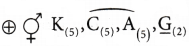
Question 15.
Write the floral formula of the Solatium plant.
Answer:
Ebr, Ebrl, Morphology of Flowering Plants Questions and Answers AP Inter 1st Year Botany Chapter 3 1

Question 16.
Give the technical description of ovary in Solanum nigrum.
Answer:

  • In Solanum nigrum ovary is bicarpellary, syncarpous, bilocular, superior ovary, with many ovules on swollen axile placentation.
  • Style terminal, stigma capitate.
  • Carpels are arranged obliquely at 45°.

V. Short Answer Questions

Question 1.
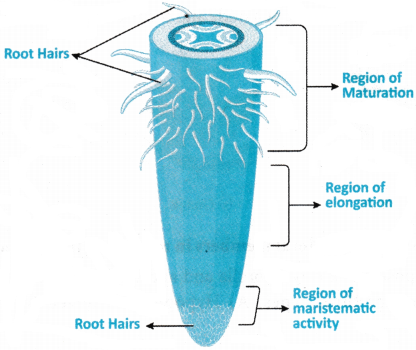
Explain different regions of root with neat labelled diagram.
Answer:
A typical young root shows 4 regions.

  1. Region of root cap
  2. Region of meristematic activity
  3. Region of elongation
  4. Region of maturation

1. Region of root cap :

  • The root is covered at the apex by a thimble-like structure called the root cap.
  • It protects the apex of the root as it makes way through the soil.

Morphology of Flowering Plants Questions and Answers AP Inter 1st Year Botany Chapter 3 2

2. Region of meristematic activity:

  • The cells of this region are very small, thin walled and with dense protoplasm.
  • These cells divide repeatedly by mitosis and produce daughter cells.

3. Region of elongation :

  • Cells proximal to the region of the meristematic zone undergo rapid elongation and enlargement.
  • This region is responsible for the growth of the root in length.

4. Region of maturation :

  • This region is proximal to the region of elongation.
  • Cells in the elongation zone gradually differentiate and mature.
  • From this region some of the epidermal cells form very fine and delicate thread like structures called “root hairs”.
  • Root hairs absorb water and minerals from the soil.

Question 2.
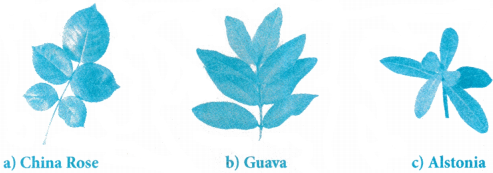
Explain different types of phyllotaxy with examples.
Answer:
The pattern of arrangement of leaves on the stem or branches is called phyllotaxy.
Phyllotaxy is usually 3 types based on the number of leaves at each node.
They are
A) Alternate phyllotaxy,
B) Opposite Phyllotaxy, and
C) Whorled Phyllotaxy

A) Alternate phyllotaxy:
A single leaf arises at each node in an alternate manner.
Ex: Hibiscus rosa-sinensis (China rose), Mustard, Sunflower.

B) Opposite phyllotaxy:

  • A pair of leaves arise at each node.
  • They lie opposite to each other.
    Ex: Calotropis, Guava.

C) Whorled phyllotaxy:
More than two leaves arise at a node and form a whorl.
Ex: Alstonia.

Morphology of Flowering Plants Questions and Answers AP Inter 1st Year Botany Chapter 3 3

Question 3.
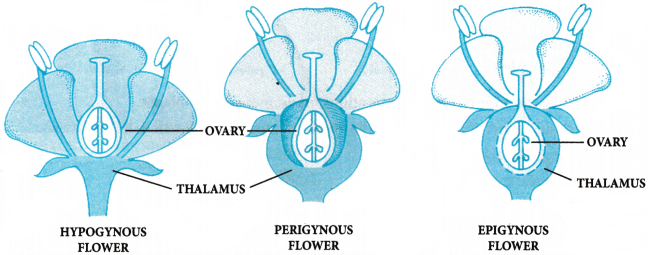
Describe the arrangement of floral members in relation to their insertion on thalamus.
Answer:
Based on the position of calyx, corolla and androecium on thalamus with respect to ovary; flowers are three types.
A) Hypogynous flower,
B) Perigynous flower
C) Epigynous flower.

A) Hypogynous flower:

  • Thalamus is convex or cone-shaped.
  • Gynoecium occupies the highest position on the thalamus.
  • Other floral parts of the flower are situated below the gynoecium.
  • Position of the ovary is superior.
    Ex: Mustard, China rose, Brinjal.

B) Perigynous flower :

  • Thalamus is saucer or shallow cup-shaped.
  • Gynoecium is situated in the centre of the thalamus.
  • Other floral parts of the flower are located on the rim of the thalamus almost at the same level.
  • Position of the ovary is half inferior / half superior.
    Ex: Plum, Rose, Peach.

C) Epigynous flower:

  • Thalamus is deep cup shaped.
  • The margins of the thalamus grow upward enclosing the ovary completely.
  • Thalamus gets fused. with the ovary wall.
  • Other floral parts of the flower arise above the ovary from the margin of the thalamus.
  • Position of the ovary is inferior.
    Ex : Guava, Cucumber, Ray and disc florets of sunflower.

Morphology of Flowering Plants Questions and Answers AP Inter 1st Year Botany Chapter 3 4

Question 4.
The flowers of many angiospermic plants which show sepals and petals, differ with respect to the arrangement of sepals and petals in respective whorls. Explain.
Answer:
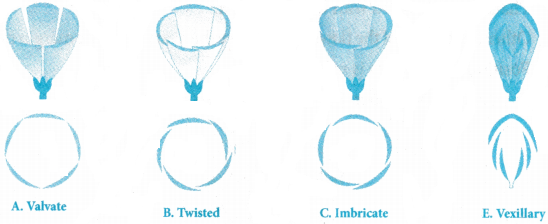
The mode of arrangement of sepals/ petals in a floral bud is known as aestivation.
It is of four types.
A) Valvate
B) Twisted
C) Imbricate
D) Vexillary

A) Valvate:
Sepals or petals in a whorl just touch one another at the margin without overlapping.
Ex: Calotropis.

B) Twisted:
One margin of the appendage (sepal/ petal) overlaps that of the next one.
Ex: China rose, Lady’s finger, Cotton.

C) Imbricate:
The margins of sepals/ petals overlap one another but not in any particular direction.
Ex: Cassia, Gulmohur.

D) Vexillary: (Papilionaceous / descendingly imbricate aestivation).

  • It is commonly found in members of Fabaceae.
  • Corolla has 5 petals.
  • Largest standard petal overlaps the two lateral wing petals.
  • Wing petals in turn overlap the two smallest anterior keel petals.
    Ex: Pea, Bean.

Morphology of Flowering Plants Questions and Answers AP Inter 1st Year Botany Chapter 3 5

Question 5.
Describe any four types of placentations found in flowering plants.
Answer:
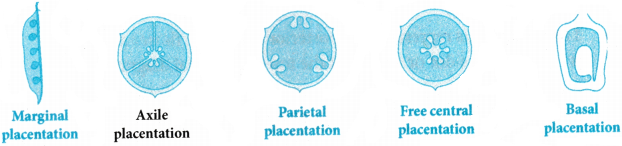
The arrangement of ovules within the ovary is known as placentation. It is of 5 types.
A) Marginal placentation
B) Parietal placentation
C) Axile placentation
D) Basal placentation
E) Free central placentation

A) Marginal placentation:

  • The placenta forms a ridge along the ventral suture of the ovary.
  • Ovules are borne on this ridge forming two rows.
    Ex: Pea.

B) Axile placentation:
Placenta is axial and the ovules are attached to it in a multi locular ovary.
Ex: China rose, Tomato, Lemon.

C) Parietal placentation:

  • Ovules develop on the inner wall of the ovary or on the peripheral parts.
  • Ovary is one chambered (unilocular). But it becomes two chambered due to formation of false septum.
    Ex: Mustard, Argemone.

D) Free central placentation :
Ovules are borne on the central columnar axis from the base without septum
Ex: Dianthns, Primrose.

E) Basal placentation:
Placenta develops at the base of the bvary, single ovule is attached to the placenta.
Ex: Sunflower, Marigold.

Morphology of Flowering Plants Questions and Answers AP Inter 1st Year Botany Chapter 3 6

Question 6.
Write a brief note on semi technical description of a typical flowering plant.
Answer:

  • The plant is described beginning with its habit, habitat, vegetative characters (root, stem and leaves) and then floral characters (inflorescence, flower and its parts) followed by fruit.
  • After describing various parts of a plant, a floral diagram and floral formula are presented.
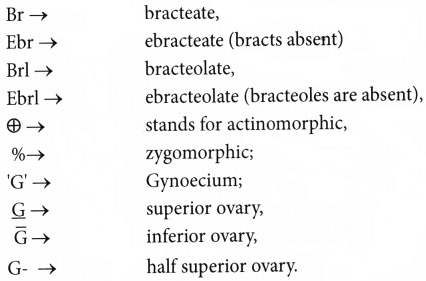
  • The floral formula is represented by some symbols of floral parts.
  • In the floral formula.

Morphology of Flowering Plants Questions and Answers AP Inter 1st Year Botany Chapter 3 7

  • Floral formula also indicates the number of free or united (within brackets) members of the corresponding whorl as subscript of the respective symbol.
  • It also shows cohesion (union among similar members) and adhesion (union between dissimilar members).
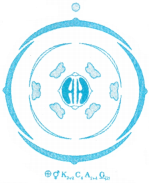
  • A floral diagram provides information about the number of parts of a flower, their arrangement and the relation they have with one another.
  • The mother axis represents the posterior side of the flower and is indicated as a dot or a circle at the top of the floral diagram.
  • Calyx, corolla, androecium and gynoecium are drawn in successive whorls, calyx being the outermost and the gynoecium being in the centre represented by a diagram of T.S. of ovary.
  • The bract represents the anterior side of the flower and is indicated at the bottom of the floral diagram.

Question 7.
Give an account of the floral diagram.
Answer:

  • A floral diagram provides information about the number of parts of a flower, their arrangement and the relation they have with one another.
  • The mother axis represents the posterior side of the flower and is indicated as a dot or a circle at the top of the floral diagram.
  • Calyx, corolla, androecium and gynoecium are drawn in successive whorls, calyx being the outermost and the gynoecium being in the centre.
  • The bract represents the anterior side of the flower and is indicated at the bottom of the floral diagram.

Morphology of Flowering Plants Questions and Answers AP Inter 1st Year Botany Chapter 3 8

Question 8.
Draw the labelled diagram of the following.
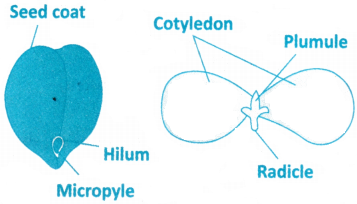
i) Gram seed
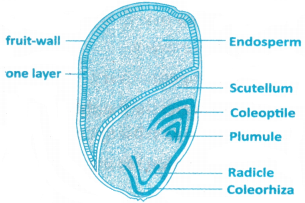
ii) V.S. of maize seed
Answer:
i) Gram seed

Morphology of Flowering Plants Questions and Answers AP Inter 1st Year Botany Chapter 3 9

ii) V.S. of maize seed

Morphology of Flowering Plants Questions and Answers AP Inter 1st Year Botany Chapter 3 10

VI. Long Answer Questions

Question 1.
What is a flower ? Describe the parts of a typical angiosperm flower.
Answer:
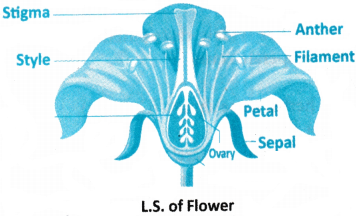
A flower is a reproductive unit of an angiosperm plant that performs sexual reproduction. It is a modified stem with a condensed axis. A typical flower has four different kinds of whorls arranged successively on the swollen end of the pedicel called thalamus or receptacle. The parts of a flower include : Calyx, Corolla, Androecium and Gynoecium. Calyx and corolla are called accessory organs whereas Androecium and Gynoecium are called reproductive organs.

1. Calyx:

  • It is the outermost whorl of a flower. It is made up of units called sepals.
  • It is generally green in colour, leaf-like and protects the flower in the bud condition.
  • The calyx may be gamosepalous(Sepals united) or polysepalous (Sepals free).

2) Corolla:

  • It is the whorl present inner to the Calyx.
  • It consists of petals. The petals are brightly coloured to attract the insects for pollination.
  • It may be gamopetalous (Petals United) or polypetalous (Petals free).

Morphology of Flowering Plants Questions and Answers AP Inter 1st Year Botany Chapter 3 11

3. Androecium:

  • It is the whorl present next to the corolla.
  • The androecium mainly consists of stamens which are the male reproductive unit of a flower.
  • A stamen is composed of two parts i.e. anther and filament.
  • The anther is the bilobed structure and each lobe has two chambers called pollen sacs.
  • The stalk of the stamen is called a filament. Inside the anther, pollen grains are formed.
  • A sterile stamen is called staminode.
  • Stamens of a flower may be united with other floral parts.
  • When stamens are attached to petals, they are Epipetalous (Brinjal), when attached to the perianth- they are called Epiphyllous (Lily).
  • The stamens in a flower may be free (Polyandrous) or may be united among themselves.
  • They may be Monadelphous- the filaments of all the stamens may be united into Diadelphous- into two bundles (Pea)
  • Polyadelphous- into more than two bundles (Citrus).
  • In Salvia, didynamous stamens are seen meaning two longer and two shorter stamens in a flower.
  • In mustard- Tetradynamous stamens are seen, meaning four are longer and two are shorter.

4. Gynoecium:

  • The innermost whorl and female reproductive part of a flower is called gynoecium.
  • It consists of carpels. A carpel is composed of three parts: stigma, style and ovary.
  • Ovary is the enlarged basal part on which lies the style.
  • The style connects the ovary to the stigma.
  • The stigma is the receptive surface for pollen grains.
  • Each ovary bears one or more ovules attached to a flattened cushion like placenta.
  • When more than one carpel is present, they may be free (Lotus, Rose) and are called apocarpous or fused they are syncarpous (Mustard, Tomato).
  • After fertilization, the ovary develops into fruit and ovules develop into seeds.

Question 2.
Write about the key characteristics of Solanaceae ?
Answer:

  • It is commonly called the ‘potato family and includes about 3200 species belonging to 85 genera.
  • Members of this family are widely distributed in mesophytic habitats of tropical, subtropical and even temperate zones.

Vegetative Characters:

  • Habit: Plants mostly herbs, some shrubs (Cestrum).
  • Root system : Tap root system.
  • Stem : Aerial, erect, herbaceous or rarely woody, cylindrical, solid or hollow, hairy or glabrous. Underground stem is tuber in Potato.
  • Leaves: Alternate phyllotaxy, exstipulate, petiolate, simple or rarely pinnately compound leaf with reticulate venation.
  • Inflorescence : Cymose, axillary as in Solanum.
  • Flower : Actinomorphic, bisexual, pentamerous, hypogynous.
  • Calyx: Sepals five, gamosepalous, persistent, valvate aestivation.
  • Corolla : Petals five, gamopetalous, valvate aestivation.
  • Androecium : Stamens five, epipetalous

Gynoecium : Bicarpellary, syncarpous, bilocular, superior ovary, placenta is swollen with many ovules on axile placentation, style terminal, stigma capitate. Carpels are arranged obliquely at 45°.

  • Fruit: Berry (Capsicum, Solanum, Lycopersicon) or capsule (Datura, Nicotiana).
  • Seed : Many, endospermic, dicotyledonous
  • Floral Formula : Ebr, Ebrl, Morphology of Flowering Plants Questions and Answers AP Inter 1st Year Botany Chapter 3 1

I. Multiple Choice Questions

Question 1.
The type of root system commonly found in dicot plants is
1. Tap root system
2. Fibrous root system
3. Adventitious root system
4. Rhizoids
Answer:
1. Tap root system

Question 2.
A few millimeters above the root cap, what region can be found
1. Elongation
2. Maturation
3. Meristematic activity
4. Root hairs
Answer:
3. Meristematic activity

Question 3.
The stem develops from
1. Hypocotyl
3. Epicotyl
3. Radicle
4. Plumule
Answer:
4. Plumule

Question 4.
Arrangement of flowers on floral axis is called
1. Placentation
2. Phyllotaxy
3. Inflorescence
4. Aestivation
Answer:
3. Inflorescence

Question 5.
In a cymose inflorescence, the main axis
1. Terminates with a flower
2. Has unlimited growth but lateral branches ends with a flower
3. Has limited growth, do not ends with a flower
4. Shows acropetal arrangement of flowers
Answer:
1. Terminates with a flower

Question 6.
Arrangement of ovules within the ovary is known as
1. Aestivation
2. Placentation
3. Cohesion
4. Adhesion
Answer:
2. Placentation

Question 7.
The basal bulged part of the carpel is
1. Filament
2. Ovary
3. Style
4. Stigma
Answer:
2. Ovary

Question 8.
Name the aestivation where the standard petal overlaps the two wing petals, which then overlap the two smaller keel petals.
1. Twisted
2. Valvate
3. Vexillary
4. Alternate
Answer:
3. Vexillary

Question 9.
The main characteristic feature of a drupe.
1. Stony mesocarp
2. Stony endocarp
3. Fleshy seed coat
4. Stony pericarp
Answer:
2. Stony endocarp

Question 10.
After fertilization, ovule develops into
1. Seed
2.Fruit
3. Flower
4. Root
Answer:
1. Seed

Question 11.
Non-endospermic monocot seed
1. Rice
2.Maize
3. Wheat
4. Orchid
Answer:
4. Orchid

Question 12.
The placentation in Solanaceae family members
1. Parietal placentation
2.Basal placentation
3. Marginal placentation
4. Axile placentation
Answer:
4. Axile placentation

Question 13.
Persistent calyx can be seen in
1. Pea
2. Brinjal
3. Lily
4. Brassica
Answer:
2. Brinjal

II. Fill In the Blanks

Question 1.
Radicle develop into ____________ of the plant.
Answer:
Primary Root system

Question 2.
Reticulate venation is a characteristic feature of ____________ Plants.
Answer:
Dicots

Question 3.
The flowers in racemose inflorescence are arranged in ____________ succession.
Answer:
Acropetal

Question 4.
The first and outermost whorl of a flower is ____________.
Answer:
Calyx

Question 5.
Epiphyllous conditions can be seen in ____________.
Answer:
Lily
Question 6.
The function of stigma is to receive ____________.
Answer:
Pollen grains

Question 7.
The sheath enclosing the radicle in a monocot seed is called ____________.
Answer:
Coleorhiza

Question 8.
Seeds with an endosperm are called ____________ seeds.
Answer:
Endospermic / Albuminous

Question 9.
The ovary of Solanum nigrum is bicarpellary, syncarpous and ____________ locular.
Answer:
Bi

Question 10.
In semi-technical description of a flower G stands for ____________ ovary.
Answer:
Superior

III. One Word Answer Questions

Question 1.
What is the role of root hair?
Answer:
Absorption of water

Question 2.
What is the swollen leaf base in leguminous plants called?
Answer:
Pulvinus

Question 3.
What is the arrangement of veins in the leaf called?
Answer:
Venation

Question 4.
What type of phyllotaxy is seen in Alstonia?
Answer:
Cyclic or whorled

Question 5.
What is the flower with both androecium and gynoecium called?
Answer:
Bisexual

Question 6.
In which type of flower does the gynoecium occupy the highest position?
Answer:
Hypogynous

Question 7.
What is the function of sepals in the bud stage?
Answer:
Protection of inner floral leaves

Question 8.
In vexillary aestivation, what is the largest petal called?
Answer:
Standard or vexillum

Question 9.
What is a sterile stamen called?
Answer:
Staminode

Question 10.
What connects the ovary to the stigma?
Answer:
Style

Question 11.
What is the middle fleshy part of the pericarp in mango fruit called?
Answer:
Mesocarp

Question 12.
How many cotyledons are present in the embryo of wheat and maize?
Answer:
One

Question 13.
Name the two layers of the dicot seed coat?
Answer:
Testa and tegmen

Question 14.
What is the large shield-shaped cotyledon in grass seed called?
Answer:
Scutellum

Question 15.
In the floral formula, “Br”stands for?
Answer:
Bracteate

AP Inter 1st Year Botany Study Material

Plant Kingdom Questions and Answers AP Inter 1st Year Botany Chapter 2

AP Inter 1st Year Botany 2nd Lesson Plant Kingdom Questions and Answers

IV. Very Short Answer Questions

Question 1.
Differentiate between antheridium and archegonium.
Answer:

Antheridium Archegonium
1. It is the male sex organ 1. It is the female sex organ
2. It is club shaped 2. It is flask shaped
3. It produce male gametes or antherozoids 3. It produces eggs

Question 2.
What are the two stages found in the gametophyte of mosses? Mention the structures from which these two stages develop.
Answer:

  • The gametophyte of a moss consists of two stages.
    • Juvenile, green, filamentous, protonema
    • The adult leafy gametophore.
  • Protonema develops by the germination of spores.
  • Gametophores develop from the buds on protonema.

Question 3.
Name the stored food materials found in Phaeophyceae and Rhodophyceae.
Answer:

  • In Phaeophyceae – Laminarin or mannitol.
  • In Rhodophyceae – Floridian starch

Question 4.
Name the pigments responsible for brown colour of Phaeophyceae and red colour of Rhodophyceae.
Answer:

  • The brown colour of Phaeophyceae is due to fucoxanthin. (a xanthophyll)
  • Red colour of Rhodophyceae is due to r-phycoerythrin. (a phycobilin)

Question 5.
Name different methods of vegetative reproduction in Bryophytes.
Answer:

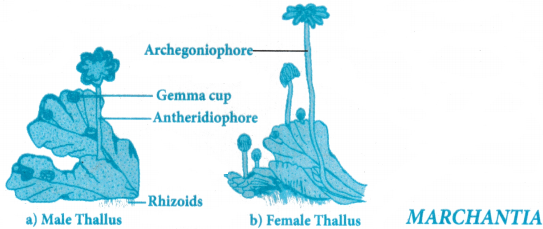
  • In liverworts, vegetative reproduction takes place by special structures called gemmae.
  • They develop in small receptacles called gemma cups.
    Ex. Marchantia
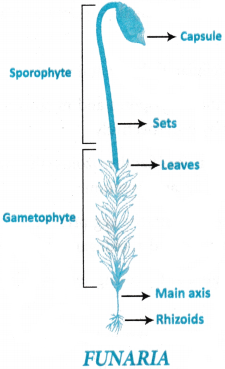
  • In mosses, vegetative reproduction is carried out by fragmentation, gemmae and budding.
    Ex. Funaria.

Question 6.
Name the composite structure in which nucellus is protected by envelops in Gymno- sperms.
Answer:
The Ovule

Question 7.
Name the Gymnosperms which contain mycorrhizae and coralloid roots respectively.
Answer:

  • Pinus is the gymnosperm which contains mycorrhiza.
  • Cycas is the gymnosperm which contains coralloid roots.

Question 8.
Name the four classes of Pteridophyta with one example each.
Answer:

  • Psilopsida – Psilotum
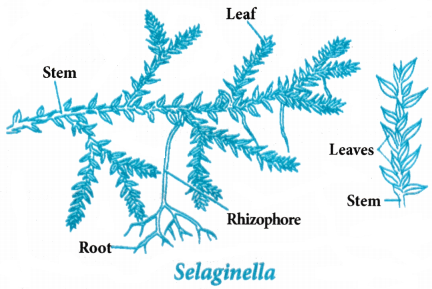
  • Lycopsida – Selaginella, Lycopodium
  • Sphenopsida – Equisetum
  • Pteropsida – Pteris,’Dryopteris

Question 9.
What are the first organisms to colonise rocks? Give the generic name of the moss which provides peat.
Answer:

  • Mosses along with Lichens are the first organisms to colonise rocks.
  • Sphagnum, a moss provides peat that is used as a fuel.

Question 10.
Why are Bryophytes called the Amphibians of Plant Kingdom ?
Answer:
Bryophytes are called amphibians of the plant kingdom because they survive in moist soils and are dependent on water for sexual reproduction.

V. Short Answer Questions

Question 1.
Differentiate between red algae and brown algae.
Answer:

Red Algae Brown Algae
1. They belong to class Rhodophyceae. 1. They belong to class Phaeophyceae
2. The thallus is multicellular. 2. The thallus is simple, branched. filamentous to profusely branched form
3. Cell wall is made up of cellulose, pectin and polysulphate esters. 3. Cell wall is made up of cellulose and algin.
4.. Flagella are absent. 4. Flagella are two, unequal and lateral.
5. The major pigments are Chlorophyll a, d and r-phycoerythrin. 5. The main pigments are chlorophyll a, c, carotenoids and xanthophylls.
6. Food is stored as floridean starch. 6. Food is stored in the form of laminarin or mannitol.
7. Asexual reproduction is by non-motilespores. 7. Asexual reproduction is by biflagellate zoospores.
8. Sexual reproduction is by non-motile gametes. 8. Sexual reproduction is by motile gametes.
Ex: Polysiphonia, Porphyra, Gracilaria and Gelidium. Ex: Ectocarpus,Laminaria, Dictyota, Fucus.

Question 2.
Differentiate between liverworts and mosses.
Answer:

Liverworts Mosses
1. Plant body is thalloid, prostrate, dorsiventral and is closely appressed to the substratum. 1. The adult stage is gametophore consists of upright slender axis gets attached to the substratum by Rhizoids.
2. Rhizoids are unicellular. 2. Rhizoids are multicellular.
3. Vegetative reproduction is by fragmentation or by Gemmae. 3. Vegetative reproduction is by fragmentation or by Gemmae or by budding on the secondary protonema.
4. Male and Female sex organs are produced on the same thallus or on different thalli. 4. Male and Female sex organs are produced at the apex of the leafy shoots.
5. Paraphysis is absent. 5. Paraphysis is present.
6. Elaters are present in the capsule which help in spore dispersal. 6. Peristomial teeth are present in the capsule which help in spore dispersal.
7. Spores germinate to form free living gametophytes. 7. Spores germinate to form creeping green branched protonema.
Ex: Marchantia Ex: Funaria

Question 3.
What is meant by homosporous and heterosporous pteridophytes? Give two examples.
Answer:

  • Pteridophytes which produce the same kind of spores are known as homosporous pteridophytes.
    Ex: Lycopodium, Pteris
  • Pteridophytes,which produce two kinds of spores i.e microspores and megaspores are called heterosporous pteridophytes.
    Ex: Selaginella, Salvinia.
  • Small spores are called microspores that develop into male gametophytes and large spores are called megaspores which develop into female gametophytes.

Question 4.
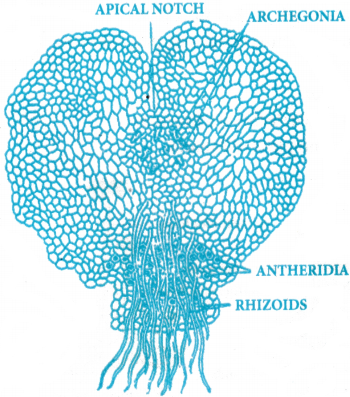
Give a brief account of prothallus.
Answer:

  • In pteridophytes, haploid spores liberated from the sporangia of sporophyte develop into inconspicuous, small, multicellular, free-living photosynthetic, thalloid gametophytes called prothallus.
  • These gametophytes require cool, damp, shady places to grow.
  • The prothallus bears sex organs male and female called antheridia and archegonia.
  • The sex organs are multicellular, jacketed and sessile.
  • Water is required for the transfer of antherozoids.
  • Fusion of male gamete with egg takes place in the archegonium.
  • After fertilization, zygote develop into Embryo.

Plant Kingdom Questions and Answers AP Inter 1st Year Botany Chapter 2 1

Question 5.
Write a note on the economic importance of algae and bryophytes.
Answer:
i) Economic importance of Algae :

  • At least a half of the total carbon dioxide fixation on earth is carried out by algae through photosynthesis.
  • Being photosynthetic, they increase the level of dissolved oxygen in their immediate environment.
  • They are important as primary producers of energy rich compounds which form the basis of the food cycles of all aquatic animals.
  • Many species of Porphyra, Laminaria and Sargassum are used as food.
  • Certain marine brown and red algae produce large amounts of hydrocolloids (water holding substances) e.g., algin (brown algae) and carrageenan (red algae) which are used commercially.
  • Agar, one of the commercial products obtained from Gelidium and Gracilaria is used to grow microbes and in preparation of ice-creams and jellies.
  • Chlorella are unicellular alga used as food supplements even by space travelers.

ii) Economic importance of Bryophytes :

  • Some mosses provide food for herbaceous mammals, birds and other animals.
  • Species of Sphagnum, (peat moss) provides peat that has long been used as fuel, and because of its capacity to hold water as packing material for trans-shipment of living material.
  • Mosses along with lichens are the first organisms to colonise rocks and hence are of great ecological importance.
  • They decompose rocks making the substrate suitable for the growth of higher plants, hence play a significant role in plant succession.
  • Since mosses form dense mats on the soil, they reduce the impact of falling rain and prevent soil erosion.

Question 6.
Draw labelled diagrams of:
a) Female thallus and male thallus of a liverwort
b) Gametophyte and sporophyte of Funaria.
Answer:
a) Plant Kingdom Questions and Answers AP Inter 1st Year Botany Chapter 2 2

b) Plant Kingdom Questions and Answers AP Inter 1st Year Botany Chapter 2 3

VI. Long Answer Questions

Question 1.
Give the salient features of Pteridophytes.
Answer:

  • The pteridophytes include club mosses, horsetails, ferns, etc.
  • They are embryophytic, archegoniate, vascular (tracheophyte) cryptogams.
  • The pteridophytes are commonly found in cool, damp, shady places.
  • The main plant body is a sporophyte which is differentiated into true roots, stems and leaves.
  • The roots are adventitious.
  • The leaves in pteridophytes are small (microphylls) as in Selaginella or large (macrophylls) as in ferns.
  • The sporophytes bear sporangia that are subtended by leaf-like appendages called sporophylls.
  • The sporangia produce spores by meiosis in spore mother cells.
  • In the majority of the pteridophytes, all the spores are of similar kind; such plants are termed homosporous.
    Ex: Lycopodium, Pteris.
  • Genera like Selaginella and Salvinia, which produce two kinds of spores, megaspores and microspores, are described as heterosporous.
  • The spores germinate to give rise to inconspicuous, small but multicellular, free-living, mostly photosynthetic, thalloid gametophytes called Prothallus.
  • The gametophytes bear male and female sex organs called antheridia and archegonia, respectively.
  • The sex organs are multicellular, jacketed and sessile.
  • In heterosporous plants, the megaspores and microspores germinate and give rise to female and male gametophytes respectively.
  • Water is required for the transfer of antherozoids (the male gametes) released from the antheridia, to the mouth of the archegonium.
  • Fusion of motile male gamete with the egg present in the archegonium results in the formation of a zygote. This is called zooidogamous oogamy.
    The development of zygote into young embryo takes place within the female gametophytes.
  • This event is a precursor to the seed habit and is considered an important step in evolution.
  • The embryo thereafter produces a multicellular, well differentiated sporophyte which is the dominant phase in the pteridophytes.
  • Pteridophytes show heteromorphic alternation of generations with a diplo-haplontic life cycle.
  • Both the sporophyte and gametophyte are independent, but the sporophyte is dominant.

Plant Kingdom Questions and Answers AP Inter 1st Year Botany Chapter 2 4

Question 2.
Describe the important characteristics of Gymnosperms.
Answer:

  • The gymnosperms (gymnos: naked, sperma : seeds) are plants in which the ovules are not enclosed by any ovary wall and remain exposed, both before and after fertilization.
  • The seeds are naked.
  • Gymnosperms include medium-sized trees or tall trees and shrubs.
  • The giant redwood tree Sequoia is one of the tallest trees.
  • The roots are generally tap roots.
  • Roots in Pinus, have a fungal association in the form of mycorrhiza, while in Cycas, small specialized roots called coralloid roots are associated with N2– fixing cyanobacteria.
  • The stem is unbranched (Cycas) or branched (Pinus, Cedrus).
  • The leaves may be simple or compound.
  • In Cycas, the pinnate leaves persist for a few years.
  • In conifers, the needle-like leaves reduce the surface area.
  • The gymnosperms are heterosporous; they produce haploid microspores and megaspores.
  • The two kinds of spores are produced within sporangia that are borne on sporophylls, which are arranged spirally along an axis to form lax or compact strobili or cones.
  • The strobili bearing microsporophylls and microsporangia are called microsporangiate or male strobili.
  • The microspores develop into a male gametophyte called a pollen grain.
  • The cones bearing megasporophylls with ovules or megasporangia are called microsporangiate or female strobili.
  • The male or female cones or strobili may be borne on the same tree (Pinus).
  • However, in Cycas male cones and megasporophylls are borne on different trees.
  • The megaspore mother cell is differentiated from one of the cells of the nucellus.
  • The nucellus is protected by envelopes and the composite structure is called an ovule.
  • The ovules are borne on megasporophylls, which may be clustered to form the female cones.
  • The megaspore mother cell divides meiotically to form four megaspores.
  • One of the megaspores enclosed within the megasporangium develops into a multicellular female gametophyte that bears two or more archegonia.
  • The multicellular female gametophyte is also retained within megasporangium.
  • The male and the female gametophytes, do not have an independent free-living existence.
  • The pollen grains are released from the microsporangium. They are carried by air currents and come in contact with the opening of the ovules borne on megasporophylls.
  • The pollen tube carrying the male gametes grows towards archegonia in the ovules and discharges their contents near the mouth of the archegonia.
  • Following fertilization, the zygote develops into an embryo, and the ovules into seeds. These seeds are not covered.

I. Multiple Choice Questions

Question 1.
Which of the following have been excluded from plant kingdom (Plantae) in the modern system of classification (Whittaker’s classification) ?
1. Algae and Fungi
2. Fungi and some members of Monera and Protista
3. Members of Monera only
4. Algae and some members of Protista
Answer:
2. Fungi and some members of Monera and Protista

Question 2.
Which of the following pieces of evidence is very crucial to establish evolutionary relationships in Phylogenetic systems of classification ?
1. Morphological evidence
2. Anatomical evidences
3. Fossil evidence
4. Cytological evidences
Answer:
3. Fossil evidence

Question 3.
Pick out the right examples for filamentous and colonial forms of algae respectively.
1. Ulothrix and Spirogyra
2. Ulothrix and Volvox
3. Volvox and Fucus
4. Spirogyra and Fucus
Answer:
2. Ulothrix and Volvox

Question 4.
Which of the following alga is not suitable as human food ?
1. Chlorella
2. Porphyra
3. Chara
4. Laminaria
Answer:
3. Chara

Question 5.
The alga Porphyra belongs to the class
1. Rhodophyceae
2. Phaeophyceae
3. Chlorophyceae
4. Cyanophyceae
Answer:
1. Rhodophyceae

Question 6.
The shape of archegonium in bryophytes is
1. Flask shape
2. Club shape
3. Saucer shape
4. Cup shape
Answer:
1. Flask shape

Question 7.
The sporophyte in mosses develops from
1. Microspore
2. Megaspore
3. Zygote
4. Zygospore
Answer:
3. Zygote

Question 8.
Heterospory in Pteridophytes is commonly seen in species of
1. Selaginella and Salvinia
2. Lycopodium and Equisetum
3. Equisetum and Psilotum
4. Lycopodium and Psilotum
Answer:
1. Selaginella and Salvinia

Question 9.
Which of the following is synonymous to the male gametophyte in Gymnosperms?
1. Megaspore
2. Microspore / pollen grain
3. Megasporangia
4. Microsporophyll
Answer:
2. Microspore / pollen grain

Question 10.
Smallest living angiosperm
1. Wolffia
2. Typha
3. Cuscuta
4. Cedrus
Answer:
1. Wolffia

II. Fill in the Blanks

Question 1.
Natural classification system based on natural affinities was given by __________.
Answer:
George Bentham and J.D. Hooker

Question 2.
Using numbers and codes for characters and utilising computers to process the data is seen in __________ taxonomy.
Answer:
Numerical

Question 3.
The fusion of two gametes dissimilar in size in Eudorina is termed as __________.
Answer:
Anisogamy

Question 4.
At Least half of the total carbon dioxide fixation on earth is carried out by __________ through photosynthesis.
Answer:
Algae

Question 5.
In green algae the members have one or more storage bodies called __________ located in the chloroplasts.
Answer:
Pyrenoids

Question 6.
In phaeophyceae, the plant body is usually attached to the substratum by a __________.
Answer:
Holdfast

Question 7.
The food is stored in the form of __________ in Rhodophyceae (red algae).
Answer:
Floridean starch

Question 8.
__________ moss provides peat and is also used as packing material to hold water.
Answer:
Sphagnum

Question 9.
__________ are green multicellular asexual buds on the thalli of liverworts.
Answer:
Gemmae

Question 10.
In mosses the first stage is the __________ stage, which directly develops from a Spore.
Answer:
Protonema

Question 11.
In Pteridophytes, the main plant body is a __________.
Answer:
Sporophyte

Question 12.
The free living, photosynthetic, thalloid gametophyte of Pteridophytes is called __________.
Answer:
Prothallus

Question 13.
Selaginella belongs to __________ class of Pteridophyta.
Answer:
Lycopsida

Question 14.
Mycorrhizal association with a fungus is seen in the Gymnosperm
Pinus

III. One Word Answer Questions

Question 1.
Which taxonomy is based on cytological information like chromosome number, structure and behaviour?
Answer:
Cytotaxonomy

Question 2.
What do you call the fusion between one large, non-motile (static) female gamete and a smaller motile male gamete in Volvox and Fucus ?
Answer:
Oogamy

Question 3.
What is the commercial product obtained from red algae Gelidium and Gracilaria?.
Answer:
Agar agar

Question 4.
Which are the two chlorophyll pigments found in chloroplasts of Phaeophyceae algae?
Answer:
Chlorophyll a and c

Question 5.
Which is the predominant red pigment present in the body of red alga?
Answer:
r-Phycoerythrin

Question 6.
In which algae the vegetative cells have a cellulose cell wall covered by algin?
Answer:
Phaeophyceae

Question 7.
Give one example for a liverwort with a thalloid plant body.
Answer:
Marchantia

Question 8.
Which stage of the mosses bears sex organs?
Answer:
Gametophyte, leafy stage

Question 9.
Majority of the Pteridophytes produce spores that are similar. What do you call this condition?
Answer:
Homosporous condition or Homospory

Question 10.
Which important step in evolution does the heterospory lead to?
Answer:
Seed-Habit

Question 11.
Name the tallest tree in Gymnosperms.
Answer:
Sequoia

Question 12.
What type of roots in Cycas show symbiosis with Nitrogen fixing cyanobacteria?
Answer:
Coralloid roots

Question 13.
In which group of plants the seeds are enclosed in a fruit?
Answer:
Angiosperms

AP Inter 1st Year Botany Study Material

Biological Classification Questions and Answers AP Inter 1st Year Botany Chapter 1

AP Inter 1st Year Botany 1st Lesson Biological Classification Questions and Answers

IV. Very Short Answer Questions

Question 1.
What is the nature of the cell wall in Diatoms?
Answer:
In Diatoms, the cell wall forms two thin overlapping shells, which fit together like a soapbox. The cell walls are embedded with silica and thus they are indestructible.

Question 2.
What do the terms “Phycobiont” and “Mycobiont” refer to?
Answer:
The algal component in a lichen is called a phycobiont and the fungal component in a lichen is called a mycobiont.

Question 3.
What do the terms “Algal blooms” and “Red tides” signify?
Answer:

  • The luxuriant growth of cyanobacterial members in stagnant polluted waters due to excess of nitrogen and phosphorus from fertilizers and sewage are called algal blooms.
  • Red dinoflagellates like Gonyaulax undergo rapid multiplication that they make the sea red. Hence it is called “red tides”.

Question 4.
How are “Viroids” different from “Viruses”?
Answer:

Viroids Viruses
i) The infectious agents with only nucleic acid (RNA) are called viroids. i) The infectious agents with both nucleic acid (DNA or RNA) and protein coat are called viruses.
Ex: Potato spindle tuber virus (PSTV) Ex: Tobacco mosaic virus (TMV).

Question 5.
State two economically important uses of Heterotrophic bacteria?
Answer:

  1. Making curd from milk.
  2.  Production of antibiotics.
  3. Nitrogen fixation in legume roots.

Question 6.
Some plants are autotrophic, Can you think of some plants that are partially heterotrophic?
Answer:
Dionaea (Venus fly trap), Utricularia (Bladderwort), Cuscuta is a parasite.

Question 7.
Give the main criteria used for classification by Whittaker? [March-26]
Answer:
The main criteria for the classification of whittaker include cell structure, thallus organisation, mode of nutrition, mode of reproduction and phylogenetic relationships.

V. Short Answer Questions

Question 1.
What are the characteristic features of Euglenoids?
Answer:

  1. These are freshwater, flagellated organisms, found in stagnant water.
  2. They are surrounded by a flexible protein rich layer called pellicle.
  3. They have two unequal flagella, a short and long one.
  4. They are photosynthetic in the presence of light.
  5. They behave as heterotrophs when deprived of light.
  6. Reproduction takes place by binary fission.
  7. This pigments of Euglenoids are Identical to those present in Higher Plants.
    Ex: Euglena.

Biological Classification Questions and Answers AP Inter 1st Year Botany Chapter 1 1

Question 2.
Give the salient features and importance of Chrysophytes?
Answer:
Salient features

  1. This group includes diatoms and desmids or golden algae.
  2. They are found in fresh water as well as in marine environments.
  3. They are microscopic, and float passively in water currents.
  4. Most of them are photosynthetic.
  5. In diatoms, the cell wall contains two thin overlapping shells, which fit together like a soap box.
  6. Cell walls are embedded with silica and thus the walls are indestructible.
  7. After death diatoms leave large amounts of cell wall deposits in their habitat and form diatomaceous earth.

Importance:

  • The diatomaceous soil is used in polishing, filtration of oils and syrups.
  • Diatoms are the chief producers of the ocean.

Biological Classification Questions and Answers AP Inter 1st Year Botany Chapter 1 2

Question 3.
Give a brief account of Dinoflagellates?
Answer:

  1. These are marine and photosynthetic forms.
  2. They appear yellow, green, blue or red based on the pigments in the cell.
  3. The cell wall contains stiff cellulosic plates on the outer surface.
  4. These are biflagellated. One lies longitudinally and the other is transversely in a furrow between the wall plates.
  5. Very often, red dinoflagellates (Ex: Gonyaulax) undergo such rapid multiplication that they make the sea appear red (red tides).
  6. Toxins released by such large numbers may even kill other marine animals such as fishes.

Biological Classification Questions and Answers AP Inter 1st Year Botany Chapter 1 3

Question 4.
Write the role of Fungi in our daily life.
Answer:
Uses:

  1. Yeast are used to make bread and beer.
  2. Some fungi like Penicillium are the source of antibiotics.
  3. Agaricus are edible mushrooms.

Diseases:

  1. Fungi spoils bread. Ex: Rhizopus.
  2. White spots appear on the leaves of mustard by Albugo.
  3. Puccinia causes rust in wheat.

VI. Long Answer Questions

Question 1.
Give the salient features and comparative account of different classes of fungi studied by You?
Answer:
Kingdom fungi includes heterotrophic organisms.

Salient Features:

  • All the fungal members are filamentous except yeast (unicellular).
  • Body of the fungi is called mycelium.
  • Each thread-like slender structure in the mycelium is called hypha.
  • In some fungi (Rhizopus), hyphae are aseptate and multinucleated, and are called “coenocytic hyphae”.
  • Cell wall is made up of chitin and polysaccharides.
  • Reserve food materials are glycogen and oil.
  • They live as “saprophytes”, parasites and symbionts. (Lichens and mycorrhizae).
  • Reproduction takes place vegetatively by fragmentation or fission or by budding.
  • Asexually by producing spores like conidia or sporangiospores or zoospores.
  • Plasmogamy, karyogamy and meiosis are the sequential steps in their sexual reproduction.

Kingdom fungi are divided into 4 classes based on their morphology of mycelium, mode of spore formation and fruiting bodies. They are

  1. Phycomycetes
  2. Ascomycetes.
  3. Basidiomycetes
  4. Deuteromycetes

1. Phycomycetes:

  • They are found in aquatic habitats and on decaying wood in moist and damp places or as obligate parasites on plants.
  • The mycelium is aseptate and coenocytic.
  • Asexual reproduction takes place by zoospores or by aplanospores.
  • Zygospores are formed by the fusion of two gametes which may be similar or dissimilar or oogamous.
    Ex: Mucor, Rhizopus, Albugo.

2. Ascomycetes (Sac Fungi):

  • They are unicellular (Yeast) or multicellular (Penicillium).
  • They live as saprophytes or decomposers or parasites or coprophilous (Grow on dung).
  • Mycelium is branched and septate
  • The asexual reproduction occurs by conidia formed on conidiophores.
  • They reproduce sexually by producing Ascospores in Asci.
    Ex: Aspergillus, Claviceps, Neurospora.
  • Neurospora are used extensively in biochemical genetic work.

3. Basidiomycetes (Bracket fungi or puffballs)

  • They grow in soil, on logs and tree stumps and in living plant bodies as parasites.
  • The mycelium is branched and septate.
  • Vegetative reproduction occurs by fragmentation.
  • Sex organs are absent but plasmogamy occurs by the fusion of two vegetative cells of different strains or genotypes.
  • The dikaryotic mycelium produces basidia which in turn produce basidiospores.
    Ex: Agaricus, Ustilago, polyporus.

4. Deuteromycetes (Imperfect fungi):

  • Some members live as saprophytes or parasites and most of the members live as decomposers and help in mineral cycling.
  • The mycelium is branched and septate.
  • They reproduce asexually by conidia.
    Ex: Alternaria, Colletotrichum, Trichoderma.

Question 2.
Describe briefly different groups of Monerans you have studied.
Answer:
Kingdom Monera includes Archaebacteria, Eubacteria, Cyanobacteria and Mycoplasmas.

Archaebacteria:

  • These are special Monerans.
  • They live in extreme habitats like salty areas, (halophiles), hot springs (thermoacido- philes) and marshy areas (methanogens).
  • Their cell wall contains Pseudomurein.
  • Their cell membrane contains a branched chain of lipids. So they can even survive in extreme conditions.
  • Methanogens are responsible for the production of methane gas from dung.

Eubacteria:

  • Bacteria are abundant microorganisms, present everywhere.
  • They also live in extreme habitats like hot springs, deserts, snow and deep oceans.
  • Bacteria appear in 4 shapes
    • spherical – coccus
    • Rod shaped – Bacillus
    • Comma shaped – Vibrio
    • Spiral shaped – Spirilla.
  • Bacteria are surrounded by a cell wall made up of peptidoglycan.
  • The infoldings of the plasma membrane are called mesosomes.
  • Genetic material is not covered by nuclear membrane.
  • Except ribosomes other cell organelles are absent.
  • Motile bacteria contain one or more flagella.
  • Based on the nutrition bacteria are 2 types,
    • Autotrophs
    • Heterotrophs
  • Autotrophs are two types:
    • Photosynthetic autotrophs.
    • Chemosynthetic autotrophs.
  • Heterotrophic bacteria are of two types:
    • Photosynthetic heterotrophs
    • Chemosynthetic heterotrophs (Saprophytes or decomposers, Parasites).
  • Bacteria reproduce mainly by binary fission. During unfavourable conditions they produce spores – endospores.
  • Bacteria reproduce sexually by transferring genetic material from one bacterium to another bacterium.

Cyanobacteria:

  • These are also known as blue green algae.
  • Cyanobacteria are unicellular, colonial or filamentous aquatic or terrestrial algae.
  • These are photosynthetic autotrophs, due to the presence of chlorophyll.
  • They show oxygenic photosynthesis.
  • The colonies and trichomes or filaments are generally surrounded by gelatinous sheath.
  • They often form blooms in polluted water bodies.
  • Some of these organisms can fix atmospheric nitrogen in specialised cells called heterocysts Ex. Nostoc and Anabaena.

Mycoplasma:

  • They do not have a cell wall and they are pleomorphic.
  • They are the smallest living cells and can survive without O2.
  • Many mycoplasmas are pathogenic to animals and plants.

I. Multiple Choice Questions

Question 1.
Two kingdom classification was given by
1. Whittaker
2. Linnaeus
3. Aristotle
4. Theophrastus
Answer:
2. Linnaeus

Question 2.
Bacteria that live in most harsh habitats are
1. Bacteria
2. Cyanobacteria
3. Mycoplasmas
4. Archaebacteria
Answer:
4. Archaebacteria

Question 3.
Nitrogen Fixing Cyanobacterium is
1. Rhizobium
2. Nostoc
3. Chlorella
4. Methanogens
Answer:
2. Nostoc

Question 4.
Smallest living monera cells that lack a cell wall are
1. Cyanobacteria
2. Protozoans
3. Mycoplasma
4. Bacteria
Answer:
3. Mycoplasma

Question 5.
Diatomaceous Earth is Indestructible due to cell walls embedded by [March-26]
1. Calcium
2. Silica
3. Zinc
4. Phosphorus
Answer:
2. Silica

Question 6.
Protists that form plasmodium are
1. Euglenoids
2. Slime moulds
3. Dinoflagellates
4. Diatoms
Answer:
2. Slime moulds

Question 7.
Which is the correct sequence of the sexual cycle of fungi
1. Mitosis-Meiosis-Fertilization
2. Plasmogamy-Karyogamy-Meiosis
3. Meiosis- Plasmogamy-Karyogamy
4. Karyogamy-Plasmogamy-Meiosis
Answer:
2. Plasmogamy-Karyogamy-Meiosis

Question 8.
The viruses which infect bacteria are known as
1. Zoophages
2. Bacteriophages
3. Cyanophages
4. Zymophages
Answer:
2. Bacteriophages

Question 9.
Fungus that is extensively used in biochemical and genetic work
1. Neurospora
2. Ustilago
3. Colletotrichum
4. Saccharomyces
Answer:
1. Neurospora

Question 10.
One of the following are very good Pollution Indicators
1. Fungi
2. Mycoplasma
3. Lichens
4. Golden algae
Answer:
3. Lichens

II. Fill in the Blanks

Question 1.
In five kingdom classification Bacteria are included in __________ kingdom.
Answer:
Monera

Question 2.
Methanogens are present in gut of several ruminant animals such as cows and buffaloes and they are responsible for the production of __________.
Answer:
Methane (biogas)

Question 3.
The colonies of cyanobacteria are generally surrounded by __________ sheath.
Answer:
Gelatinous

Question 4.
Bacteria reproduce mainly by __________.
Answer:
Binary fission

Question 5.
Diatoms are the chief __________ in the oceans.
Answer:
Producers

Question 6.
Pellicle is found in __________ organisms.
Answer:
Euglenoid

Question 7.
The network of hyphae is known as __________.
Answer:
Mycelium

Question 8.
Agaricus belongs to __________ fungi.
Answer:
Basidiomycetes

Question 9.
__________ fungi is known as Imperfect fungi.
Answer:
Deuteromycetes

Question 10.
Viroids were discovered by __________.
Answer:
T.O.Diener

III. One Word Answer Questions

Question 1.
Among five kingdom classification, eukaryotes are placed in how many kingdoms ?
Answer:
Four

Question 2.
What is the cell wall composition of fungi?
Answer:
Chitin

Question 3.
Give one example of Nitrogen fixing cyanobacteria?
Answer:
Nostoc or Anabaena

Question 4.
What is the protist responsible for Red tides?
Answer:
Gonyaulax

Question 5.
What are the smallest living cells which can survive without oxygen?
Answer:
Mycoplasma

Question 6.
What is the causative organism for Sleeping sickness disease?
Answer:
Trypanosoma

Question 7.
Which of the protists show both autotrophic and heterotrophic nutrition?
Answer:
Euglenoids (Euglena)

Question 8.
Agaricus belongs to which class of the fungi ?
Answer:
Basidiomycetes

Question 9.
Which organism causes mad cow disease?
Answer:
Prion

Question 10.
Who proposed the name “Contagium vivum fluidum”[Infectious living fluid]?
Answer:
Beijereinck

AP Inter 1st Year Botany Study Material

AP Inter 1st Year Botany Study Material

AP Intermediate 1st Year Botany Textbook Solutions

Unit I Diversity in the Living World

Unit II Structural Organisation in Plants

Unit III CELL Structure and Functions

Unit IV Plant Physiology