Production Analysis Questions and Answers AP Inter 1st Year Economics Chapter 4

AP Inter 1st Year Economics 4th Lesson Production Analysis Questions and Answers

Essay Questions

Write an essay on the following questions.

Question 1.
Explain the law of variable proportion with the help of a diagram.
Answer:
An important law relating to production (producers) is the law of variable proportions. The law states that when a business firm increases one variable factor, keeping the other fixed factors constant, the increase in output is not proportional or not equal to the increase in the quantity of variable input. This law is also known as Law of diminishing returns and was introduced by Prof. Marshall. The law mostly applies in agricultural sector and is applicable only in the short run.

Definition : Marshall has defined the law as below.

“An increase in the amount of labour and capital applied in the cultivation of land causes, in general, a less than proportionate increase in the amount of output raised, unless it happens to coincide with an improvement in the arts of agriculture”.

Assumptions: The law is based on the following assumptions.

  1. It is possible to change some inputs, keeping other factors/inputs constant to increase production.
  2. State of technology or methods of production remain constant.
  3. All units of variable inputs (labour) are homogeneous.
  4. The firm operates in the short period or short run.

The law can be explained with the help of the following table.

Fixed Factor (Land in Acres) Variable Factor Total Product Average Product Marginal Product Stages of the law operates
5 1 50 50 50 Stage I (Increasing Returns)
5 2 120 60 70
5 3 180 60 60
5 4 200 50 20 Stage II (Diminishing Returns)
5 5 200 40 0
5 6 180 30 – 20 Stage III (Negative Returns)
5 7 140 20 – 40

In the table 4.1, it is shown that one input (labour) increases while other factors remain constant results, the proportion varies. Hence, this is known as the law of variable proportions. The table shows the total, average and marginal products change as a result of the change in the proportion between the variable input (labour) and the fixed inputs (land and capital): The production process is categorized into 3 distinct stages.

Graphical Illustration of the Law:

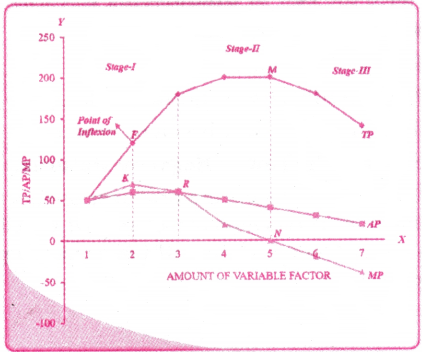
This is explained in the following diagram.

Production Analysis Questions and Answers AP Inter 1st Year Economics Chapter 4 1

Explanation of the graph:

In the above graph (fig), the number of variable factor (Laborers) is shown on the OX-axis and Output (TP, AP and MP) is shown on OY-axis. According to this law, the production behavior can be studied in three stages as identified in the above graph. They are :

1. First Stage : In this stage.

  • The Total Product )TP) curve increases at an increasing rate upto the ponit ‘F’ (Point of Inflexion, where MP is maximum) and then increases at a diminishing rate.
  • The Average Prodcuct (AP) cuve goes on rising throughout the stage and became constant.
  • The Marginal Product (MP) curve first rises and then falls after reaching its maximum, (as shown by point ‘K’ in the figure).
  • The first stage ends when the Average Product is equal to the Marginal Product (AP = MP) and AP is maximum (or) constant.
  • This stage is called as the Law of Increasing Returns.

Reasons : The main reasons for the operation of this stage of production are (a) indivisability of fixed factor, (b) Division of labour and Specialization.

2. Second Stage : In this stage.

  • The total Product (TP) curve increass at diminishing rate and reaches its maximum and constant at POint ‘M’ (Saturation Point).
  • The Aveage Product (AP) curve starts to fall after reaching its maximum (at AP=MP)
  • The Marginal Product (MP) curve continuously falls and becomes zero at the point of saturation i.e., at point ‘M’ (Here, the slope of Total product is zero at point ‘M’).
  • Second stage ends, where total product is at its maximum and marginal product is zero.
  • This stage is called the Law of Diminishing Returns.

3. Third Stage (Law of Negative Returns): In this stage,

  • The total Product (TP) curve falls.
  • The Average Product (AP) curve continues to fall.
  • The marginal Product (MP) curve becomes negative.
  • This stage is called as the Law of Negative Returns.

Conclusion : In all three stages, the producer prefers to operate in stage – II. In this stage, the proper utilisation of resources is possible. The law of variable proportions is a very crucial cocnept which helps the producer to produce at an optimum level.

Importance of Law :

  1. The law helps the business firms / producers to determine the optimum quantities of variable inputs.
  2. The law helps the producers in determining the proportion between fixed input and variable input.
  3. The law is also useful in the rational utilisation of scarce inputs/resources so as to minimise the cost of inputs (production) and to maximise profits/value of output.

Question 2.
Describe the law of return to scale with the help of a diagram.
Answer:
The Law of Returns to Scale, which applies in the long run, shows or explains the relationship between inputs and outputs in the long run. In the short run, to make changes in output, it is not possible to the producer to make changes in all the inputs. He can make changes only in variable inputs, by keeping constant all the fixed inputs. But in the long run, to increase or make changes in output, the producer can also make changes in fixed inputs.

The law of returns to scale explains, how output changes, in the long run, when there is an increase in the quantities of all inputs, both fixed and variable. When all the inputs are increased, the firm will experience three stages, namely the stage of increasing returns, followed by the stage of constant returns, further followed by the stage of decreasing returns.

The law of returns to scale can be explained with the help of table and diagram given below.

Returns to scale:

Units Combination of Inputs Total Marginal Stages
1. 10 Units of labour + 1 unit of capital 9 9 Increasing Returns to scale
2. 20 Units of labour + 2 units of capital 20 11
3. 30 Units of labour + 3 units of capital 32 12 Constant Returns to scale
4. 40 Units of labour + 4 units of capital 44 12
5. 50 Units of labour + 5 units of capital 55 11 Decreasing Returns to scale
6. 60 Units of labour + 6 units of capital

Question 3.
Distinguish between internal and external economies of scale and explain them.
Answer:
Nowadays, business firms have a tendency to produce goods on a large scale. They so because when they produce goods on a large scale, they get certain benefits known as economies of scale, also known as economies of large scale production.

Economies of large scale production are of 2 types. They are

  1. Internal Economies,
  2. External Economies.

1. Internal Economies: Internal economies are those economies or advantages which are available only to those firms which expand their size or take up production on a large scale.

2. External Economies : External economies are those economies or advantages which are enjoyed or available commonly to all the firms producing the same product, located at the same place.

Differences :

Internal Economies External Economies
1) Internal economies are production based or scale or size based economies or benefits. 1) External economies are location based economies.
2) They are available only to those units which take up large scale production. 2) They are available even to those business units which may not produce on a large scale.
3) Internal economies are not common economies. 3) They are the common economies enjoyed by all units in a place.
4) These economies are visible in the form of saving or reduction in costs, larger output, improved quality of the goods, etc. 4) These economies are visible or reflected in the form of improved facilities, better infrastructure, tax concessions, etc.
5) Internal economies lead to business rivalry, severe competition, and feeling of enmity among business firms. 5) External economies lead to friendship, cooperation, the spirit of give and take, and sharing among business firms.
6) Internal economies, can be compared to the benefit or advantage of textbook reading available to only few textbook reading students in the class. 6) External economies can be compared to the benefit of expert teaching by a senior teacher, that is enjoyed by all the students assembled in the class.

Short Answer Questions

Write the answers briefly for the following questions.

Question 1.
Define the internal Economies ? Explain the types of Internal Economies.
Answer:
Internal Economies The word ‘Internal’ is used here to denote the limitation of these economies to the firm itself.

“Internal economies are those which are open to a single factory or a single firm independently of the action of other firms”. – Cairacross.

Types of Internal Economies

Technical Economies : Technical factors affect the returns to scale. Large firms will have more resources at their disposal. They will be able to install the most suitable machinery and adopt to advanced technology. As a result, they can lower cost of production.

Managerial Economies : With the increase in the scale of production, a firm can benefit from separate managerial departments or managers with specialisation. Each department is under the charge of an expert. A small firm can not afford this specialization. Experts are able to reduce the costs of production under their supervision.

Marketing Economies : As the scale of a firm is increased, it obtained economies of purchase and sale. Since the firm purchases on a large scale, it gets all the inputs at a cheaper rate compared to the smaller firms. Similarly wholesalers charge less for the sale of products to a large firm.

Financial Economies : A large firm will be able to reduce its costs of borrowing from the market. A bigger firm is better known to the financial institutions and the stock market. Therefore, a big firm has better access to credit and can borrow on more favourable terms. They can also attract investments.

Risk – bearing Economies : Large firms will be in a position to bear risks or avoid risks. They do so by diversifying output and markets. Therefore, loss in one good or in one market can be covered by profits in other goods and markets.

Question 2.
What are the factors that determine the supply ?
Answer:
Determinants of Supply :
a) Price of a Good : Other things being constant, the supply of a commodity mainly depends on its price. That means, supply of a commodity increases with an increase in its price and vice-versa.

b) Prices of Related Goods: If the price of a substitute good goes up, the producers will be induced to divert their resources to produce that substitute good and vice-versa. For example if the price of pulses increases while the price of rice remains constant, the farmer increases production of pulses and reduces production of rice.

c) Prices of factors of production: Increases in the price of one factor of production would lead to an increase in the cost of production. This results a fall in the profit margin. Consequently, the supply of the commodity will decline. The supply may increase if input prices fall.

d) State of Technology: Discoveries and innovations will help to increase the productivity of the factors and thus contribute to the raising of the supply of a commodity.

e) Government Policy: Imposition of heavy taxes on a commodity discourages its production, and as a result its supply diminishes. On the other hand, providing production subsidies will increase the production as a result its supply will increase.

f) Other factors: Means of transport and communication, goals of the producer, natural factors etc., are also other factors that determine supply of a commodity,

Question 3.
Define Isoquant ? Explain with the help of a graph.
Answer:
Consider a production function with two inputs labour and capital, An Isoquant is the set of all possible combinations of the two inputs that yield the same maximum possible level of output. Each isoquant represents a particular level of output and is labelled with that amount of output.

The shape of isoquant is Convex.

Production Analysis Questions and Answers AP Inter 1st Year Economics Chapter 4 2

Isoquants are also known as equal product lines or producer indifference curves. The reason for slope of IQ curve is diminishing the Marginal Rate of Technical Substitution between two factors say labour & capital (MRTSLK).

We place Labour (L) on the OX axis and Capital (K) on the OY axis. We have three isoquants for the three output levels, namely q = q1, q = q2 and q = q3. Two input combinations (L1, K2) and (L2, K1) given us the same level of output q1. If we fix capital at K1 and increase labour to L3, output increases and we reach a higher isoquant, q = q2. When marginal products are positive, with greater amount of one input, the same level of output can be produced only using lesser amount of the other. Therefore, isoquants are negatively sloped.

Isoquants help the firms in finding the combination of inputs which minimizes the cost of production for a given output. This combination referred to as the “least-cost combination”.

Question 4.
The following table gives the total product schedule of labour. Find the corresponding average product and marginal product schedules of labour.

NL TPL
0 0
1 15
2 38
3 54
4 40
5 35

Answer:
Average Product : Total Product divided by the number of units of labour (NL).
AP = TPL ÷ NL

Marginal Product : Change in Total Product when one more unit of labour is employed.
MP = ∆TPL

NL TPL AP
0 0 0 – 0
1 15 15 15 ( 15 – 15)
2 38 19 23 (38 – 15)
3 54 18 16 (54 – 38)
4 40 10 – 14 (40 – 54)
5 35 7 – 5 (35 – 40)

Question 5.
The following table gives the marginal product schedule of labour. It is also given that Total product of labour is zero level of employment. Calculate the total and average product schedules of labour.

L 1 2 3 4 5 6
MPL 3 5 7 5 – 5 – 7

Answer:

L MPL TP AP
1 3 3 3 (3 ÷ 1)
2 5 8 4 (8 ÷ 2)
3 7 15 5 (15 ÷ 3)
4 – 5 20 3 (15 ÷ 3)
6 – 7 8 1.33 (8 ÷ 6)

Question 6.
Write the assumptions of the Law of Variable Proportions.
Answer:

  1. The law operates in the short run.
  2. The technique of production remains constant.
  3. All the units of variable factors are homogeneous.
  4. It is possible to use various quantities of a variable factor in combination with fixed factors of production. In other words, the proportion between the factors can be changed.

Quantities 7.
Write the Law of Returns Scale Assumptions.
Answer:

  1. The law relates to long run.
  2. In long run, all inputs are variable.
  3. State of technology remains the same.
  4. Existence of perfect competition.

Question 8.
Write a short note on change in quantity supplied.
Answer:
When supply changes due to a change in its price, other factors remaining constant, it is called change in quantity supplied. It is also called expansion and contraction in supply. In this case, there will be a movement along the same supply curve. This can be shown in the following diagram.

Quantity supplied of commodity is changed due to change in price. An upward movement (right side) from the point A to B is called expansion and a downward (left side) movement from the point A to C is called contraction in supply.

Question 9.
Briefly discuss the change in supply.
Answer:
Supply may increase or decrease at the same price, if there is a change in the other factors determining the supply. In such situations, the supply curve shifts.

Supply is said to increase (right ward shift) when more quantity is offered for sale at the same price. Supply is “said to decrease (left ward shift), when at the same price, less is offered for sale. This is illustrated by the following diagram.

From the figure, suppose SS is the supply curve at OP price. S2S2 shows decrease in supply because at the same price OP, less is offered for sale i.e., OM2. S1S1 shows increase in supply at the same price i.e., OM1. These shifts in supply curve are due to change in other determinants of supply, except price.

Question 10.
Mention the types of Price elasticity of supply.
Answer:
The price elasticity of supply is the degree of responsiveness of quantity supplied to changes in the price of the good. More specifically, the price elasticity of supply, denoted by es, is defined as follows,
es = \(\frac{Percentage change in quantity supplied}{Percentage change in price}\)
= \(\frac{\frac{\Delta Q}{Q} \times 100}{\frac{\Delta P}{P} \times 100}\)
= \(\frac{\Delta Q}{\Delta P} \times \frac{P}{Q}\)
∆Q = Change in quantity of the good supplied;
∆P = Change in price,
P = Original price,
Q = Original quantity.

Note: The price elasticity of supply value ranges between 0 & ∞.

Types of price elasticity of supply: On the basis of responsiveness of supply due to change in price, there are five types of price elasticity of supply. They are;

  1. Perfect elastic supply (es = ∞)
  2. Perfect inelastic supply (es = 0)
  3. Unitary elastic supply (es = 1)
  4. Relative elastic supply (es > 1)
  5. Relative inelastic supply (es < 1)

Very Short Answer Questions

Question 1.
Production Function.
Answer:
The term production function shows or refers to the technical (or mathematical / functional) relationship between the physical quantities of inputs and physical quantity of output. It always refers to a period of time and assumes that there is no change in technology.
Q = f (N, L, K, O) where
Q = Quantity of output,
N, L, K, Q = Quantities of inputs.

Question 2.
Two characteristics of Labour.
Answer:

  1. Labour is inseparable from the labourer and exhausts if not used.
  2. Labour supply is variable.
  3. It varies in quality from person to person.
  4. Labour has mobility.

Question 3.
Entrepreneur.
Answer:
The fourth factor of production is entrepreneur. It is not enough to say that production is a function of land, labour and capital. There must be someone to mobilize all these factors, combine them in the right proportion, initiate the production process, and bear the associated risks. The person who organises production is known as the entrepreneur. He is also called the organiser. According to Schumpeter, the true function of an entrepreneur is to introduce innovations”. He is the one who is prepared to bear the risk.

Question 4.
Two sources of Capital Formation.
Answer:
Two sources of capital formation are savings and investment. Savings can come from households, businesses and the government and are used for investment purposes, often in the form of purchasing stocks and bonds issued by corporation.

Question 5.
Cobb Douglas Production Function.
Answer:
It was developed by Paul H. Douglas and C.W. Cobb. It applies not to be an individual firm but to the whole of manufacturing industries in US. It considers output as manufacturing production and inputs used are labour and capital. It is stated as follows :
Q = AKaLb
Where Q = output
L = Quantity of Labour
K = Quantity of capital
A and a are positive constants.

Question 6.
Diagram showing AP and MP curves.
Answer:

Production Analysis Questions and Answers AP Inter 1st Year Economics Chapter 4 3

Question 7.
Second stage in the Law of variable proportions.
Answer:
Second stage : In this stage,

  1. The Total Product (TP) curve increases at diminishing rate and reaches its maximum and constant at Point ‘M’ (Saturation Point).
  2. The Average Product (AP) curve starts to fall after reaching its maximum (at AP = MP).
  3. The Marginal Product (MP) curve continuously falls and becomes zero at the point of saturation i.e., at point ‘M’. (Here, the slope of Total product is zero at point ‘M’).
  4. Second stage ends, where total product is at its maximum and marginal product is zero.
  5. This stage is called the Law of Diminishing Returns.

Question 8.
Law of Supply.
Answer:
The law of supply explains the functional relationship between price of a commodity and its quantity supplied. “Other things remaining the same, as the price of a commodity rises, its supply is extended, and as the price falls, its supply is contracted”.

The quantity offered for sale varies directly with price i.e. the higher the price the larger is the supply and vice-versa.

Question 9.
Elasticity of Supply.
Answer:
The price elasticity of supply is the degree of responsiveness of quantity supplied to changes in the price of the good. More specifically, the price elasticity of supply, denoted by es, is defined as follows,

es = \(\frac{Percentage change in quantity supplied}{Percentage change in price}\)
= \(\frac{\frac{\Delta \mathrm{Q}}{\mathrm{Q}} \times 100}{\frac{\Delta \mathrm{P}}{\mathrm{P}} \times 100}\)
= \(\frac{\Delta \mathrm{Q}}{\Delta \mathrm{P}} \times \frac{\mathrm{P}}{\mathrm{Q}}\)
Where, ∆Q = Change in quantity of the good supplied;
∆P = Change in price,
P = Original price,
Q = Original quantity.

Note: The price elasticity of supply value ranges between 0 & ∞.

One Word Answer Questions

Answer the following questions in ONE WORD.

Question 1.
The responsiveness of quantity supplied due to change in price of a good is called:
Answer:
Elasticity of supply

Question 2.
The set of all possible combinations of two inputs that yield the same maximum possible level of output is known as :
Answer:
Isoquant

Question 3.
Which factor of production has been rightly defined as Produced means of production ?
Answer:
Capital

Question 4.
Under the law of variable proportions, at point of inflexion, marginal product is :
Answer:
Maximum

Question 5.
The economies that occurred to each member firm as a result of the expansion of the industry as a whole are known as …………….
Answer:
External economies

Fill in the blanks

Question 1.
When total product is 10 units and units of variable factor are 5, the average product will be ___________
Answer:
Units

Question 2.
When TP becomes constant at its maximum, MP is equal to ___________
Answer:
Zero (0)

Question 3.
When the supply curve shifts to right side, it is called ___________
Answer:
Increase in supply

Question 4.
In short-run when average product increases, marginal product is ___________
then average product.
Answer:
Greater then average product

Question 5.
When percentage change in output is greater than percentage change in inputs, it is called ___________
Answer:
Increasing returns to scale

Multiple Choice Questions

Question 1.
The Law of Variable Proportions when MP = AP, then AP is :
1) Maximum
2) Minimum
3) Negative
4) Zero
Answer:
1) Maximum

Question 2.
The behaviour of output due to change in all inputs is studied by :
1) The Law of Variable Proportions
2) The Law of Diminishing Returns
3) The Law of returns to scale
4) The law of returns to a factor
Answer:
3) The Law of returns to scale

Question 3.
In Cobb-Douglas production function, when a + b = 1, it exhibits.
1) Increasing return to scale
2) Constant return to scale
3) Decreasing return to scale
4) Negative return to scale
Answer:
2) Constant return to scale

Question 4.
Isoquant measures.
1) Marginal rate at technical situation between labour and capital
2) Marginal rate of substitution between two goods
3) Marginal utility of money
4) Marginal Efficiency of capital
Answer:
1) Marginal rate at technical situation between labour and capital

Question 5.
The stage of actual production in the law of returns to scale:
1) Increasing returns to scale
2) Constant returns to scale
3) Diminishing returns to scale
4) Negative returns to scale
Answer:
2) Constant returns to scale

AP Inter 1st Year Economics Study Material

Theory of Demand Behaviour Questions and Answers AP Inter 1st Year Economics Chapter 3

AP Inter 1st Year Economics 3rd Lesson Theory of Demand Questions and Answers

Essay Questions

Write an essay on the following questions.

Question 1.
Distinguish between income demand and cross demand with the help of diagrams.
Answer:
Income demand explains the relationship between a consumer’s income and various quantities of goods and services demanded at various levels of income, assuming that other factors remain constant. These factors include the price of the good, the price of related goods, tastes, preferences, etc., Symbolically, the functional relationship between income and demand is shown below.
Dx = f(Y)
Where; Dx = Demand for good X,
Y = Income of a consumer,
f = Functional relationship

This means the quantity demanded of good X is a function of the consumer’s income. The functional relationship between income and quantity demanded may be inverse or direct depending on the nature of the commodity.

Table : Income Demand Schedule

Income

(Rs.)

Demand
Superior Goods (Kgs.) /(Units) Inferior Goods (Kgs.)
2000 4 12
4000 6 10
6000 8 8
8000 10 6
10000 12 4

Income Demand Schedule:

An income demand schedule is a list of various quantities of commodities of both superior and inferior goods purchased at different levels of income.

Table shows the relationship between various levels of income and the quantities demanded for both superior and inferior goods. Whenever income increases, the demand for superior goods increases and the demand for inferior goods decreases and vice versa.

Superior / Normal Goods:

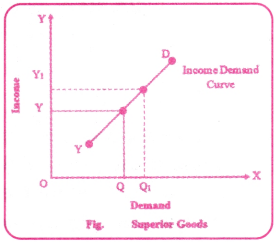
In the case of superior or normal goods, such as cereals, pulses, home appliances etc., demand increases when there is an increase in the income of consumers. The income demand for superior goods exhibits a positive relationship between income and demand.

In Fig., the OX-axis represents the demand for superior goods and the OY-axis represents the income of the consumer. YD represents the income demand curve, showing a positive slope. Whenever income increases from OY to OY1 the demand for superior or normal goods increases from OQ to OQ1 and vice versa.
Theory of Demand Behaviour Questions and Answers AP Inter 1st Year Economics Chapter 3 1

Inferior Goods:

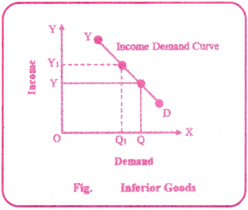
In the case of inferior goods such as ragi, bajra and broken rice etc., demand decreases with an increase in the income of consumers. The income demand for inferior goods exhibits an inverse relationship between income and demand.

In Fig., the OX-axis represents the demand, and the OY-axis represents the income of the consumer. YD is the income demand curve for inferior goods, which has a negative slope.

When the consumer’s income increases from OY to OY1 the demand for the commodity decreases from OQ to OQ1 and vice versa.
Theory of Demand Behaviour Questions and Answers AP Inter 1st Year Economics Chapter 3 2

Cross Demand:

Cross Demand refers to the relationship between any two goods that are either complementary or substitutes for each other. It indicates the quantity of goods demanded when the price of its substitute or complementary goods changes. In short, when other factors remain constant, the functional relationship between the quantity demanded of a commodity and the price of another commodity is called cross demand.

Symbolically,
Dx = f (Py)
Where;
Dx = Demand for ‘X’ commodity,
Py = Price of ‘Y’ commodity,
f = Functional relationship

Substitute Goods:

Substitutes are goods that satisfy the same want. For example tea and coffee, pepsi and coca-cola etc.

Table : Schedule for Substitutes
Coffee Tea
Price
(in Rs.)
Demand
(Cups)
Price
(in Rs.)
Demand
(Cups)
10 500 10 500
9 600 10 400

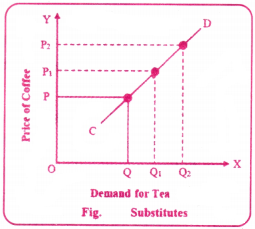
Table shows a positive relationship between the price of coffee and the demand for tea. If the price of coffee decreases, while the price of tea remains constant, then the demand for tea decreases, especially if the existing price of tea is higher than the new price of coffee. In such cases, consumers shift their demand from tea to coffee. Similarly, if the price of coffee increases, while the price of tea remains constant, the demand for tea increases. Hence, in the case of substitutes, the demand curve has a positive slope i.e. it slopes upward from left to right.

In Fig., the OY-axis represents the price of coffee and the OX-axis represents the demand for tea. An increase in the price of coffee from OP to OP2 leads to an increase in the demand for tea from OQ to OQ2. Hence, in the case of substitute goods the demand curve slopes upward from left to right.
Theory of Demand Behaviour Questions and Answers AP Inter 1st Year Economics Chapter 3 3

Complementary Goods:

Complementary goods are those goods that satisfy the same want jointly. For instance, cars and fuel, shoes and socks, bread and butter, lock and key etc.

Table : Schedule for Complementary goods
Fuel Cars
Price
(in Rs.)
Demand
(Lts)
Price
(in Lakhs)
Demand
(Units)
100 5000 10 1000
75 10000 10 2000

Table shows an inverse relationship between the price of cars and the demand for fuel. If the price of fuel decreases, the demand for cars increases, with the prices of cars remaining constant.

In Fig., the price of fuel is shown on the OY-axis and the demand for cars is shown on the OX-axis. If the price of fuel decreases from OP to OP2 the demand for cars may increase from OQ to OQ2 and vice versa. The cross demand curve for complementaries slopes downward.

So far, we have discussed important aspects of the theory of demand. Now we will proceed to learn the concept of ‘elasticity of demand’ comprehensively.

Question 2.
Which method of measuring price elasticity of demand do you consider most useful ? Explain your answer.
Answer:
The percentage (or proportionate) method of measuring price elasticity of demand is considered the most useful and widely used. This method calculates elasticity using the following formula :

\((P E D)=\frac{\% \text { Change in Quantity demanded }}{\% \text { Change in Price }}\)

Reasons why this method is most useful :

  1. Simple and clear : It directly relates the percentage change in quantity demanded to the percentage change in price, making it easy to understand and apply in real world situations.
  2. Widely applicable : It can be used across different types of goods and services, regardless of units or currency, making comparisons straight forward.
  3. Helps decision-making : Businesses and policy-makers often rely on
    percentage changes to forecast consumer behaviour, set prices or assess tax impacts, making this method practical and relevant.
  4. Flexible : It can be adopted into the mid point formula for more accurate elasticity between two points, reducing bias depending on the direction of change.

Question 3.
Explain the concepts of income elasticity and cross elasticity of demand.
Answer:
Income elasticity of demand and cross elasticity of demand are both important economic concepts that help understand consumer behaviour in response to changes in income and prices respectively.

Income Elasticity of Demand (IED) :
Definition : Income elasticity of demand measures how the quantity demanded of a good responds to a change in consumer’s income.

\(\mathrm{IED}=\frac{\% \text { Change in Demand }}{\% \text { Change in Income }}\)

Interpretation :

  1. IED > 1 : The product is a luxury good. A 10% increase in income may result in more than a 10% increase in the quantity demanded,
  2. IED < 1 The product is a necessity. A 10% increase in income may result in less than a 10% increase in the quantity demanded.
  3. IED = 0 : The demand for the product is perfectly inelastic to income.
  4. IED < 0 : The product is an interior good. Higher income leads to a decrease in demand.

Example : If the income of consumers, increases by 5% and the demand for branded clothes increases by 10% the IED would be 2 (luxury). Cross

Elasticity of Demand (CED) :

Definition : Cross elasticity of demand measures how the quantity demanded of one good respond to a change in the price of another good. Formula :

\(C E D=\frac{\text { Percentage Change in Quantity Demand of Good A }}{\% \text { Change in Price of Good B }}\)

Interpretation :

  1. CED > 0 : The goods are substitutes. An increase in the price of Good B will increase the demand for Good A (Eg: Tea and Coffee).
  2. CED < 0 : The goods are complements. An increase in the price of Good B will decrease the demand of Good A (Eg: Cameras and memory cards)
  3. CED = 0 : The goods are unrelated changes in the price of Good B do not affect the demand for Good A.

Example : If the price of coffee increases by 5% and the demand of tea increase by 2%, the CED is 0.4 indicating that tea and coffee are substitutes.

The concepts of income elasticity and cross elasticity of demand provide valuable insights into pricing strategies, consumer preferences, and market dynamics. Understanding the elasticity of demand helps businesses and policymakers make informed decisions regarding product pricing, supply chain adjustments and taxation impacts.

Question 4.
Explain the Law of Demand and examine exceptions for it.
Answer:
Demand is the desire accompanied by ability and willingness to buy the product. “By demand, we mean the various quantities of a given commodity or service, which consumers would buy in one market in a given period of time at various prices of the good” – Bober.

“The law of demand states that there is an inverse or opposite relationship between price and quantity demanded, other things remaining the same. The law states that demand curves slopes downwards from left to right. ”

Definition: “Other things being equal, the quantity demanded expands with fall in price and contracts with a rise in price. – Samuelson.

Determinants of demand : The demand for a product depends upon various factors. They are price of the products, income of consumer, prices of related goods, the habits of the consumers, advertising expenditure of the firm, etc. The functional or mathematical relationship between determinants of demand and demand of a good is known as demand function.

DA = f(Pa, y, Pr, T, A)
DA = Demand of product A
PA = Price of A
Y = Income of the consumer
Pr = Price of related goods
T = Tastes of the consumer
A = Advertising expenditure

Assumptions of Law of Demand : The Law of demand is based on a number of assumptions.

  1. There are no changes in the tastes and fashions of the consumers.
  2. People’s incomes are constant.
  3. The prices of related products remain the same.
  4. There are no substitutes to the product.
  5. There is no possibility of price changes in future.

Demand Schedule : Demand schedule is a table which shows different prices of the good and quantities demanded of the good at those prices. It is of two types. They are

  1. Individual demand schedule,
  2. Market demand schedule
Price of Apply (Rs.) Quantity Demand (Kg)
5 3
4 7
3 12
2 18
1 25

The above table shows than when the price is high (Rs. 5) quantity is demanded is less and when price is low (Re. 1). quantity demanded is more.

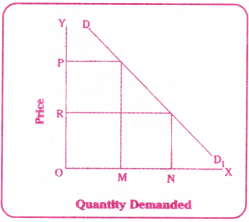
Demand Curve: Demand curve can be shown diagramatically with the help of demand schedule.
Theory of Demand Behaviour Questions and Answers AP Inter 1st Year Economics Chapter 3 4

In the adjacent diagram when the price is OP, the demand is OM. When the price has decreased from OP to OR demand has expanded from OM to ON. In other words, the above diagram shows that demand curve slopes downwards from left to right.

Exceptions to the Law of Demand :

  1. Giffen goods : The law of demand is not applicable to Giffen goods. In the case of Giffen goods, a fall in their price leads to a decrease in demand.
  2. Veblen Goods (Prestige goods) : The law of demand will not apply in the case of costly products purchased by rich people. If the price of costly diamonds purchased by rich people increases, the demand for such diamonds also increases.
  3. Speculation : If the price of the good is increasing and likely to increase further in future, speculators purchase larger quantity even at a higher price.
  4. Illusion : Some consumers, with wrong illusion, purchase less quantity of a good whose price has decreased with the wrong illusion that quality has also been reduced.

Quantity 5.
Define the concept of Elasticity of Demand and explain the concept of price, Income and cross Elasticity of Demand.
Answer:
The degree to which quantity demanded responds to a change in price is known as elasticity of demand.

In other words “The elasticity of demand is the ratio of the percentage change in the quantity demanded and the percentage change in price”.

Mathematically, it can be expressed as

Price Elasticity of Demand PEd = \(\frac{Proportionate Change in Quantity Demand}{Proportionate Change tn Price}\)

Elasticity of Demand studies the relationship between proportionate or percentage change in demand and proportionate or percentage change in price. It is of 3 types.

1. Price elasticity of demand : Price elasticity of demand studies the relationship between proportionate change in price and proportionate change in demand. It explains the rate of change in demand for a given change in the price of commodity.

Price elasticity of demand (PEd) = \(\frac{Percentage of Proportionate Change in Demanded}{Percentage of Proportionate Change in Price}\)

Price elasticity demand is of five types. They are :

  1. Perfectly or infinite elastic demand (Ed = ∞)
  2. Perfectly inelastic demand (Ed = 0)
  3. Unitary elastic demand (Ed = 1.
  4. Relatively elastic demand (Ed > 1.
  5. Relatively inelastic demand (Ed < 1.

2. Income elasticity of demand: Income elasticity of demand explains the relationship between percentage proportionate change in demand and percentage, proportionate change income.

Income elasticity of demand (LH) = \(\frac{Percentage or Proportionate Change in Demanded}{Percentage or Proportionate Change in Income}\)

Income elasticity of demand is positive for normal goods. But in the case of inferior goods, income elasticity of demand is negative.

3. Cross elasticity of demand : Cross elasticity of demand studies the relationship between percentage or proportionate change in demand of product (E.g : Coffee) because of a percentage or proportionate change in price of another related good. (E.g: Tea)

Cross elasticity of demand CrEd = \(\frac{Percentage or Proportionate Change in Demand of Coffee}{Percentage or Proportionate Change in Price of Tea}\)

Related goods are of two types. They are

  1. Substitutes and
  2. Complementary goods.

Quantity 6.
What is Price Elasticity of Demand ? Explain the various types of Price – Elasticity of Demand.
Answer:
The degree to which quantity demanded responds to a change in price is, known as elasticity of demand.

In other words, the elasticity of demand is the ratio of the percentage change in the quantity demanded to the percentage change in price.

Mathematically, it can be expressed as price elasticity of demand (E) = PEd = \(\frac{Proportionate change in quantity demand} {Proportionate change in price}\)

1. Price elasticity of demand: It shows the relationship between percentage of change in quantity demanded and percentage change in price.

Elasticity of demand (PEd) = \(\frac{Proportionate Change in Demand }{proportionate Change in Price}\)

Types of price elasticity of demand: Basing on the percentage change in demand and percentage change in price, price elasticity of demand can be divided into following.

a) Perfectly elastic or Infinite elastic demand :
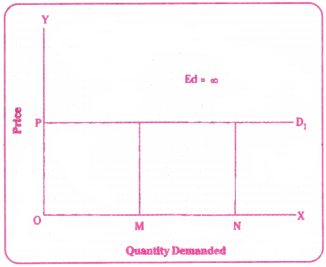
A product will have perfectly elastic demand when demand changes infinitely due to slight change in price or no change in price. Demand is also said to be perfectly elastic, when infinite quantity can be purchased at the same price.

In the given diagram, demand has increased from OM to ON, even though there is no change in price. The demand curve is horizontal straight line parallel to X – axis so, Ed = ∞
Theory of Demand Behaviour Questions and Answers AP Inter 1st Year Economics Chapter 3 5

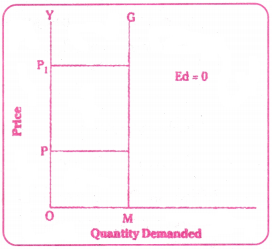
b) Perfectly Inelastic or Zero elastic demand :
If the demand for a product does not change even though price changes many times, such demand is called as perfectly inelastic demand.

In the adjacent diagram, even though price has increased from OP to OPp there is no change in demand (OM). The demand curve is vertical straight line parallel to Y – axis. so, Ed = 0.
Theory of Demand Behaviour Questions and Answers AP Inter 1st Year Economics Chapter 3 6

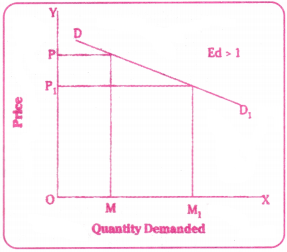
c) Relatively elastic demand :
If the proportionate or percentage change in demand is more than the proportionate or percentage change in price, it ‘is called as relatively elastic demand. Such a demand curve is more flater so, Ed > 1.
In the adjacent diagram, when the price has decreased from OP to OP1, the increase in the demand is OM to OM1 Increase in demand (M, M1) is more than change in price PP1 So Ed > 1.
Theory of Demand Behaviour Questions and Answers AP Inter 1st Year Economics Chapter 3 7

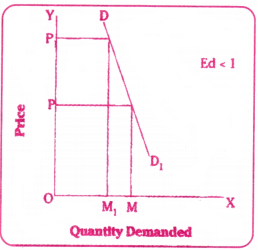
d) Relatively inelastic demand : When the proportionate or percentage change in demand is less than proportionate or percentage change in price, it is called as relatively inelastic demand. Such demand curve is more steeper.

In the adjacent diagram, when the price has increased from OP to OP1, the demand has decreased from OM to OM1. The amount of change in price (PPX) is more than the amount of change in demand (MM1). So Ed < 1.
Theory of Demand Behaviour Questions and Answers AP Inter 1st Year Economics Chapter 3 8

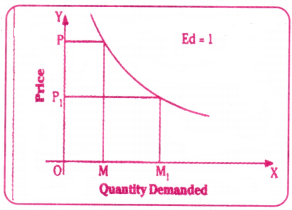
e) Unitary elastic demand: When the proportionate or percentage change in demand is equal to proportionate or percentage in price, it is called unitary elastic demand.

In the adjacent diagram, when the price has decreased from OP to OP1 demand has increased from OM to OM1. The amount of change in demand M, M1 is equal to the amount of change in price P, P1. So, Ed = 1.
Theory of Demand Behaviour Questions and Answers AP Inter 1st Year Economics Chapter 3 9

Short Answer Questions

Question 1.
Mention any four factors that determine demand with examples.
Answer:
There are a number of factors that determine the demand for a good. The following are some of the important factors that determine demand.

1. Price of the Commodity (Px) : The demand for a commodity is ordinarily inversely related to its price. If t he price of a commodity falls, its demand increases and vice versa, assuming other things remaining constant. Thus, the price of the commodity is an important determinant of its demand.

2. Prices of Substitutes and Complementaries (Pr) : Demand for a commodity is also influenced by the prices of its substitutes or complementaries. Tea and coffee are substitute goods. For instance, an increase in the price of coffee leads to an increase in the demand for tea and vice versa. In the case of substitutes, there exists a positive relationship between price and demand. Automobiles and fuel are complementary goods. If the price of fuel falls the demand for automobiles increases and vice versa. In the case of complementaries there exists a negative relationship between the price and the demand.

3. Income of the Consumer (Y): The income of the consumer is another important determinant of demand. Assuming other things remain constant, whenever the income of a consumer increases, the demand for normal goods increases and the demand for inferior goods decreases.

4. Tastes and Preferences (T) : The demand for a commodity may change due to changes in tastes, preferences, and fashion. Tastes vary from person to person and tastes do not remain the same forever. For instance, an increase in the use of trousers reduced the demand for dhotis due to a change in fashion. Advertisements also influence demand for particular commodities.

Quantity 2.
Do you agree with the law of demand? Explain your answer.
Answer:
Yes, I agree with the law of demand. It is a fundamental principle in economics that describes pretty consistent and logical relationship between the price of a good or service and the quantity of it that consumers are willing and able to purchase.

Essentially, the law of demand states that as the price of a good or service increases, the quantity demanded will decrease, all other thing being equal. Conversely as the price decreases, the quantity demand will increase.

Here is why this relationship generally hold true :

  1. Income Effect : When the price of a good falls, consumers have more purchasing power with their existing income. This allows them to buy more of that good, as well as potentially other goods and services.
  2. Substitution Effect: When the price of a good rises, consumers may look for cheaper alternatives or substitutes.
    For example, if the price of coffee goes up significantly, some people might switch to tea.
  3. Diminishing Marginal Utility : The principle suggests that the additional satisfaction, a consumer gets from consuming one more unit of a good decreases with each additional unit consumed. Therefore, consumers are generally willing to pay less for each additional unit.
  4. Increased Affordability : Lower prices make goods and services more affordable to a wider range of consumers, leading to an increase in overall demand.

In short, the law of demand provides a valuable framework for understanding how market’s function and how consumers respond to price changes. It is a cornerstone of economic analysis and has significant implication for businesses and policy makers like.

Quantity 3.
Why does a demand curve have a negative slope or downward slope from left to right?
Answer:
The law of demand states that there is an inverse or opposite relationship between the price and quantity demanded. In other words, demand curve slopes downwards left to right.

Reasons for the downward slope or demand curve: Demand curve slopes downwards because of the following reasons.

a) New buyers : Demand curve slope downwards because when price falls new buyers are attracted to the product or new buyers will also purchase the product.

b) Old buyers : When the price decreases old buyers purchases more quantity than before. So, demand curve slopes downwards.

c) Income effect : When a price of a product decreases, there will be saving in expenditure to the consumers. This saving can be treated just like an increase in the income. In other words, real income of the consumer increases. So, the consumer purchases more quantity of good whose price has decreased.

d) Substitution effect : When the price of a good (tea) decreases, the other related product (coffee) becomes relatively costlier. So consumer purchases more quantity of tea and less quantity of coffee, which has become relatively costlier.

e) Law of diminishing marginal utility : Demand curve slopes downwards from left to right also because of this law. According to the law, when the consumers are using continuously additional units of the same product, the marginal utility of additional units gradually decreases. So, at smaller quantity, consumer is prepared to pay higher price. But at larger quantities, he is prepared to pay a lower price because there he gets lesser marginal utility.

f) Multiple uses of a commodity : Goods like coal, milk, electricity have multiple uses. When prices of such goods decrease, consumers use such goods to more uses than before.

Quantity 4.
Distinguish between relatively elastic demand and relatively inelastic demand with numerical examples.
Answer:
Relatively elastic demand and relatively inelastic demand describe how much the quantity demanded of a good or service changes in response to a change in its price. The key difference lies in the degree of responsiveness.

Relatively Elastic Demand :

Definition : Demand is considered relatively elastic when a small percentage change in price leads to a larger percentage change in the quantity demanded. Consumers are quite sensitive to price changes for these goods.

Numerical Value : The price elasticity of demand coefficient (Ed) is greater than 1 (Ed > 1).

Numerical example of Relatively Elastic Demand : Suppose the price of a popular brand of coffee decreases by 5% and as a result the quantity demanded increases by 15%.

Percentage change in price = – 5%
Percentage change in quantity demanded = + 15%

The price elasticity of demand (Ed) would be calculated as :
Ed = \(\frac{Percentage change in quality demanded}{Percentage change in price}\)
= \(\frac{15 %}{- 5 %}\) = – 3 %

The absolute value of Ed is | – 3 | =3 which is greater than 1. This indicates that the demand for this brand of coffee is relatively elastic. A small decrease led to proportionally larger increase in quantity consumers wanted. Example of goods with relatively elastic demand often include luxury goods, goods with many close substitutes, and goods that represent a significant portion of a consumer’s budget.

Relatively Inelastic Demand :

Definition : Demand is considered relatively inelastic when a large percentage change in price leads to a smaller percentage change in the quantity demanded. Consumers are not very sensitive to price changes for these goods.

Numerical value : The price elasticity of demand coefficient (Ed) is less than 1 (1 Ed / < 1).

Numerical Example of Relatively inelastic demand : Consider the price gasoline increasing by 10% and as a consequence, the quantity demanded decrease by only 2%.
Percentage change in price = + 10%.
Percentage change in quantity demanded = – 2%
The price elasticity of demand (Ed) would be
Ed = \(\frac{Percentage Change in Quantity Demanded}{Percentage Change in Price}\)
= \(\frac{- 2 %}{10 %}\) = – 0.2 The absolute value of Ed is | – 2 | = 0.2 which is less than 1.

This shows that the demand for gasoline in this scenario is relatively inelastic. Even with a significant price increase, the quantity demanded did not decrease by a large proportion. Goods with relatively inelastic demand are often necessities, goods with few close substitutes, or goods that represent a small portion of consumer”s budget.

Question 5.
Calculate the price elasticity of demand with the help of the point method.
Answer:
Price elasticity of demand shows the responsiveness of quantity demanded to changes in price. In other words, it is the ratio proportionate of percentage change in quantity demanded and proportionate (percentage) change in price.
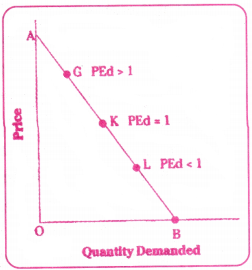
Theory of Demand Behaviour Questions and Answers AP Inter 1st Year Economics Chapter 3 10

Point method : This method was suggested by Alfred Marshall. Under this method, the elasticity of demand at a point can be calculated measured by dividing the (length of) lower segment of the demand curve with the (length of) upper segment of the demand curve. To calculate elasticity of demand, a point is placed on the demand curve and such point divides the demand curve into two parts, namely, a lower part and an upper part.

1. In the given diagram, at the middle point of the demand curve (K) PEd = 1. This is because at point K lower segment (KB) is equal to upper segment of the demand curve (KA). \(\frac{\mathrm{KB}}{\mathrm{KA}}\) = 1, Ed = 1.

2. At a point above the middle point (G), Price elasticity of demand is greater than one (Ed > 1.. This is because at point G, the lower part of the demand curve, GB is more than the upper segment/part of the demand curve (GA).
GB > GA. PE > 1. \(\frac{\mathrm{GB}}{\mathrm{GA}}\) = more than one.

3. At a point below the mid point of the demand curve, price elasticity of demand is less than one. This is because at profit L, the length of the lower segment of the demand curve (LB) is less than the length of the upper part of the demand curve (LA).
\(\frac{\mathrm{LB}}{\mathrm{LA}}\) = less than one PEd < 1.

Question 6.
What are the factors that determine the price elasticity of demand ?
Answer:
The following are some of the factors that determine the demand for a good.

  1. Price of the good : The most important determinant of demand of any good is the price. Price and demand are inversely related. If price increases, demand contracts and if price decreases demand expands.
  2. Prices of related goods (Substitutes & Complementary goods) : Demand for a good depends not only on its price but also on the prices of substitutes and complementary goods. If the price of tea (substitute of coffee) decreases, demand for coffee decreases. In the same way, when the price of jam increases (complementary good of bread) demand for the jam decreases.
  3. Income of the consumer : Another important determinant of demand is the income of the consumer. Income and demand are directly related. If income increases demand increases and vice versa.
  4. Tastes and preferences : A change in the tastes and preferences of the consumer leads to a change demand for goods. A change in the preference
    and tastes of the consumer towards cell phones results in a fall in the demand for landline phones.
  5. Population : The size of population of the country is another determinant of demand. If population increases, demand for many goods increases.
  6. Technology changes : An improvement in technology, by leading an improvement in quality and reduction cost of production and selling price, leads to an increase in demand for goods.
  7. Changes in weather conditions : Demand for a good is also determined by weather conditions. Air conditioners, cool drinks, etc. will have higher demand during summer. The demand for woollen clothes increases during winter.
  8. State of Business : In a period of Economic depression, demand for goods contracts and in a period of Economic property, the demand for goods increases.

Question 7.
Explain any four points on the importance of price elasticity of demand.
Answer:
Elasticity of demand shows the ratio of proportionate or percentage change in quantity demanded to proportionate or percentage or change in price. Elasticity of demand is having a number of uses.

  1. Finance minister : Finance minister uses elasticity of demand for imposing taxes on different goods. He imposes higher (more) taxes on goods having inelastic demand and less taxes on goods having elastic demand.
  2. Monopolist: Elasticity of demand is also useful in determining price in monopoly. Monopolist charges higher price in that sub – market where the product is having inelastic demand. He charges a lower price in that sub – market where the product is having elastic demand.
  3. Useful in factor pricing : Elasticity of demand is also useful in fixing the rewards or prices of factors of production. Factors having inelastic demand will get higher price than factors having elastic demand.
  4. International trade : The concept is also useful in international trade. It helps in determining terms of international trade, tariff policy and foreign exchange rates.
  5. Nationalisation of Industries : The concept also helps the government in making of decisions about nationalisation of industries. The government nationalises those industries whose products are having inelastic demand. E.g : Elasticity, post and telegraphs, etc.
  6. Pricing of Joint products : In the case of joint products, it is not easy to know their separate cost of production. Their prices are fixed basing on elasticity and inelasticity of such products.
  7. Granting of protection : Government grants protection to industries basing elasticity of demand. It gives protection to industries or goods having elastic demand.
  8. Helps in fixing prices of goods and services of government sector : If the products and services of public sector units are having inelastic demand, higher prices are fixed. If they have elastic demand, lower prices are fixed for them.

Question 8.
Explain the concept of Income Demand.
Answer:
Income Demand shows the functional relationship between a change in the income of the consumer and a change in quantity demanded.
ID = f (y)
ID = Income Demand,
y = Income of the Consumer,
f = function.
Income demand curves is of 2 types.

i) Normal goods : In the case of Normal goods an increase in the income of the consumer leads to an increase in the quantity purchased of such good. Income demand curve for normal goods slope upwards from left to right as shown below.
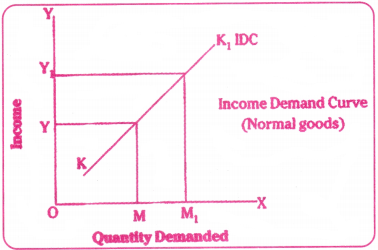
Theory of Demand Behaviour Questions and Answers AP Inter 1st Year Economics Chapter 3 11

ii) Inferior goods : In the case of inferior goods, an increase in the income of the consumer leads to a decrease in the quantity purchased of the good. Income demand curve for Inferior goods slopes downwards from left to right as shown below.
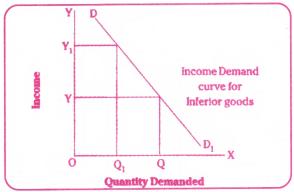
Theory of Demand Behaviour Questions and Answers AP Inter 1st Year Economics Chapter 3 12

Question 9.
Explain the concept of Cross Demand.
Answer:
Cross Demand shows the functional relationship between the change in the price of one good (coffee) and change in the demand of its related good (Tea).
Dc = f (Pt)
Dc = Demand for coffee,
Pt = Price of tea,
f = function.

Cross Demand curve is of two types – either upward sloping or downward sloping.

Substitutes:
Substitutes are those goods that are used in the place of some other good. E.g: Coffee & Tea. If there is an increase in the price of coffee, demand for tea increases. Cross Demand Curve for substitute slopes upwards from left to right as shown below.
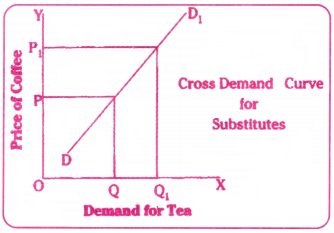
Theory of Demand Behaviour Questions and Answers AP Inter 1st Year Economics Chapter 3 13

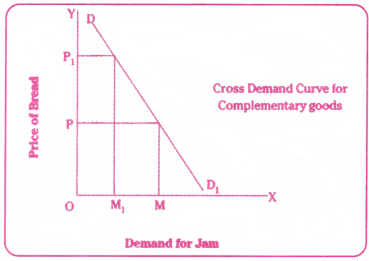
Complementary goods: Complementary goods are two or more goods used by the consumer simultaneously to satisfy the same want. E.g: Bread and jam. If the price of bread increases, the demand for jam decreases.

Cross Demand curve for complementary goods slopes downwards as shown below.
Theory of Demand Behaviour Questions and Answers AP Inter 1st Year Economics Chapter 3 14

Question 10.
Explain the Total outlay Method of Measuring Elasticity of Demand.
Answer:
The degree of sensitiveness or responsiveness of demand to a change in the price of a good is known as (price) elasticity of demand. In the words, elasticity of demand is the ratio of the percentage or proportionate change in the quantity demanded and proportionate or percentage change in the price.

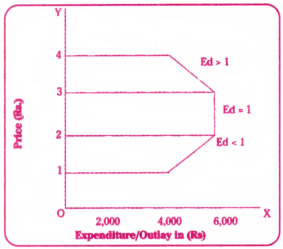
Outlay Method : (Expenditure Method): This method is associated with the name of Alfred Marshall. Under this method, elasticity of demand of a good can be calculated or measured by finding out whether the expenditure made on the good increases, decreases or remains constant with a change in the price of the good.
Theory of Demand Behaviour Questions and Answers AP Inter 1st Year Economics Chapter 3 15

In the above diagram, on Y – axis price is shown and on X – axis is outlay or expenditure made is shown.

  1. When the price has decreased 1st time from Rs. 4 to 3, the outlay expenditure made on the good has increased from Rs. 4000 to Rs. 6000. If a decrease in the price leads to an increase in expenditure (vice versa), the good will have (relatively) elastic demand. (Ed > 1).
  2. When the price has decreased, 2nd time from Rs. 3/- to Rs. 2/- there is no change in expenditure of outlay made on the good. In this way, if a change (either increase or decrease) in price leads to no change in expenditure or outlay, the good will have unitary elastic demand. (Ed = 1).
  3. When in the price has decreased 3rd time, from Rs. 2 to Re. 1, the expenditure or outlay made on the good has also decreased from Rs. 6000/- to Rs. 4000/-. In this way, if a decrease in price leads to decrease in expenditure or outlay (vice versa), the good will have (relatively) inelastic demand. (Ed < 1).

Question 11.
What are the basic determinants of Elasticity of Demand ?
Answer:
The degree to which quantity demanded responds or reacts to a change in price is known as elasticity of demand. In other words, elasticity of demand is the ratio of proportionate or percentage change in quantity demanded and proportionate or percentage change in price. Determinants of elasticity of demand :

  1. Nature of the commodity : If the good is a necessity, it will have inelastic demand. If the good is a luxury, it will have elastic demand.
  2. Existence of substitutes : If a good is having many or more substitutes, it will have elastic demand. Goods with few substitutes will have inelastic demand.
  3. Number of uses : Goods, which are having many or multiple uses, generally have elastic demand. But goods which have one or two uses will have inelastic demand.
  4. Possibility of postponement: Goods, whose purchases are not postponable, normally have inelastic demand. But goods whose purchases can be postponed have elastic demand.
  5. Time element: Generally, in the short run, goods will have inelastic demand. But the same, products will have elastic demand in the long run.
  6. Complementary of goods : If the goods are complementary that are used simultaneously, they have inelastic demand.
  7. Level of Price : If the price of good is very high (at a higher price level) the demand tends to elastic. Goods, whose price are very low (Eg : Salt, matchbox) have inelastic demand.
  8. Proportion of total expenditure on the good: If a consumer spends a large portion of his income on a single good, that good will have elastic demand. But a good on which a very small percentage of total income is spent will have inelastic demand.

Question 12.
Explain the importance of the concept of Elasticity of Demand.
Answer:
The term elasticity of demand shows the responsiveness or reaction of quantity demanded of a good to a change in the price of that good, or income of the consumer or prices of related goods.

Importance of elasticity of demand : The concept of elasticity of demand has several uses.

  1. To business people in fixing the price of the good: The concept of useful to business people in fixing the price of the good. If the good is having elastic demand, they can change a lower price. If the good possesses inelastic demand, they change a higher price.
  2. To monopolist in price discrimination: A monopolist, following the policy of price discrimination, charges higher price in that sub -market where in good is having inelastic demand. But in the sub – market where the product is having elastic demand, he charges a lower price.
  3. Pricing of joint products: In the case of joint products, it is not possible to know the cost of production separately. A businessman charges a lower price to one of the joint products which is having elastic demand and higher price to that good having inelastic demand.
  4. Nationalisation decisions: The concept is also useful to the government in making decisions relating to nationalisation of private sector organisations. The government nationalises those industries whose goods are having inelastic demand.
  5. International Trade: The concept of elasticity of demand is useful to the government in matters of foreign trade like terms of trade, exchange rates, etc.
  6. To Finance Minister in tax matters: It helps the Finance Minister in determining the tax rates on different goods. The Financial Minister imposes higher taxes on the goods having inelastic demand. He charges or imposes lower rates of taxes on goods which possess elastic demand.
  7. To trade unions in wage bargains : The concept is useful to the trade unions of workers in wage bargains. Workers can demand steep increase in their wages if the product produced by them possesses inelastic demand. But workers have to satisfy with lesser hike in their wages if the goods produced by them possess elastic demand.

Question 13.
Briefly explain the various types of price elasticity of demand.
Answer:
Price elasticity of demand measures how much the quantity demanded of a product changes in response to a change in its price.
The main types are;

  1. Perfectly Elastic Demand (Ed = ∞) : Any small change in price leads to an infinite change in quantity demanded. The demand curve is horizontal.
  2. Elastic Demand (Ed > 1. : A percentage change in price leads to a larger percentage change in quantity demanded consumers are highly responsive to price changes.
  3. Unitary Elastic Demand (Ed = 1) : The percentage change in quantity demanded is exactly equal to the percentage change in price.
  4. Inelastic Demand (Ed < 1) : A percentage change in price leads to a smaller percentage change in quantity demanded. Consumers are less responsive to price changes.
  5. Perfectly Inelastic Demand (Ed = 0) : Quantity demanded does not change at all, regardless of price changes. The demand curve is vertical.

Very Short Answer Questions

Question 1.
Law of Demand.
Answer:
The Law of demand is based on the “Law of diminishing marginal utility”. It explains the inverse relationship between the price and quantity demanded of a commodity. If the price of a good falls, ceteris paribus, the demand for the good increases and vice verrsa. Hence the Law of Demand is a qualitative concept.

Question 2.
Demand Function.
Answer:
Demand function is Mathematical equation which shows the functional relationship between the demand of a good and the determinants of that good.

Question 3.
Giffen Paradox.
Answer:
Giffen goods are those inferior goods used by poor people, invented by and named after Sir Robert Giffen. This law of demand does not apply in the case of giffen goods. For such goods an increase in price leads to an expansion of their demand.

Question 4.
Veblen Effect.
Answer:
Prestigious goods, are also known as Veblen goods, are those costly goods used by rich people. For such goods the law of demand does not apply. Rich people purchase more of such goods even at increased prices since they are not worried about money expenditure.

Question 5.
Income Effect.
Answer:
When a price of a product decreases, there will be saving in expenditure to the consumers. This saving can be treated just like an increase in the income. In other words, real income of the consumer increases. So, the consumer purchases more quantity of good whose price has decreased.

Question 6.
Substitution Effect.
Answer:
When the price of a good (tea) decreases, the other related product (coffee) becomes relatively costlier. So consumer purchases more quantity of tea and less quantity of coffee, which has become relatively costlier.

Question 7.
Income Demand.
Answer:
Income demand refers to the various quantities of a good which a consumer purchases at different levels of his income. Income demand curve states that there is direct and positive relationship between income and quantity demanded. Income demand curve for normal goods slopes upwards from left to right and for inferior goods, it slopes downwards from left to right.

Question 8.
Demand Curve for Substitutes.
Answer:
Substitutes are goods that satisfy the same want. For example, tea and coffee. If the price of coffee decreases, while the price of tea remains constant. Then the demand of tea decreases, especially if the existing price of tea is higher than the new price of coffee. In such cases consumers shift their demand from tea to coffee. Similarly if the price of coffee increases, while the price of tea remains constant the demand for tea increases. Hence, in the case of substitutes, the demand curve has a positive slope i.e., it slopes upward from left to right.

Question 9.
Price Demand Curve for complementary goods.
Answer:
Complementary goods are those goods that satisfy the same went jointly. For instance cars and fuel, shoes and socks, bread and butter, lock and key etc. If the price of fuel decreases, the demand for cars increases, with the prices of cars remaining constant. The Cross Demand Curve for complementaries slopes downward.

Question 10.
Perfectly Elastic Demand.
Answer:
A good is said to be having perfectly elastic (infinite elastic) demand, when its demand increases infinitely due to a slight change (or) no change in price. Perfectly elastic (Infinite elastic) demand curve is horizontal straight line parallel to X – axis and its numerical value is infinite Ed = ∞.

Question 11.
Perfectly Inelastic Demand.
Answer:
If the demand for a good does not change even after significant increase or repeated increases in rise, it is said to be having perfectly inelastic (zero elastic) demand. Perfectly inelastic demand curve is a vertical straight line parallel to Y – axis and its numerical value is zero, Ed = 0.

Question 12.
Price Elasticity of demand.
Answer:
Price elasticity demand shows or indicates the responsiveness or reaction in the quantity demanded to the change in price. It is the ratio of proportionate change in quantity demanded to the proportionate change in price.
\(\mathrm{PEd}=\frac{\text { Proportionate (or) } \% \text { change in Quantity demand }}{\text { Proportionate (or) \% change in Price }}\)

Question 13.
Cross Elasticity of Demand.
Answer:
Cross elastic demand shows or indicates the responsiveness (or) reaction in quantity demanded of a good X (coffee) to a change in the price of related good Y (tea). It is the ratio of proportionate change in quantity demanded of coffee and proportionate change in price of tea.
Proportionate (or) % chane in Quantity demand of X (coffee)
Proportionate (or) % change in Price Y (tea)

Question 14.
Income Elasticity of Demand.
Answer:
The term income elastic demand shows or indicates the responsiveness or reaction in the quantity demanded to a change in income. It is the ratio of proportionate change in quantity demanded and proportionate change in income.
\(\mathrm{IEd}=\frac{\text { Proportionate change in quantity demand }}{\text { Proportionate change in income }}\)

Question 15.
Arc Method.
Answer:
Arc method is a method of calculating the elasticity of demand in which elasticity is calculated in a portion (or) segment of demand curve between two points of the demand curve. In other words, in this method, elasticity is calculated at the mid point of an arc of a demand curve.

One Word Answer Questions

Answer the following questions in ONE WORD.

Question 1.
What type of relationship exists between price and quantity demanded?
Answer:
Inverse (Negative)

Question 2.
What is the combined effect of the income effect and the substitution effect?
Answer:
Price Effect

Question 3.
What formula measure elasticity at any point on a downward sloping linear demand curve?
Answer:
Lower segment ÷ Upper segment

Question 4.
What is the value of elasticity of demand, if the price of a good fall from Rs. 10 to Rs. 8 and the quantity demanded increases from 100 units?
Answer:
– 2.5 (or) 2.5

Question 5.
Which type of elastic goods are taxed by the finance minister?
Answer:
In elastic (Ed < 1)

Fill in the blanks

Question 1.
The Veblen effect and the substitution effect are ____________ to the Law.
Answer:
exceptions

Question 2.
If coffee and tea are substitution goods, write in the price of coffee will lead to a or an ____________ in the demand for tea.
Answer:
increase (rise)

Question 3.
Where total expenditure decreases with a fall in price and increases with a rise in price, the elasticity of demand is said to be ____________
Answer:
Inelastic

Question 4.
If the price falls, demand increases because of the increase in ____________
Answer:
Real income (or) purchasing power

Question 5.
In the long run the demand for a product will be ____________ because of the availability of substitutes.
Answer:
Elastic

Multiple Choice Questions

Question 1.
Demand for a commodity refers to :
1. Ability to purchase the commodity
2. Willingness to pay the price of the commodity
3. Desire for the commodity
4. Demand is always measured per unit of time.

1. 1 & 2
2. 2 & 3
3. 3 & 1
4. All of the above
Answer:
4. All of the above

Question 2.
The law of demand can be derived with the help of which of the following principles.
1. The Law of Diminishing Marginal Utility
2. The Law of Equi-marginal Utility
3. The Law of Diminishing Returns
4. The Law of Supply
Answer:
2. The Law of Equi-marginal Utility

Question 3.
A right word shift in the demand curve is the result of:
1. An increase in the price of complementary good
2. A fall in the price of a substitute good
3. An increase in the price of a substitute good
4. A fall in the price of a commodity
Answer:
3. An increase in the price of a substitute good

Question 4.
Price elasticity of demand refers to the :
1. Responsiveness of price to change in demand
2. Responsiveness of demand to a change in price
3. Responsiveness of demand to a change in income
4. Responsiveness of demand to a change in prices of related goods
Answer:
2. Responsiveness of demand to a change in price

Question 5.
As a result of a rise in the price of Onions from Rs. 30 per kg. to Rs. 70 per kg. the quantity demanded decreases from 7 kg. per week to 3 kg. per week. Calculate the price elasticity of demand by using the Arc method.
1. 0.71
2. 1.0
3. 1.71
4. 1.25
Answer:
2. 1.0

AP Inter 1st Year Economics Study Material
Theory of Consumer Behaviour Questions and Answers AP Inter 1st Year Economics Chapter 2

AP Inter 1st Year Economics 2nd Lesson Theory of Consumer Behaviour Questions and Answers

Essay Questions

Write an essay on the following questions.

Question 1.
Explain the Law of Diminishing Marginal Utility with the help of a diagram.
Answer:
Law of diminishing marginal utility :

It was originally explained by Hermann Heinrich Gossen in 1854. Hence it is called Gossen’s first law. But Alfred Marshall popularised this law and analysed it in a scientific manner.

Definition :
The additional benefit which a person derives from a given increase of his stock of a thing dimnishes with every increase in stock that he already has.

Explain:

Suppose a person starts eating slices of bread one after another. The first slice given him huge satisfaction and his appetite or hunger become less. The second slice yields less satisfaction. The satisfaction from the third slice is reduced further and that from the fourth will be lesser than that of the third. Thus, additional satisfaction will go on decreasing with every successive slice till it drops down to zero. If the consumer is forced to take more, his satisfaction may become negative or the utility changes into dissatisfaction.

Units Total Utility Marginal Utility
1 10 10
2 18 8
3 24 6
4 28 4
5 30 2
6 30 0
7 28 – 2

The above table shows the change in total utility and marginal utility as the consumer consumes more and more units of a particles good in succession. It can be observed that the slices dimnishes from the business become zero at the 6th unit and then turns negative. The total utility (TU) goes on increasing at deminishing rate until the consumption of 5th unit. Where it becomes maximum and remains the same at the 6th unit, diminishing.

Graffical Illustration:

Theory of Consumer Behaviour Questions and Answers AP Inter 1st Year Economics Chapter 2 1

  1. It is geographically illustrated in the adjacent figure.
  2. The total utility and marginal utility curves have been obtained by plotting the data given in table.
  3. The TU curve is rising till the 6th unit of X is consumed it is to be noted that the TU curve is rising but at a diminishing, rate.
  4. After reaching the saturation point. TU starts to fall, where as the marginal utility curve is continuously falling and becomes zero.
  5. Beyond 6th unit consumed, it is to be noted the marginal utility turns negative.
  6. It means the additional consumption of good x yields disutility in the form of descomfort.
  7. Hence, with an increasing consumption the marginal utility gradually diminishes.


Question 2.
Describe the Law of Equi Marginal Utility with the help of a diagram.
Answer:
Introduction :

The law of equi-marginal utility is an extension of the law of diminishing marginal utility. The law of equi-marginal utility was presented in the 19th century by German economist H. H. Gossen It is also known as Gossen’s second law, law of maximum satisfaction and the law of substitution.

Definition of the law :

“If a person has a thing which can be put to several uses, he will distribute it among these uses in such a way that it has the same marginal utility in all”. – Alfred Marshall.

Explanation of the law : As consumer has unlimited number of wants, he spends his limited income on different goods, and tries to maximise his total satisfaction from the consumption of multiple goods. The consumer can get maximum satisfaction by allocating his income among different commodities in such a way that last rupee spend on each good provides the same marginal utility.

The fundamental condition for consumer’s equilibrium can be explained in the following way.

\(\frac{MUx}{Px}\) = \(\frac{Muy}{Py}\) = MUm

Where, MUx, MUy, = Marginal utility of good X and good Y,
MUm, = Marginal utility of money,
Px, Py = prices of good X and good Y.

Illustration :

This law can be explained with the help of a table and a diagram. Suppose the consumer has a limited money income Rs. 26/- and is prepared to spend on two goods X and Y. The market prices of two goods are Rs. 4 8s Rs. 5 respectively. Further, it is assumed that the marginal utility of money is constant at eight (8) utils. The allocation of money income and equilibrium of the consumer is explained in the following table 2.2.

Units MUx MUx/Px Units MUY MUY/PY
1 44 11(1) 1 45 9(3)
2 40 10(2) 2 40 8(6)
3 36 9(4) 3 35 7
4 32 8(5) 4 30 6
5 28 7 5 25 5

In the above table, it is clear that the marginal utility of good X and good Y are decreasing due to the operation of the law of diminishing marginal utility. The column no 3 & 6 are calculated by dividing the marginal utilities of both goods at each unit of consumption with their corresponding prices (Rs. 4/- and Rs.5/ – respectively).

From the table, it is clear that being a rational consumer, he buys four units of good X and two units of good Y as the marginal utility of the fourth unit of good X is equal to the second unit of good Y. Thus, his total satisfaction from good X and good Y put together are 55 units which is the maximum. Suppose he spends his last rupee on good X rather from goodY, he get less marginal satisfaction and the total utility will be 54 units, but not 55. So he spends Rs. 16 on good X and Rs. 10 on good Y. Marginal utility of money is equal to the marginal utilities of X and Y (MUX = 32/4; MUY = 40/5, MUM = 8). Therefore, consumer will be in equilibrium at this level of consumption. Hence, this law is called as the law of maximum satisfaction.

Consumer equilibrium may be shown in the below diagram

Theory of Consumer Behaviour Questions and Answers AP Inter 1st Year Economics Chapter 2 2

In the above diagram 2.2, the curves AB and CD are the marginal utility curves of good X and good Y respectively and both curves are slopping downwards.

Suppose the MU of money is constant at Rs. 8/-, \(\frac{\mathrm{MU}}{\mathrm{P}_{\mathrm{x}}}\) is equal to 8 when 4 units of good X is brought and \(\frac{\mathrm{MU}_{\mathrm{Y}}}{\mathrm{P}_{\mathrm{Y}}}\) is equal to Rs. 8/-, when 2 units of good Y is brought.
Thus, at equilibrium, \(\frac{\mathrm{MU}_{\mathrm{x}}}{\mathrm{P}_{\mathrm{x}}}=\frac{\mathrm{MU}_{\mathrm{x}}}{\mathrm{P}_{\mathrm{x}}}\) = MUm

Question 3.
Elucidate the Consumer Equilibrium under indifference curve analysis.
Answer:
Under indifference curve analysis, the equilibrium of the consumer can be explained with the help of an indifference map and price line/budget line.

Conditions of consumer equilibrium : Under indifference technique, a consumer reaches his equilibrium, when the following two conditions are satisfied.

  1. There should be tangency between price line and indifference curve. In other words, the slope of the price line should be equal to the slope of the indifference curve (MRS xy = \(\frac{P_x}{P_y}\))
  2. At the point of tangency where the slopes of indifference curve and price line are equal, the indifference should be convex to the origin.

Explanation of consumer equilibrium :

The following diagram explains consumer equilibrium.

Theory of Consumer Behaviour Questions and Answers AP Inter 1st Year Economics Chapter 2 3

In the above diagram AB is the price line indicating an expenditure of Rs. 50. In the indifference map, there are 3 indifference curves IC1, IC2 and IC3.

At points P and Q, Indifference curve is intersecting the price line. At these points of intersection, the consumer gets lesser satisfaction with an expenditure of Rs. 50. But at point E, which is the point of tangency between price line and indifference curve 2, the consumer gets higher satisfaction / utility with the same expenditure of Rs. 50. So, P and Q the points of intersection between price line and indifference curve are not the points of consumer equilibrium. Only E, the point of tangency between price line and indifference curve 2, is the point of consumer equilibrium.

At the point E, (the point of tangency) IC2 is also convex to the origin. So, the consumer, by spending Rs. 50, and purchasing OM of X and ON of Y, is getting maximum possible satisfaction indicated by indifference curve 2.

Question 4.
Briefly discuss about the assumptions of Indifference curve analysis.
Answer:
Assumptions of Indifference curve analysis :
a) Rationality: The consumer is rational and possesses full information about all the relevant, aspects of economic environment in which he lives so as to get maximum satisfaction.

b) Scale of Preferences: All wants of a consumer are not of equal urgency or importance. Since his resources are limited and he cannot fulfill all his wants, he must pick and choose more important and more urgent wants for satisfaction. Thus, some wants take precedence over others. That is, a consumer ranks his wants and builds up a scale of preference.

c) Ordinal Utility: Unlike the cardinal utility approach, ordinal utility approach assumes the utility is only ordinally measurable. That is, a consumer is able to compare the satisfaction in ordinal terms i.e. 1st, 2nd, 3rd and so on.

d) Consistency or Transitivity of Choice : Consumer’s choices are assumed to be consistent. It means that if a consumer prefers A to B and B to C, he must prefer A to C.

e) Monotonic Preferences : Monotonic preference means that the consumer always prefers to have more of a commodity, as more quantity gives more satisfaction. In indifference curve analysis, it means that the consumer prefers a combination that has atleast more of one good, when compared to another combination. E.g., Suppose there are combinations A (2X + 3Y) and B (4X + 3Y), the consumer prefers combination B which has more of good X.

f) Substitution : To be on the same level of satisfaction, if the quantity of one good is substituted with another good in a bundle of two goods. He substitutes the good that gives less satisfaction, for a good that gives more satisfaction. Rate of substitution is that rate at which the quantity of one good is forgone for the gain of one unit of the other.

Short Answer Questions

Question 1.
Explain the properties of indifference curves.
Answer:
Indifference curves are a fundamental concept in microeconomics, particularly in consumer theory. There are some key properties.

i. Downward slopping :
Indifference curves slope downward from left to right indicating that as the quantity of one good increases, the quantity of the other good must decrease to maintain in the same level.

Theory of Consumer Behaviour Questions and Answers AP Inter 1st Year Economics Chapter 2 4

ii. Convex to origin :
Indifference curves convex to the origin, meaning that they bow inward toward the origin. This reflects the diminishing marginal rate of substitution between the two goods.

Theory of Consumer Behaviour Questions and Answers AP Inter 1st Year Economics Chapter 2 5

iii. Non-intersecting :
Indifference curves do not intersect each other. If they did, it would imply that the same bundle of goods provide two different levels of satisfaction which is not possible.

Theory of Consumer Behaviour Questions and Answers AP Inter 1st Year Economics Chapter 2 6

iv. Higher curves represent higher satisfaction :
Indifference curves that are farther from the origin represent higher levels of satisfaction. This is because they represent more goods or services being consumed.

v. Continuous and Smooth :
Indifference curves are typically assumed to be continuous and smooth reflecting the idea that consumers can make marginal adjustments to their consumption bundles.

Question 2.
What are the assumptions of Marginal Utility Analysis ?
Answer:
Definition of Law : The additional benefit which a person derives from a given increase of his stock of a thing diminishes with every increase in stock that he already has. – Alfred Marshall.

Meaning : Law that explain the relationship between quantity consumed and utility derived from each successive unit consumed is called the law of diminishing marginal utility. The law says that as a consumer consumes more and more units of a good the extra satisfaction that he derives from extra unit of a good goes on falling.

Assumptions :

  • Rationality : This law assumed that the consumer is a rational being in the sense that he seeks to maximize satisfaction.
  • Cardinal measurement of utility : Utility is a quantifiable entity and is measurable.
  • Hypothesis of Independent utility : It implies that the utility of any commodity depends on its own quantity.
  • Constant marginal utility of money : The marginal utility of money remains constant throughout when the individual is spending money on a good.
  • Homogeneous : All units of a good are homogeneous in the sense they are alike both quantitatively and qualitatively.
  • No time gap : This law assumed that there is no time lag between the consumption of one unit and another.
  • Constancy : It implies the income, tastes, and preferences of the consumer remain constant.

Question 3.
Define Budget line. Explain with the help of a diagram.
Answer:
A budget line, also known as price line, shows different combinations (quantities) of two goods (X and Y or mangoes and oranges) that can be purchased by the consumer, with a given income (Rs. 50) and with the prices X (Mangoes) Rs. 10 and with the price of Y (oranges) Rs. 5. It is also known as ISO expenditure line. Any point on the same price line/budget line results in the same or equal expenditure to the consumer. It can be drawn by connecting or joining maximum quantities of X and Y.

Price line Diagram

Theory of Consumer Behaviour Questions and Answers AP Inter 1st Year Economics Chapter 2 7

Question 4.
Draw a diagram showing shifts in budget line due to change in the price of Good Y.
Answer:
Shifts in budget line or price line take place with a change in the income of the consumer, with the price of X (mangoes) and Y (oranges) remaining constant.

Theory of Consumer Behaviour Questions and Answers AP Inter 1st Year Economics Chapter 2 8

In the above diagram, PL is the original Price line/Budget line, showing an expenditure Rs. 150 and income of Rs. 150. When his income has increased to Rs. 200/- he would be able to spend to Rs. 200, and new price line has shifted to the right of the original, and it is P1L1. When there is a decrease in his income, he would be able to spend only Rs.100. The new price line has shifted to the left of the original one, and it is P2L2.

Question 5.
Write the limitations of the Law of Diminishing Marginal Utility.
Answer:
The following cases are some of the exceptions to the law of diminishing marginal utility.

  1. This law does not apply to money.
  2. Hobbies such as collection of stamps, old paintings, coins etc., are exceptions to the law of diminishing marginal utility.
  3. It is pointed out that the consumption of liquor is not subject to the law of diminishing marginal utility. The more a person drinks liquor, the more he likes it.
  4. Further, the law does not hold good if any change in income of the consumer, tastes and preferences occurs in the middle.

Question 6.
Briefly write about the Assumptions of Law of Equi Marginal Utility.
Answer:
The followings are the assumptions of law of equi Marginal Utility.

  1. Utility is cardinally measurable.
  2. The marginal utility of money is constant.
  3. Consumer is rational.
  4. Income of the consumer is given and constant.
  5. Prices of the commodities are given and constant.
  6. The law of diminishing marginal utility operates.

Question 7.
What are the short comings of Marshall in utility analysis ?
Answer:
The following are the main defects pointed out in the Marshallian approach.

  1. Cardinal measurability of utility is not possible.
  2. Assumption of independent utilities is unrealistic.
  3. Assumption of constant marginal utility of money is unrealistic.
  4. This is one commodity model.
  5. Income effect, price effect and substitution effect are not clearly broughtout.

Question 8.
Write about Indifference Map.
Answer:
The consumer’s preferences over all the combinations can be represented by a family of indifference curves as shown in Figure. This is called an indifference map of the consumer. All points on each indifference curve represent combinations which give equal level of satisfaction to the consumer.

Theory of Consumer Behaviour Questions and Answers AP Inter 1st Year Economics Chapter 2 9

Monotonicity of preferences implies that between any two indifference curves, the consumer prefers the one which gives him more satisfaction. Obviously it contains more of either or both the goods. In fig. the IC curves are numbered and arranged in ascending order from left to right. As we move from the lower number to the higher number or from left to right, the level of satisfaction increases.

Question 9.
What are the assumptions of consumer equilibrium ?
Answer:
Assumptions :

  1. Consumer has an indifference map showing his scale of preferences which remains the same throughout the analysis.
  2. Money income is given and remains constant.
  3. Prices of the two goods are given and will remain constant.
  4. The consumer is rational and tries to maximize his satisfaction.
  5. There is no change in tastes and habits of the consumer.

Question 10.
Write a short note superiority of the I.C. Technique.
Answer:
The indifference curve analysis is superior to utility analysis

  1. as it dispenses with the asumption of measurability of utility,
  2. it studies consumption of more than one commodity at a time which is realistic in life,
  3. it does not assume constancy of money, and
  4. it segregates income effect from the substitution effect.

Very Short Answer Questions

Question 1.
Difference between Cardinal Utility and Ordinal Utility.
Answer:

Cardinal Utility Ordinal Utility
1. It can be quantified or expressed or measured in numerical terms numbers. 1. It cannot be expressed or measured or in number or numerical terms.
2. Consumer can say clearly how much more or how much less utility he gets from different goods. 2. Consumer cannot say how much or how much less he gets from different goods.

Question 2.
Relation between Total Utility and Marginal Utility.
Answer:

  1. As long as Marginal Utility is positive, total utility increases but at a decreasing rate.
  2. When Marginal Utility becomes zero, total utility reaches its maximum- this is called the point of saturation.
  3. If marginal utility turns negative (from further consumption), total utility starts to decrease.

Question 3.
Marginal Utility.
Answer:
It can be defined as the additional utility derived from an additional unit consumed. It is also defined as the addition to the total utility derived from the consumption of one additional unit. In short, Marginal Utility is the change in the total utility, resulting from the consumption of one additional unit.

Question 4.
Law of Equi Marginal Utility.
Answer:
It is an extension of the law of diminishing marginal utility. It was presented in the 19th century by German .economist H.H. Gossen. According to Alfred Marshall, If a person has a thing which can be put to several uses, he will distribute it among these uses in such a way that it has the same marginal utility in all.

Question 5.
Find the Marginal Utility from the given table.

Units of X Total Utility Marginal utility
1 40
2 70
3 90
4 100
5 100
6 90

Answer:

Units of X Total Utility Marginal utility
1 40 40
2 70 30
3 90 20
4 100 10
5 100 0
6 90 10

Question 6.
Indifference curves.
Answer:
An indifference curve can be defined as “the locus of points each representing a different combination of two goods yielding the same utility or level of satisfaction”. Therefore, a consumer is indifferent between any two combinations of goods when it comes to making a choice between them. It is also called “iso-utility curve” and “equal utility curve”.

Question 7.
Condition of transitivity.
Answer:
Transitivity is important because it ensures rational decision-making by consumers. If preference are not transitive, it can lead to cycles and inconsistencies, making it difficult for consumers to make clear choice. Overall, transitivity helps in creating predictable patterns in consumer behaviour, which is crucial for economists and marketers in understanding and analyzing purchasing decisions.

Question 8.
Marginal Rate of Substitution (MRS).
Answer:
Marginal Rate of Substitution is such substitution of one good for another (two different goods) which results in or gives the same level of satisfaction to the consumer before substitution and after substitution.

Question 9.
Price Line / Budget Line.
Answer:
A price line, also known as budget line, shows the different (quantities) combinations of two goods (namely X and Y or mangoes and oranges) that can be purchased by the consumer with a given income (Rs.50/) and with given prices of X (Rs.10) and Y (Rs.5). Price line is aso known as budget line or Iso expenditure line. Any point on the same price line / budget line results in the same or equal amount of expenditure to the consumer.

Question 10.
Consumer Equilibrium.
Answer:
A consumer is said to be in equilibrium when he obtains the maximum satisfaction. Under this analysis, with the given scale of preference and budget line.

One Word Answer Questions

Answer the following questions in ONE WORD.

Question 1.
When total utility is maximum, then marginal utility ?
Answer:
Zero

Question 2.
The sum of marginal utilities equal to :
Answer:
Total Utility.

Question 3.
The equation of consumer equilibrium under the law of equi marginal utility is :
Answer:

\(\frac{\mathrm{MUx}}{\mathrm{Px}}=\frac{\mathrm{MUy}}{\mathrm{Py}}=\mathrm{MU}_{\mathrm{m}}\)

Question 4.
Consumer’s choice are assumed to the transitive that, if a consumer prefers A to B and B to C he must prefer :
Answer:
A to C.

Question 5.
From the budget equation if Px = 5, Qx = 2, Py = 3, Qy = 5. Then calculate the money income (M) of the consumer.
Answer:
Px . Qx + Py . Qy = M
So, 5 × 2 + 3 × 5 = 10 + 15 = 25 Rs.

Fill in the blanks

Question 1.
In __________ utility analysis, utility can be measured in definite numbers such as 1, 2, 3, 4, etc.
Answer:
Cardinal

Question 2.
The Law of Diminishing Marginal Utility states that when more and more units of commodity is consumed, the marginal utility __________.
Answer:
Decreases

Question 3.
Indifference curves are always __________ to the origin.
Answer:
Convex

Question 4.
The slope of indifference curve is measured by __________
Answer:
MRS (The Marginal Rate of Substitution)

Question 5.
A set of indifference curves drawn in a graph is called __________
Answer:
Indifference Map

Multiple Choice Questions

Question 1.
Which of the following is true about the relationship between TU and MU?
1. The TU is maximum, when the MU is negative
2. The TU decreases, when the MU is negative
3. The TU increases at a decreasing rate, when the MU is negative
4. The TU is constant, when the MU is negative
Answer:
2. The TU decreases, when the MU is negative

Question 2.
The total utility that Rahul derives after consuming 4 oranges is 20, whereas, the total utility on consuming 5 oranges is 19. What is the marginal utility for 5th orange?
1. 1
2. 0
3. – 1
4. ± 1
Answer:
3. – 1

Question 3.
The marginal utilities of good X and good Y are 300 and 450 utils, at equilibrium respectively. If the price of the good Y is Rs. 60, what is the price of good X at equilibrium ?
1. Rs. 55
2. Rs. 75
3. Rs. 40
4. Rs. 60
Answer:
3. Rs. 40

Question 4.
The convex shape of indifference curve is due to :
1. Increasing MRS
2. Decreasing MRS
3. Constant MRS
4. Positive MRS
Answer:
2. Decreasing MRS

Question 5.
A parallel rightward shift in budget line is due to :
1. Increase in price of good X
2. Increase in price of good Y
3. Increase in income of the consumer
4. Scale of Preference
Answer:
3. Increase in income of the consumer

AP Inter 1st Year Economics Study Material
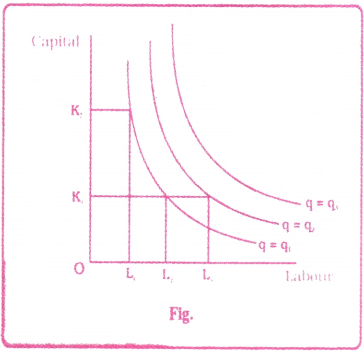
Introduction to Economics Questions and Answers AP Inter 1st Year Economics Chapter 1

AP Inter 1st Year Economics 1st Lesson Introduction to Economics Questions and Answers

Essay Questions

Write an essay on the following questions.

Question 1.
Draw and explain production possibility Frontier.
Answer:
The Production Possibility Frontier (PPF) is a curve on a graph that illustrates the possible quantities that can be produced of two products if both depend upon the same finite resource for their manufacture. The PPF is also referred to as the production possibility curve.

It also plays a crucial role in economics. For example, it can demonstrate that a nations economy has reacted the highest level of efficiency possible.

Example : Consider an economy which can produce com or cotton by using its resources. Table gives some of the combinations of corn and cotton that the economy can produce, when its resources are fully utilised.

Table : Production Possibiilities
Possibilities Corn Cotton
A 0 10
B 1 9
C 2 7
D 3 4
E 4 0

If all the resources are used in the production of corn, the maximum amount of com that can be produced is 4 units and if all resources are used in the production of cotton, at the most, 10 units of cotton can be produced. The economy can also produce 1 unit of corn and 9 units of cotton or 2 units of corn and 7 units of cotton or 3 units of com and 4 units of cotton and so on as shown in the table. There can be many other possibilities.

The figure illustrates the production possibilities of the economy. Any point on or below the curve represents’a combination of corn and cotton that can be produced with the economy’s resources. The curve gives the maximum amount of corn that can be produced in the economy for any given amount of cotton and vice-versa. This curve is called the “Production Possibility Frontier”.

The production possibility frontier gives the combinations of corn and cotton that can be produced when the resources of the economy are fully utilized. Note that a point (Point F) lying strictly below the production possibility frontier represents a combination of com and cotton that will be produced when all or some of the resources are either underemployed or are utilized in a wasteful fashion.

Introduction to Economics Questions and Answers AP Inter 1st Year Economics Chapter 1 1

If more of the scarce resources are used in the production of com, less resources are available for the production of cotton and vice versa. Therefore, if we want to have more of one of the goods, we will have less of the other good. Thus, there is always a cost of having a little more of one good in terms of the amount of the other good that has to be forgone.

This is know as the opportunity cost of an additional unit of the goods.

Every economy has to choose one of the many possibilities that it has. In other words, one of the central problems of the economy is to choose from one of the many production possibilities.

Question 2.
Distinguish between Centrally Planned Economy and Market Economy.
Answer:
In a Centrally Planned Economy, the Government or the central authority plans all the important activities in the economy while as in a market economy, all economic activities are organized through the market. Here is the differences between them :

Features Centrally Planned Economy Market Economy
Decision Making Central authority, typically the government, makes all key economic decisions regarding what to produce, how to produce it, and for whom to produce it. Economic decisions are primarily made by individuals and private firms based on their self interest and in response to market signals like prices.
Resource Allocation The Government owns most of the resources (Land, labour, capital) and directs their allocation according to a national economic plan. These are largely privately owned. Their allocation is driven by the interaction of supply and demand in free markets.
Pricing Prices are generally set by the Government rather than by the forces of supply and demand. Prices of goods and services are determined by the forces of supply and demand.
Production Production targets and methods are determined by the central plan state owned enterprises are common. Private firms decide what and how much to produce in response to consumer demand and the pursuit of profit.
Competition It is typically limited or non-existent as the state controls production. It among businesses is key characteristic, leading to innovation efficiency and variety.
Consumer Soverignity Consumer choice is often limited to what the government decides to produce. Consumers have significant influence over what is produced through their purchasing decisions.
Incentives These are often based on meeting production targets rather than profit. Profit act as a primary incentive for businesses and individuals. US, Japan.
Examples Soviet Union, North Korea and Cuba.

Question 3.
Give the meaning, importance and scope of economics.
Answer:
Meaning :

Microeconomics : The term Microeconomics is derived from the Greek word MIKROS, which means small. Thus, Microeconomics is the theory of small scale economics. Microeconomics is that branch of Economics, which deals with the analysis of individual economic units like a firm, a farmer, a good etc. It studies the economic actions and behaviour of individual units like firms and small groups of individual units like industry. Microeconomics does not study the economy in its totality. So, the microeconomics is known as partial analysis.

According to K.E. Boulding Microeconomics is the study ofparticular firms, particular households, individual prices, wages, incomes, individual industries and particular commodities.

Importance of Microeconomics :

  • Microeconomics explains how a free market economy with its millions of consumers and producers words to decide about the allocation of productive resources among the thousands of goods and services.
  • This analysis is useful to the Government to frame suitable policies to promote economic efficiency for the efficient use of scarce resources to achieve economic growth and stability.
  • Microeconomics can be used to examine the condition of economic welfare and it suggests ways and means to bring about maximum social welfare.
  • This analysis is also applicable to the field of international trade in the determination of exchange rates.

Scope of economics :
The scope of microeconomics is vast and in compasses various areas of study.

  1. Individual Units Analysis : It studies the behaviour and decisions of individual consumers, firms, and industries, focusing on how they interact in specific markets.
  2. Product Pricing : Examines how the price of a particular good or service is determined by study and demand in individual markets.
  3. Factor Pricing : Analyses how the prices of inputs (land, labour, capital and organisation) are set, resulting in rent, wages, interest and profit.
  4. Consumer and Producer Behaviour : Investigates how consumers allocate their income and how producers decide on output and input combinations.
  5. Market structures : Studies different market forms like perfect competition, monopoly, monopolistic competition, and oligopoly, and how they affect pricing and output.
  6. Economic Welfare : Looks at efficiency in production and consumption, addressing questions like what to produce, how to produce and for whom to produce aiming to maximize social welfare.
  7. Resource Allocation : Explores how limited resources are distributed among competing uses to achieve efficient outcomes.
  8. Policy Applications : Helps in formulation of economic policies, taxation and understanding international trade and tariffs.

Introduction to Economics Questions and Answers AP Inter 1st Year Economics Chapter 1 2

Question 4.
Define Macro economics explain its importance and scope.
Answer:
Macroeconomics: The term Macroeconomics is derived from the Greek word MAKROS which means large. Thus, Macroeconomics is the theoiy of large-scale economics. The modern developments in Macroeconomics are most closely associated with the work of J.M. Keynes. Macroeconomics is known as Income and Employment Theory. Macroeconomics is also called as aggregative economics. It studies aggregates like national income, total consumption, total savings and total employment etc.

According to K.E. Boulding Macroeconomics studies national income, not individual income, general price level instead of individual prices and national output instead of individual output.

Importance of Macroeconomics : Macroeconomic analysis has acquired great importance after Great Depression (1929-39). The study of macroeconomics is useful for various reasons as explained below.

  • The study of macroeconomics helps to understand the problems of unemployment, inflation etc., and suggests how to solve them.
  • It helps to evaluate the overall functioning of an economy in order to distribute national income among different sections of the society.
  • Macroeconomics provides solutions to overcome the problems of business cycles and helps to understand their occurrence.
  • Macroeconomics includes economic growth and suggests how developing countries can use their resources to maximise their growth.

Scope of Macroeconomics:

Introduction to Economics Questions and Answers AP Inter 1st Year Economics Chapter 1 3

  1. National Income and GDP : It studies the measurement, components, and growth of national income and Gross Domestic Product, helping to assess a country’s economic performance.
  2. Employment and unemployment: It examines the overall level of employment, unemployment trends, and the factors influencing job creation and joblessness,
  3. General Price Level and Inflation : The analysis of inflation, deflation and price stability is central, including their causes, effects and policy responses.
  4. Economic Growth and Development : Macroeconomics investigates long¬term economic growth, factors driving development and policies for raising living standards.
  5. Monetary and Fiscal Policy : It covers how governments and central banks use tools like taxation, government spending, and interest rates to influence economic activity and maintain stability.
  6. Business Cycles : The study of economic fluctuations – booms and recessions and their impact on the economy.
  7. International Trade and Finance : It explores trade between countries exchange rates, and the effects of globalization on domestic economies.

Short Answer Questions

Write the answers briefly for the following questions.

Question 1.
Discuss the central problem of an economy.
Answer:
Scarcity is the central problem of any economy. This fundamental issue arises from the fact that human wants and desires are virtually unlimited, while the resources available to satisfy them are finite. This mismatch between unlimited wants and limited resources forces every economy to make crucial decisions about how to allocate these scarce resources.

The central problem of an economy can be broken down in three fundamental questions :

  1. What to produce ?
  2. How to produce?
  3. For whom to produce ?

1. What to produce ? Given limited resources, an economy cannot produce everything that everyone wants. Therefore, it must decide which goods and services should be produced and in what quantities.

2. How to produce ? Once the decision on what to produce is made, the economy must determine the most efficient way to produce these goods and services.

3. For whom to produce ? After goods and services are produced, the economy must decide how they will be distributed among its members.

These three questions highlight core challenge of scarcity and the necessity for economic systems to make choices regarding the allocation of limited resources to satisfy competing wants.

Question 2.
Mention any four differences between Microeconomics and Macroeconomics.
Answer:
Both Micro and Macroeconomics are interdependent, neither of the two is complete without the other. In spite of close relationship between the two branches of economics, fundamentally they differ from each other. The following table explains the differences.

Microeconomics Macroeconomics
1. The word MICRO derived from the Greek word MIKROS, which means “small”. 1. The word MACRO derived from the Greek word “MAKROS, which means “large”.
2. Microeconomics is the study of individual units and groups of individual units of the economy. 2. Macroeconomics is the study of economy as a whole.
3. It is known as Price Theory 3. It is known as Income and Employment Theory.
4. Microeconomics explains price determination in both commodity and factor markets. 4. Macroeconomics deals with national income, total employment, aggregate savings & investment, general price level and economic growth etc.
5. Microeconomics is based on price mechanism which depends on demand and supply. 5. Macroeconomics is based on aggregate demand and aggregate supply.

Question 3.
Explain the differences between free goods and economic goods.
Answer:
Differences between Free Goods and Economic Goods.

Free Goods Economic Goods
1. Free goods are gifts of nature. 1. Economic goods are man-made.
2. These goods have no cost of production. 2. These goods have cost of production.
3. These goods do not have a price. 3. These goods do have price.
4. These goods have value in use, but no value in exchange. 4. These goods have both value in use and value in exchange.
5. These values are not included in National Income. 5. These values are included in National Income.

Question 4.
Explain any four characteristics of wants.
Answer:
Human wants are the basis for all economic activities. They depend on economic and social status of individuals. The nature of human wants can be understood by considering the following characteristics.

  1. Unlimited wants: Human wants are unlimited. If you satisfy one want another one crops up.
  2. A particular want is satiable: A single want can be fully satisfied as wants are unlimited, a person can satisfy all wants. For example, if a person is thirsty he can satisfy it by drinking a glass of water.
  3. Competition: Wants are unlimited, whereas resources to satisfy them are limited. Thus certain wants compete with each other. Eg., A consumer can buy either milk or vegetables with the money he has. Though he wants both, he has to choose one, depending on the intensity of the want.
  4. Complementary: Satisfaction of a single want may require the use of more number of commodities. For example, writing need is satisfied only when we have pen, ink and paper together.
  5. Substitution: A person can satisfy his want with different commodities. For example, if a person is hungry he can eat either a meal or fruits to satisfy his hunger. He can substitute one for the other.
  6. Recurring or Repetitive: Certain wants recur. When you satisfy a particular want at a point of time it recurs or reappears at another time, e.g., hunger, thirst, desire to play etc.
  7. Habits: Wants change into habits. For example; smoking cigarettes as a joke forms into a habit if it is not controlled.
  8. Wants vary with time, place and person: Wants are dynamic in nature. Hence, they are changing from time to time, place to place and person to person. E.g.: Dosa for breakfast and rice for lunch.

Question 5.
Explain four kinds of utility with examples.
Answer:
The concept of utility has great importance in economics. The want satisfying capacity of a commodity at a given point of time is known as utility. It is a subjective concept and resides in human mind. Others do not know it unless one expresses it in words or body language.

Types of Utility :
Utility is divided into four types. They are :

  1. Form Utility : If a commodity satisfies a consumer by changing its shape, colour, size etc., is known as form utility. For example, A log has utility in the form of a chair or a table.
  2. Place Utility : When goods’acquire utility with the change of their place, is known as place utility. For example, vegetables at the production place have no utility but when they are brought to the market they gain utility.
  3. Time Utility : Goods acquire additional utility because of time. For example, woollen clothes have utility in winter but not in summer.
  4. Service Utility : Services also have the ability to satisfy human wants. For example, the teaching of a teacher directly helps a student to build his career. This is also known as personal utility.

Question 6.
Classify of Human Wants.
Answer:
Wants are classified mainly into 3 categories like necessities, comforts, and luxuries.

1. Necessities :
Necessities are those which are essential for living. Necessities refer to the want of products or services essential for survival.
E.g., food, clothing and housing.

2. Comforts :
Comforts refer to those products or services that help in making life comfortable. Comforts are less urgent than necessities. Comforts lie between necessities and luxuries. A person can live without these comforts but they help make life easier for them.
Eg.: Fan, cot, bicycle etc.

3. Luxuries :
Luxuries are those wants which give more pleasure and prestige. They are superfluous and expensive. They make humans feel better about themselves. They don’t actually need but are mostly meant for showing off.
Eg. Jewellry, expensive cars, elegant furniture, etc.

Question 7.
Explain Deductive and Inductive Method.
Answer:
Deductive Method :
Deductive method is mainly used by the classical economists. This method is also known as abstract, hypothetical and a priori method because it is based on abstract reasoning and not on actual facts. This method of reasoning tries to deduce conclusions from certain fundamental assumptions or accepted axioms or truths established and handed over from generation to generation. This method proceeds from the general to the particular.
Eg. The Law of Diminishing Marginal Utility, The Law of Demand.

The following are the steps under Deductive Method.

  1. Selecting the problem
  2. Formulating assumptions
  3. Formulating the hypothesis
  4. Verifying the hypothesis.

Inductive Method :
Inductive method is also known as historical, empirical, concrete, ethical or realistic method. The German school of economists advocated this method. This method proceeds from particular to the general, i.e., it refers to a process where facts are collected, arranged, analyzed and then general conclusions derived.
Eg: The law of Diminishing Returns, Malthusian theory of population. These are four steps‘involved in deriving economic generalizations through this method.

They are :

  1. Selection of the problem
  2. Collection and compilation of data.
  3. Analysis and common observations
  4. Generalization

Question 8.
Write about the important features of growth definition.
Answer:
Important features of Growth Definition : This definition analyses the benefits of improving patterns of resource allocation. Some of the important features of Samuelsons definition are :

  • Prof. Samuelson’s definition is dynamic in nature as it considers both the present and future consumption, production and distribution.
  • Growth definition deals the problem of choice in a dynamic society. Hence, his definition broadened the scope of economics.
  • Samuelson’s definition is superior to that of Robbins definition, because he shifted the emphasis, from the scarcity of resources to income, output and employment and later to the problems of economic growth.

Question 9.
What are the features of Welfare Definition ?
Answer:
Important features of Welfare Definition :

  • Marshall used the term Economics for Political Economy to make it similar to Physics. He assumed that economics must be a science even though it deals with the ever-changing forces of human nature.
  • Economics studies only economic aspects of human life and it has no concern with the political, social and religious aspects of life.
  • Marshall’s definition considered those human activities which increased welfare.
  • This definition has given importance to man and his welfare and recognised wealth as a means for the promotion of human welfare.

Very Short Answer Questions

Question 1.
Jacob Viners definition.
Answer:
According to Jacob Viner, “Economics is what economists do”. It implies that the best way of understanding the scope and subject matter of economics is to study the problems and solutions offered by economists, and his definition is considered as the modem definition.

Question 2.
Cause of Choice Problem.
Answer:
The cause of choice problem refers to the underlying reasons and factors that make the act of choosing difficult, stressful or lead to suboptimal outcomes. It explores why, despite having options, individuals often stmggle with making decisions.

Question 3.
Production Possibility Curve (PPC).
Answer:
Production Possibility Curve (PPC), also known as Production Possibility Frontier (PPF). It is a graphical representation that illustrates the maximum possible combinations of two goods or services an economy can produce efficiently using all its available resources and given the current technology.

Question 4.
Value – Price.
Answer:
Value : The value of any good or service is the power to command another article or service in change.
These are of two types :

  1. Value in use,
  2. Value in exchange.

Value in use refers to the capacity of the good to satisfy human wants whereas value in exchange refers to the quantity of goods can be exchanged for another.

Question 5.
Consumer Goods.
Answer:
A consumer good is a finished good bought by individual or households for final consumption.
Eg : Fruits, milk, pens etc.

Again these are of two types :

i) Perishable goods :
Generally they perish with a single use.
Eg: Milk, Fruits.

ii) Durable goods :
These are used over time rather than being completely used up at the moment of consumption.
Eg : TV and Computer.

Question 6.
Producer or Capital Goods.
Answer:
Goods which are used in the production of other goods are called producer or capital goods. They satisfy human wants indirectly.
Eg : Machines, buildings etc.

These are divided into two types.

  1. Single-use Capital Goods : These goods are used only once in the production process.
    Eg : Raw materials, coal and chemicals
  2. Durable use Capital Goods : These goods are used for long time in the process of production.
    Eg: Machines, Tools etc.

Question 7.
Intermediary Goods.
Answer:
Goods which are under the process of production and semi-finished goods are known as intermediary goods. The goods which are not yet finished and under different stages of production are known as intermediary goods.
Eg.: Cement, bricks and steel used as intermediary goods in construction work.

Question 8.
Wealth – Income.
Answer:

  • Wealth : It means stock of assets held by an individual or institution that has the potential for yielding income in some form. It may be held in various forms. These include money shares of companies, land, ornaments etc.
  • Income : It refers to the money earned or received from various sources, such as various economic activities. It is a flow from wealth. In every economy it flows from households to firms and vice-versa.

Question 9.
Deductive Method.
Answer:
Deductive method is mainly used by the classical economists. This method is also known as abstract, hypothetical and a priorimethod because it is based on abstract reasoning and not on actual facts. This method of reasoning tries to deduce conclusions from certain fundamental assumptions or accepted axioms or truths established and handed over from generation to generation. This method proceeds from the general to the particular.
Eg : The Law of Diminishing Marginal Utility, The Law of Demand.

Question 10.
Positive Economics.
Answer:
A positive science may be defined as a body of systematized knowledge concerning What is. The classical school of economists were of the opinion that economics is purely a positive science which had to right to comment upon the rightness or wrongness of economic behaviour. Further, economist cannot give any final judgement on any matter.

One Word Answer Questions

Answer the following questions in ONE WORD.

Question 1.
The Greek term OIKONOMIA means.
Answer:
The Greek term OIKONOMIA means Household Management.

Question 2.
Who is known as the father of Economics?
Answer:
Adam Smith is known as the father of Economics.

Question 3.
Which branch of economic studies economic problems relations to individual economic units.
Answer:
Microeconomic studies economic problems relating to individual economic units.

Question 4.
The General Theory of Employment, Interest and Money was written by :
Answer:
J.M Keynes.

Question 5.
The problem of allocating scarce resources so as to achieve the greatest possible satisfaction of wants is known as ……………….
Answer:
Economic Problem.

Fill in the blanks

Question 1.
The book Wealth of Nations was written by __________
Answer:
Adam Smith

Question 2.
Macroeconomics was popularized by __________
Answer:
J.M. Keynes

Question 3.
__________ Economics deals with general price level instead of relative prices.
Answer:
Macroeconomics

Question 4.
Scarcity definition of economics was given by __________
Answer:
Lionel Robbins

Question 5.
Inductive Method is also known as __________
Answer:
Historical (Or) Empirical (Or) Realistic Method

Multiple Choice Questions

Question 1.
Which of the following is not one of the central questions that the study of economics is supposed to answer?
1. Who produces what ?
2. Who consumes what ?
3. When are goods produced ?
4. How are goods produced ?
Answer:
3. When are goods produced ?

Question 2.
Under ‘Deductive Method’ the logic proceeds from :
1. Particular to General
2. General to Particular
3. Particular to Particular
4. General to General
Answer:
2. General to Particular

Question 3.
Which of the following may he defined as a systematic body df knowledge concerning ‘What is’?
1. Micro Economics
2. Public Economics
3. Normative Economics
4. Positive Economics
Answer:
4. Positive Economics

Question 4.
What do you mean by a mixed economy?
1. Coexistence of the modern and traditional industries
2. Coexistence of the public and private sectors
3. Coexistence of foreign and domestic sectors
4. Coexistence of commercial and subsistence farming.
Answer:
2. Coexistence of the public and private sectors

Question 5.
What does the bowed-out (Concave) shape of the production possibility curve illustrate ?
1. Increasing opportunity cost
2. Constant opportunity cost
3. Decreasing opportunity cost
4. Under utilization of resources
Answer:
1. Increasing opportunity cost

AP Inter 1st Year Economics Study Material
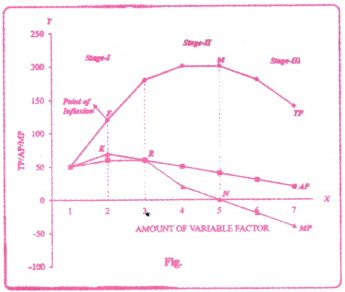
AP Inter 1st Year Economics Study Material
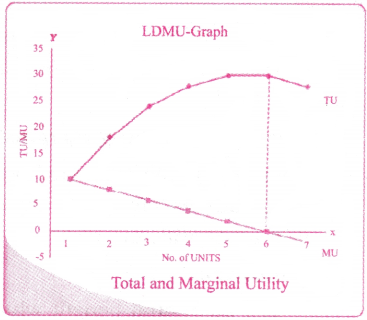
AP Intermediate 1st Year Economics Textbook Solutions

Chemical Coordination and Integration Questions and Answers AP Inter 1st Year Zoology Chapter 9

AP Inter 1st Year Zoology 9th Lesson Chemical Coordination and Integration Questions and Answers

IV. Very Short Answer Questions

Question 1.
Define the following.
A) Endocrine gland
B) Hormone
Answer:
A) Endocrine gland: These are ductless glands liberate their secretions into the bloodstream, transported to target organs located at a distance.

B) Hormone: Hormones are non-nutritive chemicals which act as intercellular messengers and are produced in trace amounts.

Question 2.
Which hormonal deficiency is responsible for the following?
A) Cretinism
B) Diabetes mellitus
Answer:
A) Cretinism: Hypothyroidism during pregnancy causes defective development and maturation of the growing baby leading to stunted growth (cretinism), mental retardation, low intelligence quotient, abnormal skin, deaf-mutism, etc.

B) Diabetes mellitus: Prolonged hyperglycemia leads to a complex disorder called diabetes mellitus which is associated with loss of glucose through urine and formation of harmful compounds known as ketone bodies.

Question 3.
What is acromegaly ? Name the hormone responsible for this disorder.
Answer:
Excess secretion of GH in adults especially in middle age can result in severe disfigurement (especially face) called Acromegaly.

  • Acromegaly may lead to serious complications and premature death if unchecked.
  • It is due to hypersecretion of growth hormone (GH) in adults.

Question 4.
Which hormone is called antidiuretic hormone? Write the name of the gland that releases it.
Answer:
Vasopressin hormone is called antidiuretic hormone (ADH). It is synthesized in hypothalamus, stored and released from posterior pituitary.

Question 5.
Name the endocrine gland that degenerates in old individuals. What important role does it play in the immune system?
Answer:
Thymus gland: It secretes thymosin hormone. It affects the development of immune, system and maturation of T-cells, which involve in Humoral immunity and cell mediated immunity.

Question 6.
Distinguish between diabetes mellitus and diabetes insipidus.
Answer:

  • Diabetes insipidus: It is due to vasopressin deficiency. It is characterized by excessive loss of water through urine without loss of glucose, that causes dehydration.
  • Diabetes mellitus: It is due to under secretion of insulin. It is characterized by hyperglycemia, excess urine with glucose and ketone bodies.

Question 7.
What are “Islets of Langerhans” ?
Answer:

  • It is the endocrine part of pancreas. Among the pancreatic acini several/many cells are * present called islets of Langerhans.
  • It contains alpha cells (∝)- secrete glucagon, beta cells (β) – secrete insulin.

Question 8.
Which gland secretes fight or flight hormones? Where is it located?
Answer:
Epinephrine and norepinephrine. They are secreted by adrenal medulla in response to stress and emergency.

Question 9.
What are Androgens? Which cells of testes secrete them?
Answer:

  • Androgens are male sex hormones, e.g.: Testosterone.
  • They are secreted by Leydig cells of testes (or) interstitial cells of Leydig.

Question 10.
What is erythropoietin? What is its function?
Answer:
The juxtaglomerular cells of the kidneys secrete a hormone called erythropoietin, which stimulates erythropoiesis (formation of RBC).

V. Short Question Answer

Question 1.
List out the names of the endocrine glands present in human beings and mention the hormones they secrete.
Answer:

Name of the endocrine gland Hormones
Pituitary gland 1) Growth hormone(GH).
2) Prolactin.
3) Thyroid stimulating hormone(TSH).
4) Adrenocorticotropic hormone (ACTH).
5) Follicle stimulating hormone (FSH).
6) Luteinizing hormone,
1. Melanocyte stimulating hormone(MSH)
1. Oxytocin 2. Vasopressin (ADH).
Pineal gland Melatonin
Thyroid gland Thyroxine, Calcitonin
Parathyroid glands Parathormone (PTH)
Thymus gland Thymosins
Adrenal glands Glucorticoids, Mineralocorticoids,
Androgens, Adrenaline, noradrenaline
Pancreas Glucagon, Insulin
Testes Testosterone
Ovaries Estrogen, Progesterone

Question 2.
Diagrammatically indicate the location of various endocrine glands in the human body.
Answer:

Chemical Coordination and Integration Questions and Answers AP Inter 1st Year Zoology Chapter 9 1

Question 3.
Write short notes on the functions of the following hormones.
a) Parathyroid hormone
b) Aldosterone
c) Thymosins
d) Insulin
Answer:
a) Parathyroid hormone:

  • In humans, four parathyroid glands are present on the back side of the thyroid gland, one pair each in the two lobes of the thyroid.
  • The parathyroid glands secrete a peptide hormone called Parathyroid hormone (PTH). The secretion of PTH is regulated by the circulating levels of calcium ions.
  • Parathyroid hormone (PTH) increases the Ca2+ levels in the blood. PTH acts on bones and stimulates the process of bone resorption (dissolution / demineralization).
  • PTH also stimulates reabsorption of Ca2+ by the renal tubules and increases Ca2+ absorption from the digested food. It is clear that PTH is a hypercalcemic hormone, i.e., it increases the blood Ca2+ levels.
  • Along with TCT, it plays a significant role in calcium balance in the body.

b) Aldosterone:

  • Aldosterone is the main mineralocorticoids in our body.
  • Aldosterone acts mainly at the renal tubules and stimulates the reabsorption of Na+ and water and excretion of K+ and phosphate ions.
  • Aldosterone helps in maintenance of electrolytes, body fluid volume, osmotic pressure and blood pressure.

c) Thymosins:

  • The thymus gland is a lobular structure located between lungs behind sternum on the ventral side of the aorta.
  • The thymus plays a major role in the development of the immune system.
  • This gland secretes the peptide hormones called Thymosins.
  • Thymosins play a major role in the differentiation of T-lymphocytes, which provide cell-mediated immunity.
  • In addition, Thymosins also promote production of antibodies to provide humoral immunity.
  • Thymus is degenerated in old individuals resulting in a decreased production of Thymosins. As result, the immune responses of old persons become weak.

d) Insulin:

  • Insulin is a peptide hormone, which plays a major role in the regulation of glucose homeostasis.
  • Insulin acts mainly on hepatocytes and adipocytes (cells of adipose tissue), and enhances cellular glucose uptake and utilization.
  • Insulin also stimulates conversion of glucose to glycogen (glycogenesis) in the target cells.
  • The glucose homeostasis in blood is thus maintained jointly by the two-insulin and Glucagon.

Question 4.
Write a note on the mechanism of hormone action.
Answer:

  • Hormones produce their effect on target tissues by binding to specific proteins called hormone receptors located in the target tissue.
  • Hormone receptors presen t on the cell membrane of the target cells are called membrane bound receptors and the receptors present inside the target cell are called Intracellular receptors, mostly nuclear receptors (Present in the nucleus).
  • Binding of a hormone to its receptor leads to the formation of a hormone-receptor complex.
  • Each receptor is specific to one hormone only and hence receptors are specific.
  • Hormone-receptor complex formation leads to certain biochemical changes in the target tissue.
  • Target tissue metabolism and hence physiological function are regulated by hormones.

On the basis of their chemical nature, hormones can be divide into groups.

a) Peptide, Polypeptide, Protein hormones (e.g., Insulin, Glucagon, Pituitary hormones, Hypothalamic hormones), TCT, PTH, Thymosins.
b) Steroids (e.g., Cortisol, Testosterone, Estradiol and Progesterone).
c) Iodothyronines (Thyroid hormones).
d) Amino-acid derivatives or biogenic amines (e.g., Epinephrine).

  • Hormones which interact with membrane-bound receptors normally do not enter the target cell, but generate second messengers (e.g., Cyclic AMP, IP3, Ca+ etc.). Which in turn regulate cellular metabolism.
  • Hormones which interact with intracellular receptors (e.g., Steroid, Iodothyronines, etc.) mostly regulate gene expression or chromosome function by the interaction of hormone-receptor complex with the genome. .
  • Cumulative biochemical actions result in physiological and developmental effects.

Chemical Coordination and Integration Questions and Answers AP Inter 1st Year Zoology Chapter 9 2

Chemical Coordination and Integration Questions and Answers AP Inter 1st Year Zoology Chapter 9 3

Question 5.
Describe the role of hypothalamus as a neurosecretory endocrine organ.
Answer:

  • It is the Master Endocrine gland of the body.
  • The hypothalamus basal part of Diencephalon (part of fore brain) and hypothalamus regulates a wide spectrum of body functions. It contains several groups of neurosecretory cells called nuclei, which produce hormones.
  • These hormones regulate synthesis and secretion of anterior pituitary hormones.
  • However, these hormones produced by hypothalamus are of 2 types.

Releasing hormones (stimulates secretion of pituitary hormones) and inhibiting hormones (Inhibit secretions of pituitary hormones).

  • For e.g., a hypothalamic hormone called Gonadotrophin releasing hormone (GnRH) stimulates to anterior pituitary for synthesis and release of Gonadotrophins (FSH/LH).
  • On the other hand Somatostatin (Growth hormone inhibiting hormone) from hypothalamus inhibits release of growth hormone from anterior pituitary.
  • These hormones (Releasing hormone or Inhibiting hormone) originating in hypothalamic neurons, pass through axons of neuron of hypothalamic nuclei and are released from their nerve endings into blood vessels.
  • These reach anterior pituitary gland through a portal circulatory system and regulate functions of anterior pituitary.
  • Posterior pituitary is under direct neural regulation of hypothalamus.

Question 6.
Give an account of the secretions of the pituitary gland.
Answer:
The hormones secreted by the pituitary gland.

Adenohypophysis:

  • Follicle-stimulating hormone (FSH).
  • Growth hormone (GH)
  • Luteinising hormone (LH).
  • Thyroid-stimulating hormone (TSH).
  • Adrenocorticotropin hormone (ACTH).

Intermediate lobe:

  • Melanocyte-stimulating hormone (MSH).

Neurohyophysis:

  • Oxytocin.
  • Anti-diuretic hormone (Vasopressin).

Question 7.
Explain how hypothyroidism and hyperthyroidism can affect the body. [March-26]
Answer:
Hypothyroidism:

  • It is a condition in which production of thyroid hormones T3 & T4 decrease.
  • It is characterized by enlargement of thyroid gland called as ‘Simple goiter’.
  • Inadequate supply of iodine or impairment in the thyroid glands leads to this condition.
  • Hypothyroidism during pregnancy leads to developmental disorder in baby called ‘cretinism’.
  • Untreated congenital hypothyroidism leads to thyroid dwarf characterized by stunted growth, mental retardation, low IQ, abnormal skin, deafness, mutism etc.
  • Hypothyroidism in adults results in myxedema-characterized by lethargy, mental impairment, puffmess of face, dry skin etc.

Hyperthyroidism:

  • It is a condition in which production of thyroid hormones T3 & T4 abnormally increase.
  • Overactivity of thyroid is due to cancer of the gland or nodule development.
  • In adults it causes exophthalmic goiter-characterized by protruded eye balls.
  • It also effects the physiology of the body like increased BMR (Basal metabolic rate) etc.

I. Multiple Choice Questions

Question 1.
Which of the following is not an endocrine gland ?
1. Pituitary
2. Pineal
3. Pancreas
4. Salivary glands
Answer:
4. Salivary glands

Question 2.
The posterior pituitary is under the direct neural regulation of the
1. Hypothalamus
2. Cerebellum
3. Epithalamus
4. Medulla oblongata
Answer:
1. Hypothalamus

Question 3.
The pituitary gland is located in a bony cavity called
1. Glenoid cavity
2. Acetabulum
3. Sella tursica
4. Pars intermedia
Answer:
3. Sella tursica

Question 4.
Oxytocin and vasopressin are synthesized in
1. Posterior pituitary
2. Anterior pituitary
3. Hypothalamus
4. Thyroid
Answer:
3. Hypothalamus

Question 5.
Excess secretion of growth hormone in adults leads to
1. Dwarfism
2. Acromegaly
3. Graves’ disease
4. Addison’s disease
Answer:
2. Acromegaly

Question 6.
Which hormone stimulates contractions of the uterus at the time of child birth and milk ejection from the mammary glands ?
1. Vasopressin
2. Oxytocin
3. Thyroxine
4. Insulin
Answer:
2. Oxytocin

Question 7.
Assertion(A): Vasopressin is called antidiuretic hormone.
Reason (R): It reduces loss of water through urine.
1. Both (A) and (R) are true, and R is the correct explanation of (A).
2. Both (A) and (R) are true, but R is not the correct explanation of (A).
3. (A) is true, but (R) is false.
4. (A) is false, but (R) is true.
Answer:
1. Both (A) and (R) are true, and R is the correct explanation of (A).

Question 8.
Match the following:

Column – I Column – II
a) T4 i) Hypothalamus
b) PTH ii) Thyroid
c) GnRH iii) Pituatory
d) LH iv) Parathyroid

1. (a)-ii, (b)-iv, (c)-i, (d)-iii
2. (a)-i, (b) iii, (c)-iv, (d)-ii
3. (a)-iii, (b)-ii, (c)-iv, (d)-i
4. (a)-iv, (b)-iii, (c)-i, (d)-ii
Answer:
1. (a)-ii, (b)-iv, (c)-i, (d)-iii

Question 9.
Circulating levels of calcium ions regulate the secretion of
1. Parathyroid hormone
2. Adrenaline
3. Insulin
4. Glucagon
Answer:
1. Parathyroid hormone

Question 10.
Prolonged hyperglycemia leads to
1. Diabetes insipidus
2. Diabetes mellitus
3. Addison’s disease
4. Cretinism
Answer:
2. Diabetes mellitus

Question 11.
Which of the following is not a symptom of Cretinism ?
1. Stunted growth
2. Low IQ
3. Deafness and mutism
4. Decalcification of bones
Answer:
4. Decalcification of bones

Question 12.
Which of the following is mismatched?
1. Hypothyroidism – Goitre.
2. Hyperthyroidism – Graves’ disease.
3. Hypersecretion of corticoids – Addison’s disease.
4. Hypersecretion of growth hormone – Gigantism.
Answer:
3. Hypersecretion of corticoids – Addison’s disease.

Question 13.
The hormone that stimulates the secretion of HCl and pepsinogen from gastric glands.
1. Gastrin
2. Insulin
3. Secretin
4. Cholecystokinin
Answer:
1. Gastrin

Question 14.
Which of the following hormones is an amino acid derivative ?
1. Insulin
2. Glucagon
3. Epinephrine
4. Growth hormone
Answer:
3. Epinephrine

Question 15.
Which of the following does not act as a second messenger in hormonal action ?
1. Cyclic AMP
2. IP3
3. FSH
4. Ca+2
Answer:
3. FSH

II. Fill in the Blanks

Question 1.
The non-nutrient chemicals which act as intercellular messengers are called ________________.
Answer:
Hormones

Question 2.
Over secretion of ________________ hormone leads to gigantism.
Answer:
Growth

Question 3.
The composite gland that acts as both exocrine and endocrine gland is ________________.
Answer:
Pancreas

Question 4.
Follicle stimulating hormone and ________________ hormone are called gonadotropins.
Answer:
Luteinizing

Question 5.
Iodine is essential for the synthesis of ________________ hormones.
Answer:
Thyroid

Question 6.
The main mineralocorticoid produced by the adrenal cortex in the human body is
________________.
Answer:
Aldosterone

Question 7.
Basal metabolic rate is regulated by ________________ hormones.
Answer:
Thyroid

Question 8.
The enlargement of ________________ gland is called Goitre.
Answer:
Thyroid

Question 9.
Chemically cortisol is a ________________ hormone.
Answer:
Steroid

Question 10.
Underproduction of glucocorticoids by adrenal cortex leads to ________________ disease.
Answer:
Addison’s

III. One Word Answer Questions

Question 1.
What are the secretions of the endocrine glands called ?
Answer:
Hormones.

Question 2.
Which gland produces melatonin hormone?
Answer:
Pineal gland.

Question 3.
Name the bilobed gland located on either side of the trachea.
Answer:
Thyroid.

Question 4.
How many parathyroid glands are found in the human body ?
Answer:
Four (4)

Question 5.
Which cells of Islets of Langerhans secrete glucagon hormone ?
Answer:
∝ (alpha) cells.

Question 6.
Which mineral is essential for the synthesis of thyroid hormones ?
Answer:
Iodine.

Question 7.
Which disorder is treated with insulin therapy ?
Answer:
Diabetes mellitus.

Question 8.
Which hormone supports pregnancy in women ?
Answer:
Progesterone.

AP Inter 1st Year Zoology Study Material
Neural Control and Coordination Questions and Answers AP Inter 1st Year Zoology Chapter 8

AP Inter 1st Year Zoology 8th Lesson Neural Control and Coordination Questions and Answers

IV. Very Short Answer Questions

Question 1.
Distinguish between afferent and efferent nerve fibres.
Answer:
The nerve fibres of the PNS are of two types.

a) Afferent fibres (sensory): The afferent nerve fibres transmit impulses from tissues/ organs to the CNS.
b) Efferent fibres (Motor): The efferent fibres transmit regulatory impulses from CNS to concerned tissues/ organs.

Question 2.
Where do we find myelinated and non-myelinated nerve fibres ?
Answer:

  • Myelinated nerve fibres are found in spinal and cranial nerve. Spinal/cranial nerves form SNS.
  • Unmyelinated nerve fibre are commonly found in autonomous and somatic neural systems.

Question 3.
Distinguish between unipolar and bipolar neurons.
Answer:

  • Unipolar: Cell body with one axon, found usually in embryonic stage.
  • Bipolar: One axon and one dendrite eg: retina of eye and olfactory membrane in nose.

Question 4.
Name the three cranial meninges covering the human brain.
Answer:
The skull of the brain is covered by cranial meninges consisting of an outer layer called Duramater (fibrous), a very thin middle layer called arachnoid and an inner layer which is in contact with the brain tissue called piamater (vascular).

Question 5.
What is corpus callosum?
Answer:

  • Corpus callosum is a transverse band internal connection between two cerebral hemispheres beneath the cerebral cortex.
  • It is made up of a wide, flat bundle of myelinated fibres. It brings co-ordination between two cerebral hemispheres.

Question 6.
What is a synapse?
Answer:
Synapse: It is formed by the membranes of a pre-synaptic and a post-synaptic neuron that may or may not be separated by a gap known as the synaptic cleft. There are two types of synapses, namely chemical synapses and electrical synapses.

Question 7.
Distinguish between the grey matter and the white matter of the central neural system.
Answer:

  • Grey matter, primarily composed of neuronal cell bodies and dendrites.
  • White matter, composed mainly of myelinated axons.

Question 8.
What are the corpora quadrigemina?
Answer:

  • Dorsal portion (posterior) of the mid brain consists mainly of four round swellings (lobes) called as corpora quadrigemina.
  • One pair is superior colliculi (visual activity) and one pair inferior colliculi (auditory activity) both are a part of corpora quadrigemina.

V. Short Answer Questions

Question 1.
Draw a labeled diagram of the human brain.
Answer:

Neural Control and Coordination Questions and Answers AP Inter 1st Year Zoology Chapter 8 1

Question 2.
Compare the following.
a) Central neural system (CNS) and Peripheral neural system (PNS).
b) Resting potential and Action potential.
Answer:
a) Central neural system (CNS) and Peripheral neural system (PNS)

Central neural system (CNS):

  • The spinal cord is protected by the vertebral column, whereas the brain is protected by the skull.
  • Consists of the spinal cord and the brain.
  • Processes information and regulates the responses to impulses.

Peripheral neural system (PNS):

  • Nerves of PNS pass impulses to the CNS and responses from the CNS to various structures of the body.
  • It consists of the spinal nerves and the cranial nerves.
  • It is divided into the autonomic nervous system and the somatic nervous system.

B) Resting potential and Action potential

Resting potential:

  • When the neuron is at the resting phase, it is the potential difference across membrane.
  • To maintain the resting potential, the sodium-potassium ATPase pump is activated, sending Na+ ions outside the neuron.
  • Permeability of K+ ions is observed to be more by the plasma membrane of neurons.
  • The exterior side of the neuron is positively charged, while the interior side is negatively charged.

Action potential:

  • When the neuron is triggered, it is the potential difference across the membrane.
  • It functions in a reverse pattern wherein the sodium-potassium ATPase pump sends Na+ ions to the neuron.
  • The exterior side of the neuron is negatively charged, and the interior side of the neuron is positively charged.
  • Permeability of Na+ ions is observed to be more by the plasma membrane of the neurons.

Question 3.
Give a brief account of the mechanism of synaptic transmission.
Answer:
Axon ending transfer nerve impulse to dendrite/cell body/axon of other neuron or to effector organ (e.g. muscle cell)

  • A nerve is transmitted from one neuron to another through junctions called synapses.
  • A synapse if formed by membranes of a pre-synaptic neuron (previous neuron) and a post-Synaptic neuron (next neuron), which may or may not be separated by a gap called synaptic cleft.

Diagram showing axon terminal and synapse

Neural Control and Coordination Questions and Answers AP Inter 1st Year Zoology Chapter 8 2

There are two types of synapses, electrical synapses and chemical synapses.

1. Electrical synapses: The membrane of the pre and postsynaptic neurons are in very close proximity. Electrical current can flow directly from one neuron into other across these synapses.

  • Transmission of an impulse in this case is very similar to impulse conduction along a single axon (Impulse directly transmitted from one neuron to another by making electric circuit).
  • Impulse transmission across it is always faster than across a chemical synapse.
  • Electrical synapses are rare in our system (but present in cardiac muscle fibre).
  • Gap between two neurons is very less in these synapses and it is less energy consuming and there is no synaptic cleft. This synapse does not involve neuro transmitters.

2. Chemical synapse: The membrane of pre and post synaptic neurons is separated by a fluid space called synaptic cleft.

  • Gap between two neurons is more, so synaptic cleft is present, impulse conduction is slow than electrical synapse and it is more energy consuming conduction. Most synapses in our neural system are of this kind.
  • Chemicals or neurotransmitters are involved in the transmission of impulse at these synapses. The axon terminals contain vesicles filled with these neurotrans¬mitters.
  • When an impulse/action potential arrives at axon terminal then voltage gated calcium channel open at terminal or synaptic knob and calcium ions enters in axon from extracellular fluid, this stimulates movement of synaptic vesicles towards pre synaptic membrane where they fuse with pre-synaptic membrane so, vesicles release their neurotransmitters (by exocytosis) in synaptic cleft.
  • Released neurotransmitters bind their specific receptors, present on post-synaptic membrane. This binding opens ion channels on post synaptic membrane and allowing entry of ions which can generate a new potential in post-synaptic neuron
  • New potential developed may be either excitatory or inhibitory depending on type of Neuro-transmitters.

Question 4.
Describe the structure of a multipolar neuron with a labeled diagram.
Answer:
A neuron is a microscopic structure composed of three major parts, namely cell body, dendrites and axon.

Cell body:

  • The cell body contains cytoplasm with typical cell organelles and certain granular bodes called Nissl’s granules (mass of ribosome’s, RER, these help in protein formation).
  • It also contains neuro-fibrils and provides support to neuron.

Dendrites (short fibre):

  • Which branch repeatedly and projects out from cell body, these also contain Nissl’s granules, and are called dendrites. These fibers transmit impulses towards the cell body.
  • These are receiving end of information (response/stimuli) so known as afferent process.

Axon:

  • It is a long fibre and distal end of which is branched.
  • Each branch terminates as a bulb like structure called synaptic knob which possess synaptic vesicles containing neurotransmitters.
  • The axon transmits nerve impulses away from cell body to a synapse (where two neurons meet) or to a neuro-muscular junction (Point of contact between neuron to muscle).
  • Axon are delivering end of information (Stimulus/response) so known as efferent process.
  • Axon part where, myelin sheath is absent is known as node of Ranvier but neurilemma is present (Layer of Schwann cell) at this place.
  • In myelinated neuron, Schwann secretes myelin sheath which acts as electrical insulator.
  • Based on the number of axon and dendrites, the neurons are divided into three types.
    • Multipolar: One axon and two or more dendrites, found in cerebral cortex.
    • Bipolar: One axon and one dendrite eg: retina of eye and olfactory membrane in nose.
    • Unipolar: cell body with one axon, found usually in embryonic stage.

Pseudo unipolar: Present in dorsal root ganglia of spinal cord.

  • On the basis of myelin sheath there are two types of axons, namely Myelinated and Non-Myelinated.
  • The myelinated nerve fibers are enveloped with Schwann cells, which form myelin sheath around the axon.
  • The gaps between two adjacent myelin sheaths are called Nodes of Ranvier.
  • Myelinated nerve fibers are found in spinal and cranial nerve. Spinal/cranial nerves form SNS.
  • Unmyelinated nerve fiber is enclosed by Schwann cell that does not form a myelin sheath around the axon, and is commonly found in autonomous and somatic neural systems.

Structure of Neuron

Neural Control and Coordination Questions and Answers AP Inter 1st Year Zoology Chapter 8 3

Question 5.
Differentiate between
a) Myelinated and Non-myelinated axons.
b) Dendrites and Axons.
a) Myelinated and Non-myelinated axons.
Answer:
On the basis of myelin sheath there are two types of axons, namely Myelinated and Non-Myelinated.

  • The myelinated nerve fibres are enveloped with Schwann cells, which form myelin sheath around the axon.
  • The gaps between two adjacent myelin sheaths are called Nodes of Ranvier.
  • Myelinated nerve fibres are found in spinal and cranial nerve. Spinal/cranial nerves form SNS.
  • The sheath acts as insulator, prevent energy loss in nerve transmission, these neurons show salutatory conduction.
  • Unmyelinated nerve fibre is enclosed by Schwann cell that does not form a myelin sheath around the axon, and is commonly found in autonomous and somatic neural systems.

b) Dendrites and Axons.
Answer:

Dendrites: Dendrites are short processes, They are branched, Nissl’s granules are found in neuroplasm, They carry impulses towards the cell body of the neuron.

Axons: They are long processes, Axons may or may not be branched, Nissl’s granules are absent in neuroplasm, They carry impulses away from the cell body to the neuron.

Question 6.
Differentiate between
a) Thalamus and Hypothalamus.
b) Cerebrum and Cerebellum.

a) Thalamus and Hypothalamus.
Answer:
Thalamus: Consists of grey matter only and is located above the midbrain, It has the centre for sensations namely – cold, pain, heat. It does not secrete hormones.

Hypothalamus: Consists of white and grey matter and is located at the base of the thalamus, it has the centre for sensations namely – regulating body temperature, homeostasis, blood pressure. It secretes several hormones that control the activity of pituitary gland.

b) Cerebrum and Cerebellum.
Answer:
Cerebrum: It is a portion of the forebrain, The brain is majorly covered by the cerebrum, It is divided into two cerebral hemispheres, It is the centre for intelligence and memory.

Cerebellum: It is part of the hindbrain, The second largest part of the brain after the cerebrum, It is divided into three lobes, It is the centre for posture and body equilibrium.

Question 7.
Draw a labeled diagram of multipolar neuron.
Answer:

Neural Control and Coordination Questions and Answers AP Inter 1st Year Zoology Chapter 8 3

VI. Long Answer Questions

Question 1.
Give a brief account of the structure and functions of human brain with a neat labeled
diagram.
Answer:

  • Brain is central information processing organ of our body, and acts as the command and control system.
  • It controls the voluntary movements, balance of the body, functioning of vital involuntary organs (Ex: Lungs, Heart, Kidneys), thermoregulation, hunger and thirst, circadian rhythms (12 hours) of our body, and also control activities of several endocrine glands and human behaviour.
  • It is also the site for processing of vision, hearing, speech, memory, intelligence, emotions and thoughts.
  • The human brain is well protected by the skull.
  • Inside the skull the brain is covered by cranial meninges consisting of an outer layer called Duramater (fibrous), a very thin middle layer called arachnoid and an inner layer which is in contact with the brain tissue called piamater (vascular).
  • The brain can be divided into three major parts -Fore brain, mid brain and hind brain.

1. Fore brain: It consists of cerebrum, thalamus and hypothalamus.

Cerebrum:

  • It forms major part of the human brain.
  • A deep cleft (longitudinal fissure) divides cerebrum into longitudinally into two halves known as left and right cerebral hemispheres.
  • Both hemispheres are connected by a tract of nerve fibres called Corpus callosum.
  • The outer layer of cells which covers cerebral hemispheres is cerebral cortex, which is thrown (divided) into prominent (visible) folds known as gyri (outgrowth) and sulci (Depression).
  • Cerebral cortex is outer part and contains grey matter, its greyish appearance is due to more neuronal cell bodies and non-myelinated neurons.
  • Cerebral cortex contains rhotor areas to control voluntary activities and has association areas; these are neither clearly sensory nor motor in function but responsible for complex functions like inter sensory associations (detection of many senses at a time), memory and communication.
  • Cerebral medulla constitutes the inner part of cerebral hemisphere. It has tracts of nerve fibers, covered with the myelin sheath.
  • They give an opaque white appearance to this layer and hence are called as white matter.
  • Cerebrum wraps (cover) around a structure called thalamus, which is major coordinating center for sensory and motor signaling.
  • Another important part of the brain are Hypothalamus Lies at the base of thalamus. It contains a number of centers which controls body temperature, urge for eating (appetite) and drinking etc.
  • It has several group of neurosecretory cells, which secrete hormones called hypothalamic hormones.
  • Inner parts of cerebral hemispheres and a group of associated deep structures like amygdale, hippocampus etc. form complex structures called limbic lobe or limbic system. Along with hypothalamus, limbic system is involved in regulation of sexual behavior, expression of emotional reactions (Excitement, pleasure and happiness, rage or anger and fear) and motivation.

2. Mid brain:

  • Located between thalamus/hypothalamus (both are part of diencephalon) of .fore brain on upper side and pons of mid brain on lower side.
  • A canal called Aqueduct passes through the mid brain.
    Dorsal portion (posterior) of the mid brain consists mainly of four round swellings (lobes) called as corpora quadrigemina.

3. Hind brain:

  • It comprises of pons, cerebellum and medulla oblongata.
  • Pons: Acts like a bridge and consists of tracts of fibres that interconnect different regions of the brain.
  • Cerebellum: It has very convoluted (folded) surface in order to provide additional space for many more neurons.

Medulla oblongata:

  • It connected to the spinal cord contains centers which controls respiration (Respiratory center), cardiovascular reflexes (cardiac center) and gastric secretions.
  • Brain stem is made of 3 major regions they are mid brain, pons and medulla oblongata.
  • Brain stem connects between the brain (cerebrum) and spinal cord.

Neural Control and Coordination Questions and Answers AP Inter 1st Year Zoology Chapter 8 1

Question 2.
Describe the mechanism of generation and conduction of nerve impulse through a nerve fibre with the help of diagrams.
Answer:
Diagram representation of Impulse conduction through an axon

Neural Control and Coordination Questions and Answers AP Inter 1st Year Zoology Chapter 8 4

  • Neurons are excitable cells because their membranes are in polarized state. Different types of ion channels are present on neural membrane.
  • These ion channels are selectively permeable to different ions.
  • When a neuron is not conducting any impulse.
  • In resting state, the axonal membrane is comparatively more permeable to potassium ions (because K+ leak channels are more so it flows outward more) and nearly impermeable to Na+ ions (number is less, it moves inward less) and impermeable to negatively charged proteins present in the axoplasm (these remains inside of axon).
  • The membrane is impermeable to negatively charged proteins present in the axoplasm. Consequently, the axoplasm inside the axon contains high concentration of K+ and negatively charged proteins and low concentration of Na+.
  • The fluid outside the axon contains a low concentration of K+, a high concentration of Na+ and thus form a concentration gradient. These ionic gradients across the resting membrane are maintained by the active transport of ions by the sodium-potassium pump which transports 3Na+ outwards and 2K+ into cell.
  • As a result, outer surface of axonal membrane possess a positive charge while its inner surface becomes negatively charged and this state is known as polarized-/resting state.
  • When a stimulus is applied at site A on polarized membrane at site A becomes freely permeable to Na+. This leads to a rapid influx of Na+ followed by reversal of the polarity at site A outer surface of membrane becomes negatively charged and inner side becomes positively charges.
  • The polarity of membrane at site A is thus reversed and hence depolarized.
  • The electrical potential difference across plasma membrane at site A is now called as action potential, which is also termed as a nerve impulse.
  • At sites immediately ahead the axon at site B, membrane has a positive charge on outer surface and a negative charge on its inner surface. As a result, a current flow on inner surface from site A to site B on outer surface current flows from site B to site A to complete circuit of current flow.
  • So polarity at B site is reversed hence an action potential is generated at site B.
  • Thus the impulse (action potential) generated at site A now arrives at site B. The sequence is repeated along length of axon and consequently impulse is conducted.
  • The rise in stimulus induced permeability to Na+ is extremely short lived.
  • It is quickly followed by a rise in permeability to K+.
  • With in a fraction of a second K+ diffuses outside the membrane and it restores resting potential of membrane at site of excitation and it is known as repolarization and nerve fibre becomes ready for further stimulation.

I. Multiple Choice Questions

Question 1.
Which two systems jointly coordinate and integrate all the activities of the organs in human body ?
1. Neural system and Circulatory system
2. Endocrine system and Digestive system
3. Neural system and Endocrine system
4. Respiratory system and Neural system
Answer:
3. Neural system and Endocrine system

Question 2.

Type of Neuron Found in
a) Multipolar i) Embryonic stage
b) Bipolar ii) Cerebral cortex
c) Unipolar iii) Retina of eye

1. (a) i, (b) iii, (c) ii
2. (a) iii, (b) ii, (c) i
3. (a) ii, (b) iii, (c) i
4. (a) ii, (b) i, (c) iii
Answer:
3. (a) ii, (b) iii, (c) i

Question 3.
Sodium potassium pump transports,
1. Three K+ outwards for two Na+ into the cell.
2. Two Na+ outwards for three K+ into the cell.
3. Two K+ outwards for three Na+ into the cell.
4. Three Na+ outwards for two K+ into the cell.
Answer:
4. Three Na+ outwards for two K+ into the cell.

Question 4.
Depolarization of an axon occurs due to
1. Influx of Na+
2. Outflow of Na+
3. Influx of K+
4. Outflow of K+
Answer:
1. Influx of Na+

Question 5.
Which organ acts as “the command-and-control system of our body ?
1. Heart
2. Lungs
3. Brain
4. Kidney
Answer:
3. Brain

Question 6.
What is the correct sequence of meninges from inner to outer side ?
1. Arachnoid, Duramater, Piamater
2. Duramater, Arachnoid, Piamater
3. Piamater, Arachnoid, Duramater
4. Duramater, Piamater, Arachnoid
Answer:
3. Piamater, Arachnoid, Duramater

Question 7.
Which part of the human brain is the most developed ?
1. Cerebral cortex
2. Thalamus
3. Hypothalamus
4. Medulla
Answer:
1. Cerebral cortex

Question 8.
The limbic system is located in the
1. Cerebral hemispheres
2. Cerebellum
3. Midbrain
4. Medulla
Answer:
1. Cerebral hemispheres

Question 9.
What is the function of thalamus ?
1. To control body temperature.
2. To regulate hunger and thirst.
3. To act as a major coordinating centre for sensory and motor signaling.
4. To process vision and hearing.
Answer:
3. To act as a major coordinating centre for sensory and motor signaling.

Question 10.
What are the three major regions of the brain stem ?
1. Forebrain, hindbrain and cerebral cortex.
2. Forebrain, midbrain and spinal cord.
3. Cerebrum, midbrain and hindbrain.
4. Midbrain, pons and medulla.
Answer:
4. Midbrain, pons and medulla.

II. Fill in the blanks

Question 1.
____________ granules are present in the cell body of a neuron.
Answer:
Nissil’s

Question 2.
The chemicals present in the synaptic vesicles are ____________.
Answer:
Neurotransmitters

Question 3.
The gaps between two adjacent myelin sheaths are called ____________.
Answer:
Nodes of Ranvier

Question 4.
Neurons are excitable cells because their membranes are in a state.
Answer:
Polarised

Question 5.
The fluid filled space that separates the membranes of the pre-synaptic and post-synaptic neurons at a chemical synapse is ____________.
Answer:
Synaptic cleft

Question 6.
The cerebral hemispheres are connected by a tract of nerve fibres known as ____________.
Answer:
Corpus callosum

Question 7.
The canal that passes through the midbrain is called ____________.
Answer:
Cerebral aqueduct

III. One Word Answer Questions

Question 1.
What is the structural and functional unit of the neural system?
Answer:
Neuron.

Question 2.
Which fibres transmit the impulses towards the cell body in a neuron?
Answer:
Dendrites

Question 3.
Name the type of neurons with one axon and two or more dendrites.
Answer:
Multipolar neuron.

Question 4.
Which part of the eye consists of bipolar neurons?
Answer:
Retina.

Question 5.
Name the cells that form myelin sheath around the nerve fibres.
Answer:
Schwann cells.

Question 6.
Which type of synapses allow faster transmission of nerve impulses?
Answer:
Electrical synapses.

Question 7.
Which part of the forebrain controls body temperature, urge for eating and drinking?
Answer:
Hypothalamus.

AP Inter 1st Year Zoology Study Material
Locomotion and Movement Questions and Answers AP Inter 1st Year Zoology Chapter 7

AP Inter 1st Year Zoology 7th Lesson Locomotion and Movement Questions and Answers

IV. Very Short Answer Questions

Question 1.
Write the differences between actin and myosin.
Answer:
Actin:

  1. Actin is thin contractile protein.
  2. It is present in thin filaments of a myofibril.
  3. Each actin filament is made of two ‘F’ actin molecules.

Myosin:

  1. Myosin is a thick contractile protein.
  2. Myosin is present as a thick filament in a dark band of a myofibril.
  3. Each myosin is made up of monomeric proteins called meromyosins.

Question 2.
Draw the diagram of a sarcomere of skeletal muscle showing different regions.
Answer:

Locomotion and Movement Questions and Answers AP Inter 1st Year Zoology Chapter 7 2

Question 3.
Distinguish between red muscle fibres and white muscle fibres.
Answer:

Red muscle fibre White muscle fibre
More myoglobin Less myoglobin
Slow contraction Fast contraction
More mitochondria Less mitochondria
Aerobic respiration Anaerobic respiration
Sarcoplasmic Reticulum is poorly developed. Sarcoplasmic Reticulum is more developed.
Slow but longer time contraction. Fast but shortlasting contraction.
Eg: Extensor muscles of back, Flight muscles of kite. Eg: Muscles of eyeballs, flight muscles of sparrow.

Question 4.
Name the type of joint between the following.
a) Atlas / Axis
b) Carpal/Metacarpal of the human thumb
Answer:
a) Joint between atlas and axis is pivot joint.
b) Joint between carpal and metacarpal of the human thumb is saddle joint.

Question 5.
Name the type of joint between
a) Cranial bones
b) Phalanges
Answer:

  • Joint between cranial bones is sutures (Fibrous joint).
  • The joints between phalanges are hinge joints.

Question 6.
Human skull is described as dicondylic skull. Give the reason.
Answer:
Human skull contains one occipital condyle on each side of the foramen magnum. Hence it is called dicondylic skull.

Question 7.
Name the ear ossicles in human beings.
Answer:
Ear ossicles are three in number in the middle car of human beings.

  1. Malleus-hammer shaped outer bone. It is derived from articular bone of lower jaw of earlier vertebrates.
  2. Incus-anvil shaped middle bone. It is derived from quadrate bone of upper jaw.
  3. Stapes- stirrup shaped inner bone.
    It is derived from hyomandibula of lower vertebrates.

V. Short Answer Questions

Question 1.
Write a short note on sliding filament theory of muscle contraction.
Answer:
The process of muscle contraction involves various steps.

a) Excitation of muscle: When a signal from CNS reaches to the neuro muscular j unction, a neurotransmitter ‘acetyl-choline’ is released. Acetyl choline generates action potential in sarcolemmAnswer: The action potential passes to T-tubules then to terminal cisternae to release Ca++ ions into sarcoplasm.

b) Formation of cross bridges: The Ca++ ions bind to Tn-C of troponin. As a result, troponin and tropomyosin move away from active sites on actin filaments. Then the head of myosin by using energy from hydrolysis of ATP go and bind to active sites on actin filaments and form cross bridges.

c) Power stroke: The cross bridges pull the actin filaments over thick myosin filaments towards the center of A band, it is called power stroke. Thus, the length of sarcomere decreases.

d) Recovery stroke: The myosin goes back to its relaxed state and releases ADP. A new ATP molecule binds to the head of myosin and the cross bridge is broken; it is called recovery stroke.

e) Relaxation of muscle: When the motor impulses from CNS stops Ca++ ions are pumped back to sarcoplasmic reticulum. Active sites are covered by troponin, tropomyosin complex. Z-lines of sarcomere reaches to original position.

Question 2.
Describe the structure of a skeletal muscle.
Answer:
Each skeletal muscle in our body is made up of a number of muscle bundles or fascicles. Each fascicle is covered by a connective tissue sheath called perimysium.

  • All the fascicles of a striated muscle are connected by a common collagenous connective tissue layer known as fascia. Each fascicle is consisting of several number of cylindrical muscle fibres. Each muscle fibre is covered by a thin connective tissue sheath called endomysium.
  • Each muscle fibre or muscle cell shows sarcolemma, sarcoplasm, many peripheral nuclei (structural syncytium), sarcoplasmic reticulum, sarcosomes, reserve energy molecules, myoglobin, myofibrils etc.
  • Each myofibril is made of thin actin filaments and thick myosin filaments. Each myofibril shows alternate arrangement of dark and light bands. So, the skeletal muscle is striated.
  • The unit of muscle contraction is sarcomere. It is a part of myofibril present in between two successive ‘Z’ lines. It consists of a middle complete A band and two half I-bands on either side of it.
  • In a skeletal muscle, triad systems are present at A-T junctions of myofibril.

Question 3.
Write short notes on contractile proteins.
Answer:
In a myofibril, there are two kinds of filaments namely.

a) Thin filament: It is made of three kinds of proteins.

i) Actin: It occurs in the form of two filamentous molecules (two F-actins) that are coiled helically around each other. Each ‘F-actin is made up of several monomers of ‘G’ actin molecules.

ii) Troponin: It is made up of three polypeptide units named as Tn-I, Tn-C and Tn-T. Tn-T binds to tropomyosin. T-I inhibits myosin n binding site on actin. T1-C binds to Ca++ ions. When Ca++ ions hind to T-C active sites open so that myosin heads bind to active sites and form actomyosin complex.

iii) Tropomyosin: It runs close to ‘F’ actin molecules all along the length of actin. Both troponin and tropomyosin are often called as regulatory proteins because they are going to mask or unmask active sites.

b) Thick filament:

  • Each thick filament is made up of myosin proteins.
  • Each thick filament contains 200-300 molecules of myosin.
  • Myosin: It is considered as a motor protein, as it convert chemical energy to mechanical energy. Each myosin is made up of several monomeric proteins called meromyosin.
  • Each meromyosin has a globular head, short arm or neck and tail.
  • Head is made up of heavy meromyosin (HMM) and the tail is made up of light meromyosin (LMM).
  • Head has two binding sites one for ATP and other to bind with active site.
  • The heads of myosin molecules are directed towards Z-membrane in the relaxed state. Myosin heads form cross bridges during contraction.
  • Short arm serves as a flexible link between head and tail regions.
  • The tails of myosin molecules are directed towards M – line of H-zone.
  • The contractile proteins of thick and thin filaments involve in muscle contraction.

Locomotion and Movement Questions and Answers AP Inter 1st Year Zoology Chapter 7 3

Question 4.
How do you distinguish between a skeletal muscle and a cardiac muscle?
Answer:
The differences between a skeletal muscle and a cardiac muscle are

Skeletal Muscle Cardiac Muscle
Linked to the primary bones. Located in the walls of the heart.
Voluntary in nature. Involuntary in nature.
Peripherally located nucleus. Centrally located nucleus.
The muscle fibres of the skeletal muscles are unbranched. The muscle fibres of the cardiac muscles are branched.
Intercalated discs are not found in the Muscle fibres of the skeletal muscles. Intercalated discs are found in the muscle fibres of the cardiac muscles.
Brings about the locomotory actions of the body and maintains body posture. Responsible for the movement/motion of the heart.

Question 5.
Write short notes on the ribs of human beings.
Answer:

  • Twelve pairs of ribs are present in the human. Ribs are thin flat curved bones, present in chest region and form the rib cage by connecting dorsally to vertebral column and ventrally to sternum.
  • Rib cage gives protection to vital organs of the body. Ribs of man are called bicephalic as they have two heads.
  • Ribs are categorized into true ribs and false ribs.

True ribs (vertebro-sternal ribs):

  • First seven pairs are true ribs as they are connected to thoracic vertebrae on dorsal side and the sternum on ventral side.
  • These ribs join to sternum by costal cartilages (hyaline cartilage).

False ribs:

  • The remaining pairs of ribs are called false ribs. 8th, 9th and 10th pairs do not articulate directly with sternum but are connected to cartilagenous parts of seventh rib. Hence they are called vertebro-chondral ribs.
  • The last two pairs (11th and 12th) are not connected to sternum or to anterior ribs, so they are called floating ribs.

Locomotion and Movement Questions and Answers AP Inter 1st Year Zoology Chapter 7 4

Question 6.
Draw a neat labelled diagram of the forelimb of man.
Answer:

Locomotion and Movement Questions and Answers AP Inter 1st Year Zoology Chapter 7 5

Question 7.
Give an account of synovial joints.
Answer:

  • Synovial joints are characterized by the presence of a fluid filled synovial cavity between the articulating surfaces of the two bones.
  • Such arrangement allows considerable movement.
  • These joints help in locomotion and many other movements.
  • Ball and socket joint (between humerus and pectoral girdle).
  • Hinge joint (knee j oint).
  • Pivot joint (between atlas and axis).
  • Gliding joint (between the carpals) and
  • Saddle joint (between carpal and metacarpal of thumb).

VI. Long Answer Questions

Question 1.
Explain the mechanism of muscle contraction.
Answer:
The mechanism of muscle contraction was well explained by Sliding Filament Theory proposed by Hugh Huxley and Jean Hansen.

  • According to this theory, muscle contraction occurs because of sliding of thin filaments over thick filaments.

Mechanism of muscle contraction:

Excitation of Muscle:

  • A signal for contraction reaches to neuromuscular junction from the CNS.
  • At the neuromuscular junction acetyl choline is released which generates action potential in sarcolemmAnswer:
  • The action potential travels through T-tubule of the triad system and the cisternae release cations into sarcoplasm.

Stages in cross bridge formation, rotation of head and breaking of cross bridge

Locomotion and Movement Questions and Answers AP Inter 1st Year Zoology Chapter 7 6

Sliding filament theory of muscle contraction

Locomotion and Movement Questions and Answers AP Inter 1st Year Zoology Chapter 7 7

Formation of cross bridges:

  • As the level of Ca++ ions increase, some Ca++ ions bind to Tn-C sub unit of troponin.
  • Attachment of Cations to Tn-C makes troponin and tropomyosin to move away from active site.
  • Thus, active sites are exposed on actin filaments Myosin head now binds to exposed active site by using the energy obtained by hydrolysis of ATP.
  • Binding of myosin with active site on actin filaments results in formation of actomyosin complex.
  • The head of myosin that fits into active site acts like a cross bridge (cross arm).

Power stroke:

  • When myosin heads hydrolysis ATP into ADP and P, the conformation of the myosin is changed to an active state so that it can perform power stroke. The bending of cross arms towards H-zone is called power stroke.
  • The actin filaments now slide over the myosin filaments. As a result, actin filaments are pulled towards the center of A-band. Thus Z-lines are also pulled inwards from both sides. Hence the sarcomere is subjected for contraction.
  • During this process the length of sarcomere decreases, but the length of A-band remains constant, whereas the length of H-zone decreases. The muscle shows the effect of contraction now.

Recovery Stroke: Myosin goes back to relaxed state by releasing ADP.A new ATP molecule binds to head of myosin and cross bridges detach from active site.

Relaxation of Muscle: Motor impulses from CNS stops, rendering the cations to re-enter into sarcoplasmic cisternae of triad system. Active sites are now masked by the regulatory proteins (troponin and tropomyosin complex). Hence head of myosin cannot bind to active site on actin filaments. Z-membrane also reaches to original position hence the muscle relaxes.

I. Multiple Choice Questions

Question 1.
Why is the skeletal muscle fibre considered a syncytium?
1. It has multiple nuclei in the sarcoplasm.
2. It is surrounded by a single membrane.
3. It lacks a cytoskeleton.
4. It has a single nucleus.
Answer:
1. It has multiple nuclei in the sarcoplasm.

Question 2.
The filamentous actin (‘F actin) is made up of
1. Tropomyosin polymers
2. G actin (Globular actin) monomers
3. Myosin filaments
4. Troponin complexes
Answer:
2. G actin (Globular actin) monomers

Question 3.
Meromyosin is composed of
1. Only heavy meromyosin (HMM).
2. Heavy meromyosin (HMM) and light meromyosin (LMM).
3. Tropomyosin and troponin.
4. ‘F’ actin and ‘G’ actin.
Answer:
2. Heavy meromyosin (HMM) and light meromyosin (LMM).

Question 4.
Which neurotransmitter is released at the neuromuscular junction?
1. Dopamine
2. Acetylcholine
3. Serotonin
4. Norepinephrine
Answer:
2. Acetylcholine

Question 5.
ATP hydrolysis provides energy for
1. Release of neurotransmitters at the neuromuscular junction.
2. Binding of calcium to troponin.
3. Relaxation of the sarcolemma.
4. Cross-bridge formation.
Answer:
4. Cross-bridge formation.

Question 6.
Muscle fatigue is caused by
1. Excess caletum ions in the sarcoplasm.
2. Accumulation of lactic acid.
3. Increased oxygen levels in red fibres.
4. Depletion of myoglobin in white fibres.
Answer:
2. Accumulation of lactic acid.

Question 7.
Red muscle fibres are rich in
1. Sarcoplasmic reticulum and glycogen
2. Lactic acid and ATP
3. Myoglobin and mitochondria
4. Troponin and tropomyosin
Answer:
3. Myoglobin and mitochondria

Question 8.
The hyoid bone is located at the
1. Front part of the skull
2. Base of the buccal cavity
3. Superior region of the vertebral column
4. Nasal cavity
Answer:
2. Base of the buccal cavity

Question 9.
Identify the A, B, C, D parts from the figure given below.

Locomotion and Movement Questions and Answers AP Inter 1st Year Zoology Chapter 7 1

1. A-true ribs B-sternum C-false ribs D-vertebral column
2. A-true ribs B-false ribs C-D-vertebral column
3. A-false ribs B-vertebral column C-true ribs D-sternum
4. A-true ribs B-sternum C-vertebral column D-false ribs
Answer:
2. A-true ribs B-false ribs C-D-vertebral column

Question 10.
Each half of the human pelvic girdle is formed by the fusion of
1. Ilium, ischium, pubis
2. Ilium, femur, tibia
3. Pubis. Femur, ischium
4. Pubis, ilium, radius
Answer:
1. Ilium, ischium, pubis

Question 11.
The disorder caused by the accumulation of uric acid crystals in the joints
1. Arthritis
2. Osteoporosis
3. Gout
4. Muscular dystrophy
Answer:
3. Gout

Question 12.
Myasthenia gravis affects the
1. Cartilages
2. Joints
3. Neuromuscular junctions
4. Bone marrow
Answer:
3. Neuromuscular junctions

Question 13.
Match Column-I with Column-II

Column-I Column-II
A) Smooth muscle i) Myoglobin
B) Tropomyosin ii) Thin filament
C) Red muscle iii) Sutures
D) Skull iv) Involuntary

Choose the correct option
1. A-i, B-iii, C-iv, D-ii
2. A-iv, B-i, C-ii, D-iii
3. A-iii, B-ii, C-i, D-iv
4. A-iv, B-ii, C-i, D-iii
Answer:
4. A-iv, B-ii, C-i, D-iii

II. Fill in the Blanks

Question 1.
The store house of calcium ions in a muscle fibre ___________.
Answer:
Sarcoplasmic reticulum

Question 2.
The functional unit of muscle contraction is ___________.
Answer:
Sarcomere

Question 3.
The Junction between a motor neuron and the sarcolemma of the muscle fibre is called ___________.
Answer:
Neuromuscular junction

Question 4.
The red coloured pigment that stores oxygen in the muscle is called ___________.
Answer:
Myoglobin

Question 5.
The number of cervical vertebrae in the human body ___________.
Answer:
Seven (7)

Question 6.
The two filaments that run close to the F’ actins in a myofibril are made up of ___________ protein.
Answer:
Tropomyosin

Question 7.
The flat bone located on the ventral midline of human thorax is ___________.
Answer:
Sternum

Question 8.
The longest bone in the human body is ___________.
Answer:
Femur

III. One Word Answer Questions

Question 1.
Which protein forms the thick filaments in a muscle fibre?
Answer:
Myosin.

Question 2.
What type of joint is found between femur and acetabulum?
Answer:
Ball and Socket joint.

Question 3.
What disorder is characterized by inflammation of joints?
Answer:
Arthritis.

Question 4.
What is the first vertebra of vertebral column called?
Answer:
Atlas.

Question 5.
Which bone is commonly known as collar bone in man?
Answer:
Clavicle.

Question 6.
Which skeletal disorder is characterized by decreased bone mass?
Answer:
Osteoporosis.

Question 7.
How many pairs of ribs are present in the human body?
Answer:
12.

Question 8.
What is the cup-shaped bone covering the knee joint?
Answer:
Patella.

AP Inter 1st Year Zoology Study Material
Excretory Products and Their Elimination Questions and Answers AP Inter 1st Year Zoology Chapter 6

AP Inter 1st Year Zoology 6th Lesson Excretory Products and Their Elimination Questions and Answers

IV. Very Short Answer Questions

Question 1.
What are columns of Bertini?
Answer:
The projections of the cortex that separate the renal pyramids are called columns of Bertin.

Question 2.
Name the structural and functional unit of the kidney. What are its two main parts?
Answer:
Nephron is the structural and functional unit of the kidney. There are two types of nephrons namely cortical nephrons and juxtamedullary nephrons. Each nephron has two parts called Glomerulus and renal tubule.

Question 3.
Distinguish between cortical and juxta medullary nephrons.
Answer:

  • Cortical nephrons: The loop of Henle is too short and extends only very little into the medulla. Vasa recta is absent or highly reduced. These are many in number.
  • Juxta medullary nephrons: The loop of Henle is very long and runs deep into the medulla. Vasa recta is well developed. These are few in number.

Question 4.
Define glomerular filtration.
Answer:
Filtration of blood through the fine slit pores and fenestrations due to NFP (Net Filtration Pressure) by passive process from glomerulus into the lumen of the Bowman’s capsule is called glomerular filtration.

Question 5.
Define Glomerular Filtration Rate (GFR).
Answer:
The amount of filtrate formed by both kidneys per minute is called Glomerular filtration rate (GFR). It is approximately 125 ml/minute. GFR per day is 180 F.

Question 6.
What is the role of atrial natriuretic peptide in the regulation of urine formation ?
Answer:

  • Atrial natriuretic peptide (ANP) is secreted by the wall of the right atrium when the flow of blood to the right atrium increases. ANP is a vasodilator and thus lowers the blood pressure.
  • ANP mechanism acts as a counter check on the ‘RAAS’ (Renin Angiotensin Aldosterone System).

Question 7.
What is meant by osmoregulation ?
Answer:
Osmoregulation is the process of maintaining the quantity of water and dissolved solutes in balance, i.e., maintenance of homeostasis of an organism with respect to water.

V. Short Answer Questions

Question 1.
Terrestrial animals are generally either ureotelic or uricotelic not ammonotelic. Why ?
Answer:
Generally, the chief nitrogenous waste material in terrestrial animals is either urea or uric acid, but not ammonia. Ammonia is the more toxic material than urea and uric acid and requires more water to be eliminated.

As terrestrial animals have to conserve body water, ammonia formed in these animals is converted into urea or uric acid that requires less water for elimination. Urea is 100,000 times less toxic than ammonia. So, it is transported and stored safely at higher concentrations in the body in certain animals such as cartilagenous fishes.

As urea is less toxic, some amount of urea is retained in the medullary fluid of kidneys, it maintain the desired osmolarity. Uric acid is less toxic than urea. It is insoluble in water, so it can be excreted as semisolid paste or pellets with very little water loss. Therefore, terrestrial animals are generally either ureotelic or uricotelic and not ammoniotelic.

Question 2.
Classify the vertebrates based on the nitrogenous waste products they excrete and give examples.
Answer
There are three types of vertebrates in accordance with their chief excretory products. They are.

i. Ammoniotelic vertebrates:The chief nitrogenous waste material is ammoniAnswer:Ammonia is formed by the oxidative deamination of amino acids in liver. Ammonia is highly toxic and readily soluble in water; hence it should be eliminated from the body quickly in diluted urine.
E.g.: Bony fishes, larval forms of amphibians.

ii. Ureotelic vertebrates: The chief nitrogenous waste material is ureAnswer:Urea is produced in liver by ornithine cycle. Urea is 100,000 times less toxic than ammonia. So, it is transported and stored safely at higher concentrations in the body in certain animals such as cartilagenous fishes. As urea is less toxic, some amount of urea is retained in the medullary fluid of kidneys to maintain the desired osmolarity.
E.g.: Cartilagenous fishes, most of the amphibians and mammals.

iii. Uricotelic vertebrates: The chief nitrogenous waste material is uric acid. It is mainly formed from ammonia mostly in liver. Uric acid is less toxic than ureAnswer:It is insoluble in water, so it can be excreted as semisolid paste or pellets with very little water loss.
E.g.: Reptiles and Birds.

Question 3.
Draw a labelled diagram of the L.S. of kidney.
Answer:

Excretory Products and Their Elimination Questions and Answers AP Inter 1st Year Zoology Chapter 6 2

Question 4.
Describe the internal structure of the kidney of man.
Answer:
Internal structure:

  • A longitudinal section of the kidney shows two distinct regions, the outer cortex and the inner medulla. The medulla is divided into multiple cone shaped masses of tissue called renal pyramids. The renal pyramids are separated by the projections of the cortex called columns of Bertin.
  • The base of each pyramid originates at the border between the cortex and the medulla and terminates in the renal papilla. Renal papillae project into cup like calyces, formed by the funnel shaped pelvis, which continues out as the ureter.

Question 5.
Explain the process of micturition.
Answer:
Micturition: The process of passing out urine is called micturition and the neural mechanism involved is called “micturition reflex”.

  • Urine formed by the nephrons is ultimately carried A to the urinary bladder where it is stored till a voluntary signal is given by the CNS.
  • This signal is initiated by the stretching of the urinary bladder as it gets filled with urine.
  • Stretch receptors on the walls of the bladder send signals to the CNS.
  • The CNS passes on motor messages to initiate the contraction of smooth muscles of the bladder and simultaneous relaxation of the urethral sphincter, causing the release of urine.

Question 6.
What is the significance of juxta glomerular apparatus (JGA) in kidney function?
Answer:
The functioning of the kidneys is efficiently monitored and regulated by hormonal feedback control mechanism involving the Hypo-thalamus, Juxta Glomerular Apparatus (JGA) and to a certain extent, the heart. The Juxta Glomerular apparatus plays a complex regulating role. A fall in glomerular blood flow / glomerular blood. A pressure/GFR can activate the JG cells to release an enzyme called renin into the blood.

This renin catalyses the conversion of 1-angiotensinogen (produced by the liver) into angiotensin-1.

  • Angiotensin-I is converted into angiotensin-II by angiotensin converting enzyme (ACE) which is released by lungs.Angiotensin-II stimulates the adrenal cortex to secrete aldosterone.
  • Aldosterone causes reabsorption of Na+ and water from the DCT and CD (collecting duct) to reduce their loss through urine, and also promotes secretion of K+ ions into the DCT and CD. It leads to an increase in the blood pressure and GFR.
  • This complex mechanism is generally known as Renin-Angiotensin-Aldosterone System (RAAS). •

Question 7.
Give a brief account on counter current mechanism.
Answer:

  • Mammals have the ability to produce concentrated urine. The Henle’s loop and vasa recta play a significant role in this. The flow of renal filtrate in the two limbs of Henle’s loop is in opposite direction and thus forms a counter current.
  • The flow of blood through the two limbs of vasa recta is also in a counter current pattern. The counter current mechanism helps to maintain a concentration gradient in the medullary interstitium.
  • The gradient is mainly caused by NaCl and urea. Presence of such interstitial gradient helps easy passage of water from the collecting duct, thereby concentrating the filtrate.

Question 8.
Describe the role of liver, lungs and skin in excretion.
Answer:
Liver, lungs and skin also help in the elimination of excretory wastes.

I. Liver: Liver is the largest gland in our body. It changes the decomposed haemoglobin of the worn-out RBCs into bile pigments, namely, bilirubin and biliverdin.These pigments pass into the alimentary canal along with the bile for elimination. The liver also excretes cholesterol, degraded steroid hormones, certain vitamins and drugs via bile.

II. Lungs: Lungs eliminate the following. About 18 L of C02, per day. Significant amount of water per day in the form of water vapor. Various volatile materials.

III. Skin: Human skin possesses two types of glands for the elimination of certain substances.

a. Sweat glands: They secrete sweat, which helps in the removal of some of the wastes like NaCl, small amounts of urea, lactic acid etc.
b. Sebaceous glands: They eliminate sterols, hydrocarbons, waxes through sebum. This secretion provides a protective ‘oily covering’ to the skin.

VI. Long Answer Questions

Question 1.
Describe the excretory system of man, giving the structure of a nephron. [March-26]
Answer:
In humans, the excretory system consists of a pair of kidneys, a pair of ureters, a urinary bladder and urethra.

Kidneys:

  • Kidneys are reddish brown, bean shaped structures.
  • They are situated on either side of the vertebral column between the levels of the last thoracic and third lumbar vertebrae.
  • They are retroperitoneal organs.
  • The right kidney is slightly lower than the left one due to the presence of liver.
  • The outer surface of the kidney is convex and the inner surface has a deep notch called hilum.
  • Each kidney is surrounded by a fibrous capsule.

Internal structure: A longitudinal section of the kidney shows two distinct regions, the outer cortex and the inner medulla.

  • The medulla is divided into multiple cone shaped masses of tissue called renal pyramids.
  • The renal pyramids are separated by the projections of the cortex, called columns of Bertin.
  • The base of each pyramid originates at the border between the cortex and the medulla and terminates in the renal papilla.
  • Renal papillae project into cup like calyces, formed by the funnel shaped pelvis, which continues out as the ureter.

Excretory Products and Their Elimination Questions and Answers AP Inter 1st Year Zoology Chapter 6 3

Excretory Products and Their Elimination Questions and Answers AP Inter 1st Year Zoology Chapter 6 2

Ureters:

  • These are slender whitish tubes emerging from the pelvis of the kidneys.
  • Their walls are lined by transitional epithelium. They run downwards and open into the urinary bladder.

Urinary bladder: It is a median storage sac, situated in the lower abdominal cavity.

  • It has thick, muscular, distensible wall lined by transitional epithelium.
  • The neck of the bladder leads into the urethra, which has an internal urethral sphincter and external urethral sphincter.
  • Each kidney has nearly one million nephrons which are the structural and functional units.
  • Each nephron has two parts – the Bowman’s capsule and the renal tubule.

Diagrammatic representation of a nephron showing blood vessels, duct and tubule.

Excretory Products and Their Elimination Questions and Answers AP Inter 1st Year Zoology Chapter 6 4

Bowman’s capsule:

  • It is present in cortex.
  • Bowman’s capsule is a double walled cup.
  • The inner wall of the Bowman’s capsule has certain unique cells called podocytes which wrap around each capillary.
  • The podocytes are arranged in an intricate manner so as to leave some minute spaces called filtration slits or slit pores. The Bowman’s capsule encloses a tuft of capillaries called glomerulus.
  • The endothelial cells of the capillaries have numerous pores or fenestrations.
  • The glomerulus along with the Bowman’s capsule constitutes the Malpighian body or renal corpuscle.

Renal tubule: It has three segments.

  1. PCT (Proximal convoluted tubule)
  2. Henle’s loop
  3. DCT (Distal convoluted tubule)

1. Proximal convoluted tubule (PCT):

  • It is present in cortex.
  • It is wide and highly coiled.
  • It is lined by simple cuboidal epithelium with brush border.

2. Henle’s loop:

  • It is present in medulla.
  • It is hair-pin shaped. It has descending and ascending limbs.
  • The proximal part of the ascending limb is thin and the distal part is thick.
  • The thick ascending limb continues into the DCT.

3. Distal convoluted tubule (DCT):

  • It is present in cortex.
  • The DCT present in cortex continues as the ‘initial collecting duct’ in the cortex.
  • Some initial collecting ducts unite to form a straight collecting duct, which passes through the medullary pyramid.
  • In the medulla, the tubes of each pyramid join and form the duct of Bellini, which finally opens on the tip of the renal papilla.,

Types of nephrons:

There are two types of nephrons namely cortical nephrons and juxta medullary nephrons.

  • Cortical nephrons: The loop of Henle is too short and extends only very little into the medullAnswer:Vasa recta is absent or highly reduced.
  • Juxta medullary nephrons: The loop of Henle is very long and runs deep into the medulla. Vasa recta is well developed.

Blood capillary network:

  • The efferent arteriole emerging from the glomerulus forms a fine capillary network called the peritubular capillaries around the renal tubule.
  • The portion of the peritubular capillaries that surrounds the loop of Henle is called vasa recta.

Question 2.
Explain the physiology of urine formation.
Answer:
Urine Formation:
The formation of urine involves three main processes namely,
a) Glomerular filtration
b) Selective reabsorption
c) Tubular secretion.

Glomerular filtration: Filtration of blood through the fine slit pores and fenestrations due to NFP by-passive process from glomerulus into the lumen of the Bowman’s capsule is called glomerular filtration.

  • The hydrostatic pressure of the blood while flowing in the glomerulus is 60mmHg.
  • It is opposed by ‘glomerular colloidal osmotic pressure’ of 32 mmHg; and Bowman’s capsular hydrostatic pressure of 18 mmHg.
  • The Net Filtration Pressure (NFP) is 10mm Hg (60 – 32 – 18 = 10).
  • This causes the filtration of blood through the 3 layered filtrate membrane.
  • The filtrate contains almost all the constituents of the plasma, except the proteins. The filtrate thus formed is called glomerular filtrate, which is hypotonic to the cortical fluid.
  • It passes into the next part of the renal tubule.

Selective reabsorption and secretion:

About 85% of the filtrate is reabsorbed by the PCT and descending limb of Henle’s loop by obligatory reabsorption and the reabsorption of the rest of the fluid is regulated.

1. In the Proximal Convoluted Tubule (PCT):

  • Nearly all the essential nutrients, 70-80% of electrolytes and water are reabsorbed.
  • Na+ is actively transported into the cortical interstitial fluid. This transfer of positive charge drives the passive transport of CF.
  • Glucose, amino acids and other essential substances are also ‘actively’ transported. Movement of water occurs by ‘osmosis’.
  • PCT also helps in the secretion of H+ ions and NH3, into the filtrate and the absorption of HCO3, to maintain the pH and ionic balance of the body fluids.
  • Proximal convoluted tubule Distal convoluted tubule

Excretory Products and Their Elimination Questions and Answers AP Inter 1st Year Zoology Chapter 6 5

2. In the Henle’s loop:

  • The descending limb is permeable to water and almost impermeable to electrolytes.
  • Reabsorption of water continues as the filtrate moves along the descending limb (passive transport). As a result, the filtrate concentration gradually increases as it moves towards the inner medulla.
  • At proximal thin segment of ascending limb, NaCl is reabsorbed passively, and at distal thick segment, NaCl is reabsorbed actively.
  • The ascending limb is impermeable to water. Thus the filtrate becomes progressively more dilute as it moves up to the cortex (towards the DCT).

3. In the Distal Convoluted Tubule (DCT):

  • “Facultative reabsorption” of Nat and water takes place in this segment.
  • The reabsorption of water is variable depending on several conditions and is regulated byADH.
  • DCT is also capable of reabsorption of HCO3, and secretion of H+ ions. K+ ions and NH3, into the DCT from the peritubular network.

4. In the Collecting Duct (CD):

  • Considerable amount of water could be reabsorbed from this region to produce concentrated urine.
  • Reabsorption of small amount of urea also takes place in this segment.
  • Selective secretion of H+ and K+ ions takes place.
  • The renal fluid after the process of facultative reabsorption in the CD, influenced by ADH, constitutes the ‘urine’, that is sent out.
  • Urine in the CD is hypertonic to the plasma of blood.

I. Multiple Choice Questions

Question 1.
The most toxic form of nitrogenous waste is
1. Uric acid
2. Ammonia
3. Urea
4. Carbon dioxide
Answer:
2. Ammonia

Question 2.
Which of the following animals are commonly ureotelic ?
1. Reptiles
2. Aquatic insects
3. Mammals
4. Land snails
Answer:
3. Mammals

Question 3.
Which of the following structures are found in between the renal pyramids ?
1. Glomerulus
2. Renal calyces
3. Renal tubule
4. Columns of Bertini
Answer:
4. Columns of Bertini

Question 4.
Identify the A. B. C. D parts of the Malpighian body given below.

Excretory Products and Their Elimination Questions and Answers AP Inter 1st Year Zoology Chapter 6 1

1. A-PCT B-Bowman’s capsule C-Efferent arteriole D-Afferent arteriole
2. A-Afferent arteriole B-Efferent arteriole C-Bowman’s capsule D-PCT
3. A-PCT B-Afferent arteriole C-Bowman’s capsule D-Efferent arteriole
4. A-Bowman’s capsule B-Efferent arteriole C-Afferent arteriole D-PCT
Answer:
2. A-Afferent arteriole B-Efferent arteriole C-Bowman’s capsule D-PCT

Question 5.
In which part of the nephron does conditional reabsorption of Na and water take place?
1. Proximal convoluted tubule (PCT)
2. Distal convoluted tubule (DCT)
3. Loop of Henle
4. Bowman’s capsule
Answer:
2. Distal convoluted tubule (DCT)

Question 6.
What is the effect of ADH on blood vessels?
1. Causes vasodilation
2. Causes vasoconstriction
3. Decreases blood pressure
4. No effect on blood vessels
Answer:
2. Causes vasoconstriction

Question 7.
Which hormone from the adrenal cortex facilitates the reabsorption of Na and water ?
1. ADH
2. Aldosterone
3. Renin
4. Angiotensin II
Answer:
2. Aldosterone

Question 8.
Which organ removes large amounts of CO2 and water as part of excretion ?
1. Liver
2. Lungs
3. Kidneys
4. Skin
Answer:
2. Lungs

Question 9.
The ultimate method for correcting acute renal failure (kidney failure) is
1. Dialysis
2. Haemodialysis
3. Medication
4. Kidney transplantation
Answer:
4. Kidney transplantation

Question 10.
Note the following and identify the correct path of renal fluid or urine
A. Calyx
B. Pelvis
C. Urinary bladder
D. Ureter
1. A, C, B, D
2. B, C, D, A
3. C, B, A, D
4. A, B, D, C
Answer:
4. A, B, D, C

II. Fill in the Blanks

Question 1.
The medulla of kidney is divided into conical masses called ____________.
Answer:
Medullary pyramids

Question
The ‘U’ shaped blood vessel that runs parallel to the loop of Henle is ____________.
Answer:
Vasa recta

Question 3.
The specialized epithelial cells of Bowman’s capsule are called ____________.
Answer:
Podocytes

Question 4.
A fall in glomerular blood pressure activates the ____________ cells to release renin.
Answer:
Juxta glomerular (JG)

Question 5.
Glycosuria and Ketonuria are the symptoms of the disorder ____________.
Answer:
Diabetes mellitus

Question 6.
____________ is added to the blood before it is pumped back into the body after haemodialysis.
Answer:
Anti-heparin

III. One Word Answer Questions

Question 1.
Which organ converts ammonia into urea in mammals?
Answer:
Liver.

Question 2.
Which nitrogenous waste requires the least amount of water for excretion?
Answer:
Uric acid.

Question 3.
What are the functional units of the kidney?
Answer:
Nephrons.

Question 4.
Name the blood vessel that carries away the blood from the glomerulus.
Answer:
Efferent arteriole.

Question 5.
What is the double walled cup like Structure of the nephron?
Answer:
Bowman’s capsule.

Question 6.
Which type of nephrons have short loops of Henle?
Answer:
Cortical nephrons.

Question 7.
Name the process of releasing urine from the bladder.
Answer:
Micturition.

AP Inter 1st Year Zoology Study Material
Body Fluids and Circulation Questions and Answers AP Inter 1st Year Zoology Chapter 5

AP Inter 1st Year Zoology 5th Lesson Body Fluids and Circulation Questions and Answers

IV. Very Short Answer Questions

Question 1.
What are the antibodies of ABO blood grouping ? Where are they present ?
Answer:

  • Blood type A persons have anti- B antibodies, blood type B persons have anti- A antibodies, the blood type AB persons have no antibodies and blood type O persons have both anti- A and anti- B antibodies in plasma.
  • ABO blood grouping system has antibodies A and B in blood plasma.

Question 2.
What is erythroblastosis foetalis ?
Answer:
The Rh antibodies of the sensitized Rh negative mother react with Rh antigen of positive foetus leading to destruction of foetal RBC. This disorder is called erythroblastosis foetals.lt occurs in an Rh+ve foetus, whose father is Rh+ve and the mother is Rh-ve.

Question 3.
Sino-atrial node is called the pacemaker of our heart. Why ?
Answer:
Sino-atrial node (SAN) is called the ‘pacemaker’ because it has the ability to generate action potentials without any external stimuli. It initiates heartbeat. It lies in the right upper part of right atrium.

Question 4.
Name the valves that guard the atrioventricular apertures in man.
Answer:
Left atrioventricular aperture is guarded by ‘bicuspid valve’ (mitral valve).Right atrioventricular aperture is guarded by tricuspid valve.

Question 5.
Name the heart sounds. When are they produced ?
Answer:

  • First heart sound is called “Lub”. It is produced in ventricular systole due to closure of the AV valves.
  • Second heart sound is called “Dub”. It is produced in cardiac diastole due to closure of semilunar valves.

Question 6.
Define cardiac cycle and cardiac output.
Answer:
Cardiac cycle:
The cardiac events that occur from the beginning of one heart beat to the beginning of the next are collectively called cardiac cycle.

Cardiac output:
The volume of blood pumped out by the heart from each ventricle per minute is called cardiac output.
Cardiac output = Stroke volume × No. of beats per minute.
70 ml × 72 beats/minute = 5040 ml/min. or approximately 5 liters.

Question 7.
What is meant by double circulation ? What is its significance ?
Answer:
Double circulation: It is the pattern of blood circulation in which blood passes through the heart twice in a complete circuit of blood. It includes pulmonary and systemic circulations.

Significance: The systemic circulation provides nutrients, O2 and other essential substances to the tissues and collects CO2 and other harmful substances away, for their elimination.

The pulmonary circulation eliminates CO2 into alveolar air and collects O2 from the alveolar air. Mixing of the oxygenated and deoxygenated types of blood is prevented.

Question 8.
What is electrocardiogram and what are the normal components of it ?
Answer:
Electrocardiogram is the technique by which the electrical activities of the heart are studied. The normal components of ECG include

  1. Waves (P.Q.R.S and T waves)
  2. Intervals (P-R; Q-T; R-R intervals)
  3. Segments (S-T segment)
  4. Complexes (QRS complex)

Question 9.
Name the three layers of blood vessels.
Answer:
Basically, each artery and vein consists of three layers: an inner lining of squamous endothelium, the tunica intima, a middle layer of smooth muscle and elastic fibers, the tunica media, and an external layer of fibrous connective tissue with collagen fibers, the tunica externAnswer:The tunica media is comparatively thin in the veins.

V. Short Answer Questions

Question 1.
Name the components of the formed elements in the blood and mention one major function of each of them.
Answer:
Formed Elements:
Erythrocytes, leucocytes and platelets are collectively called formed elements and they constitute nearly 45% of the blood.

Blood = Plasma + RBC + WBC + Platelets.

(a) Erythrocytes or Red blood cells (RBC):

  • These are the most abundant of all the cells in the blood.
  • A healthy adult man has, on an average, 5 million to 5.5 millions of RBCs mm’3 of blood.
  • RBCs are formed in the red bone marrow in the adults.
  • RBCs are devoid of nucleus in most of the mammals and are biconcave in shape
  • They have a red coloured, iron containing complex protein called haemoglobin, hence the colour and name of these cells.
  • A healthy individual has 12-16 grams of haemoglobin in every 100 ml of blood.
  • These molecules play a significant role in transport of respiratory gases.
  • RBCs have an average life span of 120 days after which they are destroyed in the spleen (graveyard of RBCs).

(b) Leucocytes:

  • These are also known as white blood cells (WBC) as they are colourless due to the lack of haemoglobin.
  • They are nucleated and are relatively lesser in number which averages 6000 – 8000 mm3 of blood.
  • Leucocytes are generally short lived. We have two main categories of WBCs – Granulocytes and Agranulocytes.
  • Neutrophils, Eosinophils and basophils are different types of granulocytes, while lymphocytes and monocytes are the Agranulocytes.
  • Neutrophils are the most abundant cells (60-65 %) of the total WBCs and basophils are the least (0.5-1%) among them.
  • Neutrophils and monocytes (6-8%) are phagocytic cells which destroy foreign organisms entering the body.
  • Basophils secrete histamine, serotonin, heparin etc. and are involved in inflammatory reactions.
  • Eosinophils (2-3%) resist infections and are also associated with allergic reactions.
  • Lymphocytes (20-25%) are the two major types – ‘B’ and T forms. Both B and T lymphocytes are responsible for immune responses of the body.

(c) Platelets:

  • These are also called Thrombocytes are cell fragments produced from megakaryocytes (special cells in the bone marrow).
  • Blood normally contain 1,50,000 – 3,50,000 platelets mm-3.
  • Platelets can release a variety of substances most of which are involved in the coagulation or clotting of blood.
  • A reduction in their number can lead to clotting disorders which will lead to excessive loss of blood from the body.

Question 2.
Explain the mechanism of clotting of blood.
Answer:

  • Blood exhibits coagulation or clotting in response to an injury or traumAnswer:This is a mechanism to prevent excessive loss of blood from the body.
  • A dark reddish brown scum formed at the site of a cut or an injury over a period of time.
  • It is a clot or coagulum formed mainly of a network of threads called fibrins in which dead and damaged formed elements of blood are trapped.
  • Fibrins are formed by the conversion of inactive fibrinogens in the plasma by the enzyme thrombin.
  • Thrombins, in turn are formed from another inactive substance present in the plasma called prothrombin.
  • An enzyme complex, thrombokinase, is required for the above reaction.
  • This complex is formed by a series of linked enzymic reactions (cascade process), involving a number of factors present in the plasma in an inactive state.
  • An injury or a trauma stimulates the platelets in the blood to release certain factors which activate the mechanism of coagulation.
  • Certain factors released by the tissues at the site of injury also can initiate coagulation.
  • Calcium ions play a very important role in clotting.

Question 3.
Write short notes on ABO blood grouping.
Answer:
ABO grouping:

  • It is based on the presence or absence of two surface antigens (chemicals that can induce immune response) on the RBCs namely A and B.
  • Similarly, the plasma of different individuals contains two natural antibodies (proteins produced in response to antigens).
  • The distribution of antigens and antibodies in the four groups of blood A, B, AB and O.

Blood Groups and Donor Compatibility

Blood Group Antigens on RBCs Antibodies in Plasma Donor’s Group
A A Anti-B A, O
B B Anti-A B, O
AB A, B nil AB, A, B, O
O nil Anit-A, B O
  • During blood transfusion, any blood cannot be used; the blood of a donor has to be carefully matched with the blood of a recipient before any blood transfusion to avoid severe problems of clumping (destruction of RBC).
  • It is evident that group ‘O’ blood can be donated to person with any other blood group and hence ‘O’ group individuals are called ‘Universal donors’.
  • Persons with ‘AB’ group can accept blood from persons with AB as well as the other groups of blood. Therefore, such persons are called ‘Universal recipients’.

Question 4.
Describe erythroblastosis foetalis.
Answer:

  • A special case of Rh incompatibility (mismatching) has been observed between the Rh-ve blood of a pregnant mother with Rh+ve blood of the foetus.
  • Rh antigens of the foetus do not get exposed to the Rh-ve blood of the mother in the first pregnancy as the two bloods are well separated by the placenta.
  • However, during the delivery of the first child, there is a possibility of exposure of the maternal blood to small amounts of the Rh+ve blood from the foetus.
  • In such cases, the mother starts preparing antibodies against Rh antigen in her blood.
  • In case of her subsequent pregnancies, the Rh antibodies from the mother (Rh-ve) can leak into the blood of the foetus (Rh+ve) and destroy the foetal RBCs.
  • This could be fatal to the foetus or could cause severe anaemia and Jaundice to the baby. This condition is called erythroblastosis foetalis.
  • This can be avoided by administering anti-Rh antibodies to the mother immediately after the delivery of the first child.

Question 5.
Write a short note on lymph.
Answer:
LYMPH (Tissue fluid):

  • As the blood passes through the capillaries in tissues, some water along with many small water soluble substances move out into the spaces between the cells of tissues leaving the larger proteins and most of the formed elements in the blood vessels.
  • This fluid released out is called the interstitial fluid or tissue fluid.
  • It has the same mineral distribution as that in plasma.
  • Exchange of nutrients, gases, etc., between the blood and the cells always occur through this fluid.
  • An elaborate network of vessels called the lymphatic system collects this fluid and drains it back to the major veins.
  • The fluid present in the lymphatic system is called the lymph. Lymph-is a colourless fluid containing specialized lymphocytes which are responsible for the immune responses of the body.
  • Lymph is also an important carrier for nutrients, hormones, etc.
  • Fats are absorbed through lymph in the lacteals present in the intestinal villi.

Question 6.
Draw a labelled diagram of the L.S of heart of man.
Answer:

Blood Group Antigens on RBCs Antibodies in Plasma Donor's Group A A Anti-B A, O B B Anti-A B, O AB A, B nil AB, A, B, O O nil Anit-A, B O 2

Question 7.
Describe the atria of the heart of man.
Answer:

  • Atria are thin walled blood ‘receiving chambers’ (upper chambers).
  • The right one is larger than the left. The two atria are separated by thin inter-atrial septum. In the foetal heart, the atrial septum has a small pore called foramen ovale.
  • In adults, fossa ovalis is present in the inter atrial septum. Fossa ovalis marks the position of the foetal foramen ovale. Right atrium receives deoxygenated blood from different parts of the body (except the lungs) through three caval veins.
  • The openings of the precaval veins into the right atrium have no valves.
  • The opening of the postcaval vein is guarded by the Eustachian valve. Eustachian valve directs the blood to the left atrium through the foramen ovale. In the foetal stage, but in the adult it becomes rudimentary and non-functional.
  • Right atrium also receives blood from the myocardium (wall of the heart) through the coronary sinus. The opening of coronary sinus into the right atrium is guarded by the valve of Thebesius.
  • Left atrium receives oxygenated blood from each lung through two pulmonary veins. The two left pulmonary veins open into the left atrium by a common aperture in some. The left and right atrioventricular apertures are guarded by bicuspid (mitral valve) and tricuspid valves respectively.

Question 8.
Describe the events in a cardiac cycle briefly.
Answer:
Cardiac Cycle

  • There are four phases in a cardiac cycle.

Joint Diastole:

  • To begin with, all the four chambers of heart are in a relaxed state, i.e., they are in joint diastole.
  • As the tricuspid and bicuspid valves are open, blood from the pulmonary veins and vena cava flows into the left and the right ventricle respectively through the left and right atria.
  • The semilunar valves are closed at this stage.

Atrial systole:

  • The SAN now generates an action potential which stimulates both the atria to undergo a simultaneous contraction – the atrial systole.
  • This increases the flow of blood into the ventricles by about 30 per cent.
  • A specialised nodal tissue embedded in the lower corner of the right atrium, close to Atrio-ventricular septum, delays the spreading of impulse to heart approximately for about 0.1 seconds. This delay allows the atria to empty completely.

Ventricular systole:

  • The action potential is conducted to the ventricular side by the AVN and AV bundle from where the bundle of His transmits it through the entire ventricular musculature.
  • This causes the ventricular muscles contract, (ventricular systole), the atria undergoes relaxation (diastole), coinciding with the ventricular systole.
  • Ventricular systole increases the ventricular pressure causing the closure of tricuspid and bicuspid valves due to attempted backflow of blood into the atria.
  • As the ventricular pressure increases further, the semilunar valves guarding the pulmonary artery (right side) and the aorta (left side) are forced open, allowing the blood in the ventricles to flow through these vessels into the circulatory pathways.

Ventricular diastole:

  • The ventricles now relax (ventricular diastole) and the ventricular pressure falls causing the closure of semilunar valves which prevents the backflow of blood into the ventricles.
  • As the ventricular pressure declines further, the tricuspid and bicuspid valves are pushed open by the pressure in the atria exerted by the blood which was being emptied into them by the veins.
  • The blood now once again moves freely to the ventricles. The ventricles and atria are now again in a relaxed (joint diastole) state, as earlier.
  • Soon the SAN generates a new action potential and the events described above are repeated in that sequence and the process continues.
  • This sequential event in the heart which is cyclically repeated is called the cardiac cycle and it consists of systole and diastole of both the atria and ventricles.
  • The heart beats 72 times per minute, i.e., that many cardiac cycles are performed per minute. From this it could be deduced that the duration of a cardiac cycle is 0.8 seconds.

Stroke volume and Cardiac output:

  • During a cardiac cycle, each ventricle pumps out approximately 70 mL of blood which is called the stroke volume.
  • The stroke volume multiplied by the heart rate (no. of beats per min.) gives the cardiac output.
  • Therefore, the cardiac output can be defined as the volume of blood pumped out by each ventricle per minute and averages 5000 mL or 5 liters in a healthy individual. During each cardiac cycle, the volume of blood pumped out by the right and left ventricle is same.
  • Cardiac output = Stroke volume × Heart rate.
    = 70 ml × 72/min = 5040 ml/min.
  • The body has the ability to alter the stroke volume as well as the heart rate and thereby the cardiac output. For example, the cardiac output of an athlete will be much higher than that of an ordinary man.
  • During each cardiac cycle two prominent sounds are produced which can be easily heard through a stethoscope.
  • The first heart sound (lub) is associated with the closure of the tricuspid and bicuspid valves whereas the second heart sound (dub) is associated with the closure of the semilunar valves.

Question 9.
Draw a standard ECG and explain the different segments in it.
Answer:

Blood Group Antigens on RBCs Antibodies in Plasma Donor's Group A A Anti-B A, O B B Anti-A B, O AB A, B nil AB, A, B, O O nil Anit-A, B O 3

  • ECG is a graphical representation of the electrical activity of the heart during a cardiac cycle.
  • To obtain a standard ECG a patient is connected to the machine with three electrical leads (one to each wrist and to the left ankle) that continuously monitor the heart activity.
  • For a detailed evaluation of the heart’s function, multiple leads are attached to the chest region. Here, we will talk only about a standard ECG.
  • Each peak in the ECG is identified with a letter from P to T that corresponds to a specific electrical activity of the heart.
  • The P-wave represents the electrical excitation (or depolarization) of the atria, which leads to the contraction of both the atria.
  • The QRS complex represents the depolarization of the ventricles, which initiates the ventricular contraction.
  • The contraction starts shortly after and marks the beginning of the systole.
  • The T-wave represents the return of the ventricles from excited to normal state (repolarization). The end of the T-wave marks the end of systole.

Since the ECGs obtained from different individuals have roughly the same shape for a given lead configuration, any deviation from this shape indicates a possible abnormality or disease. Hence, it is of a great clinical significance.

VI. Long Answer Questions

Question 1.
Describe the structure of the human heart with the help of a neat labelled diagram.
Answer:
Heart, the mesodermally derived organ, is situated in the thoracic cavity, in between the two lungs, slightly tilted to the left. It has the size of a clenched fist.

  • It is protected by a double walled membranous bag, pericardium, enclosing the pericardial fluid.
  • Our heart has four chambers, two relatively small upper chambers called atria and two larger lower chambers called ventricles.

Blood Group Antigens on RBCs Antibodies in Plasma Donor's Group A A Anti-B A, O B B Anti-A B, O AB A, B nil AB, A, B, O O nil Anit-A, B O 2

  • A thin, muscular wall called the inter-atrial septum separates the right and the left atria, whereas a thick-walled, the inter-ventricular septum, separates the left and the right ventricles.
  • The atrium and the ventricle of the same side are also separated by a thick fibrous tissue called the atrio-ventricular septum.
  • However, each of these septa is provided with an opening through which the two chambers of the same side are connected.
  • The opening between the right atrium and the right ventricle is guarded by a valve formed of three muscular flaps or cusps, the tricuspid valve, whereas a bicuspid or mitral valve guards the opening between the left atrium and the left ventricle.
  • The openings of the right and the left ventricles into the pulmonary artery and the aorta respectively are provided with the semilunar valves.
  • The valves in the heart allow the flow of blood only in one direction i.e. from the atria to the ventricles and from the ventricles to the pulmonary artery or aortAnswer:These valves prevent any backward flow.
  • The entire heart is made of cardiac muscles.
  • The walls of ventricles are much thicker than that of the atria.
  • A specialized cardiac called the nodal tissue is also distributed in the heart.
  • A patch of this tissue is present in the right upper corner of the right atrium the sino¬atrial node (SAN).
  • Another mass of this tissue is seen in the lower left corner of the right atrium close to the atrio-ventricular septum called the atrio-ventricular node (AVN).
  • A bundle of nodal fibres, atrio-ventricular bundle (AV bundle) continues from the AVN which passes through the atrio-ventricular septa to emerge on the top of the inter-ventricular septum and immediately divides into a right and left bundle.
  • These branches give rise to minute fibres throughout the ventricular musculature of the respective sides and are called purkinje fibres.
  • These fibres along with right and left bundles are known as bundle of His.
  • The nodal musculature has the ability to generate action potentials without any external stimuli, i.e., it is auto excitable.
  • However, the number of action potentials that could be generated in a minute varies at •different parts of the nodal system.
  • The SAN can generate the maximum number of action potentials, i.e., 70-75 min, and is responsible for initiating and maintaining the rhythmic contractile activity of the heart.

Question 2.
Write notes on the working of the human heart.
Answer:
There are four phases in a cardiac cycle.

Joint Diastole:

  • To begin with, all the four chambers of heart are in a relaxed state, i.e., they are in joint diastole.
  • As the tricuspid and bicuspid valves are open, blood from the pulmonary veins and vena cava flows into the left and the right ventricle respectively through the left and right atria.
  • The semilunar valves are closed at this stage.

Atrial systole:

  • The SAN now generates an action potential which stimulates both the atria to undergo a simultaneous contraction – the atrial systole.
  • This increases the flow of blood into the ventricles by about 30 per cent.
  • A specialized nodal tissue embedded in the lower corner of the right atrium, close to Atrio-ventricular septum, delays the spreading of impulse to heart approximately for about 0.1 seconds. This delay allows the atria to empty completely.

Ventricular systole:

  • The action potential is conducted to the ventricular side by the AVN and AV bundle from where the bundle of His transmits it through the entire ventricular musculature.
  • This causes the ventricular muscles contract, (ventricular systole), the atria undergoes relaxation (diastole), coinciding with the ventricular systole.
  • Ventricular systole increases the ventricular pressure causing the closure of tricuspid and bicuspid valves due to attempted backflow of blood into the atria.
  • As the ventricular pressure increases further, the semilunar valves guarding the pulmonary artery (right side) and the aorta (left side) are forced open, allowing The blood in the ventricles to flow through these vessels into the circulatory pathways.

Ventricular diastole:

  • The ventricles now relax (ventricular diastole) and the ventricular pressure falls causing the closure of semilunar valves which prevents the backflow of blood into the ventricles.
  • As the ventricular pressure declines further, the tricuspid and bicuspid valves are pushed open by the pressure in the atria exerted by the blood which was being emptied into them by the veins.
  • The blood now once again moves freely to the ventricles. The ventricles and atria are now again in a relaxed (joint diastole) state, as earlier.
  • Soon the SAN generates a new action potential and the events described above are repeated in that sequence and the process continues.
  • This sequential event in the heart which is cyclically repeated is called the cardiac cycle and it consists of systole and diastole of both the atria and ventricles.
  • The heart beats 72 times per minute, i.e., that many cardiac cycles are performed per minute. From this it could be deduced that the duration of a cardiac cycle is 0.8 seconds.

Blood Group Antigens on RBCs Antibodies in Plasma Donor's Group A A Anti-B A, O B B Anti-A B, O AB A, B nil AB, A, B, O O nil Anit-A, B O 2

Stroke volume and Cardiac output:

  • During a cardiac cycle, each ventricle pumps out approximately 70 mL of blood which is called the stroke volume.
  • The stroke volume multiplied by the heart rate (no, of beats per min.) gives the cardiac output.
  • Therefore, the cardiac output can be defined as the volume of blood pumped out by each ventricle per minute and averages 5000 mL or 5 liters in a healthy individual.
  • During each cardiac cycle, the volume of blood pumped out by the right and left ventricle is same.
  • Cardiac output = Stroke volume × Heart rate.
    = 70 ml × 72/min = 5040 ml/min.
  • The body has the ability to alter the stroke volume as well as the heart rate and thereby the cardiac output. For example, the cardiac output of an athlete will be much higher than that of an ordinary man.
  • During each cardiac cycle two prominent sounds are produced which can be easily heard through a stethoscope.
  • The first heart sound (lub) is associated with the closure of the tricuspid and bicuspid valves whereas the second heart sound (dub) is associated with the closure of the semilunar valves.

I. Multiple Choice Questions

Question 1.
Which of the following is true about human red blood cells?
1. They are lesser in number than WBC.
2. They have a nucleus.
3. They are biconcave in shape.
4. They are formed in the spleen of adults.
Answer:
3. They are biconcave in shape.

Question 2.
Identify the correctly matched pair.
1. Eosinophils – allergic reactions
2. Neutrophils – immune response
3. Lymphocytes – inflammatory reactions
4. Basophils – phagocytosis
Answer:
1. Eosinophils – allergic reactions

Question 3.
Identify the following human blood cell.

Blood Group Antigens on RBCs Antibodies in Plasma Donor's Group A A Anti-B A, O B B Anti-A B, O AB A, B nil AB, A, B, O O nil Anit-A, B O 1

1. Lymphocyte
2. RBC
3. Monocyte
4. Neutrophil
Answer:
4. Neutrophil

Question 4.
The blood group that does not contain antibodies in the plasma
1. AB
2. O
3. A
4. B
Answer:
1. AB

Question 5.
Which of the following blood type combinations can lead to Erythroblastosis foctalis?
1. Foetus: Rh+ve and Mother Rh-ve
2. Foetus: Rh+ve and Mother: Rh+ve
3. Foetus: Rh-ve and Mother Rh-ve
4. Foetus: Rh-ve and Mother Rh+ve
Answer:
1. Foetus: Rh+ve and Mother Rh-ve

Question 6.
Blood platelets are involved in the
1. Inflammatory reactions
2. Allergic reactions
3. Transport of respiratory gases
4. Clotting of blood
Answer:
4. Clotting of blood

Question 7.
The opening between the right atrium and right ventricle is guarded by
1. Bicuspid valve
2. Mitral valve
3. Semilunar valve
4. Tricuspid valve
Answer:
4. Tricuspid valve

Question 8.
Plasma without clotting factors is called
1. Interstitial fluid
2. Serum
3. Haemolymph
4. Lymph
Answer:
2. Serum

Question 9.
The smooth muscle layer in the wall of an artery or a vein is
1. Tunica externa
2. Tunica interna
3. Tunica adventitia
4. Tunica media
Answer:
4. Tunica media

Question 10.
Which blood vessels carry oxygenated blood from the lungs to the heart?
1. Pulmonary veins
2. Pulmonary arteries
3. Aorta
4. Vena cava
Answer:
1. Pulmonary veins

Question 11.
Human heart is called myogenic because
1. It is controlled by the brain.
2. It depends on external neural signals for excitation.
3. It is auto excitable by the nodal musculature
4. It contracts only in response to adrenal hormones.
Answer:
3. It is auto excitable by the nodal musculature

Question 12.
Which of the following activities decreases the rate of heart beat?
1. Parasympathetic neural signals
2. Sympathetic neural signals
3. Hormones from adrenal cortex
4. Thymosin hormone
Answer:
1. Parasympathetic neural signals

II. Fill in the Blanks

Question 1.
Erythrocytes are produced in the ___________ of adults.
Answer:
Bone Marrow

Question 2.
The volume of blood pumped out by each ventricle per minute is called ___________
Answer:
Cardiac output

Question 3.
Persons with ___________ blood group are called universal recipients.
Answer:
AB

Question 4.
___________ ions play a very important role in blood clotting.
Answer:
Calcium

Question 5.
___________ is known as graveyard of RBC.
Answer:
Spleen

Question 6.
Sympathetic neural signals ___________ the rate of heart beat.
Answer:
Increase

Question 7.
In an ECG ___________ wave represents depolarisation of atria.
Answer:
P

III. One Word Answer Questions

Question 1.
What is the average lifespan of red blood cells in man ?
Answer:
120 days.

Question 2.
What is the red coloured iron containing protein present in the RBC ?
Answer:
Haemoglobin.

Question 3.
Which type of antibodies are present in a person with blood group “A” ?
Answer:
Anti-B.

Question 4.
Where do we find Rh antigens in the Rh positive persons ?
Answer:
On the surface of RBCs.

Question 5.
Which node generates action potentials in cardiac cycle ?
Answer:
Sino Atrial Node.

Question 6.
What does QRS complex represent in ECG ?
Answer:
Depolarisation of the ventricles.

Question 7.
Name the vascular connection that exists between the digestive tract and liver.
Answer:
Hepatic portal system.

Question 8.
What are the two major types of Lymphocytes ?
Answer:
B-Lymphocytes, T-Lymphocytes.

Question 9.
Which device is used to measure the electrical activity of the heart during a cardiac cycle?
Answer:
Electrocardiograph (ECG).

Question 10.
What is the normal blood pressure in human beings ?
Answer:
120/80 mm Hg.

AP Inter 1st Year Zoology Study Material