AP Inter 1st Year Botany 8th Lesson Photosynthesis in Higher Plants Questions and Answers
IV. Very Short Answer Questions
Question 1.
Name the processes which take place in grana and stroma regions of chloroplast.
Answer:
Light reaction of photosynthesis takes place in the grana of chloroplast. Dark reactions of photosynthesis take place in the stroma of chloroplast.
Question 2.
Where does the photolysis of H2O occur? What is its significance?
Answer:
Photolysis of H2O takes place in “Lumen of thylakoids” or in grana thylakoids. Due to this process, electrons, protons and oxygen are released. Oxygen is the basis for all organisms.
Question 3.
Where is the enzyme NADP reductase located? What is released if the proton gradient breaks down?
Answer:
The enzyme NADP reductase is located on the outer side of the thylakoid membrane in the chloroplast. When the proton gradient breaks down, energy is released in the form of NADPH and ATP.
Question 4.
Explain the terms :
(a) PEP Carboxylase
(b) Bundle sheath cells.
Answer:
a) PEP Carboxylase : PEP carboxylase is an enzyme that catalyzes the reaction of phosphoenolpyruvate (PEP) with bicarbonate to form oxaloacetate.
b) Bundle Sheath Cells: Bundle sheath cells are thick-walled cells that surround vascular bundles in C4 plant leaves and stems.
Question 5.
Mention the components of ATPase enzyme. What is their location? Which part of the enzyme shows conformational change?
Answer:
- The ATPase enzyme consists of two parts: F0 is embedded in the thylakoid membrane and forms a trans-membrane channel that carries out facilitated diffusion of protons across the membrane.
- F1 protrudes on the outer surface of the thylakoid membrane that faces the stroma. It provides enough energy to cause a conformational change in the ATPase, involved in the synthesis of ATP.
Question 6.
Distinguish between action spectrum and absorption spectrum.
Answer:
- Action spectrum: A graph showing the rate of photosynthesis at different wavelengths of light.
- Absorption spectrum: A graph showing the absorption of light by the photosynthetic pigments at different wavelengths.
Question 7.
Out of the basic raw materials of photosynthesis, What is reduced? What is oxidized?
Answer:
Of the basic raw materials like CO2 and H2O, H2O is oxidized in light reaction and CO2 is reduced in the dark phase of photosynthesis.
Question 8.
Define the law of limiting factors proposed by Blackmann.
Answer:
If a process is conditioned as to its rapidly by a number of separate factors, the rate of the process is limited by the factor that is present in a relative minimum value.
Question 9.
What is the primary acceptor of CO2 in C3 plants? What is the first stable compound formed in the Calvin cycle?
Answer:
- Primary acceptor of CO2 in C3 plants is RUBP.
- The first stable compound formed in Calvin cycle is PGA.
Question 10.
What is the primary acceptor of CO2 in C4 plants? What is the first compound formed as a result of primary carboxylation in the C4 pathway?
Answer:
- Primary acceptor of CO2 in C4 plants is PEP (phosphoenol pyruvic acid).
- First stable compound formed in C4 cycle is OAA (Oxaloacetic Acid).
V. Short Answer Questions
Question 1.
Differentiate between C3 and C4 plants.
Answer:
| C3 plants | C4 plants |
| 1. They grow mainly in temperate and tropical regions of the world. | 1. They grow in tropical and subtropical regions of the world. |
| 2. Leaves do not show Kranz anatomy. | 2. Leaves show Kranz anatomy. |
| 3. Chloroplast dimorphism is not seen. | 3. Chloroplast dimorphism is seen. |
| 4. Primary acceptor of CO2 is RUBP. | 4. Primary acceptor of CO2 is PEPA. |
| 5. First formed product is PGA. | 5. First formed product is OAA. |
| 6. They cannot utilize CO2 efficiently. | 6. They can utilize CO2 efficiently. |
| 7. Photorespiration is more. | 7. Photorespiration is absent. |
| 8. The optimum temperature for photosynthesis is 15-25°C. | 8. The optimum temperature for photosynthesis is 30-45°C. |
| 9. Photosynthetic yield is less. | 9. Photosynthetic yield is high. |
| 10. 18 ATP are required to synthesize one Glucose molecule. | 10. 30 ATP are required to synthesize one Glucose molecule. |
| 11. Water utility is less. | 11. Water utility is more. |
| 12. CO compensation point is more | 12. CO2 compensation point is less. |
Question 2.
Write short notes on photorespiration.
Answer:
Photorespiration is a metabolic process in plants where oxygen binds to the enzyme RuBisCO instead of carbon dioxide, resulting in the release of carbon dioxide.
- RUBIsCO has a much greater affinity for CO2 when the CO2 and O2 are nearly equal.
- In C3 plants, Some O2 binds with RUBIs CO2 and hence CO2 fixation is reduced.
- RUBP Binds with Oxygen to form one molecule of Phosphoglycerate and phosphoglycolate (2c). So called C2 cycle.
- In this proces, release of CO2 with the utilization of ATP occurs.
- No synthesis of ATP or NADPH.
- It is a wasteful process.
- In C4 plants, photorespiration does not occur, because they have a mechanism that increases the concentration of CO2 at the enzyme site.
- In C4 plants, C4 acid from the mesophyll is broken down in the bundle sheath cells to release CO2.
- This results in increasing the intracellular concentration of CO2.
- In turn this ensures that the RUBIsCO functions as a carboxylase minimising the oxygenase activity.
- So C4 plants are more effective in productivity and yield and also show tolerance to higher temperatures than C3 plants.
Question 3.
Describe the mechanism of the C4 pathway.
Answer:
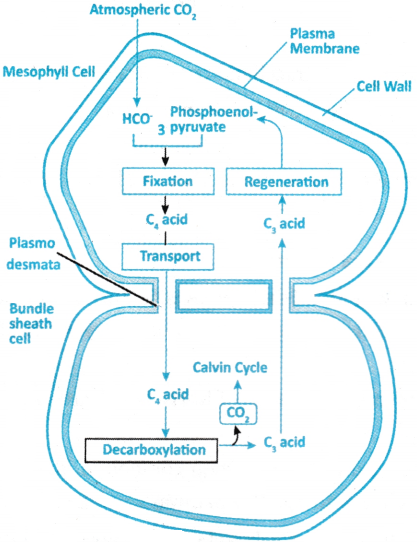
- Kortschak, Hartt and Burr found that 3-PGA is not the initial product of photosynthesis in case of sugarcane, instead it was four carbon compounds like malic and aspartic acids.
- Hatch and Slack confirmed the results of Kortschak, Hartt and Burr while working on sugarcane plants.
- The first stable compound is a four-carbon compound, the pathway is termed as C4 pathway and plants which undergo this pathway are called C4 plants.
- This pathway is also called Beta-Carboxylation pathway or Hatch-Slack pathway.
REACTIONS:
In Mesophyll cells:
- CO2 is accepted by a 3-carbon molecule phosphoenol pyruvic acid, in the form of HCO3 and is present in the mesophyll cells in the presence of PEP carboxylase and water to form oxaloacetic acid.
- CO2 phosphoenol pyruvic acid + H2O → oxaloacetic acid + H3PO4–
- Oxaloacetic acid is reduced to malic acid by using the light generated NADPH + H+ in the presence of Malic dehydrogenase.
- Oxaloacetic acid + NADPH + H+ → malic acid + NADP+
In Bundle sheath cells:
- Malic acid formed in the chloroplast of mesophyll cells is now transported to the chloroplast of bundle sheath cells.
- Malic acid now undergoes oxidative decarboxylation to form Pyruvic acid (3C) in the presence of Malic enzyme. In this NADP+ is reduced to NADPH + H+.
- Malic acid + NADP+ → pyruvic acid + NADPH + H+ + CO2
- The CO2 generated is utilized in the Calvin cycle to synthesize sugars
- The Pyruvic acid produced in bundle sheath cells moves to the chloroplast of mesophyll cells and is phosphorylated to Phosphoenol Pyruvic acid in the presence of pyruvate dikinase.
- PEP undergoes phosphorylation, then enters into the cytoplasm of the mesophyll cells.
- Pyruvic acid + 2ATP + Pi → phosphoenol pyruvic acid + 2 AMP + 2 Pi.
- During this pathway two carboxyations and one decarboxylation reaction occurs.
- To synthesize one molecule of Glucose, C4 plants utilize 30 ATP and 12 NADPH + H+.
Question 4.
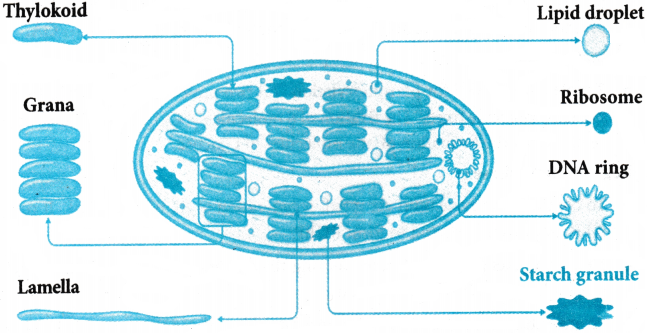
Draw a neat labelled diagram of chloroplast.
Answeer:
Question 5.
Differentiate between cyclic and non-cyclic photophosphorylation.
Answer:
| Cyclic photophosphorylation | Non-cyclic photophosphorylation |
| 1. Photosystem I is involved. | 1. Photosystem I and Photosystem II are involved. |
| 2. Electrons move in a closed circle. | 2. Electrons move in a Zigzag manner. |
| 3. Photolysis of water does not occur. | 3. Photolysis of water occurs. |
| 4. O2 is not released. | 4. O2 is released. |
| 5. One ATP molecule is formed. | 5. Two ATP molecules are formed. |
| 6. It is not inhibited by DCMU. | 6. It is inhibited by DCMU. |
VI. Long Answer Questions
Question 1.
Describe the process of reactions in the Calvin cycle.
Answer:
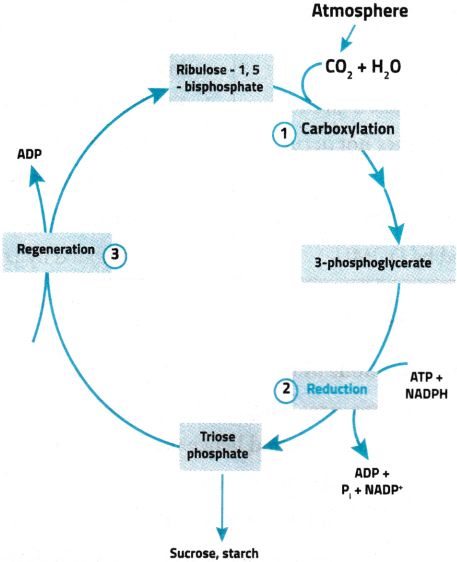
- Melvin Calvin and his associates Andrew Benson and lames Basham discovered the CO2 fixation pathway in Chlorella and hence named Calvin cycle.
- It is also called Photosynthetic carbon reduction (PCR) cycle or reductive pentose phosphate pathway (RPP cycle) or Dark reaction.
- This pathway is studied under three phases namely – A) Carboxylation, B) Reduction and C) Regeneration.
I. Carboxylation Phase:
Fixation of CO2 into a stable organic intermediate is called carboxylation. It is the most crucial step of the calvin cycle where CO2 is utilized for carboxylation of RUBP in the presence of RUBIsCO results in the formation of two molecules of 3-PGA.
II. Reduction Phase:
2 molecules of ATP for phosphorylation and two molecules of NADPH for reduction per CO2 molecule fixed. The fixation of 6 molecules of CO2 and 6 turns of the cycle are required for the formation of one molecules of Glucose.
III. Regeneration phase:
- To continue the cycle uninterrupted, regeneration of RUBP is crucial. It requires one ATP for phosphorylation to form RUBP.
- Hence for every CO2 molecule entering the Calvin cycle, 3 molecules of ATP and 2 molecules of NADPH are required.
- To meet this difference in the number of ATP and NADPH used in dark reactions, cyclic phosphorylation takes place.
- To synthesize one Glucose molecule, 18 ATP and 12 NADPH + H+ are required.
I. Multiple Choice Questions
Question 1.
Who discovered oxygen?
1. Joseph Priestly
2. T. Engel
3. Jan Ingenhousz
4. Van Neil
Answer:
1. Joseph Priestly
Question 2.
Chloroplast is
1. Single membrane-bound organelle
2. Double membrane-bound organelle
3. Triple membrane-bound organelle
4. Membrane-lacking organelle
Answer:
2. Double membrane-bound organelle
Question 3.
Which is the most abundant plant pigment in the world?
1. Chlorophyll a
2. Chlorophyll b
3. Carotenoids
4. Xanthophylls
Answer:
1. Chlorophyll a
Question 4.
Maximum absorption by chlorophyll a occurs in
1. Blue green region
2. Red green region
3. Blue red region
4. Yellow red region
Answer:
3. Blue-red region
Question 5.
LHC stands for-
1. Late Harvesting Complex
2. Light Harvesting Complex
3. Light Hanging Complex
4. Late Hanging Complex
Answer:
2. Light Harvesting Complex
Question 6.
During photosynthesis the O2 is released in
1. Lumen of thylakoid
2. Outer side of thylakoid
3. Stroma
4. Cytoplasm
Answer:
1. Lumen of thylakoid
Question 7.
For formation of 1 glucose molecule, how many turns of Calvin cycle is/are needed?
1. 3
2. 1
3. 2
4. 6
Answer:
4. 6
Question 8.
The most crucial step of Calvin cycle is
1. Carbonation
2. Carboxylation
3. Reduction
4. Regeneration
Answer:
2. Carboxylation
Question 9.
The first stable product during CO2 fixation in C4 cycle is
1. RBP
2. PEP
3. OAA
4. PGA
Answer:
3. OAA
II. Fill in the blanks
Question 1.
___________ in 1770 performed a series of experiments that revealed the essential role of air in the growth of green plants.
Answer:
Joseph Priestley
Question 2.
Chlorophyll ___________ is the chief pigment associated with photosynthesis.
Answer:
Chlorophyll a
Question 3.
In PS-I, the reaction centre chlorophyll-a has an absorption peak at ___________ nm.
Answer:
700
Question 4.
The splitting of water is associated with the PS-___________
Answer:
PS II
Question 5.
The ___________ enzyme is located on the stroma side of the membrane.
Answer:
NADP reductase
Question 6.
Chemiosmosis is helpful for the synthesis of ___________
Answer:
ATP
Question 7.
The products of light reaction are ATP, NADPH and ___________
Answer:
Oxygen
Question 8.
RuBP carboxylase also has an oxygenation activity, so it would be more correct to call. It ___________
Answer:
RUBISCO
Question 9.
‘Kranz’ anatomy is a characteristic feature of ___________ plants.
Answer:
C4
Question 10.
___________ is the major limiting factor for photosynthesis.
Answer:
CO2
III. One Word Answer Questions
Question 1.
What is the primary acceptor of CO2 in C3 plants?
Answer:
RUBP
Question 2.
Which is the first formed compound in C3 plants?
Answer:
PGA
Question 3.
What is the primary acceptor of CO2 in C4 plants?
Answer:
PEPA
Question 4.
Name the first formed compound in C4 plants.
Answer:
OAA
Question 5.
Where does photolysis of water take place in Chloroplast?
Answeer:
Lumen of thylakoid
Question 6.
Who proposed the law of limiting factors in photosynthesis?
Answer:
Blackmann
Question 7.
How many ATP are required for synthesis of one glucose in C3 plants?
Answer:
18 ATP
Question 8.
Where does light reaction take place in chloroplast?
Answer:
Grana or Thylakoids
Question 9.
Where does dark reaction take place in chloroplast?
Answer:
Stroma
Question 10.
Name the first enzyme that is involved in the carboxylation process in C3 Plants.
Answer:
RUBISCO