AP Inter 1st Year Zoology 4th Lesson Breathing and Exchange of Gases Questions and Answers
IV. Very Short Answer Questions
Question 1.
Differentiate between branchial and pulmonary respiration with examples.
Answer:
- Branchial respiration involves the use of gills, Ex: In aquatic animals like fish.
- Pulmonary respiration uses lungs, Ex: In terrestrial vertebrates like humans and birds.
Question 2.
Name the muscles that help in normal breathing movements.
Answer:
The muscles involved in normal breathing movements are the diaphragm and a specialized set of muscles- External and internal intercostal muscles.
Question 3.
Define vital capacity.
Answer:
- The maximum volume of air a person can breathe in after a forced expiration.
- This includes ERV, TV and IRV (or) the maximum volume of air a person can breathe out after a forced inspiration.
Question 4.
What factors affect the rate of diffusion of respiratory gases?
Answer:
Solubility of the gases, and the thickness of the respiratory membrane, partial pressure gradient are also some important factors that can affect the rate of diffusion.
Question 5.
Mention the three major layers of diffusion membrane in lungs.
Answer:
The diffusion membrane is made up of three major layers namely, the thin squamous epithelium of alveoli, the endothelium of alveolar capillaries and the basement membrane However, its total thickness is much less than a millimeter.
Question 6.
What is the effect of pCO2 on oxygen transport?
Answer:
The pCO2 significantly effect oxygen transport by influencing haemoglobin’s affinity for oxygen.
Question 7.
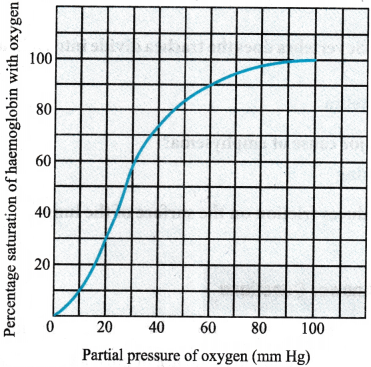
Draw a diagram of oxygen dissociation curve.
Answer:
Question 8.
Mention any two respiratory disorders and their symptoms in human beings.
Answer:
- Asthma: Asthma is difficulty in breathing causing wheezing due to inflammation of bronchi and bronchiole.
- Emphysema: Emphysema is a chronic disorder in which alveolar walls are damaged due to which respiratory surface is decreased.
- One of the major causes of this is cigarette smoking.
Question 9.
What is Tidal volume? Find out the Tidal volume (Approximate value) for a healthy human in an hour.
Answer:
During a normal respiration, the volume of air expired or inspired is referred to as tidal volume (TV). The tidal volume is approximately 500ml for a healthy individual.
- A healthy individual can expire or inspire nearly 6000-8000ml of air per minute or around 12-16 times a minute.
- Hence, the tidal volume for a healthy man in an hour approximately can be between 3,60,000 ml and 4,80,000 ml.
V. Short Answer Questions
Question 1.
Explain the process of inspiration and expiration under normal conditions in man
Answer:
Breathing involves 2 stages such as inspiration and expiration:
Inspiration: Intake of atmospheric air into the lungs is called inspiration.
- It is an active process, as it takes place by the contraction of the muscles of the diaphragm the external intercostal muscles, which extends in between the ribs.
- The contraction of the diaphragm/phrenic muscle increases the volume of the thoracic chamber in the anteroposterior axis.
- The contraction of external intercostal muscles lifts up the ribs & sternum causing an increase in the volume of the thoracic chamber in the dorsoventral axis.
- The overall increase in the thoracic volume causes a similar increase in the ‘pulmonary volume’.
- An increase in the pulmonary volume decreases the intrapulmonary pressure to less than that of the atmosphere, which forces the air from the outside to move into the lungs.
Expiration: Release of alveolar air to the exterior is called expiration.
- It is a passive process.
- Relaxation of the diaphragm and the external intercostal muscles returns the diaphragm and sternum to their normal positions, and reduces the thoracic volume and thereby the pulmonary volume.
- This leads to an increase in the intra-pulmonary pressure to slightly above that of the atmospheric pressure causing the expulsion of air from the lungs.
Question 2.
What are the major mechanisms of CO2 transport in human beings ? Explain.
Answer:
- CO2 is carried by haemoglobin as carbamino-haemoglobin (about 20-25 percent). This binding is related to the partial pressure of CO2, pO2 is a major factor which could effect this binding.
- When pCO2 is high and pO2 is low as in the tissues, more binding of carbondioxide occurs whereas, when the pCO2 is low and pO2 is high as in the alveoli, dissociation of CO2 from carbamino-haemoglobin takes place, i.e., CO2 which is bound to haemoglobin from the tissues is delivered at the alveoli.
- RBCs contain a very high concentration of the enzyme, carbonic anhydrase and minute quantities of the same are present in the plasma too. This enzyme facilitates the following reaction in both directions.

- At the tissue site where partial pressure of CO2 is high due to catabolism. CO2 diffuses into blood (RBCs and Plasma) and forms HCO3– and H+.
- At the alveolar site where pCO2 is low, the reaction proceeds in the opposite direction leading to the formation of CO2 and H2O.
- Thus CO2 trapped as bicarbonate at the tissue level and transported to the alveoli is released out as CO2.
- Every 100 ml of deoxygenated blood delivers approximately 4 ml of CO2 to the alveoli.
Question 3.
How is respiration regulated in man?
Answer:
- In humans, respiration is under both nervous and chemical regulation.
- Human beings have a significant ability to maintain and moderate the respiratory rhythm to suit the demands of the body tissues. This is done by the neural system.
- A specialized centre present in the medulla region of the brain called Respiratory rhythm centre is primarily responsible for this regulation.
- Another Centre present in the pons region of the brain called Pneumotaxic centre can moderate the functions of the respiratory rhythm centre.
- Neural signal from this center can reduce the duration of inspiration and thereby alter the respiratory rate.
Chemical regulation:
- A chemo sensitive area is situated adjacent to the rhythm center which is highly sensitive to CO2 and hydrogen ions.
- Increase in these substances can activate this center which in turn can signal the rhythm centre to make necessary adjustments in the respiratory process by which these substances can be eliminated.
- Receptors associated with aortic arch and carotid artery also can recognize changes in CO2 and H+ concentration and send necessary signals to the rhythm centre for remedial actions.
- The role of oxygen in the regulation of respiratory rhythm is quite insignificant.
Question 4.
Describe the disorders of respiratory system in man.
Answer:
Disorders of the Respiratory System:
1. Asthma:
- Asthma is difficulty in breathing causing wheezing due to inflammation of bronchi and bronchiole.
- Asthma may he attributed to allergic reactions of the mast cell in lungs.
2. Emphysema:
- Emphysema is a chronic disorder in which alveolar walls are damaged due to which respiratory surface is decreased.
- One of the major causes of this is cigarette smoking.
3. Occupational Respiratory Disorders: In certain industries, especially those involving grinding or stone-breaking, so much dust is produced that the defense mechanism of the body cannot fully cope with the situation.
Silicosis and Anthracosis are occupational respiratory disorders (ORDs)
- Long exposure can give rise to inflammation leading to fibrosis (proliferation of fibrous tissues) and thus causing serious lung damage.
- Workers in such industries should wear protective masks.
Question 5.
Distinguish between
(A) IRV and ERV
(B) VC and TLC
Answer:
(A) IRV and ERV:
- Inspiratory reserve volume (IRV): Maximum volume of air that can be inhaled during forced breathing in addition to the tidal volume. This is about 2500 ml to 3000 ml of air.
- Expiratory reserve volume (ERV): Maximum volume of air that can be exhaled during forced breathing, in addition to the tidal volume. This is about 1000 ml to 1100 ml of air.
(B) VC and TLC: Vital capacity (VC): The maximum volume of air a person can breathe in after ‘forced expiration’. This includes ERV, TV and IRV or the maximum volume of air a person can breathe out after “forced inspiration.
VC = TV + IRV + ERV
Total lung capacity (TLC): The total volume of air accommodated in the lungs at the end of “forced inspiration”. This includes RV, ERV, TV and IRV or vital capacity + residual volume.
TLCVC + RV (or) TLC = ERV + IRV + TV + RV
VI. Long Answer Questions
Question 1.
Describe the respiratory system in man.
Answer:
Human respiratory system:
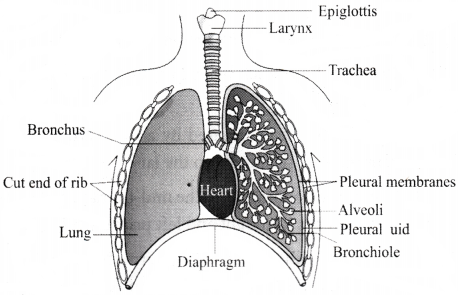
- Human have a pair of external nostrils opening out above the upper lips. It leads into a nasal chamber through the nasal passage.
- The nasal chamber opens into pharynx, a portion of which is the common passage for food and air.
- The pharynx opens through the larynx region into the trachea.
- Larynx is a cartilaginous box which helps in sound production and hence called the sound box.
- During swallowing glottis can be covered by a thin elastic cartilaginous flap called epiglottis to prevent the entry of food into the larynx.
- Trachea is a straight tube extending up to the mid-thoracic cavity, Which divides at the level of 5th thoracic vertebra into right and left primary bronchi.
- Each bronchi undergoes repeated divisions to form the secondary (lobar) and tertiary (segmental) bronchi and bronchioles ending up in very thin terminal bronchioles.
- The tracheae, primary, secondary and tertiary bronchi and initial bronchioles are supported by incomplete cartilaginous rings.
- Each terminal bronchiole gives rise to a number of very thin, irregular-walled and vascularized bag-like structures called alveoli.
- The branching network of bronchi, bronchioles and alveoli comprise the lungs.
- We have two lungs which are covered by double layered pleura, with pleural fluid between them.
- It reduces friction on the lung-surface.
- The outer pleural membrane (parietal pleura) is in close contact with the thoracic lining whereas the inner pleural membrane (Visceral pleura) is in contact with the lung surface.
- The part starting with the external nostrils up to the terminal bronchioles constitute the conducting part whereas the alveoli and their duct form the respiratory or exchange part of the respiratory system or upper respiratory tract.
- The conducting part transports the atmospheric air to the alveoli, clear it from foreign particles, humidifies and also brings the air to body temperature.
- Exchange part is the site of actual diffusion of O2 and CO2 between blood and atmospheric air.
- The lungs are situated in the thoracic chamber which is anatomically an air tight chamber.
- The thoracic chamber is formed dorsally by vertebral column, ventrally by the sternum, laterally by the ribs and on the lower side by the dome shaped diaphragm.
- The anatomical setup of lungs in thorax is such that any change in the volume of the thoracic cavity will be reflected in the lung (pulmonary) cavity. Such an arrangement is essential for breathing, as we cannot directly alter the pulmonary volume.
Question 2.
Write an essay on the transport of oxygen and carbon dioxide by blood.
Answer:
Transport of Gases:
- Blood is the medium of transport for O2 and CO2.
- About 97 percent of O2 is transported by RBCs in the blood. The remaining 3 percent of O2 is carried in a dissolved state through the plasma.
- Nearly 20-25 percent of CO2 is transported by RBCs where as 70 percent of it is carried as bicarbonate (Sodium bicarbonate).
- About 7 percent of CO2 is carried in a dissolved state through plasma.
1. Transport of oxygen
- Haemoglobin is a red coloured iron containing pigment present in the RBCs.
- O2 can bind with Haemoglobin in a reversible manner to form Oxyhaemoglobin.
- Each haemoglobin molecule carry a maximum of four molecules of O2. Thus, chemical formula of Oxyhaemoglobin is Hb(O2)4.
- Binding of oxygen with haemoglobin is primarily related to partial pressure of O2.
- Partial pressure of CO2, hydrogen ion concentration and temperature are the other factors which can interfere with this binding.
- A sigmoid curve is obtained when percentage saturation of haemoglobin with O2 is plotted against the pO2.
- This curve is called the Oxygen dissociation curve and is highly useful in studying the effect of factors like pCO2, H+ concentration, etc., on binding of O2 with haemoglobin.
- In the alveoli, where there is high pO2, low pCO2, lesser H+ concentration and lower temperature, the factors are favourable for the formation of
- Oxyhaemoglobin, whereas in the tissues, where low pO2, high pCO2 high H+ concentration and higher temperature exist, the conditions are favourable for dissociation of oxygen from the oxyhaemoglobin.
- This clearly indicates that O2 gets bound to haemoglobin in the lung surface and gets dissociated at the tissues. Every 100 ml of oxygenated blood can deliver around 5 ml of O2 to the tissues under normal physiological conditions.
2. Transport of Carbondioxide
- CO2 is carried by haemoglobin as carbamino-haemoglobin (about 20-25 percent). This binding is related to the partial pressure of CO2, pO2 is a major factor which could effect this binding.
- When pCO2 is high and pO2 is low as in the tissues, more binding of carbondioxide occurs whereas, when the pCO2 is low and pO2 is high as in the alveoli, dissociation of CO2 from carbamino-haemoglobin takes place, i.e., CO2 which is bound to haemoglobin from the tissues is delivered at the alveoli.
- RBCs contain a very high concentration of the enzyme, carbonic anhydrase and minute quantities of the same are present in the plasma too. This enzyme facilitates the following reaction in both directions.
- At the tissue site where partial pressure of CO2 is high due to catabolism. CO2 diffuses into blood (RBCs and Plasma) and forms HCO2 and H+.
- At the alveolar site where pCO2 is low, the reaction proceeds in the opposite direction leading to the formation of CO2 and H2O.
- Thus CO2 trapped as bicarbonate at the tissue level and transported to the alveoli is released out as CO2
- Every 100 ml of deoxygenated blood delivers approximately 4 ml of CO2 to the alveoli.
I. Multiple Choice Questions
Question 1.
The thoracic chamber of vertebrates is bound ventrally by the
1. diaphragm
2. ribs
3. abdomen
4. sternum
Answer:
4. sternum
Question 2.
During inspiration the diaphragm
1. contracts and moves upwards
2. contracts and moves downwards
3. relaxes and moves upwards
4. relaxes and moves downwards
Answer:
2. contracts and moves downwards
Question 3.
Air is breathed in through
1. trachea – lungs – larynx – pharynx – alveoli – bronchi – bronchioles
2. nose – trachea – lungs – larynx – pharynx – alveoli – bronchi – bronchioles
3. nostrils – pharynx – larynx – trachea – bronchi – bronchioles – alveoli
4. nose – pharynx – mouth – oesophagus – lungs – bronchi – bronchioles
Answer:
3. nostrils – pharynx – larynx – trachea – bronchi – bronchioles – alveoli
Question 4.
Which instrument helps in the clinical assessment of pulmonary functions?
1. ECG
2. Sphygmomanometer
3. Spirometer
4. Barometer
Answer:
3. Spirometer
Question 5.
The maximum volume of air a person can breathe in after a forced expiration is termed as
1. inspiratory capacity
2. expiratory capacity
3. functional residual capacity
4. vital capacity
Answer:
4. vital capacity
Question 6.
What will be the pO2 and pCO2 in the atmospheric air when compared to those in the alveolar air?
1. pO2 lesser, pCO2 higher
2. pO2 higher, pCO2 lesser
3. pO2 higher, pCO2 higher
4. pO2 lesser, pCO2 lesser
Answer:
Question 7.
The figure given below shows a small part of human lung where exchange of gases takes place. Select the option which represents the labelled parts A, B, C, D.
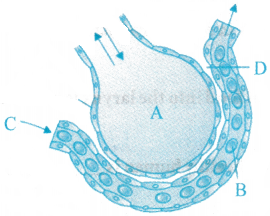
1. (A) Arterial capillary, (B) Alveolar cavity,(C) Basement substance, (D)Red blood cells
2. (A) Alveolar cavity,(B) Red blood cells, (C) Arterial capillary, (D) Basement substance
3. (A) Basement substance, (B) Alveolar cavity, (C) Arterial capillary, (D) Red blood cells
4. (A) Red blood cells, (B) Arterial capillary, (C) Basement substance, (D) Alveolar cavity
Answer:
2. (A) Alveolar cavity,(B) Red blood cells, (C) Arterial capillary, (D) Basement substance
Question 8.
Select the favourable conditions required for the formation of oxyhaemoglobin at the alveoli.
1. High pO2, low pCO2, less H+ concentration, lower temperature
2. High pO2, high pCO2, less H+ concentration, higher temperature
3. Low pO2, low pCO2, more H+ concentration, higher temperature
4. Low pO2, High PCO2, more H+ concentration, higher temperature
Answer:
1. High pO2, low pCO2, less H+ concentration, lower temperature
Question 9.
Carbonic anhydrase enzyme is mainly found in the
1. RBC
2. thrombocytes
3. WBC
4. platelets
Answer:
1. RBC
Question 10.
Match the following columns and select the correct option from the codes given below.
| Column – I | Column – II |
| A. Pneumotaxic center | i. Medulla oblongata |
| B. Haemoglobin | ii. Pons region of the brain |
| C. Carbonic anhydrase | iii. Iron |
| D. Respiratory rhythm center | iv. RBC |
1. A – i, B – iii, C – ii, D – iv
2. A – ii, B – iii, C – iv, D – i
3. A – iii, B – ii, C – iv, D – i
4. A – iv, B – i, C – iii, D – ii
Answer:
2. A – ii, B – iii, C – iv, D – i
| Column – I | Column – II |
| A. Pneumotaxic center | ii. Pons region of the brain |
| B. Haemoglobin | iii. Iron |
| C. Carbonic anhydrase | iv. RBC |
| D. Respiratory rhythm center | i. Medulla oblongata |
II. Fill in the Blanks
Question 1.
The cartilaginous box that helps in sound production in man ___________.
Answer:
Larynx
Question 2.
During swallowing, the entry of food into the larynx is prevented by ___________.
Answer:
Epiglottis
Question 3.
The average respiratory rate of a healthy human is ___________ breaths per minute.
Answer:
12 – 16 times
Question 4.
Oxygen binds with haemoglobin to form ___________.
Answer:
Oxyhaemoglobin
Question 5.
Each haemoglobin molecule can carry a maximum of
oxygen.
Answer:
Four [4]
Question 6.
The respiratory disorder characterized by whezing due to inflammation of bronchi and bronchioles ___________.
Answer:
Asthma
Question 7.
Respiratory rhythm centre is present in the ___________ of hte brain.
Answer:
Medulla
Question 8.
Contraction of the diaphragm ___________ the volume of the thoracic cavity.
Answer:
Increases
III. One Word Answer Questions
Question 1.
What is the common passage for both food and air in man?
Answer:
Pharynx
Question 2.
Name the fluid filled double layered membrane that covers the lungs in man.
Answer:
Pleura
Question 3.
What is the dome shaped structure found on the lower side of the thoracic chamber?
Answer:
Diaphragm
Question 4.
At which thoracic vertebra does the trachea divide into right and left pulmonary bronchi in man?
Answer:
5th thoracic vertebra
Question 5.
What is the major cause of emphysema?
Answer:
Cigarette smoking
Question 6.
Which fluid reduces friction on the surface of the lungs?
Answer:
Pleural fluid