AP Inter 1st Year Zoology 6th Lesson Excretory Products and Their Elimination Questions and Answers
IV. Very Short Answer Questions
Question 1.
What are columns of Bertini?
Answer:
The projections of the cortex that separate the renal pyramids are called columns of Bertin.
Question 2.
Name the structural and functional unit of the kidney. What are its two main parts?
Answer:
Nephron is the structural and functional unit of the kidney. There are two types of nephrons namely cortical nephrons and juxtamedullary nephrons. Each nephron has two parts called Glomerulus and renal tubule.
Question 3.
Distinguish between cortical and juxta medullary nephrons.
Answer:
- Cortical nephrons: The loop of Henle is too short and extends only very little into the medulla. Vasa recta is absent or highly reduced. These are many in number.
- Juxta medullary nephrons: The loop of Henle is very long and runs deep into the medulla. Vasa recta is well developed. These are few in number.
Question 4.
Define glomerular filtration.
Answer:
Filtration of blood through the fine slit pores and fenestrations due to NFP (Net Filtration Pressure) by passive process from glomerulus into the lumen of the Bowman’s capsule is called glomerular filtration.
Question 5.
Define Glomerular Filtration Rate (GFR).
Answer:
The amount of filtrate formed by both kidneys per minute is called Glomerular filtration rate (GFR). It is approximately 125 ml/minute. GFR per day is 180 F.
Question 6.
What is the role of atrial natriuretic peptide in the regulation of urine formation ?
Answer:
- Atrial natriuretic peptide (ANP) is secreted by the wall of the right atrium when the flow of blood to the right atrium increases. ANP is a vasodilator and thus lowers the blood pressure.
- ANP mechanism acts as a counter check on the ‘RAAS’ (Renin Angiotensin Aldosterone System).
Question 7.
What is meant by osmoregulation ?
Answer:
Osmoregulation is the process of maintaining the quantity of water and dissolved solutes in balance, i.e., maintenance of homeostasis of an organism with respect to water.
V. Short Answer Questions
Question 1.
Terrestrial animals are generally either ureotelic or uricotelic not ammonotelic. Why ?
Answer:
Generally, the chief nitrogenous waste material in terrestrial animals is either urea or uric acid, but not ammonia. Ammonia is the more toxic material than urea and uric acid and requires more water to be eliminated.
As terrestrial animals have to conserve body water, ammonia formed in these animals is converted into urea or uric acid that requires less water for elimination. Urea is 100,000 times less toxic than ammonia. So, it is transported and stored safely at higher concentrations in the body in certain animals such as cartilagenous fishes.
As urea is less toxic, some amount of urea is retained in the medullary fluid of kidneys, it maintain the desired osmolarity. Uric acid is less toxic than urea. It is insoluble in water, so it can be excreted as semisolid paste or pellets with very little water loss. Therefore, terrestrial animals are generally either ureotelic or uricotelic and not ammoniotelic.
Question 2.
Classify the vertebrates based on the nitrogenous waste products they excrete and give examples.
Answer
There are three types of vertebrates in accordance with their chief excretory products. They are.
i. Ammoniotelic vertebrates:The chief nitrogenous waste material is ammoniAnswer:Ammonia is formed by the oxidative deamination of amino acids in liver. Ammonia is highly toxic and readily soluble in water; hence it should be eliminated from the body quickly in diluted urine.
E.g.: Bony fishes, larval forms of amphibians.
ii. Ureotelic vertebrates: The chief nitrogenous waste material is ureAnswer:Urea is produced in liver by ornithine cycle. Urea is 100,000 times less toxic than ammonia. So, it is transported and stored safely at higher concentrations in the body in certain animals such as cartilagenous fishes. As urea is less toxic, some amount of urea is retained in the medullary fluid of kidneys to maintain the desired osmolarity.
E.g.: Cartilagenous fishes, most of the amphibians and mammals.
iii. Uricotelic vertebrates: The chief nitrogenous waste material is uric acid. It is mainly formed from ammonia mostly in liver. Uric acid is less toxic than ureAnswer:It is insoluble in water, so it can be excreted as semisolid paste or pellets with very little water loss.
E.g.: Reptiles and Birds.
Question 3.
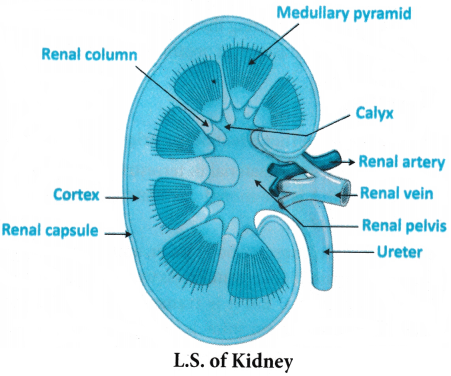
Draw a labelled diagram of the L.S. of kidney.
Answer:
Question 4.
Describe the internal structure of the kidney of man.
Answer:
Internal structure:
- A longitudinal section of the kidney shows two distinct regions, the outer cortex and the inner medulla. The medulla is divided into multiple cone shaped masses of tissue called renal pyramids. The renal pyramids are separated by the projections of the cortex called columns of Bertin.
- The base of each pyramid originates at the border between the cortex and the medulla and terminates in the renal papilla. Renal papillae project into cup like calyces, formed by the funnel shaped pelvis, which continues out as the ureter.
Question 5.
Explain the process of micturition.
Answer:
Micturition: The process of passing out urine is called micturition and the neural mechanism involved is called “micturition reflex”.
- Urine formed by the nephrons is ultimately carried A to the urinary bladder where it is stored till a voluntary signal is given by the CNS.
- This signal is initiated by the stretching of the urinary bladder as it gets filled with urine.
- Stretch receptors on the walls of the bladder send signals to the CNS.
- The CNS passes on motor messages to initiate the contraction of smooth muscles of the bladder and simultaneous relaxation of the urethral sphincter, causing the release of urine.
Question 6.
What is the significance of juxta glomerular apparatus (JGA) in kidney function?
Answer:
The functioning of the kidneys is efficiently monitored and regulated by hormonal feedback control mechanism involving the Hypo-thalamus, Juxta Glomerular Apparatus (JGA) and to a certain extent, the heart. The Juxta Glomerular apparatus plays a complex regulating role. A fall in glomerular blood flow / glomerular blood. A pressure/GFR can activate the JG cells to release an enzyme called renin into the blood.
This renin catalyses the conversion of 1-angiotensinogen (produced by the liver) into angiotensin-1.
- Angiotensin-I is converted into angiotensin-II by angiotensin converting enzyme (ACE) which is released by lungs.Angiotensin-II stimulates the adrenal cortex to secrete aldosterone.
- Aldosterone causes reabsorption of Na+ and water from the DCT and CD (collecting duct) to reduce their loss through urine, and also promotes secretion of K+ ions into the DCT and CD. It leads to an increase in the blood pressure and GFR.
- This complex mechanism is generally known as Renin-Angiotensin-Aldosterone System (RAAS). •
Question 7.
Give a brief account on counter current mechanism.
Answer:
- Mammals have the ability to produce concentrated urine. The Henle’s loop and vasa recta play a significant role in this. The flow of renal filtrate in the two limbs of Henle’s loop is in opposite direction and thus forms a counter current.
- The flow of blood through the two limbs of vasa recta is also in a counter current pattern. The counter current mechanism helps to maintain a concentration gradient in the medullary interstitium.
- The gradient is mainly caused by NaCl and urea. Presence of such interstitial gradient helps easy passage of water from the collecting duct, thereby concentrating the filtrate.
Question 8.
Describe the role of liver, lungs and skin in excretion.
Answer:
Liver, lungs and skin also help in the elimination of excretory wastes.
I. Liver: Liver is the largest gland in our body. It changes the decomposed haemoglobin of the worn-out RBCs into bile pigments, namely, bilirubin and biliverdin.These pigments pass into the alimentary canal along with the bile for elimination. The liver also excretes cholesterol, degraded steroid hormones, certain vitamins and drugs via bile.
II. Lungs: Lungs eliminate the following. About 18 L of C02, per day. Significant amount of water per day in the form of water vapor. Various volatile materials.
III. Skin: Human skin possesses two types of glands for the elimination of certain substances.
a. Sweat glands: They secrete sweat, which helps in the removal of some of the wastes like NaCl, small amounts of urea, lactic acid etc.
b. Sebaceous glands: They eliminate sterols, hydrocarbons, waxes through sebum. This secretion provides a protective ‘oily covering’ to the skin.
VI. Long Answer Questions
Question 1.
Describe the excretory system of man, giving the structure of a nephron. [March-26]
Answer:
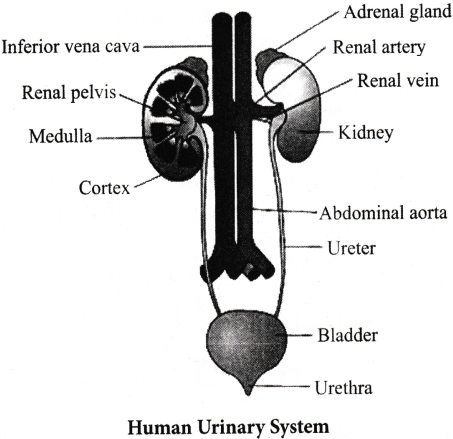
In humans, the excretory system consists of a pair of kidneys, a pair of ureters, a urinary bladder and urethra.
Kidneys:
- Kidneys are reddish brown, bean shaped structures.
- They are situated on either side of the vertebral column between the levels of the last thoracic and third lumbar vertebrae.
- They are retroperitoneal organs.
- The right kidney is slightly lower than the left one due to the presence of liver.
- The outer surface of the kidney is convex and the inner surface has a deep notch called hilum.
- Each kidney is surrounded by a fibrous capsule.
Internal structure: A longitudinal section of the kidney shows two distinct regions, the outer cortex and the inner medulla.
- The medulla is divided into multiple cone shaped masses of tissue called renal pyramids.
- The renal pyramids are separated by the projections of the cortex, called columns of Bertin.
- The base of each pyramid originates at the border between the cortex and the medulla and terminates in the renal papilla.
- Renal papillae project into cup like calyces, formed by the funnel shaped pelvis, which continues out as the ureter.
Ureters:
- These are slender whitish tubes emerging from the pelvis of the kidneys.
- Their walls are lined by transitional epithelium. They run downwards and open into the urinary bladder.
Urinary bladder: It is a median storage sac, situated in the lower abdominal cavity.
- It has thick, muscular, distensible wall lined by transitional epithelium.
- The neck of the bladder leads into the urethra, which has an internal urethral sphincter and external urethral sphincter.
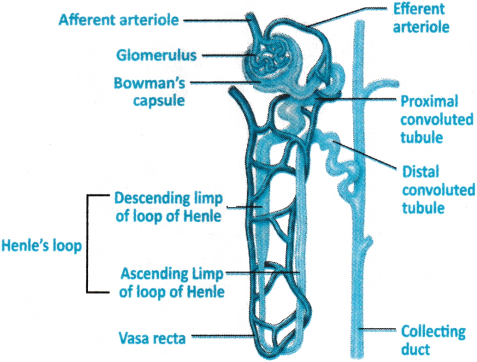
- Each kidney has nearly one million nephrons which are the structural and functional units.
- Each nephron has two parts – the Bowman’s capsule and the renal tubule.
Diagrammatic representation of a nephron showing blood vessels, duct and tubule.
Bowman’s capsule:
- It is present in cortex.
- Bowman’s capsule is a double walled cup.
- The inner wall of the Bowman’s capsule has certain unique cells called podocytes which wrap around each capillary.
- The podocytes are arranged in an intricate manner so as to leave some minute spaces called filtration slits or slit pores. The Bowman’s capsule encloses a tuft of capillaries called glomerulus.
- The endothelial cells of the capillaries have numerous pores or fenestrations.
- The glomerulus along with the Bowman’s capsule constitutes the Malpighian body or renal corpuscle.
Renal tubule: It has three segments.
- PCT (Proximal convoluted tubule)
- Henle’s loop
- DCT (Distal convoluted tubule)
1. Proximal convoluted tubule (PCT):
- It is present in cortex.
- It is wide and highly coiled.
- It is lined by simple cuboidal epithelium with brush border.
2. Henle’s loop:
- It is present in medulla.
- It is hair-pin shaped. It has descending and ascending limbs.
- The proximal part of the ascending limb is thin and the distal part is thick.
- The thick ascending limb continues into the DCT.
3. Distal convoluted tubule (DCT):
- It is present in cortex.
- The DCT present in cortex continues as the ‘initial collecting duct’ in the cortex.
- Some initial collecting ducts unite to form a straight collecting duct, which passes through the medullary pyramid.
- In the medulla, the tubes of each pyramid join and form the duct of Bellini, which finally opens on the tip of the renal papilla.,
Types of nephrons:
There are two types of nephrons namely cortical nephrons and juxta medullary nephrons.
- Cortical nephrons: The loop of Henle is too short and extends only very little into the medullAnswer:Vasa recta is absent or highly reduced.
- Juxta medullary nephrons: The loop of Henle is very long and runs deep into the medulla. Vasa recta is well developed.
Blood capillary network:
- The efferent arteriole emerging from the glomerulus forms a fine capillary network called the peritubular capillaries around the renal tubule.
- The portion of the peritubular capillaries that surrounds the loop of Henle is called vasa recta.
Question 2.
Explain the physiology of urine formation.
Answer:
Urine Formation:
The formation of urine involves three main processes namely,
a) Glomerular filtration
b) Selective reabsorption
c) Tubular secretion.
Glomerular filtration: Filtration of blood through the fine slit pores and fenestrations due to NFP by-passive process from glomerulus into the lumen of the Bowman’s capsule is called glomerular filtration.
- The hydrostatic pressure of the blood while flowing in the glomerulus is 60mmHg.
- It is opposed by ‘glomerular colloidal osmotic pressure’ of 32 mmHg; and Bowman’s capsular hydrostatic pressure of 18 mmHg.
- The Net Filtration Pressure (NFP) is 10mm Hg (60 – 32 – 18 = 10).
- This causes the filtration of blood through the 3 layered filtrate membrane.
- The filtrate contains almost all the constituents of the plasma, except the proteins. The filtrate thus formed is called glomerular filtrate, which is hypotonic to the cortical fluid.
- It passes into the next part of the renal tubule.
Selective reabsorption and secretion:
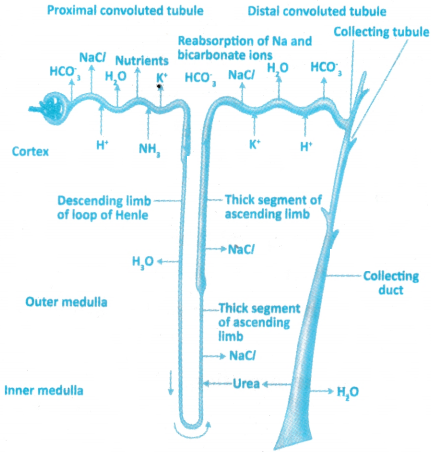
About 85% of the filtrate is reabsorbed by the PCT and descending limb of Henle’s loop by obligatory reabsorption and the reabsorption of the rest of the fluid is regulated.
1. In the Proximal Convoluted Tubule (PCT):
- Nearly all the essential nutrients, 70-80% of electrolytes and water are reabsorbed.
- Na+ is actively transported into the cortical interstitial fluid. This transfer of positive charge drives the passive transport of CF.
- Glucose, amino acids and other essential substances are also ‘actively’ transported. Movement of water occurs by ‘osmosis’.
- PCT also helps in the secretion of H+ ions and NH3, into the filtrate and the absorption of HCO3–, to maintain the pH and ionic balance of the body fluids.
- Proximal convoluted tubule Distal convoluted tubule
2. In the Henle’s loop:
- The descending limb is permeable to water and almost impermeable to electrolytes.
- Reabsorption of water continues as the filtrate moves along the descending limb (passive transport). As a result, the filtrate concentration gradually increases as it moves towards the inner medulla.
- At proximal thin segment of ascending limb, NaCl is reabsorbed passively, and at distal thick segment, NaCl is reabsorbed actively.
- The ascending limb is impermeable to water. Thus the filtrate becomes progressively more dilute as it moves up to the cortex (towards the DCT).
3. In the Distal Convoluted Tubule (DCT):
- “Facultative reabsorption” of Nat and water takes place in this segment.
- The reabsorption of water is variable depending on several conditions and is regulated byADH.
- DCT is also capable of reabsorption of HCO3–, and secretion of H+ ions. K+ ions and NH3, into the DCT from the peritubular network.
4. In the Collecting Duct (CD):
- Considerable amount of water could be reabsorbed from this region to produce concentrated urine.
- Reabsorption of small amount of urea also takes place in this segment.
- Selective secretion of H+ and K+ ions takes place.
- The renal fluid after the process of facultative reabsorption in the CD, influenced by ADH, constitutes the ‘urine’, that is sent out.
- Urine in the CD is hypertonic to the plasma of blood.
I. Multiple Choice Questions
Question 1.
The most toxic form of nitrogenous waste is
1. Uric acid
2. Ammonia
3. Urea
4. Carbon dioxide
Answer:
2. Ammonia
Question 2.
Which of the following animals are commonly ureotelic ?
1. Reptiles
2. Aquatic insects
3. Mammals
4. Land snails
Answer:
3. Mammals
Question 3.
Which of the following structures are found in between the renal pyramids ?
1. Glomerulus
2. Renal calyces
3. Renal tubule
4. Columns of Bertini
Answer:
4. Columns of Bertini
Question 4.
Identify the A. B. C. D parts of the Malpighian body given below.
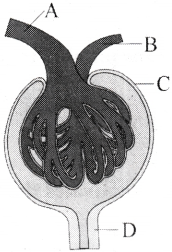
1. A-PCT B-Bowman’s capsule C-Efferent arteriole D-Afferent arteriole
2. A-Afferent arteriole B-Efferent arteriole C-Bowman’s capsule D-PCT
3. A-PCT B-Afferent arteriole C-Bowman’s capsule D-Efferent arteriole
4. A-Bowman’s capsule B-Efferent arteriole C-Afferent arteriole D-PCT
Answer:
2. A-Afferent arteriole B-Efferent arteriole C-Bowman’s capsule D-PCT
Question 5.
In which part of the nephron does conditional reabsorption of Na and water take place?
1. Proximal convoluted tubule (PCT)
2. Distal convoluted tubule (DCT)
3. Loop of Henle
4. Bowman’s capsule
Answer:
2. Distal convoluted tubule (DCT)
Question 6.
What is the effect of ADH on blood vessels?
1. Causes vasodilation
2. Causes vasoconstriction
3. Decreases blood pressure
4. No effect on blood vessels
Answer:
2. Causes vasoconstriction
Question 7.
Which hormone from the adrenal cortex facilitates the reabsorption of Na and water ?
1. ADH
2. Aldosterone
3. Renin
4. Angiotensin II
Answer:
2. Aldosterone
Question 8.
Which organ removes large amounts of CO2 and water as part of excretion ?
1. Liver
2. Lungs
3. Kidneys
4. Skin
Answer:
2. Lungs
Question 9.
The ultimate method for correcting acute renal failure (kidney failure) is
1. Dialysis
2. Haemodialysis
3. Medication
4. Kidney transplantation
Answer:
4. Kidney transplantation
Question 10.
Note the following and identify the correct path of renal fluid or urine
A. Calyx
B. Pelvis
C. Urinary bladder
D. Ureter
1. A, C, B, D
2. B, C, D, A
3. C, B, A, D
4. A, B, D, C
Answer:
4. A, B, D, C
II. Fill in the Blanks
Question 1.
The medulla of kidney is divided into conical masses called ____________.
Answer:
Medullary pyramids
Question
The ‘U’ shaped blood vessel that runs parallel to the loop of Henle is ____________.
Answer:
Vasa recta
Question 3.
The specialized epithelial cells of Bowman’s capsule are called ____________.
Answer:
Podocytes
Question 4.
A fall in glomerular blood pressure activates the ____________ cells to release renin.
Answer:
Juxta glomerular (JG)
Question 5.
Glycosuria and Ketonuria are the symptoms of the disorder ____________.
Answer:
Diabetes mellitus
Question 6.
____________ is added to the blood before it is pumped back into the body after haemodialysis.
Answer:
Anti-heparin
III. One Word Answer Questions
Question 1.
Which organ converts ammonia into urea in mammals?
Answer:
Liver.
Question 2.
Which nitrogenous waste requires the least amount of water for excretion?
Answer:
Uric acid.
Question 3.
What are the functional units of the kidney?
Answer:
Nephrons.
Question 4.
Name the blood vessel that carries away the blood from the glomerulus.
Answer:
Efferent arteriole.
Question 5.
What is the double walled cup like Structure of the nephron?
Answer:
Bowman’s capsule.
Question 6.
Which type of nephrons have short loops of Henle?
Answer:
Cortical nephrons.
Question 7.
Name the process of releasing urine from the bladder.
Answer:
Micturition.