AP Inter 1st Year Botany 1st Lesson Biological Classification Questions and Answers
IV. Very Short Answer Questions
Question 1.
What is the nature of the cell wall in Diatoms?
Answer:
In Diatoms, the cell wall forms two thin overlapping shells, which fit together like a soapbox. The cell walls are embedded with silica and thus they are indestructible.
Question 2.
What do the terms “Phycobiont” and “Mycobiont” refer to?
Answer:
The algal component in a lichen is called a phycobiont and the fungal component in a lichen is called a mycobiont.
Question 3.
What do the terms “Algal blooms” and “Red tides” signify?
Answer:
- The luxuriant growth of cyanobacterial members in stagnant polluted waters due to excess of nitrogen and phosphorus from fertilizers and sewage are called algal blooms.
- Red dinoflagellates like Gonyaulax undergo rapid multiplication that they make the sea red. Hence it is called “red tides”.
Question 4.
How are “Viroids” different from “Viruses”?
Answer:
| Viroids |
Viruses |
| i) The infectious agents with only nucleic acid (RNA) are called viroids. |
i) The infectious agents with both nucleic acid (DNA or RNA) and protein coat are called viruses. |
| Ex: Potato spindle tuber virus (PSTV) |
Ex: Tobacco mosaic virus (TMV). |
Question 5.
State two economically important uses of Heterotrophic bacteria?
Answer:
- Making curd from milk.
- Production of antibiotics.
- Nitrogen fixation in legume roots.
Question 6.
Some plants are autotrophic, Can you think of some plants that are partially heterotrophic?
Answer:
Dionaea (Venus fly trap), Utricularia (Bladderwort), Cuscuta is a parasite.
Question 7.
Give the main criteria used for classification by Whittaker? [March-26]
Answer:
The main criteria for the classification of whittaker include cell structure, thallus organisation, mode of nutrition, mode of reproduction and phylogenetic relationships.
V. Short Answer Questions
Question 1.
What are the characteristic features of Euglenoids?
Answer:
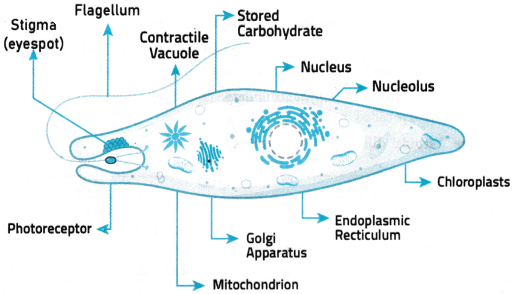
- These are freshwater, flagellated organisms, found in stagnant water.
- They are surrounded by a flexible protein rich layer called pellicle.
- They have two unequal flagella, a short and long one.
- They are photosynthetic in the presence of light.
- They behave as heterotrophs when deprived of light.
- Reproduction takes place by binary fission.
- This pigments of Euglenoids are Identical to those present in Higher Plants.
Ex: Euglena.
Question 2.
Give the salient features and importance of Chrysophytes?
Answer:
Salient features
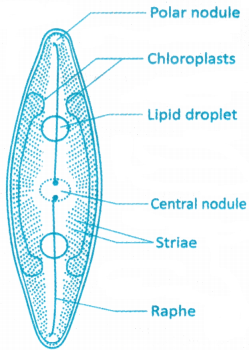
- This group includes diatoms and desmids or golden algae.
- They are found in fresh water as well as in marine environments.
- They are microscopic, and float passively in water currents.
- Most of them are photosynthetic.
- In diatoms, the cell wall contains two thin overlapping shells, which fit together like a soap box.
- Cell walls are embedded with silica and thus the walls are indestructible.
- After death diatoms leave large amounts of cell wall deposits in their habitat and form diatomaceous earth.
Importance:
- The diatomaceous soil is used in polishing, filtration of oils and syrups.
- Diatoms are the chief producers of the ocean.
Question 3.
Give a brief account of Dinoflagellates?
Answer:
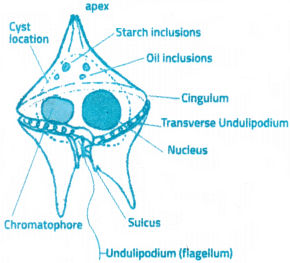
- These are marine and photosynthetic forms.
- They appear yellow, green, blue or red based on the pigments in the cell.
- The cell wall contains stiff cellulosic plates on the outer surface.
- These are biflagellated. One lies longitudinally and the other is transversely in a furrow between the wall plates.
- Very often, red dinoflagellates (Ex: Gonyaulax) undergo such rapid multiplication that they make the sea appear red (red tides).
- Toxins released by such large numbers may even kill other marine animals such as fishes.
Question 4.
Write the role of Fungi in our daily life.
Answer:
Uses:
- Yeast are used to make bread and beer.
- Some fungi like Penicillium are the source of antibiotics.
- Agaricus are edible mushrooms.
Diseases:
- Fungi spoils bread. Ex: Rhizopus.
- White spots appear on the leaves of mustard by Albugo.
- Puccinia causes rust in wheat.
VI. Long Answer Questions
Question 1.
Give the salient features and comparative account of different classes of fungi studied by You?
Answer:
Kingdom fungi includes heterotrophic organisms.
Salient Features:
- All the fungal members are filamentous except yeast (unicellular).
- Body of the fungi is called mycelium.
- Each thread-like slender structure in the mycelium is called hypha.
- In some fungi (Rhizopus), hyphae are aseptate and multinucleated, and are called “coenocytic hyphae”.
- Cell wall is made up of chitin and polysaccharides.
- Reserve food materials are glycogen and oil.
- They live as “saprophytes”, parasites and symbionts. (Lichens and mycorrhizae).
- Reproduction takes place vegetatively by fragmentation or fission or by budding.
- Asexually by producing spores like conidia or sporangiospores or zoospores.
- Plasmogamy, karyogamy and meiosis are the sequential steps in their sexual reproduction.
Kingdom fungi are divided into 4 classes based on their morphology of mycelium, mode of spore formation and fruiting bodies. They are
- Phycomycetes
- Ascomycetes.
- Basidiomycetes
- Deuteromycetes
1. Phycomycetes:
- They are found in aquatic habitats and on decaying wood in moist and damp places or as obligate parasites on plants.
- The mycelium is aseptate and coenocytic.
- Asexual reproduction takes place by zoospores or by aplanospores.
- Zygospores are formed by the fusion of two gametes which may be similar or dissimilar or oogamous.
Ex: Mucor, Rhizopus, Albugo.
2. Ascomycetes (Sac Fungi):
- They are unicellular (Yeast) or multicellular (Penicillium).
- They live as saprophytes or decomposers or parasites or coprophilous (Grow on dung).
- Mycelium is branched and septate
- The asexual reproduction occurs by conidia formed on conidiophores.
- They reproduce sexually by producing Ascospores in Asci.
Ex: Aspergillus, Claviceps, Neurospora.
- Neurospora are used extensively in biochemical genetic work.
3. Basidiomycetes (Bracket fungi or puffballs)
- They grow in soil, on logs and tree stumps and in living plant bodies as parasites.
- The mycelium is branched and septate.
- Vegetative reproduction occurs by fragmentation.
- Sex organs are absent but plasmogamy occurs by the fusion of two vegetative cells of different strains or genotypes.
- The dikaryotic mycelium produces basidia which in turn produce basidiospores.
Ex: Agaricus, Ustilago, polyporus.
4. Deuteromycetes (Imperfect fungi):
- Some members live as saprophytes or parasites and most of the members live as decomposers and help in mineral cycling.
- The mycelium is branched and septate.
- They reproduce asexually by conidia.
Ex: Alternaria, Colletotrichum, Trichoderma.
Question 2.
Describe briefly different groups of Monerans you have studied.
Answer:
Kingdom Monera includes Archaebacteria, Eubacteria, Cyanobacteria and Mycoplasmas.
Archaebacteria:
- These are special Monerans.
- They live in extreme habitats like salty areas, (halophiles), hot springs (thermoacido- philes) and marshy areas (methanogens).
- Their cell wall contains Pseudomurein.
- Their cell membrane contains a branched chain of lipids. So they can even survive in extreme conditions.
- Methanogens are responsible for the production of methane gas from dung.
Eubacteria:
- Bacteria are abundant microorganisms, present everywhere.
- They also live in extreme habitats like hot springs, deserts, snow and deep oceans.
- Bacteria appear in 4 shapes
- spherical – coccus
- Rod shaped – Bacillus
- Comma shaped – Vibrio
- Spiral shaped – Spirilla.
- Bacteria are surrounded by a cell wall made up of peptidoglycan.
- The infoldings of the plasma membrane are called mesosomes.
- Genetic material is not covered by nuclear membrane.
- Except ribosomes other cell organelles are absent.
- Motile bacteria contain one or more flagella.
- Based on the nutrition bacteria are 2 types,
- Autotrophs are two types:
- Photosynthetic autotrophs.
- Chemosynthetic autotrophs.
- Heterotrophic bacteria are of two types:
- Photosynthetic heterotrophs
- Chemosynthetic heterotrophs (Saprophytes or decomposers, Parasites).
- Bacteria reproduce mainly by binary fission. During unfavourable conditions they produce spores – endospores.
- Bacteria reproduce sexually by transferring genetic material from one bacterium to another bacterium.
Cyanobacteria:
- These are also known as blue green algae.
- Cyanobacteria are unicellular, colonial or filamentous aquatic or terrestrial algae.
- These are photosynthetic autotrophs, due to the presence of chlorophyll.
- They show oxygenic photosynthesis.
- The colonies and trichomes or filaments are generally surrounded by gelatinous sheath.
- They often form blooms in polluted water bodies.
- Some of these organisms can fix atmospheric nitrogen in specialised cells called heterocysts Ex. Nostoc and Anabaena.
Mycoplasma:
- They do not have a cell wall and they are pleomorphic.
- They are the smallest living cells and can survive without O2.
- Many mycoplasmas are pathogenic to animals and plants.
I. Multiple Choice Questions
Question 1.
Two kingdom classification was given by
1. Whittaker
2. Linnaeus
3. Aristotle
4. Theophrastus
Answer:
2. Linnaeus
Question 2.
Bacteria that live in most harsh habitats are
1. Bacteria
2. Cyanobacteria
3. Mycoplasmas
4. Archaebacteria
Answer:
4. Archaebacteria
Question 3.
Nitrogen Fixing Cyanobacterium is
1. Rhizobium
2. Nostoc
3. Chlorella
4. Methanogens
Answer:
2. Nostoc
Question 4.
Smallest living monera cells that lack a cell wall are
1. Cyanobacteria
2. Protozoans
3. Mycoplasma
4. Bacteria
Answer:
3. Mycoplasma
Question 5.
Diatomaceous Earth is Indestructible due to cell walls embedded by [March-26]
1. Calcium
2. Silica
3. Zinc
4. Phosphorus
Answer:
2. Silica
Question 6.
Protists that form plasmodium are
1. Euglenoids
2. Slime moulds
3. Dinoflagellates
4. Diatoms
Answer:
2. Slime moulds
Question 7.
Which is the correct sequence of the sexual cycle of fungi
1. Mitosis-Meiosis-Fertilization
2. Plasmogamy-Karyogamy-Meiosis
3. Meiosis- Plasmogamy-Karyogamy
4. Karyogamy-Plasmogamy-Meiosis
Answer:
2. Plasmogamy-Karyogamy-Meiosis
Question 8.
The viruses which infect bacteria are known as
1. Zoophages
2. Bacteriophages
3. Cyanophages
4. Zymophages
Answer:
2. Bacteriophages
Question 9.
Fungus that is extensively used in biochemical and genetic work
1. Neurospora
2. Ustilago
3. Colletotrichum
4. Saccharomyces
Answer:
1. Neurospora
Question 10.
One of the following are very good Pollution Indicators
1. Fungi
2. Mycoplasma
3. Lichens
4. Golden algae
Answer:
3. Lichens
II. Fill in the Blanks
Question 1.
In five kingdom classification Bacteria are included in __________ kingdom.
Answer:
Monera
Question 2.
Methanogens are present in gut of several ruminant animals such as cows and buffaloes and they are responsible for the production of __________.
Answer:
Methane (biogas)
Question 3.
The colonies of cyanobacteria are generally surrounded by __________ sheath.
Answer:
Gelatinous
Question 4.
Bacteria reproduce mainly by __________.
Answer:
Binary fission
Question 5.
Diatoms are the chief __________ in the oceans.
Answer:
Producers
Question 6.
Pellicle is found in __________ organisms.
Answer:
Euglenoid
Question 7.
The network of hyphae is known as __________.
Answer:
Mycelium
Question 8.
Agaricus belongs to __________ fungi.
Answer:
Basidiomycetes
Question 9.
__________ fungi is known as Imperfect fungi.
Answer:
Deuteromycetes
Question 10.
Viroids were discovered by __________.
Answer:
T.O.Diener
III. One Word Answer Questions
Question 1.
Among five kingdom classification, eukaryotes are placed in how many kingdoms ?
Answer:
Four
Question 2.
What is the cell wall composition of fungi?
Answer:
Chitin
Question 3.
Give one example of Nitrogen fixing cyanobacteria?
Answer:
Nostoc or Anabaena
Question 4.
What is the protist responsible for Red tides?
Answer:
Gonyaulax
Question 5.
What are the smallest living cells which can survive without oxygen?
Answer:
Mycoplasma
Question 6.
What is the causative organism for Sleeping sickness disease?
Answer:
Trypanosoma
Question 7.
Which of the protists show both autotrophic and heterotrophic nutrition?
Answer:
Euglenoids (Euglena)
Question 8.
Agaricus belongs to which class of the fungi ?
Answer:
Basidiomycetes
Question 9.
Which organism causes mad cow disease?
Answer:
Prion
Question 10.
Who proposed the name “Contagium vivum fluidum”[Infectious living fluid]?
Answer:
Beijereinck
