Breathing and Exchange of Gases Questions and Answers AP Inter 1st Year Zoology Chapter 4

AP Inter 1st Year Zoology 4th Lesson Breathing and Exchange of Gases Questions and Answers

IV. Very Short Answer Questions

Question 1.
Differentiate between branchial and pulmonary respiration with examples.
Answer:

  • Branchial respiration involves the use of gills, Ex: In aquatic animals like fish.
  • Pulmonary respiration uses lungs, Ex: In terrestrial vertebrates like humans and birds.

Question 2.
Name the muscles that help in normal breathing movements.
Answer:
The muscles involved in normal breathing movements are the diaphragm and a specialized set of muscles- External and internal intercostal muscles.

Question 3.
Define vital capacity.
Answer:

  • The maximum volume of air a person can breathe in after a forced expiration.
  • This includes ERV, TV and IRV (or) the maximum volume of air a person can breathe out after a forced inspiration.

Question 4.
What factors affect the rate of diffusion of respiratory gases?
Answer:
Solubility of the gases, and the thickness of the respiratory membrane, partial pressure gradient are also some important factors that can affect the rate of diffusion.

Question 5.
Mention the three major layers of diffusion membrane in lungs.
Answer:
The diffusion membrane is made up of three major layers namely, the thin squamous epithelium of alveoli, the endothelium of alveolar capillaries and the basement membrane However, its total thickness is much less than a millimeter.

Question 6.
What is the effect of pCO2 on oxygen transport?
Answer:
The pCO2 significantly effect oxygen transport by influencing haemoglobin’s affinity for oxygen.

Question 7.
Draw a diagram of oxygen dissociation curve.
Answer:
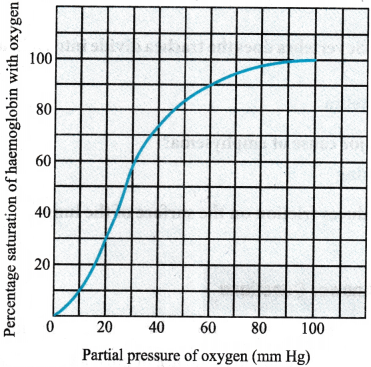
Breathing and Exchange of Gases Questions and Answers AP Inter 1st Year Zoology Chapter 4 2

Question 8.
Mention any two respiratory disorders and their symptoms in human beings.
Answer:

  1. Asthma: Asthma is difficulty in breathing causing wheezing due to inflammation of bronchi and bronchiole.
  2. Emphysema: Emphysema is a chronic disorder in which alveolar walls are damaged due to which respiratory surface is decreased.
  3. One of the major causes of this is cigarette smoking.

Question 9.
What is Tidal volume? Find out the Tidal volume (Approximate value) for a healthy human in an hour.
Answer:
During a normal respiration, the volume of air expired or inspired is referred to as tidal volume (TV). The tidal volume is approximately 500ml for a healthy individual.

  • A healthy individual can expire or inspire nearly 6000-8000ml of air per minute or around 12-16 times a minute.
  • Hence, the tidal volume for a healthy man in an hour approximately can be between 3,60,000 ml and 4,80,000 ml.

V. Short Answer Questions

Question 1.
Explain the process of inspiration and expiration under normal conditions in man
Answer:
Breathing involves 2 stages such as inspiration and expiration:

Inspiration: Intake of atmospheric air into the lungs is called inspiration.

  • It is an active process, as it takes place by the contraction of the muscles of the diaphragm the external intercostal muscles, which extends in between the ribs.
  • The contraction of the diaphragm/phrenic muscle increases the volume of the thoracic chamber in the anteroposterior axis.
  • The contraction of external intercostal muscles lifts up the ribs & sternum causing an increase in the volume of the thoracic chamber in the dorsoventral axis.
  • The overall increase in the thoracic volume causes a similar increase in the ‘pulmonary volume’.
  • An increase in the pulmonary volume decreases the intrapulmonary pressure to less than that of the atmosphere, which forces the air from the outside to move into the lungs.

Expiration: Release of alveolar air to the exterior is called expiration.

  • It is a passive process.
  • Relaxation of the diaphragm and the external intercostal muscles returns the diaphragm and sternum to their normal positions, and reduces the thoracic volume and thereby the pulmonary volume.
  • This leads to an increase in the intra-pulmonary pressure to slightly above that of the atmospheric pressure causing the expulsion of air from the lungs.

Question 2.
What are the major mechanisms of CO2 transport in human beings ? Explain.
Answer:

  • CO2 is carried by haemoglobin as carbamino-haemoglobin (about 20-25 percent). This binding is related to the partial pressure of CO2, pO2 is a major factor which could effect this binding.
  • When pCO2 is high and pO2 is low as in the tissues, more binding of carbondioxide occurs whereas, when the pCO2 is low and pO2 is high as in the alveoli, dissociation of CO2 from carbamino-haemoglobin takes place, i.e., CO2 which is bound to haemoglobin from the tissues is delivered at the alveoli.
  • RBCs contain a very high concentration of the enzyme, carbonic anhydrase and minute quantities of the same are present in the plasma too. This enzyme facilitates the following reaction in both directions.

    Breathing and Exchange of Gases Questions and Answers AP Inter 1st Year Zoology Chapter 4 3
  • At the tissue site where partial pressure of CO2 is high due to catabolism. CO2 diffuses into blood (RBCs and Plasma) and forms HCO3 and H+.
  • At the alveolar site where pCO2 is low, the reaction proceeds in the opposite direction leading to the formation of CO2 and H2O.
  • Thus CO2 trapped as bicarbonate at the tissue level and transported to the alveoli is released out as CO2.
  • Every 100 ml of deoxygenated blood delivers approximately 4 ml of CO2 to the alveoli.

Question 3.
How is respiration regulated in man?
Answer:

  • In humans, respiration is under both nervous and chemical regulation.
  • Human beings have a significant ability to maintain and moderate the respiratory rhythm to suit the demands of the body tissues. This is done by the neural system.
  • A specialized centre present in the medulla region of the brain called Respiratory rhythm centre is primarily responsible for this regulation.
  • Another Centre present in the pons region of the brain called Pneumotaxic centre can moderate the functions of the respiratory rhythm centre.
  • Neural signal from this center can reduce the duration of inspiration and thereby alter the respiratory rate.

Chemical regulation:

  • A chemo sensitive area is situated adjacent to the rhythm center which is highly sensitive to CO2 and hydrogen ions.
  • Increase in these substances can activate this center which in turn can signal the rhythm centre to make necessary adjustments in the respiratory process by which these substances can be eliminated.
  • Receptors associated with aortic arch and carotid artery also can recognize changes in CO2 and H+ concentration and send necessary signals to the rhythm centre for remedial actions.
  • The role of oxygen in the regulation of respiratory rhythm is quite insignificant.

Question 4.
Describe the disorders of respiratory system in man.
Answer:
Disorders of the Respiratory System:

1. Asthma:

  • Asthma is difficulty in breathing causing wheezing due to inflammation of bronchi and bronchiole.
  • Asthma may he attributed to allergic reactions of the mast cell in lungs.

2. Emphysema:

  • Emphysema is a chronic disorder in which alveolar walls are damaged due to which respiratory surface is decreased.
  • One of the major causes of this is cigarette smoking.

3. Occupational Respiratory Disorders: In certain industries, especially those involving grinding or stone-breaking, so much dust is produced that the defense mechanism of the body cannot fully cope with the situation.

Silicosis and Anthracosis are occupational respiratory disorders (ORDs)

  • Long exposure can give rise to inflammation leading to fibrosis (proliferation of fibrous tissues) and thus causing serious lung damage.
  • Workers in such industries should wear protective masks.

Question 5.
Distinguish between
(A) IRV and ERV
(B) VC and TLC
Answer:
(A) IRV and ERV:

  • Inspiratory reserve volume (IRV): Maximum volume of air that can be inhaled during forced breathing in addition to the tidal volume. This is about 2500 ml to 3000 ml of air.
  • Expiratory reserve volume (ERV): Maximum volume of air that can be exhaled during forced breathing, in addition to the tidal volume. This is about 1000 ml to 1100 ml of air.

(B) VC and TLC: Vital capacity (VC): The maximum volume of air a person can breathe in after ‘forced expiration’. This includes ERV, TV and IRV or the maximum volume of air a person can breathe out after “forced inspiration.

VC = TV + IRV + ERV

Total lung capacity (TLC): The total volume of air accommodated in the lungs at the end of “forced inspiration”. This includes RV, ERV, TV and IRV or vital capacity + residual volume.

TLCVC + RV (or) TLC = ERV + IRV + TV + RV

VI. Long Answer Questions

Question 1.
Describe the respiratory system in man.
Answer:
Human respiratory system:

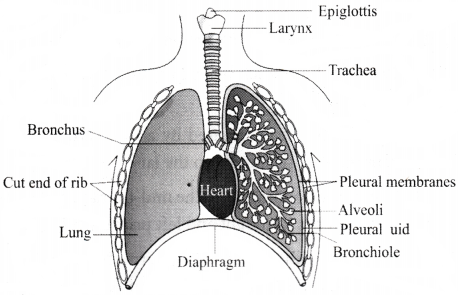
  • Human have a pair of external nostrils opening out above the upper lips. It leads into a nasal chamber through the nasal passage.
  • The nasal chamber opens into pharynx, a portion of which is the common passage for food and air.
  • The pharynx opens through the larynx region into the trachea.
  • Larynx is a cartilaginous box which helps in sound production and hence called the sound box.
  • During swallowing glottis can be covered by a thin elastic cartilaginous flap called epiglottis to prevent the entry of food into the larynx.
  • Trachea is a straight tube extending up to the mid-thoracic cavity, Which divides at the level of 5th thoracic vertebra into right and left primary bronchi.
  • Each bronchi undergoes repeated divisions to form the secondary (lobar) and tertiary (segmental) bronchi and bronchioles ending up in very thin terminal bronchioles.
  • The tracheae, primary, secondary and tertiary bronchi and initial bronchioles are supported by incomplete cartilaginous rings.
  • Each terminal bronchiole gives rise to a number of very thin, irregular-walled and vascularized bag-like structures called alveoli.
  • The branching network of bronchi, bronchioles and alveoli comprise the lungs.
  • We have two lungs which are covered by double layered pleura, with pleural fluid between them.
  • It reduces friction on the lung-surface.
  • The outer pleural membrane (parietal pleura) is in close contact with the thoracic lining whereas the inner pleural membrane (Visceral pleura) is in contact with the lung surface.
  • The part starting with the external nostrils up to the terminal bronchioles constitute the conducting part whereas the alveoli and their duct form the respiratory or exchange part of the respiratory system or upper respiratory tract.
  • The conducting part transports the atmospheric air to the alveoli, clear it from foreign particles, humidifies and also brings the air to body temperature.
  • Exchange part is the site of actual diffusion of O2 and CO2 between blood and atmospheric air.
  • The lungs are situated in the thoracic chamber which is anatomically an air tight chamber.
  • The thoracic chamber is formed dorsally by vertebral column, ventrally by the sternum, laterally by the ribs and on the lower side by the dome shaped diaphragm.
  • The anatomical setup of lungs in thorax is such that any change in the volume of the thoracic cavity will be reflected in the lung (pulmonary) cavity. Such an arrangement is essential for breathing, as we cannot directly alter the pulmonary volume.
Breathing and Exchange of Gases Questions and Answers AP Inter 1st Year Zoology Chapter 4 4

Question 2.
Write an essay on the transport of oxygen and carbon dioxide by blood.
Answer:
Transport of Gases:

  • Blood is the medium of transport for O2 and CO2.
  • About 97 percent of O2 is transported by RBCs in the blood. The remaining 3 percent of O2 is carried in a dissolved state through the plasma.
  • Nearly 20-25 percent of CO2 is transported by RBCs where as 70 percent of it is carried as bicarbonate (Sodium bicarbonate).
  • About 7 percent of CO2 is carried in a dissolved state through plasma.

1. Transport of oxygen

  • Haemoglobin is a red coloured iron containing pigment present in the RBCs.
  • O2 can bind with Haemoglobin in a reversible manner to form Oxyhaemoglobin.
  • Each haemoglobin molecule carry a maximum of four molecules of O2. Thus, chemical formula of Oxyhaemoglobin is Hb(O2)4.
  • Binding of oxygen with haemoglobin is primarily related to partial pressure of O2.
  • Partial pressure of CO2, hydrogen ion concentration and temperature are the other factors which can interfere with this binding.
  • A sigmoid curve is obtained when percentage saturation of haemoglobin with O2 is plotted against the pO2.
  • This curve is called the Oxygen dissociation curve and is highly useful in studying the effect of factors like pCO2, H+ concentration, etc., on binding of O2 with haemoglobin.
  • In the alveoli, where there is high pO2, low pCO2, lesser H+ concentration and lower temperature, the factors are favourable for the formation of
  • Oxyhaemoglobin, whereas in the tissues, where low pO2, high pCO2 high H+ concentration and higher temperature exist, the conditions are favourable for dissociation of oxygen from the oxyhaemoglobin.
  • This clearly indicates that O2 gets bound to haemoglobin in the lung surface and gets dissociated at the tissues. Every 100 ml of oxygenated blood can deliver around 5 ml of O2 to the tissues under normal physiological conditions.

2. Transport of Carbondioxide

  • CO2 is carried by haemoglobin as carbamino-haemoglobin (about 20-25 percent). This binding is related to the partial pressure of CO2, pO2 is a major factor which could effect this binding.
  • When pCO2 is high and pO2 is low as in the tissues, more binding of carbondioxide occurs whereas, when the pCO2 is low and pO2 is high as in the alveoli, dissociation of CO2 from carbamino-haemoglobin takes place, i.e., CO2 which is bound to haemoglobin from the tissues is delivered at the alveoli.
  • RBCs contain a very high concentration of the enzyme, carbonic anhydrase and minute quantities of the same are present in the plasma too. This enzyme facilitates the following reaction in both directions.
    Breathing and Exchange of Gases Questions and Answers AP Inter 1st Year Zoology Chapter 4 3
  • At the tissue site where partial pressure of CO2 is high due to catabolism. CO2 diffuses into blood (RBCs and Plasma) and forms HCO2 and H+.
  • At the alveolar site where pCO2 is low, the reaction proceeds in the opposite direction leading to the formation of CO2 and H2O.
  • Thus CO2 trapped as bicarbonate at the tissue level and transported to the alveoli is released out as CO2
  • Every 100 ml of deoxygenated blood delivers approximately 4 ml of CO2 to the alveoli.

I. Multiple Choice Questions

Question 1.
The thoracic chamber of vertebrates is bound ventrally by the
1. diaphragm
2. ribs
3. abdomen
4. sternum
Answer:
4. sternum

Question 2.
During inspiration the diaphragm
1. contracts and moves upwards
2. contracts and moves downwards
3. relaxes and moves upwards
4. relaxes and moves downwards
Answer:
2. contracts and moves downwards

Question 3.
Air is breathed in through
1. trachea – lungs – larynx – pharynx – alveoli – bronchi – bronchioles
2. nose – trachea – lungs – larynx – pharynx – alveoli – bronchi – bronchioles
3. nostrils – pharynx – larynx – trachea – bronchi – bronchioles – alveoli
4. nose – pharynx – mouth – oesophagus – lungs – bronchi – bronchioles
Answer:
3. nostrils – pharynx – larynx – trachea – bronchi – bronchioles – alveoli

Question 4.
Which instrument helps in the clinical assessment of pulmonary functions?
1. ECG
2. Sphygmomanometer
3. Spirometer
4. Barometer
Answer:
3. Spirometer

Question 5.
The maximum volume of air a person can breathe in after a forced expiration is termed as
1. inspiratory capacity
2. expiratory capacity
3. functional residual capacity
4. vital capacity
Answer:
4. vital capacity

Question 6.
What will be the pO2 and pCO2 in the atmospheric air when compared to those in the alveolar air?
1. pO2 lesser, pCO2 higher
2. pO2 higher, pCO2 lesser
3. pO2 higher, pCO2 higher
4. pO2 lesser, pCO2 lesser
Answer:

Question 7.
The figure given below shows a small part of human lung where exchange of gases takes place. Select the option which represents the labelled parts A, B, C, D.
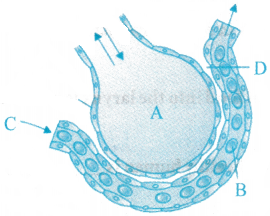
Breathing and Exchange of Gases Questions and Answers AP Inter 1st Year Zoology Chapter 4 1

1. (A) Arterial capillary, (B) Alveolar cavity,(C) Basement substance, (D)Red blood cells
2. (A) Alveolar cavity,(B) Red blood cells, (C) Arterial capillary, (D) Basement substance
3. (A) Basement substance, (B) Alveolar cavity, (C) Arterial capillary, (D) Red blood cells
4. (A) Red blood cells, (B) Arterial capillary, (C) Basement substance, (D) Alveolar cavity
Answer:
2. (A) Alveolar cavity,(B) Red blood cells, (C) Arterial capillary, (D) Basement substance

Question 8.
Select the favourable conditions required for the formation of oxyhaemoglobin at the alveoli.
1. High pO2, low pCO2, less H+ concentration, lower temperature
2. High pO2, high pCO2, less H+ concentration, higher temperature
3. Low pO2, low pCO2, more H+ concentration, higher temperature
4. Low pO2, High PCO2, more H+ concentration, higher temperature
Answer:
1. High pO2, low pCO2, less H+ concentration, lower temperature

Question 9.
Carbonic anhydrase enzyme is mainly found in the
1. RBC
2. thrombocytes
3. WBC
4. platelets
Answer:
1. RBC

Question 10.
Match the following columns and select the correct option from the codes given below.

Column – I Column – II
A. Pneumotaxic center i. Medulla oblongata
B. Haemoglobin ii. Pons region of the brain
C. Carbonic anhydrase iii. Iron
D. Respiratory rhythm center iv. RBC

1. A – i, B – iii, C – ii, D – iv
2. A – ii, B – iii, C – iv, D – i
3. A – iii, B – ii, C – iv, D – i
4. A – iv, B – i, C – iii, D – ii

Answer:
2. A – ii, B – iii, C – iv, D – i

Column – I Column – II
A. Pneumotaxic center ii. Pons region of the brain
B. Haemoglobin iii. Iron
C. Carbonic anhydrase iv. RBC
D. Respiratory rhythm center i. Medulla oblongata

II. Fill in the Blanks

Question 1.
The cartilaginous box that helps in sound production in man ___________.
Answer:
Larynx

Question 2.
During swallowing, the entry of food into the larynx is prevented by ___________.
Answer:
Epiglottis

Question 3.
The average respiratory rate of a healthy human is ___________ breaths per minute.
Answer:
12 – 16 times

Question 4.
Oxygen binds with haemoglobin to form ___________.
Answer:
Oxyhaemoglobin

Question 5.
Each haemoglobin molecule can carry a maximum of
oxygen.
Answer:
Four [4]

Question 6.
The respiratory disorder characterized by whezing due to inflammation of bronchi and bronchioles ___________.
Answer:
Asthma

Question 7.
Respiratory rhythm centre is present in the ___________ of hte brain.
Answer:
Medulla

Question 8.
Contraction of the diaphragm ___________ the volume of the thoracic cavity.
Answer:
Increases

III. One Word Answer Questions

Question 1.
What is the common passage for both food and air in man?
Answer:
Pharynx

Question 2.
Name the fluid filled double layered membrane that covers the lungs in man.
Answer:
Pleura

Question 3.
What is the dome shaped structure found on the lower side of the thoracic chamber?
Answer:
Diaphragm

Question 4.
At which thoracic vertebra does the trachea divide into right and left pulmonary bronchi in man?
Answer:
5th thoracic vertebra

Question 5.
What is the major cause of emphysema?
Answer:
Cigarette smoking

Question 6.
Which fluid reduces friction on the surface of the lungs?
Answer:
Pleural fluid
AP Inter 1st Year Zoology Study Material

Structural Organization in Animals Questions and Answers AP Inter 1st Year Zoology Chapter 3

AP Inter 1st Year Zoology 3rd Lesson Structural Organization in Animals Questions and Answers

IV. Very Short Answer Questions

Question 1.
Why are frogs not seen during peak summer and winter ?
Answer:

  • During this period they take shelter in deep burrows to protect them from extreme heat and cold.
  • This is known as summer sleep (aestivation) and winter sleep (hibernation) respectively.

Question 2.
Mention the functions of nictitating membrane and tympanum in the frog.
Answer:

  • The function of nictitating membrane is to protect the eyes in water.
  • On either side of eyes a membranous tympanum (ear) receives sound signals.

Question 3.
Compare the forelimbs and hindlimbs of the frogs.
Answer:

  • The forelimbs and hind limbs help in swimming, walking, leaping and burrowing.
  • Fore limbs that ends in four digits (fingers) and they are shorter and stouter.
  • The hind limbs ends in five digits and they are larger and muscular.

Question 4.
How do you distinguish a male frog from a female frog ?
Answer:
Male frogs can be distinguished by the presence of sound producing vocal sacs and also a copulatory pad on the first digit of the fore limbs, which are absent in female frogs.

Question 5.
What is Chyme? Where is it formed ?
Answer:
The partially digested food is called chyme. It is formed in stomach.

Question 6.
What are the respiratory organs of the frog ?
Answer:

  • In water, skin acts as aquatic respiratory organ (cutaneous respiration).
  • Dissolved oxygen in the water is exchanged through the skin by diffusion.
  • On land, the buccal cavity, skin and lungs act as the respiratory organs. The respiration by lungs is called pulmonary respiration.

Question 7.
What are hepatic and renal portal systems ?
Answer:
Special venous connection between liver and intestine is called hepatic portal system, the kidney and lower parts of the body is called renal portal system.

Question 8.
How many eggs does a female frog lay at a time ? Where does fertilization take place ?
Answer:
A mature female can lay 2500 to 3000 eggs or ova at a time. Fertilization is external and takes place in water.

Question 9.
What is the larva of frog ? Name the process by which it develops into an adult.
Answer:
The larval stage of frog is called tadpole. Tadpole undergoes metamorphosis to develop into the adult.

Question 10.
How are frogs beneficial for mankind ?
Answer:

  • Frogs are beneficial for mankind because they eat insects and protect the crop.
  • Frogs maintain ecological balance because these serve as an important link of food chain and food web in the ecosystem.
  • In some countries the muscular legs of frog are used as food by man.

V. Short Answer Questions

Question 1.
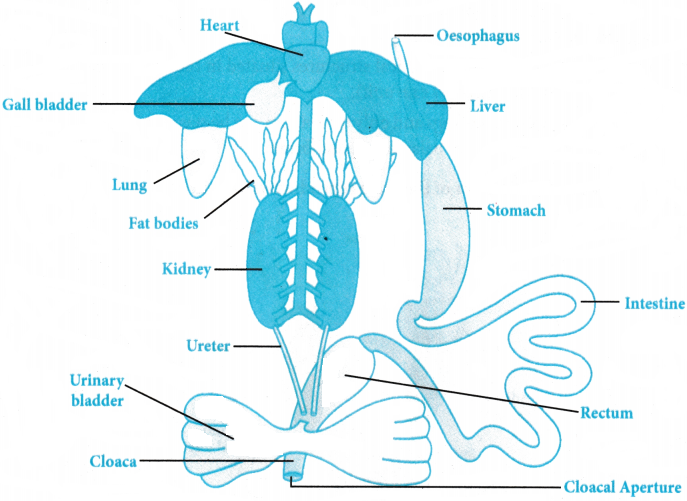
Describe the digestive system of the frog.
Answer:

  • The digestive system consists of Alimentary canal and Digestive glands.
  • The alimentary canal is short because frogs are carnivores and hence the length of intestine is reduced.
  • The mouth opens into the buccal cavity that leads to the oesophagus through pharynx.
  • Oesophagus is a short tube that opens into the stomach which in turn continues as the intestine, rectum and finally opens outside by the cloaca.
  • Liver secretes bile that is stored in the gall bladder.
  • Pancreas, a digestive gland produces pancreatic juice containing digestive enzymes.
  • Food is captured by the bilobed tongue.
  • Digestion of food takes place by the action of HC/ and gastric juices secreted from the walls of the stomach.
  • Partially digested food called chyme is passed from stomach to the first part of the small intestine, the duodenum.
  • The duodenum receives bile from gall bladder and pancreatic juices from the pancreas through a common bile duct.
  • Bile emulsifies fat and pancreatic Juices digest carbohydrates and proteins. Final digestion takes place in the intestine.
  • Digested food is absorbed by the numerous finger-like folds in the inner wall of intestine called villi and microvilli.
  • The undigested solid waste moves into the rectum and passes out through cloaca.

Question 2.
Describe the respiratory organs of frogs in the different habitats.
Answer:
Frogs respire on land and in the water by two different methods.

  • In water, skin acts as aquatic respiratory organ (cutaneous respiration).
  • Dissolved oxygen in the water is exchanged through the skin by diffusion.
  • On land, the buccal cavity, skin and lungs act as the respiratory organs. The respiration by lungs is called pulmonary respiration.
  • The lungs are a pair of elongated, pink coloured sac-like structures present in the upper part of the trunk region (thorax).
  • Air enters through the nostrils into the buccal cavity and then to lungs.
  • During aestivation and hibernation, gaseous exchange takes place through skin.

Question 3.
Describe the blood vascular system in frog.
Answer:
The vascular system of frog is well-developed and it is closed type.

  • Frogs have a lymphatic system also.
  • The blood vascular system involves heart, blood vessels and blood.
  • The lymphatic system consists of lymph, lymph channels and lymph nodes.
  • Heart is a muscular structure situated in the upper part of the body cavity. It has three chambers, two atria and one ventricle and is covered by a membrane called pericardium.
  • A triangular structure called sinus venosus joins the right atrium. It receives blood through the major veins called vena cava.
  • The ventricle opens into a sac-like conus arteriosus on the ventral side of the heart.
  • The blood from the heart is carried to all parts of the body by the arteries (arterial system).
  • The veins collect blood from different parts of body to the heart and form the venous system.
  • Special venous connection between liver and intestine as well as the kidney and lower parts of the body are present in frogs. The former is called hepatic portal system and the latter is called renal portal system;
  • The blood is composed of plasma and cells. The blood cells are RBC (red blood cells) or erythrocytes, WBC (white blood cells) or leucocytes and platelets.
  • RBC’s are nucleated and contain red coloured pigment namely haemoglobin.
  • The lymph is different from blood. It lacks few proteins and RBCs.
  • The blood carries nutrients, gases and water to the respective sites during the circulation.
  • The circulation of blood is achieved by the pumping action of the muscular heart.

Question 4.
Describe the male reproductive system of frog.
Answer:
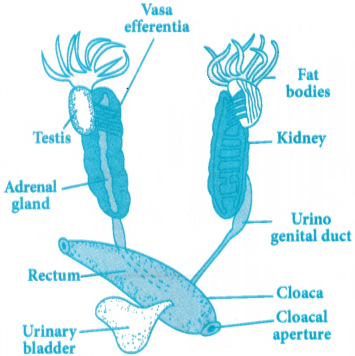
Male reproductive organs consist of a pair of yellowish ovoid testes which are found adhered to the upper part of kidneys by a double fold of peritoneum called mesorchium.

Structural Organization in Animals Questions and Answers AP Inter 1st Year Zoology Chapter 3 1

  • Vasa efferentia are 10-12 in number that arise from testes. They enter the kidneys on their side and open into Bidder’s canal.
  • Finally it communicates with the urinogenital duct that comes out of the kidneys and opens into the cloaca.
  • The cloaca is a small, median chamber that is used to pass faecal matter, urine and sperms to the exterior.

Question 5.
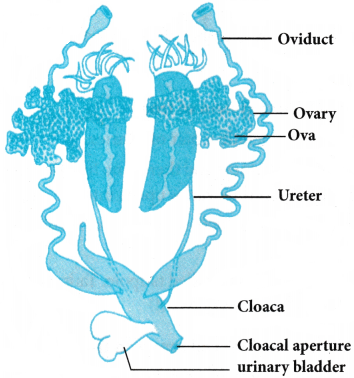
Describe the female reproductive system of frog.
Answer:
The female reproductive organs include a pair of ovaries.

Structural Organization in Animals Questions and Answers AP Inter 1st Year Zoology Chapter 3 2

  • The ovaries are situated near kidneys and there is no functional connection with kidneys. A pair of oviduct arising from the ovaries opens into the cloaca separately.
  • A mature female can lay 2500 to 3000 ova at a time. Fertilization is external and takes place in water.
  • Development involves a larval stage called tadpole. Tadpole undergoes metamorphosis to form the adult.

Question 6.
Write short notes on the organs of special senses in frog.
Answer:
Frog has different types of sense organs, namely organs of touch (sensory papillae), taste (taste buds), smell (nasal epithelium), vision (eyes) and hearing (tympanum with internal ears).

  • Out of these, eyes and internal ears are well-organised structures and the rest are cellular aggregations around nerve endings.
  • Eyes in a frog are a pair of spherical structures situated in the orbit in skull. These are simple eyes (possessing only one unit).
  • External ear is absent in frogs and only tympanum can be seen externally. The ear is an organ of hearing as well as balancing (equilibrium).

Question 7.
Draw a neat labeled diagram of the male reproductive system of frog.
Answer:

Structural Organization in Animals Questions and Answers AP Inter 1st Year Zoology Chapter 3 1

Question 8.
Draw a neat labeled diagram of the female reproductive system of frog
Answer:

Structural Organization in Animals Questions and Answers AP Inter 1st Year Zoology Chapter 3 2

Question 9.
Draw a diagram of the internal organs of a frog showing the complete digestive system and label it.
Answer:

Structural Organization in Animals Questions and Answers AP Inter 1st Year Zoology Chapter 3 3

I. Multiple Choice Questions

Question 1.
A frog with a body temperature of 20°C is transferred into an area with 30°C temperature. What will be the body temperature of the frog in the new environment?
1. 20°C
2. 30°C
3. 50°C
4. 40°C
Answer:
2. 30°C

Question 2.
During aestivation and hibernation frogs respire through
1. lungs
2. gills
3. skin
4. bucco-pharyngeal cavity
Answer:
3. skin

Question 3.
Bile juice helps in the digestion of
1. proteins
2. carbohydrates
3. fats
4. carbohydrates and proteins
Answer:
3. fats

Question 4.
The triangular structure that brings venous blood to the right atrium in frog
1. pulmonary arch
2. systemic arch
3. sinus venosus
4. conus arteriosus
Answer:
3. sinus venosus

Question 5.
Conus arteriosus is present on the side of the heart of frog.
1. ventral
2. dorsal
3. lateral
4. upper
Answer:
1. ventral

Question 6.
The chief nitrogenous excretory product in frogs is
1. Ammonia
2. Urea
3. Uric acid
4. Creatinine
Answer:
2. Urea

Question 7.
Number of cranial nerves in frogs
1. 12 pairs
2. 8 pairs
3. 10 pairs
4. 11 pairs
Answer:
3. 10 pairs

Question 8.
In frogs, sensory papillae, taste buds and nasal epithelium are
1. cellular aggregations around muscular tissue
2. cellular aggregations around nerve endings
3. cellular aggregations around fatty tissue
4. cellular aggregations around epithelial tissue
Answer:
2. cellular aggregations around nerve endings

Question 9.
In frogs, Bidder’s canal is found in the
1. liver
2. ovary
3. kidney
4. heart
Answer:
3. kidney

Question 10.
In male frogs, testes are adhered to the kidneys by
1. mesorchium
2. pericardium
3. mesovarium
4. pleura
Answer:
1. mesorchium

Question 11.
The Ecological importance of frogs is to
1. reduce insect populations and form an important link of the food chain
2. increase insect populations and form an important link of the food chain
3. act as biological vectors of plasmodium
4. prevent the water pollution
Answer:
1. reduce insect populations and form an important link of the food chain

Question 12.
Select the correct statement.
1. Neck and tail are absent in frog.
2. Tympanum protects the eyes when the frog is in water
3. Frogs do not have lymphatic system.
4. HCl is secreted by the wall of the intestine
Answer:
1. Neck and tail are absent in frog.

II. Fill in the Blanks

Question 1.
Frogs are poikilothermic as they do not have a constant body ___________.
Answer:
Temperature

Question 2.
The ability to change the colour of the body to hide themselves from the enemies is called ___________.
Answer:
Camouflage

Question 3.
The skin of the frog is smooth and slippery due to the presence of ___________.
Answer:
Mucus

Question 4.
Each forelimb of frog has ___________ digits.
Answer:
Four (4)

Question 5.
In frogs ___________ acts as aquatic respiratory organ.
Answer:
Skin

Question 6.
The ureters in male frogs act as ___________ ducts.
Answer:
Urinogenital

Question 7.
Tadpole larva undergoes ___________ to become the adult.
Answer:
Metamorphosis

III. One Word Answer Questions

Question 1.
Why do frogs never drink water ?
Answer:
Absorb water through skin

Question 2.
When do frogs undergo aestivation ?
Answer:
In summer

Question 3.
Where do we find the copulatory pads in the male frogs ?
Answer:
Fore limb (on the first digit)

Question 4.
Name the finger like folds in the inner wall of intestine in frog ?
Answer:
Villi and Microvilli

Question 5.
How many optic lobes are there in the midbrain of frog ?
Answer:
One pair (2 lobes)

Question 6.
What is the larval stage of a frog called ?
Answer:
Tadpole

Question 7.
Where does fertilization take place in frogs ?
Answer:
In water

Question 8.
Name the chamber into which the urinogenital ducts of a male frog open.
Answer:
Cloaca

AP Inter 1st Year Zoology Study Material

Animal Kingdom Questions and Answers AP Inter 1st Year Zoology Chapter 2

AP Inter 1st Year Zoology 2nd Lesson Animal Kingdom Questions and Answers

IV. Very Short Answer Questions

Question 1.
Differentiate between diploblastic and triploblastic animals.
Answer:

  • Animals in which the cells are arranged in two embryonic layers, an external ectoderm and internal endoderm are Diploblastic animals. E.g., Porifers, Coelenterates.
  • An undifferentiated layer, mesoglea, is present in between the ectoderm and the endoderm in Coelenterates.
  • Those animals in which the developing embryo has a third germinal layer, mesoderm in between the ectoderm and endoderm, are called triploblastic animals (Platyhel- minthes to chordates).

Question 2.
What are the functions of canal system in sponges?
Answer:
The function of canal sytem in sponges are helpful in food gathering, respiratory exchange of gases and removal of waste.

Question 3.
What are the two morphological forms of cnidarians? What are their chief functions?
Answer:

  • Cnidarians exhibit two basic body forms called Polyp and Medusa.
  • Polyp is sessile and cylindrical form like Hydra, Adamsia etc.
  • Whereas the medusa is umbrella-shaped and free-swimming like Aurelia or jelly fish.
  • Cnidarians which exist in both forms exhibit alternation of generation (metagenesis)
    i.e., Polyps produce medusae asexually and medusa form the polyps sexually (e.g., Obelia).

Question 4.
What are the excretory cells of flatworms called? What is the other important function of these cells?
Answer:
Excretory cells of flat worms are called as flame cells. These help in osmoregulation and excretion.

Question 5.
What do you call the lateral appendages of Nereis? What is their function?
Answer:
Parapodia are the lateral appendages in Neries, their function is swimming.

Question 6.
What is radula and which group of animals possesses it?
Answer:
Radula is a file like rasping organ present in the mouth of mollusc useful for feeding

Question 7.
What is the most distinctive system of Echinoderms? What are its functions?
Answer:
The most distinctive feature of echinoderms is the presence of water vascular system which helps in locomotion, capture and transport of food and respiration.

Question 8.
Write any two fundamental characters of chordates.
Answer:
Two fundamental characters of chordates are the presence of a dorsal hollow nerve cord and a notochord.

Question 9.
“All vertebrates are chordates, but all chordates are not vertebrates. Justify the statement.
Answer:

  • The presence of a vertebral column is a defining characteristic of vertebrates.
  • The notochord is replaced by cartilaginous or bony vertebral column in adult.
  • Thus all vertebrates are chordates but all chordates are not vertebrates.

Question 10.
Differentiate between poikilothermous and homoiothermous animals.
Answer:

  • Poikilothermic animals or “cold-blooded,” they lack the ability to regulate their internal body temperature, and it fluctuates with the surrounding environment.
  • Homoiothermic animals or “warm-blooded,” which can maintain a constant internal body temperature regardless of external temperature changes.

Question 11.
What is the difference between direct and indirect development?
Answer:

  • Direct Development – It is seen in fish, reptile, birds and mammals, In the direct development, the embryo develops into a well-grown individual without involving a larval stage. Metamorphosis is absent.
  • Indirect Development – It is seen in vertebrate amphibians. It involves a sexually immature larval stage. Metamorphosis is present.

V. Short Answer Questions

Question 1.
Describe the four different levels of organization in animals.
Answer:

Cellular level Tissue level Tissue system or organ level Organ system level
Porifera
Ex: Sponges
Coelenterate, Ctenophore Platyhelminthes Aschelminthes, Annelida, Arthropods Molluscs, Echinoderms, Hemichordate and Chordata.
  • In Sponges, the cells are arranged as loose cell aggregates (exhibit cellular level) of organization. Some division of labour , (activities) occurs among the cells.
  • In coelenterates, the arrangement of cells is more complex. Here the cells performing the same function are arranged into tissues, hence tissue level of organization.
  • Organ level is exhibited by members of Platyhelminthes and other higher phyla where tissues are grouped together to form organs each specialized for a particular function.
  • In animals like Annelida, Arthropods, Molluscs, Echinoderms and chordates, organs have associated to form functional systems; each system concerned with a specific physiological function, this pattern is called Organ system level of organization.

Question 2.
Write short notes on the salient features of the phylum Porifera. [March-26]
Answer:
Members of this phylum are commonly known as sponges. All sponges are aquatic.

  • They are generally marine and mostly asymmetrical animals.
  • These are primitive multicellular animals and have cellular level of organization.
  • Sponges have a water transport or canal system.
  • Water enters through minute pores (Ostia) in the body wall into a central cavity, spongocoel, from where it goes out through the osculum.
  • This pathway is helpful in food gathering, respiratory exchange and removal of waste.
  • Choanocytes or collar cells line the spongocoel and the canals.
  • Digestion is intracellular. The body is supported by a skeleton made up of spicules or spongin fibers.
  • Sexes are not separate (hermaphrodite-eggs and sperms are produced by the same individual).
  • Sponges reproduce asexually by Fragmentation and sexually by formation of gametes.
  • Fertilization is internal. Development is indirect having a larval stage which is morphologically distinct from the adult.
    e.g., Sycon (Scypha), Spongilla (fresh water sponge), Euspongia (Bath sponge).

Question 3.
Mention the general characters of the phylum Cnidaria.
Answer:
They are aquatic, mostly marine, Sessile or free-swimming, radially symmetrical animals.

  • The name cnidarian is derived from the cnidoblasts or cnidocytes (Which contain the stinging capsules or nematocysts) present on the tentacles and the body.
  • Cnidoblasts are used for anchorage, defense and for the capture of prey.
  • Cnidarians exhibit tissue level of organization and are diploblastic.
  • They have a central gastro-vascular cavity with a single opening, mouth on hypostome.
  • Digestion is extracellular and intracellular.
  • Some of the cnidarians e.g., corals have a skeleton composed of calcium carbonate.
  • Cnidarians exhibit two basic body forms called Polyp and Medusa.
  • Polyp (former) is sessile and cylindrical form like Hydra, Adamsia etc. Whereas the medusa (latter) is umbrella-shaped and free-swimming like Aurelia or jelly fish.
  • Those cnidarians which exist in both forms exhibit alternation of generation (Metagenesis) i.e., Polyps produce medusae asexually and medusa form the polyps sexually (e.g., Obelia).
    Example: Pysalia (Portuguese man of war), Adamsia (Sea anemone), Pennatula (Sea pen), Gorgonia (Sea fan), and Meandrina (Brain coral).

Question 4.
What are the salient features of the phylum Annelida?
Answer:
They may be aquatic (marine and fresh water) or terrestrial; free-living, and sometimes parasitic.

  • They exhibit organ-system level of body organization and bilateral symmetry.
  • They are triploblastic, metamerically segmented and coelomate animals.
  • Their body surface is distinctly marked out into segments or metameres and, hence, the phylum name Annelida (Latin, annulus: little ring).
  • They possess longitudinal and circular muscles which help in locomotion.
  • Aquatic annelids like Nereis possess lateral appendages, Parapodia which help in swimming.
  • A closed circulatory system is present.
  • Nephridia (Nephridium) help in osmoregulation and excretion.
  • Neural system consists of paired ganglia (sing-ganglion) connected by lateral nerves to a double ventral nerve cord.
    Nereis, an aquatic form, is dioecious, but earthworms and leeches are monoecious,
  • Reproduction is sexual.
    Examples: Nereis, Pheretima (Earthworm) and Hirudinaria (Blood sucking leech).

Question 5.
Which is the largest phylum of Animalia ? Mention its chief characters.
Answer:
This is the largest phylum of Animalia which includes insects (Arthropoda).

  • Over two-thirds of all named species on earth are arthropods.
  • They have organ-system level of organization.
  • They are bilateral symmetrical, Triploblastic, segmented and coelomate animals.
  • The body of arthropod is covered by chitinous exoskeleton.
  • The body consists of head, thorax and abdomen.
  • They have jointed appendages (arthros-Joint, poda-appendages).
  • Respiratory organs are gills, book gills, book lungs or tracheal system.
  • Circulatory system is of open type.
  • Sensory organs like antennae, eyes (simple and compound), statocysts or balancing organs are present.
  • Excretion takes place through Malpighian tubules.
  • They are mostly dioecious. Fertilization is usually internal. They are mostly oviparous.
  • Development may be direct or indirect.
    • Examples: Economically important insects – Apis (Honey bee), Bombyx (Silkworm), Laccifer (Lac insect).
  • Vectors- Anopheles, culex and Aedes mosquitoes.
    • Gregarious pest – Locusta (Locust).
    • Living fossil – Limulus (King crab).

Question 6.
Write any eight salient features of the phylum Echinodermata.
Answer:
These animals have an endoskeleton of calcareous ossicles and, hence, the name Echinodermata (spiny bodied).

  • All are marine with organ-system level of organization.
  • The adult echinoderms are radially symmetrical but larvae are bilaterally symmetrical.
  • They are triploblastic and coelomate animals.
  • Digestive system is complete with mouth on the lower (ventral) side and anus on the upper (dorsal) side.
  • The most distinctive feature of echinoderms is the presence of water vascular system which helps in locomotion, capture and transport of food and respiration.
  • Excretory system is absent. Sexes are separate. Reproduction is sexual.
  • Fertilization is usually external. Development is indirect with free-swimming larvAnswer:Examples: Asterias (star fish), Echinus (Sea urchin),
  • Antedon (Sea lily), Cucumaria (Sea cucumber) and Ophiura (Brittle star).

Question 7.
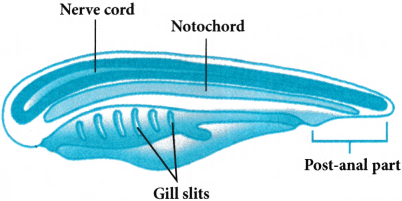
Give three major differences between chordates and non-chordates and draw the sketch of a chordate’s body showing those features.
Answer:

Chordates Non-chordates
1. Notochord present. Notochord absent.
2. Central nervous system is dorsal, hollow and single. Central nervous system is ventral, solid and double.
3. Pharynx perforated by gill slits. Gill slits are absent.
4. Heart is ventral. Heart is dorsal (if present).
5. Post-anal tail is present. Post-anal tail is absent.

Animal Kingdom Questions and Answers AP Inter 1st Year Zoology Chapter 2 1

Question 8.
Compare and contrast cartilaginous and bony fishes.
Answer:

Cartilaginous Fishes Bony Fishes
Mostly marine Both marine and fresh water
Endoskeleton is Cartilage Bony
Mouth is ventral Terminal
Operculum absent Present
Air bladder absent Present
Claspers present Absent
Sexual dimorphism present Absent
5-7 Pairs gill slits 4 Pairs
Placoid scales Cycloid or ctenoid.
Ureotelic Ammonotelic.

Question 9.
Write any eight salient features of the class Amphibia.
Answer:
Amphibians can live in aquatic as well as terrestrial habitats.

  • Most of them have two pairs of limbs. Body is divisible into Head and trunk.
  • Tail may be present in some. The amphibious skin is moist (without scales).
  • The eyes have eyelids. A tympanum represents the ear. Alimentary canal, urinary and reproductive tracts open into a common chamber called cloaca which opens to the exterior.
  • Respiration is by gills, lungs and through skin. The heart is three chambered (Two auricles and one ventricle).
  • These are cold blooded animals.
  • Sexes are separate. Fertilization is external. They are oviparous and development is indirect.
    Examples: Bufo (Toad), Rana (Frog), Hyla (Tree frog), Salamandra (Salamander), Ichthyophis (Limbless Amphibia).

Question 10.
What are the modifications in birds that help them in flight?
Answer:
The variations found in birds that help them fly are –

  1. The presence of feathers.
  2. The forelimbs are modified into wings
  3. Hind limbs generally have scales and are modified for walking, swimming or clasping the tree branches..
  4. Endoskeleton is fully ossified (bone) and the long bones are hollow with air cavities (pneumatic).
  5. Absence of urinary bladder.
  6. The body is streamlined provides less resistance

I. Multiple Choice Questions

Question 1.
Pick the odd pair out
1. Cellular level: Porifera
2. Tissue level: Aschelminthes
3. Organ level: Platyhelminthes
4. Organ system level: Annelida
Answer:
2. Tissue level: Aschelminthes

Question 2.
The type of symmetry in which the body can be divided into identical left and right halves in only one plane.
1. Radial symmetry
2. Asymmetry
3. Bilateral symmetry
4. Pentaradial symmetry
Answer:
3. Bilateral symmetry

Question 3.
Which of the following is a pseudocoelomate ?
1. Hydra
2. Periplaneta
3. Ascaris
4. Pheretima
Answer:
3. Ascaris

Question 4.
The skeleton of corals is composed of
1. Silica
2. Strontium sulphate
3. Calcium carbonate
4. Hydroxyapatite
Answer:
3. Calcium carbonate

Question 5.
Which of the following is not a feature of phylum Arthropoda ?
1. Chitinous exoskeleton
2. Metameric segmentation
3. Parapodia
4. Jointed appendages
Answer:
3. Parapodia

Question 6.
Molluscs are
1. triploblastic, acoelomates
2. triploblastic, coelomates
3. diploblastic, acoelomates
4. diploblastic, coelomates
Answer:
2. triploblastic, coelomates

Question 7.
Balanoglossus is a
1. Mollusca
2. Vertebrate
3. Hemichordate
4. Protozoan
Answer:
3. Hemichordate

Question 8.
Notochord persists throughout the life in
1. Tunicata
2. Chondrichthyes
3. Osteichthyes
4. Cephalochordata
Answer:
4. Cephalochordata

Question 9.
Sea horse belongs to the class
1. Mammalia
2. Amphibia
3. Aves
4. Pisces
Answer:
4. Pisces

Question 10.
Air bladder in bony fishes helps in
1. buoyancy
2. food collection
3. excretion
4. digestion
Answer:
1. buoyancy

Question 11.
Which of the following is a limbless amphibian ?
1. Salamandra
2. Ichthyophis
3. Bufo
4. Hyla
Answer:
2. Ichthyophis

Question 12.
Identify the given animal.
1. Hemidactylus
2. Calotes
3. Draco
4. Chameleon
Answer:
4. Chameleon

Question 13.
Which of the following is an oviparous mammal ?
1. Platypus
2. Kangaroo
3. Elephant
4. Whale
Answer:
1. Platypus

Question 14.
Select the correct match.
1. Taenia – Round worm
2. Apis – Honey bee
3. Asterias – Dog fish
4. Pavo- Frog
Answer:
2. Apis – Honey bee

Question 15.
Which of the following pair of animals has dry and cornified skin?
1. Snake and Frog
2. Lizard and Turtle
3. Frog and Pigeon
4. Crocodile and Tiger
Answer:
3. Frog and Pigeon

II. Fill in the Blanks

Question 1.
The central cavity of coelenterates is called ______________.
Answer:
Gastrovascular cavity

Question 2.
______________ cells are useful for defense and capture of the prey in Cnidarians.
Answer:
Cnidoblasts or Cnidocytes

Question 3.
Flatworms belong to the phylum ______________
Answer:
Platyhelminthes

Question 4.
The second largest phylum in the animal kingdom ______________.
Answer:
Mollusca

Question 5.
The skin of cartilaginous fishes contains minute ______________ scales.
Answer:
Placoid

Question 6.
In Urochordata, the notochord is present only in the ______________ region of larvae.
Answer:
Tail

Question 7.
The mouth in cydostomes is ______________ in shape.
Answer:
Round or Circular

Question 8.
Presence of pneumatic bones is the characteristic feature of ______________.
Answer:
Aves (Birds)

Question 9.
Gills are covered by ______________ in bony fishes.
Answer:
Operculum

III. One Word Answer Questions

Question 1.
Name the cells that line the spongocoel and canals in Poriferans.
Answer:
Choanocytes or collar cells

Question 2.
How do flatworms absorb nutrients from the host?
Answer:
Through the body surface

Question 3.
Write the common name of Ascaris.
Answer:
Round worms

Question 4.
Which organs of Nereis are useful for swimming?
Answer:
Parapodia

Question 5.
Which phylum includes spiny bodied animals?
Answer:
Echinodermata

Question 6.
Name the group of animals that possesses a stomochord.
Answer:
Hemichordata

Question 7.
Name a cartilaginous fish that can produce electric current.
Answer:
Torpedo

Question 8.
Which class of chordata exhibits creeping or crawling mode of locomotion?
Answer:
Reptilia

Question 9.
Where is the oil gland located in birds?
Answer:
Base of the tail

AP Inter 1st Year Zoology Study Material

The Living World Questions and Answers AP Inter 1st Year Zoology Chapter 1

AP Inter 1st Year Zoology 1st Lesson The Living World Questions and Answers

IV. Very Short Answer Questions

Question 1.
What does ICZN stand for ?
Answer:
International Code of Zoological Nomenclature.

Question 2.
Define taxon. Give two examples of taxa at different hierarchical levels.
Answer:

  • A taxon is a level of hierarchy in the system of classifying organisms.
  • The two examples of taxa are – The basic level of classification is species and the highest level of classification is known as kingdom.

Ex: Mango
Kingdom – Plantae
Phylum or Division – Angiospermae
Class – Dicotyledonae
Order – Sapindales
Family – Anacardiaceae
Genus – Mangifera
Species – indica

Ex: Man
Kingdom – Animalia
Phylum or Division – Chordata
Class – Mammalia
Order – primata
Family – Homonidae
Genus – Homo
Spècies – sapiens.

Question 3.
What is biodiversity?
Answer:

  • The variety of life of all living organisms, their genetic makeup, and the ecosystems they inhabit is biodiversity.
  • The number of species that are known and described ranges between 1.7 to 1.8 million.

Question 4.
What are the basic processes in taxonomy ?
Answer:
Characterisation, Identification, Classification and nomenclature are the processes in taxonomy.

Question 5.
What is nomenclature in taxonomy and which process precedes it ?
Answer:
The process of naming of animals with a distinctive (scientific) names is called nomenclature. The process that precedes nomenclature is characterization, identification, classifiction.

Question 6.
Define the word systematics. What is the title of Linnaeus’s publication ?
Answer:

  • The word systematic is derived from the Latin word ‘Systema’ means systematic arrangement of organisms.
  • The title of Linnaeus’s publication is Systema Naturae.

Question 7.
What is binomial nomenclature? Give an example.
Answer:
Binomial nomenclature is a system of scientific naming in which the organism has two components. The first name represents the genus, and the second part represents the specific epithet.
Ex: Mango – The scientific name is written as Mangifera indica.

V. Short Answer Questions

Question 1.
Define the following terms.
a) Phylum
b) Class
c) Family
d) Genus
Answer:
(a) Phylum: It includes one or more classes.

  • Classes comprising animals like fishes, amphibians, reptiles, birds along with mammals.
  • These are based on common features like presence of notochord and a dorsal hollow neural system which are included in phylum chordata.
  • In case of plants classes with a few similar characters are assigned to a higher category called Division.

(b) Class: It includes one or more related orders.

  • For example the order primata comprising monkeys, gorillas and gibbons is placed in class of mammalia and along with the order Carnivora that includes animals like tigers, cats and dogs.

(c) Family: It includes one or more genera.

  • Families are characterized on the basis of both vegetative and reproductive features of plant species.
  • For example – Among plants three different genera Solanum, Petunia and Datura are placed in the family Solanaceae.
  • Among animals Genus Panthera comprising lions, tigers, leopards is put along with genus Felis (cats) in the family Felidae.

(d) Genus:

  • It is a group of related species, resembling one another in certain characters.
  • Example: Potato and Brinjal are two different species but both belong to the genus Solanum.
  • Lion (Panthera leo), leopard (Panthera pardus) and tiger (P.tigris) with several common features are all species of the genus Panthera.

Question 2.
Illustrate the taxonomic hierarchy with an animal example.
Answer:
The table below is the taxonomic hierarchy with humans as an example of an animal.

Taxonomic categories Human
Kingdom Animalia
Phylum/Division Chordata
Class Mammalia
Order Primates
Family Hominidae
Genus Homo
Species Sapiens

Question 3.
What is binomial nomenclature? Write the universal rules of nomenclature.
Answer:

  • In binomial nomenclature biologist follow universally accepted principles to provide scientific names to known organisms.
  • Each name has two components – the generic name and the specific epithet.
  • This naming system given by carolus Linnaeus is being practised by biologists all over the world.
  • This naming system using a two word format was found convenient.
  • The scientific name of mango is written as Mangifera indicAnswer: In this name Mangifera represents the genus, while indica is species.
  • Name of the author appears after the specific epithet i.e., at the end of the biological name and is written in an abbreviated form.
    Ex : Mangifera indica Linn. It indicates that this species was first described by Linnaeus.

The universal rules of nomenclature are –

  • Biological names are generally in Latin and written in italics. They are Latinised or derived from Latin irrespective of their origin.
  • The first word in a biological name represents the genus while the second component denotes the specific epithet.
  • Both the words in a biological name, when handwritten, are separately underlined or printed in italics to indicate their Latin origin.
  • The first word denoting the genus starts with a capital letter while the specific epithet starts with a small letter.

Question 4.
Write short notes on Classification. Taxonomy and Systematics.
Answer:
Classification: Classification is the process by which anything is grouped into convenient categories based on some early observable characters.

  • For example, we easily recognise groups such as plants or animals or dogs, cats or insects.
  • The moment we use any of these terms we associate certain characters with the organism in that group.

Taxonomy:
Based on characteristics, all living organisms can be classified into different taxa. This process of classification is taxonomy.

  • Characterization, Identification, Classification and Nomenclature are the processes that are basic to taxonomy.
  • External and internal structure along with the structure of cell, development process and ecological information of organisms are essential and form the basis of modern taxonomic studies.
  • The science of classifying organisms it involves describing, naming, and grouping living things (plants, animals, and microorganisms) based on their shared characteristics and evolutionary relationships.

Systematics: The systematic arrangement of organisms.

  • The word systematic is derived from the Latin word ‘Systema’ which means systematic arrangement of organisms.
  • Linnaeus used ‘Systema naturae’ as the title of his publications.
  • The scope of systematic was later enlarged to include Identification, Nomenclature and Classification.
  • Systematics takes into account evolutionary relationships between organisms.

I. Multiple Choice Questions

Question 1.
What is the first process in taxonomy ?
1. Identification
2. Nomenclature
3. Classification
4. Characterization
Answer:
4. Characterization

Question 2.
The second word in Binomial nomenclature represents ___________
1. genus
2. family
3. species
4. class
Answer:
3. species

Question 3.
Select the correctly written scientific name of the human being.
1. Homo species
2. Homo sapiens
3. Homo sapians
4. Homo genus family
Answer:
2. Homo sapiens

Question 4.
In a taxonomic hierarchy family is placed between
1. class and kingdom
2. order and class
3. genus and order
4. genus and class
Answer:
3. genus and order

Question 5.
The lowest taxonomic category is
1. genus
2. family
3. species
4. taxon
Answer:
3. species

Question 6.
Which of the following is not a taxon in Linnaeus hierarchy ?
1. Class
2. Kingdom
3. Population
4. Family
Answer:
3. Population

Question 7.
Which of the following belongs to the family Muscidae ?
1. Housefly
2. Grasshopper
3. Firefly
4. Cockroach
Answer:
1. Housefly

Question 8.
Nomenclature is governed by the rules of ICZN. Which of the following is contrary to the rules of nomenclature ?
1. Handwritten scientific names should be underlined.
2. Every organism should have a generic name and a specific epithet.
3. Scientific names are in Latin and should be printed in italics.
4. Both genus and species names start with a capital letter.
Answer:
4. Both genus and species names start with a capital letter.

Question 9.
Can you identify the correct sequence of taxonomical categories?
1. Species – Order – Genus – Kingdom
2. Genus – Species – Order – Kingdom
3. Species – Genus – Order – Phylum
4. Genus – Family – Class – Order
Answer:
3. Species – Genus – Order – Phylum

Question 10.
Biological names are printed in
1. Bold letters
2. Capital letters
3. Italics
4. Small letters
Answer:
3. Italics

II. Fill in the Blanks

Question 1.
The book “Systema Naturae” was written by ___________.
Answer:
Linnaeus

Question 2.
The system of providing a scientific name with two components is called ___________.
Answer:
Binomial nomenclatur

Question 3.
The first word in binomial nomenclature represents ___________.
Answer:
Genus

Question 4.
In binomial nomenclature, the word denoting the genus starts with a .
Answer:
Capital letter

Question 5.
The process of classification is called ___________.
Answer:
Taxonomy

Question 6.
Biological names are generally derived from ___________.
Answer:
Latin

Question 7.
The group of individual organisms with fundamental similarities is called ___________.
Answer:
Species

Question 8.
The scientific name of lion is ___________.
Answer:
Panthera leo

III. One Word Answer Questions

Question 1.
Which taxonomic category comprises a group of related species ?
Answer:
Genus

Question 2.
Who proposed binomial nomenclature ?
Answer:
Linnaeus

Question 3.
Who is known as ‘the Darwin of the 20th century’ ?
Answer:
Ernst Mayr

Question 4.
Write the generic name of tiger.
Answer:
Panthera

Question 5.
What is the scientific term used to describe the categories in biological classification?
Answer:
Taxa

Question 6.
What is the highest category in taxonomic hierarchy?
Answer:
Kingdom

Question 7.
Name the Immediate higher category of “family” in the taxonomic hierarchy.
Answer:
Order

Question 8.
Which branch of biology deals with the different kinds of organisms, their diversities, and the relationships among them ?
Answer:
Systematics

Question 9.
Which taxonomic category includes related orders ?
Answer:
Class

AP Inter 1st Year Zoology Study Material

Plant Growth and Development Questions and Answers AP Inter 1st Year Botany Chapter 10

AP Inter 1st Year Botany 10th Lesson Plant Growth and Development Questions and Answers

IV. Very Short Answer Questions

Question 1.
Define plasticity? Give an example.
Answer:
Ability of Plants to follow different pathways in response to the environment or phases of life to form different kinds of structures is called plasticity.
Ex: Heterophylly in Cotton, Coriander and Larkspur

Question 2.
What is the disease that formed the basis of the identification of gibberellins in plants? Name the causative fungus of this disease.
Answer:
The “BAKANE” or foolish seedling disease of rice seedlings. It is caused by a fungal pathogen Gibberella fujikuroi.

Question 3.
What is apical dominance? Name the growth hormone that causes it. [March-26]
Answer:

  • The growing apical bud inhibits the growth of lateral or axillary buds is called apical dominance.
  • It is caused by Auxins.

Question 4.
What is meant by bolting? Which hormone causes bolting?
Answer:

  • The sudden elongation of internodes just prior to flowering is called bolting.
  • Gibberellins are responsible for bolting.

Question 5.
Define respiratory climactic? Name the PGR associated with it.
Answer:

  • The rise in the rate of respiration during ripening of fruits is called respiratory climactic.
  • Ethylene enhances the respiration rate during ripening of fruits.

Question 6.
What is ethephon? Write its role in agricultural practices.
Answer:

  • The most widely used compound as a source of ethylene is ethephon.
  • Ethephon releases ethylene slowly.
  • Ethephon hastens fruit ripening in tomatoes and apples and accelerates abscission in flowers and fruits.
  • It promotes female flowers in cucumbers, thereby increasing the yield.

Question 7.
Why is abscisic acid also known as stress hormone ?
Answer:

  • Abscisic acid (ABA) is a stress hormone.
  • ABA stimulates the closure of stomata in the epidermis and increases the tolerance to plants for various kinds of stresses.
  • Therefore, It is also called a stress hormone.

Question 8.
Define growth and development.
Answer:

  • Growth is an irreversible, permanent increase in size of an organism or its parts or even of an individual cell.
  • The changes that an organism goes through during its life cycle is called development.

Question 9.
Name the phases observed in sigmoid growth curve.
Answer:
Lag phase, Log phase and Stationary phase.

Question 10.
What are the very essential conditions required for growth ?
Answer:
Water, oxygen and nutrients.

V. Short Answer Questions

Question 1.
Write a note on agricultural and horticultural applications of auxins.
Answer:

  • IBA, NAA and IAA help to initiate rooting in stem cuttings, an application widely used for plant propagation in horticulture.
  • Auxins promote flowering in Pineapple.
  • Auxins help to prevent fruit and leaf drop at early stages but promote the abscission of older mature leaves and fruits.
  • Auxins are responsible for apical dominance and inhibit growth of lateral buds.
  • Auxins also induce parthenocarpy in Tomatoes.
  • Auxins like 2, 4-D are widely used as herbicides, which kill broad leafed dicot weeds.
  • Auxins also control xylem differentiation and help in cell division.

Question 2.
Write the physiological responses of the gibberellins in plants.
Answer:

  • Gibberellins have the ability to cause an increase in the length of axis or peduncle (or) pedicels in grapes.
  • Gibberellins cause fruits like apples to elongate and improve their shape.
  • Gibberellins delay senescence thus the fruits can be left on the tree longer so as to extend the market period.
  • GA3 is used to speed up the malting process in the brewing industry.
  • Spraying sugarcane crops with Gibberellins increases the length of the stem, thus increasing the yield by as much as 20 tonnes per acre.
  • Spraying juvenile conifers with Gibberellins speeds up the maturity period, thus leading to early seed production.
  • Gibberellins promote bolting in beet, cabbages and many plants with rosette habit.
  • They also promote parthenocarpic fruits in grapes and tomatoes.

Question 3.
Write any four physiological effects of cytokinins in plants.
Answer:

  • Cytokinins induce cell division.
  • Cytokinins help to produce new leaves, chloroplasts in leaves.
  • Cytokinins help in lateral shoot growth and adventitious shoot formation.
  • Cytokinins help to overcome apical dominance.
  • They promote nutrient mobilization which helps in the delay of leaf senescence.
  • Cytokinins help in the opening of stomata by increasing the concentration of K+ ions in guard cells.

Question 4.
What are the physiological processes that are regulated by ethylene in plants?
Answer:

  • Ethylene influences Horizontal growth of seedlings, swelling of the axis and apical hook formation in dicot seedlings.
  • Ethylene promotes senescence and abscission of plant organs, especially of leaves and flowers.
  • Ethylene is highly effective in fruit ripening.
  • Ethylene enhances the respiration rate during ripening of fruits. This phenomenon is called respiratory climatic.
  • Ethylene breaks seed and bud dormancy, initiates germination of peanut seeds and sprouting of potato tubers.
  • Ethylene promotes rapid inter node or petiole elongation in deep water rice plants to make the leaves or upper parts of the shoot to remain above water.
  • Ethylene promotes root growth and root hair formation, thus helping plants to increase their absorption surface.
  • Ethylene is used to initiate flowering and for synchronizing fruit set in pineapples. It also induces flowering in mango.
  • It promotes female flowers in cucumbers, thereby increasing the yield.

VI. Long Answer Questions

Question 1.
Define growth, differentiation, development, dedifferentiation, redifferentiation, determinate growth, meristem and growth rate.
Answer:

  • Growth : It is an irreversible, permanent increase in size of an organism or its parts or even of an individual cell.
  • Differentiation : The process by which cells become specialized in structure and function.
  • Development: The changes in an organism undergoes from a single cell to maturity.
  • Dedifferentiation: The process where mature cells reverse their state of differentiation and become undifferentiated.
  • Redifferentiation : The process where dedifferentiated cells lose their ability to divide and become mature to perform a specific function.
  • Determinate growth: Growth that stops after a certain point, meaning the organism or organ stops growing after reaching a certain size.
  • Meristem : A region of actively dividing cells in plants, responsible for new growth.
  • Growth rate : The increase in growth per unit time.

Question 2.
Describe briefly
a) Arithmetic growth,
b) Geometric growth,
c) Sigmoid growth curve,
d) Absolute and relative growth rates.
Answer:
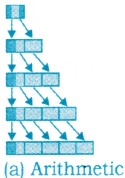
a) Arithmetic Growth:

  • In arithmetic growth, following cell division (mitosis), only one of the daughter cells continues to divide, while the other differentiates and matures.
  • Rate of Growth : The growth rate is constant, meaning the increase in size or number is the same over equal time intervals.
    Ex: The elongation of roots at a constant rate is an example of arithmetic growth.
  • Graph : A graph of length against time in arithmetic growth results in a straight line (linear curve).

Plant Growth and Development Questions and Answers AP Inter 1st Year Botany Chapter 10 1

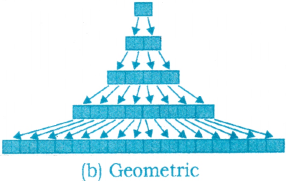
b) Geometric Growth:

  • In geometric growth, the daughter cells retain the ability to divide, but the rate of growth slows down due to factors like limited resources.
  • Rate of Growth : The initial growth is slow (lag phase), followed by a period of rapid increase (log/exponential phase), and then a slowing phase.
    Ex: The growth of all cells, tissues, and organs generally follows a geometric pattern.
  • Graph : A graph of size against time in geometric growth shows a S-shaped curve (sigmoid curve).

Plant Growth and Development Questions and Answers AP Inter 1st Year Botany Chapter 10 2

c) Sigmoid growth curve :

  • If a graph is plotted for geometrical growth, it gives a typical sigmoid or S- curve.
  • A Sigmoid curve is a characteristic of living organisms growing in a natural environ¬. ment.
  • It consists of three phases namely Lag phase, log phase and stationary phase.
  • Lag phase: Growth is slow ih the beginning when the cell number is small.
  • Log phase: Growth increases rapidly or exponentially.
  • Stationary phase : Due to shortage of space and nutrients, growth slows down leading to a stationary phase. This gives an S- shaped curve.

d) Absolute and relative growth rates:

  • Quantitative comparisons between the growth of living systems can be of two kinds.
  • Absolute growth rate: Measurement and comparison of the total growth per unit time is called the absolute growth rate.
  • Relative growth rate: The growth of the given system per unit time expressed on a common basis.
    Ex: Per unit initial parameter is called the relative growth rate.

I. Multiple Choice Questions

Question 1.
The three phases of growth in correct order is
1. Meristematic, maturation, elongation
2. Elongation, meristematic, maturation
3. Meristematic, elongation, maturation
4. Elongation, maturation, meristematic
Answer:
3. Meristematic, elongation, maturation

Question 2.
The phase in which maximum growth can be seen in the sigmoid curve.
1. Log
2. Lag
3. Stationary
4. Lag and Log
Answer:
1. Log

Question 3.
An aquatic plant which shows plasticity
1. Cotton
2. Coriander
3. Buttercup
4. Larkspur
Answer:
3. Buttercup

Question 4.
An example of adenine derivative plant growth regulator is
1. IAA
2. Kinetin
3. ABA
4. Gibberellic acid
Answer:
2. Kinetin

Question 5.
Gibberellic acid is
1. Indole compound
2. Adenine compound
3. Carotenoid derivative
4. Terpene derivative
Answer:
4. Terpene derivative

Question 6.
The foolish seedling disease of rice is caused by
1. Nematode
2. Bacteria
3. Fungus
4. Virus
Answer:
3. Fungus

Question 7.
2, 4-D is used to kill
1. Gymnosperms
2. Dicot weeds
3. Monocot grasses
4. Pteridophytes
Answer:
2. Dicot weeds

Question 8.
Bolting is
1. Yellowing of leaves
2. Internodal elongation prior to flowering
3. Early seed production
4. Re-greening of leaves
Answer:
2. Internodal elongation prior to flowering

Question 9.
Cytokinins help to produce
1. Chloroplast in leaves
2. Stem elongation in sugarcan
3. Synchronized fruit set in pineapple
4. Flowering in pineapple
Answer:
1. Chloroplast in leaves

Question 10.
Ethylene promotes
1. Senescence and abscission of flowers
2. Senescence but not abscission of flowers
3. Abscission of flowers but not senescence
4. Neither senescence nor abscission of flowers
Answer:
1. Senescence and abscission of flowers

II. Fill in the Blanks

Question 1.
Auxin was isolated by F.W.Went from tips of coleoptiles of ___________ seedlings.
Answer:
Oats

Question 2.
The ‘Bakanae’ disease of rice seedlings was caused by a fungal pathogen ___________
Answer:
Gibberella fujikuroi

Question 3.
Skoog and Miller crystallized the cytokinesis promoting active substance that they termed as ___________
Answer:
Kinetin

Question 4.
Inhibitor-b and Dormin were proved to be chemically identical and was named ___________
Answer:
ABA

Question 5.
NAA and 2,4-D are ___________ auxins.
Answer:
Synthetic

Question 6.
2, 4-D is widely used to kill ___________ weeds.
Answer:
Dicot weeds

Question 7.
___________ PGR causes elongation of apple fruits and improves its shape,
Answer:
libberellins

Question 8.
Natural cytokinin zeatin was extracted from ___________ and coconut milk.
Answer:
Corn Kernels

Question 9.
The rise in rate of respiration during ripening of fruits is called as ___________
Answer:
Respiratory climacteric

Question 10.
___________ plant growth regulator is called stress hormone.
Answer:

III. One Word Answer Questions

Question 1.
In which phase of growth is most rapid ?
Answer:
Log phase

Question 2.
Name the hormone that induce rooting in stem cutting.
Answer:
Auxins

Question 3.
Apical dominance is induced by which hormone ?
Answer:
Auxins

Question 4.
Name the auxin that kills dicotyledonous weeds.
Answer:
2,4 D

Question 5.
Which hormone is useful for ripening of fruits ?
Answer:
Ethylene

Question 6.
Name the phytohormone useful for closure of stomatAnswer:
Answer:
ABA

Question 7.
Name the fungus responsible for discovery of gibberellins.
Answer:
Gibberella fujikuroi

Question 8.
Which phytohormone induces bolting in rosette plants ?
Answer:
Gibberellins

Question 9.
Name the phytohormone which is isolated from corn kernels and coconut milk.
Answer:
Zeatin

Question 10.
Which phytohormone promotes female flowers in cucumbers ?
Answer:
Ethylene

AP Inter 1st Year Botany Study Material

Respiration in Plants Questions and Answers AP Inter 1st Year Botany Chapter 9

AP Inter 1st Year Botany 9th Lesson Respiration in Plants Questions and Answers

IV. Very Short Answer Questions

Question 1.
Where does anaerobic respiration occur in man and yeast?
Answer:

  • In muscles of man during exercise, when oxygen is inadequate for cellular respiration anaerobic respiration occurs.
  • In yeasts when oxygen is not available, anaerobic respiration occurs.

Question 2.
What is the common pathway for aerobic and anaerobic respiration? Where does it take place?
Answer:

  • The common pathway for aerobic and anaerobic respiration is Glycolysis.
  • It occurs in the cytoplasm (cytosol) of the cell.

Question 3.
What is the final acceptor of electrons in aerobic respiration? From which complex does it receive electrons?
Answer:

  • The final acceptor of electrons in aerobic respiration is oxygen.
  • The oxygen receives electrons from Enzyme complex IV.

Question 4.
Why is the RQ of fats less than that of the carbohydrates?
Answer:

  • Fats are poorer in O2 and the proportion of oxygen to carbon in fats is less when compared to carbohydrates.
  • They require more O2 for complete oxidation. So the number of O2 used is greater than CO2 released.
  • Thus the RQ of fats is less than that of carbohydrates.

Question 5.
Name the mobile electron carriers of the respiratory electron transport chain in the inner mitochondrial membrane.
Answer:

  • Mobile electron carriers of the respiratory electron transport chain are ubiquinone and cytochrome ‘C’.
  • Ubiquinone is present in the inner mitochondrial membrane while cytochrome ‘c’ is attached to the outer surface of the inner mitochondrial membrane.

Question 6.
F0 – F1 particles are involved in the synthesis of?
Answer:

  • F0 – F1 particles are the two major components of ATP synthase or Enzyme complex-V.
  • F0 is an integral membrane protein complex that forms the channel through which protons cross the inner membrane.
  • The F1 head piece is a peripheral membrane protein complex and contains the site for synthesis of ATP from ADP and inorganic phosphate.

Question 7.
What is the end product of glycolysis? Where is it produced?
Answer:

  • The end product of Glycolysis is Pyruvic acid.
  • It is produced in the cytoplasm.

Question 8.
Write the substrate level phosphorylation reaction in Krebs cycle.
Answer:

  • Succinyl Co.A splits into succinic acid and Co.A in the presence of thiokinase.
  • The energy released is utilised to form ATP from ADP and Pi.

Question 9.
What are the end products in alcoholic fermentation?
Answer:
CO2 and Ethyl alcohol.

Question 10.
How many ATP are produced in aerobic and anaerobic respiration for one glucose.
Answer:

  • In Aerobic respiration 38 ATP molecules are produced.
  • In Anaerobic respiration only 2 ATP molecules are produced.

V. Short Answer Questions

Question 1.
Distinguish between aerobic and anaerobic respiration.
Answer:

Aerobic respiration Anaerobic respiration
i) It occurs in the presence of oxygen. i) It occurs in the absence of oxygen.
ii) Glucose is completely oxidized. ii) Glucose is partially oxidized.
iii) 38 ATP molecules are produced. iii) Only 2 ATP molecules are produced.
iv) The end products are CO2 and H2O iv) The end products are CO2 and ethyl alcohol.
v) It occurs in four steps namely. Glycolysis, oxidative decarboxylation of pyruvic acid, Krebs cycle and Electron transport system. v) It occurs in two steps namely Glycolysis and fermentation.
vi) It occurs in the cytoplasm and mitochondrial matrix. vi) It occurs in the cytoplasm.

Question 2.
Define RQ? Write the RQ value of fats and carbohydrates.
Answer:

  • The ratio of the volume of CO2 evolved to the volume of O2 consumed in respiration is called the respiratory quotient.
  • The value of respiratory quotient depends on the type of respiratory substrate.
  • If carbohydrates are used as respiratory substrates, the volume of CO2 evolved is equal to the amount of O2 consumed, so the RQ value is one.
  • C6H12O6 + 6O2 + 6 H2O → 6 CO2 + 12 H2O + 686 KCal.
  • RQ = 6/6 = 1
  • If Fats are used as respiratory substrates, the volume of CO2 evolved is less than the amount of O2 consumed, so the RQ value is less than one.
  • 2 (C51H98O6) + 145O2 → 102 CO2 + 98 H2O
  • RQ = 102/145 = 0.7
  • If proteins are used as respiratory substrate, the RQ value will be around 0.9.

Question 3.
Discuss the respiratory pathway is an amphibolic pathway.
Answer:

  • Since respiration involves the breakdown of substrates, the respiratory pathway has been considered as a catabolic pathway.
  • But the respiratory pathway is involved in both anabolism and catabolism.
  • Fatty acid would be broken down to acetyl Co. A before entering the respiratory pathway when it is used as a substrate.
  • When the organism needs to synthesize fatty acids, acetyl Co.A would be withdrawn from the respiratory pathway.
  • Thus the respiratory pathway comes into picture both during breakdown and synthesis of fatty acids.
  • Similarly during the breakdown and the synthesis of proteins also, respiratory intermediates form the link.
  • The breaking-down process within the living organism is called catabolism while synthesis is called anabolism.
  • Because the respiratory pathway is involved in both anabolism and catabolism, it is better referred to as an amphibolic pathway.

Respiration in Plants Questions and Answers AP Inter 1st Year Botany Chapter 9 1

Question 4.
Explain the process of fermentation in yeast cells.
Answer:
In anaerobic conditions, Pyruvic acid undergoes partial oxidation to form ethyl alcohol called fermentation. It involves two steps.

A) Decarboxylation:
Pyruvic acid undergoes decarboxylation in the presence of Pyruvic decarboxylase to form Acetaldehyde molecules and CO2, molecules.
2 pyruvic acid → 2 Acetaldehyde + 2 CO2

B) Reduction:
2 Acetaldehyde undergoes reduction in the presence of Alcoholic dehydrogenase to form Ethyl alcohol. NADPH formed in Glycolysis supplies H+ to this reaction.
2 Acetaldehyde + 2 NADPH + H+ → 2 C2H5OH + 2 NAD+

VI. Long Answer Questions

Question 1.
Give an account of glycolysis? Where does it occur? What are the end products? Trace the fate of the products in both aerobic and anaerobic respiration.
Answer:

  • Glucose undergoes partial oxidation to form 2 molecules of pyruvic acid is called Glycolysis.
  • Glycolysis occurs in the “cytoplasm” of the cell and takes place in all living organisms.
  • Its end products are 2ATP, 2 NADH + H+ and 2 PA.
  • The reaction sequence was worked out by Embden, Mayerhoff and Paranas, hence the cycle is known as EMP-pathway.

Various steps of Glycolysis are:

  1. Phosphorylation: Glucose is phosphorylated to glucose-6 phosphate in the presence of ATP, catalyzed by the enzyme hexokinase.
  2. Isomerization : Glucose 6 phosphate is converted into its isomer fructose-6- phosphate, catalyzed by hexose phosphate isomerase.
  3. Phosphorylation: Fructose-6-phosphate is phosphorylated in the presence of ATP to form fructose 1.6 bisphosphate by phosphofructokinase.
  4. Cleavage : Fructose 1, 6 bisphosphate is split into 2 molecules of triose phosphate namely 3 phosphoglyceraldehyde (G,P or PGAI) and dihydroxyacetone phosphate (DHAP). This interconvertible reaction is catalyzed by Aldolase.
  5. Isomerization : DHAP is converted into another G3P molecule in the presence of isomerase.
  6. Dehydrogenation: 3- phosphoglyceraldehyde is oxidized to 1, 3 bisphosphoglyceric acid with the reduction of NAD to NADH + H+. This is catalysed by G-3 P dehydrogenase.
  7. Dephosphorylation: Phosphoglycerokinase catalyses the formation of 3 phosphoglyceric acid from 1, 3 bis PGA. Two molecules of ATP are produced directly by substrate level phosphorylation.
  8. Intra molecular shift: 3 phosphoglyceric acid is converted into 2 phosphoglyceric acid in the presence of phosphoglyceromutase.
  9. Dehydration: 2 PGA molecules lose water molecules in the presence of Enolase to form PEPA molecules.
  10. Dephosphorylation: 2 PGA molecules undergo dephosphorylation in the presence of pyruvic kinase to form 2 PA molecules and 2 ATP molecules are formed.
    • Fate of pyruvic acid depends on the cellular need.
    • There are three major ways in which different cells handle pyruvic acid produced by glycolysis.
    • These are lactic acid fermentation, alcoholic fermentation and aerobic respiration.
    • Fermentation takes place under anaerobic conditions in many prokaryotes and unicellular eukaryotes.
    • For the complete oxidation of glucose to CO2 and H2O organisms adopt Krebs’ cycle which is also called aerobic respiration. This requires O2 supply.

Respiration in Plants Questions and Answers AP Inter 1st Year Botany Chapter 9 1

Question 2.
Explain the reactions of Krebs cycle.
Answer:

  • Acetyl CoA is formed from pyruvic acid as a result of oxidative decarboxylation.
  • Acetyl CoA acts as a substrate for Krebs cycle, Krebs cycle may also be called Tricarboxylic acid cycle (TCA cycle) or Citric acid cycle or Organic acid cycle.
  • It is called Krebs cycle after the scientist Sir Hans Krebs who first elucidated it.
  • There are 10 biochemical reactions in Krebs cycle.


1. Condensation :
In this, acetyl Co.A condenses with oxaloacetic acid and water to yield citric acid in the presence of Citrate synthetase and Co.A is released.
Oxaloacetic acid + Acetyl Co.A + H2O → Citric acid + Co.A

2. Dehydration :
Citric acid loses water molecule to form Cis aconitic acid in the presence of aconitase.
Citric acid → Cis-aconitic acid + H2O

3. Hydration:
A water molecule is added to cis-aconitic acid to yield isocitric acid in the presence of aconitase.
Cis – aconitic acid + H2O → isocitric acid

4. Oxidation I :
Isocitric acid undergoes oxidation in the presence of isocitric dehydrogenase to yield Oxalosuccinic acid,
Isocitric Acid + NAD+ → Oxalosuccinic acid + NADH + H+

5. Decarboxylation :
Oxalosuccinic acid undergoes decarboxylation in the presence of Oxalosuccinic decarboxylase to form a – ketoglutaric acid.
Oxalosuccinic acid → ∝ – ketoglutaric acid + CO2

6. Oxidative decarboxylation, Oxidation II :
∝ – ketoglutaric acid undergoes oxidation and decarboxylation in the presence of ∝ – ketoglutaric dehydrogenase and condenses with CoA to form succinyl CoA.
∝ – keto Glutaric acid + NAD+ + CoA → succinyl CoA + NADH + H+ + CO2

7. Cleavage:
Succinyl CoA splits into succinic acid and CoA in the presence of succinic thiokinase. The energy released is utilized to form ATP from ADP and Pi.
Succinyl CoA + ADP + Pi → Succinic Acid + ATP + CoA

8. Oxidation-III:
Succinic acid undergoes oxidation and forms Fumaric acid in the presence of succinic dehydrogenase.
Succinic Acid + FAD → Fumaric acid + FADH2

9. Hydration:
A water molecule is added to Fumaric acid in the presence of Fumarase to form Malic acid.
Fumaric acid + H2O → Malic acid

10. Oxidation IV :
Malic acid undergoes oxidation in the presence of malic dehydrogenase to form oxaloacetic acid.
Malic Acid + NAD+ → Oxaloacetate + NADH + H+
In the TCA cycle, for every 2 molecules of Acetyl CoA undergoing oxidation, 2 ATP, 6 NADH + H+ 2 FADH2 molecules are formed.

Respiration in Plants Questions and Answers AP Inter 1st Year Botany Chapter 9 2

I. Multiple Choice Questions

Question 1.
Glycolysis is also known as ___________ pathway.
1. ETS
2. EMP
3. ENP
4. ELP
Answer:
2. EMP

Question 2.
End product of glycolysis is
1. Pyruvic acid
2. Oxalo acetic acid
3. Citric acid
4. Phosphoenolpyruvic acid
Answer:
1. Pyruvic acid

Question 3.
Fermentation occurs when there is
1. Complete supply of oxygen
2. No supply of oxygen
3. Complete supply of water
4. No supply of water
Answer:
2. No supply of oxygen

Question 4.
In alcoholic fermentation, pyruvate is converted to which among the following.
1. Ethanol, CO2, NADH
2. CO2and Methanol
3. CO2 and Ethanol only
4. CO2 and Carboxylic acid
Answer:
3. CO2 and Ethanol only

Question 5.
Which enzyme catalyses the oxidative decarboxylation of pyruvic acid.
1. Pyruvate carboxylase
2. Lactate dehydrogenase
3. Alcohol dehydrogenase
4. Pyruvate dehydrogenase
Answer:
4. Pyruvate dehydrogenase

Question 6.
Where does TCA cycle occurs
1. Cytoplasm
2. Inner membrane of Mitochondria
3. Mitochondrial matrix
4. Stroma of Chloroplast
Answer:
3. Mitochondrial matrix

Question 7.
What is the first formed compound in TCA cycle
1. Acetyl CoA
2. Citric acid
3. Isocitric acid
4. OAA
Answer:
2. Citric acid

Question 8.
Which among the following is synthesized during the conversion of succinyl – CoA to succinic acid inTCA cycle.
1. FADH2
2. GTP
3. NADH2
4. NADPH2
Answer:
2. GTP

Question 9.
How many total NADH + H+ are produced from a pyruvic acid after completion of TCA cycle ?
1. 2
2. 3
3. 4
4. 5
Answer:
3. 4

Question 10.
The site of ETC is
1. Outer membrane of mitochondria
2. Cytoplasm
3. Inner membrane of mitochondria
4. Matrix of mitochondria
Answer:
3. Inner membrane of mitochondria

II. Fill in the Blanks

Question 1.
The energy currency of the cell ___________
Answer:
ATP

Question 2.
Glycolysis occurs in ___________ of the cell.
Answer:
Cytoplasm

Question 3.
In muscle cells of animals, when oxygen is inadequate, pyruvic acid is converted to
Answer:
Lactic acid

Question 4.
Pyruvic acid + CoA + NAD + Acetyl CoA + CO2 + NADH + H+. Above reaction is catalyzed by enzyme ___________
Answer:
Pyruvic dehydrogenase

Question 5.
During the conversion of succinyl-CoA to succinic acid in citric acid cycle, a molecule of ___________ is synthesized.
Answer:
GTP

Question 6.
Tricarboxylic acid cycle was discovered by ___________
Answer:
Hans Krebs

Question 7.
ATP synthase is located on ___________ membrane of Mitochondria.
Answer:
Inner

Question 8.
Oxidation of one molecule of FADH2 gives rise to ___________ molecules of ATP.
Answer:
2

Question 9.
Respiratory pathway is an ___________ pathway as it involves both catabolism and anabolism.
Answer:
Amphibolic

Question 10.
The ratio of the volume of C02 evolved to the volume of 02 consumed in respiration is called ___________
Answer:
Respiratory Quotient

III. One Word Answer Questions

Question 1.
Which enzyme catalyses the phosphorylation of glucose during glycolysis?
Answer:
Hexokinase

Question 2.
Where is the electron transport system located in the mitochondria of a cell?
Answer:
Inner membrane of mitochondria

Question 3.
Name the cofactors required for the activity of pyruvate dehydrogenase.
Answer:
NAD+ and CoA

Question 4.
What is the number of ATP produced when pyruvate is converted to lactate by Fermentation?
Answer:
Zero (0)

Question 5.
In glucose, how many carbon molecules are present? [March-26]
Answer:
6 carbons

Question 6.
What is the end product of anaerobic respiration in yeast?
Answer:
Ethanol + CO2

Question 7.
Respiratory quotient of carbohydrates is 1. Why?
Answer:
Volume of CO2 released and volume of O2 consumed is equal. So the Rq value is one.

Question 8.
Glycolysis occurs in which part of the cell?
Answer:
Cytoplasm

Question 9.
Name the process of conversion of glucose into ethyl alcohol.
Answer:
Fermentation

Question 10.
Which compound serves as a connecting link between glycolysis and Kreb’s cycle?
Answer:
Acetyl CoA

AP Inter 1st Year Botany Study Material

Photosynthesis in Higher Plants Questions and Answers AP Inter 1st Year Botany Chapter 8

AP Inter 1st Year Botany 8th Lesson Photosynthesis in Higher Plants Questions and Answers

IV. Very Short Answer Questions

Question 1.
Name the processes which take place in grana and stroma regions of chloroplast.
Answer:
Light reaction of photosynthesis takes place in the grana of chloroplast. Dark reactions of photosynthesis take place in the stroma of chloroplast.

Question 2.
Where does the photolysis of H2O occur? What is its significance?
Answer:
Photolysis of H2O takes place in “Lumen of thylakoids” or in grana thylakoids. Due to this process, electrons, protons and oxygen are released. Oxygen is the basis for all organisms.

Question 3.
Where is the enzyme NADP reductase located? What is released if the proton gradient breaks down?
Answer:
The enzyme NADP reductase is located on the outer side of the thylakoid membrane in the chloroplast. When the proton gradient breaks down, energy is released in the form of NADPH and ATP.

Question 4.
Explain the terms :
(a) PEP Carboxylase
(b) Bundle sheath cells.
Answer:
a) PEP Carboxylase : PEP carboxylase is an enzyme that catalyzes the reaction of phosphoenolpyruvate (PEP) with bicarbonate to form oxaloacetate.

b) Bundle Sheath Cells: Bundle sheath cells are thick-walled cells that surround vascular bundles in C4 plant leaves and stems.

Question 5.
Mention the components of ATPase enzyme. What is their location? Which part of the enzyme shows conformational change?
Answer:

  • The ATPase enzyme consists of two parts: F0 is embedded in the thylakoid membrane and forms a trans-membrane channel that carries out facilitated diffusion of protons across the membrane.
  • F1 protrudes on the outer surface of the thylakoid membrane that faces the stroma. It provides enough energy to cause a conformational change in the ATPase, involved in the synthesis of ATP.

Question 6.
Distinguish between action spectrum and absorption spectrum.
Answer:

  • Action spectrum: A graph showing the rate of photosynthesis at different wavelengths of light.
  • Absorption spectrum: A graph showing the absorption of light by the photosynthetic pigments at different wavelengths.

Question 7.
Out of the basic raw materials of photosynthesis, What is reduced? What is oxidized?
Answer:
Of the basic raw materials like CO2 and H2O, H2O is oxidized in light reaction and CO2 is reduced in the dark phase of photosynthesis.

Question 8.
Define the law of limiting factors proposed by Blackmann.
Answer:
If a process is conditioned as to its rapidly by a number of separate factors, the rate of the process is limited by the factor that is present in a relative minimum value.

Question 9.
What is the primary acceptor of CO2 in C3 plants? What is the first stable compound formed in the Calvin cycle?
Answer:

  • Primary acceptor of CO2 in C3 plants is RUBP.
  • The first stable compound formed in Calvin cycle is PGA.

Question 10.
What is the primary acceptor of CO2 in C4 plants? What is the first compound formed as a result of primary carboxylation in the C4 pathway?
Answer:

  • Primary acceptor of CO2 in C4 plants is PEP (phosphoenol pyruvic acid).
  • First stable compound formed in C4 cycle is OAA (Oxaloacetic Acid).

V. Short Answer Questions

Question 1.
Differentiate between C3 and C4 plants.
Answer:

C3 plants C4 plants
1. They grow mainly in temperate and tropical regions of the world. 1. They grow in tropical and subtropical regions of the world.
2. Leaves do not show Kranz anatomy. 2. Leaves show Kranz anatomy.
3. Chloroplast dimorphism is not seen. 3. Chloroplast dimorphism is seen.
4. Primary acceptor of CO2 is RUBP. 4. Primary acceptor of CO2 is PEPA.
5. First formed product is PGA. 5. First formed product is OAA.
6. They cannot utilize CO2 efficiently. 6. They can utilize CO2 efficiently.
7. Photorespiration is more. 7. Photorespiration is absent.
8. The optimum temperature for photosynthesis is 15-25°C. 8. The optimum temperature for photosynthesis is 30-45°C.
9. Photosynthetic yield is less. 9. Photosynthetic yield is high.
10. 18 ATP are required to synthesize one Glucose molecule. 10. 30 ATP are required to synthesize one Glucose molecule.
11. Water utility is less. 11. Water utility is more.
12. CO compensation point is more 12. CO2 compensation point is less.

Question 2.
Write short notes on photorespiration.
Answer:
Photorespiration is a metabolic process in plants where oxygen binds to the enzyme RuBisCO instead of carbon dioxide, resulting in the release of carbon dioxide.

  • RUBIsCO has a much greater affinity for CO2 when the CO2 and O2 are nearly equal.
  • In C3 plants, Some O2 binds with RUBIs CO2 and hence CO2 fixation is reduced.
  • RUBP Binds with Oxygen to form one molecule of Phosphoglycerate and phosphoglycolate (2c). So called C2 cycle.
  • In this proces, release of CO2 with the utilization of ATP occurs.
  • No synthesis of ATP or NADPH.
  • It is a wasteful process.
  • In C4 plants, photorespiration does not occur, because they have a mechanism that increases the concentration of CO2 at the enzyme site.
  • In C4 plants, C4 acid from the mesophyll is broken down in the bundle sheath cells to release CO2.
  • This results in increasing the intracellular concentration of CO2.
  • In turn this ensures that the RUBIsCO functions as a carboxylase minimising the oxygenase activity.
  • So C4 plants are more effective in productivity and yield and also show tolerance to higher temperatures than C3 plants.

Question 3.
Describe the mechanism of the C4 pathway.
Answer:

  • Kortschak, Hartt and Burr found that 3-PGA is not the initial product of photosynthesis in case of sugarcane, instead it was four carbon compounds like malic and aspartic acids.
  • Hatch and Slack confirmed the results of Kortschak, Hartt and Burr while working on sugarcane plants.
  • The first stable compound is a four-carbon compound, the pathway is termed as C4 pathway and plants which undergo this pathway are called C4 plants.
  • This pathway is also called Beta-Carboxylation pathway or Hatch-Slack pathway.

REACTIONS:

In Mesophyll cells:

  • CO2 is accepted by a 3-carbon molecule phosphoenol pyruvic acid, in the form of HCO3 and is present in the mesophyll cells in the presence of PEP carboxylase and water to form oxaloacetic acid.
  • CO2 phosphoenol pyruvic acid + H2O → oxaloacetic acid + H3PO4
  • Oxaloacetic acid is reduced to malic acid by using the light generated NADPH + H+ in the presence of Malic dehydrogenase.
  • Oxaloacetic acid + NADPH + H+ → malic acid + NADP+

In Bundle sheath cells:

  • Malic acid formed in the chloroplast of mesophyll cells is now transported to the chloroplast of bundle sheath cells.
  • Malic acid now undergoes oxidative decarboxylation to form Pyruvic acid (3C) in the presence of Malic enzyme. In this NADP+ is reduced to NADPH + H+.
  • Malic acid + NADP+ → pyruvic acid + NADPH + H+ + CO2
  • The CO2 generated is utilized in the Calvin cycle to synthesize sugars
  • The Pyruvic acid produced in bundle sheath cells moves to the chloroplast of mesophyll cells and is phosphorylated to Phosphoenol Pyruvic acid in the presence of pyruvate dikinase.
  • PEP undergoes phosphorylation, then enters into the cytoplasm of the mesophyll cells.
  • Pyruvic acid + 2ATP + Pi → phosphoenol pyruvic acid + 2 AMP + 2 Pi.
  • During this pathway two carboxyations and one decarboxylation reaction occurs.
  • To synthesize one molecule of Glucose, C4 plants utilize 30 ATP and 12 NADPH + H+.

Photosynthesis in Higher Plants Questions and Answers AP Inter 1st Year Botany Chapter 8 1

Question 4.
Draw a neat labelled diagram of chloroplast.
Answeer:

Photosynthesis in Higher Plants Questions and Answers AP Inter 1st Year Botany Chapter 8 2

Question 5.
Differentiate between cyclic and non-cyclic photophosphorylation.
Answer:

Cyclic photophosphorylation Non-cyclic photophosphorylation
1. Photosystem I is involved. 1. Photosystem I and Photosystem II are involved.
2. Electrons move in a closed circle. 2. Electrons move in a Zigzag manner.
3. Photolysis of water does not occur. 3. Photolysis of water occurs.
4. O2 is not released. 4. O2 is released.
5. One ATP molecule is formed. 5. Two ATP molecules are formed.
6. It is not inhibited by DCMU. 6. It is inhibited by DCMU.

VI. Long Answer Questions

Question 1.
Describe the process of reactions in the Calvin cycle.
Answer:

  • Melvin Calvin and his associates Andrew Benson and lames Basham discovered the CO2 fixation pathway in Chlorella and hence named Calvin cycle.
  • It is also called Photosynthetic carbon reduction (PCR) cycle or reductive pentose phosphate pathway (RPP cycle) or Dark reaction.
  • This pathway is studied under three phases namely – A) Carboxylation, B) Reduction and C) Regeneration.

I. Carboxylation Phase:
Fixation of CO2 into a stable organic intermediate is called carboxylation. It is the most crucial step of the calvin cycle where CO2 is utilized for carboxylation of RUBP in the presence of RUBIsCO results in the formation of two molecules of 3-PGA.

II. Reduction Phase:
2 molecules of ATP for phosphorylation and two molecules of NADPH for reduction per CO2 molecule fixed. The fixation of 6 molecules of CO2 and 6 turns of the cycle are required for the formation of one molecules of Glucose.

III. Regeneration phase:

  • To continue the cycle uninterrupted, regeneration of RUBP is crucial. It requires one ATP for phosphorylation to form RUBP.
  • Hence for every CO2 molecule entering the Calvin cycle, 3 molecules of ATP and 2 molecules of NADPH are required.
  • To meet this difference in the number of ATP and NADPH used in dark reactions, cyclic phosphorylation takes place.
  • To synthesize one Glucose molecule, 18 ATP and 12 NADPH + H+ are required.

Photosynthesis in Higher Plants Questions and Answers AP Inter 1st Year Botany Chapter 8 3

I. Multiple Choice Questions

Question 1.
Who discovered oxygen?
1. Joseph Priestly
2. T. Engel
3. Jan Ingenhousz
4. Van Neil
Answer:
1. Joseph Priestly

Question 2.
Chloroplast is
1. Single membrane-bound organelle
2. Double membrane-bound organelle
3. Triple membrane-bound organelle
4. Membrane-lacking organelle
Answer:
2. Double membrane-bound organelle

Question 3.
Which is the most abundant plant pigment in the world?
1. Chlorophyll a
2. Chlorophyll b
3. Carotenoids
4. Xanthophylls
Answer:
1. Chlorophyll a

Question 4.
Maximum absorption by chlorophyll a occurs in
1. Blue green region
2. Red green region
3. Blue red region
4. Yellow red region
Answer:
3. Blue-red region

Question 5.
LHC stands for-
1. Late Harvesting Complex
2. Light Harvesting Complex
3. Light Hanging Complex
4. Late Hanging Complex
Answer:
2. Light Harvesting Complex

Question 6.
During photosynthesis the O2 is released in
1. Lumen of thylakoid
2. Outer side of thylakoid
3. Stroma
4. Cytoplasm
Answer:
1. Lumen of thylakoid

Question 7.
For formation of 1 glucose molecule, how many turns of Calvin cycle is/are needed?
1. 3
2. 1
3. 2
4. 6
Answer:
4. 6

Question 8.
The most crucial step of Calvin cycle is
1. Carbonation
2. Carboxylation
3. Reduction
4. Regeneration
Answer:
2. Carboxylation

Question 9.
The first stable product during CO2 fixation in C4 cycle is
1. RBP
2. PEP
3. OAA
4. PGA
Answer:
3. OAA

II. Fill in the blanks

Question 1.
___________ in 1770 performed a series of experiments that revealed the essential role of air in the growth of green plants.
Answer:
Joseph Priestley

Question 2.
Chlorophyll ___________ is the chief pigment associated with photosynthesis.
Answer:
Chlorophyll a

Question 3.
In PS-I, the reaction centre chlorophyll-a has an absorption peak at ___________ nm.
Answer:
700

Question 4.
The splitting of water is associated with the PS-___________
Answer:
PS II

Question 5.
The ___________ enzyme is located on the stroma side of the membrane.
Answer:
NADP reductase

Question 6.
Chemiosmosis is helpful for the synthesis of ___________
Answer:
ATP

Question 7.
The products of light reaction are ATP, NADPH and ___________
Answer:
Oxygen

Question 8.
RuBP carboxylase also has an oxygenation activity, so it would be more correct to call. It ___________
Answer:
RUBISCO

Question 9.
‘Kranz’ anatomy is a characteristic feature of ___________ plants.
Answer:
C4

Question 10.
___________ is the major limiting factor for photosynthesis.
Answer:
CO2

III. One Word Answer Questions

Question 1.
What is the primary acceptor of CO2 in C3 plants?
Answer:
RUBP

Question 2.
Which is the first formed compound in C3 plants?
Answer:
PGA

Question 3.
What is the primary acceptor of CO2 in C4 plants?
Answer:
PEPA

Question 4.
Name the first formed compound in C4 plants.
Answer:
OAA

Question 5.
Where does photolysis of water take place in Chloroplast?
Answeer:
Lumen of thylakoid

Question 6.
Who proposed the law of limiting factors in photosynthesis?
Answer:
Blackmann

Question 7.
How many ATP are required for synthesis of one glucose in C3 plants?
Answer:
18 ATP

Question 8.
Where does light reaction take place in chloroplast?
Answer:
Grana or Thylakoids

Question 9.
Where does dark reaction take place in chloroplast?
Answer:
Stroma

Question 10.
Name the first enzyme that is involved in the carboxylation process in C3 Plants.
Answer:
RUBISCO

AP Inter 1st Year Botany Study Material

AP Inter 1st Year Zoology Study Material

AP Intermediate 1st Year Zoology Textbook Solutions

Unit I Diversity in the Living World

Unit II Structural Organisation

Unit III Human Physiology

Cell Cycle and Cell Division Questions and Answers AP Inter 1st Year Botany Chapter 7

AP Inter 1st Year Botany 7th Lesson Cell Cycle and Cell Division Questions and Answers

IV. Very Short Answer Questions

Question 1.
Which tissue of animals and plants exhibit meiosis ?
Answer:

  • In higher animals, meiosis occurs in gamete mother cells (spermatocytes and oocytes) during gametogenesis.
  • In higher plants, meiosis occurs in spore mother cells, microspore mother cells and megaspore mother cells during sporogenesis.

Question 2.
What attributes does a chromatid require to be classified as a chromosome?
Answer:
A chromatid is said to be as a chromosome when it possesses

  • Independent existence.
  • Its own centromere with one DNA molecule.

Question 3.
Which of the four chromatids of a bivalent at prophase-I of meiosis can involve in crossing over?
Answer:
Non-sister chromatids of homologous chromosomes of a bivalent can involve in crossing over.

Question 4.
Write the sub stages of meiotic prophase-I in which ‘synapsis’ and ‘crossing over’ occurs.
Answer:
Synapsis occurs in Zygotene and Crossing over occurs in Pachytene stage.

Question 5.
A cell has 32 chromosomes. It undergoes mitotic division. What will be the chromosome number during metaphase and DNA content (C) during anaphase?
Answer:

  • The mitotic cell division occurs in somatic cells of an organism.
  • The chromosome number in the daughter cells remains the same as that of the parent cell. So even at metaphase, the chromosome number does not change.
  • The DNA content gets doubled at the synthetic phase or interphase and gets divided at anaphase but the chromosome number remains same.

V. Short Answer Questions

Question 1.
In which phase of meiosis the following are formed ? Choose the answers from hint points given below.
a) Synaptonemal complex
b) Recombination nodules
c) Functioning of the enzyme recombinase
d) Terminalization of chiasmata
e) Interkinesis
f) Formation of dyad of cells
Hints :
i) Pachytene,
ii) After Telophase-I/before meiosis-II,
iii) Zygotene,
iv) Telophase-I/After meiosis-I,
v) Pachytene,
vi) Diakinesis
Answer:
a) Zygotene
b) Pachytene
c) Pachytene
d) Diakinesis
e) After Telophase-I/before Meiosis-II
f) Telophase-1/After Meiosis-I

Question 2.
Mitosis results in producing two daughter cells which are similar to each other. What would be the consequence if each of the following irregularities occurs during mitosis?
a) Nuclear membrane fails to disintegrate
b) Duplication of DNA does not occur.
c) Centromere does not divide
d) Cytokinesis does not occur.
Answer:
a) If a nuclear membrane fails to disintegrate, the replicated chromosomes remain within the same cell. Nucleus does not divide (Endomitosis).

b) If duplication of DNA does not occur there is no further cell division. Every mitotic cell division must be preceded by DNA duplication. Then only separation of sister chromatids is possible in Anaphase.

c) If centromeres do not divide, daughter chromosomes are not formed (polytomy).

d) If cytokinesis does not occur, multinucleate condition arises leading to the formation of syncytium (Ex: liquid endosperm in coconut).

Question 3.
Describe the events in prophase-1 of meiosis.
Answer:
Prophase-I : This is a typically longer and complex phase. It is further subdivided into 5 phases based on the behaviour of chromosomes into

  • Leptotene,
  • Zygotene,
  • Pachytene,
  • Diplotene,
  • Diakinesis.

i) Leptotene :
During the leptotene stage, chromosomes become gradually visible. This compaction of chromosomes lasts throughout the leptotene stage.

ii) Zygotene:

  • Chromosomes start pairing together by a process called synapsis. Such chromosomes are called homologous chromosomes.
  • It is followed by the formation of synaptonemal complex.
  • Such a complex formed by a pair of synapsed homologous chromosomes is called bivalent or a tetrad of chromatids.

iii) Pachytene:

  • Bivalents clearly appear as tetrads. Formation of recombination nodules occur.
  • Crossing over is exchange of genetic material between two homologous chromosomes is mediated by recombinase enzymes.
  • It leads to recombination of genetic material on the two chromosomes.

iv) Diplotene:

  • The dissolution of the synaptonemal complex occurs.
  • Separation of bivalents from each other except at the regions of crossing over occurs. Such X- shaped regions are referred to as chiasmata.

v) Diakinesis:

  • Terminalisation of chiasmata occurs.
  • The chromosomes are fully condensed.
  • The meiotic spindle is assembled to prepare the homologous chromosomes for separation.
  • During late diakinesis, the nucleolus disappears and nuclear envelope also break down.

Question 4.
Though redundantly described as a resting phase, interphase does not really involve rest. Comment.
Answer:

  • Actually during the interphase, great metabolic activities occur so it is a preparatory phase.
  • Division of chromosomes or cytoplasm does not occur.
  • During interphase cell enlarges.
  • The interphase is divided into three phases: G1 phase (Gap 1), S-phase (Synthesis), and G1 phase (Gap 2).

Cell Cycle and Cell Division Questions and Answers AP Inter 1st Year Botany Chapter 7 1

G1 phase:

  • It corresponds to the interval between mitosis and initiation of DNA replication.
  • During G1 phase the cell is metabolically active and continuously grows.

S or synthesis phase:

  • It marks the period during which DNA synthesis or replication takes place.
  • During this time the amount of DNA per cell doubles.
  • If the initial amount of DNA is denoted as 2C, then it increases to 4C.
  • However, there is no increase in the chromosome number.

G2 phase :

  • Proteins are synthesized in preparation for mitosis.
  • Cell growth continues.
  • Hence, interphase is not a resting phase.

VI. Long Answer Questions

Question 1.
Discuss on the statement – telophase is he reverse of prophase.
Answer:
It is true to say that telophase is the reverse of the prophase stage. Based on the following points we can support this fact.

During Prophase:

  • Chromatin fibres are shorter and thicker due to coiling and folding which results in thread-like chromosomes.
  • Each chromosome consists of two coiled sister chromatids joined by centromeres
  • During late prophase, ER, Golgi complex, Nucleolus and nuclear envelope disappear.
  • Centrioles migrate towards opposite poles.
  • Sharp radiating microtubules appear around each centriole and migrate towards opposite poles.

During Telophase :

  • Daughter chromosomes undergo decondensation and uncoiling at each pole.
  • The chromatin material gets surrounded by segments of nuclear membrane formed from the elements of ER.
  • Cellular components like ER and golgi complex reorganize once again.
  • Formation of the new nucleoli can be noticed.
  • Astral rays and spindle fibres are gradually disintegrate and are absorbed into the cytoplasm.
  • Two daughter nuclei are designed.

Question 2.
Differentiate between the events of mitosis and meiosis.
Answer:

MITOSIS MEIOSIS
1. Generally occurs in somatic cells. 1. Occurs in germ cells.
2. DNA duplicates once and nucleus also divides once. 2. DNA duplicates once but nucleus divides twice.
3. Prophase is comparatively simple and consumes less time. 3. Prophase is comparatively longer and consumes more time.
4. Pairing of Homologous chromosomes does not occur. 4. Pairing of Homologous chromosomes occurs.
5. Crossing over is absent. 5. Crossing over occurs between non sister chromatids of homologous chromosomes.
6. Division of centromere occurs in Anaphase. 6. Division of centromere occurs in Anaphase II.
7. Two daughter cells are formed at the end of division. 7. Four daughter cells are formed as a result of Meiosis.
8. Both diploid and haploid cells can undergo Mitosis. 8. Only diploid cells can undergo meiosis.
9. The genetic constitution of daughter cells is identical to that of parent cell. 9. Due to crossing over, the genetic constitution of daughter cells is different from parent cells.
10. One spindle apparatus is developed. 10. Three spindle apparatus are developed.
11. Daughter cells formed at the end of mitosis have the same number of chromosomes as that of parent cells. 11. Chromosomal number in daughter cells is reduced to half that of parent cells.

Question 3.
Write a brief note on the following:
a) Synaptonemal complex,
b) Metaphase plate
Answer:
a) Synaptonemal complex:

  • Synaptonemal complex is a fibrillar structure that develops during zygotene of prophase-1 of meiosis I.
  • It develops between the synapsed homologous chromosomes.
  • It helps in stabilization of paired conditions of chromosomes and involves in chiasmata formation and crossing over.
  • The synaptonemal complex is attached at both ends through its lateral elements to the inner surface of the nuclear membrane.
  • It disappears during diplotene.
  • This helps in repulsion activity between homologous chromosomes. .
  • As a result the homologues of the bivalents are separated from each other.

b) Metaphase Plate:

  • Metaphase plate gets organised during metaphase of mitosis and metaphase of meiosis.
  • The spindle fibres organised during metaphase get accumulated at the centre of the cell.
  • The plane of alignment of the chromosomes during cell division at metaphase is referred to as the metaphase plate.
  • The orientation of the metaphase plate is based on the chromosomal arrangement.
  • Metaphase plate is important in equitable and simultaneous distribution of all the chromosomes.

Question 4.
Write briefly the significance of mitosis and meiosis in multicellular organisms.
Answer:
A) Significance of mitosis:

  • Equal distribution of chromosomes : Mitosis results in the production of diploid daughter cells with genetic complement usually identical to that of the parent cell.
  • The growth in multicellular organisms is due to mitosis only.
  • Cell growth results in disturbing the ratio between the nucleus and the cytoplasm.
  • It therefore becomes essential for the cell to divide to restore the nucleo-cytoplasmic ratio.
  • Repair: The cells of the upper layer of the epidermis, cells of the lining of the gut, and RBC are constantly being replaced.
  • Mitotic divisions in the meristematic cells and the apical and the lateral meristems result in continuous growth of plants throughout their lifetime.

B) Significance of meiosis

  • Meiosis is responsible for the formation of sex cells or gametes that are responsible for sexual reproduction.
  • In sexually reproducing organisms the constant number of chromosomes through generations is maintained by meiosis by producing haploid gametes.
  • It is the only means of restoring the chromosome number characteristic of the species.
  • In pachytene due to crossing over the hereditary factors from male and female parents get mixed thus providing a new combination of genetic material.
  • Variations inherited lead to evolution of species.

I. Multiple Choice Questions

Question 1.
Phase between two successive M-phases
1. Prophase
2. Metaphase
3. Interphase
4. Anaphase
Answer:
3. Interphase

Question 2.
Cell cycle duration of yeast
1. 24 hours
2. 90 minutes
3. 20 minutes
4. 60 minutes
Answer:
2. 90 minutes

Question 3.
During ‘S’ phase of interphase
1. DNA synthesizes, chromosome number remains same
2. DNA synthesizes, chromosome number doubled
3. DNA does not synthesize, chromosome number reduced to half
4. DNA does not synthesize, chromosome number remains same
Answer:
1. DNA synthesizes, chromosome number remains same

Question 4.
A cell in G1 phase has 16 chromosomes, how many chromosomes does the cell have a G2 phase.
1. 24
2. 32
3. 8
4. 16
Answer:
4. 16

Question 5.
The cells in the quiescent stage (G0) exit the cell cycle from the following phase;
1. G2 phase
2. G1 phase
3. S phase
4. M phase
Answer:
2. G1 phase

Question 6.
Identify the correct sequential phases in the karyokinesis.
1. Prophase, metaphase, anaphase, telophase
2. Metaphase, anaphase, telophase, prophase
3. Anaphase, telophase, prophase, metaphase
4. Telophase, prophase, metaphase, anaphase
Answer:
1. Prophase, metaphase, anaphase, telophase

Question 7.
Centromere splitting occurring in
1. Mitotic anaphase and meiotic anaphase – I
2. Mitotic anaphase and meiotic anaphase – II
3. Meiotic anaphase – I and meiotic anaphase- II
4. Mitotic anaphase only
Answer:
2. Mitotic anaphase and meiotic anaphase – II

Question 8.
Compaction of chromosomes start from
1. Zygotene
2. Pachytene
3. Leptotene
4. Diplotene
Answer:
3. Leptotene

Question 9.
Bivalent formation occurs in the following stage.
1. Zygotene
2. Pachytene
3. Leptotene
4. Diplotene
Answer:
1. Zygotene

Question 10.
The X-shaped structures called chiasmata appears in
1. Zygotene
2. Pachytene
3. Leptotene
4. Diplotene
Answer:
4. Diplotene

Question 11.
Terminalisation of chiasmata happens in
1. Zygotene
2. Pachytene
3. Diplotene
4. Diakinesis
Answer:
4. Diakinesis

Question 12.
A bivalent in meiosis-I consists of
1. One chromosome, two chromatids
2. Two chromosomes, two chromatids
3. Two chromosomes, four chromatids
4. Four chromosomes, four chromatids
Answer:
3. Two chromosomes, four chromatids

II. Fill in the Blanks

Question 1.
Most suitable phase of cell division to study the morphology of chromosomes is ____________
Answer:
Metaphase

Question 2.
Prophase – I of meiosis has leptotene, ____________ pachytene, diplotene and diakinesis.
Answer:
Zygotene

Question 3.
The stage between meiosis -I and meiosis – II is ____________
Answer:
Interkinesis

Question 4.
Crossing over happens in the ____________ of prophase – I.
Answer:
Pachytene

Question 5.
In meiosis splitting of centromere in a chromosome happens during ____________
Answer:
Anaphase – II

Question 6.
What is the longest phase in the oocytes of some vertebrates ____________
Answer:
Diplotene

Question 7.
The disc shaped structures at the surface of the centromeres are called ____________
Answer:
Kinetochores

Question 8.
Cell furrow forms during cytokinesis of ____________ cell.
Answer:
Animal

Question 9.
The duration of M-phase in human cells is ____________
Answer:
1 hour

Question 10.
Which division increases the genetic variability in the population ? ____________
Answer:
Meiosis

III. One Word Answer Questions

Question 1.
Name the two phases of cell cycle.
Answer:
M phase and Interphase

Question 2.
What is the approximate duration of human cell cycle?
Answer:
24 Hours

Question 3.
Which of the phases of the cell cycle is of longest duration?
Answer:
Interphase

Question 4.
In which stage of cell cycle does DNA synthesis occur?
Answer:
S-phase

Question 5.
Name the stage of meiosis in which actual reduction in chromosome number occurs.
Answer:
Anaphase-I

Question 6.
What is the DNA content in a cell after completion of ‘S’ phase of interphase, when taken G1 as in its phase.
Answer:
4C

Question 7.
Centriole duplication occurs in which phase of interphase.
Answer:
S-phase

Question 8.
Is the cell in quiescent stage (G0) metabolically active or not.
Answer:
Active

Question 9.
What type of cell division is also known as equational division ?
Answer:
Mitosis

Question 10.
How many chromatids does the prophase chromosome has ?
Answer:
Two

Question 11.
An anther has 1200 pollen grains. How many pollen mother cells must have been there to produce them ?
Answer:
300 pollen mother cells

Question 12.
Given that the average duplication time of E.coli is 20 minutes. How much time will two E. coli cells take to become 32 cells ?
Answer:
80 minutes

Question 13.
If a tissue has at a given time 1024 cells. How many cycles of mitosis had the original parental single cell undergone?
Answer:
10 Cycles

AP Inter 1st Year Botany Study Material

Biomolecules Questions and Answers AP Inter 1st Year Botany Chapter 6

AP Inter 1st Year Botany 6th Lesson Biomolecules Questions and Answers

IV. Very Short Answer Questions

Question 1.
Give one example for each of amino acids, sugars, nucleotides and fatty acids.
Answer:

  • Amino acids : Glycine, Alanine, Serine
  • Sugars : Glucose, Ribose, deoxyribose
  • Nucleotides : Adenylic acid, Thymidylic acid, Guanylic acid, Uridylic acid, Cytidylic acid
  • Fatty acids : Palmitic acid, Arachidonic acid

Question 2.
Explain the zwitterionic form of an amino acid.
Answer:

  • The zwitterionic form of an amino acid is when an amino acid has both a positive and a negative charge on the same molecule, but an overall neutral charge.
  • This form of amino acid exists under neutral conditions.

Question 3.
Glycine and alanine are different with respect to one substituent on the alpha carbon. What are the other common substituent groups?
Answer:
Common substituent groups on the alpha carbon of Glycine and Alanine are hydrogen, carboxyl group and amino group.

Question 4.
Starch, cellulose, glycogen, and chitin are polysaccharides found among the following.
Choose the one appropriate against each.
a) Cotton fibre ___________
b) Exoskeleton of cockroach ___________
c) Liver ___________
d) Peeled potato ___________
Answer:
a) Cotton fibre : Cellulose
b) Exoskeleton of cockroach : Chitin
c) Liver : Glycogen
d) Peeled potato : Starch

Question 5.
What are primary, secondary metabolites ? Give examples.
Answer:
Primary metabolites:
The metabolites which have identifiable functions and play known roles in normal physiological processes are called primary metabolites.
Ex: Carbohydrates, lipids, prdteins, Aminoacids

Secondary metabolites:
The metabolic products that do not have identifiable functions in the host organism are called secondary metabolites. Many of them are useful to human welfare.
Ex: Rubber, drugs, spices, scents, pigments, Alkaloids, Lectins etc.

Question 6.
Distinguish between apoenzyme and cofactor.
Answer:

  • Apoenzyme: The protein part of the enzyme is called apoenzyme.
  • Cofactor: Non-protein part of a holoenzyme is a co-factor.

Question 7.
How are prosthetic groups different from coenzymes ?
Answer:
Prosthetic Group:
Non-proteinaceous carbon cofactor that is tightly attached to the Apoenzyme is called the prosthetic group.
Ex: Haeme group of peroxidase.

Co-factor:
Non-protein part of the holoenzyme is called cofactor. It may be a metal ion co-factor or an organic cofactor.
Ex: Zn, NAD.

Question 8.
What are competitive enzyme inhibitors? Mention one example.
Answer:
The inhibitor closely resembles the substrate in its molecular structure and inhibits the activity of the enzyme known as ‘competitive inhibitor’.
Ex : Inhibition of succinic dehydrogenase by malonate which closely resembles the substrate succinate in structure.

Question 9.
Why are Oxidoreductases so named?
Answer:
Enzymes which catalyse oxidation and reduction between two substrates S and S’.
Malate + NAD → Oxaloacetate + NADH + H+.

V. Short Answer Questions

Question 1.
Schematically represent primary, secondary and tertiary structures of a hypothetical polymer using protein as an example.
Answer:

Biomolecules Questions and Answers AP Inter 1st Year Botany Chapter 6 2

Primary Structure:

Definition: The primary structure of a protein is the linear sequence of amino acids linked by peptide bonds.

Representation:
Draw a straight line of circles or squares, each representing an amino acid. Label them with their respective one-letter codes (e.g., A for Alanine, R for Arginine, etc.). Connect these with lines to represent peptide bonds.

Secondary Structure:

Definition: The secondary structure refers to the local folding of the polypeptide chain into structures such as alpha helices and beta sheets.

Representation:

For the alpha helix, draw a spiral or coiled structure.
For the beta sheet, draw arrows pointing in the direction of the polypeptide chains. Indicate whether they are parallel or antiparallel by arranging the arrows accordingly.

Tertiary Structure

Definition: The tertiary structure is the overall three-dimensional shape of a single polypeptide chain, formed by the interactions between the side chains of the amino acids.

Representation:

Draw a more complex, folded structure that incorporates both the alpha helices and beta sheets from the secondary structure.
Indicate interactions such as hydrogen bonds, Van der Waals forces, electrostatic interactions, and disulfide bonds with different types of lines or symbols.

Question 2.
Nucleic acid exhibits secondary structure, justify with example.
Answer:

  1. One of the secondary structures exhibited by DNA is the Watson-Crick model.
  2. According to this model, DNA exists as a double helix.
  3. The two polynucleotide strands are antiparallel, i.e., run in opposite directions.
  4. The backbone is formed by the sugar-phosphate-sugar chain.
  5. N2 -bases are projected-perpendicular to the back bone, but face inside.
  6. Adenine (A) and Guanine (G) of one strand pair with Thymine (T) and Cytosine (C) of other strands, respectively.
  7. Two hydrogen bonds are present in between A and T. Three hydrogen bonds are present in between G and C.
  8. Each strand looks like a helical staircase. Each step is represented by a pair of N2 -bases.
  9. At each step of ascent, the strand turns 36°
  10. Ten steps or ten base pairs are present in one full turn of the helix.
  11.  The pitch (coil) would be 34 Å. The distance between two successive base pairs would be 3.4 Å. This form of DNA is called B – DNA.

Question 3.
Explain briefly about polysaccharides.
Answer:

  • Polysaccharides are polymeric carbohydrate molecules composed of long chains of monosaccharide units bound together by glycosidic bonds.
  • The building blocks of polysaccharide are called monosaccharides.
  • Cellulose is a homopolymer as it consists of only one type of monosaccharide called glucose. It is a structural polysaccharide present in the cell walls of plants and other organisms.
  • Paper made from plant pulp is cellulose.
  • Starch is a homopolymer of glucose and is used as energy storage in plant tissues.
  • Glycogen is a branched homopolymer and is used as energy storage in animal cells.
  • Inulin is a homopolymer of fructose and is used as energy storage in tuberous roots or stems. Ex: Asteraceae.
  • In a polysaccharide chain, the right end is called the reducing end and the left end is called the non-reducing end.
  • Complex polysaccharides possess amino-acids and chemically modified sugars (glucosamine, N-acetyl galactosamine etc).
  • Exoskeleton of arthropods and the cell wall of fungi have a complex polysaccharide called chitin.

Question 4.
Explain how pH affects enzyme activity with the help of a graphical representation.
Answer:

  • Enzymes generally function in a narrow range of pH.
  • Each enzyme shows its highest activity at a particular pH, called optimum pH.
  • Mostly intracellular enzymes function near neutral pH.
  • Different digestive enzymes have different optimum pH.
    Ex: Pepsin at 2.0, trypsin at 8.0.
  • Change in pH above or below the optimum value within range reduces the rate of enzyme action.

Biomolecules Questions and Answers AP Inter 1st Year Botany Chapter 6 1

Question 5.
Explain the mechanism of enzyme action.
Answer:

  • The chemical which is converted into a product is called a ‘substrate’.
  • Hence enzymes, i.e, proteins with three dimensional structures including an ‘active site’, convert a substrate (S) into a product (P).
  • Symbolically, this can be depicted as: S → P

Nature of Enzyme action:

  • Each enzyme (E) has a substrate (S) binding site in its molecule so that a highly reactive enzyme – substrate complex (ES) is produced.
  • This complex is short – lived and dissociates into its product(s) P and the unchanged enzyme, with an intermediated formation of the enzyme – product complex (EP).
  • The formation of the ES complex is essential for catalysis.
  • E + S → (ES) (EP) → E + P
  • Formation of (ES) complex has been explained with the ‘lock and key’ hypothesis by Emil fischer (1884) and much later with the ‘induced – fit hypothesis’ by Daniel E.Koshland.

The catalytic cycle of an enzyme action :

  • First, the substrate binds to the active site of the enzyme,, fitting into the active site.
  • The binding of the substrate induces the enzyme to alter its shape, fitting more tightly around the substrate.
  • The active site of the enzyme, now in close proximity to the substrate, breaks the chemical bonds of the substrate and the new enzyme – product complex is formed.
  • The enzyme releases the products of the reaction and the free enzyme is ready to bind to another molecule of the substrate and runs through the catalytic cycle once again.

Question 6.
Define enzyme inhibition. Write briefly about competitive inhibition, give an example.
Answer:

  • The activity of an enzyme is also sensitive to the presence of specific chemicals that bind to the enzyme.
  • When the binding of the chemical shuts off enzyme activity, the process is called inhibition and the chemical is called an inhibitor.
  • When the inhibitor closely resembles the substrate in its molecular structure and inhibits the activity of the enzyme, it is known as a competitive inhibitor.
  • Due to its close structural similarity with the substrate, the inhibitor competes with the substrate for the substrate-binding site of the enzyme.
  • Consequently, the substrate cannot bind and as a result, the enzyme action declines.
    Ex : Inhibition of succinic dehydrogenase by malonate which closely resembles the substrate succinate in structure.
  • Such competitive inhibitors are often used in the control of bacterial pathogens.

Question 7.
Explain different types of cofactors.
Answer:

  • There are a number of non-protein constituents called co-factors which are bound to the apoenzyme to make the holoenzyme catalytically active.
  • The protein portion of the enzyme is called the apoenzyme, the non-protein part of the holoenzyme is called co-factor.
  • Three kinds of cofactors are :
    • Prosthetic groups
    • Coenzymes
    • Metal ions.

a) Prosthetic groups: Organic compounds that are tightly bound to the apoenzyme.
Ex : Haeme group in peroxidase enzyme.

b) Coenzymes: Organic compounds that are loosely bound to apoenzymes.
Ex : Nicotinamide adenine dinucleotide (NAD) and NADP contain the vitamin niacin, TPP.

c) Metal ions: They form coordination bonds with side chains at the active site and at the same time form one or more coordination bonds with the substrate.
Ex : Zinc is a co-factor for Carboxypeptidase. Copper for Cytochrome oxidase.

VI. Long Answer Questions

Question 1.
What are secondary metabolites? Enlist them indicating their usefulness to man.
Answer:

  • Secondary metabolites: Metabolic products that do not have identifiable functions in the host organism are called secondary metabolites.
  • Thousands of compounds found in plant, fungal and microbial cells other than primary metabolites are called secondary metabolites’.
    Eg : Alkaloids, flavonoids, rubber, essential oils, antibiotics, coloured pigments, scents, gums, spices, etc.

Some secondary metabolites:

Pigments Carotenoids, Anthocyanins etc.
Alkaloids Morphine, Codeine
Terpenoids Monoterpenes, Diterpenes
Essential oils Lemongrass oil,
Toxins Abrin, Ricin
Lectins Concanavalin A
Drugs Vinblastine, curcumin
polymeric substances Rubber, gums, cellulose

Many secondary metabolites are useful to human welfare’.
Ex: Rubber, drugs, spices, scents and pigments.

1. Rubber :

  • Uncured rubber is used for adhesive, insulating and friction tapes.
  • Other significant uses of rubber are manufacturing of belts, matting, flooring, medical gloves and much more Used rubber tyres are often recycled to make other items like shoes, bags, coats.

2. Drugs:

In medicine:

  • Antidiabetic drug is used to treat diabetes mellitus.
  • Antihistamine medicine is used to treat allergies and hypersensitivity reactions and cold.
  • Anti-inflammatory drug is intended to reduce inflammation.

In sports :
Anabolic steroids are synthetic substances that stimulate proteins that help in building non-fat muscle mass, helping an athlete become stronger and able to play for longer periods of time.

3. Spices:

  1. Cloves : Cloves offer health benefits for reducing intestinal worms, digestive discomfort and can be used topically for toothache.
  2. Cardamom : This spice has been shown to reduce cancer development in animal studies and increase cell death of cancer cells in the colon. This herb can be used for its diuretic benefits.
  3. Asafoetida It is used as a remedy for asthma and bronchitis. It has antiflatulent and antimicrobial properties.

4. Scents : These are used at various places like retail space with customers, hotel lobby with guests, an office space with clients and employees. Scents smell has a strong influence on the emotions we feel in our daily lives. Fragrances make clothes smell clean, cosmetics pretty’ and households ‘well kept’.

5. Pigments These are used in food colouring, water colour paints, clothing dyes Green tea guards against cardiovascular disease.

Question 2.
What are the processes used to analyse elemental composition, organic constituents and inorganic constituents of living tissue?
Answer:

  • Chemical analysis of a living tissue : On elemental analysis of a plant tissue, animal tissue or a microbial paste, a list of elements like carbon, hydrogen, oxygen and several others and their content per unit mass of a living tissue is known.
  • The relative abundance of carbon and hydrogen with respect to other elements is higher in any living organism than in earth’s crust.

A comparison of elements present in Non-living and Living matter

Element % weight of Earth’ crust % weight of Human body
Hydrogen (H) 0.14 0.5
Carbon (C) 0.13 18.5
Oxygen (O) 46.6 65.0
Nitrogen (N) very little 3.3
Sulphur (S) 0.03 0.3
Sodium (Na) 2.8 0.2
Calcium (Ca) 3.6 1.5
Magnesium (Mg) 2.1 0.1
Silicon (Si) 27.7 negligible
  • To analyse the organic compounds in a living tissue, any living tissue should be taken and grind it in trichloroacetic acid (Cl3CCOOH) using a mortar and a pestle.
  • The obtained thick slurry should be strained through a cheesecloth or cotton.
  • Two fractions can be obtained.
    • Filtrate or acid soluble pool, and
    • Retentate or acid insoluble fraction.
  • Thousands of organic compounds can be found in acid soluble pools.
  • To analyse a living tissue sample and to identify a particular organic compound, first the compounds should be extracted.
  • Then the extract should be subjected to various separation techniques to separate a compound from all other compounds.
  • The isolated compound should be purified. All the carbon compounds obtained from living tissue are called ‘biomolecules’.
  • Living organisms also contain inorganic elements and compounds in them.
  • To analyse inorganic elements and compounds in living organisms a small amount of a living tissue should be weighed (wet weight) and it should be dried.
  • As a result of this water evaporated. The remaining material gives dry weight.
  • Now, the tissue should be burnt. Due to this, all the carbon compounds are oxidised to gaseous form (CO2 and water vapour) and are removed.
  • The remaining substance is called ‘ash’.
  • This ash contains inorganic elements like calcium, magnesium, etc. Inorganic compounds like sulphate phosphate, etc. are also seen in the acid soluble fraction.

A list of representatives inorganic constituents of living tissues

Compound Formula
Sodium Na+
Potassium K+
Calcium Ca++
Magnesium Mg++
Water H2O
Compounds NaCl, CaCO3
  • Therefore, element analysis gives elemental composition of living tissues in the form of hydrogen, oxygen, chlorine, carbon, etc.
  • The analysis of compounds gives the analysis of organic and inorganic constituents present in living tissues.

Question 3.
Write an account of the classification of enzymes.
Answer:

  • Thousands of enzymes have been discovered, isolated and studied. Most of these enzymes have been classified into different groups based on the type of reactions they catalyse.
  • Enzymes are divided into 6 classes each with 4-13 subclasses and named accordingly by a four-digit number.

a) Oxidoreductases/dehydrogenases:

Enzymes which catalyse oxidoreduction between two substrates S and S’.
Ex: S reduced + S’ oxidised → S oxidised + S’ reduced.

b) Transferases

Enzymes catalysing a transfer of a group, G (other than hydrogen) between a pair of substrate S and S’.
Ex: S – G + S’ → S + S’ -G

c) Hydrolases
Enzymes catalysing hydrolysis of ester, ether, peptide, glycosidic, C-C, C-halide or P-N bonds.

d) Lyases
Enzymes that catalyse removal of groups from substrates by mechanisms other than hydrolysis leaving double bonds.

e) Isomerases
Includes all enzymes catalysing inter-conversion of optical, geometric or positional isomers.

f) Ligases
Enzymes catalysing the linking together of 2 compounds.
Ex: Enzymes which catalyse joining of C-O, C-S, C-N, P-0 etc. bonds.

I. Multiple Choice Questions

Question 1.
Chemical analysis of living organisms can be done by the usage of the following chemical.
1. Ethanol
2. Benzene
3. Trichloro acetic acid
4. Acetic acid
Answer:
3. Trichloro acetic acid

Question 2.
Identify the polysaccharide which is a polymer of fructose.
1. Starch
2. Glycogen
3. Cellulose
4. Inulin
Answer:
4. Inulin

Question 3.
Identify the aromatic amino acid.
1. Glutamic acid
2. Tyrosine
3. Lysine
4. Alanine
Answer:
2. Tyrosine

Question 4.
Palmitic acid contains how many carbons ?
1. 16
2. 20
3. 15
4. 19
Answer:
1. 16

Question 5.
Cytidylic acid is a
1. Nitrogen base
2. Nucleotide
3. Nucleoside
4. Nucleic acid
Answer:
2. Nucleotide

Question 6.
Concanavalin A is
1. Drug
2. Lectins
3. Alkaloids
4. Toxins
Answer:
2. Lectins

Question 7.
Identify the secondary metabolite.
1. Amino acid
2. Nucleic acids
3. Carbohydrates
4. Rubber
Answer:
4. Rubber

Question 8.
Which among the following is not a pyrimidine ?
1. Thymine
2. Cytosine
3. Adenine
4. Uracil
Answer:
3. Adenine

Question 9.
The following protein enables glucose uptake into cells.
1. GLUT-4
2. Collagen
3. Antibody
4. Trypsin
Answer:
1. GLUT-4

Question 10.
The following structure is necessary for the many biological activities of proteins.
1. Primary structure
2. Secondary structure
3. Tertiary structure
4. Quaternary structure
Answer:
3. Tertiary structure

Question 11.
Which among the following is not a polymer ?
1. Polysaccharide
2. Protein
3. Nucleic acid
4. Lipid
Answer:
4. Lipid

II. Fill in the Blanks

Question 1.
The pentose sugar in DNA is ___________
Answer:
Deoxyribose sugar

Question 2.
Nucleic acid percentage in the total cellular mass is ___________
Answer:
5 – 7%

Question 3.
Most abundant protein in the biosphere ___________
Answer:
RUBISCO

Question 4.
The molecular weight of macromolecules is greater than ___________ Daltons.
Answer:
1000

Question 5.
The amino acids in protein are linked by ___________ bond.
Answer:
Peptide

Question 6.
Exoskeleton of arthropods is made up of ___________
Answer:
Chitin

Question 7.
The R-group of the serine is ___________
Answer:
CH2OH

Question 8.
The macromolecule which is found in acid insoluble fraction ___________
Answer:
Lipids

Question 9.
Coenzyme NAD and NADP contain ___________ vitamin.
Answer:
Niacin

Question 10.
Most of the enzymes get damaged/ denatured above ___________ degrees temperature.
Answer:
40

III. One Word Answer Questions

Question 1.
Name the pyrimidine which is absent in the RNA.
Answer:
Thymine

Question 2.
Name the acid which is formed in our skeletal muscle, under anaerobic conditions.
Answer:
Lactic acid

Question 3.
In the presence of carbonic anhydrase how many H<sub>2</sub>CO<sub>3</sub> molecules can be formed per sec.
Answer:
6 lakhs

Question 4.
What is the metal ion cofactor for the proteolytic enzyme carboxypeptidase?
Answer:
Zn

Question 5.
Name the non-protein constituent of the enzyme.
Answer:
Cofactor

Question 6.
What is the most abundant protein in the animal world?
Answer:
Collagen

Question 7.
Among the starch and cellulose which one holds iodine and gives blue colour?
Answer:
Starch

Question 8.
Nucleic acids with catalytic power are known as _______ ?
Answer:
Ribozyme

Question 9.
Name the first and last amino acids of a polypeptide chain.
Answer:
N-terminal and C-terminal amino acids.

Question 10.
Enzymes are categorised into how many classes?
Answer:
6

AP Inter 1st Year Botany Study Material